In-depth Analysis: Causes, Psychological Perspectives & CBT for OCD
VerifiedAdded on 2023/06/04
|18
|3477
|64
Essay
AI Summary
This essay provides an in-depth analysis of Obsessive-Compulsive Disorder (OCD), exploring its causes from biological and psychodynamic perspectives, and evaluating Cognitive Behavioral Therapy (CBT) as a treatment approach. The essay details how OCD manifests through uncontrollable and repetitive thoughts leading to compulsive behaviors like checking and cleaning. It examines the biological perspective, highlighting the role of genetics and neurological factors, and the psychodynamic perspective, emphasizing the impact of childhood experiences and unconscious conflicts. The evaluation of CBT includes a case study demonstrating its application in identifying and modifying unrealistic thoughts and behaviors associated with OCD. The essay concludes that while medication can provide some relief, CBT offers a more comprehensive approach by addressing the underlying cognitive distortions and behavioral patterns, thus enabling individuals to manage their symptoms effectively. Desklib offers a wide range of past papers and solved assignments for students.

Psychology

Paraphrase This Document
Need a fresh take? Get an instant paraphrase of this document with our AI Paraphraser

PSYCHOLOGY: 1
Contents
Answer to Q.1).......................................................................................................................................2
Introduction.......................................................................................................................................2
Causes of OCD...................................................................................................................................2
Conclusion.........................................................................................................................................3
References.........................................................................................................................................4
Answer to Q.2).......................................................................................................................................5
Answer to Q. 3)......................................................................................................................................8
References...........................................................................................................................................16
Contents
Answer to Q.1).......................................................................................................................................2
Introduction.......................................................................................................................................2
Causes of OCD...................................................................................................................................2
Conclusion.........................................................................................................................................3
References.........................................................................................................................................4
Answer to Q.2).......................................................................................................................................5
Answer to Q. 3)......................................................................................................................................8
References...........................................................................................................................................16
PSYCHOLOGY: 2
Answer to Q.1).
Introduction
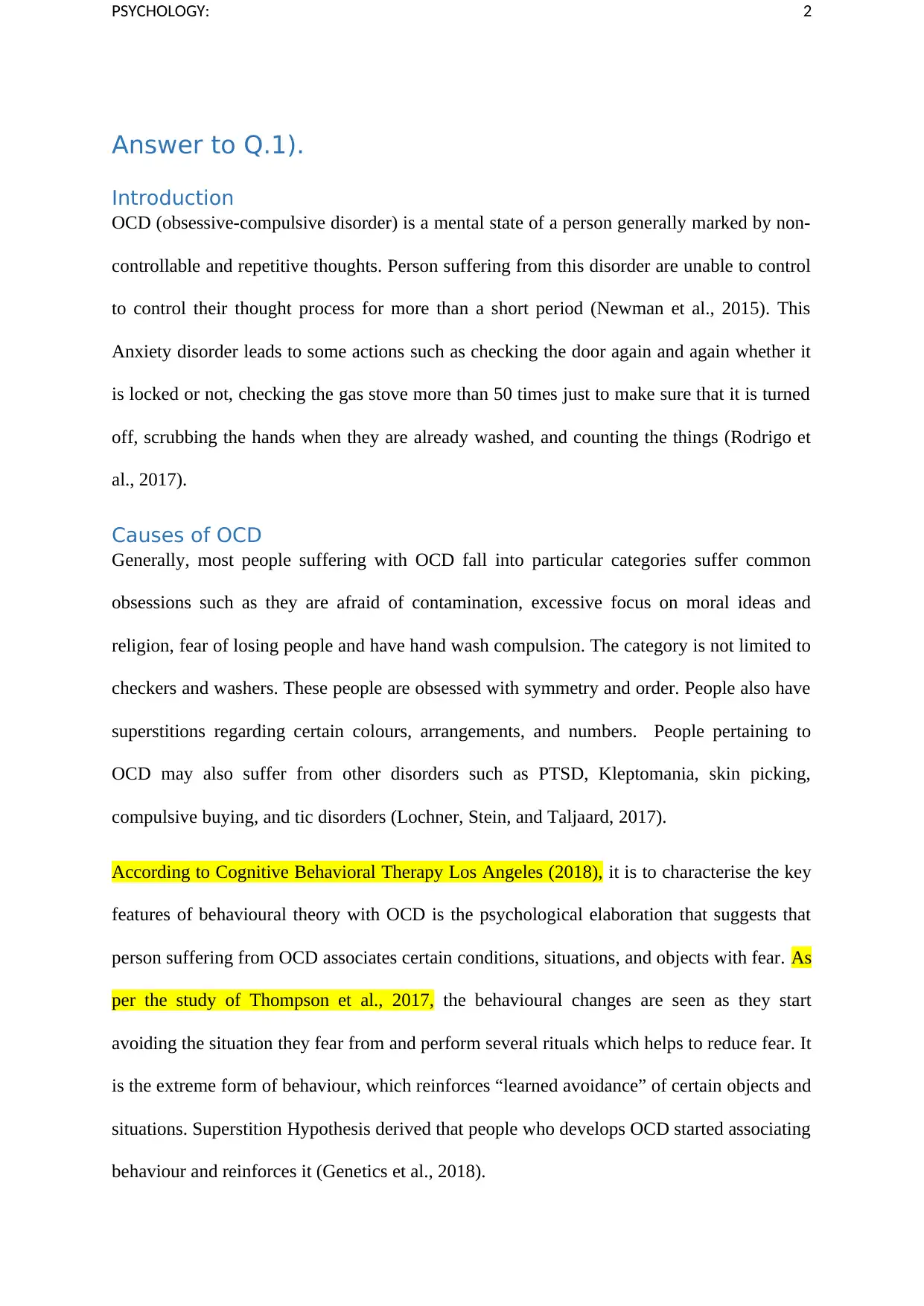
OCD (obsessive-compulsive disorder) is a mental state of a person generally marked by non-
controllable and repetitive thoughts. Person suffering from this disorder are unable to control
to control their thought process for more than a short period (Newman et al., 2015). This
Anxiety disorder leads to some actions such as checking the door again and again whether it
is locked or not, checking the gas stove more than 50 times just to make sure that it is turned
off, scrubbing the hands when they are already washed, and counting the things (Rodrigo et
al., 2017).
Causes of OCD
Generally, most people suffering with OCD fall into particular categories suffer common
obsessions such as they are afraid of contamination, excessive focus on moral ideas and
religion, fear of losing people and have hand wash compulsion. The category is not limited to
checkers and washers. These people are obsessed with symmetry and order. People also have
superstitions regarding certain colours, arrangements, and numbers. People pertaining to
OCD may also suffer from other disorders such as PTSD, Kleptomania, skin picking,
compulsive buying, and tic disorders (Lochner, Stein, and Taljaard, 2017).
According to Cognitive Behavioral Therapy Los Angeles (2018), it is to characterise the key
features of behavioural theory with OCD is the psychological elaboration that suggests that
person suffering from OCD associates certain conditions, situations, and objects with fear. As
per the study of Thompson et al., 2017, the behavioural changes are seen as they start
avoiding the situation they fear from and perform several rituals which helps to reduce fear. It
is the extreme form of behaviour, which reinforces “learned avoidance” of certain objects and
situations. Superstition Hypothesis derived that people who develops OCD started associating
behaviour and reinforces it (Genetics et al., 2018).
Answer to Q.1).
Introduction
OCD (obsessive-compulsive disorder) is a mental state of a person generally marked by non-
controllable and repetitive thoughts. Person suffering from this disorder are unable to control
to control their thought process for more than a short period (Newman et al., 2015). This
Anxiety disorder leads to some actions such as checking the door again and again whether it
is locked or not, checking the gas stove more than 50 times just to make sure that it is turned
off, scrubbing the hands when they are already washed, and counting the things (Rodrigo et
al., 2017).
Causes of OCD
Generally, most people suffering with OCD fall into particular categories suffer common
obsessions such as they are afraid of contamination, excessive focus on moral ideas and
religion, fear of losing people and have hand wash compulsion. The category is not limited to
checkers and washers. These people are obsessed with symmetry and order. People also have
superstitions regarding certain colours, arrangements, and numbers. People pertaining to
OCD may also suffer from other disorders such as PTSD, Kleptomania, skin picking,
compulsive buying, and tic disorders (Lochner, Stein, and Taljaard, 2017).
According to Cognitive Behavioral Therapy Los Angeles (2018), it is to characterise the key
features of behavioural theory with OCD is the psychological elaboration that suggests that
person suffering from OCD associates certain conditions, situations, and objects with fear. As
per the study of Thompson et al., 2017, the behavioural changes are seen as they start
avoiding the situation they fear from and perform several rituals which helps to reduce fear. It
is the extreme form of behaviour, which reinforces “learned avoidance” of certain objects and
situations. Superstition Hypothesis derived that people who develops OCD started associating
behaviour and reinforces it (Genetics et al., 2018).
⊘ This is a preview!⊘
Do you want full access?
Subscribe today to unlock all pages.

Trusted by 1+ million students worldwide
PSYCHOLOGY: 3
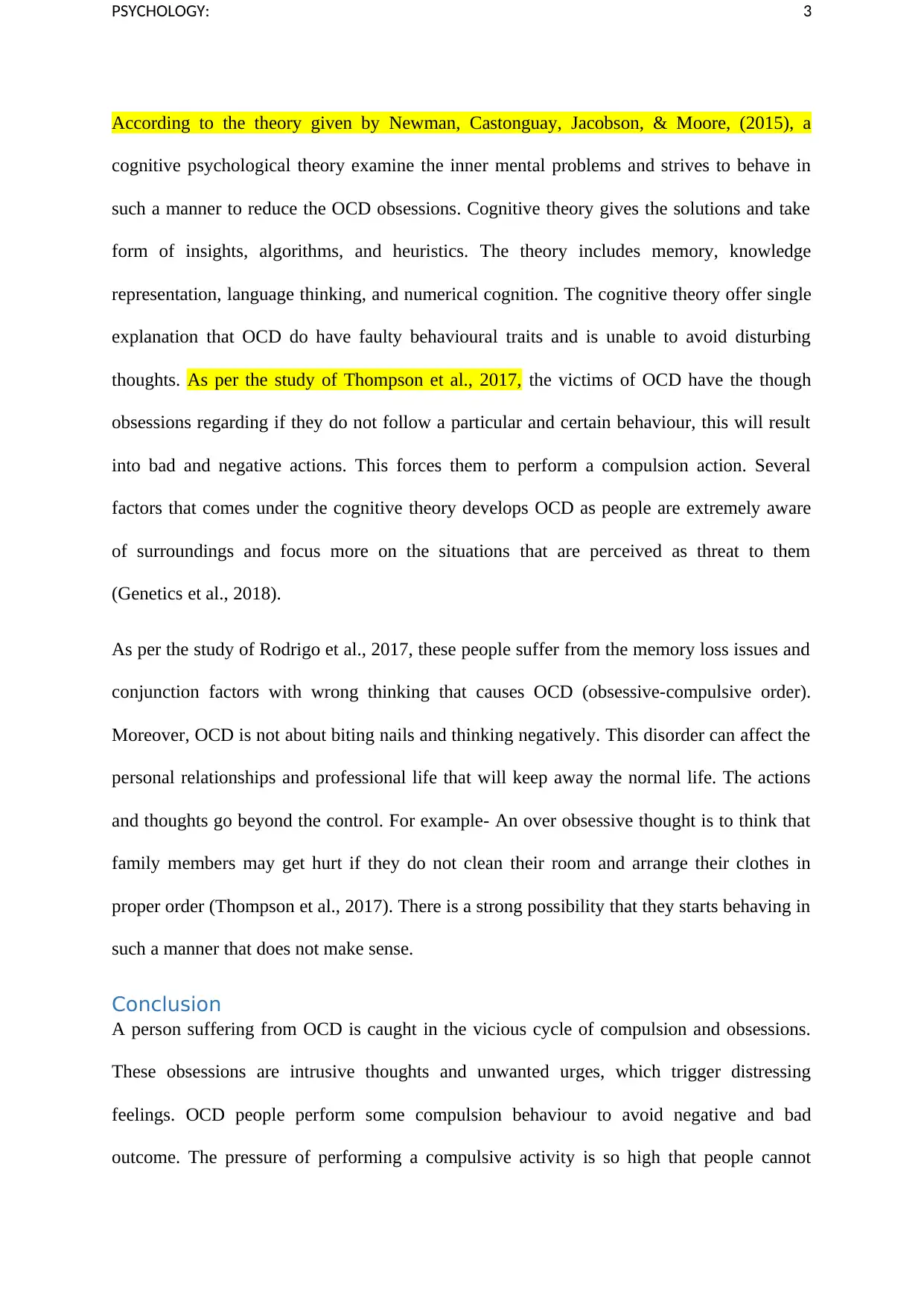
According to the theory given by Newman, Castonguay, Jacobson, & Moore, (2015), a
cognitive psychological theory examine the inner mental problems and strives to behave in
such a manner to reduce the OCD obsessions. Cognitive theory gives the solutions and take
form of insights, algorithms, and heuristics. The theory includes memory, knowledge
representation, language thinking, and numerical cognition. The cognitive theory offer single
explanation that OCD do have faulty behavioural traits and is unable to avoid disturbing
thoughts. As per the study of Thompson et al., 2017, the victims of OCD have the though
obsessions regarding if they do not follow a particular and certain behaviour, this will result
into bad and negative actions. This forces them to perform a compulsion action. Several
factors that comes under the cognitive theory develops OCD as people are extremely aware
of surroundings and focus more on the situations that are perceived as threat to them
(Genetics et al., 2018).
As per the study of Rodrigo et al., 2017, these people suffer from the memory loss issues and
conjunction factors with wrong thinking that causes OCD (obsessive-compulsive order).
Moreover, OCD is not about biting nails and thinking negatively. This disorder can affect the
personal relationships and professional life that will keep away the normal life. The actions
and thoughts go beyond the control. For example- An over obsessive thought is to think that
family members may get hurt if they do not clean their room and arrange their clothes in
proper order (Thompson et al., 2017). There is a strong possibility that they starts behaving in
such a manner that does not make sense.
Conclusion
A person suffering from OCD is caught in the vicious cycle of compulsion and obsessions.
These obsessions are intrusive thoughts and unwanted urges, which trigger distressing
feelings. OCD people perform some compulsion behaviour to avoid negative and bad
outcome. The pressure of performing a compulsive activity is so high that people cannot
According to the theory given by Newman, Castonguay, Jacobson, & Moore, (2015), a
cognitive psychological theory examine the inner mental problems and strives to behave in
such a manner to reduce the OCD obsessions. Cognitive theory gives the solutions and take
form of insights, algorithms, and heuristics. The theory includes memory, knowledge
representation, language thinking, and numerical cognition. The cognitive theory offer single
explanation that OCD do have faulty behavioural traits and is unable to avoid disturbing
thoughts. As per the study of Thompson et al., 2017, the victims of OCD have the though
obsessions regarding if they do not follow a particular and certain behaviour, this will result
into bad and negative actions. This forces them to perform a compulsion action. Several
factors that comes under the cognitive theory develops OCD as people are extremely aware
of surroundings and focus more on the situations that are perceived as threat to them
(Genetics et al., 2018).
As per the study of Rodrigo et al., 2017, these people suffer from the memory loss issues and
conjunction factors with wrong thinking that causes OCD (obsessive-compulsive order).
Moreover, OCD is not about biting nails and thinking negatively. This disorder can affect the
personal relationships and professional life that will keep away the normal life. The actions
and thoughts go beyond the control. For example- An over obsessive thought is to think that
family members may get hurt if they do not clean their room and arrange their clothes in
proper order (Thompson et al., 2017). There is a strong possibility that they starts behaving in
such a manner that does not make sense.
Conclusion
A person suffering from OCD is caught in the vicious cycle of compulsion and obsessions.
These obsessions are intrusive thoughts and unwanted urges, which trigger distressing
feelings. OCD people perform some compulsion behaviour to avoid negative and bad
outcome. The pressure of performing a compulsive activity is so high that people cannot
Paraphrase This Document
Need a fresh take? Get an instant paraphrase of this document with our AI Paraphraser
PSYCHOLOGY: 4
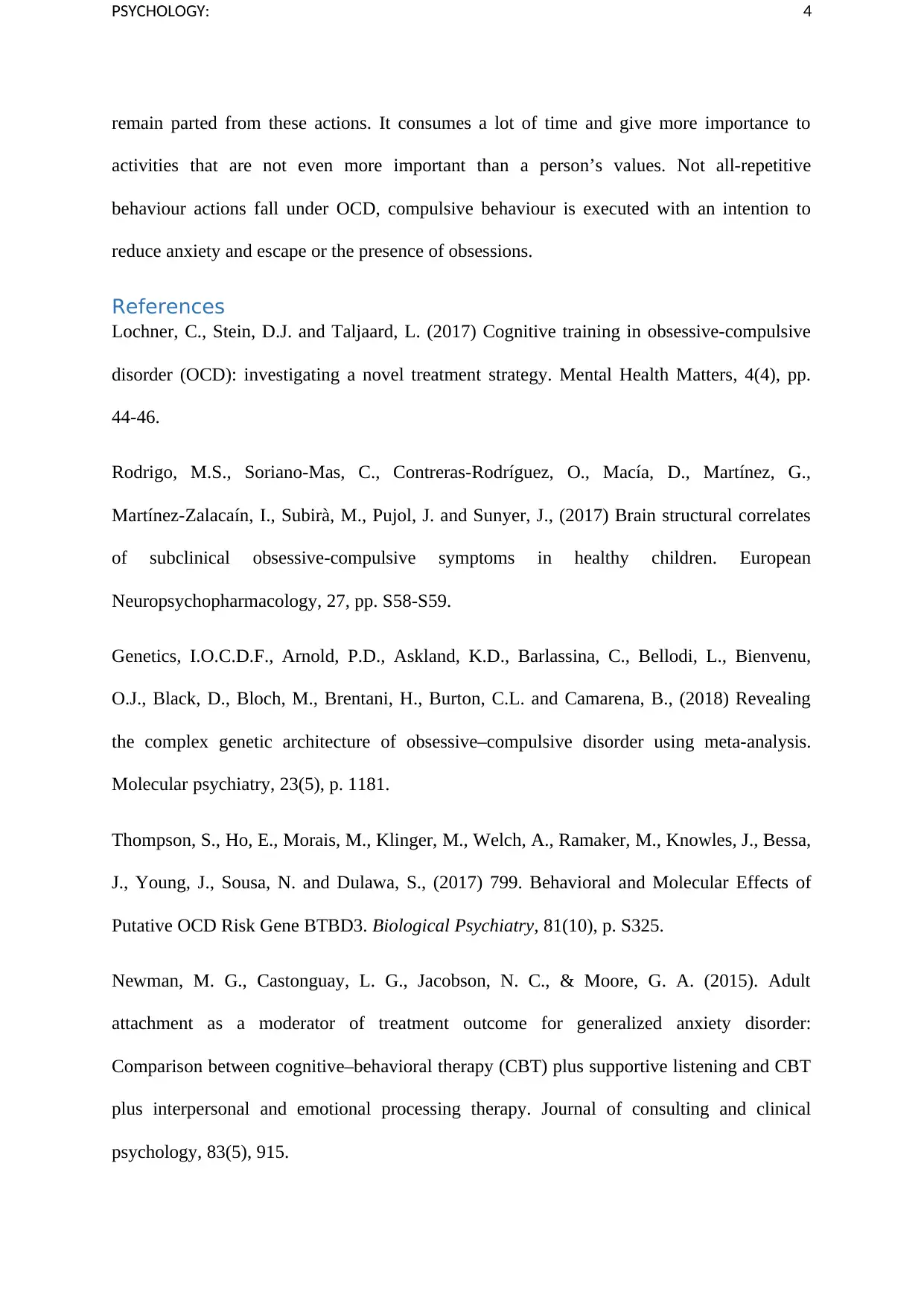
remain parted from these actions. It consumes a lot of time and give more importance to
activities that are not even more important than a person’s values. Not all-repetitive
behaviour actions fall under OCD, compulsive behaviour is executed with an intention to
reduce anxiety and escape or the presence of obsessions.
References
Lochner, C., Stein, D.J. and Taljaard, L. (2017) Cognitive training in obsessive-compulsive
disorder (OCD): investigating a novel treatment strategy. Mental Health Matters, 4(4), pp.
44-46.
Rodrigo, M.S., Soriano-Mas, C., Contreras-Rodríguez, O., Macía, D., Martínez, G.,
Martínez-Zalacaín, I., Subirà, M., Pujol, J. and Sunyer, J., (2017) Brain structural correlates
of subclinical obsessive-compulsive symptoms in healthy children. European
Neuropsychopharmacology, 27, pp. S58-S59.
Genetics, I.O.C.D.F., Arnold, P.D., Askland, K.D., Barlassina, C., Bellodi, L., Bienvenu,
O.J., Black, D., Bloch, M., Brentani, H., Burton, C.L. and Camarena, B., (2018) Revealing
the complex genetic architecture of obsessive–compulsive disorder using meta-analysis.
Molecular psychiatry, 23(5), p. 1181.
Thompson, S., Ho, E., Morais, M., Klinger, M., Welch, A., Ramaker, M., Knowles, J., Bessa,
J., Young, J., Sousa, N. and Dulawa, S., (2017) 799. Behavioral and Molecular Effects of
Putative OCD Risk Gene BTBD3. Biological Psychiatry, 81(10), p. S325.
Newman, M. G., Castonguay, L. G., Jacobson, N. C., & Moore, G. A. (2015). Adult
attachment as a moderator of treatment outcome for generalized anxiety disorder:
Comparison between cognitive–behavioral therapy (CBT) plus supportive listening and CBT
plus interpersonal and emotional processing therapy. Journal of consulting and clinical
psychology, 83(5), 915.
remain parted from these actions. It consumes a lot of time and give more importance to
activities that are not even more important than a person’s values. Not all-repetitive
behaviour actions fall under OCD, compulsive behaviour is executed with an intention to
reduce anxiety and escape or the presence of obsessions.
References
Lochner, C., Stein, D.J. and Taljaard, L. (2017) Cognitive training in obsessive-compulsive
disorder (OCD): investigating a novel treatment strategy. Mental Health Matters, 4(4), pp.
44-46.
Rodrigo, M.S., Soriano-Mas, C., Contreras-Rodríguez, O., Macía, D., Martínez, G.,
Martínez-Zalacaín, I., Subirà, M., Pujol, J. and Sunyer, J., (2017) Brain structural correlates
of subclinical obsessive-compulsive symptoms in healthy children. European
Neuropsychopharmacology, 27, pp. S58-S59.
Genetics, I.O.C.D.F., Arnold, P.D., Askland, K.D., Barlassina, C., Bellodi, L., Bienvenu,
O.J., Black, D., Bloch, M., Brentani, H., Burton, C.L. and Camarena, B., (2018) Revealing
the complex genetic architecture of obsessive–compulsive disorder using meta-analysis.
Molecular psychiatry, 23(5), p. 1181.
Thompson, S., Ho, E., Morais, M., Klinger, M., Welch, A., Ramaker, M., Knowles, J., Bessa,
J., Young, J., Sousa, N. and Dulawa, S., (2017) 799. Behavioral and Molecular Effects of
Putative OCD Risk Gene BTBD3. Biological Psychiatry, 81(10), p. S325.
Newman, M. G., Castonguay, L. G., Jacobson, N. C., & Moore, G. A. (2015). Adult
attachment as a moderator of treatment outcome for generalized anxiety disorder:
Comparison between cognitive–behavioral therapy (CBT) plus supportive listening and CBT
plus interpersonal and emotional processing therapy. Journal of consulting and clinical
psychology, 83(5), 915.

PSYCHOLOGY: 5
Cognitive Behavioral Therapy Los Angeles, (2018) Cognitive Behavioural Therapy
Exercises. [online] Available on: http://cogbtherapy.com/cognitive-behavioral-therapy-
exercises/ [Accessed on 30/09/18]
Cognitive Behavioral Therapy Los Angeles, (2018) Cognitive Behavioural Therapy
Exercises. [online] Available on: http://cogbtherapy.com/cognitive-behavioral-therapy-
exercises/ [Accessed on 30/09/18]
⊘ This is a preview!⊘
Do you want full access?
Subscribe today to unlock all pages.
Trusted by 1+ million students worldwide

PSYCHOLOGY: 6
Answer to Q.2)
Perspective Identify the key
features of the
perspective and
how they can be
used to explain
OCD.
Name the study
within the
perspective
(Some
suggestions are
given below –
others could be
used)
Strengths and
weaknesses of the
study in terms of data
collection (AC 2.2)
Biological
perspective- This
perspective explains
the biology of
nervous system of
the brain and it`s
association with the
behaviour and
actions of a person.
The perspective
states that the glands
in nervous system
secret hormones that
regulate the thought
process that
determines the
This biological
perspective assists
in understanding
the structure and
function of human
brain.
This perspective
provides logical
approach to
understand and
interpret the
human behaviour.
It also feature the
genetic
assumption that
explains that OCD
Carey and
Gottesman, 1981
(A2 level
psychology page
522)
Pauls et al., 1995
(A2 level
psychology page
522)
Strengths-
The behavioural
perspective analysis the
behaviour and find the
cause of OCD
(obsessive-compulsive
order). Moreover,
Behavioural theory do
not side effects as they
do not use medicines
and is based on
exercises which are
related to behaviour.
Limitation
The effect of this theory
is natural but affects
Answer to Q.2)
Perspective Identify the key
features of the
perspective and
how they can be
used to explain
OCD.
Name the study
within the
perspective
(Some
suggestions are
given below –
others could be
used)
Strengths and
weaknesses of the
study in terms of data
collection (AC 2.2)
Biological
perspective- This
perspective explains
the biology of
nervous system of
the brain and it`s
association with the
behaviour and
actions of a person.
The perspective
states that the glands
in nervous system
secret hormones that
regulate the thought
process that
determines the
This biological
perspective assists
in understanding
the structure and
function of human
brain.
This perspective
provides logical
approach to
understand and
interpret the
human behaviour.
It also feature the
genetic
assumption that
explains that OCD
Carey and
Gottesman, 1981
(A2 level
psychology page
522)
Pauls et al., 1995
(A2 level
psychology page
522)
Strengths-
The behavioural
perspective analysis the
behaviour and find the
cause of OCD
(obsessive-compulsive
order). Moreover,
Behavioural theory do
not side effects as they
do not use medicines
and is based on
exercises which are
related to behaviour.
Limitation
The effect of this theory
is natural but affects
Paraphrase This Document
Need a fresh take? Get an instant paraphrase of this document with our AI Paraphraser
PSYCHOLOGY: 7
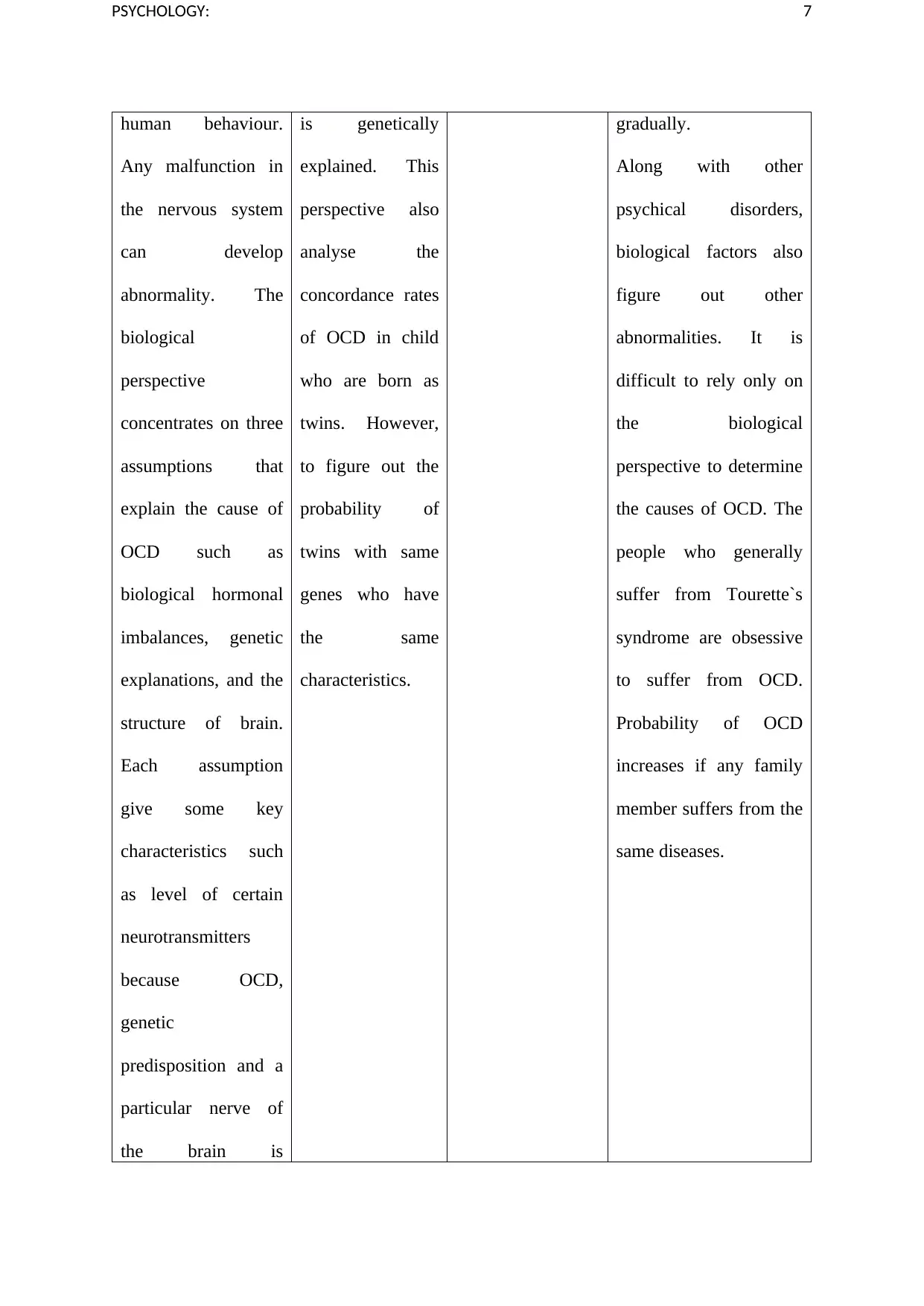
human behaviour.
Any malfunction in
the nervous system
can develop
abnormality. The
biological
perspective
concentrates on three
assumptions that
explain the cause of
OCD such as
biological hormonal
imbalances, genetic
explanations, and the
structure of brain.
Each assumption
give some key
characteristics such
as level of certain
neurotransmitters
because OCD,
genetic
predisposition and a
particular nerve of
the brain is
is genetically
explained. This
perspective also
analyse the
concordance rates
of OCD in child
who are born as
twins. However,
to figure out the
probability of
twins with same
genes who have
the same
characteristics.
gradually.
Along with other
psychical disorders,
biological factors also
figure out other
abnormalities. It is
difficult to rely only on
the biological
perspective to determine
the causes of OCD. The
people who generally
suffer from Tourette`s
syndrome are obsessive
to suffer from OCD.
Probability of OCD
increases if any family
member suffers from the
same diseases.
human behaviour.
Any malfunction in
the nervous system
can develop
abnormality. The
biological
perspective
concentrates on three
assumptions that
explain the cause of
OCD such as
biological hormonal
imbalances, genetic
explanations, and the
structure of brain.
Each assumption
give some key
characteristics such
as level of certain
neurotransmitters
because OCD,
genetic
predisposition and a
particular nerve of
the brain is
is genetically
explained. This
perspective also
analyse the
concordance rates
of OCD in child
who are born as
twins. However,
to figure out the
probability of
twins with same
genes who have
the same
characteristics.
gradually.
Along with other
psychical disorders,
biological factors also
figure out other
abnormalities. It is
difficult to rely only on
the biological
perspective to determine
the causes of OCD. The
people who generally
suffer from Tourette`s
syndrome are obsessive
to suffer from OCD.
Probability of OCD
increases if any family
member suffers from the
same diseases.
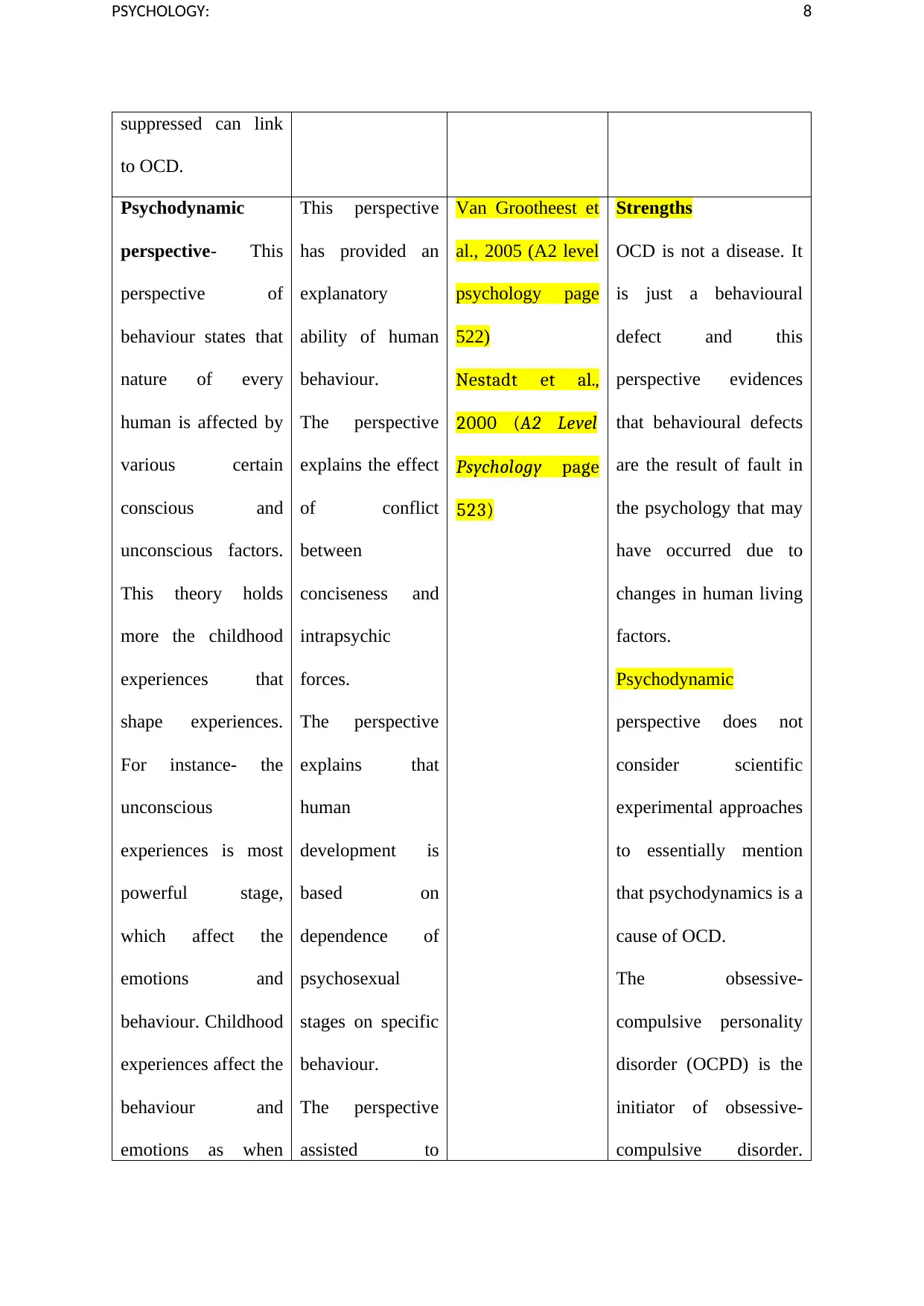
PSYCHOLOGY: 8
suppressed can link
to OCD.
Psychodynamic
perspective- This
perspective of
behaviour states that
nature of every
human is affected by
various certain
conscious and
unconscious factors.
This theory holds
more the childhood
experiences that
shape experiences.
For instance- the
unconscious
experiences is most
powerful stage,
which affect the
emotions and
behaviour. Childhood
experiences affect the
behaviour and
emotions as when
This perspective
has provided an
explanatory
ability of human
behaviour.
The perspective
explains the effect
of conflict
between
conciseness and
intrapsychic
forces.
The perspective
explains that
human
development is
based on
dependence of
psychosexual
stages on specific
behaviour.
The perspective
assisted to
Van Grootheest et
al., 2005 (A2 level
psychology page
522)
Nestadt et al.,
2000 (A2 Level
Psychology page
523)
Strengths
OCD is not a disease. It
is just a behavioural
defect and this
perspective evidences
that behavioural defects
are the result of fault in
the psychology that may
have occurred due to
changes in human living
factors.
Psychodynamic
perspective does not
consider scientific
experimental approaches
to essentially mention
that psychodynamics is a
cause of OCD.
The obsessive-
compulsive personality
disorder (OCPD) is the
initiator of obsessive-
compulsive disorder.
suppressed can link
to OCD.
Psychodynamic
perspective- This
perspective of
behaviour states that
nature of every
human is affected by
various certain
conscious and
unconscious factors.
This theory holds
more the childhood
experiences that
shape experiences.
For instance- the
unconscious
experiences is most
powerful stage,
which affect the
emotions and
behaviour. Childhood
experiences affect the
behaviour and
emotions as when
This perspective
has provided an
explanatory
ability of human
behaviour.
The perspective
explains the effect
of conflict
between
conciseness and
intrapsychic
forces.
The perspective
explains that
human
development is
based on
dependence of
psychosexual
stages on specific
behaviour.
The perspective
assisted to
Van Grootheest et
al., 2005 (A2 level
psychology page
522)
Nestadt et al.,
2000 (A2 Level
Psychology page
523)
Strengths
OCD is not a disease. It
is just a behavioural
defect and this
perspective evidences
that behavioural defects
are the result of fault in
the psychology that may
have occurred due to
changes in human living
factors.
Psychodynamic
perspective does not
consider scientific
experimental approaches
to essentially mention
that psychodynamics is a
cause of OCD.
The obsessive-
compulsive personality
disorder (OCPD) is the
initiator of obsessive-
compulsive disorder.
⊘ This is a preview!⊘
Do you want full access?
Subscribe today to unlock all pages.
Trusted by 1+ million students worldwide
PSYCHOLOGY: 9
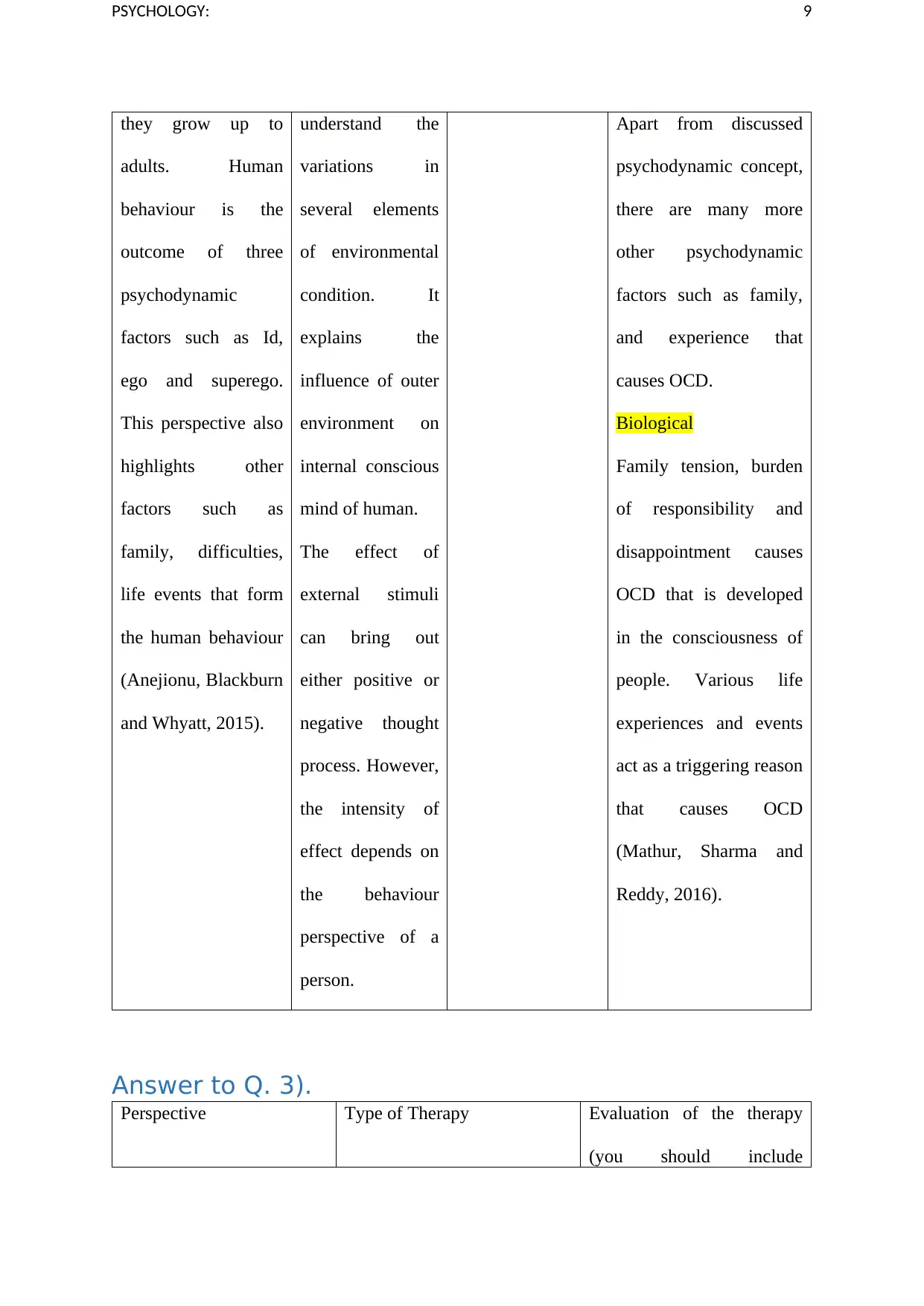
they grow up to
adults. Human
behaviour is the
outcome of three
psychodynamic
factors such as Id,
ego and superego.
This perspective also
highlights other
factors such as
family, difficulties,
life events that form
the human behaviour
(Anejionu, Blackburn
and Whyatt, 2015).
understand the
variations in
several elements
of environmental
condition. It
explains the
influence of outer
environment on
internal conscious
mind of human.
The effect of
external stimuli
can bring out
either positive or
negative thought
process. However,
the intensity of
effect depends on
the behaviour
perspective of a
person.
Apart from discussed
psychodynamic concept,
there are many more
other psychodynamic
factors such as family,
and experience that
causes OCD.
Biological
Family tension, burden
of responsibility and
disappointment causes
OCD that is developed
in the consciousness of
people. Various life
experiences and events
act as a triggering reason
that causes OCD
(Mathur, Sharma and
Reddy, 2016).
Answer to Q. 3).
Perspective Type of Therapy Evaluation of the therapy
(you should include
they grow up to
adults. Human
behaviour is the
outcome of three
psychodynamic
factors such as Id,
ego and superego.
This perspective also
highlights other
factors such as
family, difficulties,
life events that form
the human behaviour
(Anejionu, Blackburn
and Whyatt, 2015).
understand the
variations in
several elements
of environmental
condition. It
explains the
influence of outer
environment on
internal conscious
mind of human.
The effect of
external stimuli
can bring out
either positive or
negative thought
process. However,
the intensity of
effect depends on
the behaviour
perspective of a
person.
Apart from discussed
psychodynamic concept,
there are many more
other psychodynamic
factors such as family,
and experience that
causes OCD.
Biological
Family tension, burden
of responsibility and
disappointment causes
OCD that is developed
in the consciousness of
people. Various life
experiences and events
act as a triggering reason
that causes OCD
(Mathur, Sharma and
Reddy, 2016).
Answer to Q. 3).
Perspective Type of Therapy Evaluation of the therapy
(you should include
Paraphrase This Document
Need a fresh take? Get an instant paraphrase of this document with our AI Paraphraser
PSYCHOLOGY: 10
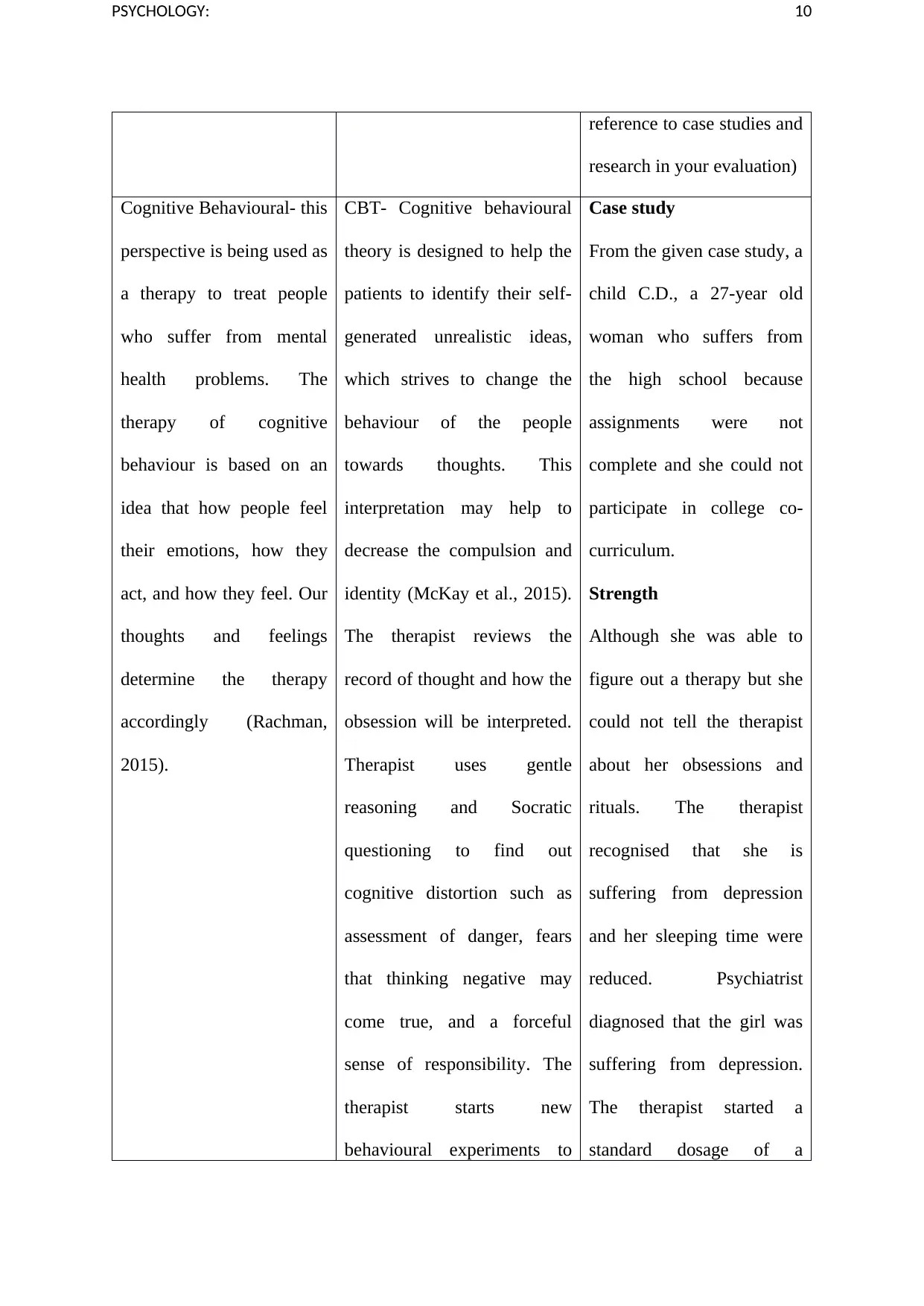
reference to case studies and
research in your evaluation)
Cognitive Behavioural- this
perspective is being used as
a therapy to treat people
who suffer from mental
health problems. The
therapy of cognitive
behaviour is based on an
idea that how people feel
their emotions, how they
act, and how they feel. Our
thoughts and feelings
determine the therapy
accordingly (Rachman,
2015).
CBT- Cognitive behavioural
theory is designed to help the
patients to identify their self-
generated unrealistic ideas,
which strives to change the
behaviour of the people
towards thoughts. This
interpretation may help to
decrease the compulsion and
identity (McKay et al., 2015).
The therapist reviews the
record of thought and how the
obsession will be interpreted.
Therapist uses gentle
reasoning and Socratic
questioning to find out
cognitive distortion such as
assessment of danger, fears
that thinking negative may
come true, and a forceful
sense of responsibility. The
therapist starts new
behavioural experiments to
Case study
From the given case study, a
child C.D., a 27-year old
woman who suffers from
the high school because
assignments were not
complete and she could not
participate in college co-
curriculum.
Strength
Although she was able to
figure out a therapy but she
could not tell the therapist
about her obsessions and
rituals. The therapist
recognised that she is
suffering from depression
and her sleeping time were
reduced. Psychiatrist
diagnosed that the girl was
suffering from depression.
The therapist started a
standard dosage of a
reference to case studies and
research in your evaluation)
Cognitive Behavioural- this
perspective is being used as
a therapy to treat people
who suffer from mental
health problems. The
therapy of cognitive
behaviour is based on an
idea that how people feel
their emotions, how they
act, and how they feel. Our
thoughts and feelings
determine the therapy
accordingly (Rachman,
2015).
CBT- Cognitive behavioural
theory is designed to help the
patients to identify their self-
generated unrealistic ideas,
which strives to change the
behaviour of the people
towards thoughts. This
interpretation may help to
decrease the compulsion and
identity (McKay et al., 2015).
The therapist reviews the
record of thought and how the
obsession will be interpreted.
Therapist uses gentle
reasoning and Socratic
questioning to find out
cognitive distortion such as
assessment of danger, fears
that thinking negative may
come true, and a forceful
sense of responsibility. The
therapist starts new
behavioural experiments to
Case study
From the given case study, a
child C.D., a 27-year old
woman who suffers from
the high school because
assignments were not
complete and she could not
participate in college co-
curriculum.
Strength
Although she was able to
figure out a therapy but she
could not tell the therapist
about her obsessions and
rituals. The therapist
recognised that she is
suffering from depression
and her sleeping time were
reduced. Psychiatrist
diagnosed that the girl was
suffering from depression.
The therapist started a
standard dosage of a
PSYCHOLOGY: 11
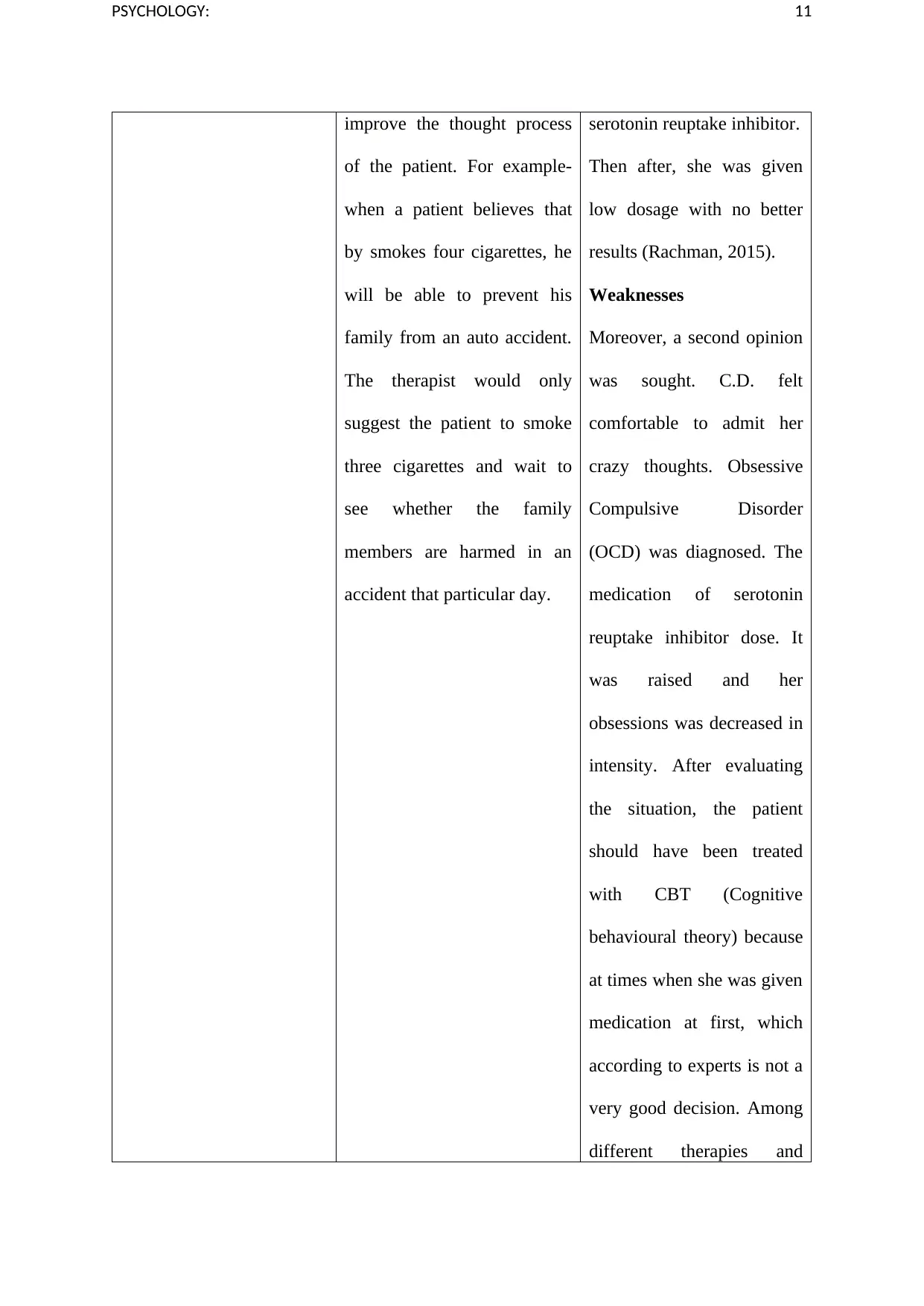
improve the thought process
of the patient. For example-
when a patient believes that
by smokes four cigarettes, he
will be able to prevent his
family from an auto accident.
The therapist would only
suggest the patient to smoke
three cigarettes and wait to
see whether the family
members are harmed in an
accident that particular day.
serotonin reuptake inhibitor.
Then after, she was given
low dosage with no better
results (Rachman, 2015).
Weaknesses
Moreover, a second opinion
was sought. C.D. felt
comfortable to admit her
crazy thoughts. Obsessive
Compulsive Disorder
(OCD) was diagnosed. The
medication of serotonin
reuptake inhibitor dose. It
was raised and her
obsessions was decreased in
intensity. After evaluating
the situation, the patient
should have been treated
with CBT (Cognitive
behavioural theory) because
at times when she was given
medication at first, which
according to experts is not a
very good decision. Among
different therapies and
improve the thought process
of the patient. For example-
when a patient believes that
by smokes four cigarettes, he
will be able to prevent his
family from an auto accident.
The therapist would only
suggest the patient to smoke
three cigarettes and wait to
see whether the family
members are harmed in an
accident that particular day.
serotonin reuptake inhibitor.
Then after, she was given
low dosage with no better
results (Rachman, 2015).
Weaknesses
Moreover, a second opinion
was sought. C.D. felt
comfortable to admit her
crazy thoughts. Obsessive
Compulsive Disorder
(OCD) was diagnosed. The
medication of serotonin
reuptake inhibitor dose. It
was raised and her
obsessions was decreased in
intensity. After evaluating
the situation, the patient
should have been treated
with CBT (Cognitive
behavioural theory) because
at times when she was given
medication at first, which
according to experts is not a
very good decision. Among
different therapies and
⊘ This is a preview!⊘
Do you want full access?
Subscribe today to unlock all pages.
Trusted by 1+ million students worldwide

1 out of 18


Related Documents


Your All-in-One AI-Powered Toolkit for Academic Success.
+13062052269
info@desklib.com
Available 24*7 on WhatsApp / Email
![[object Object]](/_next/static/media/star-bottom.7253800d.svg)
Unlock your academic potential
Copyright © 2020–2026 A2Z Services. All Rights Reserved. Developed and managed by ZUCOL.