Nursing Assignment: Psychological Perspectives and Treatments for OCD
VerifiedAdded on 2023/04/21
|17
|3764
|202
Homework Assignment
AI Summary
This nursing assignment explores the multifaceted nature of Obsessive Compulsive Disorder (OCD) by examining it through various psychological lenses. The assignment begins by delving into the cognitive and behavioral perspectives, highlighting the roles of hypervigilance, memory problems, and lack of conditioning in OCD. It then moves on to compare and contrast the biological and psychodynamic perspectives, discussing the genetic, neurological, and hormonal factors alongside the influence of unconscious conflicts and early childhood experiences. The assignment also evaluates the effectiveness of different therapeutic interventions, including Exposure and Response Prevention (ERP) therapy and the use of Selective Serotonin Reuptake Inhibitors (SSRIs), providing a comprehensive overview of OCD's etiology, manifestations, and treatment options. The assignment incorporates several studies to support the key features of each perspective, including the strengths and weaknesses of the studies. The student has incorporated the understanding of the perspectives in the case study to analyze the effectiveness of the treatments for the specific cases provided.
NURSING ASSIGNMENT
Nursing Assignment
Name of the Student
Name of the University
Author’s Note
Nursing Assignment
Name of the Student
Name of the University
Author’s Note

Paraphrase This Document
Need a fresh take? Get an instant paraphrase of this document with our AI Paraphraser
1NURSING ASSIGNMENT
TAQ: 1
Obsessive Compulsive Disorder (OCD) is mainly guided by two different perspectives,
one of cognitive perspective and another one is the behavioural perspective. The main aspect of
the cognitive perspective of OCD is hypervigilance and memory problems. According to
Seefeldt et al. (2014), people with OCD suffer from the hypervigilant attention. Hypervigilant
attention means enhanced sensitivity accompanied with exaggerated intensity in the behaviour.
This generally brings an increased state of anxiety leading to exhaustion. Anxiety, arising out of
hypervigilance among OCD patients elicits contextual stimuli like emotional valence in the face.
The emotional valence in OCD group of individuals is expressed in the form of emotional
sensitivity like whenever they are forbidden from executing their compulsive traits, they either
become angry or sad leading to over-execution of few selected activities. Bradley et al. (2016)
conducted a study in order to understand the level of the hypervigilance among the OCD patients
through the application of the eye-tracking methodology. The results highlighted that people who
are suffering from the OCD are more prone to get affected with hypervigilance in comparison to
the OCS (obsessive compulsive syndrome). Any stimuli towards the anxiety lead to increase in
the hypervigilance. For example, Bradley et al. (2016) stated that highlighted anxiety among the
OCD cause enhanced state of sensory sensitivity along with exaggerated intensity of behaviour.
The exaggerated behaviour cause repeated execution of some act. OCD also leads to memory
problems like imbalance between the long-term and short-term memory processing. The
imbalance between the long-term and short-term memory shows deficits in the non-verbal, visual
and spacial memory however, the verbal memory remains unaffected (de Vries et al. 2014). The
lack of the visual or the non-verbal memory hampers the mental engagement with the other
people. Lack of mental engagement generates isolation leading to avoidance and compulsive
TAQ: 1
Obsessive Compulsive Disorder (OCD) is mainly guided by two different perspectives,
one of cognitive perspective and another one is the behavioural perspective. The main aspect of
the cognitive perspective of OCD is hypervigilance and memory problems. According to
Seefeldt et al. (2014), people with OCD suffer from the hypervigilant attention. Hypervigilant
attention means enhanced sensitivity accompanied with exaggerated intensity in the behaviour.
This generally brings an increased state of anxiety leading to exhaustion. Anxiety, arising out of
hypervigilance among OCD patients elicits contextual stimuli like emotional valence in the face.
The emotional valence in OCD group of individuals is expressed in the form of emotional
sensitivity like whenever they are forbidden from executing their compulsive traits, they either
become angry or sad leading to over-execution of few selected activities. Bradley et al. (2016)
conducted a study in order to understand the level of the hypervigilance among the OCD patients
through the application of the eye-tracking methodology. The results highlighted that people who
are suffering from the OCD are more prone to get affected with hypervigilance in comparison to
the OCS (obsessive compulsive syndrome). Any stimuli towards the anxiety lead to increase in
the hypervigilance. For example, Bradley et al. (2016) stated that highlighted anxiety among the
OCD cause enhanced state of sensory sensitivity along with exaggerated intensity of behaviour.
The exaggerated behaviour cause repeated execution of some act. OCD also leads to memory
problems like imbalance between the long-term and short-term memory processing. The
imbalance between the long-term and short-term memory shows deficits in the non-verbal, visual
and spacial memory however, the verbal memory remains unaffected (de Vries et al. 2014). The
lack of the visual or the non-verbal memory hampers the mental engagement with the other
people. Lack of mental engagement generates isolation leading to avoidance and compulsive
2NURSING ASSIGNMENT
rituals of over repeated habits. Klenfeldt et al. (2014) stated that the memory problems are more
among the older adults or elderly people who suffer from OCS or OCD. Both the conditions are
related to depression, poor mental functioning. Under poor mental function driven by the age
associated factor there occurs decrease in memory retention. Under the behavioural perspective
of OCD the main concern is lack of proper conditioning. McGuire et al. (2016) are of the opinion
that it is the behavioural nature of the people suffering from OCD that they have lack of
conditioning. Lack of proper conditioning means acquisition of fear and extinction. The fear
acquisition further helps in the promotion of the development of the severe symptoms where an
emotionally neutral stimulus (conditioned stimulus) is combined with an aversive unconditioned
stimulus. This unconditioned stimulus of fear generates a mindset that the handle of door might
be contaminated or the fear of the contamination of the hands after few minutes, leading to the
development of the obsessive compulsion (McGuire et al. 2016). Harsányi et al. (2014) defined
the lack of condition under the perspective of behavioural-executive impairment. The behaviour
executive impairment increases a sense of compulsion. This compulsive attitude forces them to
execute the same action or report same phrase over and over again in order decrease their
apprehensive anxiety. Ludvik, Boschen and Neumann (2015) related the behavioural aspect of
condition of OCD with the Pavlovian conditioning (classical conditioning). Under this
behavioural state of mind, continuous stimulus is released in order to execution of certain
function. The intensity of this continuous stimulus is high among the OCD patients.
rituals of over repeated habits. Klenfeldt et al. (2014) stated that the memory problems are more
among the older adults or elderly people who suffer from OCS or OCD. Both the conditions are
related to depression, poor mental functioning. Under poor mental function driven by the age
associated factor there occurs decrease in memory retention. Under the behavioural perspective
of OCD the main concern is lack of proper conditioning. McGuire et al. (2016) are of the opinion
that it is the behavioural nature of the people suffering from OCD that they have lack of
conditioning. Lack of proper conditioning means acquisition of fear and extinction. The fear
acquisition further helps in the promotion of the development of the severe symptoms where an
emotionally neutral stimulus (conditioned stimulus) is combined with an aversive unconditioned
stimulus. This unconditioned stimulus of fear generates a mindset that the handle of door might
be contaminated or the fear of the contamination of the hands after few minutes, leading to the
development of the obsessive compulsion (McGuire et al. 2016). Harsányi et al. (2014) defined
the lack of condition under the perspective of behavioural-executive impairment. The behaviour
executive impairment increases a sense of compulsion. This compulsive attitude forces them to
execute the same action or report same phrase over and over again in order decrease their
apprehensive anxiety. Ludvik, Boschen and Neumann (2015) related the behavioural aspect of
condition of OCD with the Pavlovian conditioning (classical conditioning). Under this
behavioural state of mind, continuous stimulus is released in order to execution of certain
function. The intensity of this continuous stimulus is high among the OCD patients.
⊘ This is a preview!⊘
Do you want full access?
Subscribe today to unlock all pages.

Trusted by 1+ million students worldwide
NURSING ASSIGNMENT
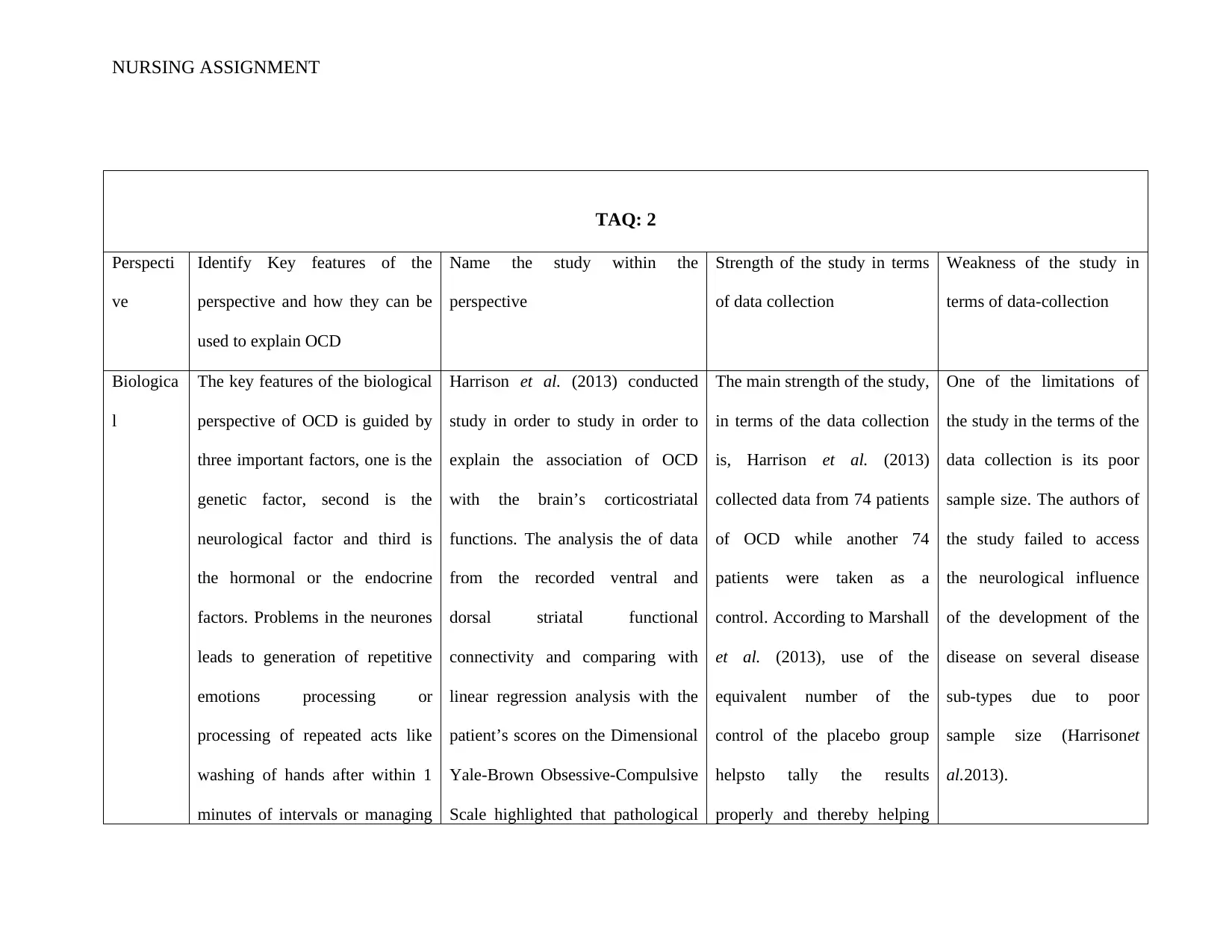
TAQ: 2
Perspecti
ve
Identify Key features of the
perspective and how they can be
used to explain OCD
Name the study within the
perspective
Strength of the study in terms
of data collection
Weakness of the study in
terms of data-collection
Biologica
l
The key features of the biological
perspective of OCD is guided by
three important factors, one is the
genetic factor, second is the
neurological factor and third is
the hormonal or the endocrine
factors. Problems in the neurones
leads to generation of repetitive
emotions processing or
processing of repeated acts like
washing of hands after within 1
minutes of intervals or managing
Harrison et al. (2013) conducted
study in order to study in order to
explain the association of OCD
with the brain’s corticostriatal
functions. The analysis the of data
from the recorded ventral and
dorsal striatal functional
connectivity and comparing with
linear regression analysis with the
patient’s scores on the Dimensional
Yale-Brown Obsessive-Compulsive
Scale highlighted that pathological
The main strength of the study,
in terms of the data collection
is, Harrison et al. (2013)
collected data from 74 patients
of OCD while another 74
patients were taken as a
control. According to Marshall
et al. (2013), use of the
equivalent number of the
control of the placebo group
helpsto tally the results
properly and thereby helping
One of the limitations of
the study in the terms of the
data collection is its poor
sample size. The authors of
the study failed to access
the neurological influence
of the development of the
disease on several disease
sub-types due to poor
sample size (Harrisonet
al.2013).
TAQ: 2
Perspecti
ve
Identify Key features of the
perspective and how they can be
used to explain OCD
Name the study within the
perspective
Strength of the study in terms
of data collection
Weakness of the study in
terms of data-collection
Biologica
l
The key features of the biological
perspective of OCD is guided by
three important factors, one is the
genetic factor, second is the
neurological factor and third is
the hormonal or the endocrine
factors. Problems in the neurones
leads to generation of repetitive
emotions processing or
processing of repeated acts like
washing of hands after within 1
minutes of intervals or managing
Harrison et al. (2013) conducted
study in order to study in order to
explain the association of OCD
with the brain’s corticostriatal
functions. The analysis the of data
from the recorded ventral and
dorsal striatal functional
connectivity and comparing with
linear regression analysis with the
patient’s scores on the Dimensional
Yale-Brown Obsessive-Compulsive
Scale highlighted that pathological
The main strength of the study,
in terms of the data collection
is, Harrison et al. (2013)
collected data from 74 patients
of OCD while another 74
patients were taken as a
control. According to Marshall
et al. (2013), use of the
equivalent number of the
control of the placebo group
helpsto tally the results
properly and thereby helping
One of the limitations of
the study in the terms of the
data collection is its poor
sample size. The authors of
the study failed to access
the neurological influence
of the development of the
disease on several disease
sub-types due to poor
sample size (Harrisonet
al.2013).
Paraphrase This Document
Need a fresh take? Get an instant paraphrase of this document with our AI Paraphraser

1NURSING ASSIGNMENT
of hair after every seconds. changes in the orbitofromtal-striatal
regions is common among all the
patients of OCD. Thus highlighting
a biological interplay behind the
disease development
to perform a comparative
study
Psychody
namic
The key-features of the psycho-
dynamic factors underlying the
development of OCD is guided
by the symptoms like the
recurrent obsession or
compulsion that leads to
increased level of distress and
interference in the daily activities
of living (Olatunji et al. 2013).
Other key features of the
psychodynamic perspective
include sexual impulses or
aggressive nature, distorted
Freud (1009) study of Ratman was
conducted in order to study the
psychodynamic perspective of OCD
through psychoanalytic
understanding. Mr. Ernst Lanzer
referred to as the “Rat Man” in the
history of psychoanalysis. He was
diagnosed with obsessive-
compulsive disorder by Sigmund
Freud who was a famous obsession
neurosis during that time. The
patient was presented to Freud with
different distressing obsessions. The
The main strength of the study
of Freud is the data gathering.
This study has used the
process of observational
psychoanalysis for the
gathering of the
psychodynamic data or the
psychological behavioural
characteristics of Ratman. This
can be regarded as the main
strength of the study. This is
because, Hinshelwood (2013)
have highlighted that
The main weakness of the
study in terms of the data
collection is, Freud used
only single object for the
observation of the
psychodymanic perspective
of OCD and then
simultaneous framing of the
interventions. Thus the
outcome is targeted towards
a specific person and not
towards an individual as a
whole. The results or the
of hair after every seconds. changes in the orbitofromtal-striatal
regions is common among all the
patients of OCD. Thus highlighting
a biological interplay behind the
disease development
to perform a comparative
study
Psychody
namic
The key-features of the psycho-
dynamic factors underlying the
development of OCD is guided
by the symptoms like the
recurrent obsession or
compulsion that leads to
increased level of distress and
interference in the daily activities
of living (Olatunji et al. 2013).
Other key features of the
psychodynamic perspective
include sexual impulses or
aggressive nature, distorted
Freud (1009) study of Ratman was
conducted in order to study the
psychodynamic perspective of OCD
through psychoanalytic
understanding. Mr. Ernst Lanzer
referred to as the “Rat Man” in the
history of psychoanalysis. He was
diagnosed with obsessive-
compulsive disorder by Sigmund
Freud who was a famous obsession
neurosis during that time. The
patient was presented to Freud with
different distressing obsessions. The
The main strength of the study
of Freud is the data gathering.
This study has used the
process of observational
psychoanalysis for the
gathering of the
psychodynamic data or the
psychological behavioural
characteristics of Ratman. This
can be regarded as the main
strength of the study. This is
because, Hinshelwood (2013)
have highlighted that
The main weakness of the
study in terms of the data
collection is, Freud used
only single object for the
observation of the
psychodymanic perspective
of OCD and then
simultaneous framing of the
interventions. Thus the
outcome is targeted towards
a specific person and not
towards an individual as a
whole. The results or the
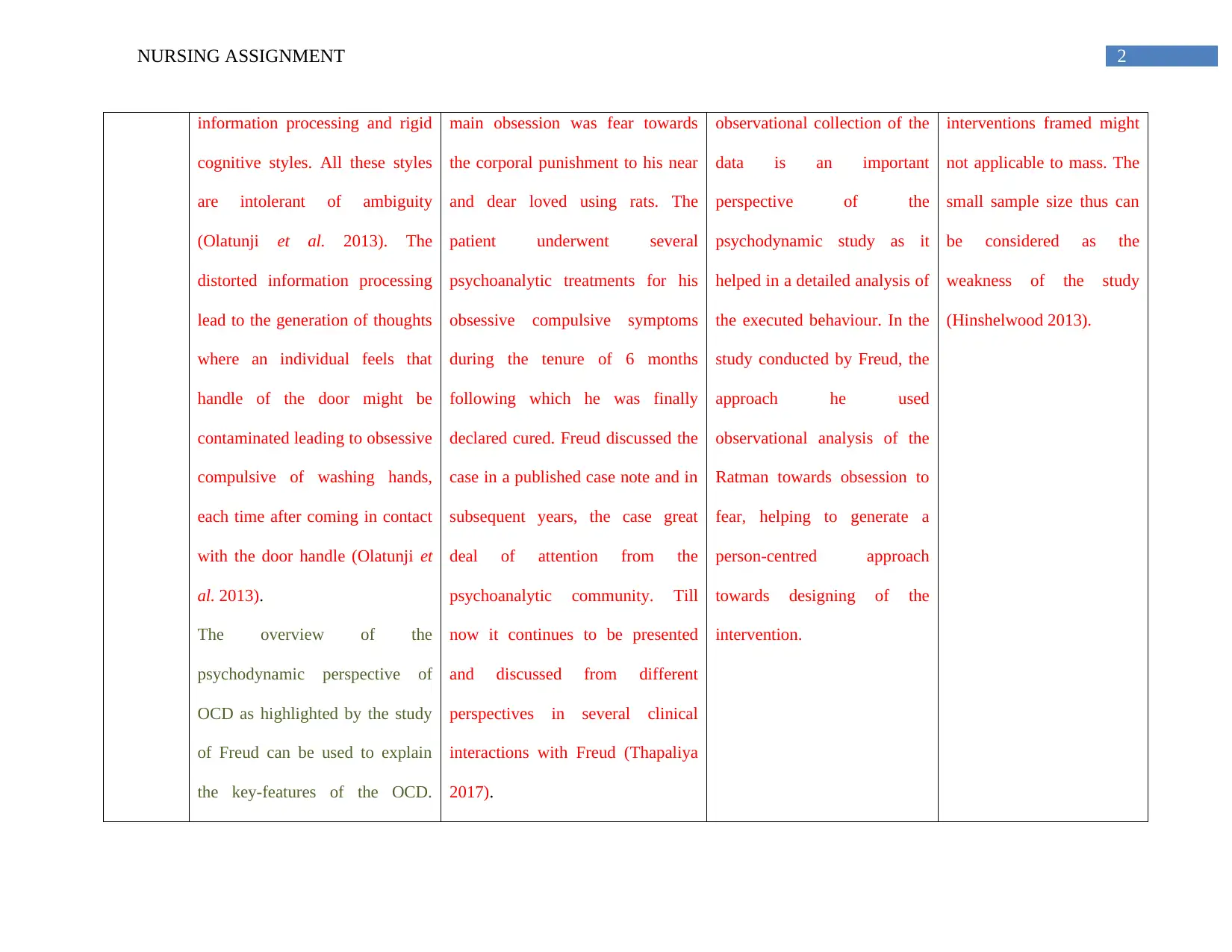
2NURSING ASSIGNMENT
information processing and rigid
cognitive styles. All these styles
are intolerant of ambiguity
(Olatunji et al. 2013). The
distorted information processing
lead to the generation of thoughts
where an individual feels that
handle of the door might be
contaminated leading to obsessive
compulsive of washing hands,
each time after coming in contact
with the door handle (Olatunji et
al. 2013).
The overview of the
psychodynamic perspective of
OCD as highlighted by the study
of Freud can be used to explain
the key-features of the OCD.
main obsession was fear towards
the corporal punishment to his near
and dear loved using rats. The
patient underwent several
psychoanalytic treatments for his
obsessive compulsive symptoms
during the tenure of 6 months
following which he was finally
declared cured. Freud discussed the
case in a published case note and in
subsequent years, the case great
deal of attention from the
psychoanalytic community. Till
now it continues to be presented
and discussed from different
perspectives in several clinical
interactions with Freud (Thapaliya
2017).
observational collection of the
data is an important
perspective of the
psychodynamic study as it
helped in a detailed analysis of
the executed behaviour. In the
study conducted by Freud, the
approach he used
observational analysis of the
Ratman towards obsession to
fear, helping to generate a
person-centred approach
towards designing of the
intervention.
interventions framed might
not applicable to mass. The
small sample size thus can
be considered as the
weakness of the study
(Hinshelwood 2013).
information processing and rigid
cognitive styles. All these styles
are intolerant of ambiguity
(Olatunji et al. 2013). The
distorted information processing
lead to the generation of thoughts
where an individual feels that
handle of the door might be
contaminated leading to obsessive
compulsive of washing hands,
each time after coming in contact
with the door handle (Olatunji et
al. 2013).
The overview of the
psychodynamic perspective of
OCD as highlighted by the study
of Freud can be used to explain
the key-features of the OCD.
main obsession was fear towards
the corporal punishment to his near
and dear loved using rats. The
patient underwent several
psychoanalytic treatments for his
obsessive compulsive symptoms
during the tenure of 6 months
following which he was finally
declared cured. Freud discussed the
case in a published case note and in
subsequent years, the case great
deal of attention from the
psychoanalytic community. Till
now it continues to be presented
and discussed from different
perspectives in several clinical
interactions with Freud (Thapaliya
2017).
observational collection of the
data is an important
perspective of the
psychodynamic study as it
helped in a detailed analysis of
the executed behaviour. In the
study conducted by Freud, the
approach he used
observational analysis of the
Ratman towards obsession to
fear, helping to generate a
person-centred approach
towards designing of the
intervention.
interventions framed might
not applicable to mass. The
small sample size thus can
be considered as the
weakness of the study
(Hinshelwood 2013).
⊘ This is a preview!⊘
Do you want full access?
Subscribe today to unlock all pages.
Trusted by 1+ million students worldwide

3NURSING ASSIGNMENT
Freud in his study highlighted
that the psychodynamic
perspective of ego and surperego
while explaining the traits of
OCD. According to Besharat and
Kamali (2016) obsessions in
OCD is described as “ego-
dystonic”. This means that even
though the person who
experiences them recognise it as
their own thoughts, they fell a
constant obsessions in execution
of the task. Super-ego on the
other hand is negatively co-
related with scrupulosity. This
pathological guilt increases a
sense of distress among the
person leading to impairment in
Freud in his study highlighted
that the psychodynamic
perspective of ego and surperego
while explaining the traits of
OCD. According to Besharat and
Kamali (2016) obsessions in
OCD is described as “ego-
dystonic”. This means that even
though the person who
experiences them recognise it as
their own thoughts, they fell a
constant obsessions in execution
of the task. Super-ego on the
other hand is negatively co-
related with scrupulosity. This
pathological guilt increases a
sense of distress among the
person leading to impairment in
Paraphrase This Document
Need a fresh take? Get an instant paraphrase of this document with our AI Paraphraser

4NURSING ASSIGNMENT
the social functioning. This is the
reason why the people with OCD
refuse of socialized (Besharat and
Kamali 2016).
the social functioning. This is the
reason why the people with OCD
refuse of socialized (Besharat and
Kamali 2016).
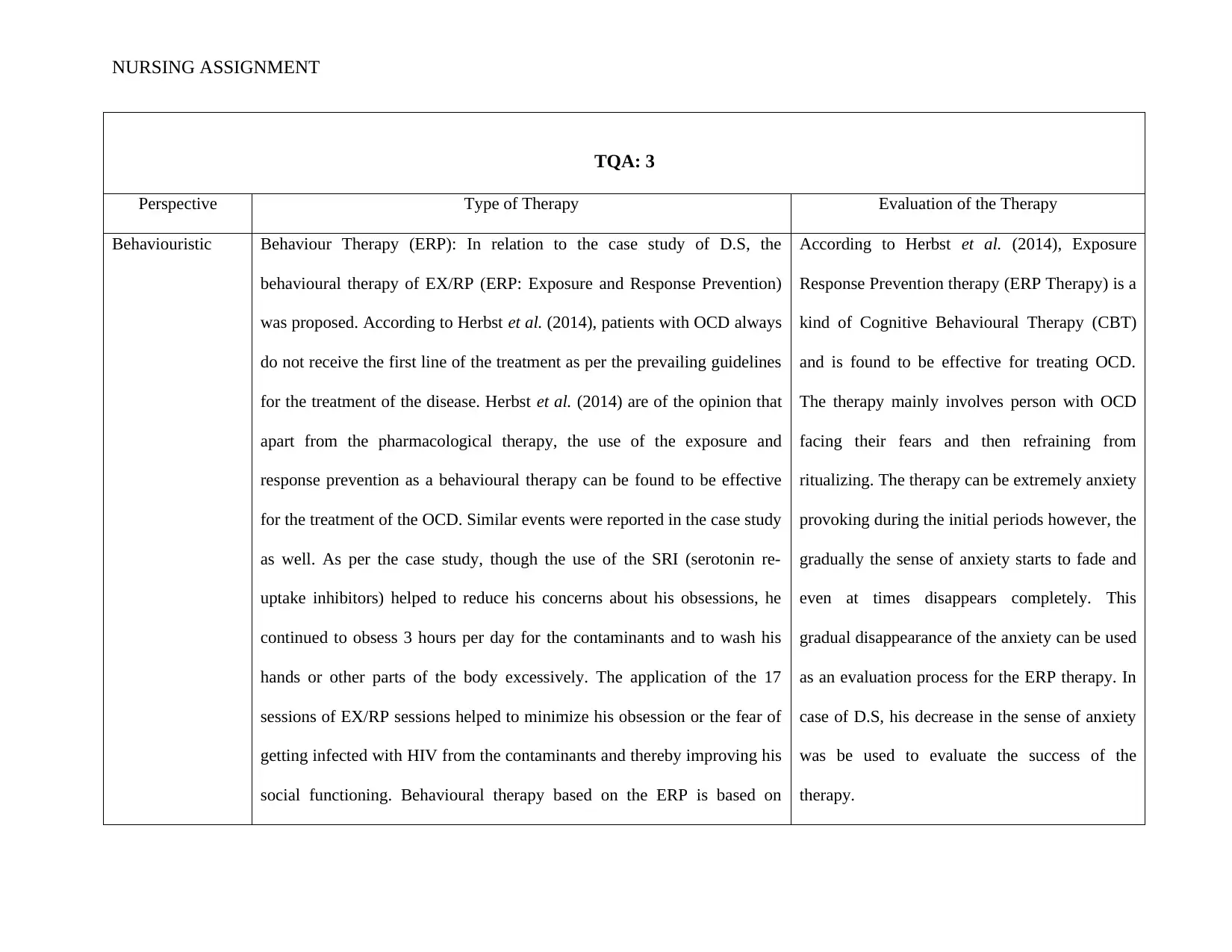
NURSING ASSIGNMENT
TQA: 3
Perspective Type of Therapy Evaluation of the Therapy
Behaviouristic Behaviour Therapy (ERP): In relation to the case study of D.S, the
behavioural therapy of EX/RP (ERP: Exposure and Response Prevention)
was proposed. According to Herbst et al. (2014), patients with OCD always
do not receive the first line of the treatment as per the prevailing guidelines
for the treatment of the disease. Herbst et al. (2014) are of the opinion that
apart from the pharmacological therapy, the use of the exposure and
response prevention as a behavioural therapy can be found to be effective
for the treatment of the OCD. Similar events were reported in the case study
as well. As per the case study, though the use of the SRI (serotonin re-
uptake inhibitors) helped to reduce his concerns about his obsessions, he
continued to obsess 3 hours per day for the contaminants and to wash his
hands or other parts of the body excessively. The application of the 17
sessions of EX/RP sessions helped to minimize his obsession or the fear of
getting infected with HIV from the contaminants and thereby improving his
social functioning. Behavioural therapy based on the ERP is based on
According to Herbst et al. (2014), Exposure
Response Prevention therapy (ERP Therapy) is a
kind of Cognitive Behavioural Therapy (CBT)
and is found to be effective for treating OCD.
The therapy mainly involves person with OCD
facing their fears and then refraining from
ritualizing. The therapy can be extremely anxiety
provoking during the initial periods however, the
gradually the sense of anxiety starts to fade and
even at times disappears completely. This
gradual disappearance of the anxiety can be used
as an evaluation process for the ERP therapy. In
case of D.S, his decrease in the sense of anxiety
was be used to evaluate the success of the
therapy.
TQA: 3
Perspective Type of Therapy Evaluation of the Therapy
Behaviouristic Behaviour Therapy (ERP): In relation to the case study of D.S, the
behavioural therapy of EX/RP (ERP: Exposure and Response Prevention)
was proposed. According to Herbst et al. (2014), patients with OCD always
do not receive the first line of the treatment as per the prevailing guidelines
for the treatment of the disease. Herbst et al. (2014) are of the opinion that
apart from the pharmacological therapy, the use of the exposure and
response prevention as a behavioural therapy can be found to be effective
for the treatment of the OCD. Similar events were reported in the case study
as well. As per the case study, though the use of the SRI (serotonin re-
uptake inhibitors) helped to reduce his concerns about his obsessions, he
continued to obsess 3 hours per day for the contaminants and to wash his
hands or other parts of the body excessively. The application of the 17
sessions of EX/RP sessions helped to minimize his obsession or the fear of
getting infected with HIV from the contaminants and thereby improving his
social functioning. Behavioural therapy based on the ERP is based on
According to Herbst et al. (2014), Exposure
Response Prevention therapy (ERP Therapy) is a
kind of Cognitive Behavioural Therapy (CBT)
and is found to be effective for treating OCD.
The therapy mainly involves person with OCD
facing their fears and then refraining from
ritualizing. The therapy can be extremely anxiety
provoking during the initial periods however, the
gradually the sense of anxiety starts to fade and
even at times disappears completely. This
gradual disappearance of the anxiety can be used
as an evaluation process for the ERP therapy. In
case of D.S, his decrease in the sense of anxiety
was be used to evaluate the success of the
therapy.
⊘ This is a preview!⊘
Do you want full access?
Subscribe today to unlock all pages.
Trusted by 1+ million students worldwide
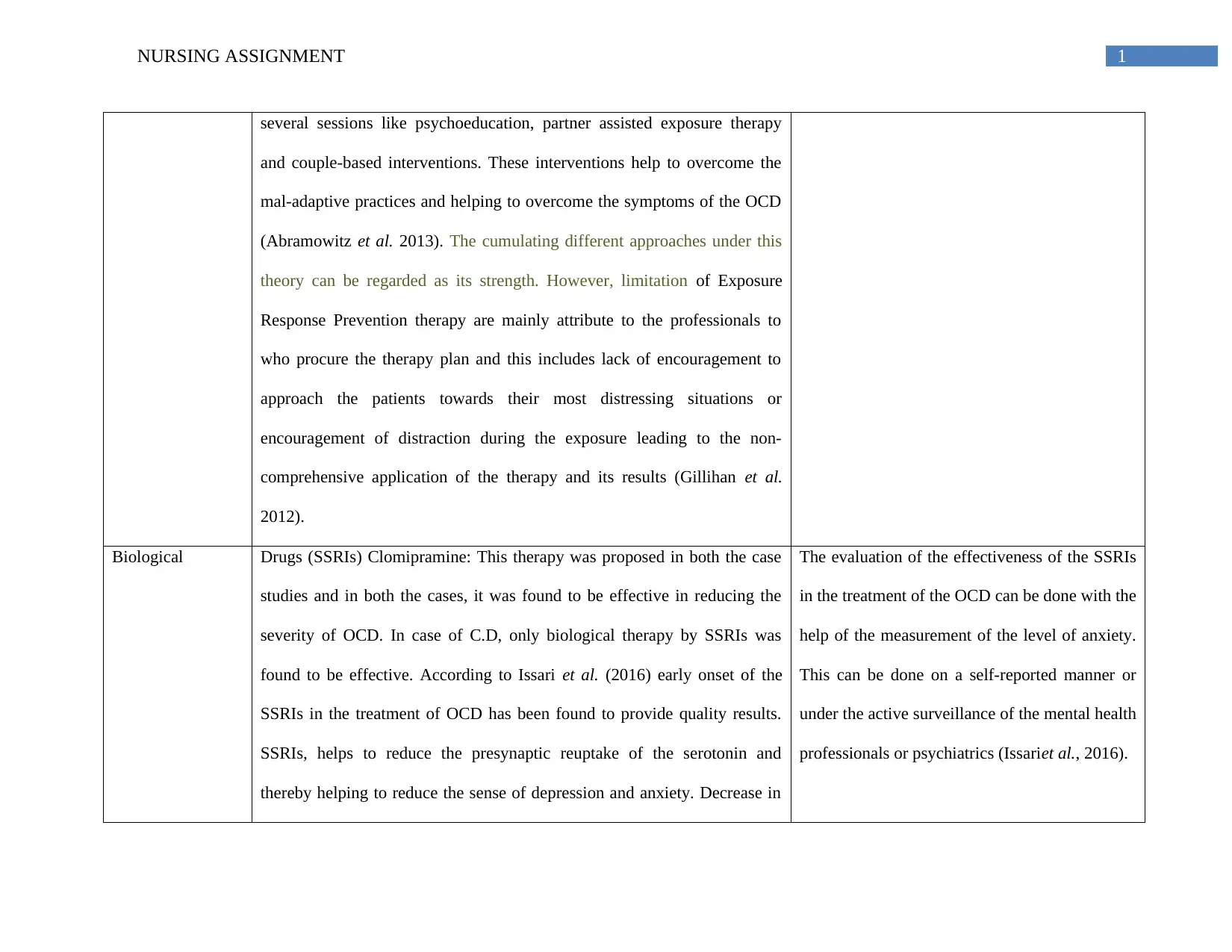
1NURSING ASSIGNMENT
several sessions like psychoeducation, partner assisted exposure therapy
and couple-based interventions. These interventions help to overcome the
mal-adaptive practices and helping to overcome the symptoms of the OCD
(Abramowitz et al. 2013). The cumulating different approaches under this
theory can be regarded as its strength. However, limitation of Exposure
Response Prevention therapy are mainly attribute to the professionals to
who procure the therapy plan and this includes lack of encouragement to
approach the patients towards their most distressing situations or
encouragement of distraction during the exposure leading to the non-
comprehensive application of the therapy and its results (Gillihan et al.
2012).
Biological Drugs (SSRIs) Clomipramine: This therapy was proposed in both the case
studies and in both the cases, it was found to be effective in reducing the
severity of OCD. In case of C.D, only biological therapy by SSRIs was
found to be effective. According to Issari et al. (2016) early onset of the
SSRIs in the treatment of OCD has been found to provide quality results.
SSRIs, helps to reduce the presynaptic reuptake of the serotonin and
thereby helping to reduce the sense of depression and anxiety. Decrease in
The evaluation of the effectiveness of the SSRIs
in the treatment of the OCD can be done with the
help of the measurement of the level of anxiety.
This can be done on a self-reported manner or
under the active surveillance of the mental health
professionals or psychiatrics (Issariet al., 2016).
several sessions like psychoeducation, partner assisted exposure therapy
and couple-based interventions. These interventions help to overcome the
mal-adaptive practices and helping to overcome the symptoms of the OCD
(Abramowitz et al. 2013). The cumulating different approaches under this
theory can be regarded as its strength. However, limitation of Exposure
Response Prevention therapy are mainly attribute to the professionals to
who procure the therapy plan and this includes lack of encouragement to
approach the patients towards their most distressing situations or
encouragement of distraction during the exposure leading to the non-
comprehensive application of the therapy and its results (Gillihan et al.
2012).
Biological Drugs (SSRIs) Clomipramine: This therapy was proposed in both the case
studies and in both the cases, it was found to be effective in reducing the
severity of OCD. In case of C.D, only biological therapy by SSRIs was
found to be effective. According to Issari et al. (2016) early onset of the
SSRIs in the treatment of OCD has been found to provide quality results.
SSRIs, helps to reduce the presynaptic reuptake of the serotonin and
thereby helping to reduce the sense of depression and anxiety. Decrease in
The evaluation of the effectiveness of the SSRIs
in the treatment of the OCD can be done with the
help of the measurement of the level of anxiety.
This can be done on a self-reported manner or
under the active surveillance of the mental health
professionals or psychiatrics (Issariet al., 2016).
Paraphrase This Document
Need a fresh take? Get an instant paraphrase of this document with our AI Paraphraser

2NURSING ASSIGNMENT
anxiety helps to overcome the symptoms of OCD (Issari et al.2016). Thus
one of the strength of this biological intervention of OCD it helps in
overcoming the complication of the disease from the underlying
neurological perspective. Effective management of the dosage of SSRIs
help to improve the quality of life of people with OCD. However, prolong
and high dosage use of SSRIs like in case of C.D causes numerous side-
effects like dry mouth, nausea, stomach upset and loss of appetite. At times
it might lead to trouble in concentrating and this might be problematic in
case of C.D who is still a student (Rapoport2013). This might be regarded
as one of the limitation of this approach.
Cognitive
Behaviour
Cognitive Behavioural Therapy is another behavioural aspect behind the treatment of the OCD. This therapy was not used in
any of the cases however. According to OCD UK (2018), CBT is a treatment of choice of OCD by NHS (National Health
Service). This therapy is delivered with a person centred approach and focuses on the present problem rather than the past. If
there is a co-morbidity like depression then CBT is effective is given in combination with pharmacological therapy. This can be
regarded as one of the strength of this intervention. McKay et al. (2015) argued that initial stages of CBT requires confronting
complex emotions and thereby making the subject emotionally unstable leading to immense mental exhaustion. McKay et al.
(2015) also stated CBT mainly focus on the individual capacity of changing themselves and it does not address wider problems
like family related problems that might harm the mental health of people.
anxiety helps to overcome the symptoms of OCD (Issari et al.2016). Thus
one of the strength of this biological intervention of OCD it helps in
overcoming the complication of the disease from the underlying
neurological perspective. Effective management of the dosage of SSRIs
help to improve the quality of life of people with OCD. However, prolong
and high dosage use of SSRIs like in case of C.D causes numerous side-
effects like dry mouth, nausea, stomach upset and loss of appetite. At times
it might lead to trouble in concentrating and this might be problematic in
case of C.D who is still a student (Rapoport2013). This might be regarded
as one of the limitation of this approach.
Cognitive
Behaviour
Cognitive Behavioural Therapy is another behavioural aspect behind the treatment of the OCD. This therapy was not used in
any of the cases however. According to OCD UK (2018), CBT is a treatment of choice of OCD by NHS (National Health
Service). This therapy is delivered with a person centred approach and focuses on the present problem rather than the past. If
there is a co-morbidity like depression then CBT is effective is given in combination with pharmacological therapy. This can be
regarded as one of the strength of this intervention. McKay et al. (2015) argued that initial stages of CBT requires confronting
complex emotions and thereby making the subject emotionally unstable leading to immense mental exhaustion. McKay et al.
(2015) also stated CBT mainly focus on the individual capacity of changing themselves and it does not address wider problems
like family related problems that might harm the mental health of people.
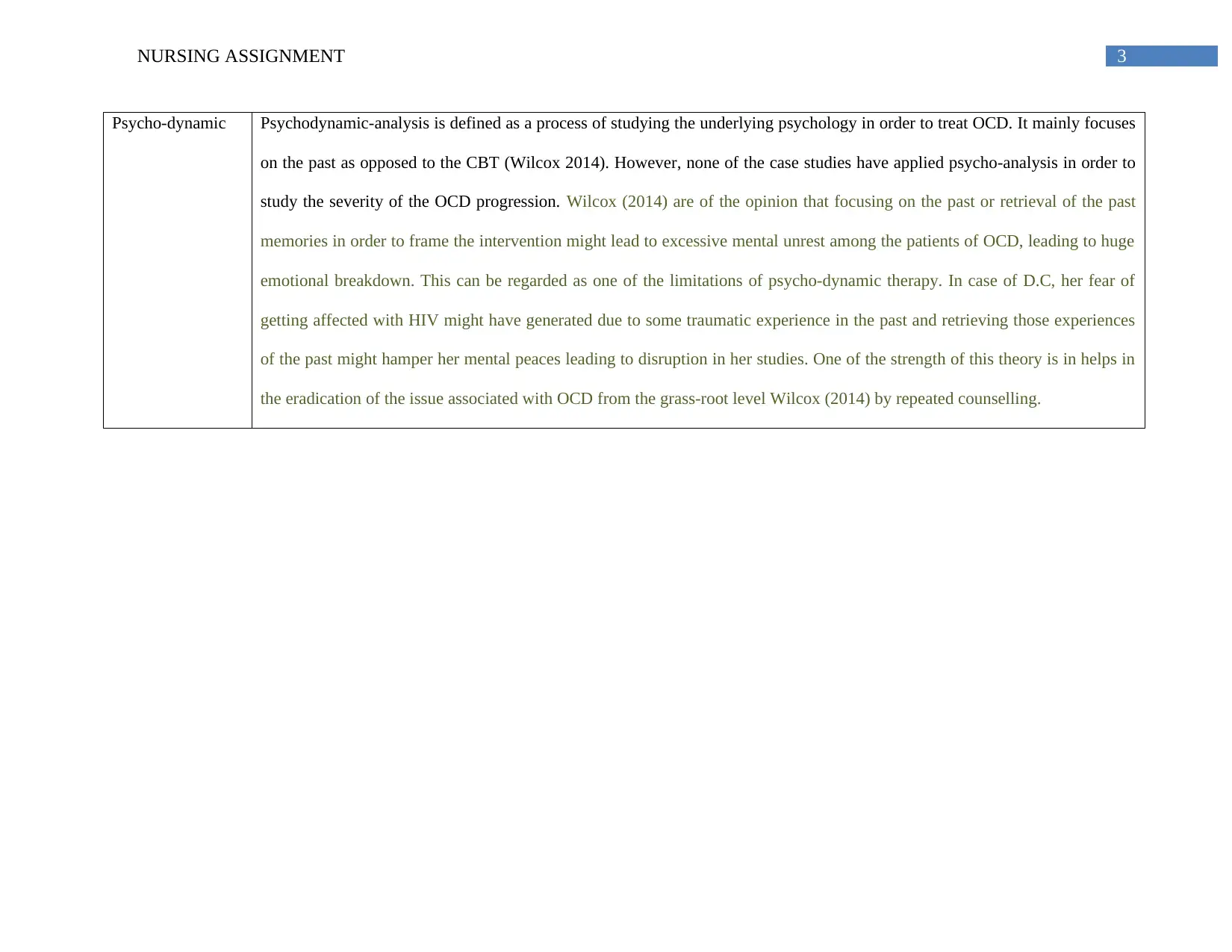
3NURSING ASSIGNMENT
Psycho-dynamic Psychodynamic-analysis is defined as a process of studying the underlying psychology in order to treat OCD. It mainly focuses
on the past as opposed to the CBT (Wilcox 2014). However, none of the case studies have applied psycho-analysis in order to
study the severity of the OCD progression. Wilcox (2014) are of the opinion that focusing on the past or retrieval of the past
memories in order to frame the intervention might lead to excessive mental unrest among the patients of OCD, leading to huge
emotional breakdown. This can be regarded as one of the limitations of psycho-dynamic therapy. In case of D.C, her fear of
getting affected with HIV might have generated due to some traumatic experience in the past and retrieving those experiences
of the past might hamper her mental peaces leading to disruption in her studies. One of the strength of this theory is in helps in
the eradication of the issue associated with OCD from the grass-root level Wilcox (2014) by repeated counselling.
Psycho-dynamic Psychodynamic-analysis is defined as a process of studying the underlying psychology in order to treat OCD. It mainly focuses
on the past as opposed to the CBT (Wilcox 2014). However, none of the case studies have applied psycho-analysis in order to
study the severity of the OCD progression. Wilcox (2014) are of the opinion that focusing on the past or retrieval of the past
memories in order to frame the intervention might lead to excessive mental unrest among the patients of OCD, leading to huge
emotional breakdown. This can be regarded as one of the limitations of psycho-dynamic therapy. In case of D.C, her fear of
getting affected with HIV might have generated due to some traumatic experience in the past and retrieving those experiences
of the past might hamper her mental peaces leading to disruption in her studies. One of the strength of this theory is in helps in
the eradication of the issue associated with OCD from the grass-root level Wilcox (2014) by repeated counselling.
⊘ This is a preview!⊘
Do you want full access?
Subscribe today to unlock all pages.
Trusted by 1+ million students worldwide

1 out of 17


Your All-in-One AI-Powered Toolkit for Academic Success.
+13062052269
info@desklib.com
Available 24*7 on WhatsApp / Email
![[object Object]](/_next/static/media/star-bottom.7253800d.svg)
Unlock your academic potential
Copyright © 2020–2026 A2Z Services. All Rights Reserved. Developed and managed by ZUCOL.