Detailed Report on Principles of Administration for Office Management
VerifiedAdded on 2020/10/05
|9
|4540
|379
Report
AI Summary
This report provides a comprehensive overview of office management principles. It begins by explaining legal requirements, including health and safety regulations, data protection, and equality acts, crucial for maintaining a compliant and safe workplace. The report then details typical office services, such as managing communications, organizing meetings, and supporting colleagues. It outlines procedures for establishing office management, covering communication, staffing, and resource utilization. Furthermore, it explains how to manage office resources like stationary, equipment, and staff, emphasizing cost assessment, training, and performance management. The report also explores techniques for monitoring and managing work flows at business, department, and individual levels, along with accident and emergency procedures. Finally, it addresses employee support and welfare facilities, legal obligations of employers and employees, and the importance of accurate meeting minutes, including what should and should not be included. This report is a valuable resource for understanding the multifaceted aspects of office management.
[Type text]
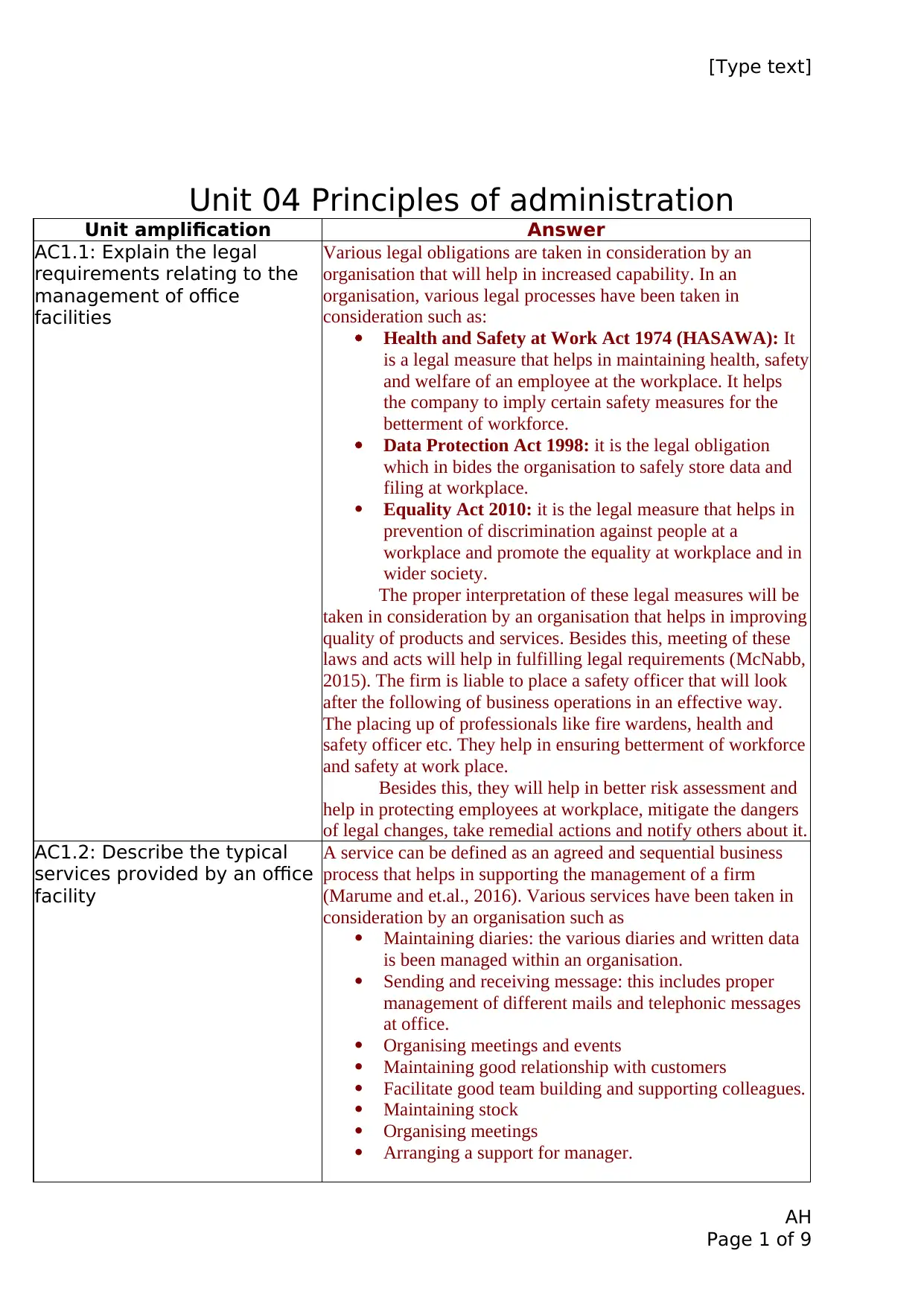
Unit 04 Principles of administration
Unit amplification Answer
AC1.1: Explain the legal
requirements relating to the
management of office
facilities
Various legal obligations are taken in consideration by an
organisation that will help in increased capability. In an
organisation, various legal processes have been taken in
consideration such as:
Health and Safety at Work Act 1974 (HASAWA): It
is a legal measure that helps in maintaining health, safety
and welfare of an employee at the workplace. It helps
the company to imply certain safety measures for the
betterment of workforce.
Data Protection Act 1998: it is the legal obligation
which in bides the organisation to safely store data and
filing at workplace.
Equality Act 2010: it is the legal measure that helps in
prevention of discrimination against people at a
workplace and promote the equality at workplace and in
wider society.
The proper interpretation of these legal measures will be
taken in consideration by an organisation that helps in improving
quality of products and services. Besides this, meeting of these
laws and acts will help in fulfilling legal requirements (McNabb,
2015). The firm is liable to place a safety officer that will look
after the following of business operations in an effective way.
The placing up of professionals like fire wardens, health and
safety officer etc. They help in ensuring betterment of workforce
and safety at work place.
Besides this, they will help in better risk assessment and
help in protecting employees at workplace, mitigate the dangers
of legal changes, take remedial actions and notify others about it.
AC1.2: Describe the typical
services provided by an office
facility
A service can be defined as an agreed and sequential business
process that helps in supporting the management of a firm
(Marume and et.al., 2016). Various services have been taken in
consideration by an organisation such as
Maintaining diaries: the various diaries and written data
is been managed within an organisation.
Sending and receiving message: this includes proper
management of different mails and telephonic messages
at office.
Organising meetings and events
Maintaining good relationship with customers
Facilitate good team building and supporting colleagues.
Maintaining stock
Organising meetings
Arranging a support for manager.
AH
Page 1 of 9
Unit 04 Principles of administration
Unit amplification Answer
AC1.1: Explain the legal
requirements relating to the
management of office
facilities
Various legal obligations are taken in consideration by an
organisation that will help in increased capability. In an
organisation, various legal processes have been taken in
consideration such as:
Health and Safety at Work Act 1974 (HASAWA): It
is a legal measure that helps in maintaining health, safety
and welfare of an employee at the workplace. It helps
the company to imply certain safety measures for the
betterment of workforce.
Data Protection Act 1998: it is the legal obligation
which in bides the organisation to safely store data and
filing at workplace.
Equality Act 2010: it is the legal measure that helps in
prevention of discrimination against people at a
workplace and promote the equality at workplace and in
wider society.
The proper interpretation of these legal measures will be
taken in consideration by an organisation that helps in improving
quality of products and services. Besides this, meeting of these
laws and acts will help in fulfilling legal requirements (McNabb,
2015). The firm is liable to place a safety officer that will look
after the following of business operations in an effective way.
The placing up of professionals like fire wardens, health and
safety officer etc. They help in ensuring betterment of workforce
and safety at work place.
Besides this, they will help in better risk assessment and
help in protecting employees at workplace, mitigate the dangers
of legal changes, take remedial actions and notify others about it.
AC1.2: Describe the typical
services provided by an office
facility
A service can be defined as an agreed and sequential business
process that helps in supporting the management of a firm
(Marume and et.al., 2016). Various services have been taken in
consideration by an organisation such as
Maintaining diaries: the various diaries and written data
is been managed within an organisation.
Sending and receiving message: this includes proper
management of different mails and telephonic messages
at office.
Organising meetings and events
Maintaining good relationship with customers
Facilitate good team building and supporting colleagues.
Maintaining stock
Organising meetings
Arranging a support for manager.
AH
Page 1 of 9

Paraphrase This Document
Need a fresh take? Get an instant paraphrase of this document with our AI Paraphraser
[Type text]
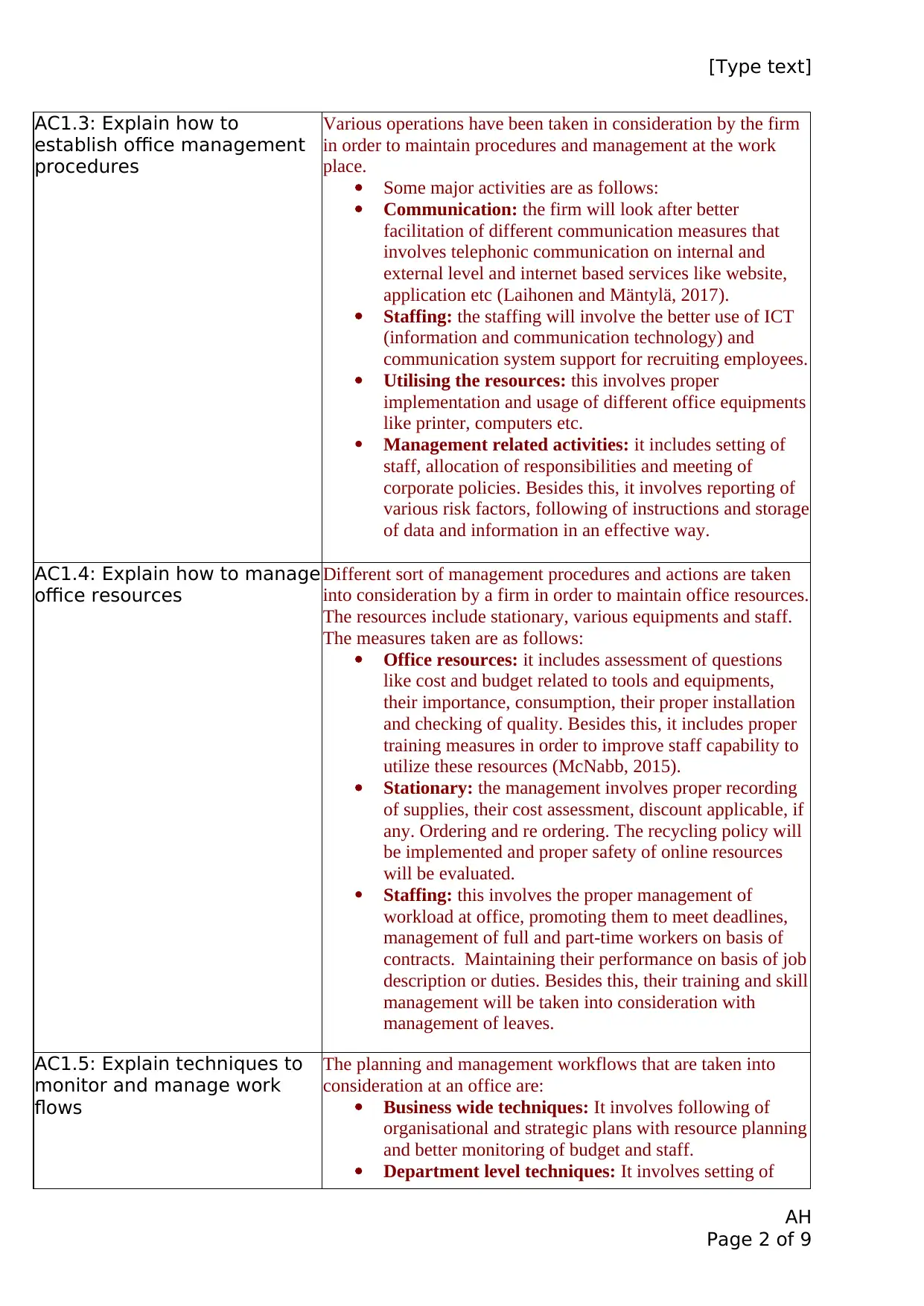
AC1.3: Explain how to
establish office management
procedures
Various operations have been taken in consideration by the firm
in order to maintain procedures and management at the work
place.
Some major activities are as follows:
Communication: the firm will look after better
facilitation of different communication measures that
involves telephonic communication on internal and
external level and internet based services like website,
application etc (Laihonen and Mäntylä, 2017).
Staffing: the staffing will involve the better use of ICT
(information and communication technology) and
communication system support for recruiting employees.
Utilising the resources: this involves proper
implementation and usage of different office equipments
like printer, computers etc.
Management related activities: it includes setting of
staff, allocation of responsibilities and meeting of
corporate policies. Besides this, it involves reporting of
various risk factors, following of instructions and storage
of data and information in an effective way.
AC1.4: Explain how to manage
office resources
Different sort of management procedures and actions are taken
into consideration by a firm in order to maintain office resources.
The resources include stationary, various equipments and staff.
The measures taken are as follows:
Office resources: it includes assessment of questions
like cost and budget related to tools and equipments,
their importance, consumption, their proper installation
and checking of quality. Besides this, it includes proper
training measures in order to improve staff capability to
utilize these resources (McNabb, 2015).
Stationary: the management involves proper recording
of supplies, their cost assessment, discount applicable, if
any. Ordering and re ordering. The recycling policy will
be implemented and proper safety of online resources
will be evaluated.
Staffing: this involves the proper management of
workload at office, promoting them to meet deadlines,
management of full and part-time workers on basis of
contracts. Maintaining their performance on basis of job
description or duties. Besides this, their training and skill
management will be taken into consideration with
management of leaves.
AC1.5: Explain techniques to
monitor and manage work
flows
The planning and management workflows that are taken into
consideration at an office are:
Business wide techniques: It involves following of
organisational and strategic plans with resource planning
and better monitoring of budget and staff.
Department level techniques: It involves setting of
AH
Page 2 of 9
AC1.3: Explain how to
establish office management
procedures
Various operations have been taken in consideration by the firm
in order to maintain procedures and management at the work
place.
Some major activities are as follows:
Communication: the firm will look after better
facilitation of different communication measures that
involves telephonic communication on internal and
external level and internet based services like website,
application etc (Laihonen and Mäntylä, 2017).
Staffing: the staffing will involve the better use of ICT
(information and communication technology) and
communication system support for recruiting employees.
Utilising the resources: this involves proper
implementation and usage of different office equipments
like printer, computers etc.
Management related activities: it includes setting of
staff, allocation of responsibilities and meeting of
corporate policies. Besides this, it involves reporting of
various risk factors, following of instructions and storage
of data and information in an effective way.
AC1.4: Explain how to manage
office resources
Different sort of management procedures and actions are taken
into consideration by a firm in order to maintain office resources.
The resources include stationary, various equipments and staff.
The measures taken are as follows:
Office resources: it includes assessment of questions
like cost and budget related to tools and equipments,
their importance, consumption, their proper installation
and checking of quality. Besides this, it includes proper
training measures in order to improve staff capability to
utilize these resources (McNabb, 2015).
Stationary: the management involves proper recording
of supplies, their cost assessment, discount applicable, if
any. Ordering and re ordering. The recycling policy will
be implemented and proper safety of online resources
will be evaluated.
Staffing: this involves the proper management of
workload at office, promoting them to meet deadlines,
management of full and part-time workers on basis of
contracts. Maintaining their performance on basis of job
description or duties. Besides this, their training and skill
management will be taken into consideration with
management of leaves.
AC1.5: Explain techniques to
monitor and manage work
flows
The planning and management workflows that are taken into
consideration at an office are:
Business wide techniques: It involves following of
organisational and strategic plans with resource planning
and better monitoring of budget and staff.
Department level techniques: It involves setting of
AH
Page 2 of 9
[Type text]
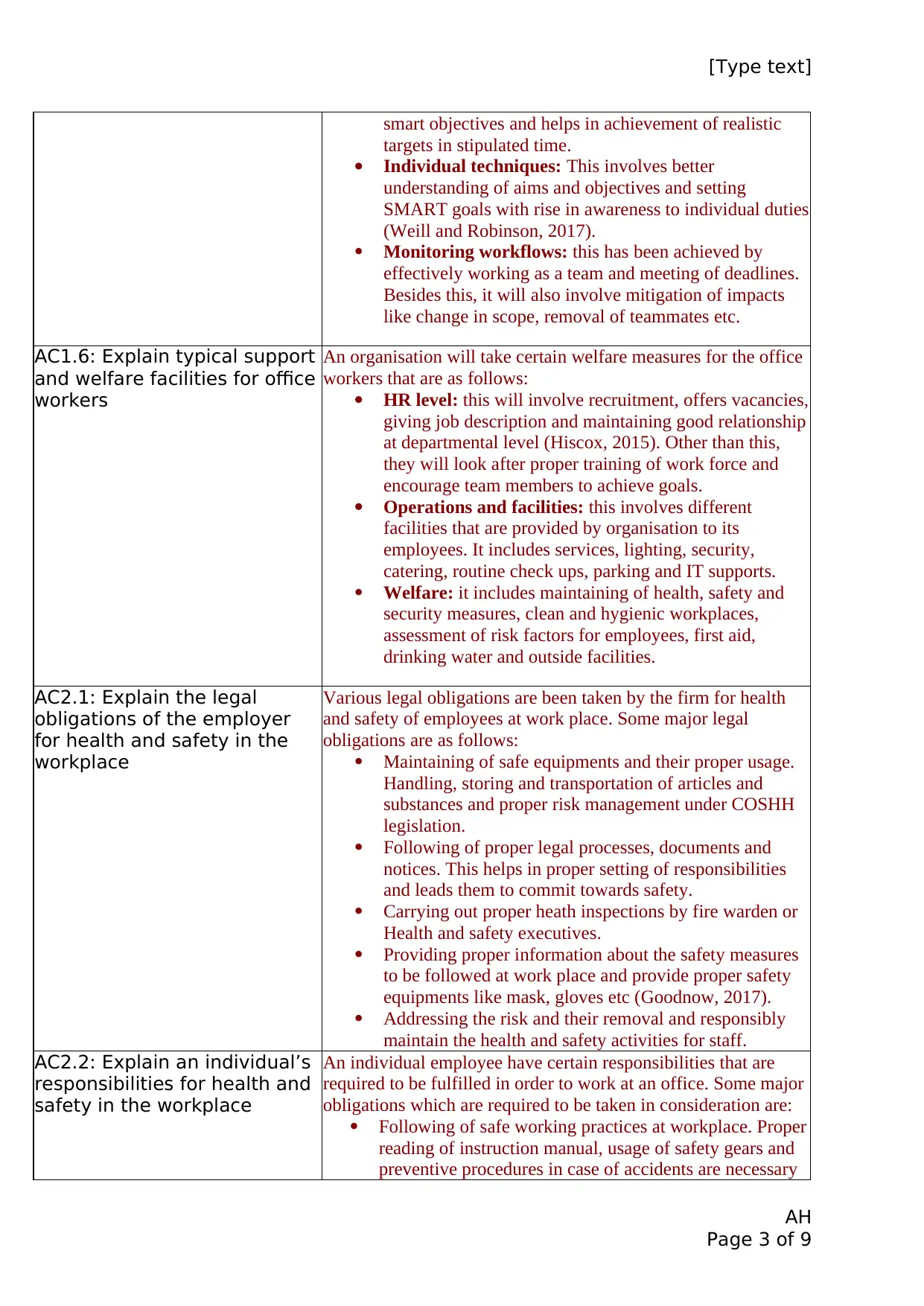
smart objectives and helps in achievement of realistic
targets in stipulated time.
Individual techniques: This involves better
understanding of aims and objectives and setting
SMART goals with rise in awareness to individual duties
(Weill and Robinson, 2017).
Monitoring workflows: this has been achieved by
effectively working as a team and meeting of deadlines.
Besides this, it will also involve mitigation of impacts
like change in scope, removal of teammates etc.
AC1.6: Explain typical support
and welfare facilities for office
workers
An organisation will take certain welfare measures for the office
workers that are as follows:
HR level: this will involve recruitment, offers vacancies,
giving job description and maintaining good relationship
at departmental level (Hiscox, 2015). Other than this,
they will look after proper training of work force and
encourage team members to achieve goals.
Operations and facilities: this involves different
facilities that are provided by organisation to its
employees. It includes services, lighting, security,
catering, routine check ups, parking and IT supports.
Welfare: it includes maintaining of health, safety and
security measures, clean and hygienic workplaces,
assessment of risk factors for employees, first aid,
drinking water and outside facilities.
AC2.1: Explain the legal
obligations of the employer
for health and safety in the
workplace
Various legal obligations are been taken by the firm for health
and safety of employees at work place. Some major legal
obligations are as follows:
Maintaining of safe equipments and their proper usage.
Handling, storing and transportation of articles and
substances and proper risk management under COSHH
legislation.
Following of proper legal processes, documents and
notices. This helps in proper setting of responsibilities
and leads them to commit towards safety.
Carrying out proper heath inspections by fire warden or
Health and safety executives.
Providing proper information about the safety measures
to be followed at work place and provide proper safety
equipments like mask, gloves etc (Goodnow, 2017).
Addressing the risk and their removal and responsibly
maintain the health and safety activities for staff.
AC2.2: Explain an individual’s
responsibilities for health and
safety in the workplace
An individual employee have certain responsibilities that are
required to be fulfilled in order to work at an office. Some major
obligations which are required to be taken in consideration are:
Following of safe working practices at workplace. Proper
reading of instruction manual, usage of safety gears and
preventive procedures in case of accidents are necessary
AH
Page 3 of 9
smart objectives and helps in achievement of realistic
targets in stipulated time.
Individual techniques: This involves better
understanding of aims and objectives and setting
SMART goals with rise in awareness to individual duties
(Weill and Robinson, 2017).
Monitoring workflows: this has been achieved by
effectively working as a team and meeting of deadlines.
Besides this, it will also involve mitigation of impacts
like change in scope, removal of teammates etc.
AC1.6: Explain typical support
and welfare facilities for office
workers
An organisation will take certain welfare measures for the office
workers that are as follows:
HR level: this will involve recruitment, offers vacancies,
giving job description and maintaining good relationship
at departmental level (Hiscox, 2015). Other than this,
they will look after proper training of work force and
encourage team members to achieve goals.
Operations and facilities: this involves different
facilities that are provided by organisation to its
employees. It includes services, lighting, security,
catering, routine check ups, parking and IT supports.
Welfare: it includes maintaining of health, safety and
security measures, clean and hygienic workplaces,
assessment of risk factors for employees, first aid,
drinking water and outside facilities.
AC2.1: Explain the legal
obligations of the employer
for health and safety in the
workplace
Various legal obligations are been taken by the firm for health
and safety of employees at work place. Some major legal
obligations are as follows:
Maintaining of safe equipments and their proper usage.
Handling, storing and transportation of articles and
substances and proper risk management under COSHH
legislation.
Following of proper legal processes, documents and
notices. This helps in proper setting of responsibilities
and leads them to commit towards safety.
Carrying out proper heath inspections by fire warden or
Health and safety executives.
Providing proper information about the safety measures
to be followed at work place and provide proper safety
equipments like mask, gloves etc (Goodnow, 2017).
Addressing the risk and their removal and responsibly
maintain the health and safety activities for staff.
AC2.2: Explain an individual’s
responsibilities for health and
safety in the workplace
An individual employee have certain responsibilities that are
required to be fulfilled in order to work at an office. Some major
obligations which are required to be taken in consideration are:
Following of safe working practices at workplace. Proper
reading of instruction manual, usage of safety gears and
preventive procedures in case of accidents are necessary
AH
Page 3 of 9
⊘ This is a preview!⊘
Do you want full access?
Subscribe today to unlock all pages.

Trusted by 1+ million students worldwide
[Type text]
to avoid a work hazard.
Cooperating with employer is very important. It helps in
following of health and safety procedures. The employee
must report immediately in case of hazard, have regular
health check ups and maintain the safety standards
(Lemmen and et.al., 2016).
Other responsibilities like interacting with health officer,
proper risk assessment, maintaining Fire warden
responsibilities and facilitating evacuation process in
case of accident like fire or leakage.
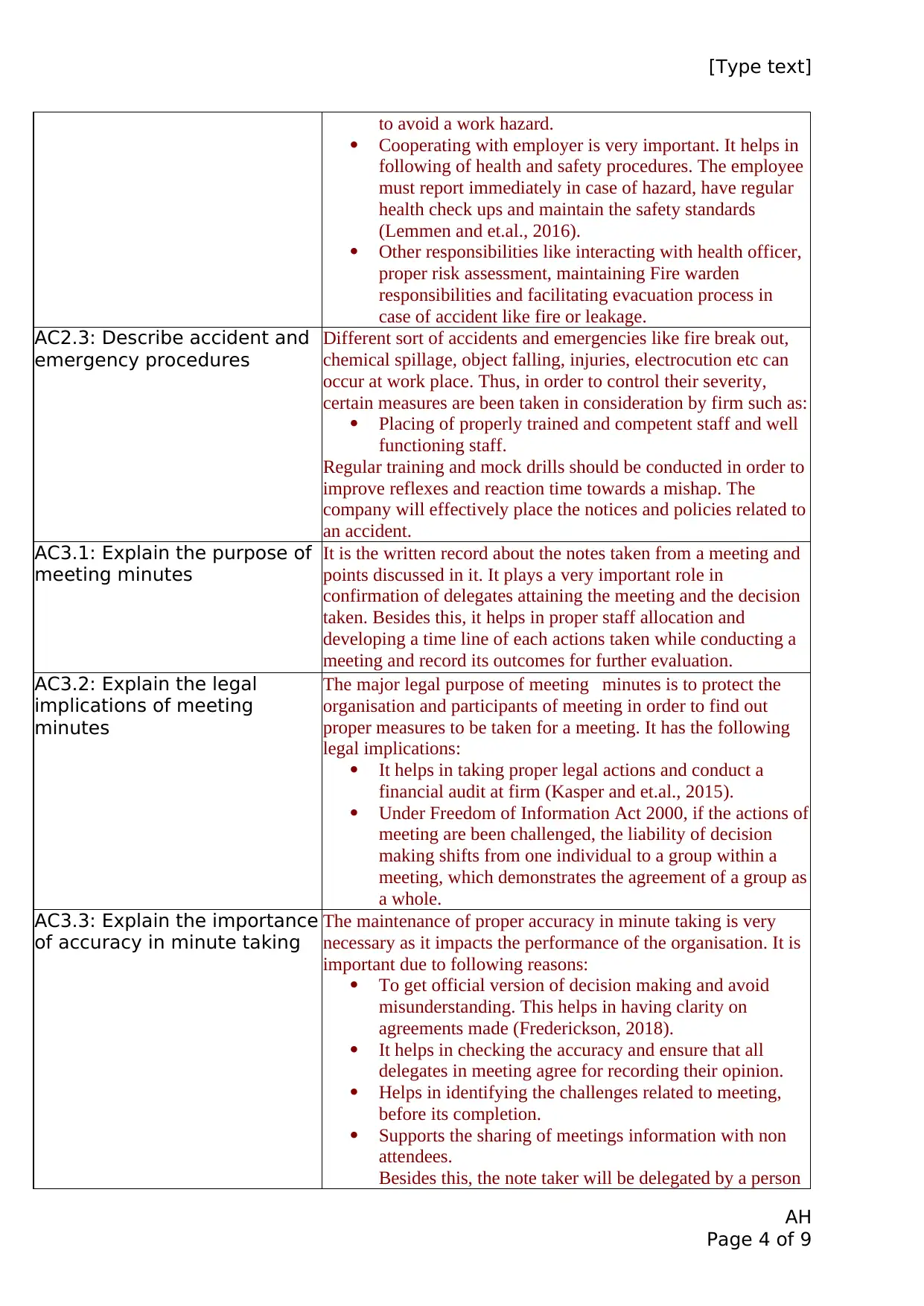
AC2.3: Describe accident and
emergency procedures
Different sort of accidents and emergencies like fire break out,
chemical spillage, object falling, injuries, electrocution etc can
occur at work place. Thus, in order to control their severity,
certain measures are been taken in consideration by firm such as:
Placing of properly trained and competent staff and well
functioning staff.
Regular training and mock drills should be conducted in order to
improve reflexes and reaction time towards a mishap. The
company will effectively place the notices and policies related to
an accident.
AC3.1: Explain the purpose of
meeting minutes
It is the written record about the notes taken from a meeting and
points discussed in it. It plays a very important role in
confirmation of delegates attaining the meeting and the decision
taken. Besides this, it helps in proper staff allocation and
developing a time line of each actions taken while conducting a
meeting and record its outcomes for further evaluation.
AC3.2: Explain the legal
implications of meeting
minutes
The major legal purpose of meeting minutes is to protect the
organisation and participants of meeting in order to find out
proper measures to be taken for a meeting. It has the following
legal implications:
It helps in taking proper legal actions and conduct a
financial audit at firm (Kasper and et.al., 2015).
Under Freedom of Information Act 2000, if the actions of
meeting are been challenged, the liability of decision
making shifts from one individual to a group within a
meeting, which demonstrates the agreement of a group as
a whole.
AC3.3: Explain the importance
of accuracy in minute taking
The maintenance of proper accuracy in minute taking is very
necessary as it impacts the performance of the organisation. It is
important due to following reasons:
To get official version of decision making and avoid
misunderstanding. This helps in having clarity on
agreements made (Frederickson, 2018).
It helps in checking the accuracy and ensure that all
delegates in meeting agree for recording their opinion.
Helps in identifying the challenges related to meeting,
before its completion.
Supports the sharing of meetings information with non
attendees.
Besides this, the note taker will be delegated by a person
AH
Page 4 of 9
to avoid a work hazard.
Cooperating with employer is very important. It helps in
following of health and safety procedures. The employee
must report immediately in case of hazard, have regular
health check ups and maintain the safety standards
(Lemmen and et.al., 2016).
Other responsibilities like interacting with health officer,
proper risk assessment, maintaining Fire warden
responsibilities and facilitating evacuation process in
case of accident like fire or leakage.
AC2.3: Describe accident and
emergency procedures
Different sort of accidents and emergencies like fire break out,
chemical spillage, object falling, injuries, electrocution etc can
occur at work place. Thus, in order to control their severity,
certain measures are been taken in consideration by firm such as:
Placing of properly trained and competent staff and well
functioning staff.
Regular training and mock drills should be conducted in order to
improve reflexes and reaction time towards a mishap. The
company will effectively place the notices and policies related to
an accident.
AC3.1: Explain the purpose of
meeting minutes
It is the written record about the notes taken from a meeting and
points discussed in it. It plays a very important role in
confirmation of delegates attaining the meeting and the decision
taken. Besides this, it helps in proper staff allocation and
developing a time line of each actions taken while conducting a
meeting and record its outcomes for further evaluation.
AC3.2: Explain the legal
implications of meeting
minutes
The major legal purpose of meeting minutes is to protect the
organisation and participants of meeting in order to find out
proper measures to be taken for a meeting. It has the following
legal implications:
It helps in taking proper legal actions and conduct a
financial audit at firm (Kasper and et.al., 2015).
Under Freedom of Information Act 2000, if the actions of
meeting are been challenged, the liability of decision
making shifts from one individual to a group within a
meeting, which demonstrates the agreement of a group as
a whole.
AC3.3: Explain the importance
of accuracy in minute taking
The maintenance of proper accuracy in minute taking is very
necessary as it impacts the performance of the organisation. It is
important due to following reasons:
To get official version of decision making and avoid
misunderstanding. This helps in having clarity on
agreements made (Frederickson, 2018).
It helps in checking the accuracy and ensure that all
delegates in meeting agree for recording their opinion.
Helps in identifying the challenges related to meeting,
before its completion.
Supports the sharing of meetings information with non
attendees.
Besides this, the note taker will be delegated by a person
AH
Page 4 of 9
Paraphrase This Document
Need a fresh take? Get an instant paraphrase of this document with our AI Paraphraser
[Type text]
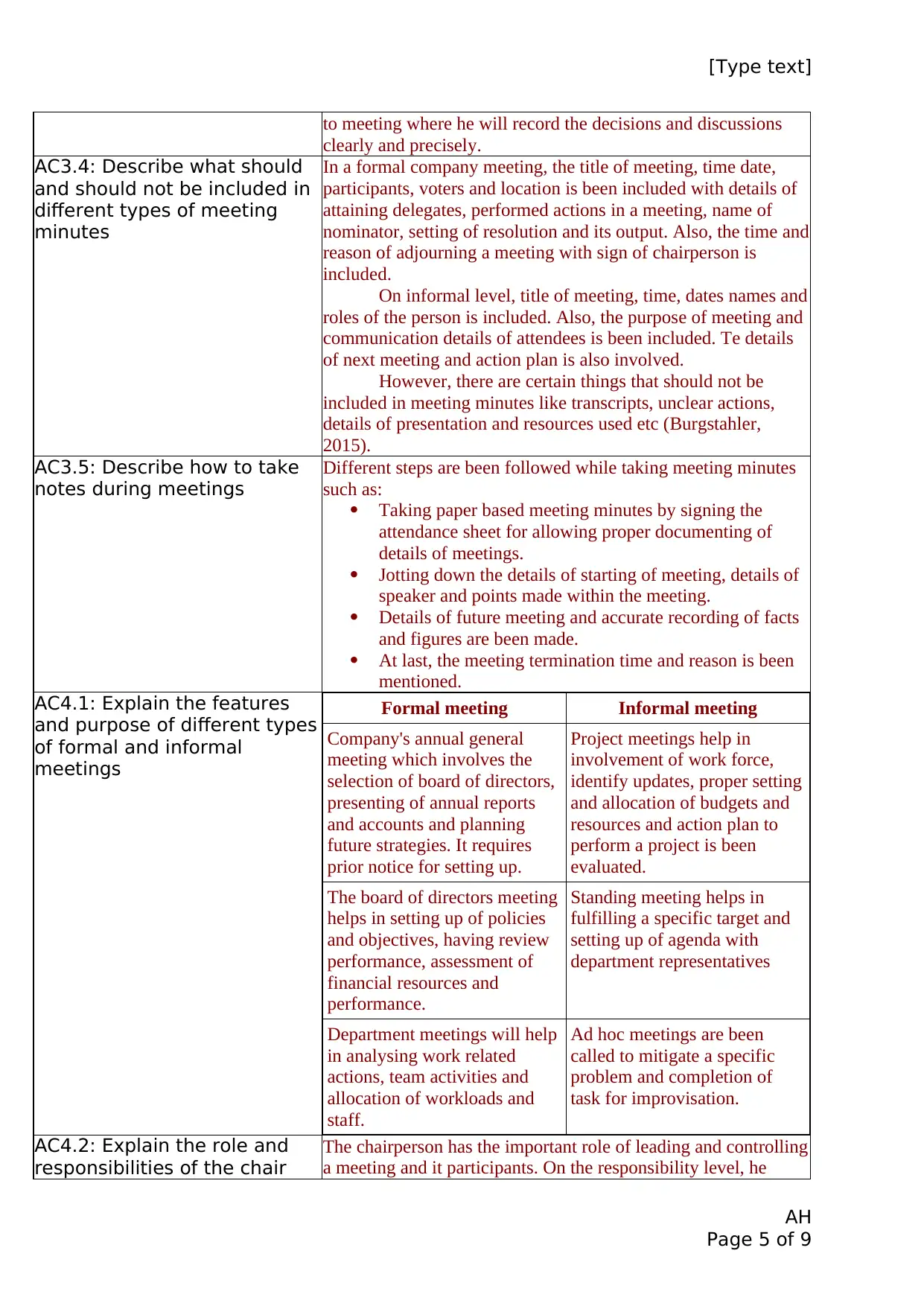
to meeting where he will record the decisions and discussions
clearly and precisely.
AC3.4: Describe what should
and should not be included in
different types of meeting
minutes
In a formal company meeting, the title of meeting, time date,
participants, voters and location is been included with details of
attaining delegates, performed actions in a meeting, name of
nominator, setting of resolution and its output. Also, the time and
reason of adjourning a meeting with sign of chairperson is
included.
On informal level, title of meeting, time, dates names and
roles of the person is included. Also, the purpose of meeting and
communication details of attendees is been included. Te details
of next meeting and action plan is also involved.
However, there are certain things that should not be
included in meeting minutes like transcripts, unclear actions,
details of presentation and resources used etc (Burgstahler,
2015).
AC3.5: Describe how to take
notes during meetings
Different steps are been followed while taking meeting minutes
such as:
Taking paper based meeting minutes by signing the
attendance sheet for allowing proper documenting of
details of meetings.
Jotting down the details of starting of meeting, details of
speaker and points made within the meeting.
Details of future meeting and accurate recording of facts
and figures are been made.
At last, the meeting termination time and reason is been
mentioned.
AC4.1: Explain the features
and purpose of different types
of formal and informal
meetings
Formal meeting Informal meeting
Company's annual general
meeting which involves the
selection of board of directors,
presenting of annual reports
and accounts and planning
future strategies. It requires
prior notice for setting up.
Project meetings help in
involvement of work force,
identify updates, proper setting
and allocation of budgets and
resources and action plan to
perform a project is been
evaluated.
The board of directors meeting
helps in setting up of policies
and objectives, having review
performance, assessment of
financial resources and
performance.
Standing meeting helps in
fulfilling a specific target and
setting up of agenda with
department representatives
Department meetings will help
in analysing work related
actions, team activities and
allocation of workloads and
staff.
Ad hoc meetings are been
called to mitigate a specific
problem and completion of
task for improvisation.
AC4.2: Explain the role and
responsibilities of the chair
The chairperson has the important role of leading and controlling
a meeting and it participants. On the responsibility level, he
AH
Page 5 of 9
to meeting where he will record the decisions and discussions
clearly and precisely.
AC3.4: Describe what should
and should not be included in
different types of meeting
minutes
In a formal company meeting, the title of meeting, time date,
participants, voters and location is been included with details of
attaining delegates, performed actions in a meeting, name of
nominator, setting of resolution and its output. Also, the time and
reason of adjourning a meeting with sign of chairperson is
included.
On informal level, title of meeting, time, dates names and
roles of the person is included. Also, the purpose of meeting and
communication details of attendees is been included. Te details
of next meeting and action plan is also involved.
However, there are certain things that should not be
included in meeting minutes like transcripts, unclear actions,
details of presentation and resources used etc (Burgstahler,
2015).
AC3.5: Describe how to take
notes during meetings
Different steps are been followed while taking meeting minutes
such as:
Taking paper based meeting minutes by signing the
attendance sheet for allowing proper documenting of
details of meetings.
Jotting down the details of starting of meeting, details of
speaker and points made within the meeting.
Details of future meeting and accurate recording of facts
and figures are been made.
At last, the meeting termination time and reason is been
mentioned.
AC4.1: Explain the features
and purpose of different types
of formal and informal
meetings
Formal meeting Informal meeting
Company's annual general
meeting which involves the
selection of board of directors,
presenting of annual reports
and accounts and planning
future strategies. It requires
prior notice for setting up.
Project meetings help in
involvement of work force,
identify updates, proper setting
and allocation of budgets and
resources and action plan to
perform a project is been
evaluated.
The board of directors meeting
helps in setting up of policies
and objectives, having review
performance, assessment of
financial resources and
performance.
Standing meeting helps in
fulfilling a specific target and
setting up of agenda with
department representatives
Department meetings will help
in analysing work related
actions, team activities and
allocation of workloads and
staff.
Ad hoc meetings are been
called to mitigate a specific
problem and completion of
task for improvisation.
AC4.2: Explain the role and
responsibilities of the chair
The chairperson has the important role of leading and controlling
a meeting and it participants. On the responsibility level, he
AH
Page 5 of 9
[Type text]
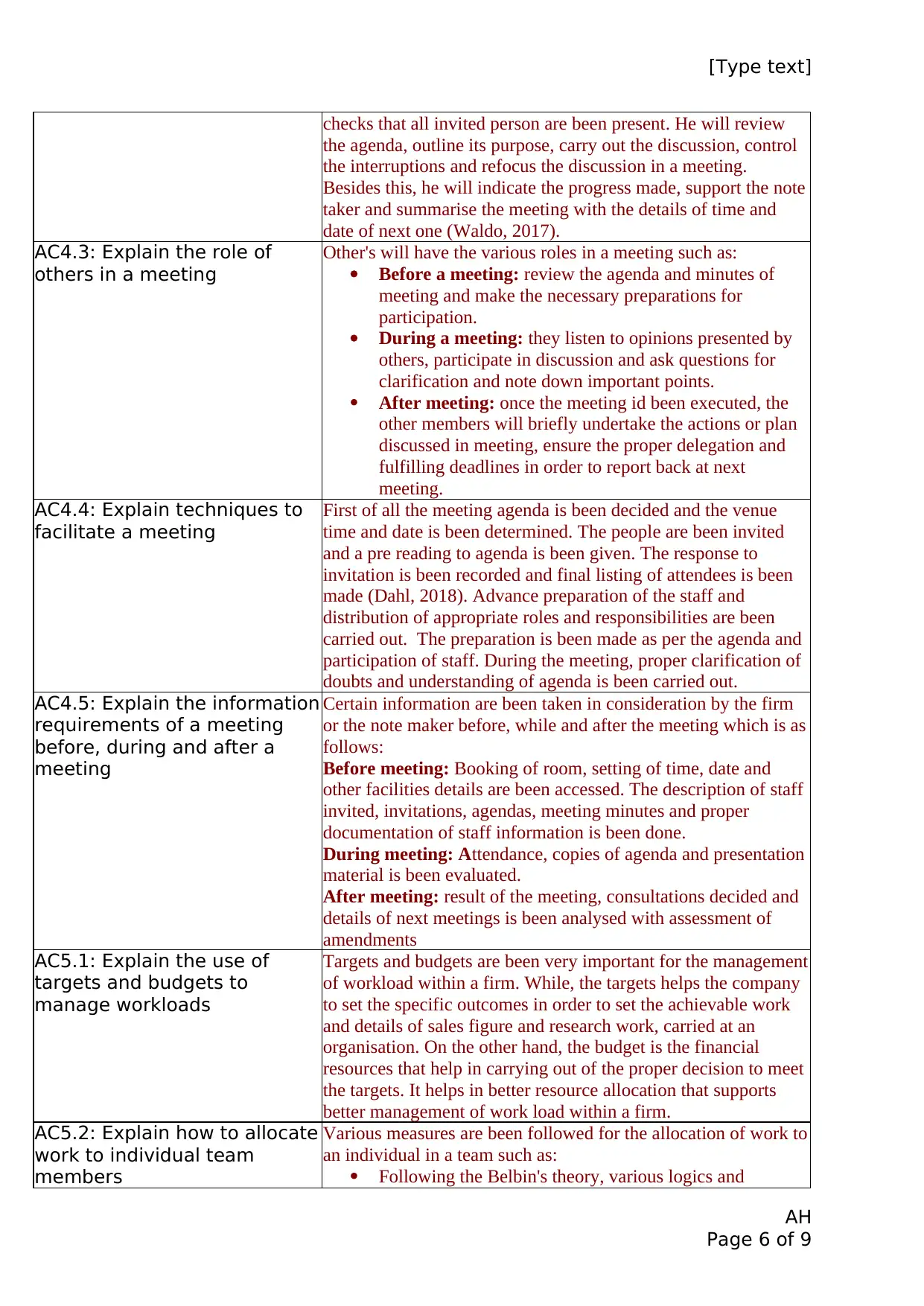
checks that all invited person are been present. He will review
the agenda, outline its purpose, carry out the discussion, control
the interruptions and refocus the discussion in a meeting.
Besides this, he will indicate the progress made, support the note
taker and summarise the meeting with the details of time and
date of next one (Waldo, 2017).
AC4.3: Explain the role of
others in a meeting
Other's will have the various roles in a meeting such as:
Before a meeting: review the agenda and minutes of
meeting and make the necessary preparations for
participation.
During a meeting: they listen to opinions presented by
others, participate in discussion and ask questions for
clarification and note down important points.
After meeting: once the meeting id been executed, the
other members will briefly undertake the actions or plan
discussed in meeting, ensure the proper delegation and
fulfilling deadlines in order to report back at next
meeting.
AC4.4: Explain techniques to
facilitate a meeting
First of all the meeting agenda is been decided and the venue
time and date is been determined. The people are been invited
and a pre reading to agenda is been given. The response to
invitation is been recorded and final listing of attendees is been
made (Dahl, 2018). Advance preparation of the staff and
distribution of appropriate roles and responsibilities are been
carried out. The preparation is been made as per the agenda and
participation of staff. During the meeting, proper clarification of
doubts and understanding of agenda is been carried out.
AC4.5: Explain the information
requirements of a meeting
before, during and after a
meeting
Certain information are been taken in consideration by the firm
or the note maker before, while and after the meeting which is as
follows:
Before meeting: Booking of room, setting of time, date and
other facilities details are been accessed. The description of staff
invited, invitations, agendas, meeting minutes and proper
documentation of staff information is been done.
During meeting: Attendance, copies of agenda and presentation
material is been evaluated.
After meeting: result of the meeting, consultations decided and
details of next meetings is been analysed with assessment of
amendments
AC5.1: Explain the use of
targets and budgets to
manage workloads
Targets and budgets are been very important for the management
of workload within a firm. While, the targets helps the company
to set the specific outcomes in order to set the achievable work
and details of sales figure and research work, carried at an
organisation. On the other hand, the budget is the financial
resources that help in carrying out of the proper decision to meet
the targets. It helps in better resource allocation that supports
better management of work load within a firm.
AC5.2: Explain how to allocate
work to individual team
members
Various measures are been followed for the allocation of work to
an individual in a team such as:
Following the Belbin's theory, various logics and
AH
Page 6 of 9
checks that all invited person are been present. He will review
the agenda, outline its purpose, carry out the discussion, control
the interruptions and refocus the discussion in a meeting.
Besides this, he will indicate the progress made, support the note
taker and summarise the meeting with the details of time and
date of next one (Waldo, 2017).
AC4.3: Explain the role of
others in a meeting
Other's will have the various roles in a meeting such as:
Before a meeting: review the agenda and minutes of
meeting and make the necessary preparations for
participation.
During a meeting: they listen to opinions presented by
others, participate in discussion and ask questions for
clarification and note down important points.
After meeting: once the meeting id been executed, the
other members will briefly undertake the actions or plan
discussed in meeting, ensure the proper delegation and
fulfilling deadlines in order to report back at next
meeting.
AC4.4: Explain techniques to
facilitate a meeting
First of all the meeting agenda is been decided and the venue
time and date is been determined. The people are been invited
and a pre reading to agenda is been given. The response to
invitation is been recorded and final listing of attendees is been
made (Dahl, 2018). Advance preparation of the staff and
distribution of appropriate roles and responsibilities are been
carried out. The preparation is been made as per the agenda and
participation of staff. During the meeting, proper clarification of
doubts and understanding of agenda is been carried out.
AC4.5: Explain the information
requirements of a meeting
before, during and after a
meeting
Certain information are been taken in consideration by the firm
or the note maker before, while and after the meeting which is as
follows:
Before meeting: Booking of room, setting of time, date and
other facilities details are been accessed. The description of staff
invited, invitations, agendas, meeting minutes and proper
documentation of staff information is been done.
During meeting: Attendance, copies of agenda and presentation
material is been evaluated.
After meeting: result of the meeting, consultations decided and
details of next meetings is been analysed with assessment of
amendments
AC5.1: Explain the use of
targets and budgets to
manage workloads
Targets and budgets are been very important for the management
of workload within a firm. While, the targets helps the company
to set the specific outcomes in order to set the achievable work
and details of sales figure and research work, carried at an
organisation. On the other hand, the budget is the financial
resources that help in carrying out of the proper decision to meet
the targets. It helps in better resource allocation that supports
better management of work load within a firm.
AC5.2: Explain how to allocate
work to individual team
members
Various measures are been followed for the allocation of work to
an individual in a team such as:
Following the Belbin's theory, various logics and
AH
Page 6 of 9
⊘ This is a preview!⊘
Do you want full access?
Subscribe today to unlock all pages.
Trusted by 1+ million students worldwide
[Type text]
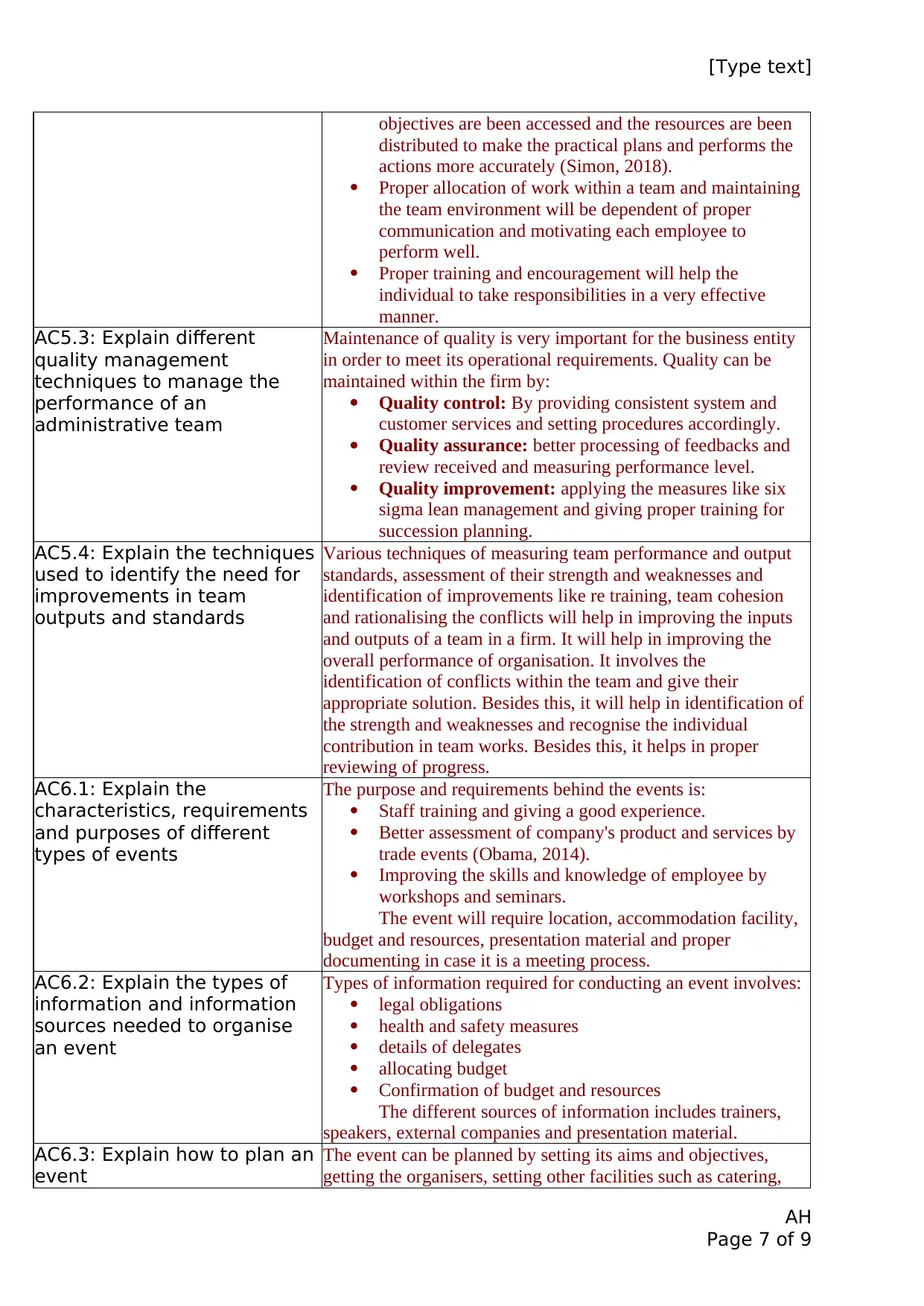
objectives are been accessed and the resources are been
distributed to make the practical plans and performs the
actions more accurately (Simon, 2018).
Proper allocation of work within a team and maintaining
the team environment will be dependent of proper
communication and motivating each employee to
perform well.
Proper training and encouragement will help the
individual to take responsibilities in a very effective
manner.
AC5.3: Explain different
quality management
techniques to manage the
performance of an
administrative team
Maintenance of quality is very important for the business entity
in order to meet its operational requirements. Quality can be
maintained within the firm by:
Quality control: By providing consistent system and
customer services and setting procedures accordingly.
Quality assurance: better processing of feedbacks and
review received and measuring performance level.
Quality improvement: applying the measures like six
sigma lean management and giving proper training for
succession planning.
AC5.4: Explain the techniques
used to identify the need for
improvements in team
outputs and standards
Various techniques of measuring team performance and output
standards, assessment of their strength and weaknesses and
identification of improvements like re training, team cohesion
and rationalising the conflicts will help in improving the inputs
and outputs of a team in a firm. It will help in improving the
overall performance of organisation. It involves the
identification of conflicts within the team and give their
appropriate solution. Besides this, it will help in identification of
the strength and weaknesses and recognise the individual
contribution in team works. Besides this, it helps in proper
reviewing of progress.
AC6.1: Explain the
characteristics, requirements
and purposes of different
types of events
The purpose and requirements behind the events is:
Staff training and giving a good experience.
Better assessment of company's product and services by
trade events (Obama, 2014).
Improving the skills and knowledge of employee by
workshops and seminars.
The event will require location, accommodation facility,
budget and resources, presentation material and proper
documenting in case it is a meeting process.
AC6.2: Explain the types of
information and information
sources needed to organise
an event
Types of information required for conducting an event involves:
legal obligations
health and safety measures
details of delegates
allocating budget
Confirmation of budget and resources
The different sources of information includes trainers,
speakers, external companies and presentation material.
AC6.3: Explain how to plan an
event
The event can be planned by setting its aims and objectives,
getting the organisers, setting other facilities such as catering,
AH
Page 7 of 9
objectives are been accessed and the resources are been
distributed to make the practical plans and performs the
actions more accurately (Simon, 2018).
Proper allocation of work within a team and maintaining
the team environment will be dependent of proper
communication and motivating each employee to
perform well.
Proper training and encouragement will help the
individual to take responsibilities in a very effective
manner.
AC5.3: Explain different
quality management
techniques to manage the
performance of an
administrative team
Maintenance of quality is very important for the business entity
in order to meet its operational requirements. Quality can be
maintained within the firm by:
Quality control: By providing consistent system and
customer services and setting procedures accordingly.
Quality assurance: better processing of feedbacks and
review received and measuring performance level.
Quality improvement: applying the measures like six
sigma lean management and giving proper training for
succession planning.
AC5.4: Explain the techniques
used to identify the need for
improvements in team
outputs and standards
Various techniques of measuring team performance and output
standards, assessment of their strength and weaknesses and
identification of improvements like re training, team cohesion
and rationalising the conflicts will help in improving the inputs
and outputs of a team in a firm. It will help in improving the
overall performance of organisation. It involves the
identification of conflicts within the team and give their
appropriate solution. Besides this, it will help in identification of
the strength and weaknesses and recognise the individual
contribution in team works. Besides this, it helps in proper
reviewing of progress.
AC6.1: Explain the
characteristics, requirements
and purposes of different
types of events
The purpose and requirements behind the events is:
Staff training and giving a good experience.
Better assessment of company's product and services by
trade events (Obama, 2014).
Improving the skills and knowledge of employee by
workshops and seminars.
The event will require location, accommodation facility,
budget and resources, presentation material and proper
documenting in case it is a meeting process.
AC6.2: Explain the types of
information and information
sources needed to organise
an event
Types of information required for conducting an event involves:
legal obligations
health and safety measures
details of delegates
allocating budget
Confirmation of budget and resources
The different sources of information includes trainers,
speakers, external companies and presentation material.
AC6.3: Explain how to plan an
event
The event can be planned by setting its aims and objectives,
getting the organisers, setting other facilities such as catering,
AH
Page 7 of 9
Paraphrase This Document
Need a fresh take? Get an instant paraphrase of this document with our AI Paraphraser
[Type text]
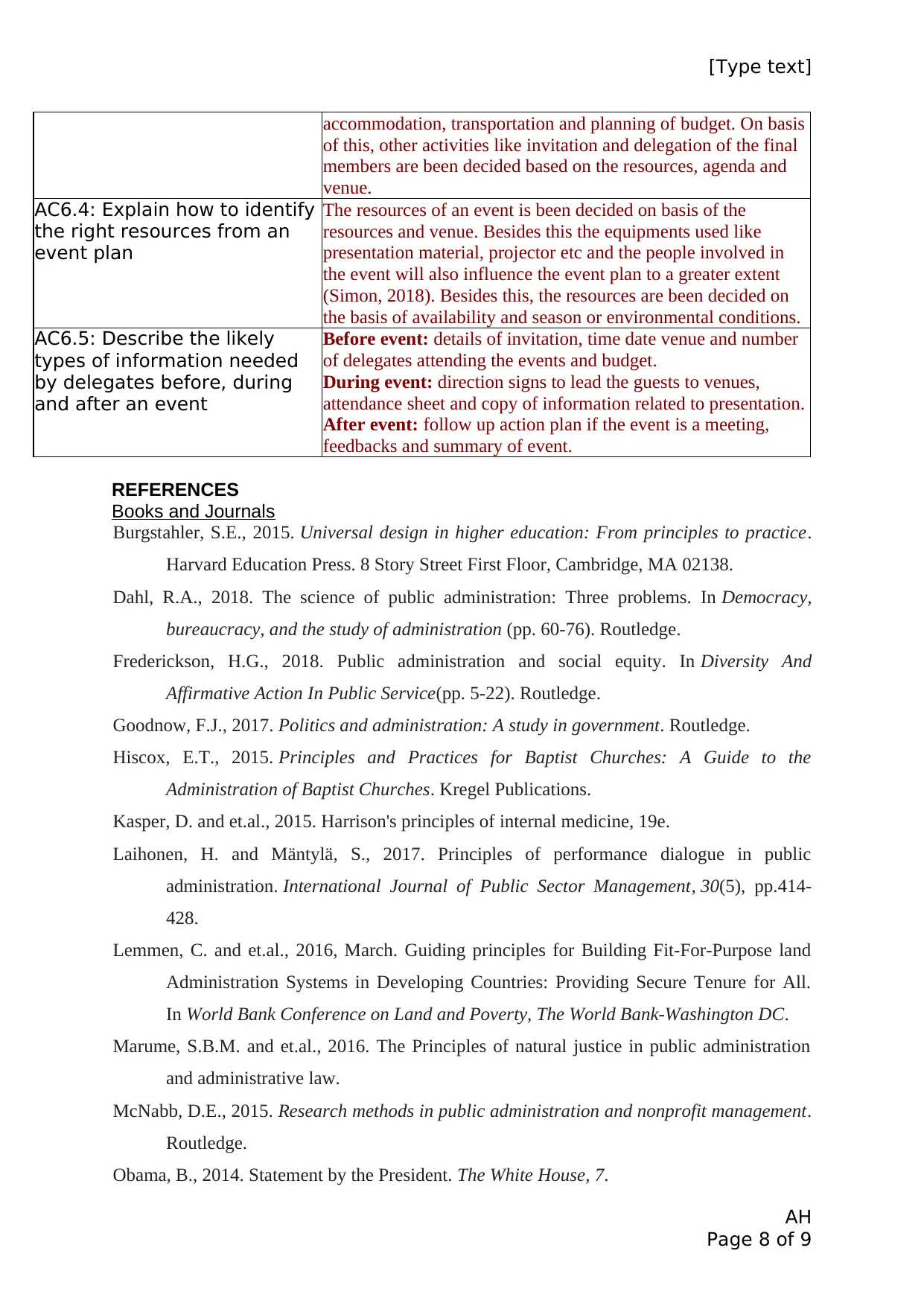
accommodation, transportation and planning of budget. On basis
of this, other activities like invitation and delegation of the final
members are been decided based on the resources, agenda and
venue.
AC6.4: Explain how to identify
the right resources from an
event plan
The resources of an event is been decided on basis of the
resources and venue. Besides this the equipments used like
presentation material, projector etc and the people involved in
the event will also influence the event plan to a greater extent
(Simon, 2018). Besides this, the resources are been decided on
the basis of availability and season or environmental conditions.
AC6.5: Describe the likely
types of information needed
by delegates before, during
and after an event
Before event: details of invitation, time date venue and number
of delegates attending the events and budget.
During event: direction signs to lead the guests to venues,
attendance sheet and copy of information related to presentation.
After event: follow up action plan if the event is a meeting,
feedbacks and summary of event.
REFERENCES
Books and Journals
Burgstahler, S.E., 2015. Universal design in higher education: From principles to practice.
Harvard Education Press. 8 Story Street First Floor, Cambridge, MA 02138.
Dahl, R.A., 2018. The science of public administration: Three problems. In Democracy,
bureaucracy, and the study of administration (pp. 60-76). Routledge.
Frederickson, H.G., 2018. Public administration and social equity. In Diversity And
Affirmative Action In Public Service(pp. 5-22). Routledge.
Goodnow, F.J., 2017. Politics and administration: A study in government. Routledge.
Hiscox, E.T., 2015. Principles and Practices for Baptist Churches: A Guide to the
Administration of Baptist Churches. Kregel Publications.
Kasper, D. and et.al., 2015. Harrison's principles of internal medicine, 19e.
Laihonen, H. and Mäntylä, S., 2017. Principles of performance dialogue in public
administration. International Journal of Public Sector Management, 30(5), pp.414-
428.
Lemmen, C. and et.al., 2016, March. Guiding principles for Building Fit-For-Purpose land
Administration Systems in Developing Countries: Providing Secure Tenure for All.
In World Bank Conference on Land and Poverty, The World Bank-Washington DC.
Marume, S.B.M. and et.al., 2016. The Principles of natural justice in public administration
and administrative law.
McNabb, D.E., 2015. Research methods in public administration and nonprofit management.
Routledge.
Obama, B., 2014. Statement by the President. The White House, 7.
AH
Page 8 of 9
accommodation, transportation and planning of budget. On basis
of this, other activities like invitation and delegation of the final
members are been decided based on the resources, agenda and
venue.
AC6.4: Explain how to identify
the right resources from an
event plan
The resources of an event is been decided on basis of the
resources and venue. Besides this the equipments used like
presentation material, projector etc and the people involved in
the event will also influence the event plan to a greater extent
(Simon, 2018). Besides this, the resources are been decided on
the basis of availability and season or environmental conditions.
AC6.5: Describe the likely
types of information needed
by delegates before, during
and after an event
Before event: details of invitation, time date venue and number
of delegates attending the events and budget.
During event: direction signs to lead the guests to venues,
attendance sheet and copy of information related to presentation.
After event: follow up action plan if the event is a meeting,
feedbacks and summary of event.
REFERENCES
Books and Journals
Burgstahler, S.E., 2015. Universal design in higher education: From principles to practice.
Harvard Education Press. 8 Story Street First Floor, Cambridge, MA 02138.
Dahl, R.A., 2018. The science of public administration: Three problems. In Democracy,
bureaucracy, and the study of administration (pp. 60-76). Routledge.
Frederickson, H.G., 2018. Public administration and social equity. In Diversity And
Affirmative Action In Public Service(pp. 5-22). Routledge.
Goodnow, F.J., 2017. Politics and administration: A study in government. Routledge.
Hiscox, E.T., 2015. Principles and Practices for Baptist Churches: A Guide to the
Administration of Baptist Churches. Kregel Publications.
Kasper, D. and et.al., 2015. Harrison's principles of internal medicine, 19e.
Laihonen, H. and Mäntylä, S., 2017. Principles of performance dialogue in public
administration. International Journal of Public Sector Management, 30(5), pp.414-
428.
Lemmen, C. and et.al., 2016, March. Guiding principles for Building Fit-For-Purpose land
Administration Systems in Developing Countries: Providing Secure Tenure for All.
In World Bank Conference on Land and Poverty, The World Bank-Washington DC.
Marume, S.B.M. and et.al., 2016. The Principles of natural justice in public administration
and administrative law.
McNabb, D.E., 2015. Research methods in public administration and nonprofit management.
Routledge.
Obama, B., 2014. Statement by the President. The White House, 7.
AH
Page 8 of 9
[Type text]
Simon, H.A., 2018. Some Accepted Administrative Principles. Democracy, Bureaucracy,
And The Study Of Administration.
Simon, H.A., 2018. The proverbs of administration. In Democracy, bureaucracy, and the
study of administration (pp. 38-59). Routledge.
Waldo, D., 2017. The administrative state: A study of the political theory of American public
administration. Routledge.
Weill, S. and Robinson, M., 2017. The Decaux Principles on the Administration of Justice by
Military Tribunals and the Guantanamo Bay Trials.
AH
Page 9 of 9
Simon, H.A., 2018. Some Accepted Administrative Principles. Democracy, Bureaucracy,
And The Study Of Administration.
Simon, H.A., 2018. The proverbs of administration. In Democracy, bureaucracy, and the
study of administration (pp. 38-59). Routledge.
Waldo, D., 2017. The administrative state: A study of the political theory of American public
administration. Routledge.
Weill, S. and Robinson, M., 2017. The Decaux Principles on the Administration of Justice by
Military Tribunals and the Guantanamo Bay Trials.
AH
Page 9 of 9
⊘ This is a preview!⊘
Do you want full access?
Subscribe today to unlock all pages.
Trusted by 1+ million students worldwide

1 out of 9


Related Documents


Your All-in-One AI-Powered Toolkit for Academic Success.
+13062052269
info@desklib.com
Available 24*7 on WhatsApp / Email
![[object Object]](/_next/static/media/star-bottom.7253800d.svg)
Unlock your academic potential
Copyright © 2020–2025 A2Z Services. All Rights Reserved. Developed and managed by ZUCOL.