Project Management Report: Office Relocation Strategies and Aspects
VerifiedAdded on 2022/09/08
|24
|6710
|11
Report
AI Summary
This report provides a detailed analysis of project management aspects related to an office relocation project. It begins by introducing the project's objectives, highlighting the importance of relocation for business expansion and employee satisfaction. The report then delves into crucial areas such as defining project requirements, scoping activities, and strategies for scope adjustment. It emphasizes the significance of stakeholder management, both internal and external, and outlines approaches for effective communication and engagement. Furthermore, the report discusses risk and quality management strategies to ensure project success. The document covers topics such as defining project scope, setting priorities, establishing communication, and managing potential changes within the project. The report recommends the implementation of structured approaches for documentation, evaluation, and approval of the project scope. Overall, the report provides valuable insights and recommendations for the successful execution of office relocation projects.
Running head: PROJECT MANAGEMENT ASPECTS BASED ON OFFICE RELOCATION
Project Management Aspects based on Office Relocation
Name of the Student
Name of the University
Author note
Project Management Aspects based on Office Relocation
Name of the Student
Name of the University
Author note

Paraphrase This Document
Need a fresh take? Get an instant paraphrase of this document with our AI Paraphraser
1PROJECT MANAGEMENT ASPECTS BASED ON OFFICE RELOCATION
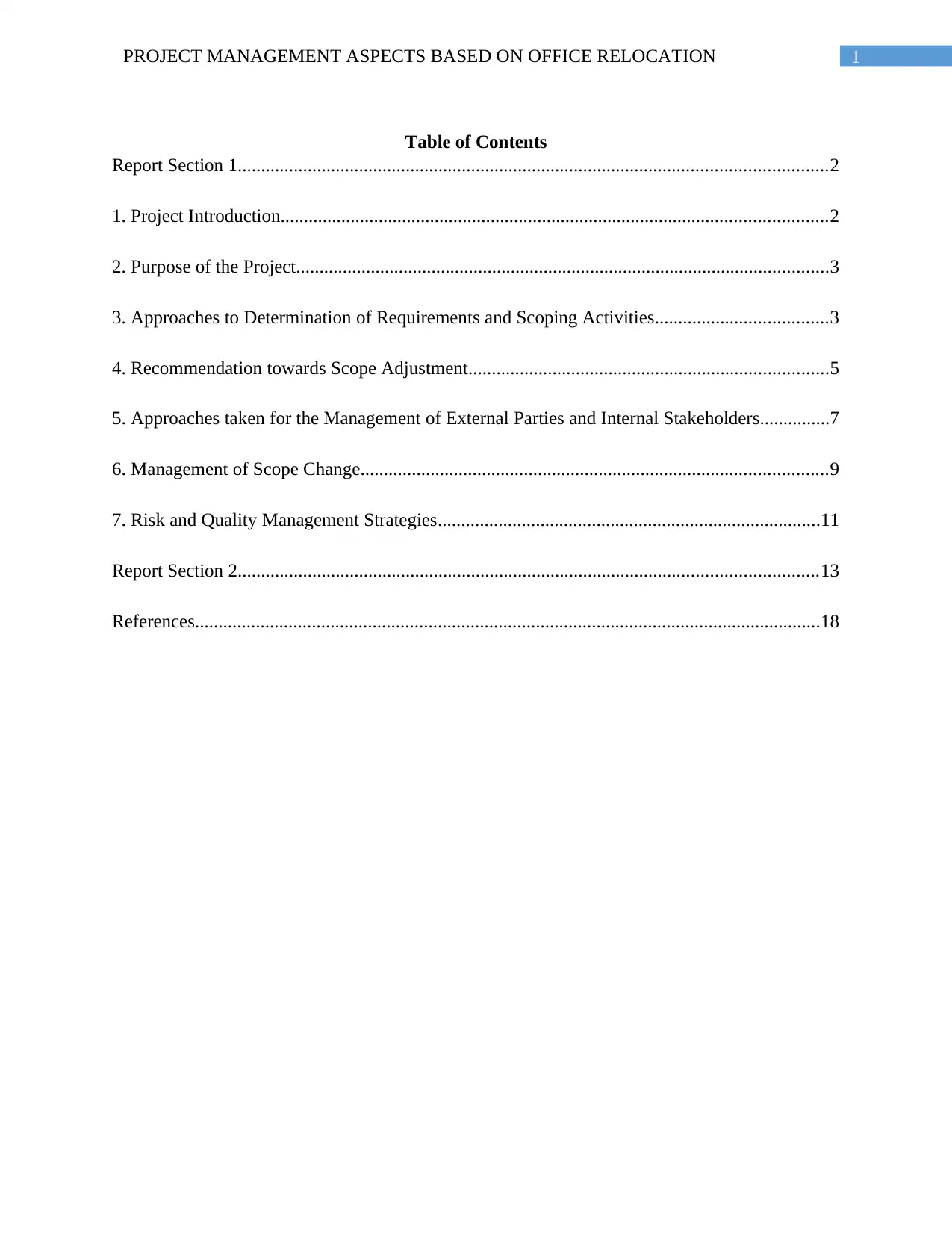
Table of Contents
Report Section 1..............................................................................................................................2
1. Project Introduction.....................................................................................................................2
2. Purpose of the Project..................................................................................................................3
3. Approaches to Determination of Requirements and Scoping Activities.....................................3
4. Recommendation towards Scope Adjustment.............................................................................5
5. Approaches taken for the Management of External Parties and Internal Stakeholders...............7
6. Management of Scope Change....................................................................................................9
7. Risk and Quality Management Strategies..................................................................................11
Report Section 2............................................................................................................................13
References......................................................................................................................................18
Table of Contents
Report Section 1..............................................................................................................................2
1. Project Introduction.....................................................................................................................2
2. Purpose of the Project..................................................................................................................3
3. Approaches to Determination of Requirements and Scoping Activities.....................................3
4. Recommendation towards Scope Adjustment.............................................................................5
5. Approaches taken for the Management of External Parties and Internal Stakeholders...............7
6. Management of Scope Change....................................................................................................9
7. Risk and Quality Management Strategies..................................................................................11
Report Section 2............................................................................................................................13
References......................................................................................................................................18
2PROJECT MANAGEMENT ASPECTS BASED ON OFFICE RELOCATION
Report Section 1
1. Project Introduction
The project discusses on the best form of choices and project management strategies for
the successful accomplishment of the office relation project. This project is considered as
essential for the office as it would help in solving the most important aspects of the employees
and further bring improvement towards the condition of the project. The relocation of the project
is considered as important for expansion of the office (Whitaker 2016). The office has hired an
additional number of employees and staff members within the last years in order to bring in
improvements within the business. Hence, in order to bring in changes within the business
processes, there would be a need to present a brief idea for the project according to which it
would be designed. The project would also need to include the responsibilities of the
stakeholders, which would include both external and internal.
The project focusing on the relocation plan of an office is considered to be highly
important for the perspective of the business. In the defined project scenario, the relocation of the
office would include the facilitation of different aspects that would include the installation of
new furniture, implementation of the best kind of technology, relocate the people to the new
office and ensure minimal form of disruption. Facilitating the best infrastructure within the office
would help in increasing the satisfaction factor for people to work in different sectors
(Haapakangas et al. 2018). A better work space would ensure that the employees and staff
working together would be able to produce the best kind of outputs and higher future returns.
Hence, the other sections of the report would focus over different aspects of the project such as
defining of necessary requirements, management of stakeholders and the various approaches.
Report Section 1
1. Project Introduction
The project discusses on the best form of choices and project management strategies for
the successful accomplishment of the office relation project. This project is considered as
essential for the office as it would help in solving the most important aspects of the employees
and further bring improvement towards the condition of the project. The relocation of the project
is considered as important for expansion of the office (Whitaker 2016). The office has hired an
additional number of employees and staff members within the last years in order to bring in
improvements within the business. Hence, in order to bring in changes within the business
processes, there would be a need to present a brief idea for the project according to which it
would be designed. The project would also need to include the responsibilities of the
stakeholders, which would include both external and internal.
The project focusing on the relocation plan of an office is considered to be highly
important for the perspective of the business. In the defined project scenario, the relocation of the
office would include the facilitation of different aspects that would include the installation of
new furniture, implementation of the best kind of technology, relocate the people to the new
office and ensure minimal form of disruption. Facilitating the best infrastructure within the office
would help in increasing the satisfaction factor for people to work in different sectors
(Haapakangas et al. 2018). A better work space would ensure that the employees and staff
working together would be able to produce the best kind of outputs and higher future returns.
Hence, the other sections of the report would focus over different aspects of the project such as
defining of necessary requirements, management of stakeholders and the various approaches.
⊘ This is a preview!⊘
Do you want full access?
Subscribe today to unlock all pages.

Trusted by 1+ million students worldwide
3PROJECT MANAGEMENT ASPECTS BASED ON OFFICE RELOCATION
While designing the project, there might be many forms of changes within the scope.
Hence, these would also be need to be managed in order to bring in better form of benefits.
However, the quality of the project would also be need to be taken into major consideration
(Gerdenitsch, Korunka and Hertel 2018). Based on meeting with the quality aspects of the
project, it can be discussed that the project should be considered as highly necessary for meeting
up to the expectations of the client and that it would help in raising the standards of the
organization. The office relocation project can be discussed as of utmost importance as it would
lead to many kind of benefits for the project management team working over the project and
might create an impact over the organization.
2. Purpose of the Project
The project is based on the discussion and preparation of a project plan for the office
relocation project. Office relocation project would incur a wide range of tasks and requirements
that would help in proper project delivery within the estimated time (Too, Le and Yap 2017).
This project would also consider the use of the best kind of project management approaches,
which would further help in increasing the possibilities of project success rate.
3. Approaches to Determination of Requirements and Scoping Activities
The planning approaches towards the management of scoping activities would generally
be considered with the work definition that would be needed in order to meet with the business
or organizational objectives. Before the initiation work over the project, the project manager and
each of the involved stakeholders within the project outcomes should develop a clear vision
regarding the occurring within the project. With the progress of the project works based on the
relocation of the office, it can be discussed that there should be a proper planning over the
While designing the project, there might be many forms of changes within the scope.
Hence, these would also be need to be managed in order to bring in better form of benefits.
However, the quality of the project would also be need to be taken into major consideration
(Gerdenitsch, Korunka and Hertel 2018). Based on meeting with the quality aspects of the
project, it can be discussed that the project should be considered as highly necessary for meeting
up to the expectations of the client and that it would help in raising the standards of the
organization. The office relocation project can be discussed as of utmost importance as it would
lead to many kind of benefits for the project management team working over the project and
might create an impact over the organization.
2. Purpose of the Project
The project is based on the discussion and preparation of a project plan for the office
relocation project. Office relocation project would incur a wide range of tasks and requirements
that would help in proper project delivery within the estimated time (Too, Le and Yap 2017).
This project would also consider the use of the best kind of project management approaches,
which would further help in increasing the possibilities of project success rate.
3. Approaches to Determination of Requirements and Scoping Activities
The planning approaches towards the management of scoping activities would generally
be considered with the work definition that would be needed in order to meet with the business
or organizational objectives. Before the initiation work over the project, the project manager and
each of the involved stakeholders within the project outcomes should develop a clear vision
regarding the occurring within the project. With the progress of the project works based on the
relocation of the office, it can be discussed that there should be a proper planning over the
Paraphrase This Document
Need a fresh take? Get an instant paraphrase of this document with our AI Paraphraser
4PROJECT MANAGEMENT ASPECTS BASED ON OFFICE RELOCATION
project processes would be necessary to be updated and written under the plan of scope
management.
The project scope is considered as the documentation of the goals specified for the
project, defining the deliverables and setting up of activities, defining deadlines and relatable
costs (Sunder 2016). In order to determine the requirements for the project and define the
activities of scoping, certain recommendations that could be followed for adjusting the scope of
the project are:
1. Defining an accurate set of documentation and requirements – During the defining
of the project and setting up of a clear plan, each of the stakeholders should be sought clearly and
thus a proper form of signing off from both parties should be confirmed. Once the initial plan
should be shared, the scope document should be set. This could be defined as a project charter
that would be distributed with the project team (Rolfö 2018). The understanding over the scope
document would help each stakeholders to gain a proper form of vision over the project. They
would also understand the objectives and set deliverables for the project.
2. Setting Prioritization – Once it would be detected that there would be a
comprehensive requirement list, the idea should be brainstormed and then a proper discussion
should be sorted with customer based on prioritizing the project requirements. In the case of the
concerned project based on relocation of the office, it can be discussed that although there might
be different activities, the project manager should sort for the most prioritized activity to be in
proper order. In most of the situations of the project, the business officials would have a
tendency to require everything from the project (Shirazi, Kazemipoor and Tavakkoli-
Moghaddam 2017). Hence, it could be the defined as the responsibility of project manager for
figuring out the most important requirements that would be considered as mostly benefiting for
project processes would be necessary to be updated and written under the plan of scope
management.
The project scope is considered as the documentation of the goals specified for the
project, defining the deliverables and setting up of activities, defining deadlines and relatable
costs (Sunder 2016). In order to determine the requirements for the project and define the
activities of scoping, certain recommendations that could be followed for adjusting the scope of
the project are:
1. Defining an accurate set of documentation and requirements – During the defining
of the project and setting up of a clear plan, each of the stakeholders should be sought clearly and
thus a proper form of signing off from both parties should be confirmed. Once the initial plan
should be shared, the scope document should be set. This could be defined as a project charter
that would be distributed with the project team (Rolfö 2018). The understanding over the scope
document would help each stakeholders to gain a proper form of vision over the project. They
would also understand the objectives and set deliverables for the project.
2. Setting Prioritization – Once it would be detected that there would be a
comprehensive requirement list, the idea should be brainstormed and then a proper discussion
should be sorted with customer based on prioritizing the project requirements. In the case of the
concerned project based on relocation of the office, it can be discussed that although there might
be different activities, the project manager should sort for the most prioritized activity to be in
proper order. In most of the situations of the project, the business officials would have a
tendency to require everything from the project (Shirazi, Kazemipoor and Tavakkoli-
Moghaddam 2017). Hence, it could be the defined as the responsibility of project manager for
figuring out the most important requirements that would be considered as mostly benefiting for
5PROJECT MANAGEMENT ASPECTS BASED ON OFFICE RELOCATION
the project. This activity should be taken under prioritization and work should be done
accordingly.
3. Defining Milestones – During the designing of the project and the included project
activities, it would be recommended that small kind of milestones should be set and thus the
team should be made aware of the changes. The employees working over the project should be
rewarded in order to encourage them. Hence, minor form of targets should be set because it
would be considered to be managed. During the process of working with a team, it would always
be considered to be advisable to estimate a usual time for the project (Loikkanen 2015). Based
on setting of milestones and setting of minor targets, it would be considered that the project
schedule would be considered as to be realistic and under-delivered.
4. Establishing best Communication approaches – The aspect of communication can
be described as one of the best kind of approaches towards the aspect of project management. In
the case of any project, there should be a proper level of communication between the project
managerial levels and the customers (Sanghera 2019). Hence, the establishing of proper level of
communication would be considered as helpful for stakeholders and would ensure the success
rate of projects.
4. Recommendation towards Scope Adjustment
The project scope is determined as a part of the processes based on planning for the
project. The defining of project scope can be determined as a process of planning and making a
documentation over the specific goals that would be set for the project. The documentation of the
project is defined under the scope of the project. In case of any construction project or the case of
relocation of an office, there would be a major need to describe each of the process and define
the project. This activity should be taken under prioritization and work should be done
accordingly.
3. Defining Milestones – During the designing of the project and the included project
activities, it would be recommended that small kind of milestones should be set and thus the
team should be made aware of the changes. The employees working over the project should be
rewarded in order to encourage them. Hence, minor form of targets should be set because it
would be considered to be managed. During the process of working with a team, it would always
be considered to be advisable to estimate a usual time for the project (Loikkanen 2015). Based
on setting of milestones and setting of minor targets, it would be considered that the project
schedule would be considered as to be realistic and under-delivered.
4. Establishing best Communication approaches – The aspect of communication can
be described as one of the best kind of approaches towards the aspect of project management. In
the case of any project, there should be a proper level of communication between the project
managerial levels and the customers (Sanghera 2019). Hence, the establishing of proper level of
communication would be considered as helpful for stakeholders and would ensure the success
rate of projects.
4. Recommendation towards Scope Adjustment
The project scope is determined as a part of the processes based on planning for the
project. The defining of project scope can be determined as a process of planning and making a
documentation over the specific goals that would be set for the project. The documentation of the
project is defined under the scope of the project. In case of any construction project or the case of
relocation of an office, there would be a major need to describe each of the process and define
⊘ This is a preview!⊘
Do you want full access?
Subscribe today to unlock all pages.
Trusted by 1+ million students worldwide
6PROJECT MANAGEMENT ASPECTS BASED ON OFFICE RELOCATION
them accordingly. In case of such projects, it can be discussed as a natural process that things
would change and would not be performed as planned. Hence, it is recommended that the project
should have a proper scope statement at the initial phase. This would also help in manage the
changes that would be affecting the project at later stages.
During the process of documentation over the scope of the project, the project should
have a properly defined scope statement. The stakeholders involved within the aspect of the
relocation project for the office should be able to define and focus over a proper form of scope
for the project (Raza 2019). This would also help in avoiding the scope creep happening within
the project. An effective form of scope management strategy would require a good level of
communication skills in order to ensure that everyone present within the team would be having a
clear idea about the project scope. They would also need to agree about the ways in which the
goals of the project would be met. As a part of the managing of scope for the project, the team
leader would need to seek major approvals from the high managerial level of people.
In order to adjust according to the scope of the project and the changing phases of a
project, the involved project managers should have the capability to anticipate any need for
changes and updates that would happen over the project. The project scope would have the major
capability to organize every aspect of the project and control them accordingly. Any project
would have a major need for changes within the project scope (Mok, Shen and Yang 2015). In
spite of taking precautionary actions, there would be massive changes that might happen over the
project scope. The scope creep would majorly happen when a lot of work would be stacked on
upon the other. The project manager who would be working over the project should implement a
process based on the defining of scope. An immediate need that would be required for the
them accordingly. In case of such projects, it can be discussed as a natural process that things
would change and would not be performed as planned. Hence, it is recommended that the project
should have a proper scope statement at the initial phase. This would also help in manage the
changes that would be affecting the project at later stages.
During the process of documentation over the scope of the project, the project should
have a properly defined scope statement. The stakeholders involved within the aspect of the
relocation project for the office should be able to define and focus over a proper form of scope
for the project (Raza 2019). This would also help in avoiding the scope creep happening within
the project. An effective form of scope management strategy would require a good level of
communication skills in order to ensure that everyone present within the team would be having a
clear idea about the project scope. They would also need to agree about the ways in which the
goals of the project would be met. As a part of the managing of scope for the project, the team
leader would need to seek major approvals from the high managerial level of people.
In order to adjust according to the scope of the project and the changing phases of a
project, the involved project managers should have the capability to anticipate any need for
changes and updates that would happen over the project. The project scope would have the major
capability to organize every aspect of the project and control them accordingly. Any project
would have a major need for changes within the project scope (Mok, Shen and Yang 2015). In
spite of taking precautionary actions, there would be massive changes that might happen over the
project scope. The scope creep would majorly happen when a lot of work would be stacked on
upon the other. The project manager who would be working over the project should implement a
process based on the defining of scope. An immediate need that would be required for the
Paraphrase This Document
Need a fresh take? Get an instant paraphrase of this document with our AI Paraphraser
7PROJECT MANAGEMENT ASPECTS BASED ON OFFICE RELOCATION
capturing of processes within the objectives of the business is to define a structured approach
based on documentation, evaluation and giving a final approval over the project scope.
Change request if placed to the project manager should be looked into and then a proper
approach should be set based on limiting the requests based on the features and deliverables of
work. After a brief analysis over the scope of the work, the project manager should curb the
requirements of the project accordingly by stating the benefits and expected outputs. The scope
change would be able to control and protect the project manager from the happening of scope
creep and thus would majorly contribute towards the expectations of stakeholders (McDavid,
Huse and Hawthorn 2018). Hence, from the above discussion, it could further be recommended
that the project manager should have a proper control over the project details and scoping
statements, which would further be required to complete all aspects of the project.
5. Approaches taken for the Management of External Parties and Internal Stakeholders
The management of stakeholders within an organization can be described as one of the
most important ways in which different aspects of the project could be performed in an
organized manner. The concept of stakeholder management could be embedded firmly based on
the field of stakeholder management (Landy, Zedeck and Cleveland 2017). In this context,
‘stakeholder analysis’ could be defined as a technique in which organizations or individuals
would be able to include them within the project or programme.
Some of the approaches that could be taken for the management of both external parties
and partners along with the mention of key stakeholders are:
1. Identification and mapping of Internal and External Stakeholders – Stakeholder
mapping can be described as one of the most important process of stakeholder engagement. With
capturing of processes within the objectives of the business is to define a structured approach
based on documentation, evaluation and giving a final approval over the project scope.
Change request if placed to the project manager should be looked into and then a proper
approach should be set based on limiting the requests based on the features and deliverables of
work. After a brief analysis over the scope of the work, the project manager should curb the
requirements of the project accordingly by stating the benefits and expected outputs. The scope
change would be able to control and protect the project manager from the happening of scope
creep and thus would majorly contribute towards the expectations of stakeholders (McDavid,
Huse and Hawthorn 2018). Hence, from the above discussion, it could further be recommended
that the project manager should have a proper control over the project details and scoping
statements, which would further be required to complete all aspects of the project.
5. Approaches taken for the Management of External Parties and Internal Stakeholders
The management of stakeholders within an organization can be described as one of the
most important ways in which different aspects of the project could be performed in an
organized manner. The concept of stakeholder management could be embedded firmly based on
the field of stakeholder management (Landy, Zedeck and Cleveland 2017). In this context,
‘stakeholder analysis’ could be defined as a technique in which organizations or individuals
would be able to include them within the project or programme.
Some of the approaches that could be taken for the management of both external parties
and partners along with the mention of key stakeholders are:
1. Identification and mapping of Internal and External Stakeholders – Stakeholder
mapping can be described as one of the most important process of stakeholder engagement. With
8PROJECT MANAGEMENT ASPECTS BASED ON OFFICE RELOCATION
the use of the technique of stakeholder mapping, it would be easy to identify the target groups
and gather information that would be necessary to progress over the project (Invernizzi, Locatelli
and Brookes 2018). In case of the office relocation project, the project manager should be
extremely careful in identifying the proper stakeholders. This would help them in detailing out
the project aspects and discuss on the primary matters that could be included within the project.
2. Assessment over the influence and importance of each stakeholder – The project
manager would have a major responsibility for the determination of the various aspects of the
project and thus should carefully understand the nature of the stakeholders involved within the
project. Each of the nature of stakeholders would need to be understood properly based on
determining the kind of actions that need to be taken by them in order to accomplish the different
tasks of the project accordingly. The stakeholders who are involved within a project should form
a major impact over the designing aspects of the relocation project (Hornstein 2015). In cases of
such projects, the stakeholder should be informed about the different aspects that needs to be
included within the current project plan.
3. Construction of Matrix for identification of Stakeholder Importance and
Influence – The importance or influence matrix could be defined as one of the basic tool used
for analysis of stakeholders. The use of the matrix could be further be related to a particular form
of strategic development. The stakeholders involved within the project should be plotted based
on a relation of their lining up – their nature and level based on their importance and the
influence acting upon them (Hilali, Charoenngam and Barman 2019). A second map could also
be plotted that would display the ways in which the stakeholders could be lined up during the
process of development of the project work based on estimation of project success.
the use of the technique of stakeholder mapping, it would be easy to identify the target groups
and gather information that would be necessary to progress over the project (Invernizzi, Locatelli
and Brookes 2018). In case of the office relocation project, the project manager should be
extremely careful in identifying the proper stakeholders. This would help them in detailing out
the project aspects and discuss on the primary matters that could be included within the project.
2. Assessment over the influence and importance of each stakeholder – The project
manager would have a major responsibility for the determination of the various aspects of the
project and thus should carefully understand the nature of the stakeholders involved within the
project. Each of the nature of stakeholders would need to be understood properly based on
determining the kind of actions that need to be taken by them in order to accomplish the different
tasks of the project accordingly. The stakeholders who are involved within a project should form
a major impact over the designing aspects of the relocation project (Hornstein 2015). In cases of
such projects, the stakeholder should be informed about the different aspects that needs to be
included within the current project plan.
3. Construction of Matrix for identification of Stakeholder Importance and
Influence – The importance or influence matrix could be defined as one of the basic tool used
for analysis of stakeholders. The use of the matrix could be further be related to a particular form
of strategic development. The stakeholders involved within the project should be plotted based
on a relation of their lining up – their nature and level based on their importance and the
influence acting upon them (Hilali, Charoenngam and Barman 2019). A second map could also
be plotted that would display the ways in which the stakeholders could be lined up during the
process of development of the project work based on estimation of project success.
⊘ This is a preview!⊘
Do you want full access?
Subscribe today to unlock all pages.
Trusted by 1+ million students worldwide
9PROJECT MANAGEMENT ASPECTS BASED ON OFFICE RELOCATION
4. Monitoring and management of Stakeholder Relationships – The stakeholder
management is essentially defined as stakeholder relationship management as it can be defined
as the kind of relationship and not the management of actual stakeholder groups. After the
identification of stakeholders, they would be assigned to particular job roles and then their work
would be monitored accordingly. Different stakeholders working over different parts of work
over the relocation project would need to be monitored for the purpose of ensuring that each of
the work over the project would be accomplished in a structured manner (Gilani and O’Brien
2017). In case, there are any problems in the planning over the project related aspects, the project
manager would form a meeting and discuss the most critical aspects in relation to the project.
6. Management of Scope Change
Managing of scope changes within the project could be defined as crucial for the delivery
of projects within a proper scheduled period. The proper form of management of changes within
the scope would be helpful for meeting with the project objectives set by the sponsors and
important stakeholders participating within the project. The responsibilities assigned to the
project manager working for the office relocation project should be able to manage the scope of
the project from the point of inception till the implementation (Bourne 2016). The process of
scope change management would mean that after the implementation of the initial project scope,
which would be authorised and executed within the project charter phase, it would be managed
and controlled and documented based on determining any kind of changes.
The extension of project timelines and increase in the factor of project costs are the
primary consequences of the modification over the project scope. Hence, it would be highly be
essential to comply with the formal process of change management. The change management
process within the project scope can be defined as a certain sequence of activities or steps that
4. Monitoring and management of Stakeholder Relationships – The stakeholder
management is essentially defined as stakeholder relationship management as it can be defined
as the kind of relationship and not the management of actual stakeholder groups. After the
identification of stakeholders, they would be assigned to particular job roles and then their work
would be monitored accordingly. Different stakeholders working over different parts of work
over the relocation project would need to be monitored for the purpose of ensuring that each of
the work over the project would be accomplished in a structured manner (Gilani and O’Brien
2017). In case, there are any problems in the planning over the project related aspects, the project
manager would form a meeting and discuss the most critical aspects in relation to the project.
6. Management of Scope Change
Managing of scope changes within the project could be defined as crucial for the delivery
of projects within a proper scheduled period. The proper form of management of changes within
the scope would be helpful for meeting with the project objectives set by the sponsors and
important stakeholders participating within the project. The responsibilities assigned to the
project manager working for the office relocation project should be able to manage the scope of
the project from the point of inception till the implementation (Bourne 2016). The process of
scope change management would mean that after the implementation of the initial project scope,
which would be authorised and executed within the project charter phase, it would be managed
and controlled and documented based on determining any kind of changes.
The extension of project timelines and increase in the factor of project costs are the
primary consequences of the modification over the project scope. Hence, it would be highly be
essential to comply with the formal process of change management. The change management
process within the project scope can be defined as a certain sequence of activities or steps that
Paraphrase This Document
Need a fresh take? Get an instant paraphrase of this document with our AI Paraphraser
10PROJECT MANAGEMENT ASPECTS BASED ON OFFICE RELOCATION
should be followed with the project leader or change management team. The scope of a project is
defined at a higher project level based on the description of deliverables and boundaries present
within the project. More form of detailed information could be provided to the project definition
based on the gathering over the requirements set by the business manager who has tasked with
the office relocation project (Rothe et al. 2015). After a formal approval with the project sponsor,
the overall changes within the project scope could be implemented with a process of scope
change.
The management for the scope change could be implemented based on a certain process,
which could be further be implemented within the project. The steps are:
1. Placing of potential and solicit requests for scope changes that could be made to any
project stakeholder. The requests could be placed to sponsors, project team members and clients
who would be involved with the project.
2. The change request over the project scope could be placed in the form an e-mail. The
process of documentation could also be followed in the process of a Scope Change Request
Form.
3. The Scope Change Log request could be made based on the purposes of tracking.
4. The person who would be responsible for making a request over the scope changes
should be able to define the value for the business based on the relocation project. The project
sponsor would need this kind of information based on making a final project decision.
5. The scope change request would be placed to the to the team members who would
perform the work over the project. This would be provided based on a further level of
should be followed with the project leader or change management team. The scope of a project is
defined at a higher project level based on the description of deliverables and boundaries present
within the project. More form of detailed information could be provided to the project definition
based on the gathering over the requirements set by the business manager who has tasked with
the office relocation project (Rothe et al. 2015). After a formal approval with the project sponsor,
the overall changes within the project scope could be implemented with a process of scope
change.
The management for the scope change could be implemented based on a certain process,
which could be further be implemented within the project. The steps are:
1. Placing of potential and solicit requests for scope changes that could be made to any
project stakeholder. The requests could be placed to sponsors, project team members and clients
who would be involved with the project.
2. The change request over the project scope could be placed in the form an e-mail. The
process of documentation could also be followed in the process of a Scope Change Request
Form.
3. The Scope Change Log request could be made based on the purposes of tracking.
4. The person who would be responsible for making a request over the scope changes
should be able to define the value for the business based on the relocation project. The project
sponsor would need this kind of information based on making a final project decision.
5. The scope change request would be placed to the to the team members who would
perform the work over the project. This would be provided based on a further level of
11PROJECT MANAGEMENT ASPECTS BASED ON OFFICE RELOCATION
investigation (Butt, Naaranoja and Savolainen 2016). The team member would be able to
determine the total amount of time that would be taken for the investigation of the project scope.
6. The request for scope changes should be taken with full interest. On the other hand,
alternatives should also be sought based on focusing over the business value and the kind of
impact that would be made over the project. This would be further made based on making a
certain kind of resolution.
7. There should be a proper form of documentation that should be made based on the
resolution or the action course.
8. A documentation should also be made based on providing a brief over the Scope
Change log.
7. Risk and Quality Management Strategies
The risk management strategies, which are applied to the office relocation project are:
1. Avoid – The process of avoidance would be able to eliminate the different risks that
could approach towards the project based on the removal of a cause. Based on using the strategy
of ‘avoid’ the assigned project manager to the project might be able to change or isolate the kind
of objective that has been set for the project.
2. Transfer – By using this approach of risk transfer, the risk that would be approaching
towards the relocation project could be shifted to any kind of third party. This third party vendor
would be paid based on accepting or handling the risks and hence they would be able to accept
the ownership (Nelson and Ehrenfeucht 2016). The impact of the risks would be borne by any
third party. The contracts would thus be signed based on the transferring of the risks to any kind
of third party.
investigation (Butt, Naaranoja and Savolainen 2016). The team member would be able to
determine the total amount of time that would be taken for the investigation of the project scope.
6. The request for scope changes should be taken with full interest. On the other hand,
alternatives should also be sought based on focusing over the business value and the kind of
impact that would be made over the project. This would be further made based on making a
certain kind of resolution.
7. There should be a proper form of documentation that should be made based on the
resolution or the action course.
8. A documentation should also be made based on providing a brief over the Scope
Change log.
7. Risk and Quality Management Strategies
The risk management strategies, which are applied to the office relocation project are:
1. Avoid – The process of avoidance would be able to eliminate the different risks that
could approach towards the project based on the removal of a cause. Based on using the strategy
of ‘avoid’ the assigned project manager to the project might be able to change or isolate the kind
of objective that has been set for the project.
2. Transfer – By using this approach of risk transfer, the risk that would be approaching
towards the relocation project could be shifted to any kind of third party. This third party vendor
would be paid based on accepting or handling the risks and hence they would be able to accept
the ownership (Nelson and Ehrenfeucht 2016). The impact of the risks would be borne by any
third party. The contracts would thus be signed based on the transferring of the risks to any kind
of third party.
⊘ This is a preview!⊘
Do you want full access?
Subscribe today to unlock all pages.
Trusted by 1+ million students worldwide

1 out of 24


Related Documents


Your All-in-One AI-Powered Toolkit for Academic Success.
+13062052269
info@desklib.com
Available 24*7 on WhatsApp / Email
![[object Object]](/_next/static/media/star-bottom.7253800d.svg)
Unlock your academic potential
Copyright © 2020–2025 A2Z Services. All Rights Reserved. Developed and managed by ZUCOL.