Singapore-Based E2's Offshore Subsidiary in India: Research Report
VerifiedAdded on 2022/10/08
|11
|2056
|18
Report
AI Summary
This report provides a detailed analysis of E2's strategy for establishing an offshore subsidiary in India, focusing on key aspects of international business expansion. The report begins with an introduction to E2, a Singapore-based company, and the rationale for establishing a subsidiary in India. It then delves into the cultural differences between Singapore and India, highlighting the implications of Hofstede's cultural dimensions on organizational design and structure. The report examines staffing strategies, recommending a mix of parent company nationals (PCN) and host country nationals (HCN), along with the use of specific selection tools. It also outlines comprehensive training and development programs for expatriates, including documentary, cultural simulation, and field simulation training. Finally, the report analyzes different remuneration package approaches, recommending the host-based or balance sheet approach for compensating expatriates. The conclusion emphasizes the importance of a well-defined plan and training program to ensure the subsidiary's success.
Research for overseas assignees
1
1
1
1

Paraphrase This Document
Need a fresh take? Get an instant paraphrase of this document with our AI Paraphraser
Introduction of Organization, Home country and Host country
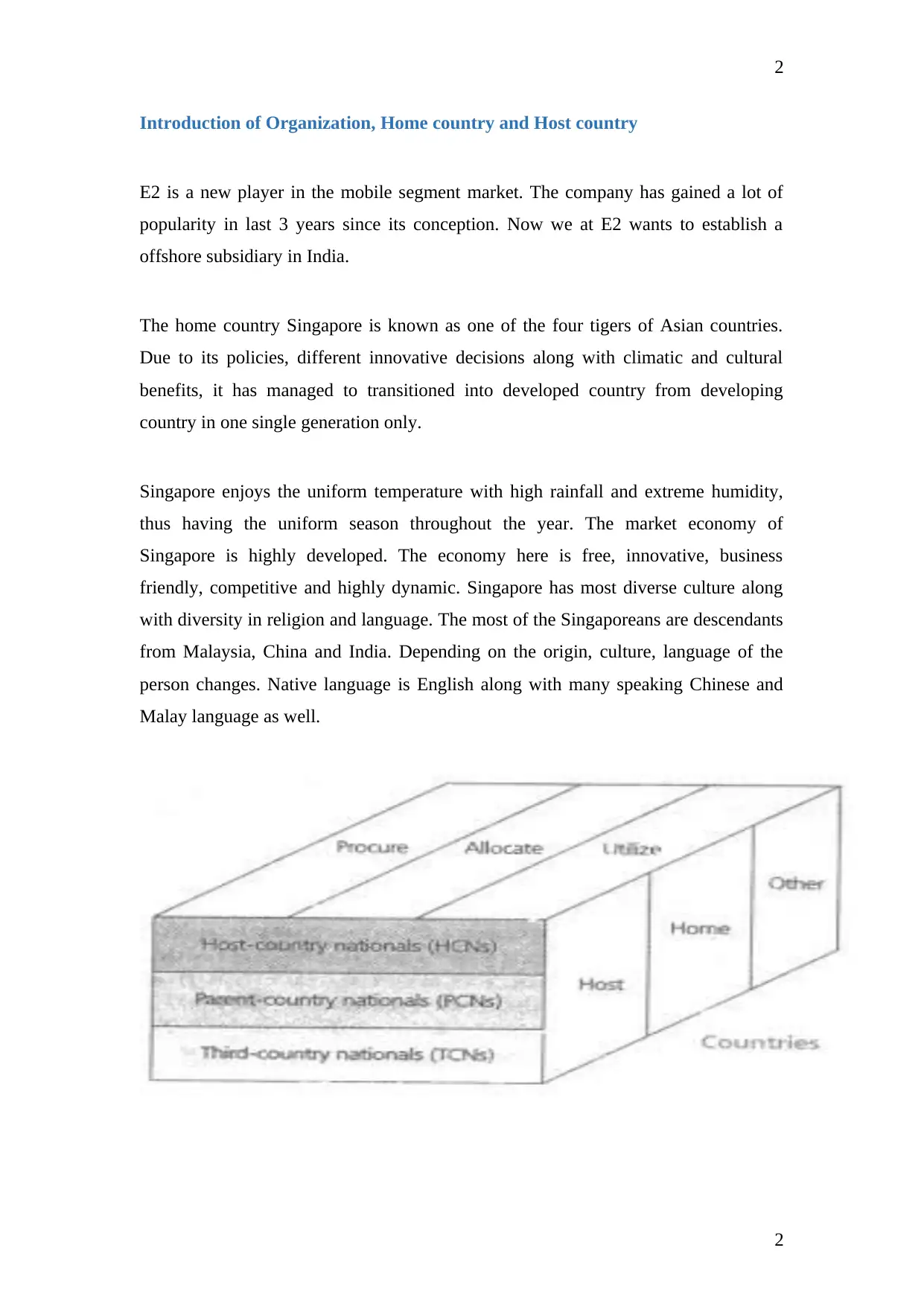
E2 is a new player in the mobile segment market. The company has gained a lot of
popularity in last 3 years since its conception. Now we at E2 wants to establish a
offshore subsidiary in India.
The home country Singapore is known as one of the four tigers of Asian countries.
Due to its policies, different innovative decisions along with climatic and cultural
benefits, it has managed to transitioned into developed country from developing
country in one single generation only.
Singapore enjoys the uniform temperature with high rainfall and extreme humidity,
thus having the uniform season throughout the year. The market economy of
Singapore is highly developed. The economy here is free, innovative, business
friendly, competitive and highly dynamic. Singapore has most diverse culture along
with diversity in religion and language. The most of the Singaporeans are descendants
from Malaysia, China and India. Depending on the origin, culture, language of the
person changes. Native language is English along with many speaking Chinese and
Malay language as well.
2
2
E2 is a new player in the mobile segment market. The company has gained a lot of
popularity in last 3 years since its conception. Now we at E2 wants to establish a
offshore subsidiary in India.
The home country Singapore is known as one of the four tigers of Asian countries.
Due to its policies, different innovative decisions along with climatic and cultural
benefits, it has managed to transitioned into developed country from developing
country in one single generation only.
Singapore enjoys the uniform temperature with high rainfall and extreme humidity,
thus having the uniform season throughout the year. The market economy of
Singapore is highly developed. The economy here is free, innovative, business
friendly, competitive and highly dynamic. Singapore has most diverse culture along
with diversity in religion and language. The most of the Singaporeans are descendants
from Malaysia, China and India. Depending on the origin, culture, language of the
person changes. Native language is English along with many speaking Chinese and
Malay language as well.
2
2
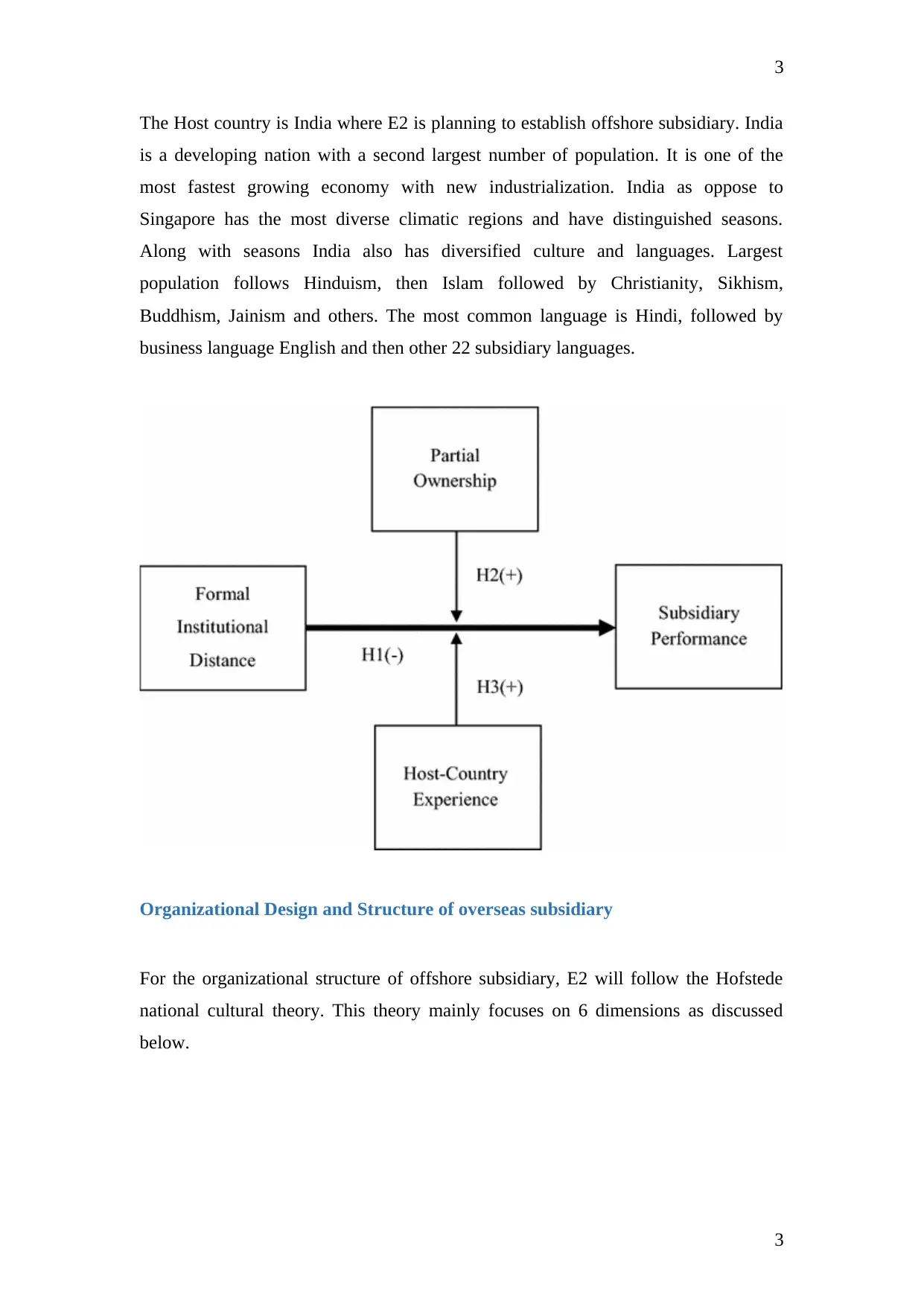
The Host country is India where E2 is planning to establish offshore subsidiary. India
is a developing nation with a second largest number of population. It is one of the
most fastest growing economy with new industrialization. India as oppose to
Singapore has the most diverse climatic regions and have distinguished seasons.
Along with seasons India also has diversified culture and languages. Largest
population follows Hinduism, then Islam followed by Christianity, Sikhism,
Buddhism, Jainism and others. The most common language is Hindi, followed by
business language English and then other 22 subsidiary languages.
Organizational Design and Structure of overseas subsidiary
For the organizational structure of offshore subsidiary, E2 will follow the Hofstede
national cultural theory. This theory mainly focuses on 6 dimensions as discussed
below.
3
3
is a developing nation with a second largest number of population. It is one of the
most fastest growing economy with new industrialization. India as oppose to
Singapore has the most diverse climatic regions and have distinguished seasons.
Along with seasons India also has diversified culture and languages. Largest
population follows Hinduism, then Islam followed by Christianity, Sikhism,
Buddhism, Jainism and others. The most common language is Hindi, followed by
business language English and then other 22 subsidiary languages.
Organizational Design and Structure of overseas subsidiary
For the organizational structure of offshore subsidiary, E2 will follow the Hofstede
national cultural theory. This theory mainly focuses on 6 dimensions as discussed
below.
3
3
⊘ This is a preview!⊘
Do you want full access?
Subscribe today to unlock all pages.

Trusted by 1+ million students worldwide
Power Distance
It specifies that how much distribution of power is unequally distributed within the
less powerful members of organization and the extent of their expectation and
acceptance.In India clear cut hierarchy is present with top to down structure, where in
person on top is supposed to give direction and the lower level person needs to follow
them and get rewards in exchange of their loyalty. In Singapore as well employees
depend on boss to tell what to do.
Individualism
It explains degree of independence among members of society. India has both
individual as well as collectivism traits. Singapore is mainly more of collectivist
society where group is important than individual and people considers team and
organization first before themselves.
Masculinity
It determines whether society is competitive, success and achievement oriented
(Masculine) or prefers quality of life and caring (Feminine). The Indian society is
more of masculine where power and success is celebrated. As oppose to India,
Singapore is feminine society with more caring attitude and prefers quality of life
instead.
Uncertainty Avoidance
It is measured in degrees with which members are scared of unknown and
uncertainties and try to avoid it. India is a patient country and believes that
unexpected things will hinder the plans. It believes in the fact that no plan is perfect.
In Singapore people abide by rules and does not expect unexpected much.
Long Term Orientation
It specifies the need of maintaining links with past of culture or nation and facing the
challenges for present and future. Normative societies trust in old traditions and have
suspicion for change while pragmatic societies encourage change for better future.
4
4
It specifies that how much distribution of power is unequally distributed within the
less powerful members of organization and the extent of their expectation and
acceptance.In India clear cut hierarchy is present with top to down structure, where in
person on top is supposed to give direction and the lower level person needs to follow
them and get rewards in exchange of their loyalty. In Singapore as well employees
depend on boss to tell what to do.
Individualism
It explains degree of independence among members of society. India has both
individual as well as collectivism traits. Singapore is mainly more of collectivist
society where group is important than individual and people considers team and
organization first before themselves.
Masculinity
It determines whether society is competitive, success and achievement oriented
(Masculine) or prefers quality of life and caring (Feminine). The Indian society is
more of masculine where power and success is celebrated. As oppose to India,
Singapore is feminine society with more caring attitude and prefers quality of life
instead.
Uncertainty Avoidance
It is measured in degrees with which members are scared of unknown and
uncertainties and try to avoid it. India is a patient country and believes that
unexpected things will hinder the plans. It believes in the fact that no plan is perfect.
In Singapore people abide by rules and does not expect unexpected much.
Long Term Orientation
It specifies the need of maintaining links with past of culture or nation and facing the
challenges for present and future. Normative societies trust in old traditions and have
suspicion for change while pragmatic societies encourage change for better future.
4
4
Paraphrase This Document
Need a fresh take? Get an instant paraphrase of this document with our AI Paraphraser
India has intermediate approach. Singapore whereas has high degree for pragmatic
approach and believes in long term investments with slow results.
Indulgence
Degree to which members control their desires and impulses. India is a restraint
society with strong controls over desires and impulses and thus the leisure time is very
limited here. Singapore has intermediate approach regarding this.
Staffing Strategy
E2 will be staffing the mixture of parent company nationals and Host company
nationals in the overseas subsidiary. Both PCN and HCN will provide their key
characteristics to the subsidiary. Host company nationals (HCN) are more in contact
with the customers, government, policies, suppliers and competitors. They are
embedded in the system and know the external factors better than parent company
nationals (HCN). HCN Subsidiaries are more autonomous and on basis of market
conditions can make strategic decisions. Whereas the PCN led subsidiaries have more
clear view of vision of parent company. The control is much better. E2 is already a
successful enterprise in Singapore so employees are more confidents and knows the in
and out of trade. Also they think globally and keep eyes on global market as well and
decisions are taken in consideration of each and everything.
The rate of wages in India is low with huge diversity in culture and language. The
people in India tends to trust their own more. Thus it is beneficial for organization to
follow mixture of ethnocentric and polycentric staffing strategy where in to sent some
of home company employees and to recruit some of the local staff. The 3 selection
tools used would be screening of employees on basis of their resume and past
experience. Telephonic interviews of selected candidates would be done and then the
final interview with the hiring manager will be arranged.
5
5
approach and believes in long term investments with slow results.
Indulgence
Degree to which members control their desires and impulses. India is a restraint
society with strong controls over desires and impulses and thus the leisure time is very
limited here. Singapore has intermediate approach regarding this.
Staffing Strategy
E2 will be staffing the mixture of parent company nationals and Host company
nationals in the overseas subsidiary. Both PCN and HCN will provide their key
characteristics to the subsidiary. Host company nationals (HCN) are more in contact
with the customers, government, policies, suppliers and competitors. They are
embedded in the system and know the external factors better than parent company
nationals (HCN). HCN Subsidiaries are more autonomous and on basis of market
conditions can make strategic decisions. Whereas the PCN led subsidiaries have more
clear view of vision of parent company. The control is much better. E2 is already a
successful enterprise in Singapore so employees are more confidents and knows the in
and out of trade. Also they think globally and keep eyes on global market as well and
decisions are taken in consideration of each and everything.
The rate of wages in India is low with huge diversity in culture and language. The
people in India tends to trust their own more. Thus it is beneficial for organization to
follow mixture of ethnocentric and polycentric staffing strategy where in to sent some
of home company employees and to recruit some of the local staff. The 3 selection
tools used would be screening of employees on basis of their resume and past
experience. Telephonic interviews of selected candidates would be done and then the
final interview with the hiring manager will be arranged.
5
5
Training and Development Analysis
The expatriate would need two types of skills to succeed in Host Company, mainly
hard skills and soft skill trainings. The hard skills are related to one’s field and more
related to person’s job and thus easy in this case. Soft skills training whereas are more
critical. Since the employees would be going for more than a year, a high rigorous
training is needed. In this experimental learning on extensive basis is done, followed
by the interaction with HCN (Host Country Nationals) along with language training.
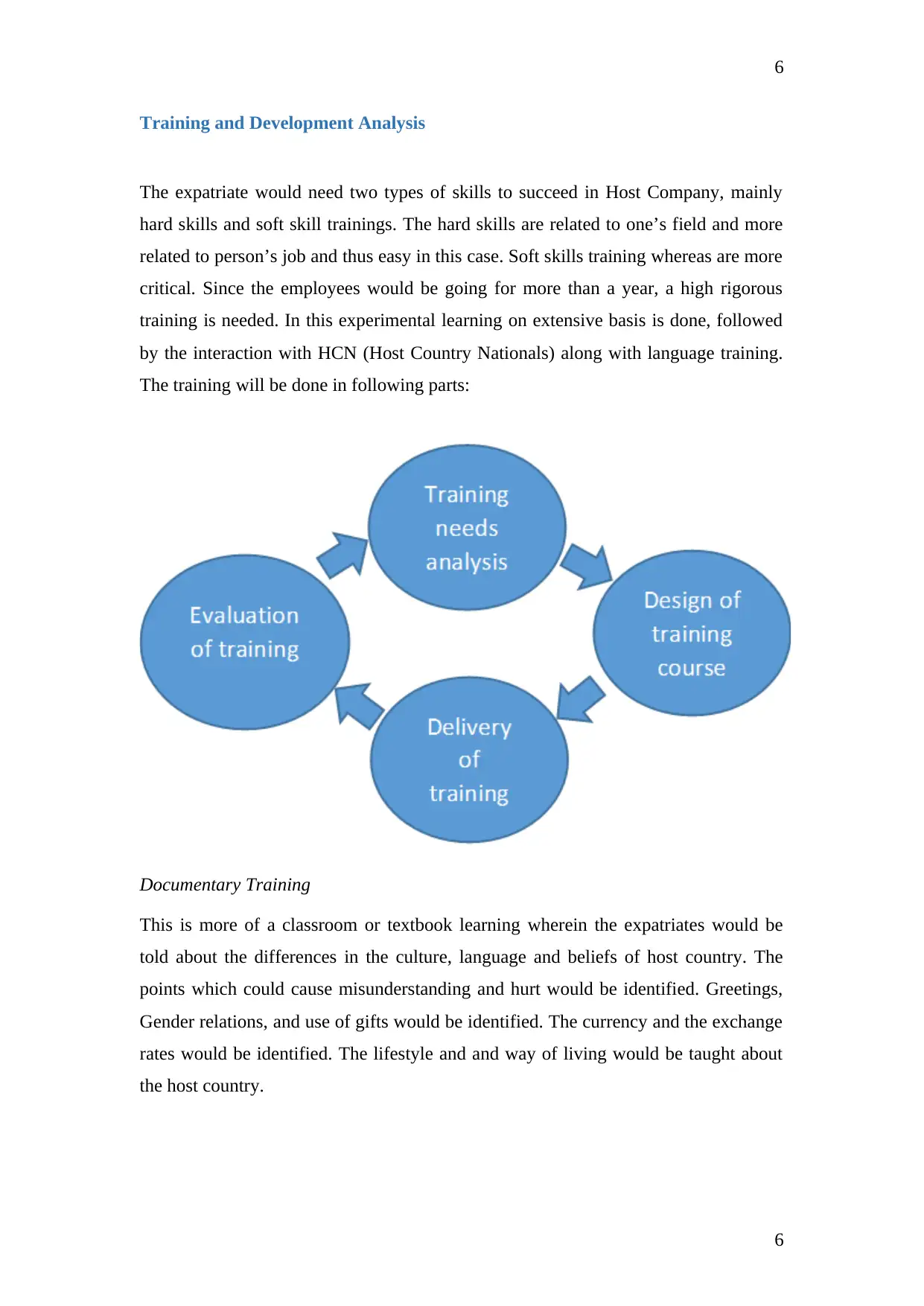
The training will be done in following parts:
Documentary Training
This is more of a classroom or textbook learning wherein the expatriates would be
told about the differences in the culture, language and beliefs of host country. The
points which could cause misunderstanding and hurt would be identified. Greetings,
Gender relations, and use of gifts would be identified. The currency and the exchange
rates would be identified. The lifestyle and and way of living would be taught about
the host country.
6
6
The expatriate would need two types of skills to succeed in Host Company, mainly
hard skills and soft skill trainings. The hard skills are related to one’s field and more
related to person’s job and thus easy in this case. Soft skills training whereas are more
critical. Since the employees would be going for more than a year, a high rigorous
training is needed. In this experimental learning on extensive basis is done, followed
by the interaction with HCN (Host Country Nationals) along with language training.
The training will be done in following parts:
Documentary Training
This is more of a classroom or textbook learning wherein the expatriates would be
told about the differences in the culture, language and beliefs of host country. The
points which could cause misunderstanding and hurt would be identified. Greetings,
Gender relations, and use of gifts would be identified. The currency and the exchange
rates would be identified. The lifestyle and and way of living would be taught about
the host country.
6
6
⊘ This is a preview!⊘
Do you want full access?
Subscribe today to unlock all pages.
Trusted by 1+ million students worldwide
Cultural Simulation Training
After do’s and don’ts are taught, cultural simulation would be done wherein role plays
of various situations would be done. It would help in identifying how to respond in
various cultural situation in the host country in sensitive way. It can happen in host
country or the people from host country can be included.
Field Simulation training
If the employee clears the survival training, employee is asked to visit the
neighbourhood with same ethnicity and culture. They can be dropped in random areas
and asked to return to offices. Or they can be shifted to housing society with same
background asked for doing shopping and interact with people.
One should consider different kind of languages used in host country (, Formal, casual
and regional), different kind of food and dress , exchange rates and currency used and
professional expectation in host country before sending expatriate to host country.
Also it is important to make a plan for reintegration. The employee should be asked
about the expectations from the assignment. What skills, qualification and insights
employees expect to gain and how he would use it in home country on return. The
organization should reveal how they envision employee future in home office and
what are the opportunities for him in home office upon return.
Analysis of Remuneration Package
There could be 3 approaches for the remuneration package. First home based
approach also known as balance sheet approach wherein expatriate is provided with
the cost difference of same assignment in host country and home country. Second is
host based approach wherein the expatriate is transferred to host country payroll and
base and incentive pay is given as per host country policies. Thirdly global market
approach provides equivalent compensation package to all assignees irrespective of
the home country.
7
7
After do’s and don’ts are taught, cultural simulation would be done wherein role plays
of various situations would be done. It would help in identifying how to respond in
various cultural situation in the host country in sensitive way. It can happen in host
country or the people from host country can be included.
Field Simulation training
If the employee clears the survival training, employee is asked to visit the
neighbourhood with same ethnicity and culture. They can be dropped in random areas
and asked to return to offices. Or they can be shifted to housing society with same
background asked for doing shopping and interact with people.
One should consider different kind of languages used in host country (, Formal, casual
and regional), different kind of food and dress , exchange rates and currency used and
professional expectation in host country before sending expatriate to host country.
Also it is important to make a plan for reintegration. The employee should be asked
about the expectations from the assignment. What skills, qualification and insights
employees expect to gain and how he would use it in home country on return. The
organization should reveal how they envision employee future in home office and
what are the opportunities for him in home office upon return.
Analysis of Remuneration Package
There could be 3 approaches for the remuneration package. First home based
approach also known as balance sheet approach wherein expatriate is provided with
the cost difference of same assignment in host country and home country. Second is
host based approach wherein the expatriate is transferred to host country payroll and
base and incentive pay is given as per host country policies. Thirdly global market
approach provides equivalent compensation package to all assignees irrespective of
the home country.
7
7
Paraphrase This Document
Need a fresh take? Get an instant paraphrase of this document with our AI Paraphraser
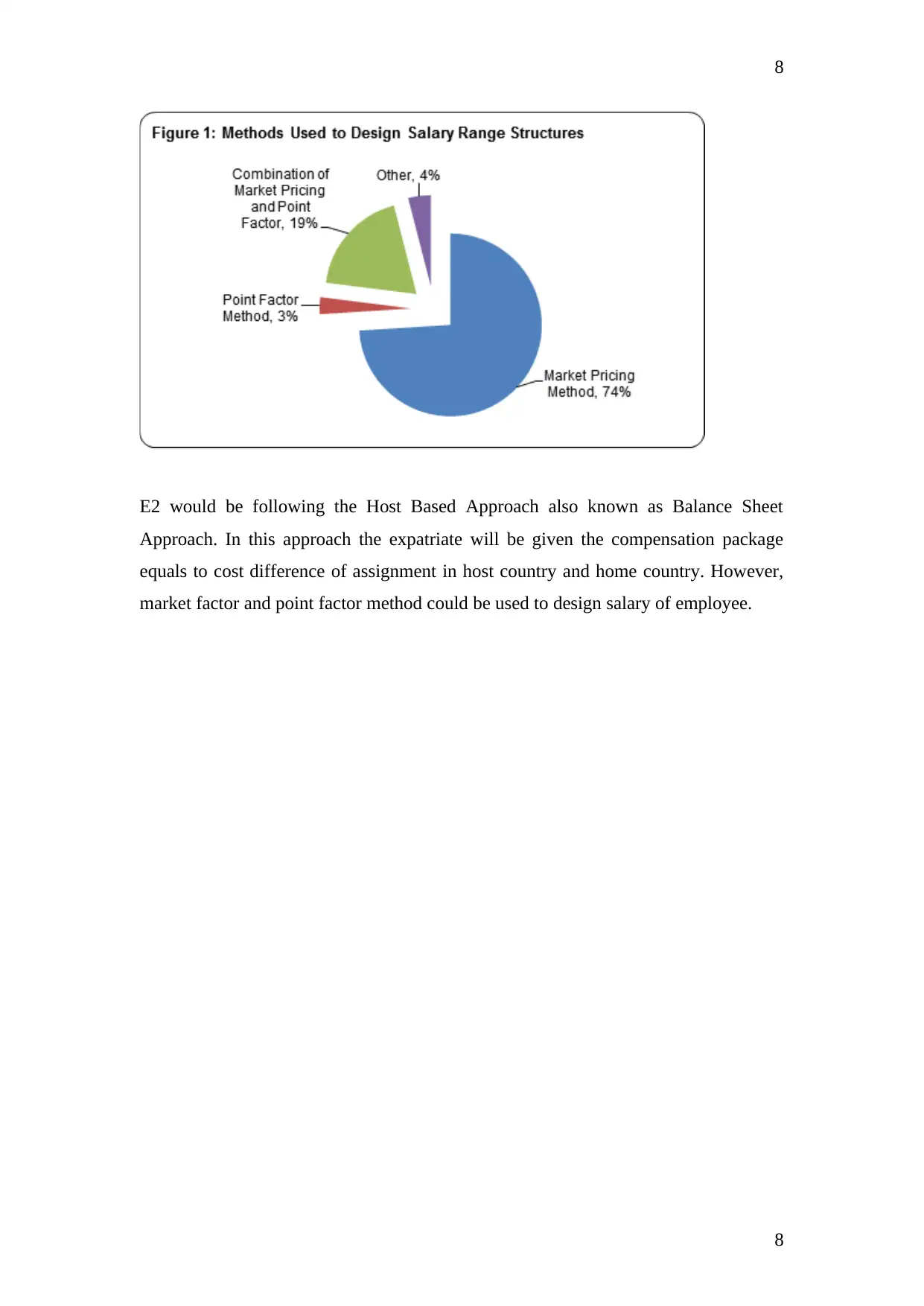
E2 would be following the Host Based Approach also known as Balance Sheet
Approach. In this approach the expatriate will be given the compensation package
equals to cost difference of assignment in host country and home country. However,
market factor and point factor method could be used to design salary of employee.
8
8
Approach. In this approach the expatriate will be given the compensation package
equals to cost difference of assignment in host country and home country. However,
market factor and point factor method could be used to design salary of employee.
8
8
Conclusion
After careful study of all the information available it has been found that the
Singapore and India while being both Asian countries have very different cultures,
languages and climates. There is difference in all fields. Thus to succeed its important
to have a very solid plan and strong training program in place. The employee must be
aware of all the formal and casual culture etiquettes to work better and efficiently. It is
important to have mix of staff hired from both within parent company and Host
Company.
9
9
After careful study of all the information available it has been found that the
Singapore and India while being both Asian countries have very different cultures,
languages and climates. There is difference in all fields. Thus to succeed its important
to have a very solid plan and strong training program in place. The employee must be
aware of all the formal and casual culture etiquettes to work better and efficiently. It is
important to have mix of staff hired from both within parent company and Host
Company.
9
9
⊘ This is a preview!⊘
Do you want full access?
Subscribe today to unlock all pages.
Trusted by 1+ million students worldwide
References
Chang, Y. Y., Gong, Y., & Peng, M. W. (2012). Expatriate knowledge transfer, subsidiary
absorptive capacity, and subsidiary performance. Academy of Management
Journal, 55(4), 927-948.
Firth, B. M., Chen, G., Kirkman, B. L., & Kim, K. (2014). Newcomers abroad:
Expatriate adaptation during early phases of international
assignments. Academy of Management Journal, 57(1), 280-300.
Howe-Walsh, L., & Schyns, B. (2010). Self-initiated expatriation: implications for
HRM. The International Journal of Human Resource Management, 21(2), 260-
273.
Ko, H. C., & Yang, M. L. (2011). The effects of cross-cultural training on expatriate
assignments. Intercultural Communication Studies, 20(1).
Kühlmann, T., & Hutchings, K. (2010). Expatriate assignments vs localization of
management in China: Staffing choices of Australian and German
companies. Career Development International, 15(1), 20-38.
Migliore, L. A. (2011). Relation between big five personality traits and Hofstede's
cultural dimensions: Samples from the USA and India. Cross Cultural
Management: An International Journal, 18(1), 38-54.
Story, J. S., Barbuto Jr, J. E., Luthans, F., & Bovaird, J. A. (2014). Meeting the
challenges of effective international HRM: Analysis of the antecedents of
global mindset. Human Resource Management, 53(1), 131-155.
Takeuchi, R. (2010). A critical review of expatriate adjustment research through a
multiple stakeholder view: Progress, emerging trends, and prospects. Journal
of management, 36(4), 1040-1064.
10
10
Chang, Y. Y., Gong, Y., & Peng, M. W. (2012). Expatriate knowledge transfer, subsidiary
absorptive capacity, and subsidiary performance. Academy of Management
Journal, 55(4), 927-948.
Firth, B. M., Chen, G., Kirkman, B. L., & Kim, K. (2014). Newcomers abroad:
Expatriate adaptation during early phases of international
assignments. Academy of Management Journal, 57(1), 280-300.
Howe-Walsh, L., & Schyns, B. (2010). Self-initiated expatriation: implications for
HRM. The International Journal of Human Resource Management, 21(2), 260-
273.
Ko, H. C., & Yang, M. L. (2011). The effects of cross-cultural training on expatriate
assignments. Intercultural Communication Studies, 20(1).
Kühlmann, T., & Hutchings, K. (2010). Expatriate assignments vs localization of
management in China: Staffing choices of Australian and German
companies. Career Development International, 15(1), 20-38.
Migliore, L. A. (2011). Relation between big five personality traits and Hofstede's
cultural dimensions: Samples from the USA and India. Cross Cultural
Management: An International Journal, 18(1), 38-54.
Story, J. S., Barbuto Jr, J. E., Luthans, F., & Bovaird, J. A. (2014). Meeting the
challenges of effective international HRM: Analysis of the antecedents of
global mindset. Human Resource Management, 53(1), 131-155.
Takeuchi, R. (2010). A critical review of expatriate adjustment research through a
multiple stakeholder view: Progress, emerging trends, and prospects. Journal
of management, 36(4), 1040-1064.
10
10
Paraphrase This Document
Need a fresh take? Get an instant paraphrase of this document with our AI Paraphraser
Warneke, D., & Schneider, M. (2011). Expatriate compensation packages: what do
employees prefer?. Cross Cultural Management: An International
Journal, 18(2), 236-256.
Zhou, E., Lu, Z., Li, X., Li, T., Papola, T. S., Pais, J., & Sahu, P. P. (2010).
Remuneration differences in the emerging economies of China and
India. International Journal of Psychology, 45(5), 360-370.
11
11
employees prefer?. Cross Cultural Management: An International
Journal, 18(2), 236-256.
Zhou, E., Lu, Z., Li, X., Li, T., Papola, T. S., Pais, J., & Sahu, P. P. (2010).
Remuneration differences in the emerging economies of China and
India. International Journal of Psychology, 45(5), 360-370.
11
11

1 out of 11


Your All-in-One AI-Powered Toolkit for Academic Success.
+13062052269
info@desklib.com
Available 24*7 on WhatsApp / Email
![[object Object]](/_next/static/media/star-bottom.7253800d.svg)
Unlock your academic potential
Copyright © 2020–2026 A2Z Services. All Rights Reserved. Developed and managed by ZUCOL.