Principles of Microeconomics: Oil and Gas Industry Analysis Report

Verified

Added on  2023/06/08

|7
|1130
|363
Report
AI Summary
This report provides a microeconomic analysis of the oil and gas extraction industry. It begins by identifying the industry's oligopolistic market structure, characterized by a few dominant players like ExxonMobil, Chevron, ConocoPhillips, and Marathon Oil, who possess significant market share and face high entry barriers. The report then examines microeconomic trends, highlighting the relationship between supply, demand, and price, illustrating how increased production can lead to declining spot prices, and vice versa. A key element is the discussion of government intervention, including price ceilings and anti-trust laws, to protect social interests from potential market manipulations. The report concludes by summarizing the industry's characteristics, emphasizing the role of supply and demand in price determination and the rationale for government oversight to ensure fair market practices.
Document Page
Running Head: PRINCIPLES OF MICROECONOMICS
Principles of Microeconomics
Name of the Student
Name of the University
Course ID
tabler-icon-diamond-filled.svg

Paraphrase This Document

Need a fresh take? Get an instant paraphrase of this document with our AI Paraphraser
Document Page
1PRINCIPLES OF MICROECONOMICS
Table of Contents
Introduction......................................................................................................................................2
Market structure of Oil and Gas extraction industry.......................................................................2
Microeconomic trends in the industry.............................................................................................3
Scope of government intervention in the market.............................................................................4
Conclusion.......................................................................................................................................4
References........................................................................................................................................6
Document Page
2PRINCIPLES OF MICROECONOMICS
Introduction
Operation of an industry is largely attributed to specific characteristics of the industry.
Market structure of an industry is determined by concentration of firms in the industry. The oil
and gas subsector of United State operate under oil and gas field properties. The major activities
of the industry include extraction of oil and natural gas, equipping wells, emulsion breaker,
operating separators and others (census.gov, 2018). The concerned industry is largely
characterized as an oligopoly market. The concerned industry has characteristics similar to that
of an oligopoly market.
Market structure of Oil and Gas extraction industry
An oligopoly market is identified as being dominated by few large players. The major
players in the industry captures a significant portion of market share. As oil and gas industry in
United State is dominated by few large player, it is identified as an operating oligopoly (Baumol
& Blinder, 2015). Following merger and acquisition in the concerned industry there are four
large oil companies in United State enjoying a significant market power.
ExxonMobil, ConocoPhillips, Chevron and Marathon Oil are the four largest oil
companies that dominate US oil industry. The four big companies represent nearly 80 percent of
all Oil and Gas companies in United State. Among the four firms Exxon Mobil has a market
share of 41 percent which is followed by 25 share of Chevron (Shaffer, 2016). The market share
of ConocoPhillips and Marathon are 12 percent and 21 percent respectively.
An important feature of oligopoly market is the presence of high entry barriers. The large
firm heavily invest in research and technology development to reduce cost and increase reserves.
For example, with the objective of maintaining dominant position in the industry Exxon Mobil
Document Page
3PRINCIPLES OF MICROECONOMICS
invest approximately $600 million annually (Joskow, 2013). New firms find it difficult to enter
the industry because of huge sunk cost.
Microeconomic trends in the industry
There are limited alternative to oil and gas consumption in the short term. As a result,
price is extremely sensitive to a change in supply and demand. Change in demand and supply
condition results in large change in prices which bring the supply and demand in balance as
explained by standard microeconomic theory (Mankiw, 2017).
In for some reason supply increases, then given demand there exists an excess supply in
the market. The excess supply over its demand reduces price in the market. The lower price then
encourages people to increase demand following the law of demand. This in turn leads to a
balance between market supply and market demand. Conversely, if there is an increase in
demand then given constant supply price increases. Higher price encourages producers to supply
more because of higher profitability (Baumol & Blinder, 2015). The increased supply then
matches with demand to restore equilibrium in the market.
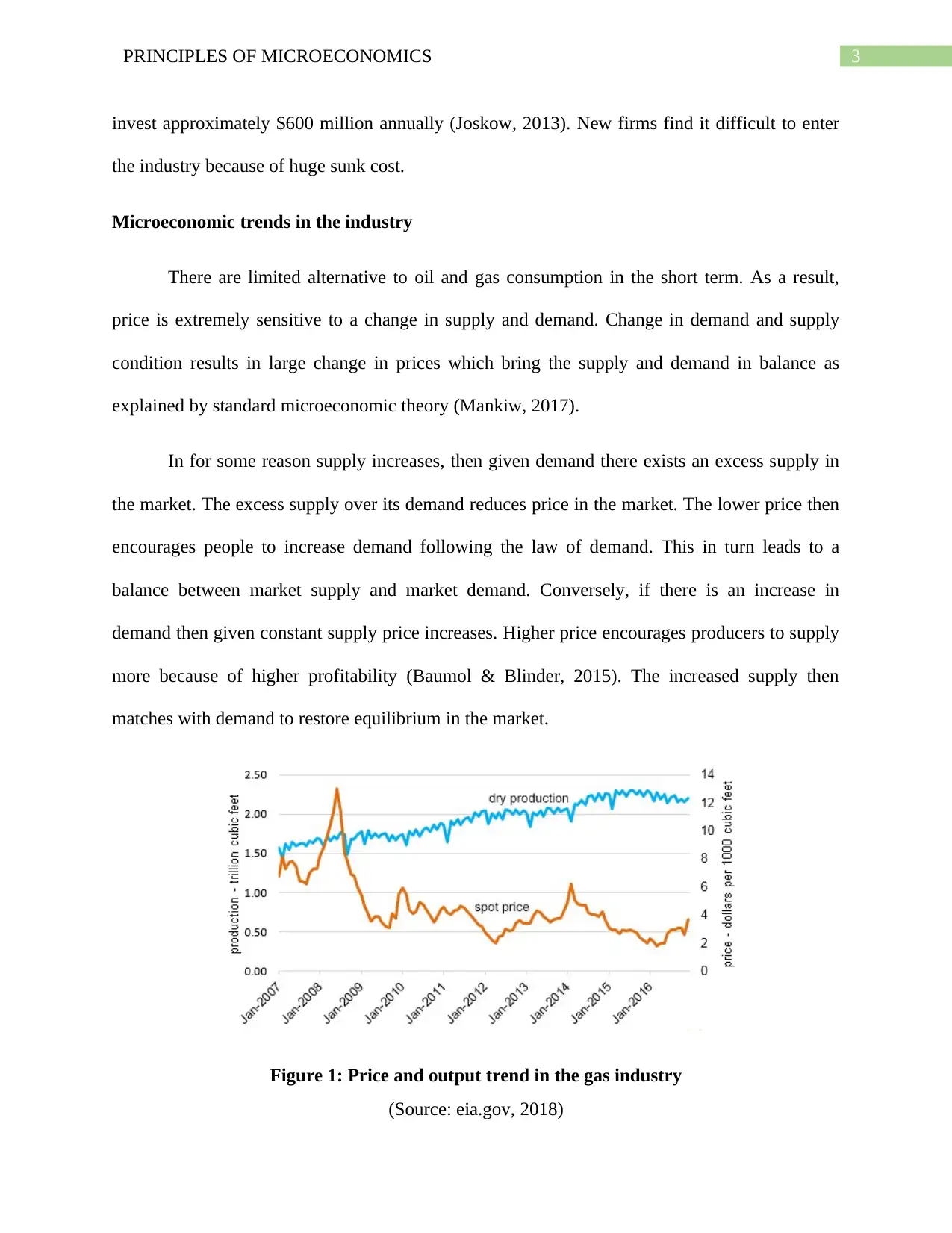
Figure 1: Price and output trend in the gas industry
(Source: eia.gov, 2018)
tabler-icon-diamond-filled.svg

Paraphrase This Document

Need a fresh take? Get an instant paraphrase of this document with our AI Paraphraser
Document Page
4PRINCIPLES OF MICROECONOMICS
The figure above shows movement of spot price and dry gas production in the market. As
show in the figure an increase production is associated a decline in spot prices. The consumption
of natural gas in United State is mostly satisfied with domestic production. The dry natural gas
production increased continuously from 2006 to 2015 (Shaffer, 2016). As a result of increased
production of natural gas there is a decline in corresponding spot and consumption prices.
Scope of government intervention in the market
Excessive concentration of the market might harm social interest. In the concentrated Oil
and Gas industry in United State, the four big companies are able to manipulate price and output
in the industry. The companies can also involve in merger to influence output and price in the
industry. To prevent excessively high price in the market government might set an upper limit of
price by the policy of price limit. Price ceiling is defined as a set maximum limit beyond which
firms cannot increase price in the market (Baumol & Blinder, 2015). The policy aims to offer
commodity at an affordable price.
Government might implement anti-trust law to protect consumers from self-satisfying
motive of business. The law works against any form of cartel in the industry. By preventing
behavior of cartel government might increase social welfare (Mankiw, 2017). The
encouragement of a competitive environment might change the market structure from an
oligopolistic market to a competitive one.
Conclusion
The gas and oil extraction industry in United State possess the characteristics of an
oligopoly market. Like an oligopoly market the industry is dominate by few large seller,
maintain a high barrier to entry and other features of the specific market. Supply and demand
Document Page
5PRINCIPLES OF MICROECONOMICS
plays a vital role in determining price in the industry. Followed by the increasing production of
natural gas from 2006 to 2015 prices constituted a declining trend. Because of huge market
concentration, there is room for government intervention to protect social interest.
Document Page
6PRINCIPLES OF MICROECONOMICS
References
Baumol, W. J., & Blinder, A. S. (2015). Microeconomics: Principles and policy. Nelson
Education.
Factors Affecting Natural Gas Prices - Energy Explained, Your Guide To Understanding Energy
- Energy Information Administration. (2018). Retrieved from
https://www.eia.gov/energyexplained/index.php?
page=natural_gas_factors_affecting_prices
Joskow, P. L. (2013). Natural gas: from shortages to abundance in the United States. American
Economic Review, 103(3), 338-43.
Mankiw, N. G. (2017). On welfare economics in the principles course. The Journal of Economic
Education, 48(1), 27-28.
NAICS Search. (2018). Retrieved from https://www.census.gov/cgi-bin/sssd/naics/naicsrch?
code=211&search=2017%20NAICS%20Search
Shaffer, E. H. (2016). The United States and the control of world oil. Routledge.
chevron_up_icon
1 out of 7
circle_padding
hide_on_mobile
zoom_out_icon
[object Object]