Examining Depression in Elderly Residents of Malta's Old Age Homes
VerifiedAdded on 2020/12/29
|14
|3363
|243
Report
AI Summary
This report presents a study on old age homes in Malta, investigating the factors contributing to depression among elderly residents. The research includes a literature review on the needs of elderly people and the issues they face in old age homes, such as physical and mental health concerns, financial security, loneliness, and social isolation. The methodology section outlines the research design, which is non-experimental and quantitative, the study area, population, sample size (20 elderly people), and data collection methods using questionnaires. Data analysis involves the interpretation of questionnaire responses, revealing that most residents have lived in these homes for 2-4 years, with irresponsible children being the primary reason for their placement. The study also highlights issues such as physical and mental health problems, social isolation, and healthcare concerns. The report concludes with recommendations to improve the quality of life for elderly residents, addressing their needs and suggesting ways to mitigate the challenges they face. The study aims to provide insights into the current state of elderly care in Malta and suggest improvements for the well-being of senior citizens.
Old Age Homes in
Malta
1
Malta
1

Paraphrase This Document
Need a fresh take? Get an instant paraphrase of this document with our AI Paraphraser
Table of Contents
1 INTRODUCTION........................................................................................................................3
1.1. Background of the study......................................................................................................3
1.2. Statement of the problems....................................................................................................3
1.3. Research Objectives.............................................................................................................3
1.4. Scope of the study................................................................................................................4
2. LITERATURE REVIEW ...........................................................................................................4
2.1. The need of elderly people and issues faced by them in old age homes..............................4
3. RESEARCH METHODOLOGY ................................................................................................6
3.1 Research design.....................................................................................................................6
3.1.1 Research problem ..............................................................................................................6
3.1.2 Develop a hypothesis ........................................................................................................6
3.1.3 Predictions based on the hypothesis...................................................................................6
3.1.4 Devising hypothesis test.....................................................................................................6
3.1.5 Conduct a test.....................................................................................................................6
3.1.6 Experimental or Non-experimental research.....................................................................6
3.2 Study area .............................................................................................................................7
3.3 Study population...................................................................................................................7
3.4 Sample size and sampling procedure ...................................................................................7
3.4.1 Population and sample.......................................................................................................7
3.4.2 Sample selection and size...................................................................................................7
3.4.3 Sampling methods..............................................................................................................7
3.5 Data collection method.........................................................................................................7
4. DATA ANALYSIS AND PRESENTATION.............................................................................8
4.1. Data Analysis.......................................................................................................................8
4.2. Data Presentation...............................................................................................................10
5. RECOMMENDATION AND CONCLUSION.........................................................................13
5.1 Conclusion...........................................................................................................................13
5.2 Recommendations...............................................................................................................13
REFERENCES..............................................................................................................................14
2
1 INTRODUCTION........................................................................................................................3
1.1. Background of the study......................................................................................................3
1.2. Statement of the problems....................................................................................................3
1.3. Research Objectives.............................................................................................................3
1.4. Scope of the study................................................................................................................4
2. LITERATURE REVIEW ...........................................................................................................4
2.1. The need of elderly people and issues faced by them in old age homes..............................4
3. RESEARCH METHODOLOGY ................................................................................................6
3.1 Research design.....................................................................................................................6
3.1.1 Research problem ..............................................................................................................6
3.1.2 Develop a hypothesis ........................................................................................................6
3.1.3 Predictions based on the hypothesis...................................................................................6
3.1.4 Devising hypothesis test.....................................................................................................6
3.1.5 Conduct a test.....................................................................................................................6
3.1.6 Experimental or Non-experimental research.....................................................................6
3.2 Study area .............................................................................................................................7
3.3 Study population...................................................................................................................7
3.4 Sample size and sampling procedure ...................................................................................7
3.4.1 Population and sample.......................................................................................................7
3.4.2 Sample selection and size...................................................................................................7
3.4.3 Sampling methods..............................................................................................................7
3.5 Data collection method.........................................................................................................7
4. DATA ANALYSIS AND PRESENTATION.............................................................................8
4.1. Data Analysis.......................................................................................................................8
4.2. Data Presentation...............................................................................................................10
5. RECOMMENDATION AND CONCLUSION.........................................................................13
5.1 Conclusion...........................................................................................................................13
5.2 Recommendations...............................................................................................................13
REFERENCES..............................................................................................................................14
2
1 INTRODUCTION
1.1. Background of the study
Old age homes are meant for senior citizens who are unable to stay with their families or
are destitute. Old age is said to be second childhood. The medical facility and care are very
special for the senior citizen. There are various services or facilities which are provided by the
old age homes at Malta are mobile healthcare systems, nurses, ambulances as well as provisions
of well- balanced meals (Fileborn and et.al., 2017). In Malta there are 13 old age centres. This
study will focus on the addressing the issues which are faced by the old age people living in the
Malta.
1.2. Statement of the problems
The statement of the problem in increasing of depression among the elderly people living
in Old age homes at Malta. The people living in old age homes needs special care and support
physically and mentally. Most of the old age homes are not concerned with the inner feelings and
sentiments of the elderly people. Thus, it may be possible that the main reason of depression
among them is the lack of communication among the care providers and elderly people. The
elderly people are not living a quality lives at old age homes in Malta (Neves, Waycott and
Malta, 2018). It is very essential that all the problem of the study must be address because senior
citizens are very important person of the country.
1.3. Research Objectives
Aim- “To examine the depression among elderly people living in old age homes, A study of
Malta old age homes.”
Objectives
To identify the needs of elderly people.
To identify the issues faced by the people living in old age homes.
To recommend ways to improve the quality of living of old age people.
Research Questions
1. What are the needs of elderly people?
2. What are the issues faced by the people living in old age homes?
3. State the recommendations to improve the quality of living of old age people.
3
1.1. Background of the study
Old age homes are meant for senior citizens who are unable to stay with their families or
are destitute. Old age is said to be second childhood. The medical facility and care are very
special for the senior citizen. There are various services or facilities which are provided by the
old age homes at Malta are mobile healthcare systems, nurses, ambulances as well as provisions
of well- balanced meals (Fileborn and et.al., 2017). In Malta there are 13 old age centres. This
study will focus on the addressing the issues which are faced by the old age people living in the
Malta.
1.2. Statement of the problems
The statement of the problem in increasing of depression among the elderly people living
in Old age homes at Malta. The people living in old age homes needs special care and support
physically and mentally. Most of the old age homes are not concerned with the inner feelings and
sentiments of the elderly people. Thus, it may be possible that the main reason of depression
among them is the lack of communication among the care providers and elderly people. The
elderly people are not living a quality lives at old age homes in Malta (Neves, Waycott and
Malta, 2018). It is very essential that all the problem of the study must be address because senior
citizens are very important person of the country.
1.3. Research Objectives
Aim- “To examine the depression among elderly people living in old age homes, A study of
Malta old age homes.”
Objectives
To identify the needs of elderly people.
To identify the issues faced by the people living in old age homes.
To recommend ways to improve the quality of living of old age people.
Research Questions
1. What are the needs of elderly people?
2. What are the issues faced by the people living in old age homes?
3. State the recommendations to improve the quality of living of old age people.
3
⊘ This is a preview!⊘
Do you want full access?
Subscribe today to unlock all pages.

Trusted by 1+ million students worldwide
1.4. Scope of the study.
The scope of the study of research is very wide. In this research the knowledge of
researcher will be raised because it is very important topic. The health of old age people always
matter for the economy. The researcher in this study will collect data from the people of different
old age homes at Malta (Betz, 2017). In addition to this, research will also explain theoretical
framework of that will address the needs and issues faced by the people living in old age homes.
Researcher will also provide recommendations to improve the quality of life of old age people.
2. LITERATURE REVIEW
2.1. The need of elderly people and issues faced by them in old age homes.
According to the Gorman, (2017) Old age people are very important part of the economy,
they are the ancestors of the country. Old age is said to be second childhood. It is identified from
the world statical data that about 36% old people of world population is living in the old age
homes. It is fact that ageing process changes both the body and the mind. There are various
needs of old age people which should b fulfilled. The fundamental need of elderly people is
dietary need. They should contain foods which are acceptable to their digestive system because
with the passing of age the digestive system does not work properly. They face problems if they
did not find sufficient and healthy food. In addition to this, elderly people also have financial
needs. They need certain amount of funds in order to fend for themselves for everything such as
groceries, medicines, food etc. Moser and Kalton, (2017) said that, The needs with the growing
age become just as like small children's and babies. Moreover, the most importation need that are
very critical part of their life is social needs. They need friends, society, family when they grew
old. Thus, it is very important that they should shower all the love and care. Furthermore, it is
also important that they also need of proper care of health. With the passing of age the body
tends to slow down and becomes less efficient. Old age people are probe to a few age related
health issues as this is the normal aspect of life and no one can help it. But proper care can be
provided to old age people so that they can live the life in more better way.
As per the Berk, (2017), There are many issues which old age people faced in old age
homes such as physical and mental heath, cost of healthcare. Financial security, loneliness, social
isolation, alder abuse etc. these issues are raising the depression among the people living in the
old age homes. Many older people faced issues regarding physical and mental health as with the
passing of age their bones and muscles does not able to work properly, eyesight is sometime lost,
4
The scope of the study of research is very wide. In this research the knowledge of
researcher will be raised because it is very important topic. The health of old age people always
matter for the economy. The researcher in this study will collect data from the people of different
old age homes at Malta (Betz, 2017). In addition to this, research will also explain theoretical
framework of that will address the needs and issues faced by the people living in old age homes.
Researcher will also provide recommendations to improve the quality of life of old age people.
2. LITERATURE REVIEW
2.1. The need of elderly people and issues faced by them in old age homes.
According to the Gorman, (2017) Old age people are very important part of the economy,
they are the ancestors of the country. Old age is said to be second childhood. It is identified from
the world statical data that about 36% old people of world population is living in the old age
homes. It is fact that ageing process changes both the body and the mind. There are various
needs of old age people which should b fulfilled. The fundamental need of elderly people is
dietary need. They should contain foods which are acceptable to their digestive system because
with the passing of age the digestive system does not work properly. They face problems if they
did not find sufficient and healthy food. In addition to this, elderly people also have financial
needs. They need certain amount of funds in order to fend for themselves for everything such as
groceries, medicines, food etc. Moser and Kalton, (2017) said that, The needs with the growing
age become just as like small children's and babies. Moreover, the most importation need that are
very critical part of their life is social needs. They need friends, society, family when they grew
old. Thus, it is very important that they should shower all the love and care. Furthermore, it is
also important that they also need of proper care of health. With the passing of age the body
tends to slow down and becomes less efficient. Old age people are probe to a few age related
health issues as this is the normal aspect of life and no one can help it. But proper care can be
provided to old age people so that they can live the life in more better way.
As per the Berk, (2017), There are many issues which old age people faced in old age
homes such as physical and mental heath, cost of healthcare. Financial security, loneliness, social
isolation, alder abuse etc. these issues are raising the depression among the people living in the
old age homes. Many older people faced issues regarding physical and mental health as with the
passing of age their bones and muscles does not able to work properly, eyesight is sometime lost,
4
Paraphrase This Document
Need a fresh take? Get an instant paraphrase of this document with our AI Paraphraser
hearing capacity also decreases which directly and indirectly affects the mental health of people.
Goffman, (2017) said that, in old age homes, it is also identified that old age people are not
getting proper health which is also affecting the health. With the high cost of medical, old age
homes does not provide quality of healthcare to them. The most emerging issues that old age
people are facing is loneliness and social isolation. They used to miss the children's who have put
them in old age home and many other reasons which makes them feel alone.
5
Goffman, (2017) said that, in old age homes, it is also identified that old age people are not
getting proper health which is also affecting the health. With the high cost of medical, old age
homes does not provide quality of healthcare to them. The most emerging issues that old age
people are facing is loneliness and social isolation. They used to miss the children's who have put
them in old age home and many other reasons which makes them feel alone.
5
3. RESEARCH METHODOLOGY
There are various research methods and techniques which are required in order to collect,
analyse and interpret data. These methodologies are very essential to achieve research aims and
objectives(Quinlan and et.al., 2019). There are various research methods which are used in this
research as below -
3.1 Research design
It refers to a basic plan that guides the collection of data and analysis stages of a research
project. There are two major types of research designs – Exploratory and Conclusive research
design. Exploratory research refers to the associated to qualitative study and conclusive refers to
quantitative (Srinivas and Babu, 2017). In the present research quantitative research design is
used.
3.1.1 Research problem
Research problem is the depression among the elderly people living in Old age homes.
3.1.2 Develop a hypothesis
The elderly people are not living a quality lives at old age homes in Malta.
3.1.3 Predictions based on the hypothesis
The people living in old age homes needs special care and support physically and
mentally. Most of the old age homes are not concerned with the inner feelings and sentiments of
the elderly people. Therefore, it might be possible that the main reason of depression among
them is the lack of communication among the care providers and elderly people.
3.1.4 Devising hypothesis test
Scientific research method instructs researchers for testing the hypothesis. Testing
generally includes designing a method for collecting information that helps in evaluating the
hypothesis and choose to accept or reject it.
3.1.5 Conduct a test
In order to collect the data research conducted a survey from elderly people living in old
homes at Malta. More than 70% of the participants said that they are depressed due to lack of
emotional support. Therefore, the research hypothesis can be treated positive and is accepted.
3.1.6 Experimental or Non-experimental research
The researcher has conducted a non-experimental research to collect most relevant and
real data (Martin and Larkin, 2018).
6
There are various research methods and techniques which are required in order to collect,
analyse and interpret data. These methodologies are very essential to achieve research aims and
objectives(Quinlan and et.al., 2019). There are various research methods which are used in this
research as below -
3.1 Research design
It refers to a basic plan that guides the collection of data and analysis stages of a research
project. There are two major types of research designs – Exploratory and Conclusive research
design. Exploratory research refers to the associated to qualitative study and conclusive refers to
quantitative (Srinivas and Babu, 2017). In the present research quantitative research design is
used.
3.1.1 Research problem
Research problem is the depression among the elderly people living in Old age homes.
3.1.2 Develop a hypothesis
The elderly people are not living a quality lives at old age homes in Malta.
3.1.3 Predictions based on the hypothesis
The people living in old age homes needs special care and support physically and
mentally. Most of the old age homes are not concerned with the inner feelings and sentiments of
the elderly people. Therefore, it might be possible that the main reason of depression among
them is the lack of communication among the care providers and elderly people.
3.1.4 Devising hypothesis test
Scientific research method instructs researchers for testing the hypothesis. Testing
generally includes designing a method for collecting information that helps in evaluating the
hypothesis and choose to accept or reject it.
3.1.5 Conduct a test
In order to collect the data research conducted a survey from elderly people living in old
homes at Malta. More than 70% of the participants said that they are depressed due to lack of
emotional support. Therefore, the research hypothesis can be treated positive and is accepted.
3.1.6 Experimental or Non-experimental research
The researcher has conducted a non-experimental research to collect most relevant and
real data (Martin and Larkin, 2018).
6
⊘ This is a preview!⊘
Do you want full access?
Subscribe today to unlock all pages.
Trusted by 1+ million students worldwide
3.2 Study area
The area of this research is understanding the level of depression the elderly people, the
study is focusing on the people living in old age homes in Malta. Student will identify the factors
affecting old people.
3.3 Study population
The population which will be examined in this research is group of elderly people living
in old age homes at Malta.
3.4 Sample size and sampling procedure
Sample size for this research is 20 elderly people living in different old age homes, the
sampling procedure selected is probabilistic.
3.4.1 Population and sample
The population selected is each and every old individual or person living in old age
home, sample has been selected as 20 elderly people to collect specific information or data
related to the level of depression.
3.4.2 Sample selection and size
The sample has been selected using probabilistic sampling method and size has been
selected 20 in order to collect data from different old age individual so that information can be
reliable and different perspectives can be determined.
3.4.3 Sampling methods
Researcher has used probabilistic sampling method, as the data can be collected only
through elderly population living in old age homes.
3.5 Data collection method
There are two types of data collection method, Primary and Secondary. Primary data
collection method includes interviews, surveys and questionnaire that helps in collecting primary
data or information which is not used in previous studies (Bell, Bryman and Harley, 2018). On
the other hand Secondary data collection method includes gathering information through various
secondary sources of data such as books, journals and articles. These sources of data or
information are already used by researchers and previous studies. In the present research,
examiner has used both primary and secondary data collection methods to collect most
appropriate and relevant information.
7
The area of this research is understanding the level of depression the elderly people, the
study is focusing on the people living in old age homes in Malta. Student will identify the factors
affecting old people.
3.3 Study population
The population which will be examined in this research is group of elderly people living
in old age homes at Malta.
3.4 Sample size and sampling procedure
Sample size for this research is 20 elderly people living in different old age homes, the
sampling procedure selected is probabilistic.
3.4.1 Population and sample
The population selected is each and every old individual or person living in old age
home, sample has been selected as 20 elderly people to collect specific information or data
related to the level of depression.
3.4.2 Sample selection and size
The sample has been selected using probabilistic sampling method and size has been
selected 20 in order to collect data from different old age individual so that information can be
reliable and different perspectives can be determined.
3.4.3 Sampling methods
Researcher has used probabilistic sampling method, as the data can be collected only
through elderly population living in old age homes.
3.5 Data collection method
There are two types of data collection method, Primary and Secondary. Primary data
collection method includes interviews, surveys and questionnaire that helps in collecting primary
data or information which is not used in previous studies (Bell, Bryman and Harley, 2018). On
the other hand Secondary data collection method includes gathering information through various
secondary sources of data such as books, journals and articles. These sources of data or
information are already used by researchers and previous studies. In the present research,
examiner has used both primary and secondary data collection methods to collect most
appropriate and relevant information.
7
Paraphrase This Document
Need a fresh take? Get an instant paraphrase of this document with our AI Paraphraser
4. DATA ANALYSIS AND PRESENTATION
4.1. Data Analysis
QUESTIONNAIRE
Name:
Age:
Gender:
1.How long you are living in the old age home/
1 to 2 years
2 to 4 years
4 years and above
2.What is the reason behind living in the old age home?
Irresponsible children's
Financial condition
No guardian
Family disputes
3.What are the issues you are facing living in old age homes?
Physical and mental issues
Social Isolation
Healthcare issues
All the above
4.What improvements you want with the services provided by old age home?
Improving medical services
Providing emotional supporting
Healthy and Hygienic food and environment
Conducting Leisure activities.
8
4.1. Data Analysis
QUESTIONNAIRE
Name:
Age:
Gender:
1.How long you are living in the old age home/
1 to 2 years
2 to 4 years
4 years and above
2.What is the reason behind living in the old age home?
Irresponsible children's
Financial condition
No guardian
Family disputes
3.What are the issues you are facing living in old age homes?
Physical and mental issues
Social Isolation
Healthcare issues
All the above
4.What improvements you want with the services provided by old age home?
Improving medical services
Providing emotional supporting
Healthy and Hygienic food and environment
Conducting Leisure activities.
8
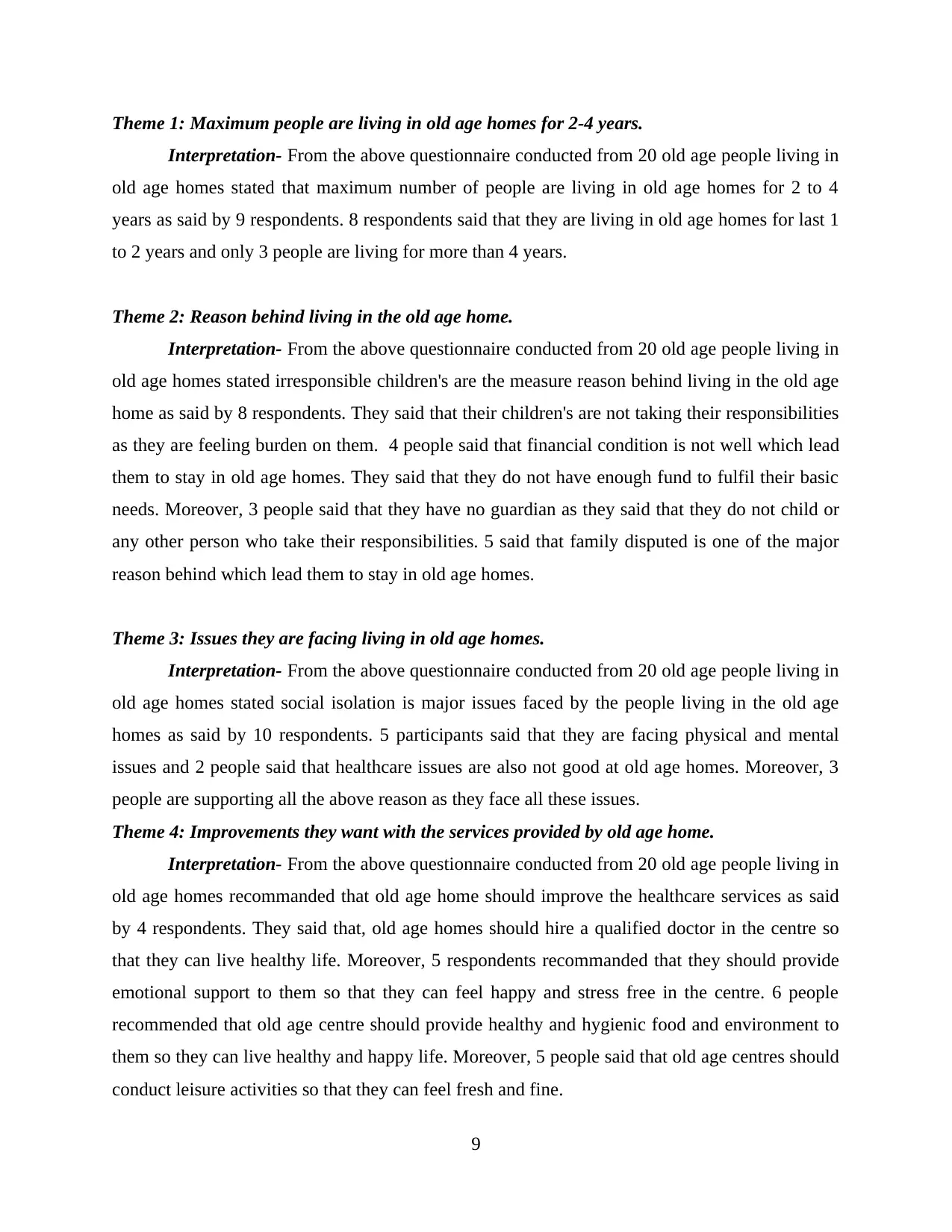
Theme 1: Maximum people are living in old age homes for 2-4 years.
Interpretation- From the above questionnaire conducted from 20 old age people living in
old age homes stated that maximum number of people are living in old age homes for 2 to 4
years as said by 9 respondents. 8 respondents said that they are living in old age homes for last 1
to 2 years and only 3 people are living for more than 4 years.
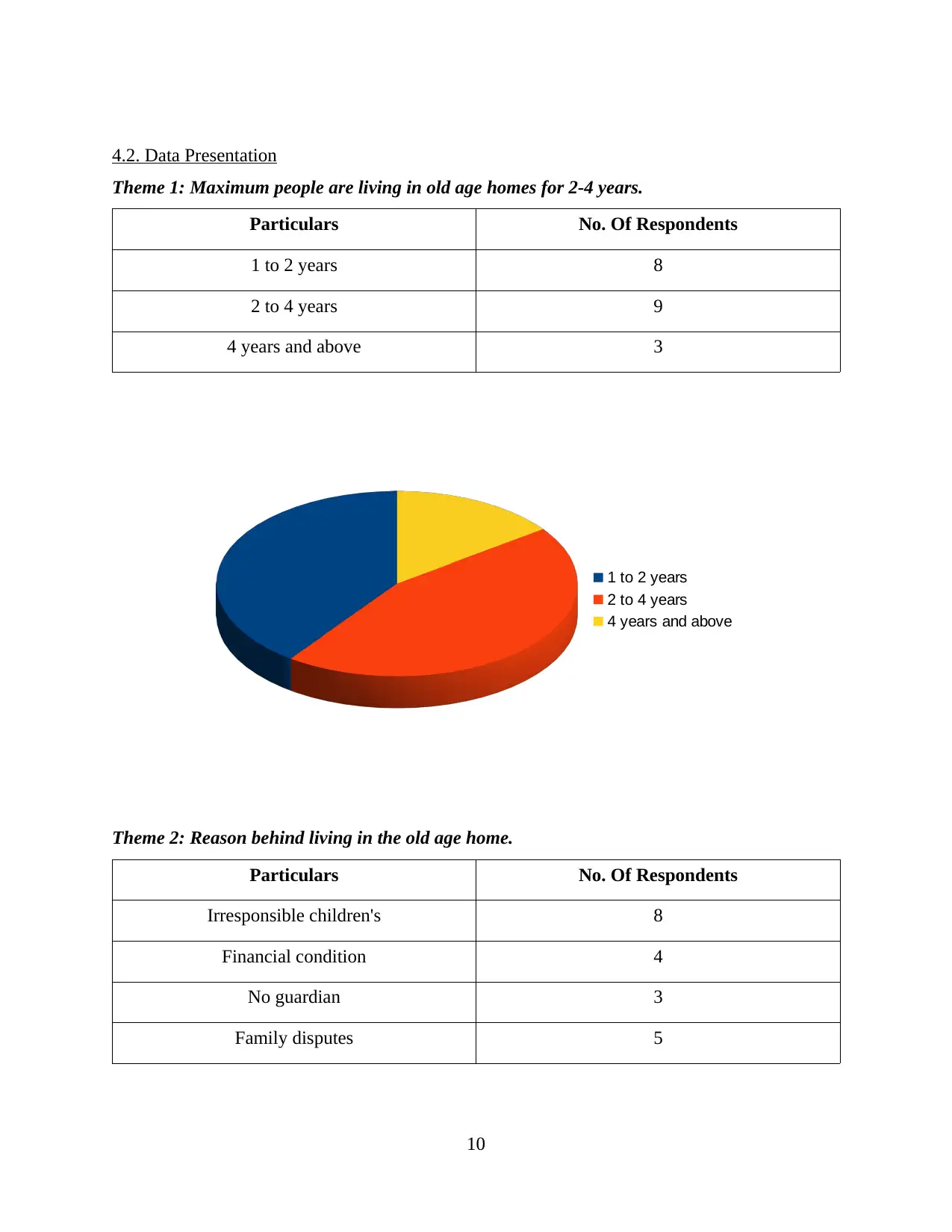
Theme 2: Reason behind living in the old age home.
Interpretation- From the above questionnaire conducted from 20 old age people living in
old age homes stated irresponsible children's are the measure reason behind living in the old age
home as said by 8 respondents. They said that their children's are not taking their responsibilities
as they are feeling burden on them. 4 people said that financial condition is not well which lead
them to stay in old age homes. They said that they do not have enough fund to fulfil their basic
needs. Moreover, 3 people said that they have no guardian as they said that they do not child or
any other person who take their responsibilities. 5 said that family disputed is one of the major
reason behind which lead them to stay in old age homes.
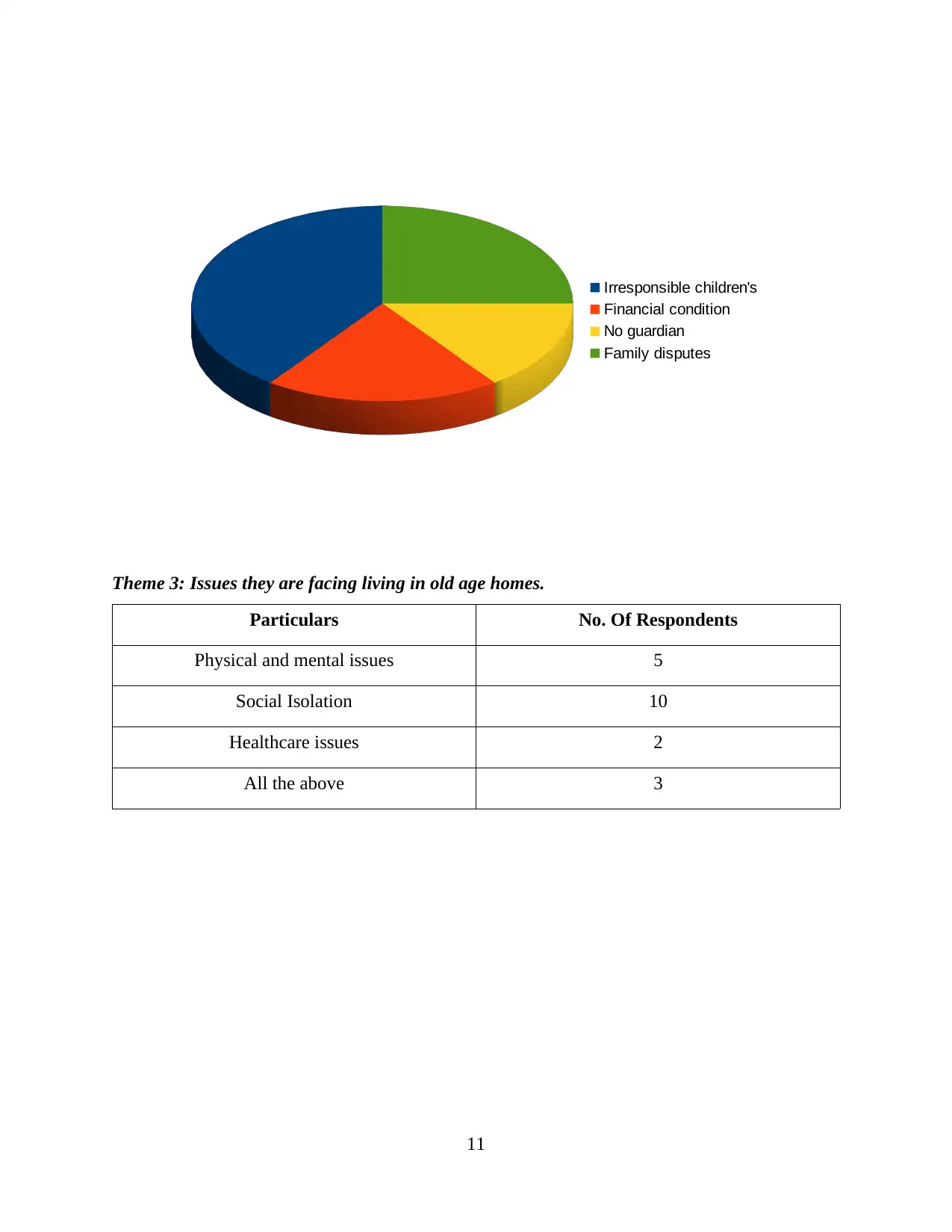
Theme 3: Issues they are facing living in old age homes.
Interpretation- From the above questionnaire conducted from 20 old age people living in
old age homes stated social isolation is major issues faced by the people living in the old age
homes as said by 10 respondents. 5 participants said that they are facing physical and mental
issues and 2 people said that healthcare issues are also not good at old age homes. Moreover, 3
people are supporting all the above reason as they face all these issues.
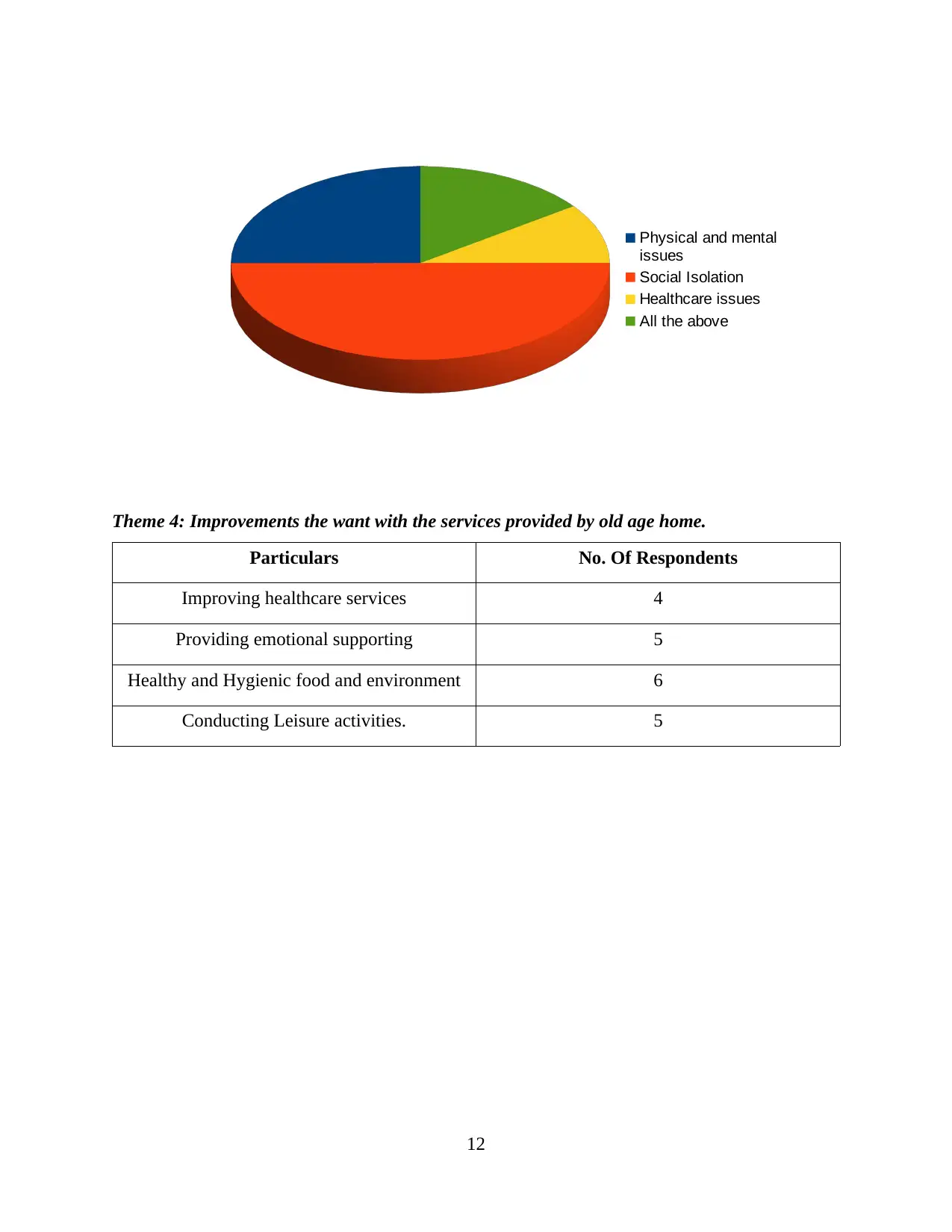
Theme 4: Improvements they want with the services provided by old age home.
Interpretation- From the above questionnaire conducted from 20 old age people living in
old age homes recommanded that old age home should improve the healthcare services as said
by 4 respondents. They said that, old age homes should hire a qualified doctor in the centre so
that they can live healthy life. Moreover, 5 respondents recommanded that they should provide
emotional support to them so that they can feel happy and stress free in the centre. 6 people
recommended that old age centre should provide healthy and hygienic food and environment to
them so they can live healthy and happy life. Moreover, 5 people said that old age centres should
conduct leisure activities so that they can feel fresh and fine.
9
Interpretation- From the above questionnaire conducted from 20 old age people living in
old age homes stated that maximum number of people are living in old age homes for 2 to 4
years as said by 9 respondents. 8 respondents said that they are living in old age homes for last 1
to 2 years and only 3 people are living for more than 4 years.
Theme 2: Reason behind living in the old age home.
Interpretation- From the above questionnaire conducted from 20 old age people living in
old age homes stated irresponsible children's are the measure reason behind living in the old age
home as said by 8 respondents. They said that their children's are not taking their responsibilities
as they are feeling burden on them. 4 people said that financial condition is not well which lead
them to stay in old age homes. They said that they do not have enough fund to fulfil their basic
needs. Moreover, 3 people said that they have no guardian as they said that they do not child or
any other person who take their responsibilities. 5 said that family disputed is one of the major
reason behind which lead them to stay in old age homes.
Theme 3: Issues they are facing living in old age homes.
Interpretation- From the above questionnaire conducted from 20 old age people living in
old age homes stated social isolation is major issues faced by the people living in the old age
homes as said by 10 respondents. 5 participants said that they are facing physical and mental
issues and 2 people said that healthcare issues are also not good at old age homes. Moreover, 3
people are supporting all the above reason as they face all these issues.
Theme 4: Improvements they want with the services provided by old age home.
Interpretation- From the above questionnaire conducted from 20 old age people living in
old age homes recommanded that old age home should improve the healthcare services as said
by 4 respondents. They said that, old age homes should hire a qualified doctor in the centre so
that they can live healthy life. Moreover, 5 respondents recommanded that they should provide
emotional support to them so that they can feel happy and stress free in the centre. 6 people
recommended that old age centre should provide healthy and hygienic food and environment to
them so they can live healthy and happy life. Moreover, 5 people said that old age centres should
conduct leisure activities so that they can feel fresh and fine.
9
⊘ This is a preview!⊘
Do you want full access?
Subscribe today to unlock all pages.
Trusted by 1+ million students worldwide
4.2. Data Presentation
Theme 1: Maximum people are living in old age homes for 2-4 years.
Particulars No. Of Respondents
1 to 2 years 8
2 to 4 years 9
4 years and above 3
Theme 2: Reason behind living in the old age home.
Particulars No. Of Respondents
Irresponsible children's 8
Financial condition 4
No guardian 3
Family disputes 5
10
1 to 2 years
2 to 4 years
4 years and above
Theme 1: Maximum people are living in old age homes for 2-4 years.
Particulars No. Of Respondents
1 to 2 years 8
2 to 4 years 9
4 years and above 3
Theme 2: Reason behind living in the old age home.
Particulars No. Of Respondents
Irresponsible children's 8
Financial condition 4
No guardian 3
Family disputes 5
10
1 to 2 years
2 to 4 years
4 years and above
Paraphrase This Document
Need a fresh take? Get an instant paraphrase of this document with our AI Paraphraser
Theme 3: Issues they are facing living in old age homes.
Particulars No. Of Respondents
Physical and mental issues 5
Social Isolation 10
Healthcare issues 2
All the above 3
11
Irresponsible children's
Financial condition
No guardian
Family disputes
Particulars No. Of Respondents
Physical and mental issues 5
Social Isolation 10
Healthcare issues 2
All the above 3
11
Irresponsible children's
Financial condition
No guardian
Family disputes
Theme 4: Improvements the want with the services provided by old age home.
Particulars No. Of Respondents
Improving healthcare services 4
Providing emotional supporting 5
Healthy and Hygienic food and environment 6
Conducting Leisure activities. 5
12
Physical and mental
issues
Social Isolation
Healthcare issues
All the above
Particulars No. Of Respondents
Improving healthcare services 4
Providing emotional supporting 5
Healthy and Hygienic food and environment 6
Conducting Leisure activities. 5
12
Physical and mental
issues
Social Isolation
Healthcare issues
All the above
⊘ This is a preview!⊘
Do you want full access?
Subscribe today to unlock all pages.
Trusted by 1+ million students worldwide

1 out of 14


Related Documents


Your All-in-One AI-Powered Toolkit for Academic Success.
+13062052269
info@desklib.com
Available 24*7 on WhatsApp / Email
![[object Object]](/_next/static/media/star-bottom.7253800d.svg)
Unlock your academic potential
Copyright © 2020–2026 A2Z Services. All Rights Reserved. Developed and managed by ZUCOL.