ECON20039 Essay: Price Elasticity of Demand, Oligopoly, Climate Change
VerifiedAdded on 2022/09/01
|14
|3664
|17
Essay
AI Summary
This essay delves into the economic principles of price elasticity of demand, exploring its types, importance, and role in producer pricing decisions, supported by real-world examples of elastic and inelastic goods. The analysis extends to the characteristics of oligopoly market structures, with a specific focus on the car manufacturing industry, examining the impacts of product differentiation and advertising within this context. Furthermore, the essay addresses the economic consequences of climate change, discussing its causes, environmental, societal, and economic effects, and highlighting preventive measures implemented by the Australian government. The essay integrates economic theory with practical applications, providing a comprehensive overview of these interconnected topics.

Running head: ECONOMICS
Economics
Name of the Student
Name of the University
Author note
Economics
Name of the Student
Name of the University
Author note

Paraphrase This Document
Need a fresh take? Get an instant paraphrase of this document with our AI Paraphraser
1ECONOMICS
Introduction
This paper intends to discuss the price elasticity of demand and its importance in deciding
the price of the producers. This paper also includes the characteristics of oligopoly market
structure. It also taken into consideration car manufacturing industry, which operates under
oligopoly structure. This paper examines the role of product differentiation and advertising on
car manufacturing industry (Wang et al., 2015). This paper emphasizes on climate change, which
a most important aspect of economy. It analyses the effects of the climate change on the
environment, society and economy. This paper also discusses the preventive measures taken by
the government of Australia in order to protect the environment, economy and society.
(a) Price elasticity of demand
The types and concept of price elasticity of demand and its importance
The changes in quantity demanded of a goods and services with the change in price,
while keeping all other factors constant is called price elasticity of demand. More specifically,
price elasticity of demand (PED) shows the percentage change in quantity demand with the
percentage change in price (Hursh & Roma, 2016). In general, price elasticity of demand is
negative. However, it can be positive in case of goods like Giffen and Veblen goods. There are
five types of price elasticity of demand such as perfectly elastic demand, relatively elastic
demand, perfectly inelastic demand, unitary elastic demand and relatively inelastic demand.
When a small change in price leads to large change in quantity demanded, then it is known as the
perfectly elastic demand. Moreover, it is also called infinite elasticity. It is denoted by EP is
equal to ∞. On the contrary, when a change in price does not lead to any change in quantity
Introduction
This paper intends to discuss the price elasticity of demand and its importance in deciding
the price of the producers. This paper also includes the characteristics of oligopoly market
structure. It also taken into consideration car manufacturing industry, which operates under
oligopoly structure. This paper examines the role of product differentiation and advertising on
car manufacturing industry (Wang et al., 2015). This paper emphasizes on climate change, which
a most important aspect of economy. It analyses the effects of the climate change on the
environment, society and economy. This paper also discusses the preventive measures taken by
the government of Australia in order to protect the environment, economy and society.
(a) Price elasticity of demand
The types and concept of price elasticity of demand and its importance
The changes in quantity demanded of a goods and services with the change in price,
while keeping all other factors constant is called price elasticity of demand. More specifically,
price elasticity of demand (PED) shows the percentage change in quantity demand with the
percentage change in price (Hursh & Roma, 2016). In general, price elasticity of demand is
negative. However, it can be positive in case of goods like Giffen and Veblen goods. There are
five types of price elasticity of demand such as perfectly elastic demand, relatively elastic
demand, perfectly inelastic demand, unitary elastic demand and relatively inelastic demand.
When a small change in price leads to large change in quantity demanded, then it is known as the
perfectly elastic demand. Moreover, it is also called infinite elasticity. It is denoted by EP is
equal to ∞. On the contrary, when a change in price does not lead to any change in quantity
2ECONOMICS
demanded is called perfectly inelastic demand. It is denoted by EP is equal to 0. It is also known
as zero elasticity.
When the percentage change in price is equal to the percentage change in quantity
demanded, then it is known as unitary elastic demand (Bönte et al., 2015). It also known as
unitary elasticity. It is denoted by EP is equal to 1. When a large change in price leads to small
change in quantity demanded is called relatively inelastic demand. It is also known as inelastic or
less elastic demand. It is denoted by EP is less than 1. Likewise, when a small change in price
leads to large change in quantity demanded is called relatively elastic demand. It is also known
as elastic or highly elastic demand. It is denote by EP is greater than 1. It is one of the most
essential tool to determine price of a product. It is important to know the elasticity of demand of
that particular product. There are wide range of application of price elasticity of demand in
economics. Elasticity of demand plays vital role in international trade, determination of price
policy, shifting of tax burden, price discrimination, determination of factors prices, taxation and
subsidy policy, determination of sale policy for super market, public utility and pricing of joint
supply products.
The estimation of actual elasticity of demand and its magnitudes
The price elasticity of demand of any product depends on whether the demand for the
goods is elastic or inelastic. There are several elastic and inelastic goods available in market.
There exists various substitutes of the elastic goods. Whereas inelastic goods have few or no
substitutes. Thus, it makes inelastic goods irreplaceable. Basically, the items such as non-
necessities and luxury comes under elastic goods. Here, the price elasticity of demand for coffee
has taken into consideration to understand the difference with inelastic goods. Coffee is an
demanded is called perfectly inelastic demand. It is denoted by EP is equal to 0. It is also known
as zero elasticity.
When the percentage change in price is equal to the percentage change in quantity
demanded, then it is known as unitary elastic demand (Bönte et al., 2015). It also known as
unitary elasticity. It is denoted by EP is equal to 1. When a large change in price leads to small
change in quantity demanded is called relatively inelastic demand. It is also known as inelastic or
less elastic demand. It is denoted by EP is less than 1. Likewise, when a small change in price
leads to large change in quantity demanded is called relatively elastic demand. It is also known
as elastic or highly elastic demand. It is denote by EP is greater than 1. It is one of the most
essential tool to determine price of a product. It is important to know the elasticity of demand of
that particular product. There are wide range of application of price elasticity of demand in
economics. Elasticity of demand plays vital role in international trade, determination of price
policy, shifting of tax burden, price discrimination, determination of factors prices, taxation and
subsidy policy, determination of sale policy for super market, public utility and pricing of joint
supply products.
The estimation of actual elasticity of demand and its magnitudes
The price elasticity of demand of any product depends on whether the demand for the
goods is elastic or inelastic. There are several elastic and inelastic goods available in market.
There exists various substitutes of the elastic goods. Whereas inelastic goods have few or no
substitutes. Thus, it makes inelastic goods irreplaceable. Basically, the items such as non-
necessities and luxury comes under elastic goods. Here, the price elasticity of demand for coffee
has taken into consideration to understand the difference with inelastic goods. Coffee is an
⊘ This is a preview!⊘
Do you want full access?
Subscribe today to unlock all pages.

Trusted by 1+ million students worldwide
3ECONOMICS
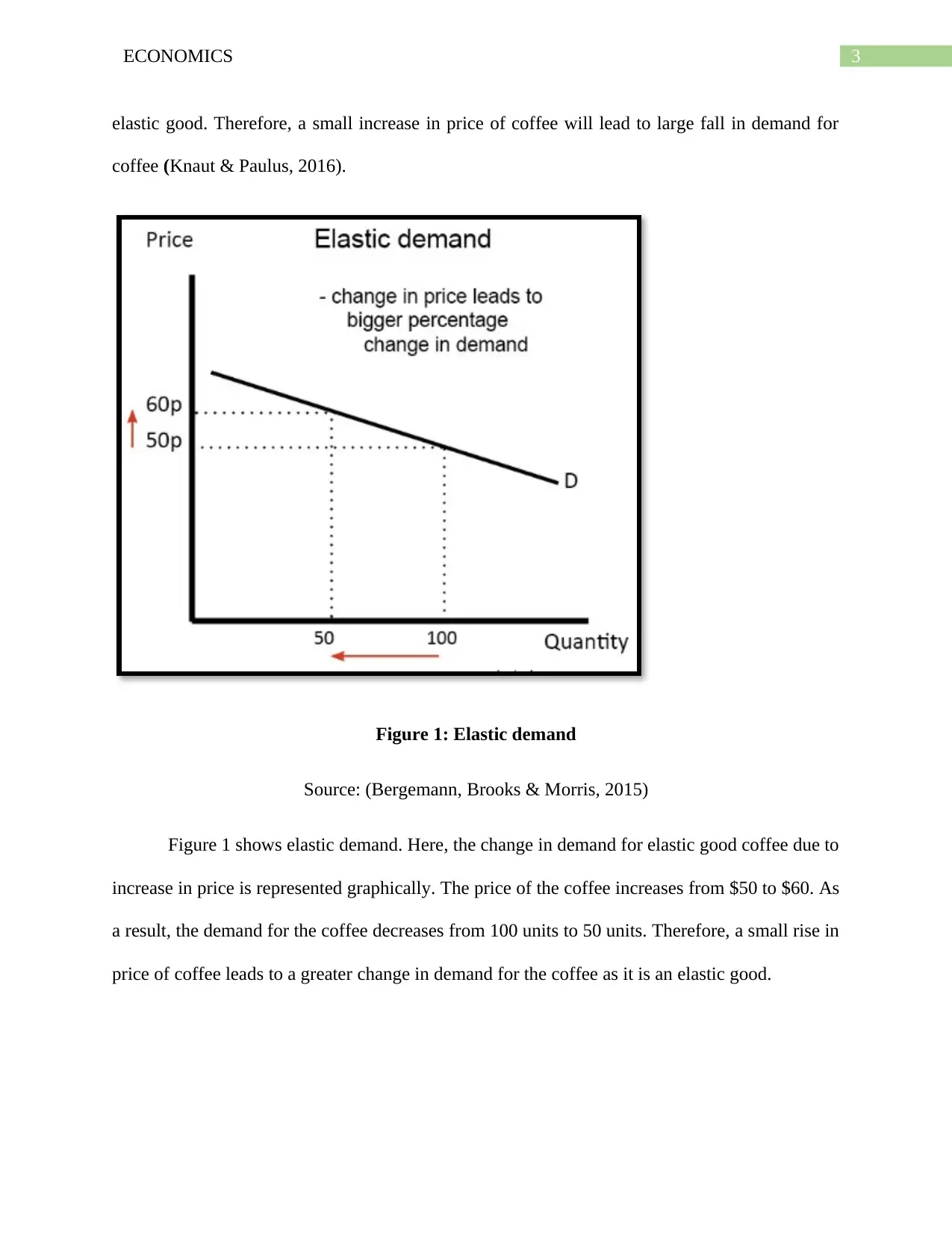
elastic good. Therefore, a small increase in price of coffee will lead to large fall in demand for
coffee (Knaut & Paulus, 2016).
Figure 1: Elastic demand
Source: (Bergemann, Brooks & Morris, 2015)
Figure 1 shows elastic demand. Here, the change in demand for elastic good coffee due to
increase in price is represented graphically. The price of the coffee increases from $50 to $60. As
a result, the demand for the coffee decreases from 100 units to 50 units. Therefore, a small rise in
price of coffee leads to a greater change in demand for the coffee as it is an elastic good.
elastic good. Therefore, a small increase in price of coffee will lead to large fall in demand for
coffee (Knaut & Paulus, 2016).
Figure 1: Elastic demand
Source: (Bergemann, Brooks & Morris, 2015)
Figure 1 shows elastic demand. Here, the change in demand for elastic good coffee due to
increase in price is represented graphically. The price of the coffee increases from $50 to $60. As
a result, the demand for the coffee decreases from 100 units to 50 units. Therefore, a small rise in
price of coffee leads to a greater change in demand for the coffee as it is an elastic good.
Paraphrase This Document
Need a fresh take? Get an instant paraphrase of this document with our AI Paraphraser
4ECONOMICS
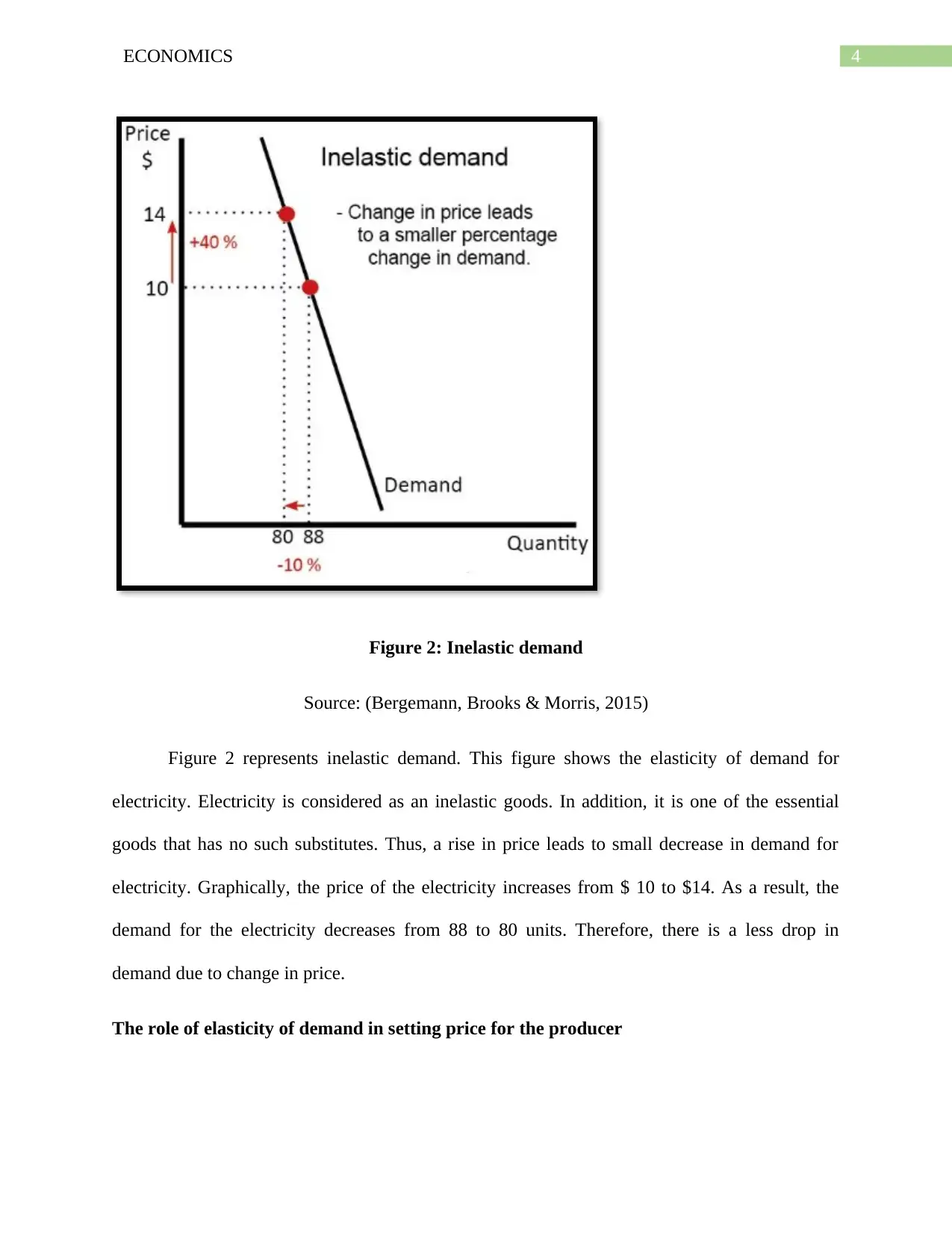
Figure 2: Inelastic demand
Source: (Bergemann, Brooks & Morris, 2015)
Figure 2 represents inelastic demand. This figure shows the elasticity of demand for
electricity. Electricity is considered as an inelastic goods. In addition, it is one of the essential
goods that has no such substitutes. Thus, a rise in price leads to small decrease in demand for
electricity. Graphically, the price of the electricity increases from $ 10 to $14. As a result, the
demand for the electricity decreases from 88 to 80 units. Therefore, there is a less drop in
demand due to change in price.
The role of elasticity of demand in setting price for the producer
Figure 2: Inelastic demand
Source: (Bergemann, Brooks & Morris, 2015)
Figure 2 represents inelastic demand. This figure shows the elasticity of demand for
electricity. Electricity is considered as an inelastic goods. In addition, it is one of the essential
goods that has no such substitutes. Thus, a rise in price leads to small decrease in demand for
electricity. Graphically, the price of the electricity increases from $ 10 to $14. As a result, the
demand for the electricity decreases from 88 to 80 units. Therefore, there is a less drop in
demand due to change in price.
The role of elasticity of demand in setting price for the producer
5ECONOMICS
The role of price elasticity of demand is significant in determining the price for the
producer. Before fixing a price of a product, the producer taken into consideration the price
elasticity of demand (Colchero et al., 2015). He identifies how the demand of the product will
react with the change in price of product. Therefore, if by lowering the price, the demand of the
product stimulates, then it would also result in increase in profit. The responsiveness of quantity
demanded with respect to price helps to decide the level of change in price. Hence, the
knowledge of the price elasticity of demand helps in determining the price for the producer.
(b) Oligopolistic market
Key features of oligopoly
A market structure which consists of few numbers of firms, which greatly influence other
factors and price of the market. The main features of this market form includes advertising,
interdependence, group behaviour, barriers to entry, no unique pattern of pricing behaviour,
competition, lack of uniformity, indeterminateness of demand curve and existence of price
rigidity (Chen & Lawell, 2019). The most important characteristics of an oligopoly market form
is interdependence. All the participating organizations of the oligopoly market structure are
interdependent in terms of decision making. Any change in strategy of one firm will affect other
rival firms of the industry. Thus, the rival firms stay vigilant about any initiates and policy
changes of the firms. One of the most essential tools of an oligopoly firm is advertising, which
brings significant changes. Group behaviour plays a vital role in the oligopolistic market
structure. Thus, the group may have a common goal. Any step taken by the one firm of the group
would impact the performance of the whole group (Brander & Spencer, 2015). To maintain a
true competition in the market, each firm closely analyse moves of each firm. Higher capital
requirements and economies of scale restricts the entry by any new firm.
The role of price elasticity of demand is significant in determining the price for the
producer. Before fixing a price of a product, the producer taken into consideration the price
elasticity of demand (Colchero et al., 2015). He identifies how the demand of the product will
react with the change in price of product. Therefore, if by lowering the price, the demand of the
product stimulates, then it would also result in increase in profit. The responsiveness of quantity
demanded with respect to price helps to decide the level of change in price. Hence, the
knowledge of the price elasticity of demand helps in determining the price for the producer.
(b) Oligopolistic market
Key features of oligopoly
A market structure which consists of few numbers of firms, which greatly influence other
factors and price of the market. The main features of this market form includes advertising,
interdependence, group behaviour, barriers to entry, no unique pattern of pricing behaviour,
competition, lack of uniformity, indeterminateness of demand curve and existence of price
rigidity (Chen & Lawell, 2019). The most important characteristics of an oligopoly market form
is interdependence. All the participating organizations of the oligopoly market structure are
interdependent in terms of decision making. Any change in strategy of one firm will affect other
rival firms of the industry. Thus, the rival firms stay vigilant about any initiates and policy
changes of the firms. One of the most essential tools of an oligopoly firm is advertising, which
brings significant changes. Group behaviour plays a vital role in the oligopolistic market
structure. Thus, the group may have a common goal. Any step taken by the one firm of the group
would impact the performance of the whole group (Brander & Spencer, 2015). To maintain a
true competition in the market, each firm closely analyse moves of each firm. Higher capital
requirements and economies of scale restricts the entry by any new firm.
⊘ This is a preview!⊘
Do you want full access?
Subscribe today to unlock all pages.
Trusted by 1+ million students worldwide
6ECONOMICS
The car manufacturing industry and its oligopolistic characteristics
The structure of the car manufacturing industry is oligopoly. In this market structure,
small numbers of firms sells differentiated or homogenous products. The car manufacturing
industry includes design, manufacturing, development, selling and marketing of motor vehicles.
It is also known as automotive industry (Dadpay, Yilmaz & Xie, 2019). The oligopolistic
characteristics of the car manufacturing industry involves interdependence of companies,
competition, barriers to entry, advertising. All the companies of the car manufacturing industry
are interdependent. As the decision of firm will influence the whole market. The high entry cost
of the industry make it difficult for new firm to enter the market. Moreover, in the oligopolistic
car manufacturing industry, the number of companies is lesser in comparison with numbers of
customer. Thus, the competition remains very high. One rival affects the business of other rivals
easily. The role of advertising is significant in this industry. Advertising helps to attract large
numbers of customers in car manufacturing industry. Hence, the performance of the companies
can be manipulated with the help of this powerful tool.
The impact of product differentiation and advertising in car manufacturing industry
The major factors that affect the car manufacturing industry includes advertising and
product differentiation. Both are part of marketing strategy of an organization. Product
differentiation is a tool, which is used to differentiate the product or services of the organization
from the competition (Head & Spencer, 2017). It is a widely used tool in car manufacturing
industry. In the process of product differentiation, the unique offerings of the organization is
identified and communicated in order to highlight the differences between the unique offerings
of the organization and products offered by other organization on the market. It is useful tool that
creates a robust value proposition. In addition, this value proposition makes the services or
The car manufacturing industry and its oligopolistic characteristics
The structure of the car manufacturing industry is oligopoly. In this market structure,
small numbers of firms sells differentiated or homogenous products. The car manufacturing
industry includes design, manufacturing, development, selling and marketing of motor vehicles.
It is also known as automotive industry (Dadpay, Yilmaz & Xie, 2019). The oligopolistic
characteristics of the car manufacturing industry involves interdependence of companies,
competition, barriers to entry, advertising. All the companies of the car manufacturing industry
are interdependent. As the decision of firm will influence the whole market. The high entry cost
of the industry make it difficult for new firm to enter the market. Moreover, in the oligopolistic
car manufacturing industry, the number of companies is lesser in comparison with numbers of
customer. Thus, the competition remains very high. One rival affects the business of other rivals
easily. The role of advertising is significant in this industry. Advertising helps to attract large
numbers of customers in car manufacturing industry. Hence, the performance of the companies
can be manipulated with the help of this powerful tool.
The impact of product differentiation and advertising in car manufacturing industry
The major factors that affect the car manufacturing industry includes advertising and
product differentiation. Both are part of marketing strategy of an organization. Product
differentiation is a tool, which is used to differentiate the product or services of the organization
from the competition (Head & Spencer, 2017). It is a widely used tool in car manufacturing
industry. In the process of product differentiation, the unique offerings of the organization is
identified and communicated in order to highlight the differences between the unique offerings
of the organization and products offered by other organization on the market. It is useful tool that
creates a robust value proposition. In addition, this value proposition makes the services or
Paraphrase This Document
Need a fresh take? Get an instant paraphrase of this document with our AI Paraphraser
7ECONOMICS
products of the organization lucrative to a particular target customers or market. Therefore,
product differentiation in car manufacturing industry develops a competitive advantage for the
organization. It strengthens the process of marketing. Moreover, it also creates brand awareness.
Another important marketing tool is advertising, which goes hand in hand with product
differentiation. The marketing communication such as advertising involves non-personal and
openly sponsored messages to sell or promote a service, product or idea. Advertising helps to
reach the unique offerings of the organization to the customers or market (Murry, 2017). It
creates awareness about the services or products of the organization. In addition, it also
highlights the unique offerings of the organization to establish the brand value. As car
manufacturing industry operates under oligopoly market structure (Schroeder & Tremblay,
2016). Thus, it may easily influence the market and other organization operating in the market
with its product differentiation and advertising tool. After the process of product differentiation,
the organization spread the message through several mass media including new media and
traditional media. New media includes social media, search results, text or website message and
blogs helps in marketing of the products or services. Moreover, traditional media includes radio,
television, magazines, newspapers, direct mail or outdoor advertising also plays a pivotal role in
advertising.
(c) The economic consequences of climate change
The causes and consequences of climate change
When there is a typical imbalance in climatic conditions like wind patterns, precipitations
and heat, it is known as climate change. In general, it is characterized by climate change in all
regions of the earth (Lares & Lehenbauer, 2019). The climate change is a serious environmental
products of the organization lucrative to a particular target customers or market. Therefore,
product differentiation in car manufacturing industry develops a competitive advantage for the
organization. It strengthens the process of marketing. Moreover, it also creates brand awareness.
Another important marketing tool is advertising, which goes hand in hand with product
differentiation. The marketing communication such as advertising involves non-personal and
openly sponsored messages to sell or promote a service, product or idea. Advertising helps to
reach the unique offerings of the organization to the customers or market (Murry, 2017). It
creates awareness about the services or products of the organization. In addition, it also
highlights the unique offerings of the organization to establish the brand value. As car
manufacturing industry operates under oligopoly market structure (Schroeder & Tremblay,
2016). Thus, it may easily influence the market and other organization operating in the market
with its product differentiation and advertising tool. After the process of product differentiation,
the organization spread the message through several mass media including new media and
traditional media. New media includes social media, search results, text or website message and
blogs helps in marketing of the products or services. Moreover, traditional media includes radio,
television, magazines, newspapers, direct mail or outdoor advertising also plays a pivotal role in
advertising.
(c) The economic consequences of climate change
The causes and consequences of climate change
When there is a typical imbalance in climatic conditions like wind patterns, precipitations
and heat, it is known as climate change. In general, it is characterized by climate change in all
regions of the earth (Lares & Lehenbauer, 2019). The climate change is a serious environmental
8ECONOMICS
problem, which affects the whole living beings as well as earth. The problem is increasing at
alarming rate. Therefore, awareness about the consequences and causes of climate change is
required. The boost in anthropogenic activity of greenhouse gases leads to climate change. It
releases excessive heats in the atmosphere. The main contributory factor of the greenhouse effect
involves carbon dioxide. The maximum amount of carbon dioxide generates from the
combustion of oil, natural gas and coal in factories, power plants and cars as well as from
deforestation. Another greenhouse gas which plays a major role in the greenhouse effect includes
methane (Crate & Nuttall, 2016). The emission of harmful methane caused by activities such as
mining, cattle breeding, waste dumps, gas pipelines and rice farms. In addition, the corrosion of
ozone layer is caused by chlorofluorocarbons (CFCs).
These gases retains more heat, which results in global warming. The complex lifestyle
followed by the human society leads to increase in energy use (Bulkeley & Newell, 2015). As a
result, to fulfil the growing demand for the energy, the burning of fossil fuels like gas, coal and
oil also scales up. Thus, the proportion of greenhouse gases in the atmosphere also rises.
Therefore, the contribution of human is huge in increasing the greenhouse gases and global
warming. There are various risks associated with the greenhouse gas effect other than heating the
planet. Furthermore, several consequences of the climate change is related to greenhouse effect
(Schuur et al., 2015). Climate change results in large change in climate patterns. There exists
several social, environmental and economic consequences of climate change.
One of the major problem of the climate change is shortage in drinking water stocks. It is
predicted that the loss of drinking water will intensify within 50 years. Moreover, the number of
people suffering from shortages in drinking water will hike from 5 billion to 8 billion. Climate
change also affects the agricultural production (Huang et al., 2016). It reduces the agricultural
problem, which affects the whole living beings as well as earth. The problem is increasing at
alarming rate. Therefore, awareness about the consequences and causes of climate change is
required. The boost in anthropogenic activity of greenhouse gases leads to climate change. It
releases excessive heats in the atmosphere. The main contributory factor of the greenhouse effect
involves carbon dioxide. The maximum amount of carbon dioxide generates from the
combustion of oil, natural gas and coal in factories, power plants and cars as well as from
deforestation. Another greenhouse gas which plays a major role in the greenhouse effect includes
methane (Crate & Nuttall, 2016). The emission of harmful methane caused by activities such as
mining, cattle breeding, waste dumps, gas pipelines and rice farms. In addition, the corrosion of
ozone layer is caused by chlorofluorocarbons (CFCs).
These gases retains more heat, which results in global warming. The complex lifestyle
followed by the human society leads to increase in energy use (Bulkeley & Newell, 2015). As a
result, to fulfil the growing demand for the energy, the burning of fossil fuels like gas, coal and
oil also scales up. Thus, the proportion of greenhouse gases in the atmosphere also rises.
Therefore, the contribution of human is huge in increasing the greenhouse gases and global
warming. There are various risks associated with the greenhouse gas effect other than heating the
planet. Furthermore, several consequences of the climate change is related to greenhouse effect
(Schuur et al., 2015). Climate change results in large change in climate patterns. There exists
several social, environmental and economic consequences of climate change.
One of the major problem of the climate change is shortage in drinking water stocks. It is
predicted that the loss of drinking water will intensify within 50 years. Moreover, the number of
people suffering from shortages in drinking water will hike from 5 billion to 8 billion. Climate
change also affects the agricultural production (Huang et al., 2016). It reduces the agricultural
⊘ This is a preview!⊘
Do you want full access?
Subscribe today to unlock all pages.
Trusted by 1+ million students worldwide
9ECONOMICS
crop due to change drastic change in climate patterns. As a result, the food stock also declines.
The change in climate will bring changing rainfall pattern, changing plant habits and increasing
drought. Therefore, there will be exacerbation in desertification. It will reduce the fertility of soil.
Moreover, it will worsen erosion. Another major consequence of the climate change is high
temperature, which is favourable condition for increase in diseases and pests. Hence, the spread
of diseases rises in high temperature.
Steps taken by Australia to address climate change
In order to control growing climate change, most of the countries of world singed Paris
Climate Agreement (Saltré et al., 2016). Australia also took various steps to control climate
change. Australia planned to reduce its emission level from 2005 by decreasing 26-28% emission
within 2030 under Paris Climate Agreement. Though, the goals of Australia has been criticized
for being too low. However, the government of Australia launched the Emissions Reduction
Fund (ERF) under climate plan of central. The major emissions in Australia is done by the
farmers and businesses. In order to help them reduce the emission level, government invested an
amount of 2 billion Australian dollars (Howes et al., 2015). In addition, it also planned to scale
up the amount from 2 billion Australian dollars to 4.5 billion Australian dollars within 15 years.
It is considered as one of the important step of the Australian government to control the emission
level in the country. The government of Australia estimated that it would decline the emission
level by 100 million tonnes. As the global temperature is record high and every country should
take necessary measures to prevent increasing heat. Australia took various measures to control
emissions from its coal mines. Carbon tax is another form of control measure, which is
implemented by the government of Australia. It is applicable for the organizations those who
crop due to change drastic change in climate patterns. As a result, the food stock also declines.
The change in climate will bring changing rainfall pattern, changing plant habits and increasing
drought. Therefore, there will be exacerbation in desertification. It will reduce the fertility of soil.
Moreover, it will worsen erosion. Another major consequence of the climate change is high
temperature, which is favourable condition for increase in diseases and pests. Hence, the spread
of diseases rises in high temperature.
Steps taken by Australia to address climate change
In order to control growing climate change, most of the countries of world singed Paris
Climate Agreement (Saltré et al., 2016). Australia also took various steps to control climate
change. Australia planned to reduce its emission level from 2005 by decreasing 26-28% emission
within 2030 under Paris Climate Agreement. Though, the goals of Australia has been criticized
for being too low. However, the government of Australia launched the Emissions Reduction
Fund (ERF) under climate plan of central. The major emissions in Australia is done by the
farmers and businesses. In order to help them reduce the emission level, government invested an
amount of 2 billion Australian dollars (Howes et al., 2015). In addition, it also planned to scale
up the amount from 2 billion Australian dollars to 4.5 billion Australian dollars within 15 years.
It is considered as one of the important step of the Australian government to control the emission
level in the country. The government of Australia estimated that it would decline the emission
level by 100 million tonnes. As the global temperature is record high and every country should
take necessary measures to prevent increasing heat. Australia took various measures to control
emissions from its coal mines. Carbon tax is another form of control measure, which is
implemented by the government of Australia. It is applicable for the organizations those who
Paraphrase This Document
Need a fresh take? Get an instant paraphrase of this document with our AI Paraphraser
10ECONOMICS
exceeds the mandated limits of the emissions. Hence, it helps significantly in reduction of
emission level.
Conclusion
There are various types of goods according to their elasticity of demand. Moreover,
coffee is considered as the elastic good and electricity is considered as inelastic good. Therefore,
a small hike in price brings greater drop in demand in case of coffee. On the contrary, a hike in
price brings small drop in demand for electricity. As few firms operate in oligopoly market
structure decision taken by one firm would influence other firms as well as whole market.
Therefore, the marketing features such as product differentiation and advertising influence the
car manufacturing industry significantly. Climate change plays an essential role in the growth
and development of a country and world. To prevent the recent drastic change in climatic
pattern, government of Australia took several steps such as carbon tax and financial aid.
exceeds the mandated limits of the emissions. Hence, it helps significantly in reduction of
emission level.
Conclusion
There are various types of goods according to their elasticity of demand. Moreover,
coffee is considered as the elastic good and electricity is considered as inelastic good. Therefore,
a small hike in price brings greater drop in demand in case of coffee. On the contrary, a hike in
price brings small drop in demand for electricity. As few firms operate in oligopoly market
structure decision taken by one firm would influence other firms as well as whole market.
Therefore, the marketing features such as product differentiation and advertising influence the
car manufacturing industry significantly. Climate change plays an essential role in the growth
and development of a country and world. To prevent the recent drastic change in climatic
pattern, government of Australia took several steps such as carbon tax and financial aid.
11ECONOMICS
References
Bergemann, D., Brooks, B., & Morris, S. (2015). The limits of price discrimination. American
Economic Review, 105(3), 921-57.
Bönte, W., Nielen, S., Valitov, N., & Engelmeyer, T. (2015). Price elasticity of demand in the
EPEX spot market for electricity—New empirical evidence. Economics Letters, 135, 5-8.
Brander, J. A., & Spencer, B. J. (2015). Intra-industry trade with Bertrand and Cournot
oligopoly: The role of endogenous horizontal product differentiation. Research in
Economics, 69(2), 157-165.
Bulkeley, H., & Newell, P. (2015). Governing climate change. Routledge.
Chen, Y., & Lawell, C. Y. C. L. (2019). Supply and Demand in the Chinese Automobile Market:
A Random Coefficients Mixed Oligopolistic Differentiated Products Model1.
Colchero, M. A., Salgado, J. C., Unar-Munguía, M., Hernandez-Avila, M., & Rivera-Dommarco,
J. A. (2015). Price elasticity of the demand for sugar sweetened beverages and soft drinks
in Mexico. Economics & Human Biology, 19, 129-137.
Crate, S. A., & Nuttall, M. (Eds.). (2016). Anthropology and climate change: from encounters to
actions. Routledge.
Dadpay, A., Yilmaz, H., & Xie, J. (2019). Entry Barriers to Motivate Multinational Joint
Ventures: A Mixed Oligopoly Analysis.
Gabszewicz, J. J., & Tarola, O. (2018). Oligopoly and product differentiation. Handbook of
Game Theory and Industrial Organization, Volume I, 1, 137.
References
Bergemann, D., Brooks, B., & Morris, S. (2015). The limits of price discrimination. American
Economic Review, 105(3), 921-57.
Bönte, W., Nielen, S., Valitov, N., & Engelmeyer, T. (2015). Price elasticity of demand in the
EPEX spot market for electricity—New empirical evidence. Economics Letters, 135, 5-8.
Brander, J. A., & Spencer, B. J. (2015). Intra-industry trade with Bertrand and Cournot
oligopoly: The role of endogenous horizontal product differentiation. Research in
Economics, 69(2), 157-165.
Bulkeley, H., & Newell, P. (2015). Governing climate change. Routledge.
Chen, Y., & Lawell, C. Y. C. L. (2019). Supply and Demand in the Chinese Automobile Market:
A Random Coefficients Mixed Oligopolistic Differentiated Products Model1.
Colchero, M. A., Salgado, J. C., Unar-Munguía, M., Hernandez-Avila, M., & Rivera-Dommarco,
J. A. (2015). Price elasticity of the demand for sugar sweetened beverages and soft drinks
in Mexico. Economics & Human Biology, 19, 129-137.
Crate, S. A., & Nuttall, M. (Eds.). (2016). Anthropology and climate change: from encounters to
actions. Routledge.
Dadpay, A., Yilmaz, H., & Xie, J. (2019). Entry Barriers to Motivate Multinational Joint
Ventures: A Mixed Oligopoly Analysis.
Gabszewicz, J. J., & Tarola, O. (2018). Oligopoly and product differentiation. Handbook of
Game Theory and Industrial Organization, Volume I, 1, 137.
⊘ This is a preview!⊘
Do you want full access?
Subscribe today to unlock all pages.
Trusted by 1+ million students worldwide

1 out of 14


Related Documents


Your All-in-One AI-Powered Toolkit for Academic Success.
+13062052269
info@desklib.com
Available 24*7 on WhatsApp / Email
![[object Object]](/_next/static/media/star-bottom.7253800d.svg)
Unlock your academic potential
Copyright © 2020–2026 A2Z Services. All Rights Reserved. Developed and managed by ZUCOL.