Analysis of Oligopoly Markets: Features, Structure, and Examples
VerifiedAdded on 2020/01/07
|7
|1599
|657
Essay
AI Summary
This essay provides a comprehensive analysis of oligopoly, a market structure characterized by a small number of firms dominating the market. It begins by defining oligopoly and contrasting it with monopoly, emphasizing the interdependence of firms within the market. The essay then details the key features of oligopoly, including few sellers, interdependence, advertising, lack of uniformity, and barriers to entry and exit. It explores the market structure under oligopoly, highlighting the competitive strategies firms employ, such as advertising and brand promotion, as well as the impact of pricing and output decisions. Real-world examples of oligopoly industries, such as car manufacturing and telecommunications, are provided. Furthermore, the essay explains the kinked demand curve model, which illustrates how firms react to price changes. The conclusion summarizes the key takeaways, emphasizing the interdependence of firms and the strategic considerations involved in oligopoly markets. The document includes references to relevant academic journals and online resources.
OLIGOPOLY
1
1
Paraphrase This Document
Need a fresh take? Get an instant paraphrase of this document with our AI Paraphraser

TABLE OF CONTENTS
SECTION 1 INTRODUCTION......................................................................................................3
SECTION 2 MAIN BODY..............................................................................................................3
SECTION 3 CONCLUSION...........................................................................................................4
REFERENCES ...............................................................................................................................6
2
SECTION 1 INTRODUCTION......................................................................................................3
SECTION 2 MAIN BODY..............................................................................................................3
SECTION 3 CONCLUSION...........................................................................................................4
REFERENCES ...............................................................................................................................6
2

SECTION 1 INTRODUCTION
Oligopoly is considered as the market structure wherein the smaller number of business
possess larger majority of market share (Sushko, 2013). There is similarity among oligopoly and
monopoly except in terms that instead of one firm more than one organizations are involved in
dominating the market. There is lack of preciseness within the upper limit towards the number of
business within an oligopoly. However the number must be low enough that actions of one
business to a significant level affects another (Oligopoly, 2017). In other words oligopoly is
regarded as the form of market or industry which is being dominated by sellers that are smaller
in number. This can result from several firms of collusion that minimize the competition and
results in greater prices for the customers. Oligopoly possess its own structure of market. With
the fewer seller every oligopolist is likely to possess awareness regarding the actions of others. In
accordance with the game theory, the decisions of one business affects and is also influenced by
the other business decisions (Bauer, 2013). The strategic planning by oligopolist is required to
consider responses of participants in the market. It the present investigation in-depth analysis has
been done in relation with the subject that is related with oligopoly.
SECTION 2 MAIN BODY
Features of oligopoly market
There is presence several features that are being possessed by oligopoly market. Such are
as such. The initial one presents that there is presence of few sellers. In case of oligopoly market
there is presence of less number of sellers and more number of customers. Under this there is few
number of firms that dominates the market and take the benefit of controlling the price of the
product (Okuguchi, 2013). Another one is related with interdependence. This is regarded as the
most significant features in relation with oligopoly in which the sellers needs to be cautious in
relation to the actions which rivalry firm can take. A there are few number of sellers within the
market, in case there are any changes made by firm in relation with price all the organizations in
the industry are required to follow the same in order to be in the competition. Therefore each
business is alert in relation to the actions of others and makes plans regarding their counterattack
before in order to get out from turmoil (Eichner, 2008). Thus there is presence of complete
independence in the seller in relation to their policies associated with price-output. Next in the
3
Oligopoly is considered as the market structure wherein the smaller number of business
possess larger majority of market share (Sushko, 2013). There is similarity among oligopoly and
monopoly except in terms that instead of one firm more than one organizations are involved in
dominating the market. There is lack of preciseness within the upper limit towards the number of
business within an oligopoly. However the number must be low enough that actions of one
business to a significant level affects another (Oligopoly, 2017). In other words oligopoly is
regarded as the form of market or industry which is being dominated by sellers that are smaller
in number. This can result from several firms of collusion that minimize the competition and
results in greater prices for the customers. Oligopoly possess its own structure of market. With
the fewer seller every oligopolist is likely to possess awareness regarding the actions of others. In
accordance with the game theory, the decisions of one business affects and is also influenced by
the other business decisions (Bauer, 2013). The strategic planning by oligopolist is required to
consider responses of participants in the market. It the present investigation in-depth analysis has
been done in relation with the subject that is related with oligopoly.
SECTION 2 MAIN BODY
Features of oligopoly market
There is presence several features that are being possessed by oligopoly market. Such are
as such. The initial one presents that there is presence of few sellers. In case of oligopoly market
there is presence of less number of sellers and more number of customers. Under this there is few
number of firms that dominates the market and take the benefit of controlling the price of the
product (Okuguchi, 2013). Another one is related with interdependence. This is regarded as the
most significant features in relation with oligopoly in which the sellers needs to be cautious in
relation to the actions which rivalry firm can take. A there are few number of sellers within the
market, in case there are any changes made by firm in relation with price all the organizations in
the industry are required to follow the same in order to be in the competition. Therefore each
business is alert in relation to the actions of others and makes plans regarding their counterattack
before in order to get out from turmoil (Eichner, 2008). Thus there is presence of complete
independence in the seller in relation to their policies associated with price-output. Next in the
3
⊘ This is a preview!⊘
Do you want full access?
Subscribe today to unlock all pages.

Trusted by 1+ million students worldwide

series is related advertising. In case of oligopoly market each business is required to advertise
their product on frequent basis in order to reach greater number of customers and increase the
base of target market (Naik, Prasad and Sethi, 2008). Such is because of the reason of advertising
which is making intense competition. For the sake of being in the race it is important that every
firm is required to make investment of immense amount of funds in advertisement activities.
Another feature is related with absence of uniformity. This is being presented that lack of
uniformity in the firm with respect to their size that can be either big or small (Esteban and
Shum, 2007). As there is presence of lesser number of business thus any action that is being
taken by one business has impact on another. Another feature of oligopoly is associated with
barrier to entry and exist. Under this the organization can effectively exist the industry whenever
it desires but it is required to face some barriers in relation to entering the market. Such barriers
are comprised of government license, patent, economies of scale, higher need for capital,
complex technology. The regulations of the regulatory authority at some point of time are
favoring the present large business, thus regarded as barrier for the new entrants (Larivière,
Haustein and Mongeon, 2015).
Market structure under Oligopoly
It has been assessed that oligopolies do not make competition on the basis of prices. Price
wars results in lowering down the profits that is resulting in altering the shares of the market. The
firm under oligopoly tends at charging reasonable premium prices, however they are competing
on the basis of advertising as well as other means of promotion. For instance in case the products
are promoted on greater basis and producers possess number of existing brands that are
successful then it is costly and difficult for the new business to launch their own brand within the
oligopoly market (Fudenberg and Tirole, 2013). As there is presence of few business under
oligopoly industry thus every business has larger share in the market. Thus pricing and output of
each firm has greater impact on the profitability of the another. Oligopolist have drawn two
varied direction either this can be competing with one another or colluding with one another. In
case they collude then they are ending up acting as monopoly and thus increasing the
profitability of the industry. However they are often competing with one another for the sake of
gaining greater share of the profit in relation with the industry. Under oligopoly the exact
behavior pattern of the producer cannot be assessed. Therefore the demand curve that is being
4
their product on frequent basis in order to reach greater number of customers and increase the
base of target market (Naik, Prasad and Sethi, 2008). Such is because of the reason of advertising
which is making intense competition. For the sake of being in the race it is important that every
firm is required to make investment of immense amount of funds in advertisement activities.
Another feature is related with absence of uniformity. This is being presented that lack of
uniformity in the firm with respect to their size that can be either big or small (Esteban and
Shum, 2007). As there is presence of lesser number of business thus any action that is being
taken by one business has impact on another. Another feature of oligopoly is associated with
barrier to entry and exist. Under this the organization can effectively exist the industry whenever
it desires but it is required to face some barriers in relation to entering the market. Such barriers
are comprised of government license, patent, economies of scale, higher need for capital,
complex technology. The regulations of the regulatory authority at some point of time are
favoring the present large business, thus regarded as barrier for the new entrants (Larivière,
Haustein and Mongeon, 2015).
Market structure under Oligopoly
It has been assessed that oligopolies do not make competition on the basis of prices. Price
wars results in lowering down the profits that is resulting in altering the shares of the market. The
firm under oligopoly tends at charging reasonable premium prices, however they are competing
on the basis of advertising as well as other means of promotion. For instance in case the products
are promoted on greater basis and producers possess number of existing brands that are
successful then it is costly and difficult for the new business to launch their own brand within the
oligopoly market (Fudenberg and Tirole, 2013). As there is presence of few business under
oligopoly industry thus every business has larger share in the market. Thus pricing and output of
each firm has greater impact on the profitability of the another. Oligopolist have drawn two
varied direction either this can be competing with one another or colluding with one another. In
case they collude then they are ending up acting as monopoly and thus increasing the
profitability of the industry. However they are often competing with one another for the sake of
gaining greater share of the profit in relation with the industry. Under oligopoly the exact
behavior pattern of the producer cannot be assessed. Therefore the demand curve that is being
4
Paraphrase This Document
Need a fresh take? Get an instant paraphrase of this document with our AI Paraphraser

faced is uncertain (Ghosh and Morita, 2007). As the businesses are interdependent thus
organization cannot ignore the reaction of rivalry business.
Examples of Oligopoly
This is comprised of several industries such as:
Car industry
Airline industry
Cigarettes
Steel industry
Telecommunication
Kinked demand curve
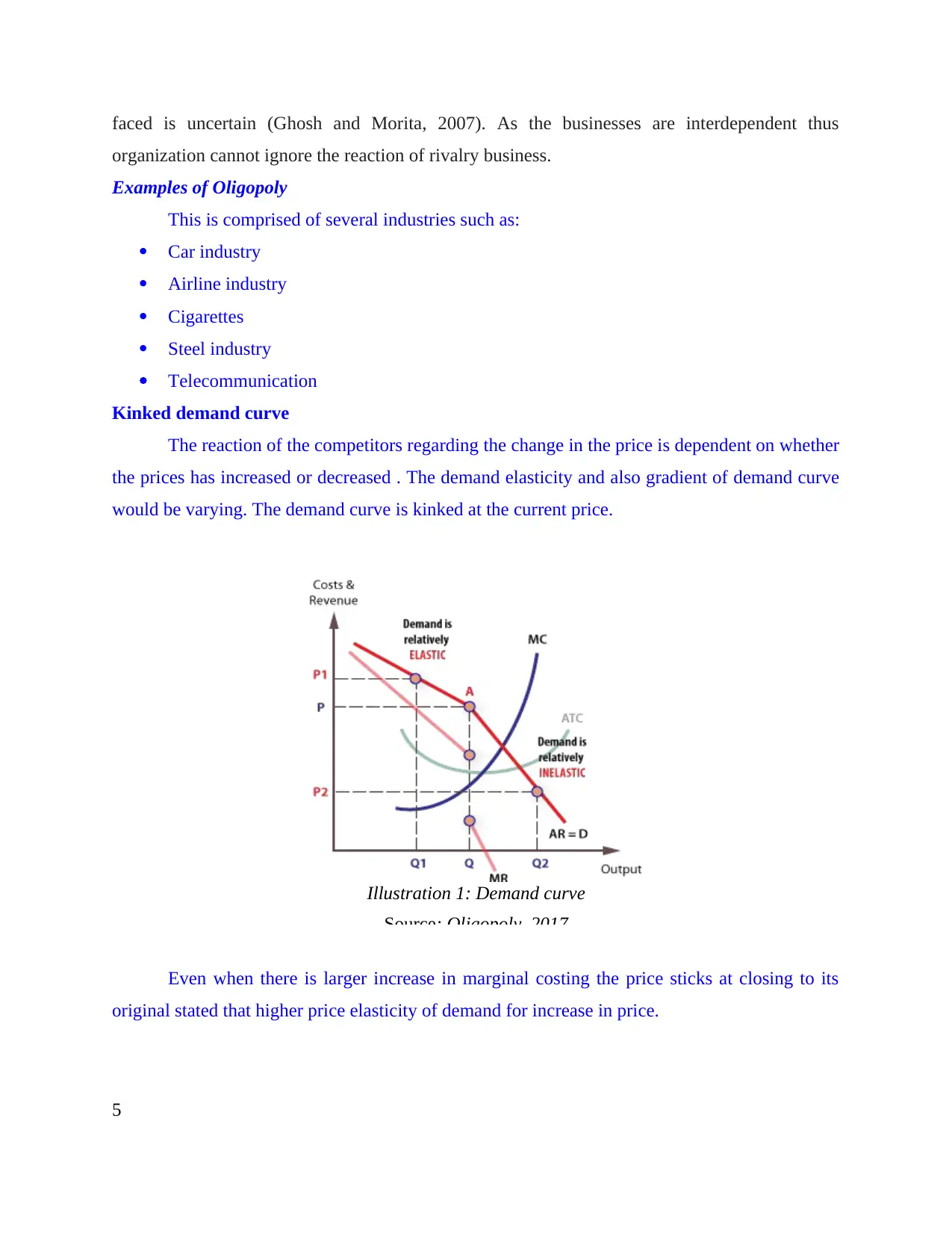
The reaction of the competitors regarding the change in the price is dependent on whether
the prices has increased or decreased . The demand elasticity and also gradient of demand curve
would be varying. The demand curve is kinked at the current price.
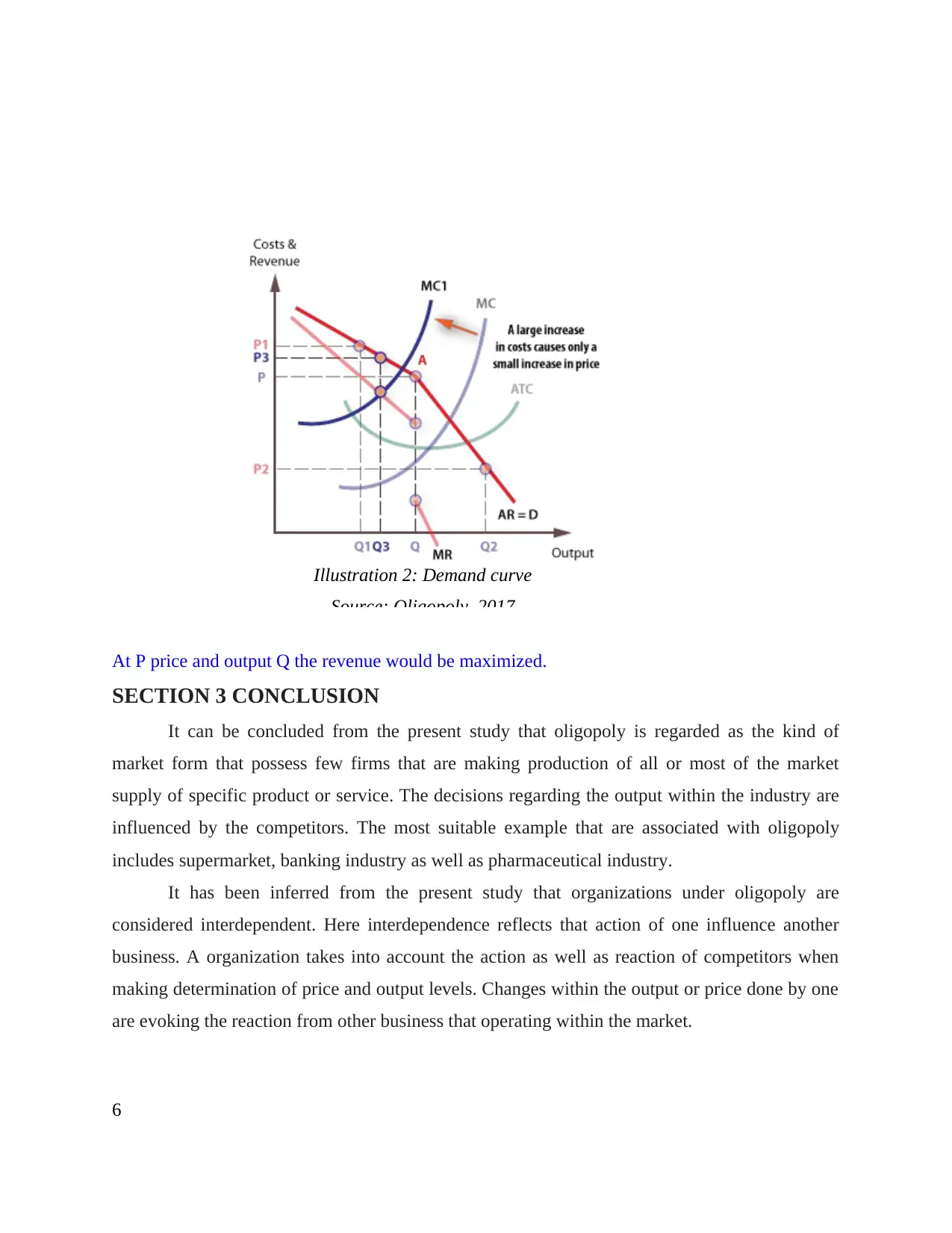
Even when there is larger increase in marginal costing the price sticks at closing to its
original stated that higher price elasticity of demand for increase in price.
5
Illustration 1: Demand curve
Source: Oligopoly, 2017
organization cannot ignore the reaction of rivalry business.
Examples of Oligopoly
This is comprised of several industries such as:
Car industry
Airline industry
Cigarettes
Steel industry
Telecommunication
Kinked demand curve
The reaction of the competitors regarding the change in the price is dependent on whether
the prices has increased or decreased . The demand elasticity and also gradient of demand curve
would be varying. The demand curve is kinked at the current price.
Even when there is larger increase in marginal costing the price sticks at closing to its
original stated that higher price elasticity of demand for increase in price.
5
Illustration 1: Demand curve
Source: Oligopoly, 2017

At P price and output Q the revenue would be maximized.
SECTION 3 CONCLUSION
It can be concluded from the present study that oligopoly is regarded as the kind of
market form that possess few firms that are making production of all or most of the market
supply of specific product or service. The decisions regarding the output within the industry are
influenced by the competitors. The most suitable example that are associated with oligopoly
includes supermarket, banking industry as well as pharmaceutical industry.
It has been inferred from the present study that organizations under oligopoly are
considered interdependent. Here interdependence reflects that action of one influence another
business. A organization takes into account the action as well as reaction of competitors when
making determination of price and output levels. Changes within the output or price done by one
are evoking the reaction from other business that operating within the market.
6
Illustration 2: Demand curve
Source: Oligopoly, 2017
SECTION 3 CONCLUSION
It can be concluded from the present study that oligopoly is regarded as the kind of
market form that possess few firms that are making production of all or most of the market
supply of specific product or service. The decisions regarding the output within the industry are
influenced by the competitors. The most suitable example that are associated with oligopoly
includes supermarket, banking industry as well as pharmaceutical industry.
It has been inferred from the present study that organizations under oligopoly are
considered interdependent. Here interdependence reflects that action of one influence another
business. A organization takes into account the action as well as reaction of competitors when
making determination of price and output levels. Changes within the output or price done by one
are evoking the reaction from other business that operating within the market.
6
Illustration 2: Demand curve
Source: Oligopoly, 2017
⊘ This is a preview!⊘
Do you want full access?
Subscribe today to unlock all pages.

Trusted by 1+ million students worldwide

REFERENCES
Journals and Books
Bauer, P.T., 2013. West African trade: A study of competition, oligopoly and monopoly in a
changing economy. Cambridge University Press.
Eichner, A.S., 2008. The megacorp and oligopoly. Cambridge Books.
Esteban, S. and Shum, M., 2007. Durable‐goods oligopoly with secondary markets: the case of
automobiles. The RAND Journal of Economics. 38(2). pp.332-354.
Fudenberg, D. and Tirole, J., 2013. Dynamic models of oligopoly. Taylor & Francis.
Fujiwara, K., 2007. Partial privatization in a differentiated mixed oligopoly. Journal of
Economics. 92(1). pp.51-65.
Ghosh, A. and Morita, H., 2007. Free entry and social efficiency under vertical oligopoly. The
Rand Journal of Economics. 38(2). pp.541-554.
Larivière, V., Haustein, S. and Mongeon, P., 2015. The oligopoly of academic publishers in the
digital era. PloS one. 10(6). p.e0127502.
Naik, P.A., Prasad, A. and Sethi, S.P., 2008. Building brand awareness in dynamic oligopoly
markets. Management Science. 54(1). pp.129-138.
Okuguchi, K., 2013. Expectations and stability in oligopoly models (Vol. 138). Springer Science
& Business Media.
Sushko, I. ed., 2013. Oligopoly dynamics: Models and tools. Springer Science & Business
Media.
Online
Oligopoly. 2017. [Online]. Available through:
<http://www.businessdictionary.com/definition/oligopoly.html>. [Accessed on 30th May 2017].
Oligopoly. 2017. [Online]. Available through:
<http://www.economicsonline.co.uk/Business_economics/Oligopoly.html>. [Accessed on 5th
June 2017].
7
Journals and Books
Bauer, P.T., 2013. West African trade: A study of competition, oligopoly and monopoly in a
changing economy. Cambridge University Press.
Eichner, A.S., 2008. The megacorp and oligopoly. Cambridge Books.
Esteban, S. and Shum, M., 2007. Durable‐goods oligopoly with secondary markets: the case of
automobiles. The RAND Journal of Economics. 38(2). pp.332-354.
Fudenberg, D. and Tirole, J., 2013. Dynamic models of oligopoly. Taylor & Francis.
Fujiwara, K., 2007. Partial privatization in a differentiated mixed oligopoly. Journal of
Economics. 92(1). pp.51-65.
Ghosh, A. and Morita, H., 2007. Free entry and social efficiency under vertical oligopoly. The
Rand Journal of Economics. 38(2). pp.541-554.
Larivière, V., Haustein, S. and Mongeon, P., 2015. The oligopoly of academic publishers in the
digital era. PloS one. 10(6). p.e0127502.
Naik, P.A., Prasad, A. and Sethi, S.P., 2008. Building brand awareness in dynamic oligopoly
markets. Management Science. 54(1). pp.129-138.
Okuguchi, K., 2013. Expectations and stability in oligopoly models (Vol. 138). Springer Science
& Business Media.
Sushko, I. ed., 2013. Oligopoly dynamics: Models and tools. Springer Science & Business
Media.
Online
Oligopoly. 2017. [Online]. Available through:
<http://www.businessdictionary.com/definition/oligopoly.html>. [Accessed on 30th May 2017].
Oligopoly. 2017. [Online]. Available through:
<http://www.economicsonline.co.uk/Business_economics/Oligopoly.html>. [Accessed on 5th
June 2017].
7
1 out of 7
Related Documents
Your All-in-One AI-Powered Toolkit for Academic Success.
+13062052269
info@desklib.com
Available 24*7 on WhatsApp / Email
Unlock your academic potential
Copyright © 2020–2025 A2Z Services. All Rights Reserved. Developed and managed by ZUCOL.