ECO101 Microeconomics Assignment: Oligopoly Market Structure Analysis

Verified

Added on  2022/10/04

|6
|769
|13
Homework Assignment
AI Summary
This document provides a comprehensive solution to an ECO101 microeconomics assignment focusing on oligopoly market structure. The assignment analyzes the strategic interactions of firms, including the impact of research and development (R&D) on profits. It explores the concept of Nash equilibrium, where firms make decisions based on their rivals' actions, and contrasts it with cooperative outcomes. The solution also delves into the characteristics of oligopoly markets, differentiating them from monopolistic competition and examining the role of market power and barriers to entry. The document includes a pay-off matrix to illustrate decision-making and profitability, and it clarifies the relationship between output levels and market structures. The assignment also evaluates the truth of a statement regarding Nash equilibrium and output levels.
Document Page
Running head: OLIGOPOLY MARKET STRUCTURE
Oligopoly Market Structure
Name of the Student
Name of the University
Student ID
tabler-icon-diamond-filled.svg

Paraphrase This Document

Need a fresh take? Get an instant paraphrase of this document with our AI Paraphraser
Document Page
1OLIGOPOLY MARKET STRUCTURE
Table of Contents
Answer a.....................................................................................................................................2
Answer b....................................................................................................................................2
Answer c.....................................................................................................................................2
Answer d....................................................................................................................................3
Answer e.....................................................................................................................................3
Answer f.....................................................................................................................................3
Answer g....................................................................................................................................3
References..................................................................................................................................5
Document Page
2OLIGOPOLY MARKET STRUCTURE
Answer a
Answer b
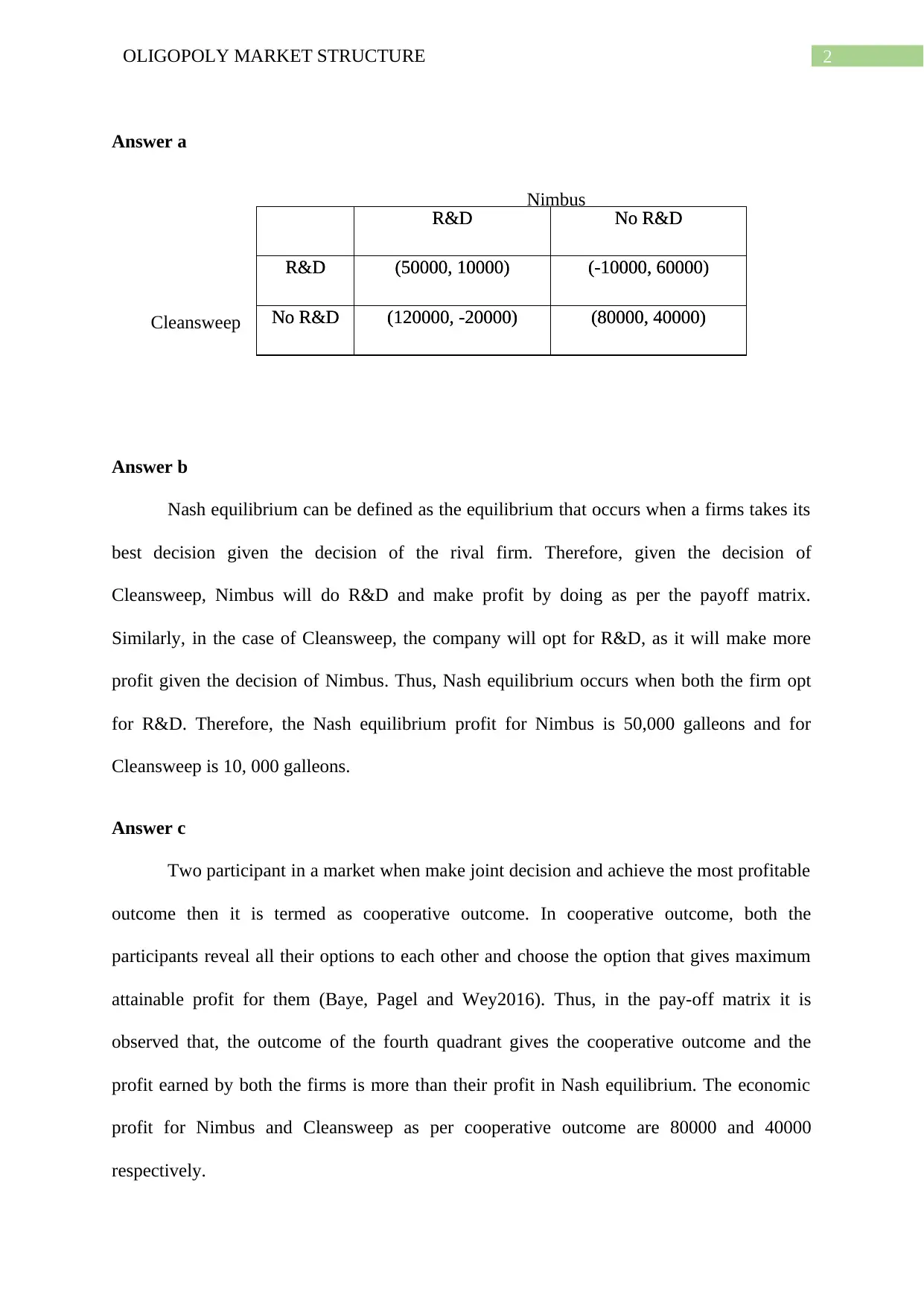
Nash equilibrium can be defined as the equilibrium that occurs when a firms takes its
best decision given the decision of the rival firm. Therefore, given the decision of
Cleansweep, Nimbus will do R&D and make profit by doing as per the payoff matrix.
Similarly, in the case of Cleansweep, the company will opt for R&D, as it will make more
profit given the decision of Nimbus. Thus, Nash equilibrium occurs when both the firm opt
for R&D. Therefore, the Nash equilibrium profit for Nimbus is 50,000 galleons and for
Cleansweep is 10, 000 galleons.
Answer c
Two participant in a market when make joint decision and achieve the most profitable
outcome then it is termed as cooperative outcome. In cooperative outcome, both the
participants reveal all their options to each other and choose the option that gives maximum
attainable profit for them (Baye, Pagel and Wey2016). Thus, in the pay-off matrix it is
observed that, the outcome of the fourth quadrant gives the cooperative outcome and the
profit earned by both the firms is more than their profit in Nash equilibrium. The economic
profit for Nimbus and Cleansweep as per cooperative outcome are 80000 and 40000
respectively.
Cleansweep
Nimbus
R&D No R&D
R&D (50000, 10000) (-10000, 60000)
No R&D (120000, -20000) (80000, 40000)
R&D No R&D
R&D (50000, 10000) (-10000, 60000)
No R&D (120000, -20000) (80000, 40000)
Document Page
3OLIGOPOLY MARKET STRUCTURE
Answer d
Oligopoly is an imperfect market structure in which numbers of sellers are limited and
buyers are numerous. The sellers thus have market power and market forces do not determine
price of the market, rather the sellers determine price (Na 2015). The sellers make price
decision either cooperatively or non-cooperatively. The price charged in oligopoly market is
higher than perfect competition. Moreover, if the firms collude then the price charged would
be equal to the price in monopoly market. The quantity supplied in oligopoly market stricture
is also lower that the free market quantity. In addition, the market power to the sellers
generated entry and exit barriers in oligopoly market structure. The above mentioned all are
the characteristics of the oligopoly market.
Answer e
Monopolistic competition is a market structure other than oligopoly in which is one
firm’s decision affect the decision of its competitors (Bertoletti and Etro 2016). In
monopolistic competition, there are limited firms with moderate market power and the firms
determine price depending on the price of the rivals as given as the product sold in the market
are differentiated.
Answer f
The statement given in the question is false because in Nash equilibrium the firms
decide their output given the output of the rivals. The output thus produced lies between
monopoly and free market output. Alternatively, if the firms collude then the output will be
equal to monopoly market which is the least output produced under any market structure.
Answer g
Natural oligopoly is defined as the oligopoly market structure that generates by itself
due to the characteristics of the industry and not by firms’ intervention.
tabler-icon-diamond-filled.svg

Paraphrase This Document

Need a fresh take? Get an instant paraphrase of this document with our AI Paraphraser
Document Page
4OLIGOPOLY MARKET STRUCTURE
Natural oligopoly arises when the fixed cost associated with an industry is very large
creating entry and exit barrier and thus few firms operate in the industry.
Telecommunication industry is an example of natural oligopoly.
Document Page
5OLIGOPOLY MARKET STRUCTURE
References
Baye, I., Pagel, B. and Wey, C., 2016. How to counter union power? Equilibrium mergers in
international oligopoly. Journal of Economic Behavior & Organization, 127, pp.16-29.
Bertoletti, P. and Etro, F., 2016. Monopolistic competition when income matters. The
Economic Journal, 127(603), pp.1217-1243.
Na, N., 2015. On competition in economic theory. Springer.
chevron_up_icon
1 out of 6
circle_padding
hide_on_mobile
zoom_out_icon
[object Object]