Comparative Analysis: Oligopoly and Monopolistic Competition Markets
VerifiedAdded on 2023/06/12
|24
|4446
|206
Essay
AI Summary
This essay provides a comprehensive analysis of oligopoly and monopolistic competition market structures, highlighting key distinguishing factors such as the number of sellers, market size, control, and entry barriers. It uses case studies from India, focusing on the FMCG (Fast Moving Consumer Goods) industry to illustrate monopolistic competition and the aviation industry to represent oligopoly. The essay examines short-run and long-run equilibrium conditions in both market structures, using diagrams to explain profit maximization and resource allocation. Additionally, the essay addresses the issue of housing affordability, outlining government solutions and suggesting alternative approaches based on economic theory. This resource is available on Desklib, where students can find a wealth of similar solved assignments and study materials.
Running Head: ECONOMICS FOR MANAGERS
Economics for Managers
Name of the Student
Name of the University
Course ID
Economics for Managers
Name of the Student
Name of the University
Course ID

Paraphrase This Document
Need a fresh take? Get an instant paraphrase of this document with our AI Paraphraser
1ECONOMICS FOR MANAGERS
Part A
The economc definition of market structure differs from that understood by marketers.
Marketers view market as competetive device and hence focuses on only marketing strategies or
plan. Economists on the other hand comsiders the overall structure of market beyond only
competition with an attempt to analyze and anticipate behaviours market participants. The
concept of market in economics thus extended beyond just a simple place of exchanging goods
and services (Goodwin et al., 2015). The four common form of market structure based on
number of participants in the market include perfectly cometitive market, monopoly, oligopoly
and monopolstic competition.
Oligopoly
The oligopoly market is a representative market structure containimg small number of
competiting firm with each enjoying a relatively large size in the market. High level of
concenration is an obivios feature of oligopoly market. Firms in the oligopoly market do not
have large number of competitiors. Rather there are intense competition among the few large
firms. Each firm keeps a close look on strategy of its rival firms (Baumol & Blinder, 2015).
Strategy of the firms are interdepenent on each other. For this, if one firm decide to lower price
to increases its share of market the competiting firms follow the same and this iften results in a
price war in the market place. Apart from price competion firms in this form of market are
engage in non-price competition in terms of product differentiation, investment in advertisimg
and others.
The oliopolistic firms need to take decision regarding price and competition. The firms in
the market place decides whether to compete with other firms or to agree on a mutually
Part A
The economc definition of market structure differs from that understood by marketers.
Marketers view market as competetive device and hence focuses on only marketing strategies or
plan. Economists on the other hand comsiders the overall structure of market beyond only
competition with an attempt to analyze and anticipate behaviours market participants. The
concept of market in economics thus extended beyond just a simple place of exchanging goods
and services (Goodwin et al., 2015). The four common form of market structure based on
number of participants in the market include perfectly cometitive market, monopoly, oligopoly
and monopolstic competition.
Oligopoly
The oligopoly market is a representative market structure containimg small number of
competiting firm with each enjoying a relatively large size in the market. High level of
concenration is an obivios feature of oligopoly market. Firms in the oligopoly market do not
have large number of competitiors. Rather there are intense competition among the few large
firms. Each firm keeps a close look on strategy of its rival firms (Baumol & Blinder, 2015).
Strategy of the firms are interdepenent on each other. For this, if one firm decide to lower price
to increases its share of market the competiting firms follow the same and this iften results in a
price war in the market place. Apart from price competion firms in this form of market are
engage in non-price competition in terms of product differentiation, investment in advertisimg
and others.
The oliopolistic firms need to take decision regarding price and competition. The firms in
the market place decides whether to compete with other firms or to agree on a mutually
2ECONOMICS FOR MANAGERS
beneficial understanding. When firm in the oligopoly market takes their joint decision about
price and outout combination then they it is called collusive oligopoly. In contrast, if the fims
decode to compete with each other then it is called non-collusive oligopoly (McKenzie & Lee,
2016). Firms in a pure oligopoly market sell homogenous products while firms in differentiated
oligopoly sells heteregenous or differentiated product.
Monopolistic Competition
The monopolistically competetive market structure has several small firms in the market.
The firms in the monopolistically competitive market exercise a freedom to enter or exit the
market. Each firm in the market has large number of competitors with each sellling a
differentiated product. Each seller in the market takes decision of price and outpt if its own
product indepent of other competitors. The seller in the monopolistic competition thus enjoy
some degree of monopoly power over its own product (Friedman, 2017). Again they face intense
competition like the perfectly comprtitive market. The monopolistically competitive market thus
is comsidered to have characteristics of both monopoly and perfectly comprtitive market.
One exclusive feature of monopolistic competition is product differentaition. Each seller
in the market tries to make its own product as much different as possiblr from its competitors.
With product differenatition firms attempts to make its perceive demand curve less elastic. Aprt
from physical product differentiation firms also engage in marketing differentiation,
differentation of human capital or differentiation in the distribution. The mnopolistically
competitive firms faces a downward sloping demand curve as they are able to chragge a higher
or lower price than its competitors (Moulin, 2014). However, because of availability of close
substitute firms usually do not engage in such price competition. Rather they focus on
advertising, brand promotion or other forms of non-price competition.
beneficial understanding. When firm in the oligopoly market takes their joint decision about
price and outout combination then they it is called collusive oligopoly. In contrast, if the fims
decode to compete with each other then it is called non-collusive oligopoly (McKenzie & Lee,
2016). Firms in a pure oligopoly market sell homogenous products while firms in differentiated
oligopoly sells heteregenous or differentiated product.
Monopolistic Competition
The monopolistically competetive market structure has several small firms in the market.
The firms in the monopolistically competitive market exercise a freedom to enter or exit the
market. Each firm in the market has large number of competitors with each sellling a
differentiated product. Each seller in the market takes decision of price and outpt if its own
product indepent of other competitors. The seller in the monopolistic competition thus enjoy
some degree of monopoly power over its own product (Friedman, 2017). Again they face intense
competition like the perfectly comprtitive market. The monopolistically competitive market thus
is comsidered to have characteristics of both monopoly and perfectly comprtitive market.
One exclusive feature of monopolistic competition is product differentaition. Each seller
in the market tries to make its own product as much different as possiblr from its competitors.
With product differenatition firms attempts to make its perceive demand curve less elastic. Aprt
from physical product differentiation firms also engage in marketing differentiation,
differentation of human capital or differentiation in the distribution. The mnopolistically
competitive firms faces a downward sloping demand curve as they are able to chragge a higher
or lower price than its competitors (Moulin, 2014). However, because of availability of close
substitute firms usually do not engage in such price competition. Rather they focus on
advertising, brand promotion or other forms of non-price competition.
⊘ This is a preview!⊘
Do you want full access?
Subscribe today to unlock all pages.

Trusted by 1+ million students worldwide
3ECONOMICS FOR MANAGERS
Both the above discussed market structures represent imperfect competition. These two forms of
markets are however differs in a number of ways. The key factors distingusing oligopoly and
monopolistic competition are given below
Number of sellers
The oligopoly market is characterized as having a few large sellerswhile in the
monopolistically competitive market there present a large number of small sellers (Rader, 2014).
Because of dufferences in number of sellers the degree of competition differ in the two form of
market.
Market size and market control
Difference in the two firm of market exists in terms of their relative size and market
control devised by each of these firms. There is though no speific size to clearly defining the two
form of market but in general a monpolistically competitive firm is relatively large in size as
compared to an oligopoly market. Because of presence of large number of firms in the market,
the market share is divided between these firms with each having a relatively small share in the
market. As each firms have a small market share decision of any signle firm does not have much
impact on the entire market (Stoneman, Bartoloni & Baussola, 2018). The oligopoly market on
the other hand is chsaracterized by dominance of few large sellers. The sellers in the oligopoly
market enjoy a considerble share of market and thus devices a greater control in the mrket.
Entry barriers
The incumbant firms in the oligopoly market maintains a high barriers to entry of the new
firms in the market. The need for government authorization often acts as a major entry barrier in
the market. Government often limits the number of competitors in the oligopoly market. Apart
Both the above discussed market structures represent imperfect competition. These two forms of
markets are however differs in a number of ways. The key factors distingusing oligopoly and
monopolistic competition are given below
Number of sellers
The oligopoly market is characterized as having a few large sellerswhile in the
monopolistically competitive market there present a large number of small sellers (Rader, 2014).
Because of dufferences in number of sellers the degree of competition differ in the two form of
market.
Market size and market control
Difference in the two firm of market exists in terms of their relative size and market
control devised by each of these firms. There is though no speific size to clearly defining the two
form of market but in general a monpolistically competitive firm is relatively large in size as
compared to an oligopoly market. Because of presence of large number of firms in the market,
the market share is divided between these firms with each having a relatively small share in the
market. As each firms have a small market share decision of any signle firm does not have much
impact on the entire market (Stoneman, Bartoloni & Baussola, 2018). The oligopoly market on
the other hand is chsaracterized by dominance of few large sellers. The sellers in the oligopoly
market enjoy a considerble share of market and thus devices a greater control in the mrket.
Entry barriers
The incumbant firms in the oligopoly market maintains a high barriers to entry of the new
firms in the market. The need for government authorization often acts as a major entry barrier in
the market. Government often limits the number of competitors in the oligopoly market. Apart
Paraphrase This Document
Need a fresh take? Get an instant paraphrase of this document with our AI Paraphraser
4ECONOMICS FOR MANAGERS
from government regulation there exists other forms of barriers as well. The existing firms might
enjoys exclusive owenership over a specific input. With lack of access to such input new firms
cannot enter the market. The presence of high fixed cost likely to discourage new seller to enter
the industry (Cowen & Tabarrok, 2015). The exising firms enjoys advantages of economies of
scale which help them to recover huge fixed cost. The new entrants however cannot have the
benefits of economies of scale and hence fear to enter the industry.
The entry or exit in a monopolostically competitive market is less cumbersome process.
Depending on the short run profit or loss firms decides whether to enter or exit the market. The
economic profit in the short run encourages new firm to enter while in presence of economic loss
firms leave the the industry.
State of equilibrium in monopolistically competitive market
Short run
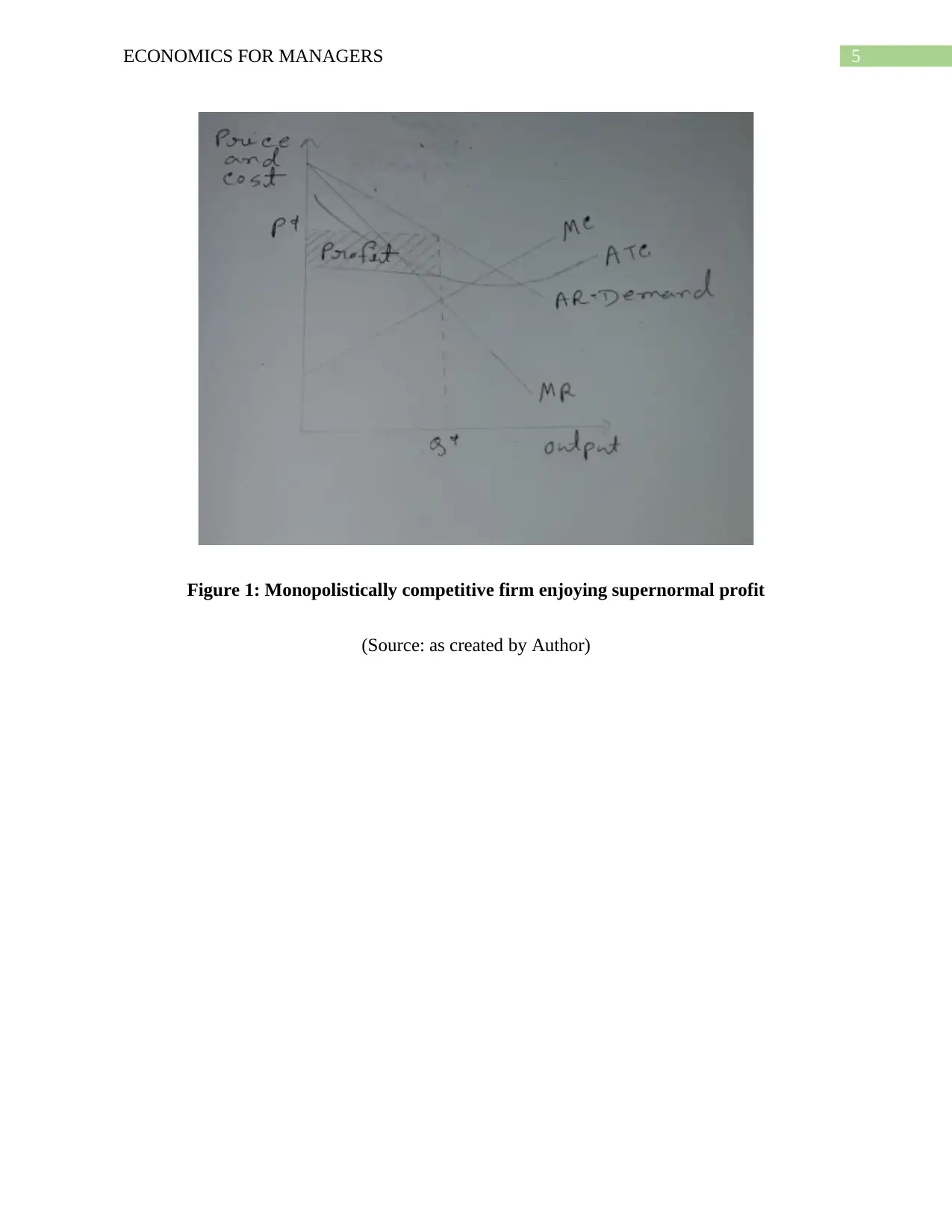
Firms in any form of market have the common objective of maximizing profit. The
marginal revenue and average revenue curve in the monopolistic competition slope downward.
The standard profit maximization condition require marginal revenue to be equal to marginal
cost and marginal cost curve cuts the the marginal revenue curve from below that is at the profit
maximizing level of output slope of MC curve is greater than slope of MR curve (Nicholson &
Snyder, 2014). Because of indeoendent price output decision existing firms in the short run have
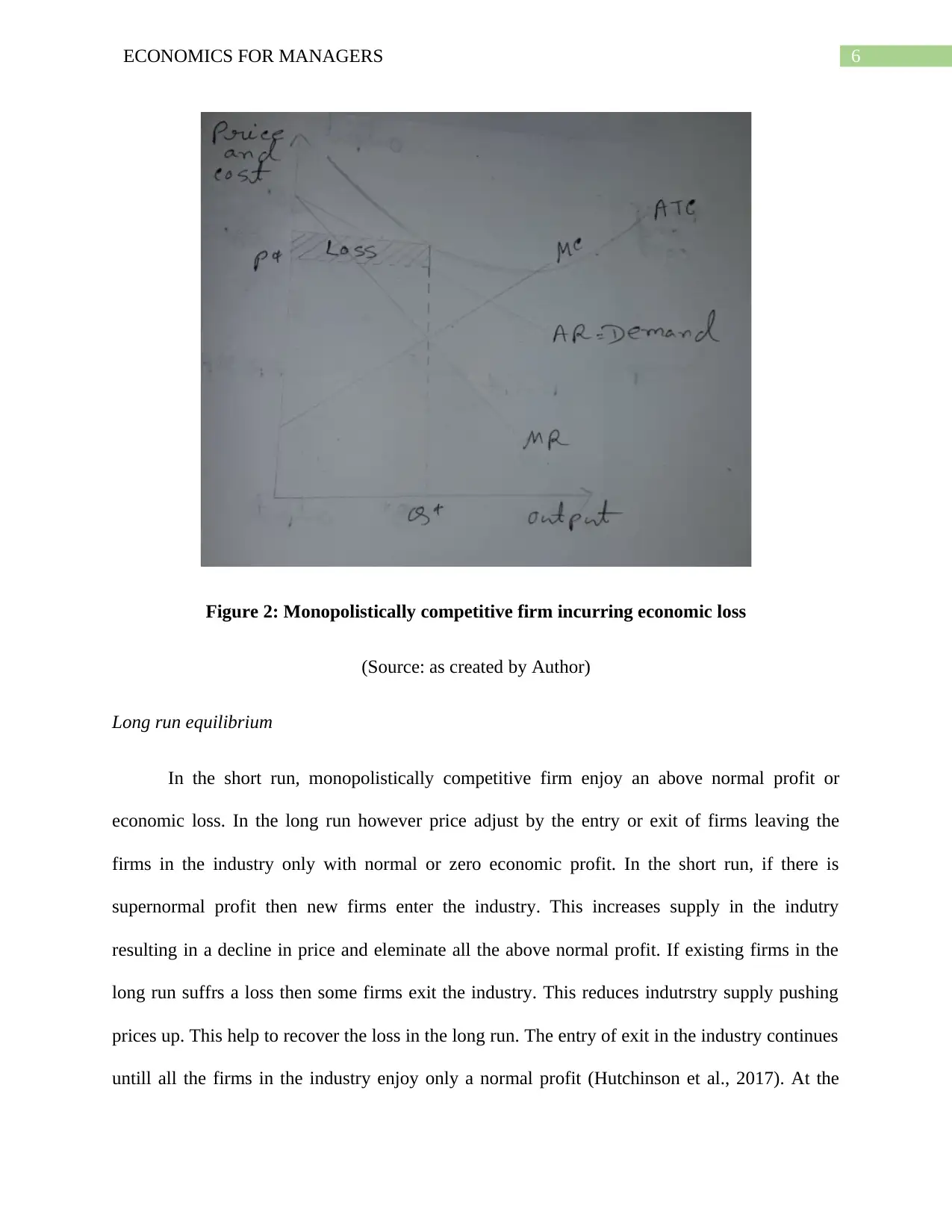
the opportunity to enjoy profit above the normal profit. Firms also can incurr a loss in the short
run is price is set below the total average cost.
from government regulation there exists other forms of barriers as well. The existing firms might
enjoys exclusive owenership over a specific input. With lack of access to such input new firms
cannot enter the market. The presence of high fixed cost likely to discourage new seller to enter
the industry (Cowen & Tabarrok, 2015). The exising firms enjoys advantages of economies of
scale which help them to recover huge fixed cost. The new entrants however cannot have the
benefits of economies of scale and hence fear to enter the industry.
The entry or exit in a monopolostically competitive market is less cumbersome process.
Depending on the short run profit or loss firms decides whether to enter or exit the market. The
economic profit in the short run encourages new firm to enter while in presence of economic loss
firms leave the the industry.
State of equilibrium in monopolistically competitive market
Short run
Firms in any form of market have the common objective of maximizing profit. The
marginal revenue and average revenue curve in the monopolistic competition slope downward.
The standard profit maximization condition require marginal revenue to be equal to marginal
cost and marginal cost curve cuts the the marginal revenue curve from below that is at the profit
maximizing level of output slope of MC curve is greater than slope of MR curve (Nicholson &
Snyder, 2014). Because of indeoendent price output decision existing firms in the short run have
the opportunity to enjoy profit above the normal profit. Firms also can incurr a loss in the short
run is price is set below the total average cost.
5ECONOMICS FOR MANAGERS
Figure 1: Monopolistically competitive firm enjoying supernormal profit
(Source: as created by Author)
Figure 1: Monopolistically competitive firm enjoying supernormal profit
(Source: as created by Author)
⊘ This is a preview!⊘
Do you want full access?
Subscribe today to unlock all pages.
Trusted by 1+ million students worldwide
6ECONOMICS FOR MANAGERS
Figure 2: Monopolistically competitive firm incurring economic loss
(Source: as created by Author)
Long run equilibrium
In the short run, monopolistically competitive firm enjoy an above normal profit or
economic loss. In the long run however price adjust by the entry or exit of firms leaving the
firms in the industry only with normal or zero economic profit. In the short run, if there is
supernormal profit then new firms enter the industry. This increases supply in the indutry
resulting in a decline in price and eleminate all the above normal profit. If existing firms in the
long run suffrs a loss then some firms exit the industry. This reduces indutrstry supply pushing
prices up. This help to recover the loss in the long run. The entry of exit in the industry continues
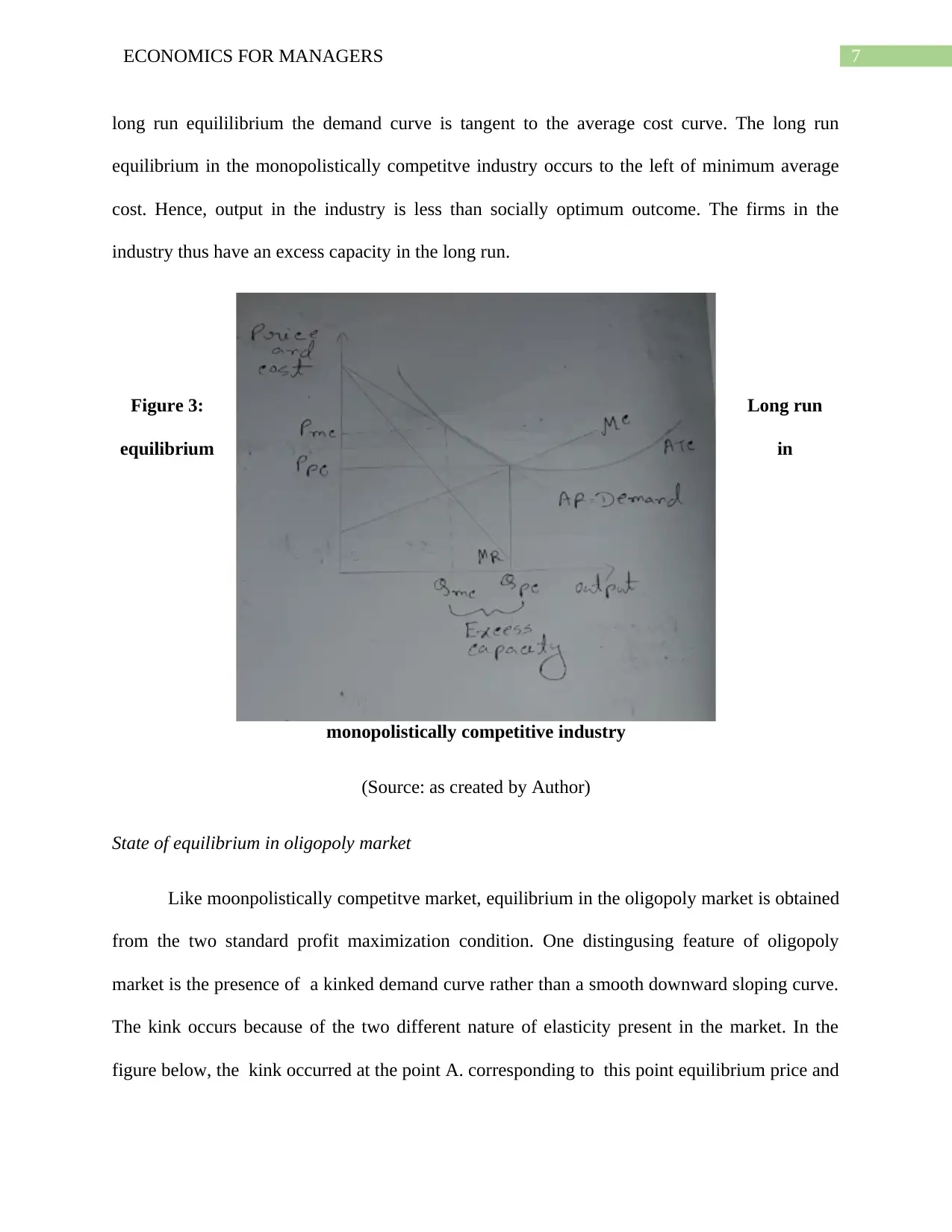
untill all the firms in the industry enjoy only a normal profit (Hutchinson et al., 2017). At the
Figure 2: Monopolistically competitive firm incurring economic loss
(Source: as created by Author)
Long run equilibrium
In the short run, monopolistically competitive firm enjoy an above normal profit or
economic loss. In the long run however price adjust by the entry or exit of firms leaving the
firms in the industry only with normal or zero economic profit. In the short run, if there is
supernormal profit then new firms enter the industry. This increases supply in the indutry
resulting in a decline in price and eleminate all the above normal profit. If existing firms in the
long run suffrs a loss then some firms exit the industry. This reduces indutrstry supply pushing
prices up. This help to recover the loss in the long run. The entry of exit in the industry continues
untill all the firms in the industry enjoy only a normal profit (Hutchinson et al., 2017). At the
Paraphrase This Document
Need a fresh take? Get an instant paraphrase of this document with our AI Paraphraser
7ECONOMICS FOR MANAGERS
long run equililibrium the demand curve is tangent to the average cost curve. The long run
equilibrium in the monopolistically competitve industry occurs to the left of minimum average
cost. Hence, output in the industry is less than socially optimum outcome. The firms in the
industry thus have an excess capacity in the long run.
Figure 3: Long run
equilibrium in
monopolistically competitive industry
(Source: as created by Author)
State of equilibrium in oligopoly market
Like moonpolistically competitve market, equilibrium in the oligopoly market is obtained
from the two standard profit maximization condition. One distingusing feature of oligopoly
market is the presence of a kinked demand curve rather than a smooth downward sloping curve.
The kink occurs because of the two different nature of elasticity present in the market. In the
figure below, the kink occurred at the point A. corresponding to this point equilibrium price and
long run equililibrium the demand curve is tangent to the average cost curve. The long run
equilibrium in the monopolistically competitve industry occurs to the left of minimum average
cost. Hence, output in the industry is less than socially optimum outcome. The firms in the
industry thus have an excess capacity in the long run.
Figure 3: Long run
equilibrium in
monopolistically competitive industry
(Source: as created by Author)
State of equilibrium in oligopoly market
Like moonpolistically competitve market, equilibrium in the oligopoly market is obtained
from the two standard profit maximization condition. One distingusing feature of oligopoly
market is the presence of a kinked demand curve rather than a smooth downward sloping curve.
The kink occurs because of the two different nature of elasticity present in the market. In the
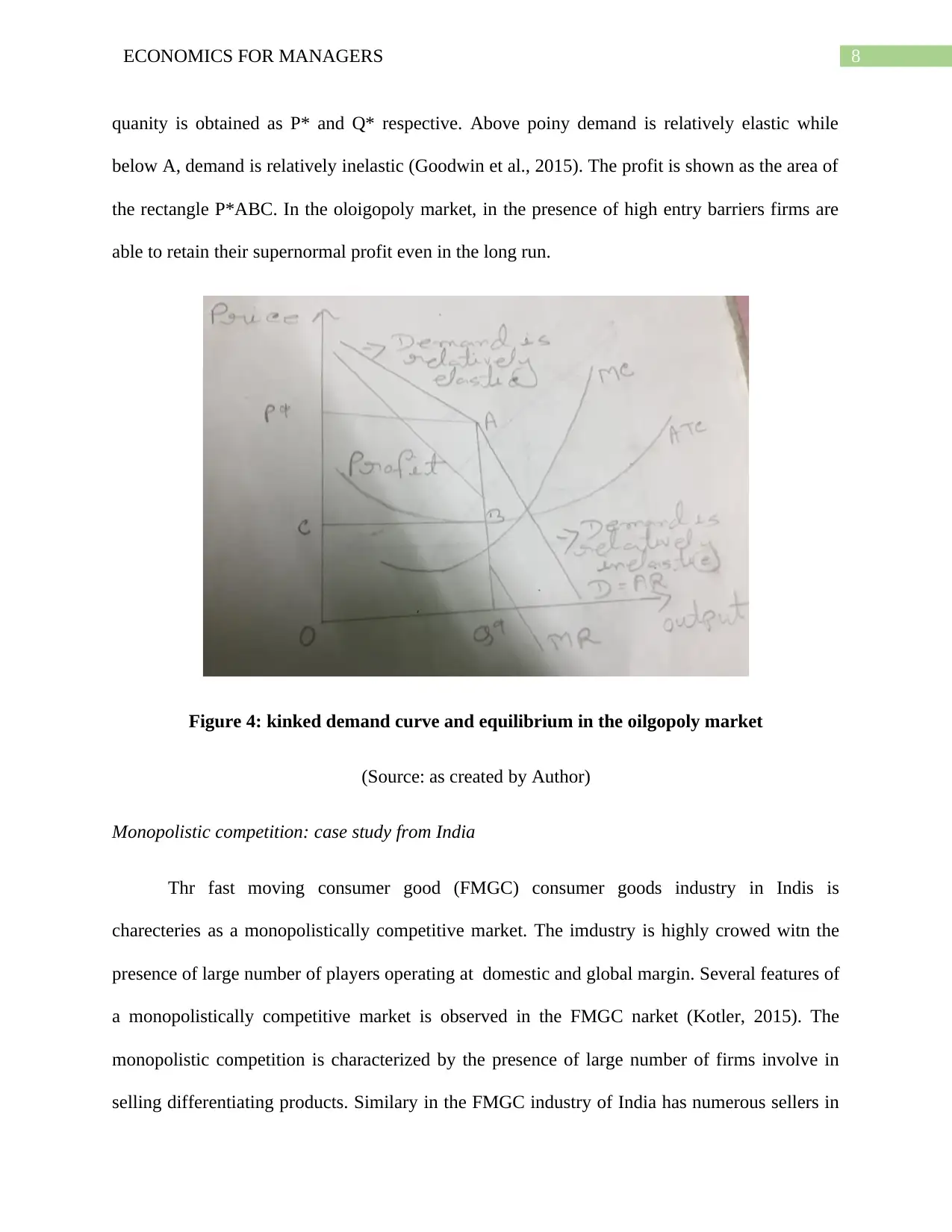
figure below, the kink occurred at the point A. corresponding to this point equilibrium price and
8ECONOMICS FOR MANAGERS
quanity is obtained as P* and Q* respective. Above poiny demand is relatively elastic while
below A, demand is relatively inelastic (Goodwin et al., 2015). The profit is shown as the area of
the rectangle P*ABC. In the oloigopoly market, in the presence of high entry barriers firms are
able to retain their supernormal profit even in the long run.
Figure 4: kinked demand curve and equilibrium in the oilgopoly market
(Source: as created by Author)
Monopolistic competition: case study from India
Thr fast moving consumer good (FMGC) consumer goods industry in Indis is
charecteries as a monopolistically competitive market. The imdustry is highly crowed witn the
presence of large number of players operating at domestic and global margin. Several features of
a monopolistically competitive market is observed in the FMGC narket (Kotler, 2015). The
monopolistic competition is characterized by the presence of large number of firms involve in
selling differentiating products. Similary in the FMGC industry of India has numerous sellers in
quanity is obtained as P* and Q* respective. Above poiny demand is relatively elastic while
below A, demand is relatively inelastic (Goodwin et al., 2015). The profit is shown as the area of
the rectangle P*ABC. In the oloigopoly market, in the presence of high entry barriers firms are
able to retain their supernormal profit even in the long run.
Figure 4: kinked demand curve and equilibrium in the oilgopoly market
(Source: as created by Author)
Monopolistic competition: case study from India
Thr fast moving consumer good (FMGC) consumer goods industry in Indis is
charecteries as a monopolistically competitive market. The imdustry is highly crowed witn the
presence of large number of players operating at domestic and global margin. Several features of
a monopolistically competitive market is observed in the FMGC narket (Kotler, 2015). The
monopolistic competition is characterized by the presence of large number of firms involve in
selling differentiating products. Similary in the FMGC industry of India has numerous sellers in
⊘ This is a preview!⊘
Do you want full access?
Subscribe today to unlock all pages.
Trusted by 1+ million students worldwide
9ECONOMICS FOR MANAGERS
the industry. This fact is highlighted from the presence of more than 700 companies in the
Indian soap and detergent market. Some of the major players in the industry include ITC limited,
Hindustan Unilever Limited and Procter & Gamble (Dey & Sharma, 2017).
Like monopolistically competitive market firms in the industry are allowed to freely enter
or exit the market. The propect of rising income from rural and urban consumers make the
industry an atrractive one with several new companies entering the business. The mechanism of
free entry or exit result lead to only a normal profit in the industry (Roshif, 2015). For example,
the brand Nirma was introduced a low priced detergent to capture customer group belonging to
middle income class. The successful strategy of Nirma was encouraged other companies to
launch product with a much lower price.
Another feature of monopolistic competition is product differentiation. The products in
the industry differs in terms of packaging, size, color, associate discount and shape. Ariel, a
product of P&G group is avaible in different variety. Ariel color, Ariel strain remover and Ariel
Quiclwash are the different sub product each having at least one distingushing characteristic
((Dey & Sharma, 2017).
The other features of a monopolistically competitive market that are found in the
concerned industry include investment in advertising, promotion of sales, absence of
interdependece and a downward sloping demand curve.
Oligopoly: case study from India
The aviation industry in India has characteristics similar to a oligopoly market. The
airlinbe industry is dominated by a few large airline companies. The degree of competition in the
industry is indenfied from the concentreation ratio in the industry. Four to eight airline
the industry. This fact is highlighted from the presence of more than 700 companies in the
Indian soap and detergent market. Some of the major players in the industry include ITC limited,
Hindustan Unilever Limited and Procter & Gamble (Dey & Sharma, 2017).
Like monopolistically competitive market firms in the industry are allowed to freely enter
or exit the market. The propect of rising income from rural and urban consumers make the
industry an atrractive one with several new companies entering the business. The mechanism of
free entry or exit result lead to only a normal profit in the industry (Roshif, 2015). For example,
the brand Nirma was introduced a low priced detergent to capture customer group belonging to
middle income class. The successful strategy of Nirma was encouraged other companies to
launch product with a much lower price.
Another feature of monopolistic competition is product differentiation. The products in
the industry differs in terms of packaging, size, color, associate discount and shape. Ariel, a
product of P&G group is avaible in different variety. Ariel color, Ariel strain remover and Ariel
Quiclwash are the different sub product each having at least one distingushing characteristic
((Dey & Sharma, 2017).
The other features of a monopolistically competitive market that are found in the
concerned industry include investment in advertising, promotion of sales, absence of
interdependece and a downward sloping demand curve.
Oligopoly: case study from India
The aviation industry in India has characteristics similar to a oligopoly market. The
airlinbe industry is dominated by a few large airline companies. The degree of competition in the
industry is indenfied from the concentreation ratio in the industry. Four to eight airline
Paraphrase This Document
Need a fresh take? Get an instant paraphrase of this document with our AI Paraphraser
10ECONOMICS FOR MANAGERS
companies in India capture 80 percent share in the market (Jain & Natarajan, 2015) Major player
in the industry include Indigo (30%), Air India (19%), Spice jet (20%), Go Air (17%), Jet
Airways (17%) and Jetlite (5%).
In the oligopoly market there are only few seller selling homogenous product or service.
In the Indian airline industry there are only eight domestic carriers. Like an oligopoly market,
entry of new firms in the industry is limited by permit of government. Similar to collusive
oligopoly, the existing sellers in the forms a cartel with an attemp to fix prices at a relatively high
level (Albers et al., 2017).
Productive and Allocative efficiency
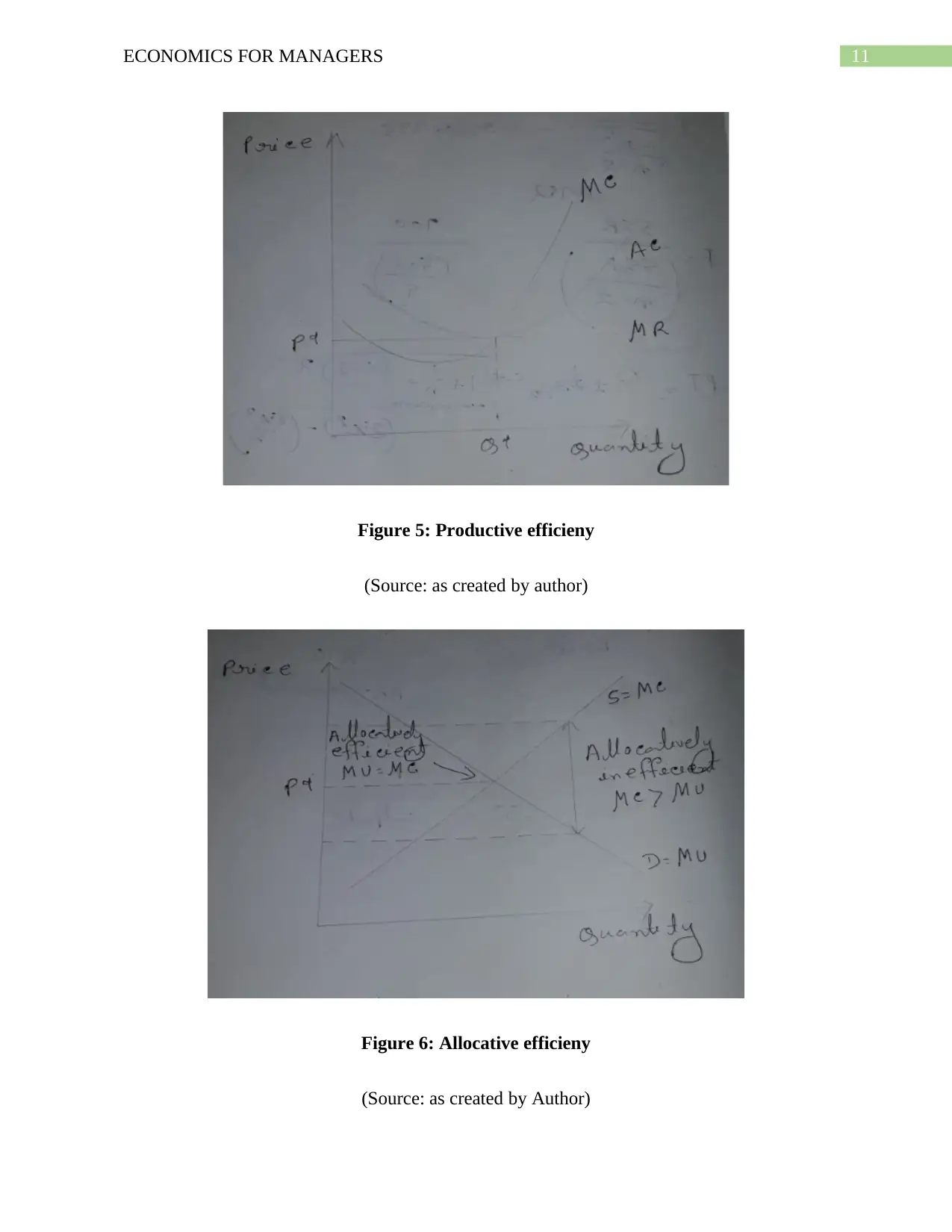
Productive efficiency is concerned with efficient allocation of resources. This sugeests
production needs to be done in such a way that no amlunt of resoources is wasted. In a market
productive efficieny is achieved only when the price charged in the long run equals the minimum
of average cost. Allocative efficiency on the other hand is concerned with socially preferred
production and distribution of a good (McKenzie & Lee, 2016).
companies in India capture 80 percent share in the market (Jain & Natarajan, 2015) Major player
in the industry include Indigo (30%), Air India (19%), Spice jet (20%), Go Air (17%), Jet
Airways (17%) and Jetlite (5%).
In the oligopoly market there are only few seller selling homogenous product or service.
In the Indian airline industry there are only eight domestic carriers. Like an oligopoly market,
entry of new firms in the industry is limited by permit of government. Similar to collusive
oligopoly, the existing sellers in the forms a cartel with an attemp to fix prices at a relatively high
level (Albers et al., 2017).
Productive and Allocative efficiency
Productive efficiency is concerned with efficient allocation of resources. This sugeests
production needs to be done in such a way that no amlunt of resoources is wasted. In a market
productive efficieny is achieved only when the price charged in the long run equals the minimum
of average cost. Allocative efficiency on the other hand is concerned with socially preferred
production and distribution of a good (McKenzie & Lee, 2016).
11ECONOMICS FOR MANAGERS
Figure 5: Productive efficieny
(Source: as created by author)
Figure 6: Allocative efficieny
(Source: as created by Author)
Figure 5: Productive efficieny
(Source: as created by author)
Figure 6: Allocative efficieny
(Source: as created by Author)
⊘ This is a preview!⊘
Do you want full access?
Subscribe today to unlock all pages.
Trusted by 1+ million students worldwide

1 out of 24


Related Documents


Your All-in-One AI-Powered Toolkit for Academic Success.
+13062052269
info@desklib.com
Available 24*7 on WhatsApp / Email
![[object Object]](/_next/static/media/star-bottom.7253800d.svg)
Unlock your academic potential
Copyright © 2020–2026 A2Z Services. All Rights Reserved. Developed and managed by ZUCOL.