Market Structure: Oligopoly Analysis of the UK Supermarket Sector

Verified

Added on  2022/08/22

|9
|2055
|16
Report
AI Summary
This report provides a comprehensive analysis of market structure, focusing on the oligopoly model and its application to the UK supermarket sector. The report begins with an introduction to market structure and its importance in business decision-making, followed by a detailed explanation of the oligopoly market structure, including its characteristics, such as few firms, price-giving behavior, and high barriers to entry and exit. The report then examines the UK supermarket sector, providing data on market share, revenue, and employment. It argues that the sector exhibits oligopolistic characteristics, supported by the calculation of the Four Firm Concentration Ratio (FFCR). The analysis highlights the kinked demand curve faced by firms, the impact of economies of scale, and the potential for collusion, concluding that the supermarket sector is indeed oligopolistic in nature and that high entry barriers contribute to the dominance of existing firms. The report references relevant economic literature throughout its analysis.
Document Page
Running head: MARKET STRUCTURE
Market Structure
Name of the Student
Name of the University
Student ID
tabler-icon-diamond-filled.svg

Paraphrase This Document

Need a fresh take? Get an instant paraphrase of this document with our AI Paraphraser
Document Page
1MARKET STRUCTURE
Table of Contents
Introduction......................................................................................................................................2
Brief on oligopoly market structure.................................................................................................2
Supermarket sector of the UK.........................................................................................................4
Conclusion.......................................................................................................................................6
Reference.........................................................................................................................................7
Document Page
2MARKET STRUCTURE
Introduction
Market structure is an important part of any kind of business. The decision making part of
business is majorly dependent on its market structure. According to theory of microeconomics,
there are four kind of market structure and they are perfect competition, monopolistic
competition, oligopoly and monopoly (Indounas 2018). The first market structure is the most
competitive which is evident from its name and the last one is the least competitive or not all
competitive. The report discusses the market structure of the supermarket sector of the UK. It is
argued that that the supermarket sector is of oligopoly in nature. Hence, the report studies the
supermarket sector in the industry and analyses how concept of oligopoly market structure helps
to evaluate the market structure of the concerned sector present in the UK. Therefore, the report
first discusses the oligopoly market structure in detail and then the supermarket sector of the UK.
Brief on oligopoly market structure
Oligopoly market structure is the 2nd least competitive markets structure. In an oligopoly
market, few number of operating firms serves the entire market comprised of numerous buyers
(Monavasilis et al. 2019). Therefore, it can be said that the firms in this market are price giver
and the buyers are price taker. Hence, the firms in the market have power over the market and
thus they dominate it. The products in a sector with oligopoly market structure could be
homogeneous or differentiated (Ara, Ghosh and Zhang 2017). As there are few number of firms
in an oligopoly market structure, the price charged by the firms are much above the price
charged in perfectly competitive market. Thus, firms in this market structure are earn super
normal profit. However, the price charged are lower than the price in the monopoly market. In
oligopoly markets, the fixed cost is very high and since the firms operating in it have significant
amount of market power, entry to the market is very difficult. On the other, due to presence of
Document Page
3MARKET STRUCTURE
high fixed cost making exit from the market is difficult. Therefore, it is clearly understandable
that in oligopoly market there is presence of high barriers to both entry and exit (Head and
Spencer 2017). In order to gain more profit the firms in the industry provide less quantity at
higher price and the buyers having no option have to buy from the exiting few firms. Hence, the
firms in the sector with oligopoly structure are inefficient in both productive and allocative
aspect. A firm in the market charges price for its product considering the price charged for the
product by the other firms. Therefore, firms in the market are price giver but on setting price,
they depend on each other. The demand curve faced by the firms in the oligopoly market is of
kinked shape. In a kinked shaped demand curve, the upper portion is more price elastic in
comparison to the lower portion (Roman and Lenka 2017). It means that if a firm increase price
of product above the market price then it will lose more percentage of market share than the
increase in percentage of price. On the other hand, as the lower part is relatively inelastic a firm
if lowers the price of product to capture more markets share, then its rival would lower the price
too in order to match the price level. Hence, it is quite difficult for a firm in an oligopoly market
to go into price war with the rival firms. The structure of a market can be measured with the help
of Four Firm Concentration Ratio (FFCR) and Herfindahl Hirschman Index (HHI) (Nocke and
Schutz 2018). In case of FFCR if a market is found to have ratio over 0.5 then it is said to be
oligopoly. Alternatively, in the case of HHI, if the value found to be more than 1500 but lower
than 2500 then it is close to oligopoly market (Bos et al. 2017). On the other hand, if the value is
over 2500 then the market is of oligopolistic nature. It should be further noted that the firms in
oligopoly market can act as monopoly firms if they collude with each other. The act of collusion
is popularly known as cartel (Gomez-Martinez, Ondersta and Sonnemans 2016). In order to
collude the firms cooperate with each other to decide about supply and price. In this way of
tabler-icon-diamond-filled.svg

Paraphrase This Document

Need a fresh take? Get an instant paraphrase of this document with our AI Paraphraser
Document Page
4MARKET STRUCTURE
collusion firms in oligopoly market charge price as high as monopoly market and earn super
normal profit equivalent to monopoly firms. The best example of cartel is the organization of
petroleum exporting countries. In the next section evaluating how oligopoly helps in
understanding the supermarket sector of the UK.
Supermarket sector of the UK
The supermarket sector of the UK is a huge market and it contributes to the economy
greatly. In 2019, the total revenue earned by the sector is around £181 billion and the number of
people employed in the sector is nearly 1.1 million (Ibisworld.com. 2020). This large sector is
dominated by 12 firms and the market served by these firms is the whole of the UK. Therefore, it
is evident that there are few firms in the sector that serve the numerous buyers present in the
country. The firms thus have significant amount of market power. Supermarket business require
huge investment because to compete with the existing firms a new firms should open stores in
many areas. Along with that, huge amount of money is required to stock goods and working
capital is required to keep the flow of goods smooth. The firms will exert pressure on eh new
firms by price war strategy. Hence, there exit and entry barriers are very high in this industry.
Some products that the firms in the supermarket sector in the UK are homogeneous in nature and
some are differentiated. The major firms in the supermarket sector in the UK are Tesco, Asda,
Sainsbury’s, Aldi, The Cooperative, Lidl, Morrisons, Waitrose, Symbols and Independent,
Ocado, Iceland and Other Multiples. Among these supermarket chains top four firms captures
68.3% of total market share (Statista 2020). The top for firms are Tesco, Sainsbury’s. Asda and
Morrisons. It is evident from the data that the market is dominated by four firms. Hence, it can
be said that the market structure of the sector is of oligopoly nature. The type of the market
structure of the sector can be assured by calculating FFCR of the market.
Document Page
5MARKET STRUCTURE
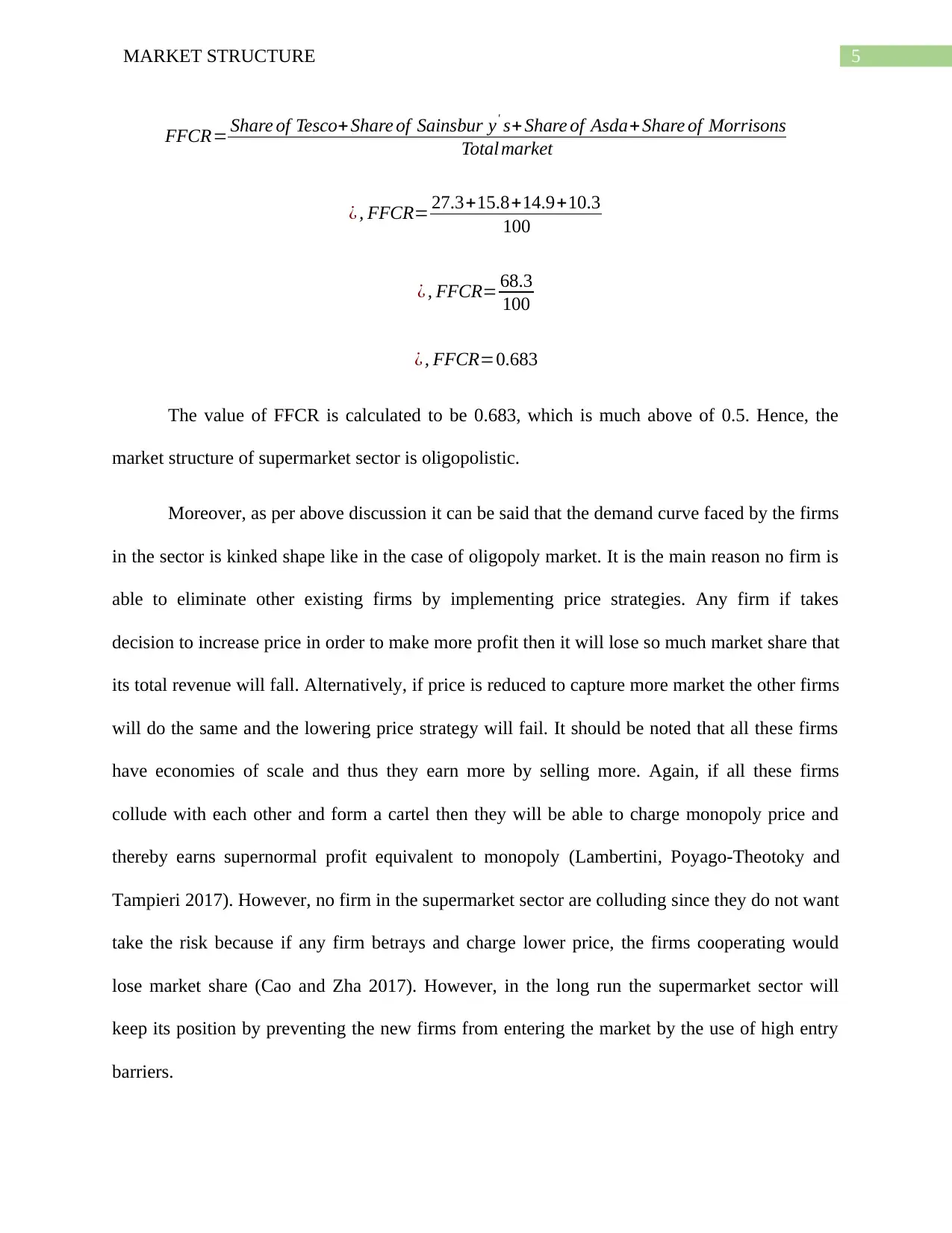
FFCR= Share of Tesco+ Share of Sainsbur y' s+ Share of Asda+ Share of Morrisons
Total market
¿ , FFCR= 27.3+15.8+14.9+10.3
100
¿ , FFCR= 68.3
100
¿ , FFCR=0.683
The value of FFCR is calculated to be 0.683, which is much above of 0.5. Hence, the
market structure of supermarket sector is oligopolistic.
Moreover, as per above discussion it can be said that the demand curve faced by the firms
in the sector is kinked shape like in the case of oligopoly market. It is the main reason no firm is
able to eliminate other existing firms by implementing price strategies. Any firm if takes
decision to increase price in order to make more profit then it will lose so much market share that
its total revenue will fall. Alternatively, if price is reduced to capture more market the other firms
will do the same and the lowering price strategy will fail. It should be noted that all these firms
have economies of scale and thus they earn more by selling more. Again, if all these firms
collude with each other and form a cartel then they will be able to charge monopoly price and
thereby earns supernormal profit equivalent to monopoly (Lambertini, Poyago-Theotoky and
Tampieri 2017). However, no firm in the supermarket sector are colluding since they do not want
take the risk because if any firm betrays and charge lower price, the firms cooperating would
lose market share (Cao and Zha 2017). However, in the long run the supermarket sector will
keep its position by preventing the new firms from entering the market by the use of high entry
barriers.
Document Page
6MARKET STRUCTURE
Conclusion
The discussion made above regarding the supermarkets sector present in the UK leads to
the inference that the market structure of the sector is of oligopolistic in nature. It is evident from
the number of firms dominating the sector and the calculation of the Four Firm Concentration
Ration. It is a method of measuring the concentration of a market to understand its
characteristics. Therefore, being an oligopolistic market the supermarket sector earns
supernormal profit and no new small firm is able to enter the concerned market due to presence
of high entry barriers. Due to this entry barrier, the existing firms in the market keep on
dominating the sector in future. This the reason why the firms in the supermarket sector in the
UK are so large.
tabler-icon-diamond-filled.svg

Paraphrase This Document

Need a fresh take? Get an instant paraphrase of this document with our AI Paraphraser
Document Page
7MARKET STRUCTURE
Reference
Ara, T., Ghosh, A. and Zhang, H., 2017. Tariffs, vertical oligopoly and market structure. RIETI
Discussion Paper Series 17-E-025.
Bos, J.W., Chan, Y.L., Kolari, J.W. and Yuan, J., 2017. Competition, concentration and critical
mass: why the Herfindahl–Hirschman Index is a biased competition measure. In Handbook of
Competition in Banking and Finance. Edward Elgar Publishing.
Cao, W. and Zha, F., 2017. Research on the Impact of Price’s Co-opetition on Stability of the
Enterprise Willingness to Cooperate Based on Game Analysis. DEStech Transactions on
Environment, Energy and Earth Sciences, (icseep).
Gomez-Martinez, F., Onderstal, S. and Sonnemans, J., 2016. Firm-specific information and
explicit collusion in experimental oligopolies. European Economic Review, 82, pp.132-141.
Head, K. and Spencer, B.J., 2017. Oligopoly in international trade: Rise, fall and
resurgence. Canadian Journal of Economics/Revue canadienne d'économique, 50(5), pp.1414-
1444.
Ibisworld.com. (2020). IBISWorld - Industry Market Research, Reports, and Statistics. [online]
Available at: https://www.ibisworld.com/united-kingdom/market-research-reports/supermarkets-
industry/.
Indounas, K., 2018. Market structure and pricing objectives in the services sector. Journal of
Services Marketing.
Document Page
8MARKET STRUCTURE
Lambertini, L., Poyago-Theotoky, J. and Tampieri, A., 2017. Cournot competition and “green”
innovation: An inverted-U relationship. Energy Economics, 68, pp.116-123.
Monovasilis, T., Kalogiratou, Z., Tsounis, N., Bertsatos, G. and Moustakli, S., 2019, June. Use
of Differential Equations in Firms Behavior in an Oligopoly Market. In International Conference
on Applied Economics (pp. 627-634). Springer, Cham.
Nocke, V. and Schutz, N., 2018. Multiproduct‐firm oligopoly: An aggregative games
approach. Econometrica, 86(2), pp.523-557.
Roman, S. and Lenka, K., 2017. The Sweezy model of price competition among private labels of
chain stores. Agricultural Economics, 63(7), pp.299-307.
Statista. (2020). Great Britain: Grocery market share 2015-2020 | Statista. [online] Available at:
https://www.statista.com/statistics/280208/grocery-market-share-in-the-united-kingdom-uk/.
chevron_up_icon
1 out of 9
circle_padding
hide_on_mobile
zoom_out_icon
[object Object]