Oman Oil Company: Organizational Behavior and Human Resource Practices
VerifiedAdded on 2019/09/23
|18
|4626
|363
Report
AI Summary
This report provides a comprehensive analysis of Oman Oil Company's organizational behavior, focusing on its reward, motivation, and human resource management (HRM) practices. The report examines the company's background, highlighting its mission and structure. It then delves into the reward practices employed by Oman Oil, differentiating between intrinsic and extrinsic rewards, and how these contribute to employee motivation and engagement. Furthermore, the report explores the various motivational practices and theories adopted by the company, including Maslow's Hierarchy of Needs, Herzberg's Two-Factor Theory, ERG Theory, and Expectancy Theory. The analysis provides insights into how Oman Oil utilizes these practices to direct its human resources and create a positive internal environment. The report also includes recommendations and a conclusion summarizing the key findings.

organizational behavior and human resource Management

Paraphrase This Document
Need a fresh take? Get an instant paraphrase of this document with our AI Paraphraser
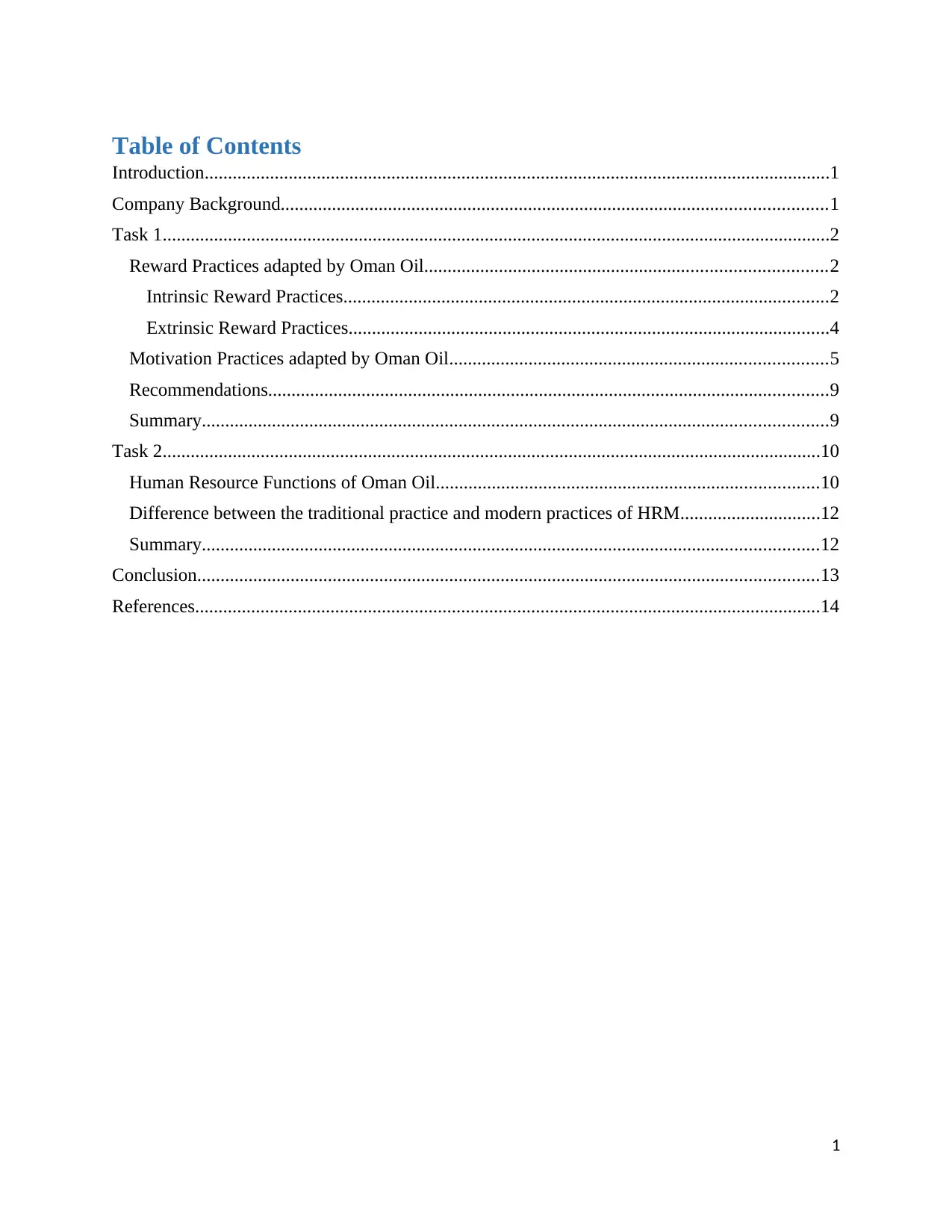
Table of Contents
Introduction......................................................................................................................................1
Company Background.....................................................................................................................1
Task 1...............................................................................................................................................2
Reward Practices adapted by Oman Oil......................................................................................2
Intrinsic Reward Practices........................................................................................................2
Extrinsic Reward Practices.......................................................................................................4
Motivation Practices adapted by Oman Oil.................................................................................5
Recommendations........................................................................................................................9
Summary......................................................................................................................................9
Task 2.............................................................................................................................................10
Human Resource Functions of Oman Oil..................................................................................10
Difference between the traditional practice and modern practices of HRM..............................12
Summary....................................................................................................................................12
Conclusion.....................................................................................................................................13
References......................................................................................................................................14
1
Introduction......................................................................................................................................1
Company Background.....................................................................................................................1
Task 1...............................................................................................................................................2
Reward Practices adapted by Oman Oil......................................................................................2
Intrinsic Reward Practices........................................................................................................2
Extrinsic Reward Practices.......................................................................................................4
Motivation Practices adapted by Oman Oil.................................................................................5
Recommendations........................................................................................................................9
Summary......................................................................................................................................9
Task 2.............................................................................................................................................10
Human Resource Functions of Oman Oil..................................................................................10
Difference between the traditional practice and modern practices of HRM..............................12
Summary....................................................................................................................................12
Conclusion.....................................................................................................................................13
References......................................................................................................................................14
1
Introduction
In this paper, we have been studied about the reward, motivation, and human resource functions
or practices of Oman Oil. It is a famous company of Oman and completely owned by its
government. The company is famous due to its well-structured internal environment and high-
quality products and services. This paper will prove beneficial for a lot of target audiences who
are interested in the same field. On the other hand, the conclusion is also propounded here. It has
been prepared on the basis of overall analysis of the paper.
Company Background
Oman Oil Company is defined as a commercial organization which is fully managed by the
Oman government. It was established during 1996 to pursue investment opportunities in the
energy sector both outside and inside Oman. The main motive of the company behind
participation in energy-related projects is to diversify the Omani economy and foreign private
sector investment (https://www.bloomberg.com/research/stocks/private/snapshot.asp?
privcapId=10877852). The mission of the company is to grow talent by developing business
leaders and professional, maximize value through Oman's resources, create meaning employment
within Oman, and invest in profitable business houses domestically and globally. The current
structure of the organization is developed on four different pillars which operate OOC's assets
and projects. These four pillars are named as; Oman Oil Duqm Development L.L.C, Oman Oil
company exploration and production, Oman Oil Facilities Development Company L.L.C, and
Takamul Investment Company S.A.O.C. All these four pillars are effectively managed by the
OOC international investment unit. Moreover, it is also said that the outside Oman, the
2
In this paper, we have been studied about the reward, motivation, and human resource functions
or practices of Oman Oil. It is a famous company of Oman and completely owned by its
government. The company is famous due to its well-structured internal environment and high-
quality products and services. This paper will prove beneficial for a lot of target audiences who
are interested in the same field. On the other hand, the conclusion is also propounded here. It has
been prepared on the basis of overall analysis of the paper.
Company Background
Oman Oil Company is defined as a commercial organization which is fully managed by the
Oman government. It was established during 1996 to pursue investment opportunities in the
energy sector both outside and inside Oman. The main motive of the company behind
participation in energy-related projects is to diversify the Omani economy and foreign private
sector investment (https://www.bloomberg.com/research/stocks/private/snapshot.asp?
privcapId=10877852). The mission of the company is to grow talent by developing business
leaders and professional, maximize value through Oman's resources, create meaning employment
within Oman, and invest in profitable business houses domestically and globally. The current
structure of the organization is developed on four different pillars which operate OOC's assets
and projects. These four pillars are named as; Oman Oil Duqm Development L.L.C, Oman Oil
company exploration and production, Oman Oil Facilities Development Company L.L.C, and
Takamul Investment Company S.A.O.C. All these four pillars are effectively managed by the
OOC international investment unit. Moreover, it is also said that the outside Oman, the
2
⊘ This is a preview!⊘
Do you want full access?
Subscribe today to unlock all pages.

Trusted by 1+ million students worldwide
organization is actively engaged in the energy value chain to offer revenue and an alternate
source for the Oman government.
Task 1
Reward Practices adapted by Oman Oil
Ajmal (2015) has been defined reward as benefits offered by an organization to its employers. It
is in the form of both monetary and non-monetary forms. Oman Oil also used a lot of reward
practices which gives it a unique identity among the employers and other competitors. It is the
reward practices of the company which help it in gaining the competitive advantage in existing
market. Oman Oil is utilizing both the intrinsic and extrinsic reward practices. Armstrong (2014)
concluded the intrinsic reward as a reward linked to the job itself. On the other hand, Brewster
(2017) defined the extrinsic rewards as rewards which are not linked to the job’s content. The
inclusion of both intrinsic and extrinsic reward practices makes easy its operations. Due to the
effective reward practices, Oman Oil able to attract new talent in an effective manner. The
below-mentioned are intrinsic and extrinsic job practices adapted by Oman Oil to motivate its
employees and spread happiness among them.
Intrinsic Reward Practices
Oman Oil believed in the approach propounded by Frederick W. Taylor. According to his
approach, the company design jobs to stimulate work performance of its employees and gain an
effective outcome (Beardwell, 2017). No wasted time and no wasted movements added up to
effective performance. The following are intrinsic reward practices followed by Oman Oil to
keep its employees motivated and engaged in their day to day activities:
Job Enlargement
3
source for the Oman government.
Task 1
Reward Practices adapted by Oman Oil
Ajmal (2015) has been defined reward as benefits offered by an organization to its employers. It
is in the form of both monetary and non-monetary forms. Oman Oil also used a lot of reward
practices which gives it a unique identity among the employers and other competitors. It is the
reward practices of the company which help it in gaining the competitive advantage in existing
market. Oman Oil is utilizing both the intrinsic and extrinsic reward practices. Armstrong (2014)
concluded the intrinsic reward as a reward linked to the job itself. On the other hand, Brewster
(2017) defined the extrinsic rewards as rewards which are not linked to the job’s content. The
inclusion of both intrinsic and extrinsic reward practices makes easy its operations. Due to the
effective reward practices, Oman Oil able to attract new talent in an effective manner. The
below-mentioned are intrinsic and extrinsic job practices adapted by Oman Oil to motivate its
employees and spread happiness among them.
Intrinsic Reward Practices
Oman Oil believed in the approach propounded by Frederick W. Taylor. According to his
approach, the company design jobs to stimulate work performance of its employees and gain an
effective outcome (Beardwell, 2017). No wasted time and no wasted movements added up to
effective performance. The following are intrinsic reward practices followed by Oman Oil to
keep its employees motivated and engaged in their day to day activities:
Job Enlargement
3
Paraphrase This Document
Need a fresh take? Get an instant paraphrase of this document with our AI Paraphraser
The first and the foremost intrinsic reward practice adapted by Oman Oil is job enlargement. It is
an important intrinsic reward to enhance the motivation level of employees. The company has
adapted this practice with a sole motive of enlarging the number of tasks performed by an
employee. But, it keeps all tasks and activities at the same level of responsibility and difficulty.
Due to the job enlargement, the company might increase intrinsic motivation of its employers
(Barta, 2014). On the basis of such intrinsic reward, it able to spread happiness among
employees and they start consider themselves as an important part of the company. Generally, it
is believed that job enlargement does neither contain higher job responsibility not great skills,
just a wider range of similar type activities. Therefore, with the job enlargement practice Oman
Oil able to decrease boredom by giving people a large variety of jobs to do.
Job Enrichment
Another important intrinsic reward practice is job enrichment. According to this practice, the
Oman oil designs a variety of jobs to offer a lot of opportunities to its employees. This has been
performed by providing employee greater control and responsibility for their work (Cerasoli,
2014). Most of the time, job enrichment practice of intrinsic reward is also known as vertical job
loading. It is because employees are awarded some responsibilities that used to belong to their
supervisors. The main motive behind the use of job enrichment practice is to enhance intrinsic
motivation by satisfying its employees. On the basis of job enrichment practice, the company is
permitting to its employees to plan their work schedules. On the other hand, job enrichment
practice also enforces the Oman Oil team to permit the employee to learn new skills and perform
accordingly.
Recognition
4
an important intrinsic reward to enhance the motivation level of employees. The company has
adapted this practice with a sole motive of enlarging the number of tasks performed by an
employee. But, it keeps all tasks and activities at the same level of responsibility and difficulty.
Due to the job enlargement, the company might increase intrinsic motivation of its employers
(Barta, 2014). On the basis of such intrinsic reward, it able to spread happiness among
employees and they start consider themselves as an important part of the company. Generally, it
is believed that job enlargement does neither contain higher job responsibility not great skills,
just a wider range of similar type activities. Therefore, with the job enlargement practice Oman
Oil able to decrease boredom by giving people a large variety of jobs to do.
Job Enrichment
Another important intrinsic reward practice is job enrichment. According to this practice, the
Oman oil designs a variety of jobs to offer a lot of opportunities to its employees. This has been
performed by providing employee greater control and responsibility for their work (Cerasoli,
2014). Most of the time, job enrichment practice of intrinsic reward is also known as vertical job
loading. It is because employees are awarded some responsibilities that used to belong to their
supervisors. The main motive behind the use of job enrichment practice is to enhance intrinsic
motivation by satisfying its employees. On the basis of job enrichment practice, the company is
permitting to its employees to plan their work schedules. On the other hand, job enrichment
practice also enforces the Oman Oil team to permit the employee to learn new skills and perform
accordingly.
Recognition
4
Apart from the above-mentioned intrinsic reward practices, Oman Oil also follows recognition
practice to satisfy growth needs of its employees. Generally, it is believed that every employee
wants recognition where they work. Therefore, the recognition is offered by the company to its
long-term employees (Eklöf, 2017). This has been done with the sole motive of retention and
larger customer satisfaction.
On the other hand, the company also offers work freedom and autonomy to its employees. These
intrinsic reward practices become the foremost success factors of the company.
Extrinsic Reward Practices
Oman Oil also follows extrinsic reward practices. The extrinsic reward practices are followed by
the company to attach employee and their values emotionally. The extrinsic reward practices will
have a direct influence on the performance of employees (Fang, 2013). The extrinsic reward
motivates the employees to accomplish their task with required quality and within the
determined time frame. The below-mentioned are some extrinsic reward practices followed by
the management of Oman Oil:
Pay
It is first extrinsic reward paid by the company to its employees. A good payment system has
been designed by the management of the company as the reward for contributing their energy
and valuable time in obtaining the firm's objective (Ferris, 2013). This good payment works as a
big motivational factor that influences their job satisfaction.
Commission or Bonus
Another extrinsic reward practice followed by the Oman Oil is commission or bonus. It is right
to say that the company is earning profit due to high efforts of its human resources. Therefore, in
5
practice to satisfy growth needs of its employees. Generally, it is believed that every employee
wants recognition where they work. Therefore, the recognition is offered by the company to its
long-term employees (Eklöf, 2017). This has been done with the sole motive of retention and
larger customer satisfaction.
On the other hand, the company also offers work freedom and autonomy to its employees. These
intrinsic reward practices become the foremost success factors of the company.
Extrinsic Reward Practices
Oman Oil also follows extrinsic reward practices. The extrinsic reward practices are followed by
the company to attach employee and their values emotionally. The extrinsic reward practices will
have a direct influence on the performance of employees (Fang, 2013). The extrinsic reward
motivates the employees to accomplish their task with required quality and within the
determined time frame. The below-mentioned are some extrinsic reward practices followed by
the management of Oman Oil:
Pay
It is first extrinsic reward paid by the company to its employees. A good payment system has
been designed by the management of the company as the reward for contributing their energy
and valuable time in obtaining the firm's objective (Ferris, 2013). This good payment works as a
big motivational factor that influences their job satisfaction.
Commission or Bonus
Another extrinsic reward practice followed by the Oman Oil is commission or bonus. It is right
to say that the company is earning profit due to high efforts of its human resources. Therefore, in
5
⊘ This is a preview!⊘
Do you want full access?
Subscribe today to unlock all pages.
Trusted by 1+ million students worldwide
order to appreciate their efforts, the management of Oman Oil is providing the bonuses and extra
commission to its employees (Facer Jr, 2014). This has been done with the objective of
appreciating employees’ effort by offering monetary rewards.
Fringe Benefits
Oman Oil also offers a lot of fringe benefits to its employees. Kim (2014) concluded the fringe
benefits as extra facility offered to employees in addition to their salary. These fringe benefits
mainly include employee pension plan, discount scheme, health insurance, and company's car.
Apart from above-mentioned extrinsic benefits, the company is also offering a lot of extrinsic
reward practices. These practices included improved working condition, healthy environment,
promotion, and profit sharing. The inclusion of all these extrinsic benefits makes it capable of
gaining competitive image.
Motivation Practices adapted by Oman Oil
Generally, it can be said that motivational practices work as a key to an organization success. It
is because on the basis of motivation an organization can lead its human resources in a right
direction. Khan (2013) has been defined the motivation as a process of arousing, directing, and
managing behavior towards a particular aim. Therefore, it can be said that motivation is a
combination of three different components. The first one is arousal. On the other hand, other
components are direction and maintenance. The combination of all these components helps an
organization to think of motivation by using the analogy of driving a car. Oman Oil concentrates
enough on adoption of motivational practices. These motivational practices do not only help it in
improving the internal environment within the organization but also the employee retention. The
6
commission to its employees (Facer Jr, 2014). This has been done with the objective of
appreciating employees’ effort by offering monetary rewards.
Fringe Benefits
Oman Oil also offers a lot of fringe benefits to its employees. Kim (2014) concluded the fringe
benefits as extra facility offered to employees in addition to their salary. These fringe benefits
mainly include employee pension plan, discount scheme, health insurance, and company's car.
Apart from above-mentioned extrinsic benefits, the company is also offering a lot of extrinsic
reward practices. These practices included improved working condition, healthy environment,
promotion, and profit sharing. The inclusion of all these extrinsic benefits makes it capable of
gaining competitive image.
Motivation Practices adapted by Oman Oil
Generally, it can be said that motivational practices work as a key to an organization success. It
is because on the basis of motivation an organization can lead its human resources in a right
direction. Khan (2013) has been defined the motivation as a process of arousing, directing, and
managing behavior towards a particular aim. Therefore, it can be said that motivation is a
combination of three different components. The first one is arousal. On the other hand, other
components are direction and maintenance. The combination of all these components helps an
organization to think of motivation by using the analogy of driving a car. Oman Oil concentrates
enough on adoption of motivational practices. These motivational practices do not only help it in
improving the internal environment within the organization but also the employee retention. The
6
Paraphrase This Document
Need a fresh take? Get an instant paraphrase of this document with our AI Paraphraser
below-mentioned are some motivational practices and theories used by Oman Oil to direct the
company in a particular direction:
Maslow’s Hierarchy of Needs Theory
The first and the foremost motivational approach focused by Oman Oil is Maslow’s Hierarchy of
Needs. The company management believed that human resources are motivated to satisfy their
needs-whether these needs are for food and anything else. On the basis of Maslow’ hierarchy of
need, the company would be able to attract the best people and motivate them to perform
excellent work (Legault, 2016). The Oman Oil management team believed that human resources
would not be well-adjusted and healthy unless they satisfy their basic needs. This satisfaction
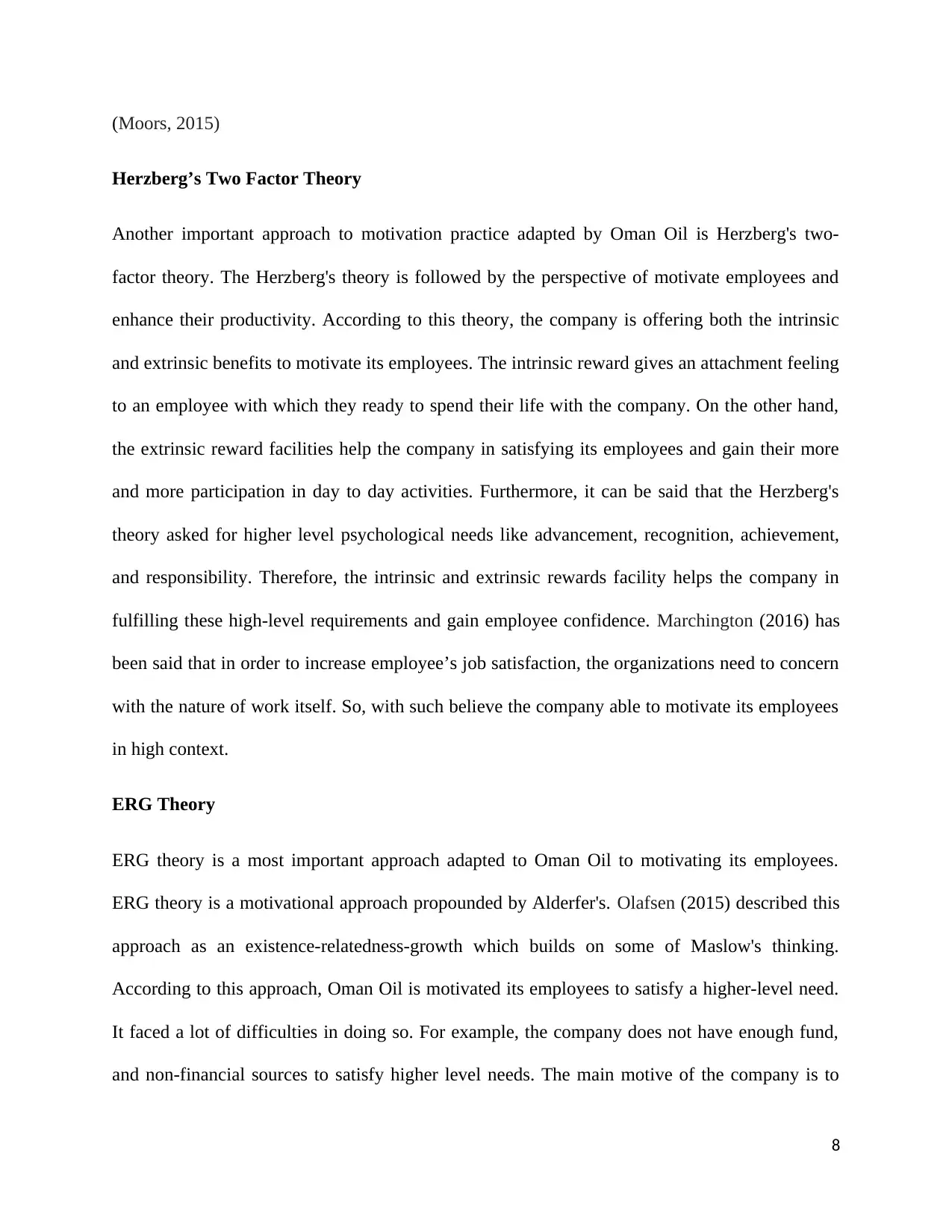
will further prepare an employee to be a productive part of the belonging organization. Miner
(2015) has been defined the Maslow' Hierarchy of Needs theory is a combination of five
different needs. These needs can understand by looking the figure 1. Therefore, Oman Oil takes a
lot of initiatives to satisfy all these needs and motivate an employee in a well-context. On the
basis of such efforts, the company would be able to win the confidence of its customers.
Figure 1
7
company in a particular direction:
Maslow’s Hierarchy of Needs Theory
The first and the foremost motivational approach focused by Oman Oil is Maslow’s Hierarchy of
Needs. The company management believed that human resources are motivated to satisfy their
needs-whether these needs are for food and anything else. On the basis of Maslow’ hierarchy of
need, the company would be able to attract the best people and motivate them to perform
excellent work (Legault, 2016). The Oman Oil management team believed that human resources
would not be well-adjusted and healthy unless they satisfy their basic needs. This satisfaction
will further prepare an employee to be a productive part of the belonging organization. Miner
(2015) has been defined the Maslow' Hierarchy of Needs theory is a combination of five
different needs. These needs can understand by looking the figure 1. Therefore, Oman Oil takes a
lot of initiatives to satisfy all these needs and motivate an employee in a well-context. On the
basis of such efforts, the company would be able to win the confidence of its customers.
Figure 1
7
(Moors, 2015)
Herzberg’s Two Factor Theory
Another important approach to motivation practice adapted by Oman Oil is Herzberg's two-
factor theory. The Herzberg's theory is followed by the perspective of motivate employees and
enhance their productivity. According to this theory, the company is offering both the intrinsic
and extrinsic benefits to motivate its employees. The intrinsic reward gives an attachment feeling
to an employee with which they ready to spend their life with the company. On the other hand,
the extrinsic reward facilities help the company in satisfying its employees and gain their more
and more participation in day to day activities. Furthermore, it can be said that the Herzberg's
theory asked for higher level psychological needs like advancement, recognition, achievement,
and responsibility. Therefore, the intrinsic and extrinsic rewards facility helps the company in
fulfilling these high-level requirements and gain employee confidence. Marchington (2016) has
been said that in order to increase employee’s job satisfaction, the organizations need to concern
with the nature of work itself. So, with such believe the company able to motivate its employees
in high context.
ERG Theory
ERG theory is a most important approach adapted to Oman Oil to motivating its employees.
ERG theory is a motivational approach propounded by Alderfer's. Olafsen (2015) described this
approach as an existence-relatedness-growth which builds on some of Maslow's thinking.
According to this approach, Oman Oil is motivated its employees to satisfy a higher-level need.
It faced a lot of difficulties in doing so. For example, the company does not have enough fund,
and non-financial sources to satisfy higher level needs. The main motive of the company is to
8
Herzberg’s Two Factor Theory
Another important approach to motivation practice adapted by Oman Oil is Herzberg's two-
factor theory. The Herzberg's theory is followed by the perspective of motivate employees and
enhance their productivity. According to this theory, the company is offering both the intrinsic
and extrinsic benefits to motivate its employees. The intrinsic reward gives an attachment feeling
to an employee with which they ready to spend their life with the company. On the other hand,
the extrinsic reward facilities help the company in satisfying its employees and gain their more
and more participation in day to day activities. Furthermore, it can be said that the Herzberg's
theory asked for higher level psychological needs like advancement, recognition, achievement,
and responsibility. Therefore, the intrinsic and extrinsic rewards facility helps the company in
fulfilling these high-level requirements and gain employee confidence. Marchington (2016) has
been said that in order to increase employee’s job satisfaction, the organizations need to concern
with the nature of work itself. So, with such believe the company able to motivate its employees
in high context.
ERG Theory
ERG theory is a most important approach adapted to Oman Oil to motivating its employees.
ERG theory is a motivational approach propounded by Alderfer's. Olafsen (2015) described this
approach as an existence-relatedness-growth which builds on some of Maslow's thinking.
According to this approach, Oman Oil is motivated its employees to satisfy a higher-level need.
It faced a lot of difficulties in doing so. For example, the company does not have enough fund,
and non-financial sources to satisfy higher level needs. The main motive of the company is to
8
⊘ This is a preview!⊘
Do you want full access?
Subscribe today to unlock all pages.
Trusted by 1+ million students worldwide
motivate employees to live their life as per their expectations. Furthermore, it can be said that
satisfy a higher-level need will automatically increase the satisfaction level derived from lower-
level needs (Sparrow, 2016). Therefore, on the basis of such an active approach, Oman Oil
management team able to satisfy the growth needs, existence needs, and relatedness needs of its
employees.
Expectancy Theory and Practices
Another important motivational approach followed by the management team of Oman Oil is
expectancy theory. The company management believed that human resources could easily
motivate through satisfy their expectations that they will get some required benefits by putting
more effort. Therefore, according to this theory the management motivates its employees by
paying extra time and bonuses to them. The overtime payment and bonus motivate them to give
their significant contribution during peak time (Thompson, 2016). The company has evaluated
that there is a clear link between their rate of pay and effective job performance. Therefore, the
company is putting more and more effort to affect the motivation level of its employees.
Moreover, it can be said that the management team of Oman Oil views the motivation as the
combination of three different aspects. The first one is expectancy. It is considered as a belief
that one’s hard work will influence work performance. On the other hand, another belief is
instrumentality. It is a belief which means that the performance of an individual will get
subsequent rewards. In addition, the last and final belief is valence. The valence means the
perceived value of expected rewards. Oman Oil believes in satisfying all these beliefs and
improves its performance.
Equity Theory
9
satisfy a higher-level need will automatically increase the satisfaction level derived from lower-
level needs (Sparrow, 2016). Therefore, on the basis of such an active approach, Oman Oil
management team able to satisfy the growth needs, existence needs, and relatedness needs of its
employees.
Expectancy Theory and Practices
Another important motivational approach followed by the management team of Oman Oil is
expectancy theory. The company management believed that human resources could easily
motivate through satisfy their expectations that they will get some required benefits by putting
more effort. Therefore, according to this theory the management motivates its employees by
paying extra time and bonuses to them. The overtime payment and bonus motivate them to give
their significant contribution during peak time (Thompson, 2016). The company has evaluated
that there is a clear link between their rate of pay and effective job performance. Therefore, the
company is putting more and more effort to affect the motivation level of its employees.
Moreover, it can be said that the management team of Oman Oil views the motivation as the
combination of three different aspects. The first one is expectancy. It is considered as a belief
that one’s hard work will influence work performance. On the other hand, another belief is
instrumentality. It is a belief which means that the performance of an individual will get
subsequent rewards. In addition, the last and final belief is valence. The valence means the
perceived value of expected rewards. Oman Oil believes in satisfying all these beliefs and
improves its performance.
Equity Theory
9
Paraphrase This Document
Need a fresh take? Get an instant paraphrase of this document with our AI Paraphraser
Apart from above-mentioned theories, Oman Oil also follows equity theory approach of
motivation. The main motive behind the selection of this approach is to compare the
performance of its employees with others (Yoon, 2015). With the help of such outcomes, Oman
Oil fixes the value of equity which they will receive in exchange for efforts to the organization.
Therefore, it can be said that the Oman Oil focused each aspect of motivation to maintain its
internal environment and employee’s job satisfaction.
Recommendations
On the basis of the above-mentioned analysis, it has been clarified that the motivational efforts of
the company are effective than other companies. But, somehow it becomes a failure in
maintaining fairness in its operations. Due to this, it is not able to motivate its employees in a
right direction. Therefore, it is recommended to the Oman Oil that the company should follow
procedural justice theory of motivation (Moors, 2015). This theory will help the management in
perceiving fairness of the procedures used to make decisions about the distribution of outcomes,
performance, and inputs. By doing this, it can motive employees through giving an adequate
explanation of their decisions.
Summary
This task has been described the rewards and motivational practices adapted by Oman Oil in
favor of its employees. The above-mentioned analysis has been represented that the company is
motivating its employees in a well-organized manner. For this purpose, it has taken the help of
intrinsic and extrinsic rewards and a lot of motivational approaches. These approaches do not
improve only its performance but also the motivation level of employees.
10
motivation. The main motive behind the selection of this approach is to compare the
performance of its employees with others (Yoon, 2015). With the help of such outcomes, Oman
Oil fixes the value of equity which they will receive in exchange for efforts to the organization.
Therefore, it can be said that the Oman Oil focused each aspect of motivation to maintain its
internal environment and employee’s job satisfaction.
Recommendations
On the basis of the above-mentioned analysis, it has been clarified that the motivational efforts of
the company are effective than other companies. But, somehow it becomes a failure in
maintaining fairness in its operations. Due to this, it is not able to motivate its employees in a
right direction. Therefore, it is recommended to the Oman Oil that the company should follow
procedural justice theory of motivation (Moors, 2015). This theory will help the management in
perceiving fairness of the procedures used to make decisions about the distribution of outcomes,
performance, and inputs. By doing this, it can motive employees through giving an adequate
explanation of their decisions.
Summary
This task has been described the rewards and motivational practices adapted by Oman Oil in
favor of its employees. The above-mentioned analysis has been represented that the company is
motivating its employees in a well-organized manner. For this purpose, it has taken the help of
intrinsic and extrinsic rewards and a lot of motivational approaches. These approaches do not
improve only its performance but also the motivation level of employees.
10
Task 2
Marchington (2016) has been defined that an effectively managed human resource department
can offer a better structure and ability to fulfill business needs to an organization. Therefore, it is
necessary for organizations to adopt some HR disciplines so that human resource of the company
can guide in a right direction and their efforts can utilize effectively. It is believed that without a
dedicated HR department, an organization is not able to attain the same level of workforce
management and efficiency through outsourcing HR functions. So, it can be said that HR
functions play an effective role in today's scenario.
Human Resource Functions of Oman Oil
Oman Oil has taken a lot of active initiative to guide the team in a right direction. It manages the
human resource development to have control over the working scenario of the firm, employee,
and outcomes. The below-mentioned are some human resource functions of Oman Oil:
Leadership
The first and foremost function of Oman Oil is to enforce good control through appropriate
leadership (Legault, 2016). The main motive of the Oman Oil management is to develop
teamwork and the integration of group goals and individual. This aim achieved by Oman Oil
through leadership. It is the leadership that enforces it to put a control over work practices and
outcomes of employees. Due to the well-manner leadership styles, the organization able to
accomplish its corporate goals and bring the company in a right direction. On the other hand, it is
the leadership function of HR department which encourages intrinsic and extrinsic motivation to
employees. Therefore, such consideration and focus towards employees motivate the company to
gain employee participation and spread satisfaction. So, it can be said that the leadership is a best
11
Marchington (2016) has been defined that an effectively managed human resource department
can offer a better structure and ability to fulfill business needs to an organization. Therefore, it is
necessary for organizations to adopt some HR disciplines so that human resource of the company
can guide in a right direction and their efforts can utilize effectively. It is believed that without a
dedicated HR department, an organization is not able to attain the same level of workforce
management and efficiency through outsourcing HR functions. So, it can be said that HR
functions play an effective role in today's scenario.
Human Resource Functions of Oman Oil
Oman Oil has taken a lot of active initiative to guide the team in a right direction. It manages the
human resource development to have control over the working scenario of the firm, employee,
and outcomes. The below-mentioned are some human resource functions of Oman Oil:
Leadership
The first and foremost function of Oman Oil is to enforce good control through appropriate
leadership (Legault, 2016). The main motive of the Oman Oil management is to develop
teamwork and the integration of group goals and individual. This aim achieved by Oman Oil
through leadership. It is the leadership that enforces it to put a control over work practices and
outcomes of employees. Due to the well-manner leadership styles, the organization able to
accomplish its corporate goals and bring the company in a right direction. On the other hand, it is
the leadership function of HR department which encourages intrinsic and extrinsic motivation to
employees. Therefore, such consideration and focus towards employees motivate the company to
gain employee participation and spread satisfaction. So, it can be said that the leadership is a best
11
⊘ This is a preview!⊘
Do you want full access?
Subscribe today to unlock all pages.
Trusted by 1+ million students worldwide

1 out of 18


Your All-in-One AI-Powered Toolkit for Academic Success.
+13062052269
info@desklib.com
Available 24*7 on WhatsApp / Email
![[object Object]](/_next/static/media/star-bottom.7253800d.svg)
Unlock your academic potential
Copyright © 2020–2026 A2Z Services. All Rights Reserved. Developed and managed by ZUCOL.