Walter Ong's Insights on Culture, Communication, and Technology
VerifiedAdded on 2022/08/12
|13
|1115
|31
Essay
AI Summary
This essay explores the work of Walter Ong, a prominent scholar known for his contributions to understanding the evolution of culture and consciousness. It focuses on Ong's central argument regarding the transition from orality to literacy and its profound effects on human thought, communication, and social structures. The essay delves into Ong's key concepts, including the characteristics of oral cultures, the impact of writing and print, and the role of technology in shaping cultural forms. It examines his major works, such as "Orality and Literacy: The Technologizing of the Word," and analyzes his insights into the conservation of culture through communication. Furthermore, the essay discusses the impact of literacy on the development of Western educational systems. It concludes by emphasizing the significance of Ong's ideas in understanding the ongoing transformation of culture in the digital age and the lasting relevance of his work in the fields of communication, philosophy, and cultural studies.
WALTER ONG
C O N S E R V I N G C U LT U R E
Paraphrase This Document
Need a fresh take? Get an instant paraphrase of this document with our AI Paraphraser

INTRODUCTION
• The aim of this presentation is to discuss the personal
and philosophical life of the key thinker Walter Ong.
• He was an Jesuit priest of America and a professor of
English literature.
• Walter Ong is mainly reputed for his works on the
cultural history and religion guided by philosophy.
• The major interest of Walter Ong was in exposing his
transition of human consciousness from orality to
literacy.
• The aim of this presentation is to discuss the personal
and philosophical life of the key thinker Walter Ong.
• He was an Jesuit priest of America and a professor of
English literature.
• Walter Ong is mainly reputed for his works on the
cultural history and religion guided by philosophy.
• The major interest of Walter Ong was in exposing his
transition of human consciousness from orality to
literacy.

WHAT IS ORALITY AND
LITERACY
• World cannot sustain without communication and in
this process, the importance of orality and literacy are
essential.
• Orality has described the principal verbal medium that
is employed through the cultures with small and no
exposure to writing.
• On the contrary, literary if the ability to reading and
writing.
• A great division can be found between these assigning
LITERACY
• World cannot sustain without communication and in
this process, the importance of orality and literacy are
essential.
• Orality has described the principal verbal medium that
is employed through the cultures with small and no
exposure to writing.
• On the contrary, literary if the ability to reading and
writing.
• A great division can be found between these assigning
⊘ This is a preview!⊘
Do you want full access?
Subscribe today to unlock all pages.

Trusted by 1+ million students worldwide

MAIN INTEREST OF ONG
• Visualise tendencies
• Mathematical transformation behind logic
• Oral cyclic thoughts
• Movement of print culture from oral heroic poetry
• Development of manuscript culture
• New dimension of orality fostered by modern
communication
• Western educational system
• Learned Latin in the western culture.
• Visualise tendencies
• Mathematical transformation behind logic
• Oral cyclic thoughts
• Movement of print culture from oral heroic poetry
• Development of manuscript culture
• New dimension of orality fostered by modern
communication
• Western educational system
• Learned Latin in the western culture.
Paraphrase This Document
Need a fresh take? Get an instant paraphrase of this document with our AI Paraphraser

CULTURE CONSERVATION
• To Walter Ong, this chief has affected the education and
culture in a great way.
• To this thinker, the knowledge of technologies in the early
human beings include the knowledge about fire or for that
matter steam engine has the similar process to learn writing.
• This technology when was introduced to the primary oral
culture had a wide ranging impact upon them and influenced
all areas of life (Ferrel 2017).
• To Walter Ong, this chief has affected the education and
culture in a great way.
• To this thinker, the knowledge of technologies in the early
human beings include the knowledge about fire or for that
matter steam engine has the similar process to learn writing.
• This technology when was introduced to the primary oral
culture had a wide ranging impact upon them and influenced
all areas of life (Ferrel 2017).

CULTURE CONSERVATION
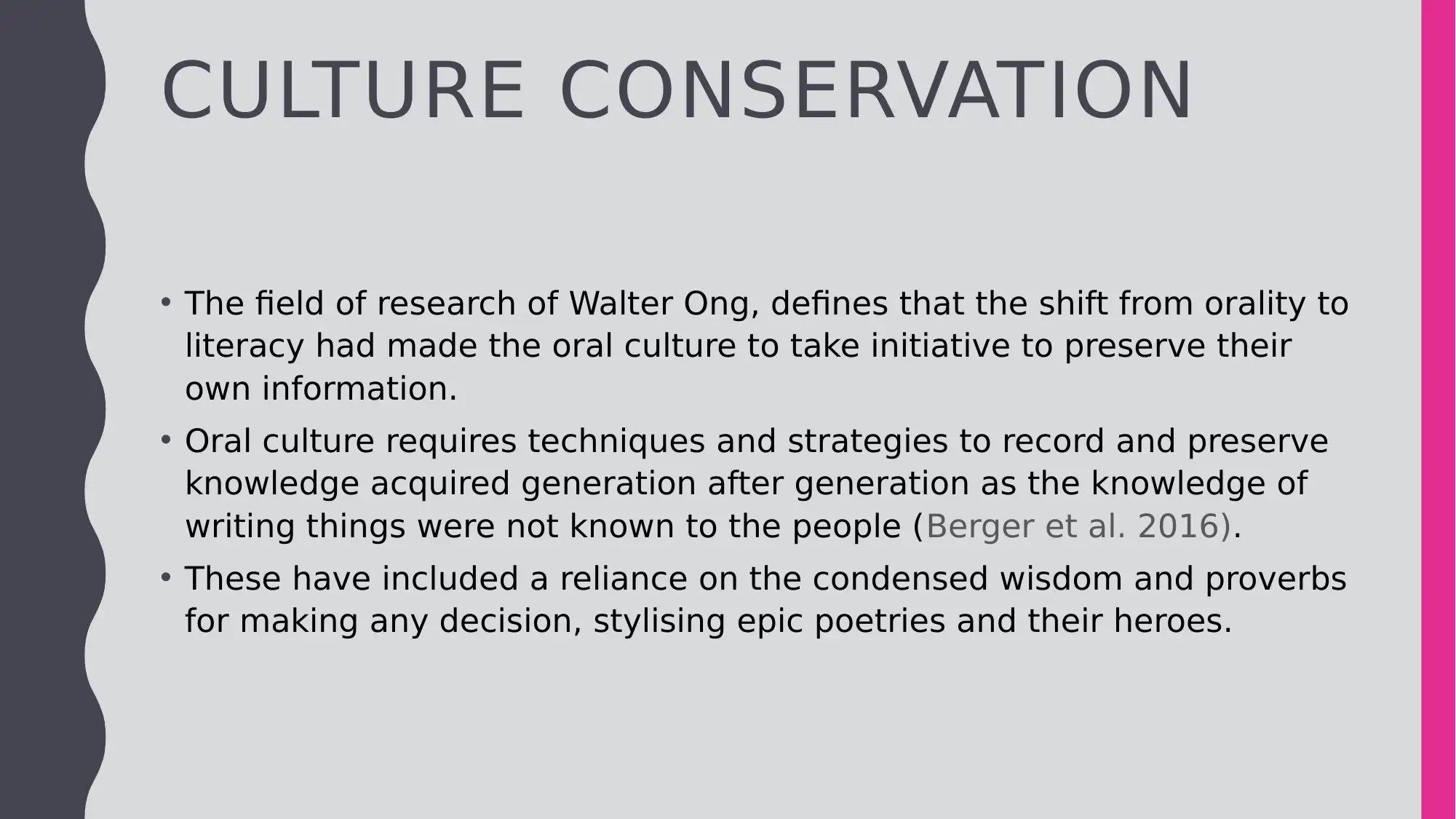
• The field of research of Walter Ong, defines that the shift from orality to
literacy had made the oral culture to take initiative to preserve their
own information.
• Oral culture requires techniques and strategies to record and preserve
knowledge acquired generation after generation as the knowledge of
writing things were not known to the people (Berger et al. 2016).
• These have included a reliance on the condensed wisdom and proverbs
for making any decision, stylising epic poetries and their heroes.
• The field of research of Walter Ong, defines that the shift from orality to
literacy had made the oral culture to take initiative to preserve their
own information.
• Oral culture requires techniques and strategies to record and preserve
knowledge acquired generation after generation as the knowledge of
writing things were not known to the people (Berger et al. 2016).
• These have included a reliance on the condensed wisdom and proverbs
for making any decision, stylising epic poetries and their heroes.
⊘ This is a preview!⊘
Do you want full access?
Subscribe today to unlock all pages.

Trusted by 1+ million students worldwide

CULTURE CONSERVATION
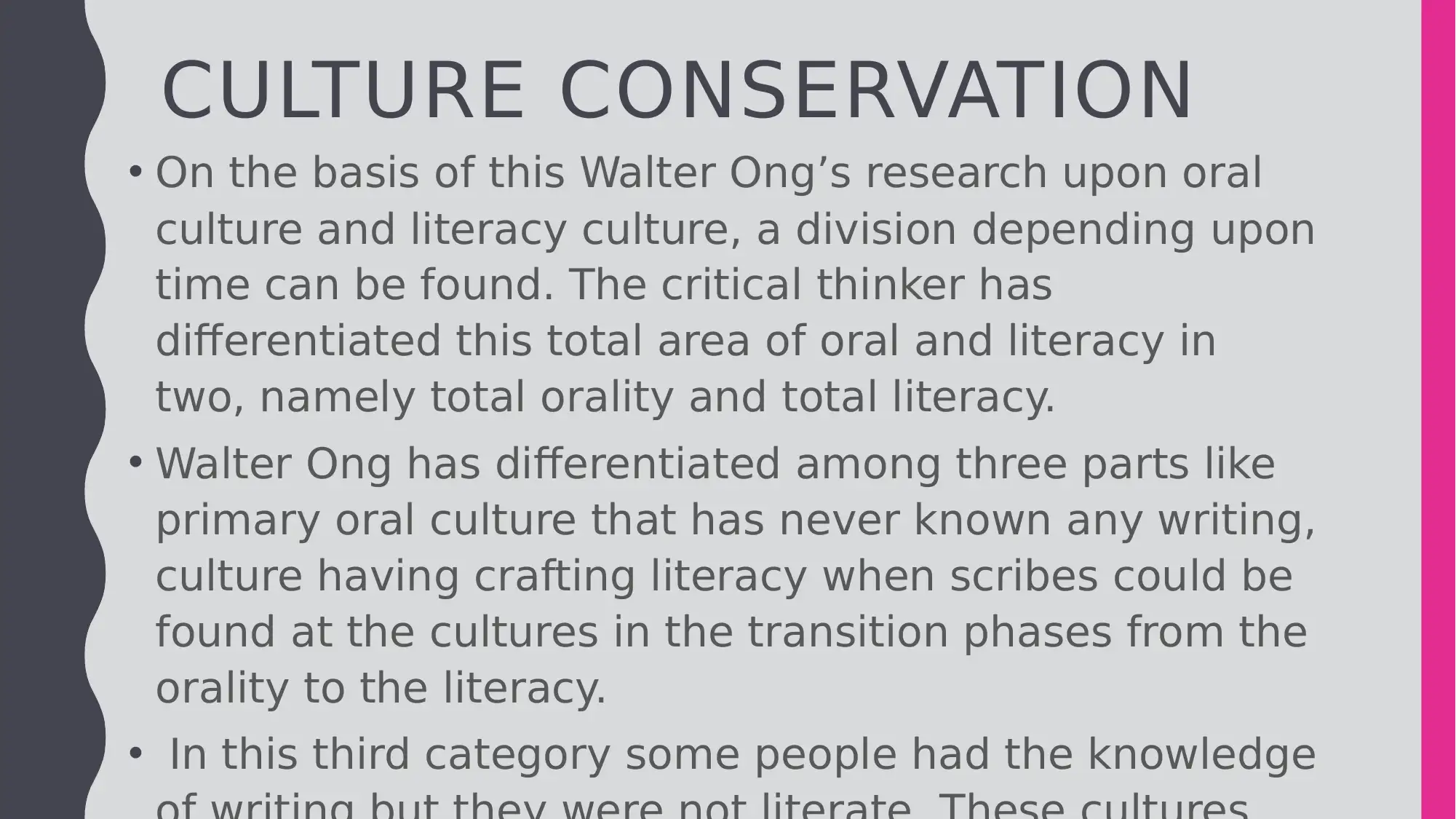
• On the basis of this Walter Ong’s research upon oral
culture and literacy culture, a division depending upon
time can be found. The critical thinker has
differentiated this total area of oral and literacy in
two, namely total orality and total literacy.
• Walter Ong has differentiated among three parts like
primary oral culture that has never known any writing,
culture having crafting literacy when scribes could be
found at the cultures in the transition phases from the
orality to the literacy.
• In this third category some people had the knowledge
• On the basis of this Walter Ong’s research upon oral
culture and literacy culture, a division depending upon
time can be found. The critical thinker has
differentiated this total area of oral and literacy in
two, namely total orality and total literacy.
• Walter Ong has differentiated among three parts like
primary oral culture that has never known any writing,
culture having crafting literacy when scribes could be
found at the cultures in the transition phases from the
orality to the literacy.
• In this third category some people had the knowledge
Paraphrase This Document
Need a fresh take? Get an instant paraphrase of this document with our AI Paraphraser

MAJOR WORKS
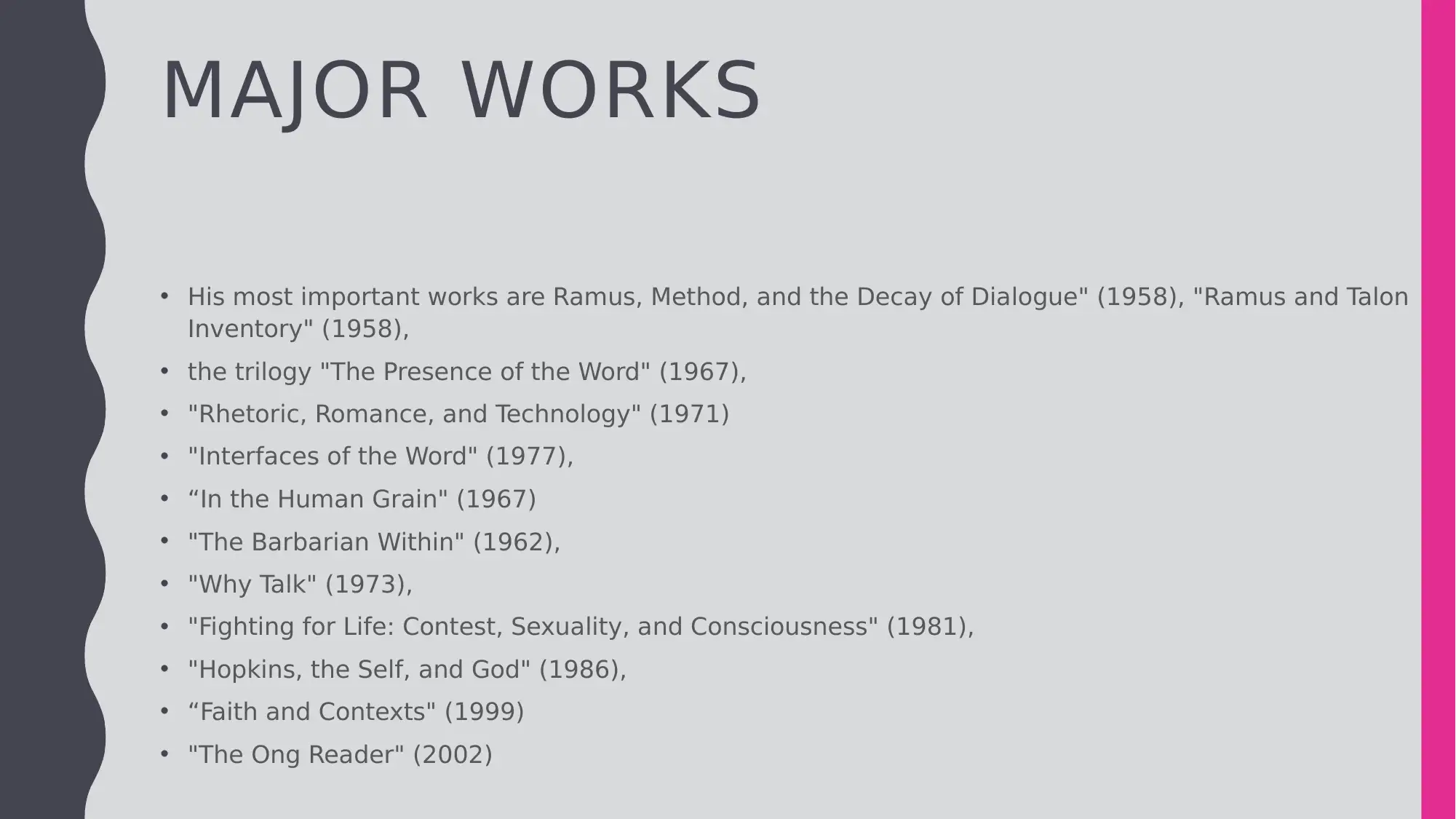
• His most important works are Ramus, Method, and the Decay of Dialogue" (1958), "Ramus and Talon
Inventory" (1958),
• the trilogy "The Presence of the Word" (1967),
• "Rhetoric, Romance, and Technology" (1971)
• "Interfaces of the Word" (1977),
• “In the Human Grain" (1967)
• "The Barbarian Within" (1962),
• "Why Talk" (1973),
• "Fighting for Life: Contest, Sexuality, and Consciousness" (1981),
• "Hopkins, the Self, and God" (1986),
• “Faith and Contexts" (1999)
• "The Ong Reader" (2002)
• His most important works are Ramus, Method, and the Decay of Dialogue" (1958), "Ramus and Talon
Inventory" (1958),
• the trilogy "The Presence of the Word" (1967),
• "Rhetoric, Romance, and Technology" (1971)
• "Interfaces of the Word" (1977),
• “In the Human Grain" (1967)
• "The Barbarian Within" (1962),
• "Why Talk" (1973),
• "Fighting for Life: Contest, Sexuality, and Consciousness" (1981),
• "Hopkins, the Self, and God" (1986),
• “Faith and Contexts" (1999)
• "The Ong Reader" (2002)

WORKS ON CULTURE
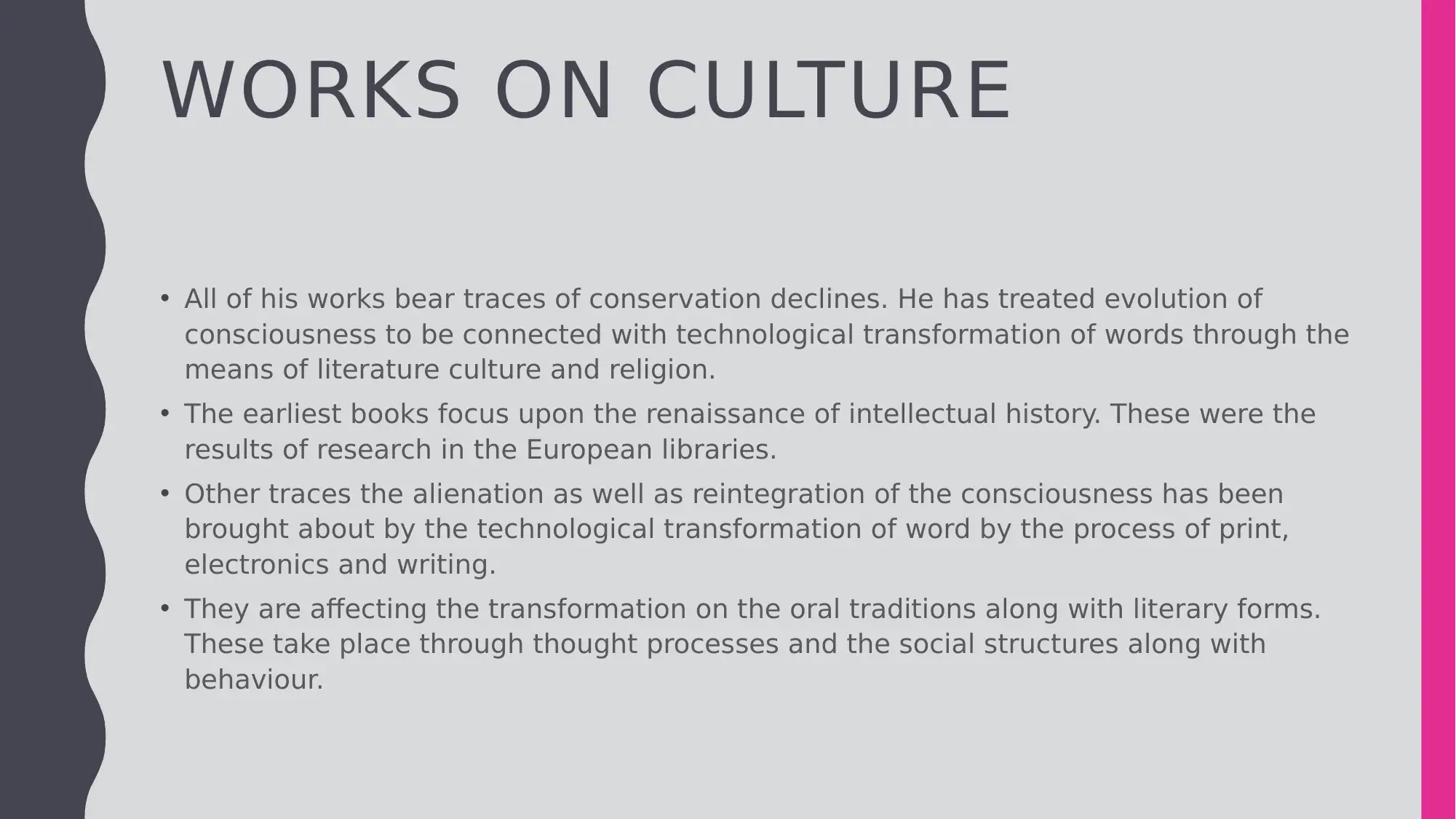
• All of his works bear traces of conservation declines. He has treated evolution of
consciousness to be connected with technological transformation of words through the
means of literature culture and religion.
• The earliest books focus upon the renaissance of intellectual history. These were the
results of research in the European libraries.
• Other traces the alienation as well as reintegration of the consciousness has been
brought about by the technological transformation of word by the process of print,
electronics and writing.
• They are affecting the transformation on the oral traditions along with literary forms.
These take place through thought processes and the social structures along with
behaviour.
• All of his works bear traces of conservation declines. He has treated evolution of
consciousness to be connected with technological transformation of words through the
means of literature culture and religion.
• The earliest books focus upon the renaissance of intellectual history. These were the
results of research in the European libraries.
• Other traces the alienation as well as reintegration of the consciousness has been
brought about by the technological transformation of word by the process of print,
electronics and writing.
• They are affecting the transformation on the oral traditions along with literary forms.
These take place through thought processes and the social structures along with
behaviour.
⊘ This is a preview!⊘
Do you want full access?
Subscribe today to unlock all pages.

Trusted by 1+ million students worldwide

WORKS ON CULTURE
• Two of the books by Walter Ong like "In the Human Grain" and
"The Barbarian Within" , are the critical examinations of
contemporary cultures, literature, and religion.
• Similarly "Why Talk" presents nontechnical communication
between the history and the nature of language.
• In Walter Ong's most extensively known book named "Orality
and Literacy: The Technologizing of the Word" (1982) has
reviewed revolutionary works on the orality-literacy contrast
from the ancient times through the present culture.
• Two of the books by Walter Ong like "In the Human Grain" and
"The Barbarian Within" , are the critical examinations of
contemporary cultures, literature, and religion.
• Similarly "Why Talk" presents nontechnical communication
between the history and the nature of language.
• In Walter Ong's most extensively known book named "Orality
and Literacy: The Technologizing of the Word" (1982) has
reviewed revolutionary works on the orality-literacy contrast
from the ancient times through the present culture.
Paraphrase This Document
Need a fresh take? Get an instant paraphrase of this document with our AI Paraphraser

CONCLUSION
• Therefore it can be concluded that Walter Ong was one of the major
scholars who have undetanding the process of conservation of culture
through communication.
• From the ancient times, the process of sharing knowledge has changed and
with the passing of time new technologies have added to these processes.
• Initially the oral tradition used to play essential part in the sharing of stories
and important information
• Towards the later part, the invention of writing system had replaced this
process.
• Through these, the conservation of culture has been made possible and in
understanding these steps, the contribution of Walter Ong is unmatched.
• Therefore it can be concluded that Walter Ong was one of the major
scholars who have undetanding the process of conservation of culture
through communication.
• From the ancient times, the process of sharing knowledge has changed and
with the passing of time new technologies have added to these processes.
• Initially the oral tradition used to play essential part in the sharing of stories
and important information
• Towards the later part, the invention of writing system had replaced this
process.
• Through these, the conservation of culture has been made possible and in
understanding these steps, the contribution of Walter Ong is unmatched.

REFERENCES
Bahl, RR, 2017. Outsourcing Our Memory 2.0: Using Walter Ong's
Orality/Literacy Studies to Recognize Technologies Effects on
Memory.
Berger, C, Calabrese, R.,Ellul, J, Adorno, T, Horkheimer, M,
Barthes, R, Ong, W, Luhmann, N, & Castells, M, 2018.
Communication theory.
Farrell, TJ, 2017. Condoleezza Rice's New Book and Walter J.
Ong's Thought.
Ouda, OK, El-Nakla, S, Yahya, CB, Peterson, H & Ouda, M, 2017.
Energy Conservation Awareness among Residential Consumers
in Saudi Arabia. International Journal of Computing and Digital
Systems, 6(06), pp.349-355.
Bahl, RR, 2017. Outsourcing Our Memory 2.0: Using Walter Ong's
Orality/Literacy Studies to Recognize Technologies Effects on
Memory.
Berger, C, Calabrese, R.,Ellul, J, Adorno, T, Horkheimer, M,
Barthes, R, Ong, W, Luhmann, N, & Castells, M, 2018.
Communication theory.
Farrell, TJ, 2017. Condoleezza Rice's New Book and Walter J.
Ong's Thought.
Ouda, OK, El-Nakla, S, Yahya, CB, Peterson, H & Ouda, M, 2017.
Energy Conservation Awareness among Residential Consumers
in Saudi Arabia. International Journal of Computing and Digital
Systems, 6(06), pp.349-355.
⊘ This is a preview!⊘
Do you want full access?
Subscribe today to unlock all pages.

Trusted by 1+ million students worldwide
1 out of 13
Your All-in-One AI-Powered Toolkit for Academic Success.
+13062052269
info@desklib.com
Available 24*7 on WhatsApp / Email
Unlock your academic potential
Copyright © 2020–2025 A2Z Services. All Rights Reserved. Developed and managed by ZUCOL.