University IT Project Management Plan: Airline Online Ticketing System
VerifiedAdded on 2022/08/27
|27
|5504
|23
Project
AI Summary
This project management plan details the development of an IT project management plan for an airline online ticketing system. It comprehensively addresses project risk management, including risk identification, qualitative and quantitative risk analysis, and the formulation of risk responses. The plan also covers project stakeholder management, outlining stakeholder identification, planning, engagement, and control strategies. The assignment analyzes various risks associated with online airline ticketing systems, such as technical, cost, schedule, client-related, contractual, and financial risks, along with their potential impacts and mitigation strategies. The project emphasizes the coordination between stakeholders, defining their roles, responsibilities, and engagement methods to ensure project success. The plan includes detailed tables and matrices for risk assessment and provides a structured approach to managing the project's complexities, with the aim of providing a comprehensive and practical guide for implementing the online airline ticketing system. This student assignment is published on Desklib, a platform providing AI-based study tools.
Running head: PROJECT MANAGEMENT
IT Project Management Plan for Airline Online Ticketing System
Name of the Student:
Name of the University:
IT Project Management Plan for Airline Online Ticketing System
Name of the Student:
Name of the University:
Paraphrase This Document
Need a fresh take? Get an instant paraphrase of this document with our AI Paraphraser

1PROJECT MANAGEMENT
Table of Contents
Project Risk Management..........................................................................................................2
11.1 Plan Risk Management..................................................................................................2
11.1.1 Risk Mitigation Plan...............................................................................................2
11.2 Identify Risks.................................................................................................................4
11.3 Perform Qualitative Risk Analysis.................................................................................5
11.4 Perform Quantitative Risk Analysis...............................................................................7
11.5 Plan Risk Responses....................................................................................................11
11.6 Implement Risk Responses..........................................................................................13
11.7 Control Risks................................................................................................................14
Project Stakeholder Management............................................................................................15
13.1.......................................................................................................................................15
13.2 Plan Stakeholder Management.....................................................................................15
13.3 Manage Stakeholder Engagement................................................................................20
13.4 Control Stakeholder Engagement................................................................................23
References................................................................................................................................24
Table of Contents
Project Risk Management..........................................................................................................2
11.1 Plan Risk Management..................................................................................................2
11.1.1 Risk Mitigation Plan...............................................................................................2
11.2 Identify Risks.................................................................................................................4
11.3 Perform Qualitative Risk Analysis.................................................................................5
11.4 Perform Quantitative Risk Analysis...............................................................................7
11.5 Plan Risk Responses....................................................................................................11
11.6 Implement Risk Responses..........................................................................................13
11.7 Control Risks................................................................................................................14
Project Stakeholder Management............................................................................................15
13.1.......................................................................................................................................15
13.2 Plan Stakeholder Management.....................................................................................15
13.3 Manage Stakeholder Engagement................................................................................20
13.4 Control Stakeholder Engagement................................................................................23
References................................................................................................................................24

2PROJECT MANAGEMENT
Project Risk Management
11.1 Plan Risk Management
According to Qazi et al., (2016), the risk management plan is a document helps the
project manager to identify possible project risks in the project (online airline ticketing
system), estimate impacts of the risks on the project work as well as define responses for the
project risks. It is being reviewed by the project team members to avoid the risks so that the
project can get success.
11.1.1 Risk Mitigation Plan
Risk Work Breakdown Structure (Risk WBS)
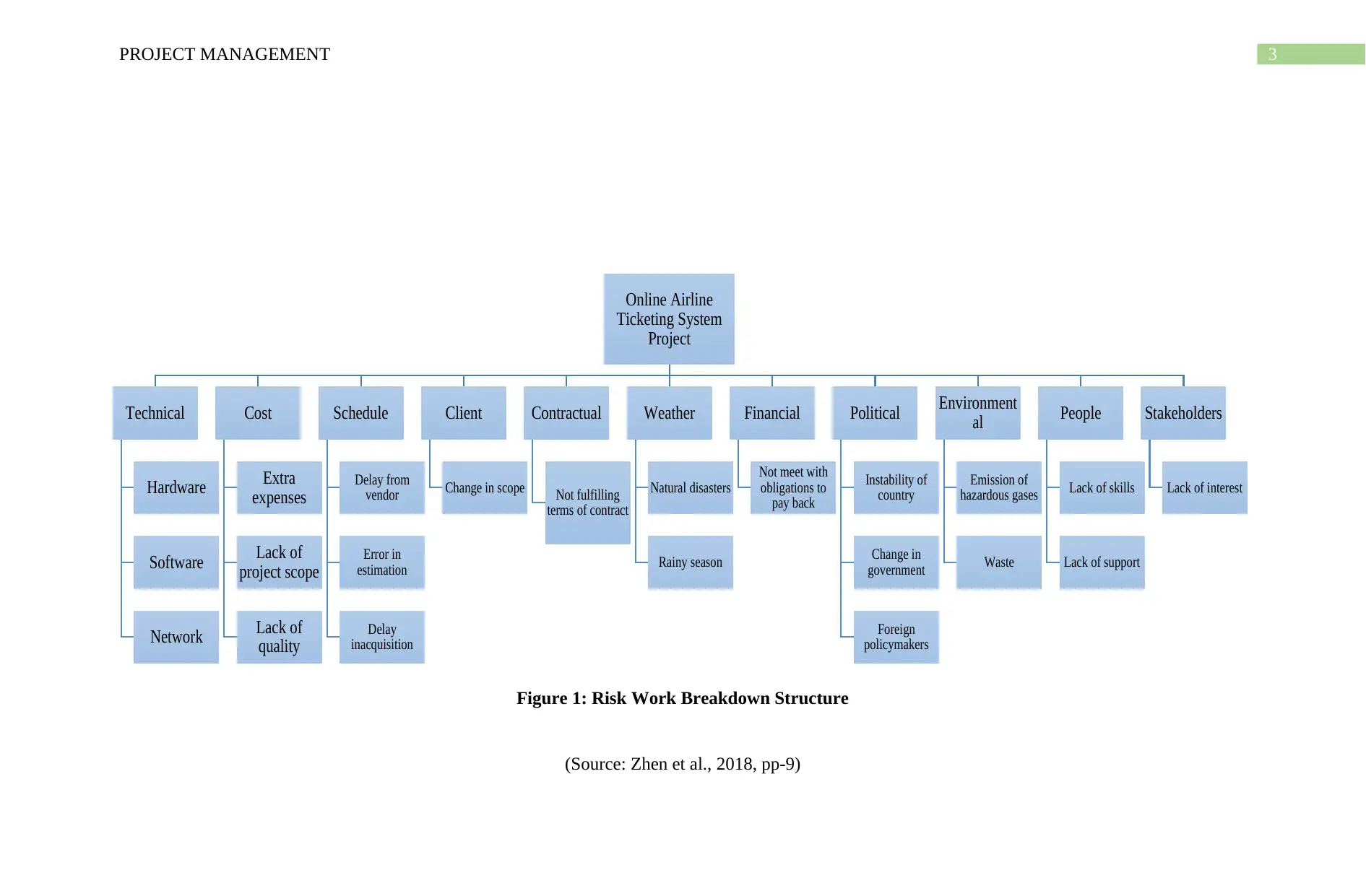
The risk identification is done through a process that each project manager can follow,
termed as risk breakdown structure. Paquin, Gauthier and Morin (2016) mentioned that it is a
disciplined process involved by means of identifying the main category and sub-category of
the risks and evaluate the risks based on its likelihood. The Risk WBS is organized the
project risks in the online airline ticketing system, which is an IT project. The risks are shown
in three levels- risk title, risk categories and risk factors.
Project Risk Management
11.1 Plan Risk Management
According to Qazi et al., (2016), the risk management plan is a document helps the
project manager to identify possible project risks in the project (online airline ticketing
system), estimate impacts of the risks on the project work as well as define responses for the
project risks. It is being reviewed by the project team members to avoid the risks so that the
project can get success.
11.1.1 Risk Mitigation Plan
Risk Work Breakdown Structure (Risk WBS)
The risk identification is done through a process that each project manager can follow,
termed as risk breakdown structure. Paquin, Gauthier and Morin (2016) mentioned that it is a
disciplined process involved by means of identifying the main category and sub-category of
the risks and evaluate the risks based on its likelihood. The Risk WBS is organized the
project risks in the online airline ticketing system, which is an IT project. The risks are shown
in three levels- risk title, risk categories and risk factors.
⊘ This is a preview!⊘
Do you want full access?
Subscribe today to unlock all pages.

Trusted by 1+ million students worldwide

3PROJECT MANAGEMENT
Figure 1: Risk Work Breakdown Structure
(Source: Zhen et al., 2018, pp-9)
Online Airline
Ticketing System
Project
Technical
Hardware
Software
Network
Cost
Extra
expenses
Lack of
project scope
Lack of
quality
Schedule
Delay from
vendor
Error in
estimation
Delay
inacquisition
Client
Change in scope
Contractual
Not fulfilling
terms of contract
Weather
Natural disasters
Rainy season
Financial
Not meet with
obligations to
pay back
Political
Instability of
country
Change in
government
Foreign
policymakers
Environment
al
Emission of
hazardous gases
Waste
People
Lack of skills
Lack of support
Stakeholders
Lack of interest
Figure 1: Risk Work Breakdown Structure
(Source: Zhen et al., 2018, pp-9)
Online Airline
Ticketing System
Project
Technical
Hardware
Software
Network
Cost
Extra
expenses
Lack of
project scope
Lack of
quality
Schedule
Delay from
vendor
Error in
estimation
Delay
inacquisition
Client
Change in scope
Contractual
Not fulfilling
terms of contract
Weather
Natural disasters
Rainy season
Financial
Not meet with
obligations to
pay back
Political
Instability of
country
Change in
government
Foreign
policymakers
Environment
al
Emission of
hazardous gases
Waste
People
Lack of skills
Lack of support
Stakeholders
Lack of interest
Paraphrase This Document
Need a fresh take? Get an instant paraphrase of this document with our AI Paraphraser

4PROJECT MANAGEMENT
11.2 Identify Risks
Technical: This risk is raised due to out of the hardware as well as software failure as
outdated hardware along with software used for developing the online airline ticketing
system. There is also possibility of the network failures causes delay of the implementation
work of the system.
Cost: It is the cost risk that the project costs more than it is budgeted. The estimated
budget for this project exceeds its limit when there is addition of extra expenses to the project
activities. The cost overrun causes reduction of project scope as well as quality.
Schedule: The schedule risks related to online airline ticketing system includes delays
of the scheduling such as delay from the vendors side as the suppliers are not delivered to the
project client on time. There are errors in estimation and delay in acquisition, lead to cause
delays in entire project activities.
Client: Sudden change in the project scope due to change in the requirements of
project client, lead to cause project client risk.
Contractual: There is chance of facing losses in the project as result that the buyer is
not fulfilling terms of the contract included the buyer is not able to pay (Olechowski et al.,
2016).
Weather: Sudden change in the weather conditions such as disasters, high temperature
and others are potential for the severe weather to cause disrupt of the business operations and
damage the assets.
Financial: It is the risk that the company is not able to meet with the obligations to
pay back the debts. The potential investors have lost the money invested into the online
airline ticketing system project. If the company has more debt, then there is higher risk of
financial.
Political: It is the risk of the investment returns provide effect as result of the political
changes and instability of the country. Instability of the project provides effect on investment
returns could stream from change into the government, and foreign policymakers.
Environmental factors: This risk provides effect on the environment due to emission
of hazardous gases and wastes raised out of the organizational activities (Hirman et al.,
11.2 Identify Risks
Technical: This risk is raised due to out of the hardware as well as software failure as
outdated hardware along with software used for developing the online airline ticketing
system. There is also possibility of the network failures causes delay of the implementation
work of the system.
Cost: It is the cost risk that the project costs more than it is budgeted. The estimated
budget for this project exceeds its limit when there is addition of extra expenses to the project
activities. The cost overrun causes reduction of project scope as well as quality.
Schedule: The schedule risks related to online airline ticketing system includes delays
of the scheduling such as delay from the vendors side as the suppliers are not delivered to the
project client on time. There are errors in estimation and delay in acquisition, lead to cause
delays in entire project activities.
Client: Sudden change in the project scope due to change in the requirements of
project client, lead to cause project client risk.
Contractual: There is chance of facing losses in the project as result that the buyer is
not fulfilling terms of the contract included the buyer is not able to pay (Olechowski et al.,
2016).
Weather: Sudden change in the weather conditions such as disasters, high temperature
and others are potential for the severe weather to cause disrupt of the business operations and
damage the assets.
Financial: It is the risk that the company is not able to meet with the obligations to
pay back the debts. The potential investors have lost the money invested into the online
airline ticketing system project. If the company has more debt, then there is higher risk of
financial.
Political: It is the risk of the investment returns provide effect as result of the political
changes and instability of the country. Instability of the project provides effect on investment
returns could stream from change into the government, and foreign policymakers.
Environmental factors: This risk provides effect on the environment due to emission
of hazardous gases and wastes raised out of the organizational activities (Hirman et al.,

5PROJECT MANAGEMENT
2019). The environmental exposure provides harmful effect on the water and natural
resources and others.
People: People those are involved in the development work have inexperience and
lack of skills related to technical work. Therefore, most of the people are not provided proper
support to the work. Inefficient project team structure also reduces productivity of the
business.
Stakeholders: The project stakeholders are not enough interest to work in the project,
therefore lack of support from the stakeholders lead to cause stakeholder issues.
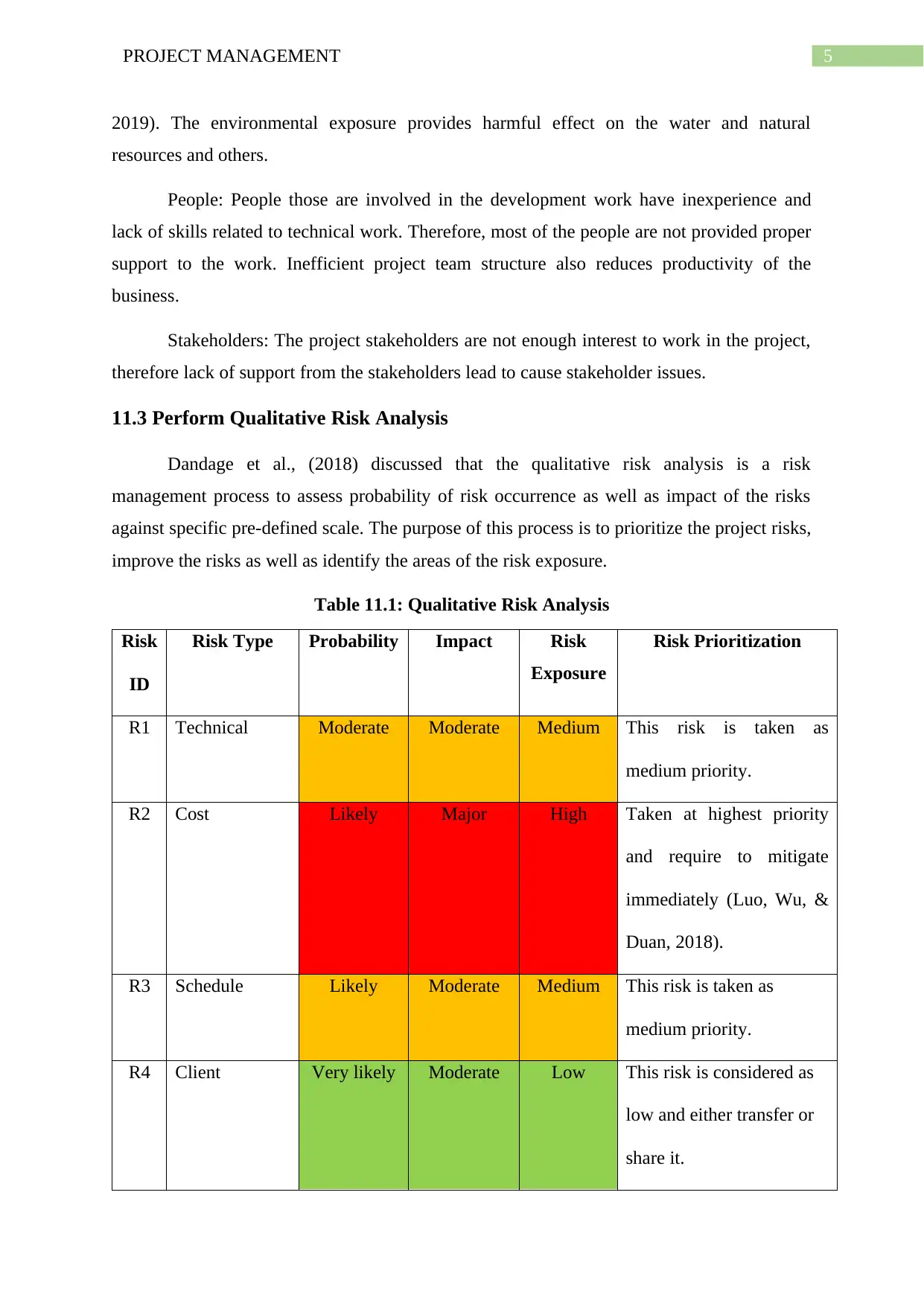
11.3 Perform Qualitative Risk Analysis
Dandage et al., (2018) discussed that the qualitative risk analysis is a risk
management process to assess probability of risk occurrence as well as impact of the risks
against specific pre-defined scale. The purpose of this process is to prioritize the project risks,
improve the risks as well as identify the areas of the risk exposure.
Table 11.1: Qualitative Risk Analysis
Risk
ID
Risk Type Probability Impact Risk
Exposure
Risk Prioritization
R1 Technical Moderate Moderate Medium This risk is taken as
medium priority.
R2 Cost Likely Major High Taken at highest priority
and require to mitigate
immediately (Luo, Wu, &
Duan, 2018).
R3 Schedule Likely Moderate Medium This risk is taken as
medium priority.
R4 Client Very likely Moderate Low This risk is considered as
low and either transfer or
share it.
2019). The environmental exposure provides harmful effect on the water and natural
resources and others.
People: People those are involved in the development work have inexperience and
lack of skills related to technical work. Therefore, most of the people are not provided proper
support to the work. Inefficient project team structure also reduces productivity of the
business.
Stakeholders: The project stakeholders are not enough interest to work in the project,
therefore lack of support from the stakeholders lead to cause stakeholder issues.
11.3 Perform Qualitative Risk Analysis
Dandage et al., (2018) discussed that the qualitative risk analysis is a risk
management process to assess probability of risk occurrence as well as impact of the risks
against specific pre-defined scale. The purpose of this process is to prioritize the project risks,
improve the risks as well as identify the areas of the risk exposure.
Table 11.1: Qualitative Risk Analysis
Risk
ID
Risk Type Probability Impact Risk
Exposure
Risk Prioritization
R1 Technical Moderate Moderate Medium This risk is taken as
medium priority.
R2 Cost Likely Major High Taken at highest priority
and require to mitigate
immediately (Luo, Wu, &
Duan, 2018).
R3 Schedule Likely Moderate Medium This risk is taken as
medium priority.
R4 Client Very likely Moderate Low This risk is considered as
low and either transfer or
share it.
⊘ This is a preview!⊘
Do you want full access?
Subscribe today to unlock all pages.

Trusted by 1+ million students worldwide

6PROJECT MANAGEMENT
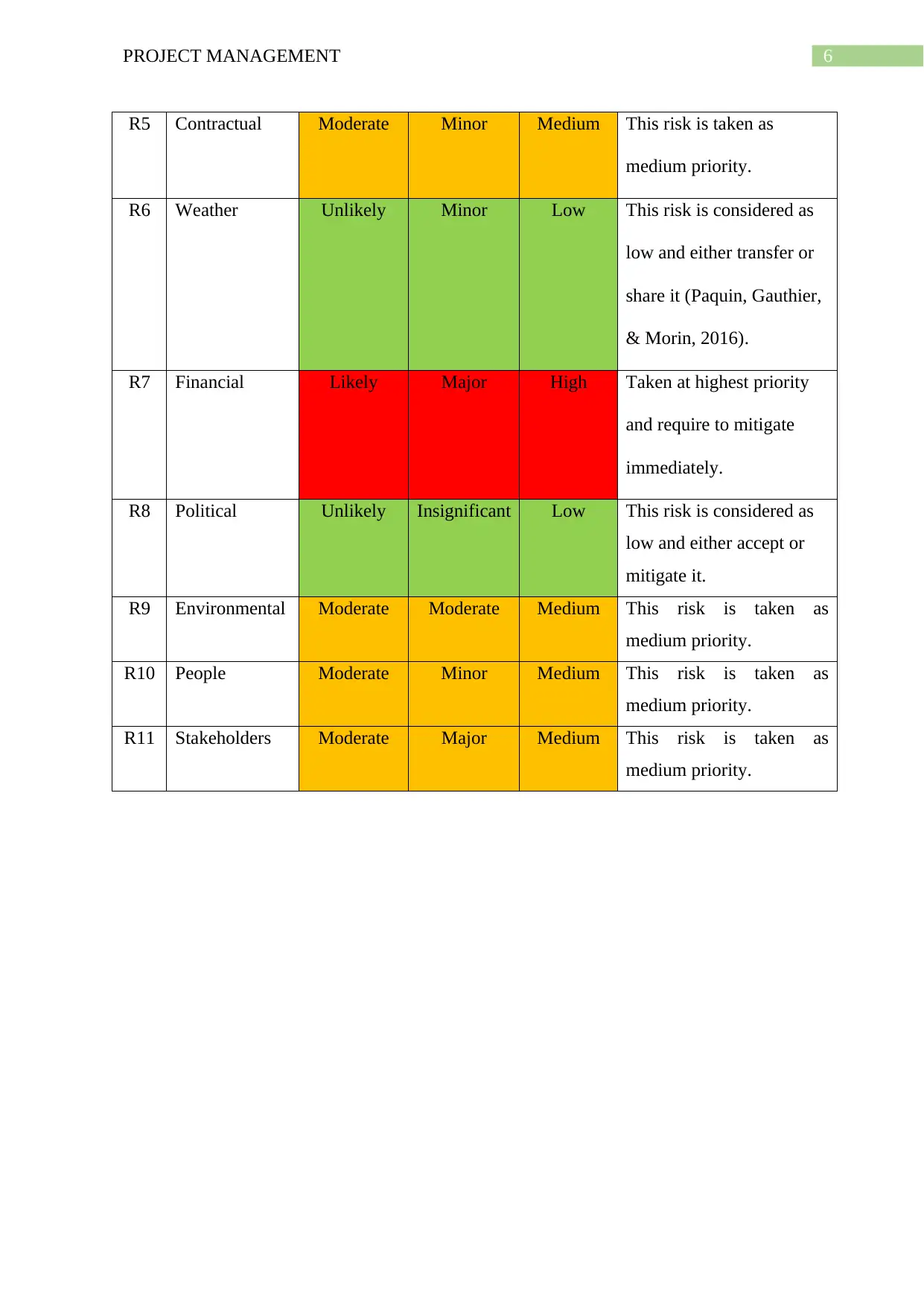
R5 Contractual Moderate Minor Medium This risk is taken as
medium priority.
R6 Weather Unlikely Minor Low This risk is considered as
low and either transfer or
share it (Paquin, Gauthier,
& Morin, 2016).
R7 Financial Likely Major High Taken at highest priority
and require to mitigate
immediately.
R8 Political Unlikely Insignificant Low This risk is considered as
low and either accept or
mitigate it.
R9 Environmental Moderate Moderate Medium This risk is taken as
medium priority.
R10 People Moderate Minor Medium This risk is taken as
medium priority.
R11 Stakeholders Moderate Major Medium This risk is taken as
medium priority.
R5 Contractual Moderate Minor Medium This risk is taken as
medium priority.
R6 Weather Unlikely Minor Low This risk is considered as
low and either transfer or
share it (Paquin, Gauthier,
& Morin, 2016).
R7 Financial Likely Major High Taken at highest priority
and require to mitigate
immediately.
R8 Political Unlikely Insignificant Low This risk is considered as
low and either accept or
mitigate it.
R9 Environmental Moderate Moderate Medium This risk is taken as
medium priority.
R10 People Moderate Minor Medium This risk is taken as
medium priority.
R11 Stakeholders Moderate Major Medium This risk is taken as
medium priority.
Paraphrase This Document
Need a fresh take? Get an instant paraphrase of this document with our AI Paraphraser

7PROJECT MANAGEMENT
Risk Exposure:
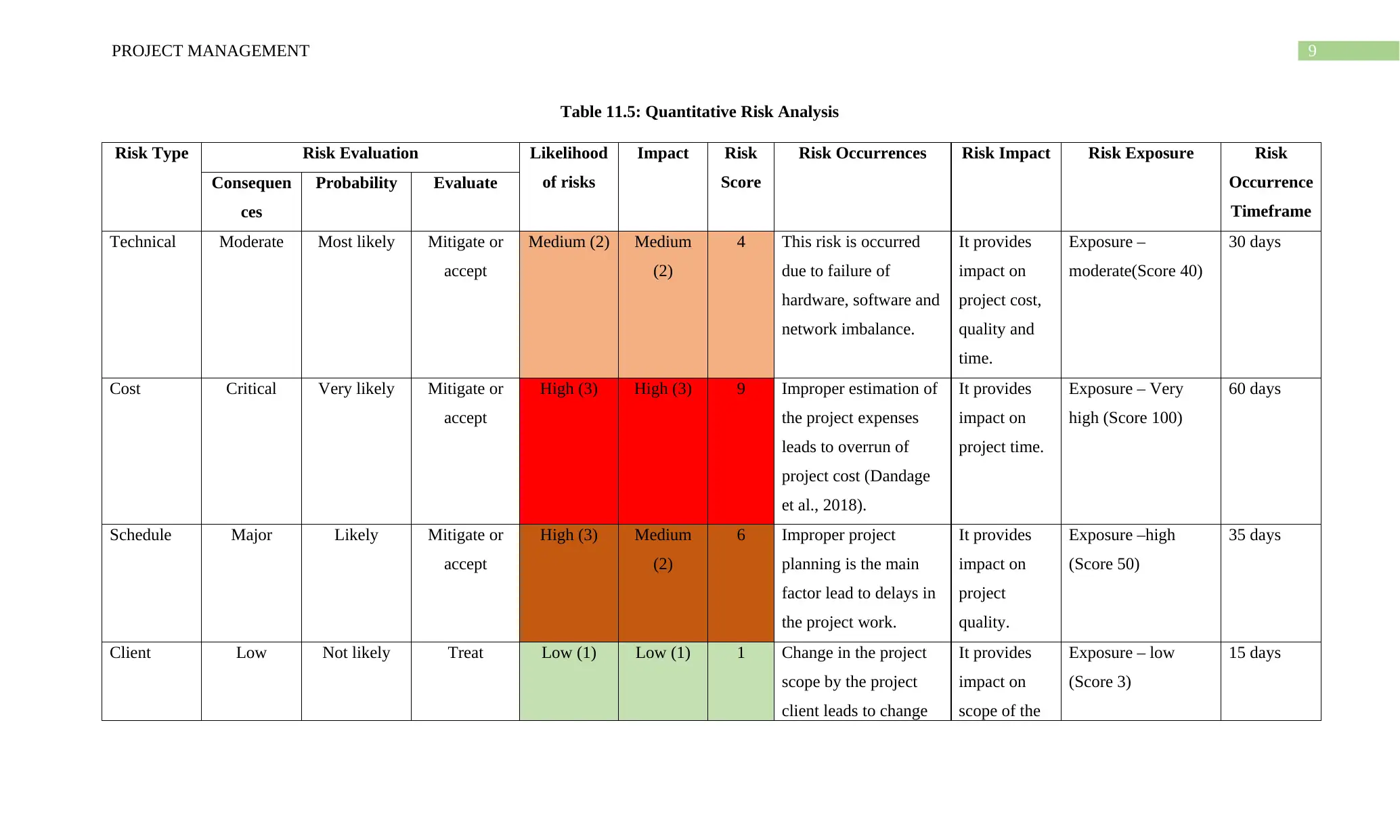
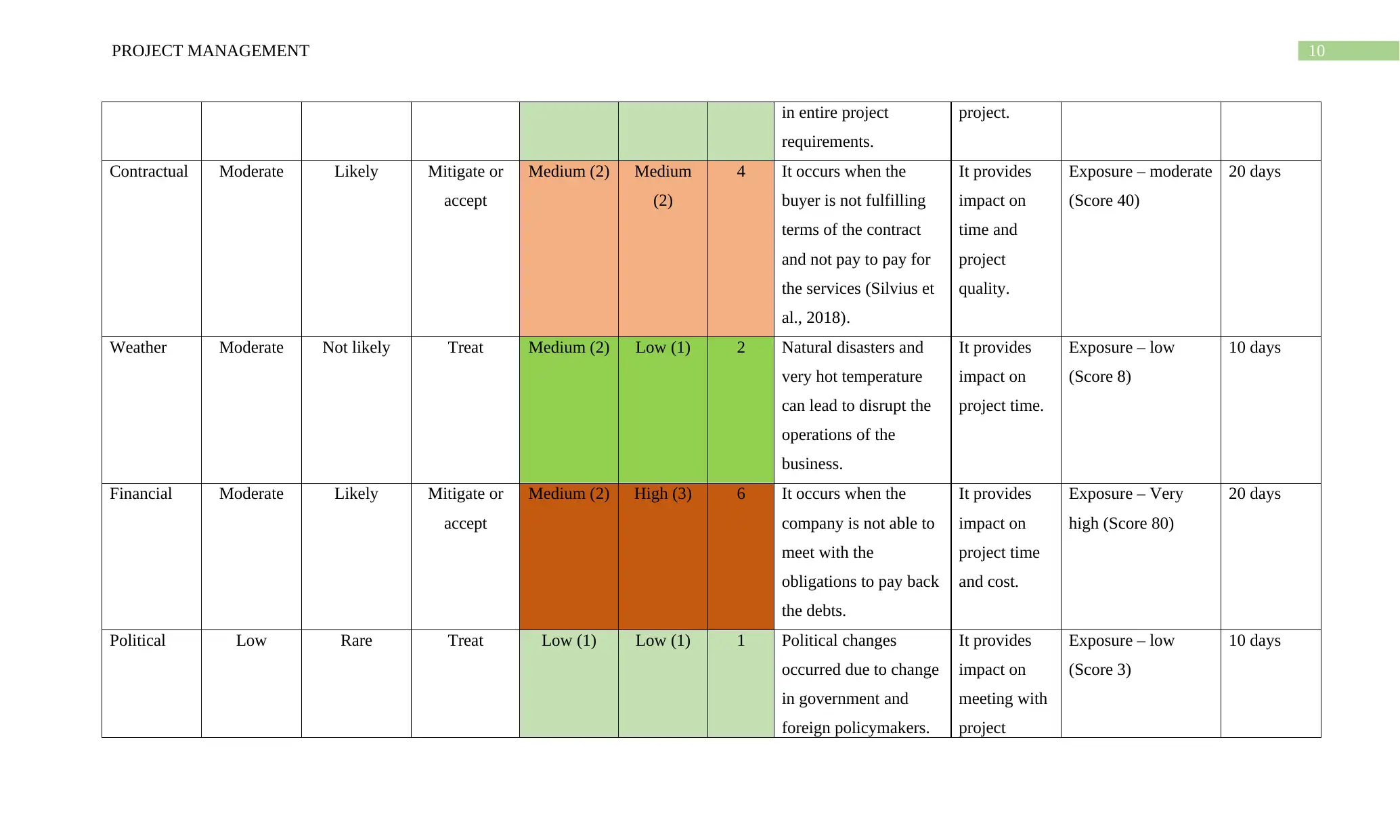
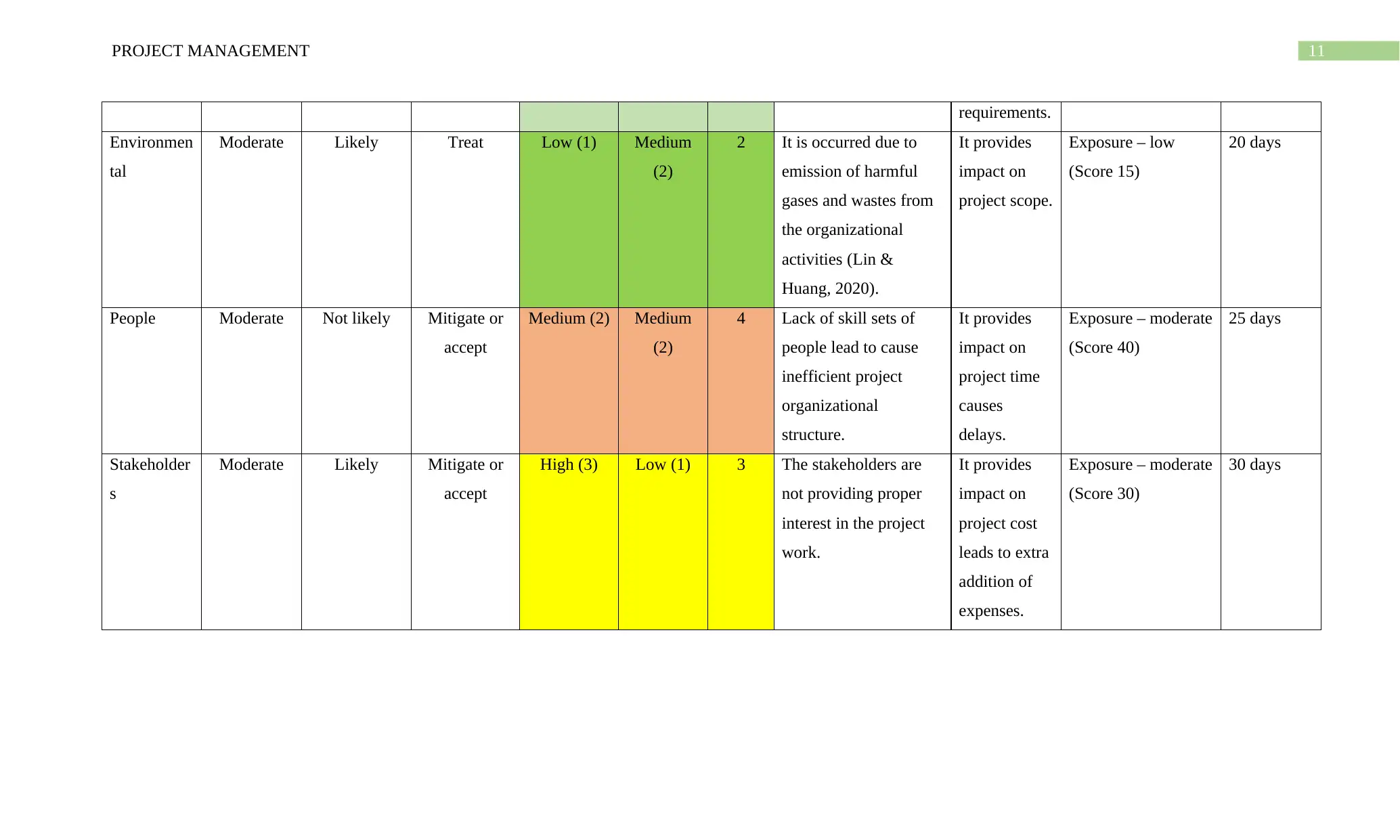
11.4 Perform Quantitative Risk Analysis
Paquin et al., (2016) mentioned that the quantitative risk analysis is an analysis of
project risks through the numerical and quantitative rating to progress a probabilistic analysis
of identified project risks. It provides the project manager with quantitative risk approach to
take decisions when there is project uncertainty.
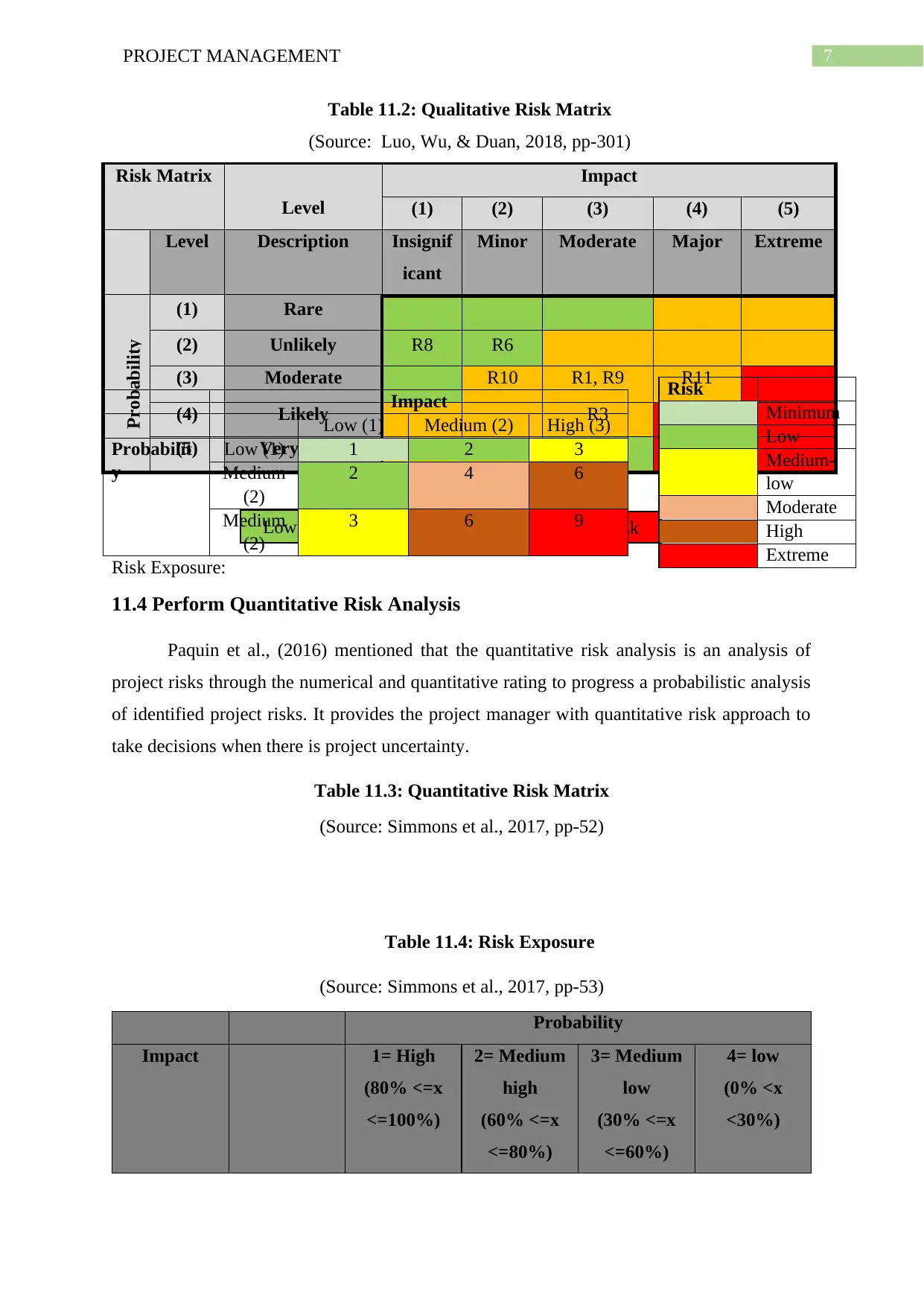
Table 11.3: Quantitative Risk Matrix
(Source: Simmons et al., 2017, pp-52)
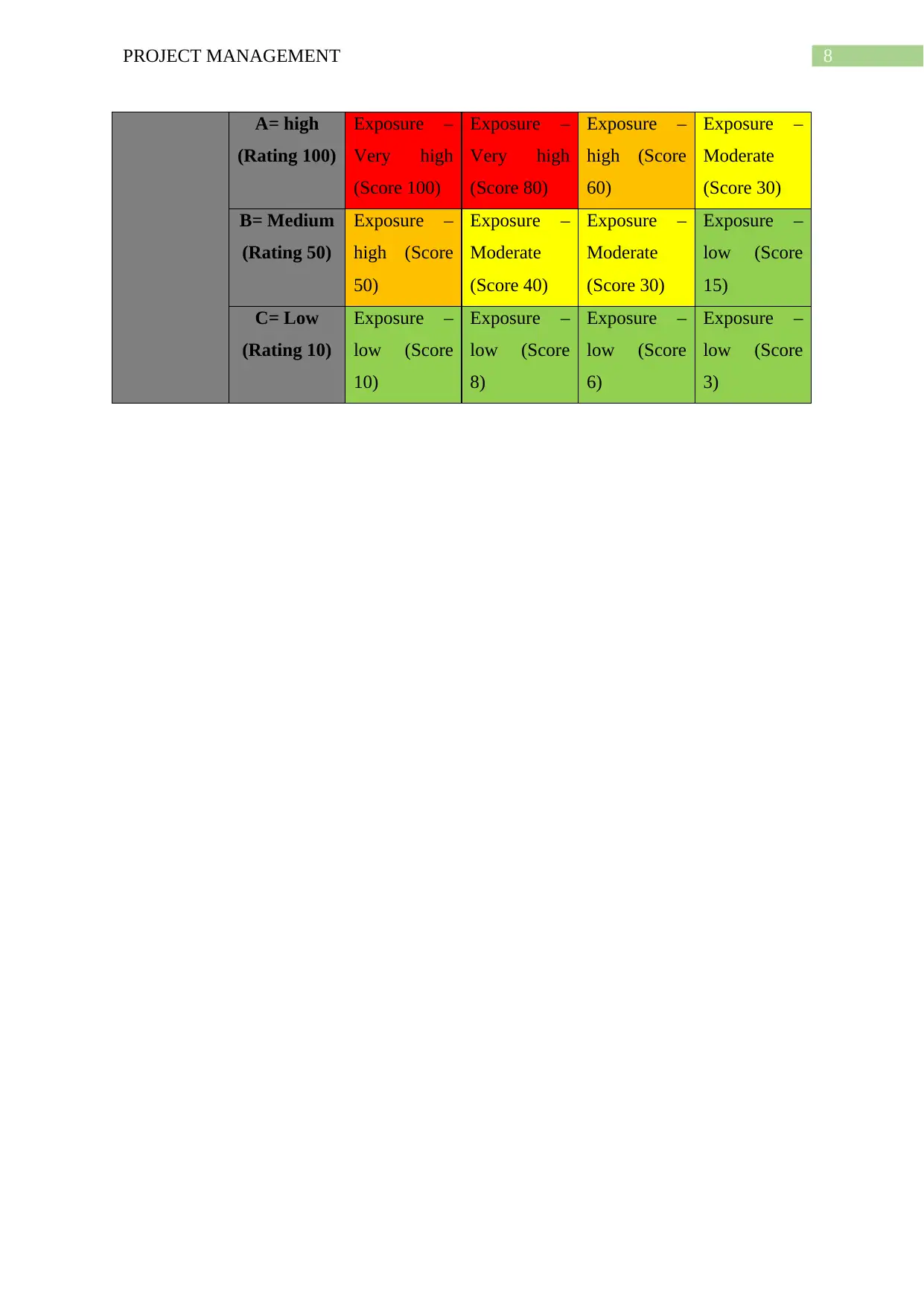
Table 11.4: Risk Exposure
(Source: Simmons et al., 2017, pp-53)
Probability
Impact 1= High
(80% <=x
<=100%)
2= Medium
high
(60% <=x
<=80%)
3= Medium
low
(30% <=x
<=60%)
4= low
(0% <x
<30%)
Low Risk Medium Risk High Risk
Table 11.2: Qualitative Risk Matrix
(Source: Luo, Wu, & Duan, 2018, pp-301)
Risk Matrix
Level
Impact
(1) (2) (3) (4) (5)
Level Description Insignif
icant
Minor Moderate Major Extreme
Probability
(1) Rare
(2) Unlikely R8 R6
(3) Moderate R10 R1, R9 R11
(4) Likely R3 R2, R7
(5) Very likely R5
Risk
Minimum
Low
Medium-
low
Moderate
High
Extreme
Impact
Low (1) Medium (2) High (3)
Probabilit
y
Low (1) 1 2 3
Medium
(2)
2 4 6
Medium
(2)
3 6 9
Risk Exposure:
11.4 Perform Quantitative Risk Analysis
Paquin et al., (2016) mentioned that the quantitative risk analysis is an analysis of
project risks through the numerical and quantitative rating to progress a probabilistic analysis
of identified project risks. It provides the project manager with quantitative risk approach to
take decisions when there is project uncertainty.
Table 11.3: Quantitative Risk Matrix
(Source: Simmons et al., 2017, pp-52)
Table 11.4: Risk Exposure
(Source: Simmons et al., 2017, pp-53)
Probability
Impact 1= High
(80% <=x
<=100%)
2= Medium
high
(60% <=x
<=80%)
3= Medium
low
(30% <=x
<=60%)
4= low
(0% <x
<30%)
Low Risk Medium Risk High Risk
Table 11.2: Qualitative Risk Matrix
(Source: Luo, Wu, & Duan, 2018, pp-301)
Risk Matrix
Level
Impact
(1) (2) (3) (4) (5)
Level Description Insignif
icant
Minor Moderate Major Extreme
Probability
(1) Rare
(2) Unlikely R8 R6
(3) Moderate R10 R1, R9 R11
(4) Likely R3 R2, R7
(5) Very likely R5
Risk
Minimum
Low
Medium-
low
Moderate
High
Extreme
Impact
Low (1) Medium (2) High (3)
Probabilit
y
Low (1) 1 2 3
Medium
(2)
2 4 6
Medium
(2)
3 6 9

8PROJECT MANAGEMENT
A= high
(Rating 100)
Exposure –
Very high
(Score 100)
Exposure –
Very high
(Score 80)
Exposure –
high (Score
60)
Exposure –
Moderate
(Score 30)
B= Medium
(Rating 50)
Exposure –
high (Score
50)
Exposure –
Moderate
(Score 40)
Exposure –
Moderate
(Score 30)
Exposure –
low (Score
15)
C= Low
(Rating 10)
Exposure –
low (Score
10)
Exposure –
low (Score
8)
Exposure –
low (Score
6)
Exposure –
low (Score
3)
A= high
(Rating 100)
Exposure –
Very high
(Score 100)
Exposure –
Very high
(Score 80)
Exposure –
high (Score
60)
Exposure –
Moderate
(Score 30)
B= Medium
(Rating 50)
Exposure –
high (Score
50)
Exposure –
Moderate
(Score 40)
Exposure –
Moderate
(Score 30)
Exposure –
low (Score
15)
C= Low
(Rating 10)
Exposure –
low (Score
10)
Exposure –
low (Score
8)
Exposure –
low (Score
6)
Exposure –
low (Score
3)
⊘ This is a preview!⊘
Do you want full access?
Subscribe today to unlock all pages.

Trusted by 1+ million students worldwide

9PROJECT MANAGEMENT
Table 11.5: Quantitative Risk Analysis
Risk Type Risk Evaluation Likelihood
of risks
Impact Risk
Score
Risk Occurrences Risk Impact Risk Exposure Risk
Occurrence
Timeframe
Consequen
ces
Probability Evaluate
Technical Moderate Most likely Mitigate or
accept
Medium (2) Medium
(2)
4 This risk is occurred
due to failure of
hardware, software and
network imbalance.
It provides
impact on
project cost,
quality and
time.
Exposure –
moderate(Score 40)
30 days
Cost Critical Very likely Mitigate or
accept
High (3) High (3) 9 Improper estimation of
the project expenses
leads to overrun of
project cost (Dandage
et al., 2018).
It provides
impact on
project time.
Exposure – Very
high (Score 100)
60 days
Schedule Major Likely Mitigate or
accept
High (3) Medium
(2)
6 Improper project
planning is the main
factor lead to delays in
the project work.
It provides
impact on
project
quality.
Exposure –high
(Score 50)
35 days
Client Low Not likely Treat Low (1) Low (1) 1 Change in the project
scope by the project
client leads to change
It provides
impact on
scope of the
Exposure – low
(Score 3)
15 days
Table 11.5: Quantitative Risk Analysis
Risk Type Risk Evaluation Likelihood
of risks
Impact Risk
Score
Risk Occurrences Risk Impact Risk Exposure Risk
Occurrence
Timeframe
Consequen
ces
Probability Evaluate
Technical Moderate Most likely Mitigate or
accept
Medium (2) Medium
(2)
4 This risk is occurred
due to failure of
hardware, software and
network imbalance.
It provides
impact on
project cost,
quality and
time.
Exposure –
moderate(Score 40)
30 days
Cost Critical Very likely Mitigate or
accept
High (3) High (3) 9 Improper estimation of
the project expenses
leads to overrun of
project cost (Dandage
et al., 2018).
It provides
impact on
project time.
Exposure – Very
high (Score 100)
60 days
Schedule Major Likely Mitigate or
accept
High (3) Medium
(2)
6 Improper project
planning is the main
factor lead to delays in
the project work.
It provides
impact on
project
quality.
Exposure –high
(Score 50)
35 days
Client Low Not likely Treat Low (1) Low (1) 1 Change in the project
scope by the project
client leads to change
It provides
impact on
scope of the
Exposure – low
(Score 3)
15 days
Paraphrase This Document
Need a fresh take? Get an instant paraphrase of this document with our AI Paraphraser

10PROJECT MANAGEMENT
in entire project
requirements.
project.
Contractual Moderate Likely Mitigate or
accept
Medium (2) Medium
(2)
4 It occurs when the
buyer is not fulfilling
terms of the contract
and not pay to pay for
the services (Silvius et
al., 2018).
It provides
impact on
time and
project
quality.
Exposure – moderate
(Score 40)
20 days
Weather Moderate Not likely Treat Medium (2) Low (1) 2 Natural disasters and
very hot temperature
can lead to disrupt the
operations of the
business.
It provides
impact on
project time.
Exposure – low
(Score 8)
10 days
Financial Moderate Likely Mitigate or
accept
Medium (2) High (3) 6 It occurs when the
company is not able to
meet with the
obligations to pay back
the debts.
It provides
impact on
project time
and cost.
Exposure – Very
high (Score 80)
20 days
Political Low Rare Treat Low (1) Low (1) 1 Political changes
occurred due to change
in government and
foreign policymakers.
It provides
impact on
meeting with
project
Exposure – low
(Score 3)
10 days
in entire project
requirements.
project.
Contractual Moderate Likely Mitigate or
accept
Medium (2) Medium
(2)
4 It occurs when the
buyer is not fulfilling
terms of the contract
and not pay to pay for
the services (Silvius et
al., 2018).
It provides
impact on
time and
project
quality.
Exposure – moderate
(Score 40)
20 days
Weather Moderate Not likely Treat Medium (2) Low (1) 2 Natural disasters and
very hot temperature
can lead to disrupt the
operations of the
business.
It provides
impact on
project time.
Exposure – low
(Score 8)
10 days
Financial Moderate Likely Mitigate or
accept
Medium (2) High (3) 6 It occurs when the
company is not able to
meet with the
obligations to pay back
the debts.
It provides
impact on
project time
and cost.
Exposure – Very
high (Score 80)
20 days
Political Low Rare Treat Low (1) Low (1) 1 Political changes
occurred due to change
in government and
foreign policymakers.
It provides
impact on
meeting with
project
Exposure – low
(Score 3)
10 days

11PROJECT MANAGEMENT
requirements.
Environmen
tal
Moderate Likely Treat Low (1) Medium
(2)
2 It is occurred due to
emission of harmful
gases and wastes from
the organizational
activities (Lin &
Huang, 2020).
It provides
impact on
project scope.
Exposure – low
(Score 15)
20 days
People Moderate Not likely Mitigate or
accept
Medium (2) Medium
(2)
4 Lack of skill sets of
people lead to cause
inefficient project
organizational
structure.
It provides
impact on
project time
causes
delays.
Exposure – moderate
(Score 40)
25 days
Stakeholder
s
Moderate Likely Mitigate or
accept
High (3) Low (1) 3 The stakeholders are
not providing proper
interest in the project
work.
It provides
impact on
project cost
leads to extra
addition of
expenses.
Exposure – moderate
(Score 30)
30 days
requirements.
Environmen
tal
Moderate Likely Treat Low (1) Medium
(2)
2 It is occurred due to
emission of harmful
gases and wastes from
the organizational
activities (Lin &
Huang, 2020).
It provides
impact on
project scope.
Exposure – low
(Score 15)
20 days
People Moderate Not likely Mitigate or
accept
Medium (2) Medium
(2)
4 Lack of skill sets of
people lead to cause
inefficient project
organizational
structure.
It provides
impact on
project time
causes
delays.
Exposure – moderate
(Score 40)
25 days
Stakeholder
s
Moderate Likely Mitigate or
accept
High (3) Low (1) 3 The stakeholders are
not providing proper
interest in the project
work.
It provides
impact on
project cost
leads to extra
addition of
expenses.
Exposure – moderate
(Score 30)
30 days
⊘ This is a preview!⊘
Do you want full access?
Subscribe today to unlock all pages.

Trusted by 1+ million students worldwide
1 out of 27
Related Documents
Your All-in-One AI-Powered Toolkit for Academic Success.
+13062052269
info@desklib.com
Available 24*7 on WhatsApp / Email
Unlock your academic potential
Copyright © 2020–2025 A2Z Services. All Rights Reserved. Developed and managed by ZUCOL.