Ahsanullah University Online Education Student Perception Report
VerifiedAdded on 2022/01/19
|18
|7529
|156
Report
AI Summary
This report, submitted to Ahsanullah University of Science and Technology, investigates students' perceptions of online education during the COVID-19 pandemic. It begins with background information on education, comparing online and face-to-face learning, and explores the advantages and disadvantages of online learning, including flexibility, accessibility, and cost reduction, as well as challenges like technical issues and social isolation. The report further analyzes the impact of COVID-19 on higher education, covering academic calendars, funding, and GDP. It examines how different countries are using technology to support remote learning and discusses factors contributing to student failure in online studies. The report also includes student reviews and a bibliography, providing a comprehensive overview of the topic.
Ahsanullah University of Science and Technolog
Assignment On
Students Perception Regarding Online Education
during Covid-19 Pandemic
Course Title : Legal Aspects of Business Course Code : BBA 225
Submitted To:
Ms. Sabreya Khanom Zuma
Assistant Professor
School of Business
Submitted By:
Md. Golam Mawla Jony
ID: 18.01.02.091
Submission date: 14.02.2021
1
Assignment On
Students Perception Regarding Online Education
during Covid-19 Pandemic
Course Title : Legal Aspects of Business Course Code : BBA 225
Submitted To:
Ms. Sabreya Khanom Zuma
Assistant Professor
School of Business
Submitted By:
Md. Golam Mawla Jony
ID: 18.01.02.091
Submission date: 14.02.2021
1

Paraphrase This Document
Need a fresh take? Get an instant paraphrase of this document with our AI Paraphraser
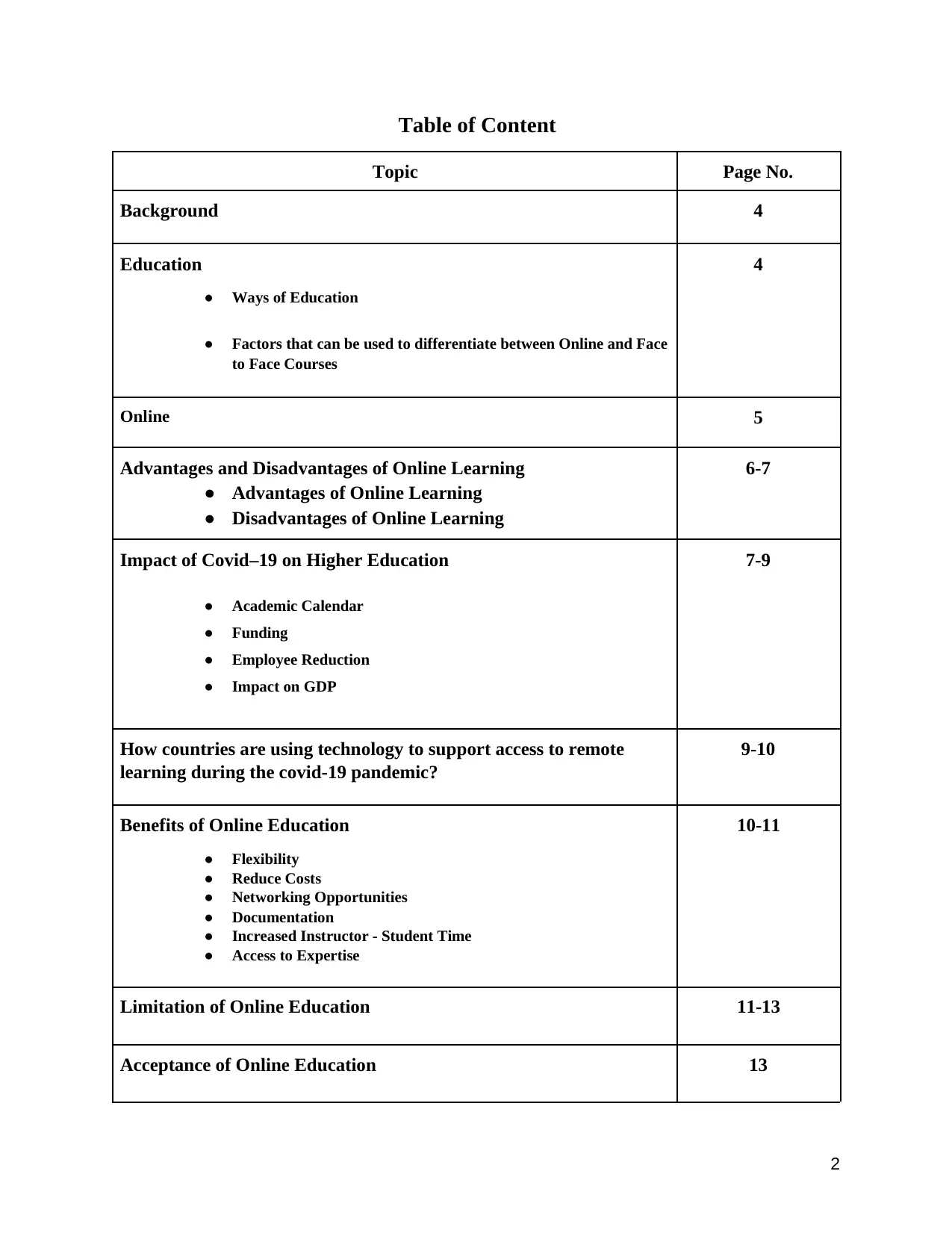
Table of Content
Topic Page No.
Background 4
Education
● Ways of Education
● Factors that can be used to differentiate between Online and Face
to Face Courses
4
Online 5
Advantages and Disadvantages of Online Learning
● Advantages of Online Learning
● Disadvantages of Online Learning
6-7
Impact of Covid–19 on Higher Education
● Academic Calendar
● Funding
● Employee Reduction
● Impact on GDP
7-9
How countries are using technology to support access to remote
learning during the covid-19 pandemic?
9-10
Benefits of Online Education
● Flexibility
● Reduce Costs
● Networking Opportunities
● Documentation
● Increased Instructor - Student Time
● Access to Expertise
10-11
Limitation of Online Education 11-13
Acceptance of Online Education 13
2
Topic Page No.
Background 4
Education
● Ways of Education
● Factors that can be used to differentiate between Online and Face
to Face Courses
4
Online 5
Advantages and Disadvantages of Online Learning
● Advantages of Online Learning
● Disadvantages of Online Learning
6-7
Impact of Covid–19 on Higher Education
● Academic Calendar
● Funding
● Employee Reduction
● Impact on GDP
7-9
How countries are using technology to support access to remote
learning during the covid-19 pandemic?
9-10
Benefits of Online Education
● Flexibility
● Reduce Costs
● Networking Opportunities
● Documentation
● Increased Instructor - Student Time
● Access to Expertise
10-11
Limitation of Online Education 11-13
Acceptance of Online Education 13
2
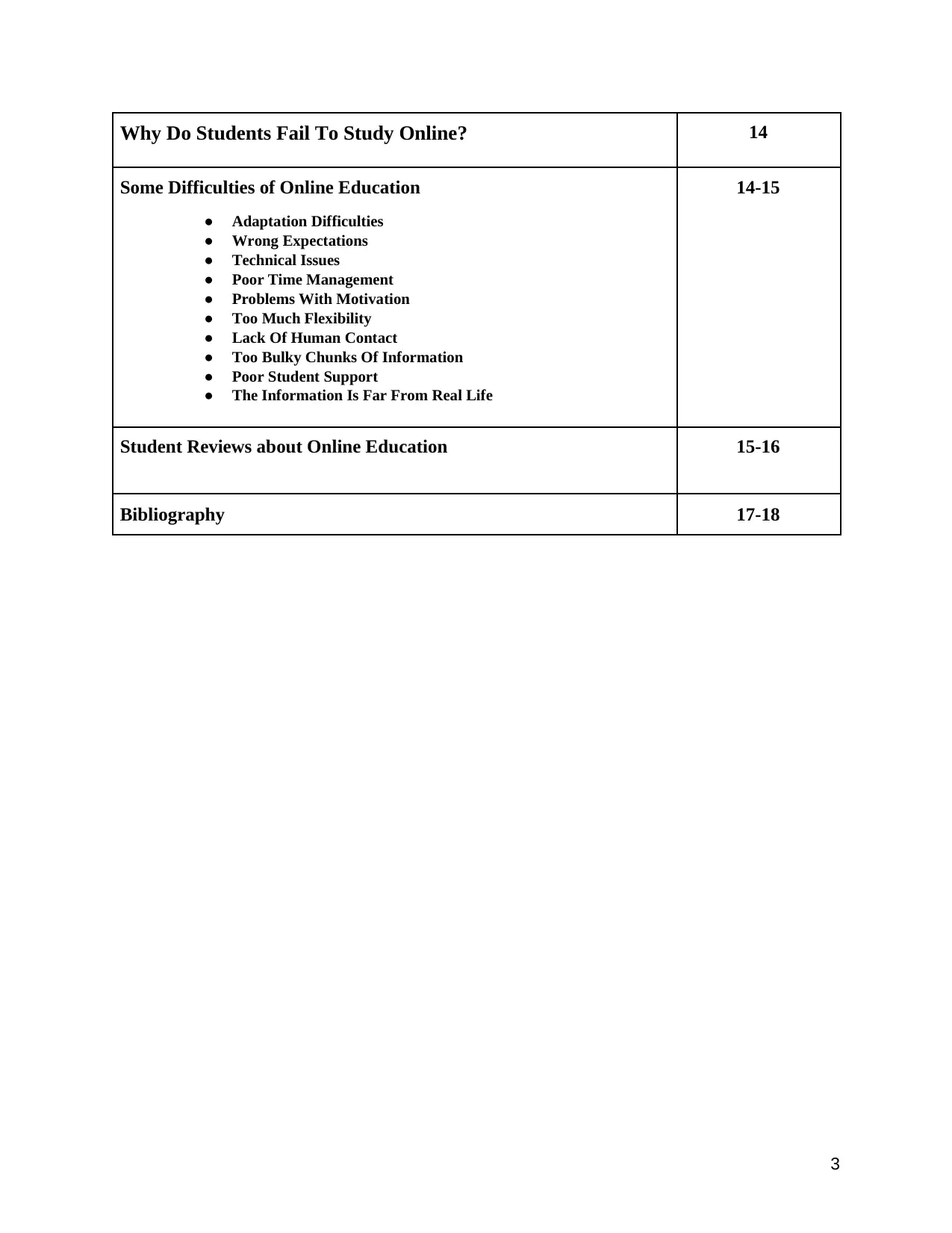
Why Do Students Fail To Study Online? 14
Some Difficulties of Online Education
● Adaptation Difficulties
● Wrong Expectations
● Technical Issues
● Poor Time Management
● Problems With Motivation
● Too Much Flexibility
● Lack Of Human Contact
● Too Bulky Chunks Of Information
● Poor Student Support
● The Information Is Far From Real Life
14-15
Student Reviews about Online Education 15-16
Bibliography 17-18
3
Some Difficulties of Online Education
● Adaptation Difficulties
● Wrong Expectations
● Technical Issues
● Poor Time Management
● Problems With Motivation
● Too Much Flexibility
● Lack Of Human Contact
● Too Bulky Chunks Of Information
● Poor Student Support
● The Information Is Far From Real Life
14-15
Student Reviews about Online Education 15-16
Bibliography 17-18
3
⊘ This is a preview!⊘
Do you want full access?
Subscribe today to unlock all pages.

Trusted by 1+ million students worldwide
Background
The COVID-19 pandemic disrupting the school calendars has shut down educational institutes
worldwide. In order to keep the research programs running, most education institutions have
switched to online learning sites. But the issues concerning e-learning preparedness, architecture
and productivity are still not clear, particularly for a developing country like Bangladesh where
technological constraints such as system suitability and usable bandwidth pose a major
challenge. We concentrate on an online study of students to consider the understanding and
desire of students for online learning. We also analyzed the expectations of students for different
qualities of online courses, which will help design an efficient online environment. The findings
showed that the majority of participants (70%) are able to choose online program management
courses during this pandemic. Most students choose to use smartphones to read online. We find
through content review that students prefer registered lessons to boost learning performance with
a questionnaire at the end of a lesson. The students offer their views.Students thought that the
accessibility and convenience of online courses make it an appealing choice, while the difficulty
of using online learning programs is internet access problems in rural areas. However, the
observations in this essay will assist in planning the curriculum for the current standard in
agricultural education systems, of which many classes are focused in operation, it may not be
possible to turn entirely to the on-line mode and require a hybrid mode.
Education
The process of facilitating learning, or the acquisition of knowledge, skills, values,
morals, beliefs, and habits. Educational methods include teaching, training, storytelling,
discussion and directed research. Education frequently takes place under the guidance of
educators, however learners can also educate themselves. Education can take place in
formal or informal settings and any experience that has a formative effect on the way one
thinks, feels, or acts may be considered educational. The methodology of teaching is
called pedagogy.
Ways of Education.
1. Online
2. Offline/Face to Face
Factors that can be used to differentiate between Online and Face to Face Courses
● Online courses are predominantly asynchronous
● Successful online learners must also be motivated, disciplined, self-directed, and good at
time management
● Diverse communication skills are paramount in online learning
● Students depend even more on the facilitation, assignment clarification, and feedback
provided by their instructor
4
The COVID-19 pandemic disrupting the school calendars has shut down educational institutes
worldwide. In order to keep the research programs running, most education institutions have
switched to online learning sites. But the issues concerning e-learning preparedness, architecture
and productivity are still not clear, particularly for a developing country like Bangladesh where
technological constraints such as system suitability and usable bandwidth pose a major
challenge. We concentrate on an online study of students to consider the understanding and
desire of students for online learning. We also analyzed the expectations of students for different
qualities of online courses, which will help design an efficient online environment. The findings
showed that the majority of participants (70%) are able to choose online program management
courses during this pandemic. Most students choose to use smartphones to read online. We find
through content review that students prefer registered lessons to boost learning performance with
a questionnaire at the end of a lesson. The students offer their views.Students thought that the
accessibility and convenience of online courses make it an appealing choice, while the difficulty
of using online learning programs is internet access problems in rural areas. However, the
observations in this essay will assist in planning the curriculum for the current standard in
agricultural education systems, of which many classes are focused in operation, it may not be
possible to turn entirely to the on-line mode and require a hybrid mode.
Education
The process of facilitating learning, or the acquisition of knowledge, skills, values,
morals, beliefs, and habits. Educational methods include teaching, training, storytelling,
discussion and directed research. Education frequently takes place under the guidance of
educators, however learners can also educate themselves. Education can take place in
formal or informal settings and any experience that has a formative effect on the way one
thinks, feels, or acts may be considered educational. The methodology of teaching is
called pedagogy.
Ways of Education.
1. Online
2. Offline/Face to Face
Factors that can be used to differentiate between Online and Face to Face Courses
● Online courses are predominantly asynchronous
● Successful online learners must also be motivated, disciplined, self-directed, and good at
time management
● Diverse communication skills are paramount in online learning
● Students depend even more on the facilitation, assignment clarification, and feedback
provided by their instructor
4
Paraphrase This Document
Need a fresh take? Get an instant paraphrase of this document with our AI Paraphraser
● Majority of communication from student-to-instructor and student-to-student involves
non-verbal asynchronous correspondence
● Digital literacy and netiquette is a must
● Discussions in the online environment may offer more opportunity for students to think
about, research and even draft their discussion posts and responses
● Online courses are often more personal and individualized
● Bring together diverse people, cultures, communities and cities
● Multi-dimensional content and learning exercises
● Active and frequent participation from everyone
● Instructors aren't on the stage
Instructors role is focused on facilitating student efforts to think critically, apply and make sense
of new knowledge
Online:
In the wake of the decision taken by the Bangladesh Govt, education institutions have also made
a move to an online teaching climate, which was later expanded. The key issue is, however, the
level of instruction, closely connected with the design and the delivery of the materials.
As schools and colleges are shut down for an unspecified duration, schools and students play
with methods to complete the prescribed course in compliance with the instructional agenda
within the defined time frame. Certainly these initiatives caused some discomfort, but they also
contributed to new examples of instructional innovation through interactive approaches. The
style of change of academic facilities is silver, with millennia-old methods based on the
seminars, strong structural inclinations and redundant classrooms in teaching. This style is silver.
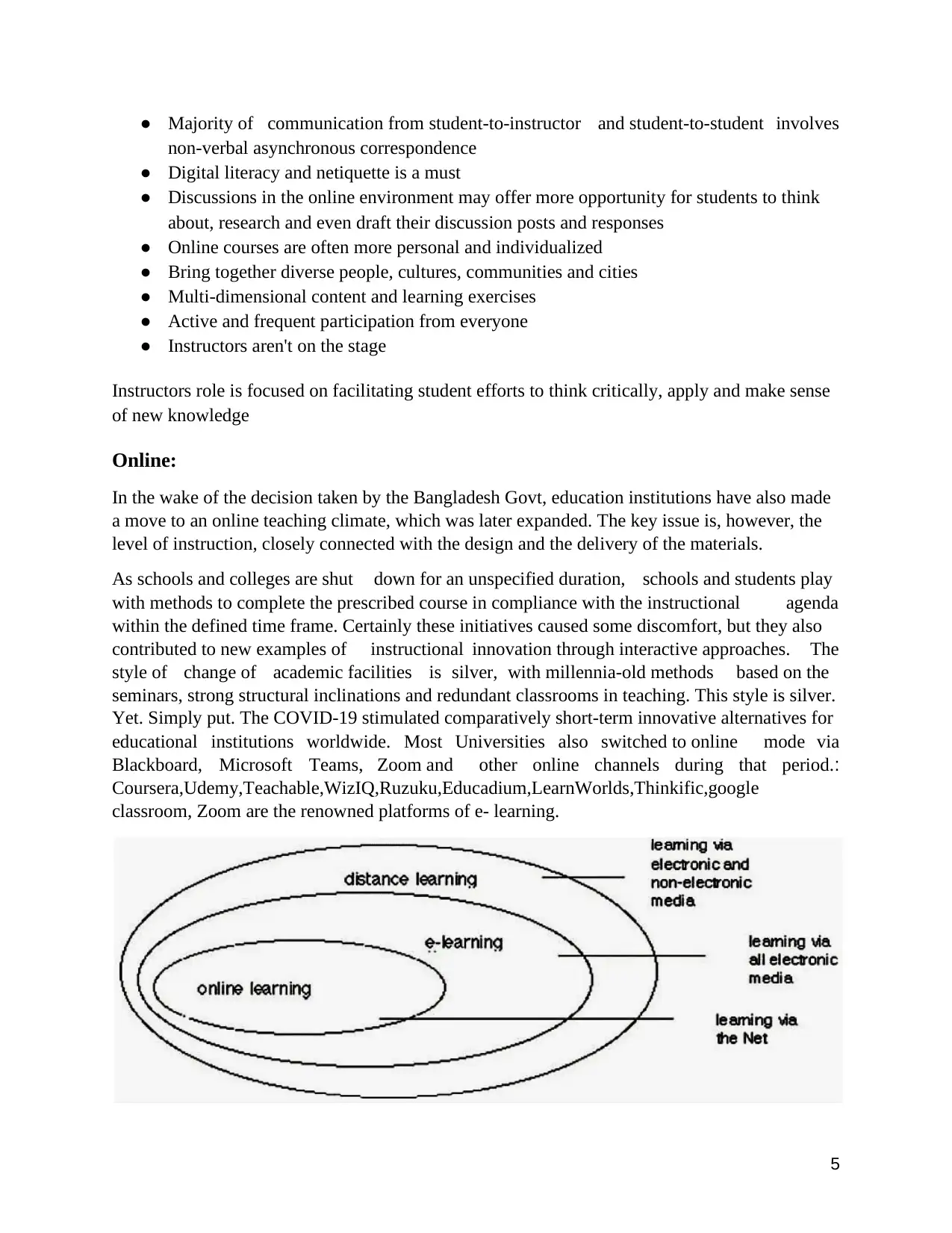
Yet. Simply put. The COVID-19 stimulated comparatively short-term innovative alternatives for
educational institutions worldwide. Most Universities also switched to online mode via
Blackboard, Microsoft Teams, Zoom and other online channels during that period.:
Coursera,Udemy,Teachable,WizIQ,Ruzuku,Educadium,LearnWorlds,Thinkific,google
classroom, Zoom are the renowned platforms of e- learning.
5
non-verbal asynchronous correspondence
● Digital literacy and netiquette is a must
● Discussions in the online environment may offer more opportunity for students to think
about, research and even draft their discussion posts and responses
● Online courses are often more personal and individualized
● Bring together diverse people, cultures, communities and cities
● Multi-dimensional content and learning exercises
● Active and frequent participation from everyone
● Instructors aren't on the stage
Instructors role is focused on facilitating student efforts to think critically, apply and make sense
of new knowledge
Online:
In the wake of the decision taken by the Bangladesh Govt, education institutions have also made
a move to an online teaching climate, which was later expanded. The key issue is, however, the
level of instruction, closely connected with the design and the delivery of the materials.
As schools and colleges are shut down for an unspecified duration, schools and students play
with methods to complete the prescribed course in compliance with the instructional agenda
within the defined time frame. Certainly these initiatives caused some discomfort, but they also
contributed to new examples of instructional innovation through interactive approaches. The
style of change of academic facilities is silver, with millennia-old methods based on the
seminars, strong structural inclinations and redundant classrooms in teaching. This style is silver.
Yet. Simply put. The COVID-19 stimulated comparatively short-term innovative alternatives for
educational institutions worldwide. Most Universities also switched to online mode via
Blackboard, Microsoft Teams, Zoom and other online channels during that period.:
Coursera,Udemy,Teachable,WizIQ,Ruzuku,Educadium,LearnWorlds,Thinkific,google
classroom, Zoom are the renowned platforms of e- learning.
5
Advantages and Disadvantages of Online Learning
The COVID-19 pandemic has created the largest disruption of education systems in history.
Educational institutes across the world have been shut to prevent the spread of the virus and this
has given way to online classrooms. Most educational institutes have shifted to online learning
platforms to keep the academic activities going. Online learning plays a huge positive role in the
disruption of Covid-19.
Online technology is applicable in every aspect of human life including learning. Today,
individuals do not need to be in a physical building to learn something. There are many online
learning platforms to help with that including websites, blogs, video based sites and even social
media. Even with an online video conferencing app such as Zoom, Meeting, people are sharing
and learning a lot about different issues.
Now, we need to know the advantages and disadvantages of online learning. This way, we can
decide whether it is a worthwhile course to undertake or not.
Advantages of Online Learning
The students who participated in this study are satisfied with the free and comfortable
educational environment offered by distance learning. The advantage of online learning is that
students can take classes from any location provided they have access to a computer, which this
study reaffirmed. In addition, the participants identified that the class interactions are smooth,
they can easily use class material, and they can concentrate better in class. The fact that
participants highlight their satisfaction with online classroom interactions. These Advantages
are:
1. Efficiency
2. Accessibility Of Time And Place
3. Improved Student Attendance
4. Suits A Variety Of Learning Styles
5. Reaches A Wider Audience
6. Supports Flexible Schedules
7. A Variety of Courses on One Platform
8. Builds A Learner's Character
Disadvantages of Online Learning
Suggested improvements for online learning are often associated with student dissatisfaction. For
example, students suggest improvements around areas of dissatisfaction such as increasing
network instability, activating interactions through increased one-sided interactions, and
conducting face-to-face classes for exercise. The greatest dissatisfaction with distance learning is
6
The COVID-19 pandemic has created the largest disruption of education systems in history.
Educational institutes across the world have been shut to prevent the spread of the virus and this
has given way to online classrooms. Most educational institutes have shifted to online learning
platforms to keep the academic activities going. Online learning plays a huge positive role in the
disruption of Covid-19.
Online technology is applicable in every aspect of human life including learning. Today,
individuals do not need to be in a physical building to learn something. There are many online
learning platforms to help with that including websites, blogs, video based sites and even social
media. Even with an online video conferencing app such as Zoom, Meeting, people are sharing
and learning a lot about different issues.
Now, we need to know the advantages and disadvantages of online learning. This way, we can
decide whether it is a worthwhile course to undertake or not.
Advantages of Online Learning
The students who participated in this study are satisfied with the free and comfortable
educational environment offered by distance learning. The advantage of online learning is that
students can take classes from any location provided they have access to a computer, which this
study reaffirmed. In addition, the participants identified that the class interactions are smooth,
they can easily use class material, and they can concentrate better in class. The fact that
participants highlight their satisfaction with online classroom interactions. These Advantages
are:
1. Efficiency
2. Accessibility Of Time And Place
3. Improved Student Attendance
4. Suits A Variety Of Learning Styles
5. Reaches A Wider Audience
6. Supports Flexible Schedules
7. A Variety of Courses on One Platform
8. Builds A Learner's Character
Disadvantages of Online Learning
Suggested improvements for online learning are often associated with student dissatisfaction. For
example, students suggest improvements around areas of dissatisfaction such as increasing
network instability, activating interactions through increased one-sided interactions, and
conducting face-to-face classes for exercise. The greatest dissatisfaction with distance learning is
6
⊘ This is a preview!⊘
Do you want full access?
Subscribe today to unlock all pages.
Trusted by 1+ million students worldwide
due to instability Network and students were cited as having network difficulties that disrupt
their class.These Disadvantages are:
1. Inability To Focus On Screens
2. Technology Issues
3. Sense Of Isolation
4. Teacher Training
5. Requires A Good Grasp of Tech Skills
6. Possibility of Distractions:
7. Manage Screen Time
Impact of Covid–19 on Higher Education
According to UNESCO, on 1st April 2020, schools and higher education institutions were closed
in 185 countries, which affected 1,542,412,000 learners, which constitute 89.4% of total enrolled
learners. At the beginning of May, some countries, experiencing decreasing numbers of cases
and deaths, started lifting confinement measures. However, on 7 May (the time of writing the
report), schools and higher education institutions were still closed in 177 countries, affecting
1,268,164,088 learners, which constitute 72.4% of total enrolled learners.
In order to better understand the disruption caused by COVID-19 on higher education and to
investigate the first measures undertaken by higher education institutions around the world to
respond to the crisis, the International Association of Universities (IAU) decided to launch the
IAU Global Survey on the impact of COVID-19 on higher education around the world. It was
available online and open from 25 March until 17 April 2020.
❖ Academic Calendar
As many as 78% of respondents think that COVID-19 will have an impact on the enrollment
numbers for the new academic year. Almost half (46%) indicate that the current pandemic will
impact both international and local students. This group of HEIs might be heavily impacted,
especially if they rely financially on enrollment numbers.
7
their class.These Disadvantages are:
1. Inability To Focus On Screens
2. Technology Issues
3. Sense Of Isolation
4. Teacher Training
5. Requires A Good Grasp of Tech Skills
6. Possibility of Distractions:
7. Manage Screen Time
Impact of Covid–19 on Higher Education
According to UNESCO, on 1st April 2020, schools and higher education institutions were closed
in 185 countries, which affected 1,542,412,000 learners, which constitute 89.4% of total enrolled
learners. At the beginning of May, some countries, experiencing decreasing numbers of cases
and deaths, started lifting confinement measures. However, on 7 May (the time of writing the
report), schools and higher education institutions were still closed in 177 countries, affecting
1,268,164,088 learners, which constitute 72.4% of total enrolled learners.
In order to better understand the disruption caused by COVID-19 on higher education and to
investigate the first measures undertaken by higher education institutions around the world to
respond to the crisis, the International Association of Universities (IAU) decided to launch the
IAU Global Survey on the impact of COVID-19 on higher education around the world. It was
available online and open from 25 March until 17 April 2020.
❖ Academic Calendar
As many as 78% of respondents think that COVID-19 will have an impact on the enrollment
numbers for the new academic year. Almost half (46%) indicate that the current pandemic will
impact both international and local students. This group of HEIs might be heavily impacted,
especially if they rely financially on enrollment numbers.
7
Paraphrase This Document
Need a fresh take? Get an instant paraphrase of this document with our AI Paraphraser
❖ Funding
The outbreak of the coronavirus has become a major disruption to colleges and universities
across the country, with most institutions canceling in-person classes and moving to online-only
instruction. The pandemic also threatens to significantly alter nearly every aspect of college life,
from admissions and enrollment to collegiate athletics. These concerns extend to the financial
future of higher education institutions in a time of considerable financial instability, both in the
form of unexpected costs and potential reductions in revenue.
❖ Employee Reduction
COVID-19 is responsible for the death of over 74,431 persons across the world. These people
are from different professions including the teaching profession. According to the Department of
Education and the South African Democratic Teachers' Union have sent their condolences to the
family of a teacher who died of COVID-19 complications. The Loudoun County Health
Department also reported the first death of a hospitalized patient who tested positive for COVID-
19. The patient, a woman in her 70s, died of respiratory failure Wednesday night as a result of
COVID-19. She was a former first grade teacher who was working as a reading tutor at two
Ashburn elementary schools. On April 3, 2020, in New York City, a beloved Brooklyn
elementary school teacher died from complications of COVID-19.
❖ Impact on GDP
While there is no way to tell exactly what the economic damage from the global COVID-19
novel coronavirus pandemic will be, there is widespread agreement among economists that it
will have severe negative impacts on the global economy. Early estimates predicted that, should
the virus become a global pandemic, most major economies will lose at least 2.4 percent of the
value of their gross domestic product (GDP) over 2020, leading economists to already reduce
their 2020 forecasts of global economic growth down from around 3.0 percent to 2.4 percent. To
put this number in perspective, global GDP was estimated at around 86.6 trillion U.S. dollars in
2019 – meaning that just a 0.4 percent drop in economic growth amounts to almost 3.5 trillion
U.S. dollars in lost economic output. However, these predictions were made prior to COVID-19
becoming a global pandemic, and before the implementation of widespread restrictions on social
contact to stop the spread of the virus. Since then, global stock markets have suffered dramatic
8
The outbreak of the coronavirus has become a major disruption to colleges and universities
across the country, with most institutions canceling in-person classes and moving to online-only
instruction. The pandemic also threatens to significantly alter nearly every aspect of college life,
from admissions and enrollment to collegiate athletics. These concerns extend to the financial
future of higher education institutions in a time of considerable financial instability, both in the
form of unexpected costs and potential reductions in revenue.
❖ Employee Reduction
COVID-19 is responsible for the death of over 74,431 persons across the world. These people
are from different professions including the teaching profession. According to the Department of
Education and the South African Democratic Teachers' Union have sent their condolences to the
family of a teacher who died of COVID-19 complications. The Loudoun County Health
Department also reported the first death of a hospitalized patient who tested positive for COVID-
19. The patient, a woman in her 70s, died of respiratory failure Wednesday night as a result of
COVID-19. She was a former first grade teacher who was working as a reading tutor at two
Ashburn elementary schools. On April 3, 2020, in New York City, a beloved Brooklyn
elementary school teacher died from complications of COVID-19.
❖ Impact on GDP
While there is no way to tell exactly what the economic damage from the global COVID-19
novel coronavirus pandemic will be, there is widespread agreement among economists that it
will have severe negative impacts on the global economy. Early estimates predicted that, should
the virus become a global pandemic, most major economies will lose at least 2.4 percent of the
value of their gross domestic product (GDP) over 2020, leading economists to already reduce
their 2020 forecasts of global economic growth down from around 3.0 percent to 2.4 percent. To
put this number in perspective, global GDP was estimated at around 86.6 trillion U.S. dollars in
2019 – meaning that just a 0.4 percent drop in economic growth amounts to almost 3.5 trillion
U.S. dollars in lost economic output. However, these predictions were made prior to COVID-19
becoming a global pandemic, and before the implementation of widespread restrictions on social
contact to stop the spread of the virus. Since then, global stock markets have suffered dramatic
8
falls due to the outbreak, and the Dow Jones reported its largest-ever single day fall of almost
3,000 points on March 16, 2020 – beating its previous record of 2,300 points that was set only
four days earlier.
How countries are using technology to support access to remote learning
during the covid-19 pandemic?
The “new normal” is not normal. Countries worldwide are trying to adjust to the disruptions in
the education landscape caused by the COVID-19 pandemic. The Education Technology
(EdTech) team in the Education Global Practice of the World Bank Group (WBG) has been
actively working with Ministries of Education and multilateral organizations to provide guidance
and technical assistance to maximize countries’ effectiveness in the design and execution of
remote learning strategies.
Bangladesh
The state-owned Television network in Bangladesh , Bangladesh Television (BTV), started
broadcasting education television lessons for students for grades six to ten . The program, called
"My School at My Home" broadcasts daily from 9.00 a.m. to 12.30 p.m. local time. These
television lessons can also be accessed as on-demand content on the Bangladesh Television
YouTube channel. To ensure that learning continues from home during school closures, the
Government is working with UNICEF to help implement effective remote learning programmes
using TV, radio, mobile phone and Internet platforms. As part of this collaboration, UNICEF will
support parents and caregivers with information on supporting children with learning at home.
India
In a press release put out by the Ministry of Human Resource Development (HRD) on March 21,
2020, the Union HRD Minister shared various free digital e-Learning platforms by the Ministry
of HRD that students capitalize on to continue their learning during COVID-19 based school
closures. The DIKSHA portal contains e-Learning content for students, teachers, and parents
aligned to the curriculum, including video lessons, worksheets, textbooks and assessments.
Under the guidance of its national board of education (CBSE) and NCERT, the content has been
created by more than 250 teachers who teach in multiple languages. QR codes in textbooks
encourage students to go beyond the book. The app is available to use offline.
Italy
The Italian government created a web site to support schools to activate different forms of
distance learning during the closure period linked to the coronavirus emergency. The links of the
various sections of the following page allow users to reach and use the platforms and tools made
available to educational institutions free of charge thanks to specific protocols signed by the
Ministry of Education.
9
3,000 points on March 16, 2020 – beating its previous record of 2,300 points that was set only
four days earlier.
How countries are using technology to support access to remote learning
during the covid-19 pandemic?
The “new normal” is not normal. Countries worldwide are trying to adjust to the disruptions in
the education landscape caused by the COVID-19 pandemic. The Education Technology
(EdTech) team in the Education Global Practice of the World Bank Group (WBG) has been
actively working with Ministries of Education and multilateral organizations to provide guidance
and technical assistance to maximize countries’ effectiveness in the design and execution of
remote learning strategies.
Bangladesh
The state-owned Television network in Bangladesh , Bangladesh Television (BTV), started
broadcasting education television lessons for students for grades six to ten . The program, called
"My School at My Home" broadcasts daily from 9.00 a.m. to 12.30 p.m. local time. These
television lessons can also be accessed as on-demand content on the Bangladesh Television
YouTube channel. To ensure that learning continues from home during school closures, the
Government is working with UNICEF to help implement effective remote learning programmes
using TV, radio, mobile phone and Internet platforms. As part of this collaboration, UNICEF will
support parents and caregivers with information on supporting children with learning at home.
India
In a press release put out by the Ministry of Human Resource Development (HRD) on March 21,
2020, the Union HRD Minister shared various free digital e-Learning platforms by the Ministry
of HRD that students capitalize on to continue their learning during COVID-19 based school
closures. The DIKSHA portal contains e-Learning content for students, teachers, and parents
aligned to the curriculum, including video lessons, worksheets, textbooks and assessments.
Under the guidance of its national board of education (CBSE) and NCERT, the content has been
created by more than 250 teachers who teach in multiple languages. QR codes in textbooks
encourage students to go beyond the book. The app is available to use offline.
Italy
The Italian government created a web site to support schools to activate different forms of
distance learning during the closure period linked to the coronavirus emergency. The links of the
various sections of the following page allow users to reach and use the platforms and tools made
available to educational institutions free of charge thanks to specific protocols signed by the
Ministry of Education.
9
⊘ This is a preview!⊘
Do you want full access?
Subscribe today to unlock all pages.
Trusted by 1+ million students worldwide
Japan
The Ministry of Education, Culture, Sports, Science and Technology (MEXT) has a centralized
website that synthesizes all information related to COVID19 response, including diverse coping
strategies that schools have undertaken. School districts and schools have employed different
coping strategies. While many of them are ICT-based distance learning (e.g., online-class
delivery, video-conferences, groupware based instructions), there are also many initiatives that
maximize the usage of school grounds and facilities in a safe and healthy manner.
Saudi Arabia
he Ministry of Education (MOE) is utilizing TV and social media to broadcast lessons for all
grades and have designated 127 supervisors and teachers to deliver daily lessons in 112
educational subjects through 19 TV channels (broadcasting nationally from a classroom in
Riyadh).Students are offered five options by the ministry for virtual learning.
Does online education give any benefit to students?
An online education is preferred by individuals who may not be able to make it for classes in a
traditional brick and mortar kind of college due to various reasons. Below we'll examine some of
the benefits this exciting education provides to such students.
Benefits of Online Education
1. Flexibility
Students have the freedom to juggle their careers and school because they aren't tied down to
a fixed schedule. In a traditional classroom setting, class meeting times are set, and the student
has no power over this, forcing them to work their schedules around these dates. Most people
who choose online learning tend to have other commitments, and prefer this mode of learning as
it gives them power over how they will delegate their time towards their different projects.
2. Reduce Costs
Online education can cost less due to a variety of reasons. For example, there is no cost for
commuting. Assorted costs that are related to transport, such as fuel, parking, car maintenance,
and public transportation costs don't affect the online student.
3. Networking Opportunities
Online education also provides students with the chance to network with peers across nations or
even different continents. This often leads to other opportunities in terms of collaboration with
other individuals in the implementation of a project. At the same time, it makes them culturally
sensitive and able to fit into other environments easily given their exposure to other cultures.
10
The Ministry of Education, Culture, Sports, Science and Technology (MEXT) has a centralized
website that synthesizes all information related to COVID19 response, including diverse coping
strategies that schools have undertaken. School districts and schools have employed different
coping strategies. While many of them are ICT-based distance learning (e.g., online-class
delivery, video-conferences, groupware based instructions), there are also many initiatives that
maximize the usage of school grounds and facilities in a safe and healthy manner.
Saudi Arabia
he Ministry of Education (MOE) is utilizing TV and social media to broadcast lessons for all
grades and have designated 127 supervisors and teachers to deliver daily lessons in 112
educational subjects through 19 TV channels (broadcasting nationally from a classroom in
Riyadh).Students are offered five options by the ministry for virtual learning.
Does online education give any benefit to students?
An online education is preferred by individuals who may not be able to make it for classes in a
traditional brick and mortar kind of college due to various reasons. Below we'll examine some of
the benefits this exciting education provides to such students.
Benefits of Online Education
1. Flexibility
Students have the freedom to juggle their careers and school because they aren't tied down to
a fixed schedule. In a traditional classroom setting, class meeting times are set, and the student
has no power over this, forcing them to work their schedules around these dates. Most people
who choose online learning tend to have other commitments, and prefer this mode of learning as
it gives them power over how they will delegate their time towards their different projects.
2. Reduce Costs
Online education can cost less due to a variety of reasons. For example, there is no cost for
commuting. Assorted costs that are related to transport, such as fuel, parking, car maintenance,
and public transportation costs don't affect the online student.
3. Networking Opportunities
Online education also provides students with the chance to network with peers across nations or
even different continents. This often leads to other opportunities in terms of collaboration with
other individuals in the implementation of a project. At the same time, it makes them culturally
sensitive and able to fit into other environments easily given their exposure to other cultures.
10
Paraphrase This Document
Need a fresh take? Get an instant paraphrase of this document with our AI Paraphraser
4. Documentation
All the information that you will need will be safely stored in an online database. This includes
things like live discussion documents, training materials and emails. This means that if there's
ever anything that needs to be clarified, the student will be able to access these documents fast,
saving valuable time. This is especially useful for individuals that need to carry out research for a
project and submit their findings to a panel.
5. Increased Instructor - Student Time
Students in traditional classrooms may not get the personalized attention they need to have
concepts clarified. Although class sizes are small at CCA, most colleges have classes of students
that number in the hundreds. This is not a problem for this type of education because online
guided discussions and personal talk time with their professors and lecturers is a hallmark of
online classes. This increases the chances of a student performing well due to the time their
instructors give them. This also enhances their problem-solving and communication skills, as
well as knowing how to defend their arguments to superiors if needed.
6. Access to Expertise
An online college education might give students access to specialized degree courses that may
not be available in an easily accessible or local institution of learning. Online classes allow the
sharing of expertise that helps more people have access to education that is not readily available
in certain geographic locations.
Limitation of Online Education
It’s too many people at low cost, but that is not education, which requires rig
orous conversation, dialogue in office hours, paper conferences, graded tests, supervised labs and
individualized assessment. All of this has to be done by well-educated and experienced faculty
members, regardless of delivery mode. Doing all this online offers many The massive expansion
of online education across the United States in response to COVID-19 is teaching us many
lessons about the value of distributed learning, but equally important, it is reminding us of its
limits. In the Naval University System (which consists of the U.S. Naval Academy at Annapolis,
Md.; the Naval War College in Newport, R.I.; the Naval Postgraduate School in Monterrey,
Calif.; and Marine Corps University at Quantico, Va., which I oversee as the Navy’s chief
learning officer) we have moved to 100 percent online learning during the crisis. In the process,
we have gained a much clearer understanding of what online education cannot do -- or, in other
words, the ways in which traditional in-person education cannot be replaced.
The most obvious area in which online delivery simply cannot replicate the value of in-person
learning is in science and technology education. In many of the degree programs offered by the
Naval University System, STEM is a major priority, with students working long hours with their
teams in our labs, conducting experiments. As COVID-19 has forced us to adopt online
education, our faculty has responded magnificently. At Annapolis, for example, which offers one
of the best undergraduate science and technology educations in the world, faculty members have
been performing labs on Zoom and then providing data sets to students to analyze.
11
All the information that you will need will be safely stored in an online database. This includes
things like live discussion documents, training materials and emails. This means that if there's
ever anything that needs to be clarified, the student will be able to access these documents fast,
saving valuable time. This is especially useful for individuals that need to carry out research for a
project and submit their findings to a panel.
5. Increased Instructor - Student Time
Students in traditional classrooms may not get the personalized attention they need to have
concepts clarified. Although class sizes are small at CCA, most colleges have classes of students
that number in the hundreds. This is not a problem for this type of education because online
guided discussions and personal talk time with their professors and lecturers is a hallmark of
online classes. This increases the chances of a student performing well due to the time their
instructors give them. This also enhances their problem-solving and communication skills, as
well as knowing how to defend their arguments to superiors if needed.
6. Access to Expertise
An online college education might give students access to specialized degree courses that may
not be available in an easily accessible or local institution of learning. Online classes allow the
sharing of expertise that helps more people have access to education that is not readily available
in certain geographic locations.
Limitation of Online Education
It’s too many people at low cost, but that is not education, which requires rig
orous conversation, dialogue in office hours, paper conferences, graded tests, supervised labs and
individualized assessment. All of this has to be done by well-educated and experienced faculty
members, regardless of delivery mode. Doing all this online offers many The massive expansion
of online education across the United States in response to COVID-19 is teaching us many
lessons about the value of distributed learning, but equally important, it is reminding us of its
limits. In the Naval University System (which consists of the U.S. Naval Academy at Annapolis,
Md.; the Naval War College in Newport, R.I.; the Naval Postgraduate School in Monterrey,
Calif.; and Marine Corps University at Quantico, Va., which I oversee as the Navy’s chief
learning officer) we have moved to 100 percent online learning during the crisis. In the process,
we have gained a much clearer understanding of what online education cannot do -- or, in other
words, the ways in which traditional in-person education cannot be replaced.
The most obvious area in which online delivery simply cannot replicate the value of in-person
learning is in science and technology education. In many of the degree programs offered by the
Naval University System, STEM is a major priority, with students working long hours with their
teams in our labs, conducting experiments. As COVID-19 has forced us to adopt online
education, our faculty has responded magnificently. At Annapolis, for example, which offers one
of the best undergraduate science and technology educations in the world, faculty members have
been performing labs on Zoom and then providing data sets to students to analyze.
11
This is the best we can do in present circumstances, and I deeply appreciate the faculty for their
heroic effort, but it is obvious to all of us that this distributed approach does not produce
anything close to the value that would have been achieved if students were present in their labs,
learning directly how to make and correct their own mistakes. This problem is even more
profound in our graduate programs at institutions like the Naval Postgraduate School, where
independent work in a lab is a core part of the student experience in engineering and technology
fields. Simply put, the COVID-19 experience reminds all of us -- and should remind policy
makers and administrators who will shape the future of American education -- that if we want the
United States to remain the world leader in science and technology education at the university
level, we have to invest in and protect traditional in-person academic programs.
Universities are also discovering that in a host of specialized areas, online education is
completely inadequate compared to the traditional learning model. In the Naval University
System, one clear example is in classified education. Because our education programs are
focused primarily on educating military officers, many of our graduate programs feature learning
experiences that are classified as secret or top secret. For example, we teach classes that focus on
the latest classified information about Chinese and Russian military capabilities, the technology
used in our latest weapons systems, and that test certain operational solutions to current and
future combat challenges. The percentage of our educational programs that will operate in the
classified realm is expected to grow significantly in the coming years, because they offer our
students powerful learning outcomes that boost national security and that cannot be obtained
from our civilian university colleagues.
These classes, however, cannot be taught in an online mode, where they would be vulnerable to
hacking. Instead, to protect national security, they can only be offered in a sensitive
compartmentalized information facility, or SCIF, an enclosed and secured area within a building
that is used to handle classified information and materials. In many of our programs, we are
teaching our students as best we can online, with unclassified materials, but the education they
receive during this crisis will not be as useful as that they would have obtained had we taught
more advanced classes in person. I am sure other universities are identifying similar specialized
education contexts that cannot be mimicked online.
We are also learning that for many professors and students, holding classes online, gazing at a
small screen, is more tiring and less joyful than traditional in-person experiences. Though we do
not yet have any comprehensive data or surveys that capture this phenomenon, many teachers
and students report that they simply cannot spend as much time learning online as they could in
person without fatigue and burnout setting in. In some of our courses, we have had to reduce
class time in order to maintain a positive learning environment. This is not merely a
quality-of-life matter but offers important insights into the limits of full-time online education.
While online models may be great for the part-time student, they may not be able to achieve the
same results in rigorous educational settings where five or more hours of classes, labs and office
hours a day are the expected norm.
Finally, our massive move to online education has reminded us -- and hopefully, will teach this
same lesson to university leaders and administrators who are adopting online education for the
first time -- that reputation and rumor to the contrary, great online education is not really cheaper
12
heroic effort, but it is obvious to all of us that this distributed approach does not produce
anything close to the value that would have been achieved if students were present in their labs,
learning directly how to make and correct their own mistakes. This problem is even more
profound in our graduate programs at institutions like the Naval Postgraduate School, where
independent work in a lab is a core part of the student experience in engineering and technology
fields. Simply put, the COVID-19 experience reminds all of us -- and should remind policy
makers and administrators who will shape the future of American education -- that if we want the
United States to remain the world leader in science and technology education at the university
level, we have to invest in and protect traditional in-person academic programs.
Universities are also discovering that in a host of specialized areas, online education is
completely inadequate compared to the traditional learning model. In the Naval University
System, one clear example is in classified education. Because our education programs are
focused primarily on educating military officers, many of our graduate programs feature learning
experiences that are classified as secret or top secret. For example, we teach classes that focus on
the latest classified information about Chinese and Russian military capabilities, the technology
used in our latest weapons systems, and that test certain operational solutions to current and
future combat challenges. The percentage of our educational programs that will operate in the
classified realm is expected to grow significantly in the coming years, because they offer our
students powerful learning outcomes that boost national security and that cannot be obtained
from our civilian university colleagues.
These classes, however, cannot be taught in an online mode, where they would be vulnerable to
hacking. Instead, to protect national security, they can only be offered in a sensitive
compartmentalized information facility, or SCIF, an enclosed and secured area within a building
that is used to handle classified information and materials. In many of our programs, we are
teaching our students as best we can online, with unclassified materials, but the education they
receive during this crisis will not be as useful as that they would have obtained had we taught
more advanced classes in person. I am sure other universities are identifying similar specialized
education contexts that cannot be mimicked online.
We are also learning that for many professors and students, holding classes online, gazing at a
small screen, is more tiring and less joyful than traditional in-person experiences. Though we do
not yet have any comprehensive data or surveys that capture this phenomenon, many teachers
and students report that they simply cannot spend as much time learning online as they could in
person without fatigue and burnout setting in. In some of our courses, we have had to reduce
class time in order to maintain a positive learning environment. This is not merely a
quality-of-life matter but offers important insights into the limits of full-time online education.
While online models may be great for the part-time student, they may not be able to achieve the
same results in rigorous educational settings where five or more hours of classes, labs and office
hours a day are the expected norm.
Finally, our massive move to online education has reminded us -- and hopefully, will teach this
same lesson to university leaders and administrators who are adopting online education for the
first time -- that reputation and rumor to the contrary, great online education is not really cheaper
12
⊘ This is a preview!⊘
Do you want full access?
Subscribe today to unlock all pages.
Trusted by 1+ million students worldwide

1 out of 18


Related Documents


Your All-in-One AI-Powered Toolkit for Academic Success.
+13062052269
info@desklib.com
Available 24*7 on WhatsApp / Email
![[object Object]](/_next/static/media/star-bottom.7253800d.svg)
Unlock your academic potential
Copyright © 2020–2026 A2Z Services. All Rights Reserved. Developed and managed by ZUCOL.