CO4804 MSc Project Proposal: Development of Online PETT Questionnaire

Verified

Added on  2022/11/27

|5
|2164
|322
Project
AI Summary
This MSc project proposal outlines the development of an online version of the PETT questionnaire, designed to assist researchers in studies involving children. The project aims to address the limitations of the current manual, paper-based system by creating a web-based tool with features such as automated data analytics, mobile and desktop compatibility, and user-specific questionnaire creation. The methodology will employ agile SCRUM for system development, with PHP and MySQL for the tool's backend and responsive web design for user interaction. The proposal includes a literature review highlighting the benefits of web-based questionnaires, a detailed methodology section outlining the agile approach, technology choices, and testing procedures, as well as a work breakdown structure and Gantt chart. Ethical considerations, including data security and privacy, are also addressed. The project's goal is to provide researchers with a more efficient, accessible, and user-friendly tool for gathering and analyzing data, ultimately enhancing the quality and efficiency of research involving children.
Document Page
CO4804 MSc Project | School of Physical Science and Computing | UCLan |
MSc Project Proposal
Name: Course:
Supervisor (lecturer):
Current Modules (and previous modules if Computing or direct entrant)
The Project Title
The Onlification of PETT
Project Introduction
The project includes the development of the online version of the PETT questionnaire. The
questionnaire has been developed in order to provide assistance to the researchers in conducting studies
with the children. It is required that an understanding of the prior experience of children in the fields,
such as, general technology experience, specific technology experience, and task related experience is
obtained.
Presently, the manual paper-based version is used that does not support any of the automated processes,
such as automated data analytics. The manual version may not be easily accessed by certain users as
availability may be an issue. The collection of responses and their analysis can be time-consuming
without the online version of the tool. The conversion of the questionnaire in the online form will
resolve these issues and there will be numerous benefits that will also be provided.
The online version of the tool will provide the ability to the researchers to log in and create PETT
questionnaires specific to their field of research and studies. The tool will provide the users with the
ability to create online or offline versions of the questionnaires. The online version will provide further
benefits, such as automated analysis of the data sets to bring out the statistics and patterns. It will be
compatible with the mobile and desktop versions.
Literature Review
Web-based questionnaire is one of the most significant methods for data collection. Traditionally,
paper-based questionnaires were the primary method used for gathering of the data sets. However, with
the development of technology, it is now possible to create the online version of these questionnaires
and launch it over the web platforms. There are a number of drawbacks associated with the traditional
paper-based questionnaires. These include the time-consuming process and involvement of additional
steps, such as printing and distribution of the questionnaire. Also, these questionnaires are not
favourable from the environment perspective (Ebert et al., 2018). There is also enhanced expenditure
associated with the paper-based questionnaire. With the enhancement of technology, the web-based
questionnaire has resulted in the reduction of the costs. Also, it has provided the ability to reach out to
increased number of respondents in lesser timeframe. There is more number of data sets that can be
gathered using the web-based questionnaires (Hohwu et al., 2013).
When the web-based questionnaires were first launched, there were issues around internet access that
came up. Also, the users were not familiar with the online mode. However, Internet accessibility has
improved over the years and there are majority of users that can now access the Internet with ease. In
the case of academic domain, it is necessary that the understanding of the perspective of the
children/students is obtained and is well analysed. The use of questionnaires or surveys as a technique
provides the ability to gather the response in a shorter timeframe (Rajmil et al., 2014). Also, increased
participation rate is also made possible with the help of the questionnaires. The researchers need to
tabler-icon-diamond-filled.svg

Paraphrase This Document

Need a fresh take? Get an instant paraphrase of this document with our AI Paraphraser
Document Page
CO4804 MSc Project | School of Physical Science and Computing | UCLan |
obtain the perspective of the children or the students so that the research and studies can be planned and
designed accordingly.
Academic expectations have a significant role to play in the quality of student adaptation. Also, it plays
an important role in the academic success. There are multi-dimensional factors that are involved behind
the understanding of the academic expectations and perspectives. It is required that the gathering of the
data sets is done in such a manner that the varied perspective is obtained. The use of online tools can be
done for gathering and understanding such expectations (Casanova et al., 2019).
Questionnaires are inexpensive and are also practical to collect the data sets. The overall collection and
analysis of the data sets in an academic environment needs to be quickly done. This is because the
perspective, prior experience, and level of understanding of the children need to be obtained. The web-
based questionnaires provide the ability to collect data and get results (Regmi et al., 2017). These are
also scalable in nature. The researchers may wish to make changes in some of the questionnaires that
are designed. There are also chances wherein the number of respondents varies over the time. The web-
based questionnaires allow the ability to handle the varying number of users (Bolarinwa, 2015).
Method / Proposed Approach
The methodology that will be followed for the development of online version of PETT questionnaire
shall be agile methodology for system development. The agile methodology will provide ad-hoc
mechanism for development of the tool and the use of agile SCRUM as the method shall be done. The
PETT questionnaire that is to be developed will require the compatibility with the mobile as well as the
desktop versions. The agile methodology will provide the required level of scalability along with the
adaptive approach in the development processes (Rajasekaran, 2015). There will be involvement of
sprints in the development process and the entire set of requirements will be defined and included in
the product backlog. There will be requirements extracted from the product backlog for each sprint and
the working sets of the tool will be provided to the end-users for feedback and improvement. There will
be self-managed teams involved that will be provided with the project requirements and details.
The management of the project will be done using the Project Management Body of Knowledge. The
methodology will provide the project team and the managers with the ability to manage the different
project areas. The management of the project will be equally important as the development of the tool.
The methodology will integrate the different areas of management, such as schedule, budget, risks,
communication, etc. with each other. The management of the project scope will also be integrated with
the agile methods. This will provide the ability to manage the scope of the project.
The development of the PETT questionnaire will be done using PHP as the programming language.
The cross-platform application will be created using the programming language and the quality of
scalability will also be added. The database engine that will be used for the tool will be MySQL and
easy database connection will be formed with it using the PHP programming language. The ease of
integration will provide enhanced user experience and the functional aspects will also be met. The
methodology for designing the tool will be responsive web design. The use of this methodology will
promote the interaction between the tool and the users. The methodology will make sure that the
elements as consistency and error resolution are maintained in the tool. Also, it will be ensured that the
navigation and scrolling on the screen is accurate. There shall be no over-scrolling on any of the
screens and smooth navigation is provided (Natda, 2013). There will also be customization and
personalization as the features that will be added to the online tool with the use of responsive web
design as the methodology. The use of this methodology will make sure that the various screen
resolutions are supported and the user experience is enhanced. The conduction of functional and user
testing will also be done. With the agile development, the usability testing will be conducted at the end
Document Page
CO4804 MSc Project | School of Physical Science and Computing | UCLan |
of every sprint. Also, functional testing, such as system & integration testing and regression testing will
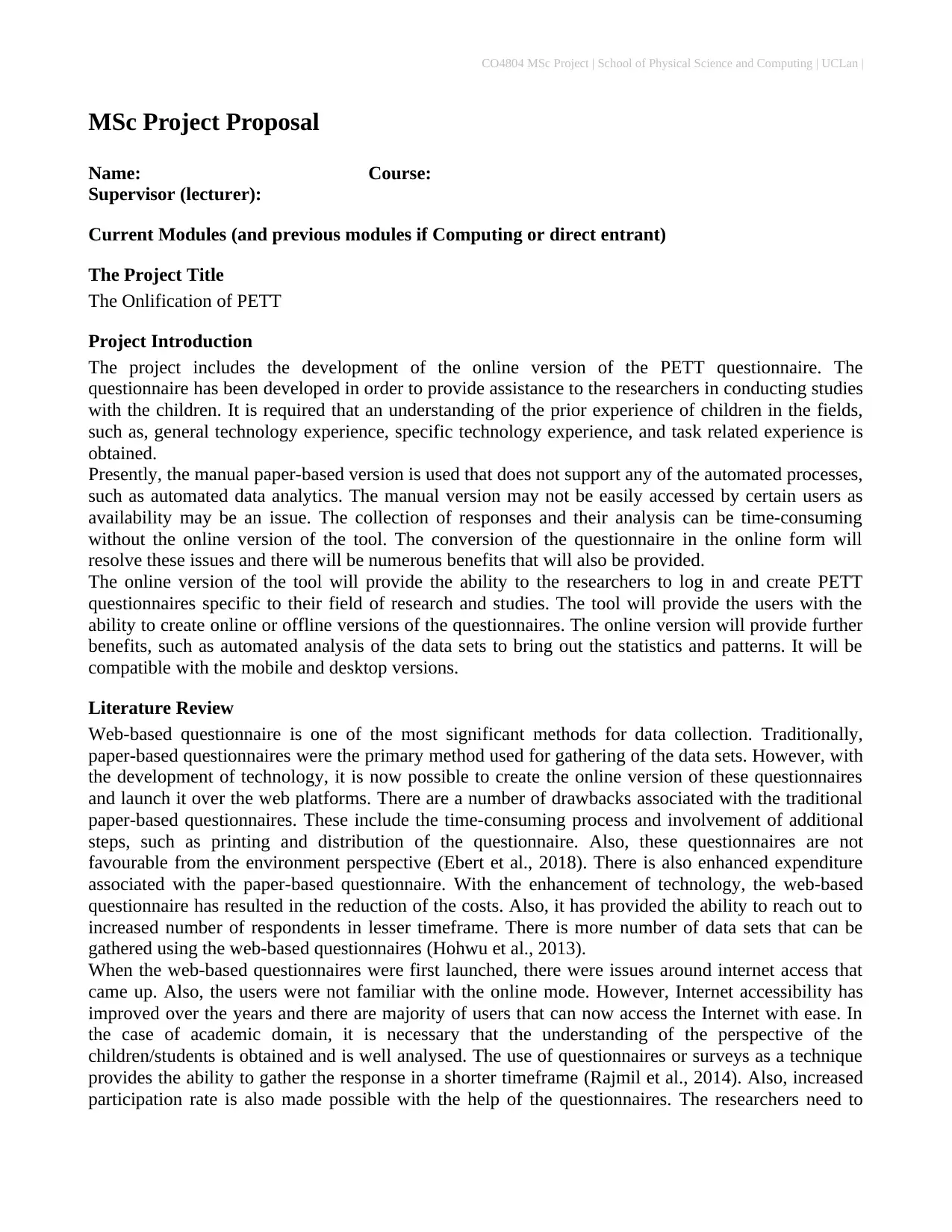
be carried out. There are different tasks that will be included in the project. The details of these
activities along with their duration and dates are specified in the table below.
WBS Task Name Duration Start Finish Predecessors
1 PETT Questionnaire Online Tool
Development 75 days Tue 02-07-19 Mon 14-10-19
1.1 Literature Review 20 days Tue 02-07-19 Mon 29-07-19
1.2 Requirements Gathering 10 days Tue 16-07-19 Mon 29-07-19
1.3 Requirements and Data Analysis 15 days Tue 30-07-19 Mon 19-08-19 3
1.4 Design & Development of the Online Tool 25 days Tue 20-08-19 Mon 23-09-19 4
1.5 Quality Assurance, Control, and Continuous
Improvement 30 days Tue 20-08-19 Mon 30-09-19 4
1.6 Deployment & Go-Live 5 days Tue 01-10-19 Mon 07-10-19 6
1.7 Performance evaluation and closure 10 days Tue 01-10-19 Mon 14-10-19 6
The Gantt chart is shown in the diagram below.
Potential Ethical or Legal Issues
There are a few issues that may also get associated with the project. There are security issues that
usually get associated with the involvement of web technologies. The information of the children will
be collected using the online questionnaire which may be exposed to the network-based information
security risks and attacks. Some of these attacks may include malware attacks, information breaches, or
man in the middle attack. The information properties, such as confidentiality and integrity of the
information may be compromised in the occurrence of such cases. These issues may result in ethical
issues with the violation of ethical principles. The researchers will also have the access to the
information sets provided by the children. The misuse of the permissions and inadequate use of the
rights granted may also bring up ethical issues for the project.
The violation of the information security and privacy may also bring up the legal issues for the project
team and the organization. The violation of the data protection act and information security laws may
bring up legal obligations and punishments.
The data on the system shall be anonymous so that the misuse of the data is prevented. The school
teacher shall be responsible for linking the student username for the purpose of authentication.
Document Page
CO4804 MSc Project | School of Physical Science and Computing | UCLan |
It will, therefore, be necessary to make sure that the information sets are protected at all times. There
are technical and logical security controls that have been developed and these shall be integrated with
the online tool. The integration of these controls will make sure that the prevention and detection of
these issues is adequately done.
tabler-icon-diamond-filled.svg

Paraphrase This Document

Need a fresh take? Get an instant paraphrase of this document with our AI Paraphraser
Document Page
CO4804 MSc Project | School of Physical Science and Computing | UCLan |
References
Bolarinwa, O. (2015). Principles and methods of validity and reliability testing of questionnaires used
in social and health science researches. Nigerian Postgraduate Medical Journal, 22(4), p.195.
Casanova, J., Almeida, L., Peixoto, F., Ribeiro, R. and Marôco, J. (2019). Academic Expectations
Questionnaire: A Proposal for a Short Version. SAGE Open, 9(1), p.215824401882449.
Ebert, J., Huibers, L., Christensen, B. and Christensen, M. (2018). Paper- or Web-Based Questionnaire
Invitations as a Method for Data Collection: Cross-Sectional Comparative Study of Differences in
Response Rate, Completeness of Data, and Financial Cost. Journal of Medical Internet Research,
20(1), p.e24.
Hohwü, L., Lyshol, H., Gissler, M., Jonsson, S., Petzold, M. and Obel, C. (2013). Web-Based Versus
Traditional Paper Questionnaires: A Mixed-Mode Survey With a Nordic Perspective. Journal of
Medical Internet Research, 15(8), p.e173.
Natda, K. (2013). Responsive Web Design. Eduvantage, 1(1).
Rajasekaran, V. (2015). Issues in Scrum Agile Development Principles and Practices in software
development. Indian Journal of Science and Technology, 8(35).
Rajmil, L., Robles, N., Rodriguez-Arjona, D., Azuara, M., Codina, F., Raat, H. and Ravens-Sieberer,
U. (2014). Comparison of the Web-Based and Digital Questionnaires of the Spanish and Catalan
Versions of the KIDSCREEN-52. PLoS ONE, 9(12), p.e114527.
Regmi, P., Waithaka, E., Paudyal, A., Simkhada, P. and Van Teijlingen, E. (2017). Guide to the design
and application of online questionnaire surveys. Nepal Journal of Epidemiology, 6(4), pp.640-644.
chevron_up_icon
1 out of 5
circle_padding
hide_on_mobile
zoom_out_icon
[object Object]