Online Privacy and Piracy: Exploring Threats and Commercial Practices
VerifiedAdded on 2019/09/19
|15
|5222
|317
Homework Assignment
AI Summary
This assignment delves into the interconnected topics of online privacy and piracy, highlighting the evolving landscape shaped by technological advancements and economic models. It defines privacy as the control individuals have over their personal information, outlining its various components and emphasizing the variable nature of privacy across different contexts. The assignment explores how businesses, the media, and even the government exploit digitization and weak regulations to access and utilize personal data, detailing specific threats like monitoring, spamming, and the use of cookies. It examines the commercial exploitation of online activity, including data collection, targeted advertising, and the impact of user agreements. The assignment also addresses the legal and ethical implications of surveillance and data breaches, encouraging critical analysis of online behavior and the importance of safeguarding personal information in an increasingly interconnected world.
Piracy & Privacy p. 1
Online Privacy and Piracy p. 1
Online privacy and piracy may seem like two very different topics as you begin this
week's content. Privacy and Piracy are all about deciding where to draw lines of
acceptable and unacceptable practices. They are linked by two larger issues which are
currently quite relevant. They are:
1. Technology – How does emerging technology change the
availability of personal information online? How does emerging technology
change how we pirate content? Hint: Largely, advances in technology
capabilities have made it easier to share private information online, and
easier to to illegally get content online.
2. Economic model – How do media companies make money using
your personal information? How do they make money when their content is
being pirated? Hint: Your information has value, which is growing, and
pirating content tends to have complex effects on industries and varied
implications for consumers.
Defining Privacy
Let's start with a multiple part definition of privacy, which is the secluding of personal
information by individuals about themselves, It generally contains four components:
There is a basic assumption that some information is private rather than public.
There are some parts of information that the general public has access to, and other
bits of information that the general public does not have access to. You can keep
some things to yourself.
Different people and entities have access to different types of information about
you. Privacy is variable.
Individuals should have control over their own private information. If another
individual or company takes control of this type of information, that is an invasion of
privacy.
When we share private information about ourselves with a person or entity, we
expect them not to share it and respect our boundaries.
It is best to think about our personal information as existing somewhere along a private
-- public continuum. There are some types of private information we don't want to share
with anyone, or very few select others. Number three is an interesting component.
Think about who knows these things about you:
Where you work
Your home address
Your major at UCF
Your political and religious affiliations
Your medical history
Your account passwords
Online Privacy and Piracy p. 1
Online privacy and piracy may seem like two very different topics as you begin this
week's content. Privacy and Piracy are all about deciding where to draw lines of
acceptable and unacceptable practices. They are linked by two larger issues which are
currently quite relevant. They are:
1. Technology – How does emerging technology change the
availability of personal information online? How does emerging technology
change how we pirate content? Hint: Largely, advances in technology
capabilities have made it easier to share private information online, and
easier to to illegally get content online.
2. Economic model – How do media companies make money using
your personal information? How do they make money when their content is
being pirated? Hint: Your information has value, which is growing, and
pirating content tends to have complex effects on industries and varied
implications for consumers.
Defining Privacy
Let's start with a multiple part definition of privacy, which is the secluding of personal
information by individuals about themselves, It generally contains four components:
There is a basic assumption that some information is private rather than public.
There are some parts of information that the general public has access to, and other
bits of information that the general public does not have access to. You can keep
some things to yourself.
Different people and entities have access to different types of information about
you. Privacy is variable.
Individuals should have control over their own private information. If another
individual or company takes control of this type of information, that is an invasion of
privacy.
When we share private information about ourselves with a person or entity, we
expect them not to share it and respect our boundaries.
It is best to think about our personal information as existing somewhere along a private
-- public continuum. There are some types of private information we don't want to share
with anyone, or very few select others. Number three is an interesting component.
Think about who knows these things about you:
Where you work
Your home address
Your major at UCF
Your political and religious affiliations
Your medical history
Your account passwords

Paraphrase This Document
Need a fresh take? Get an instant paraphrase of this document with our AI Paraphraser
Now, think about if another individual shared this information with others, after you had
shared it with them, without your approval or knowing. What if an online company did
the same?
Some bits of information are very context-dependent. Your doctor should know very
personal health information about you, and your accountant should know very personal
financial information about you. There are other bits of information that you would not
want companies to know about you (out of fear they would bombard you with unwanted
messages) or complete strangers, but that you would share with almost strangers.
Think about sharing your phone number, becoming Facebook friends, or connecting
with others via Snapchat or Instagram after meeting through friends, in a work
environment, or meeting with fellow students to work on a school project out of class.
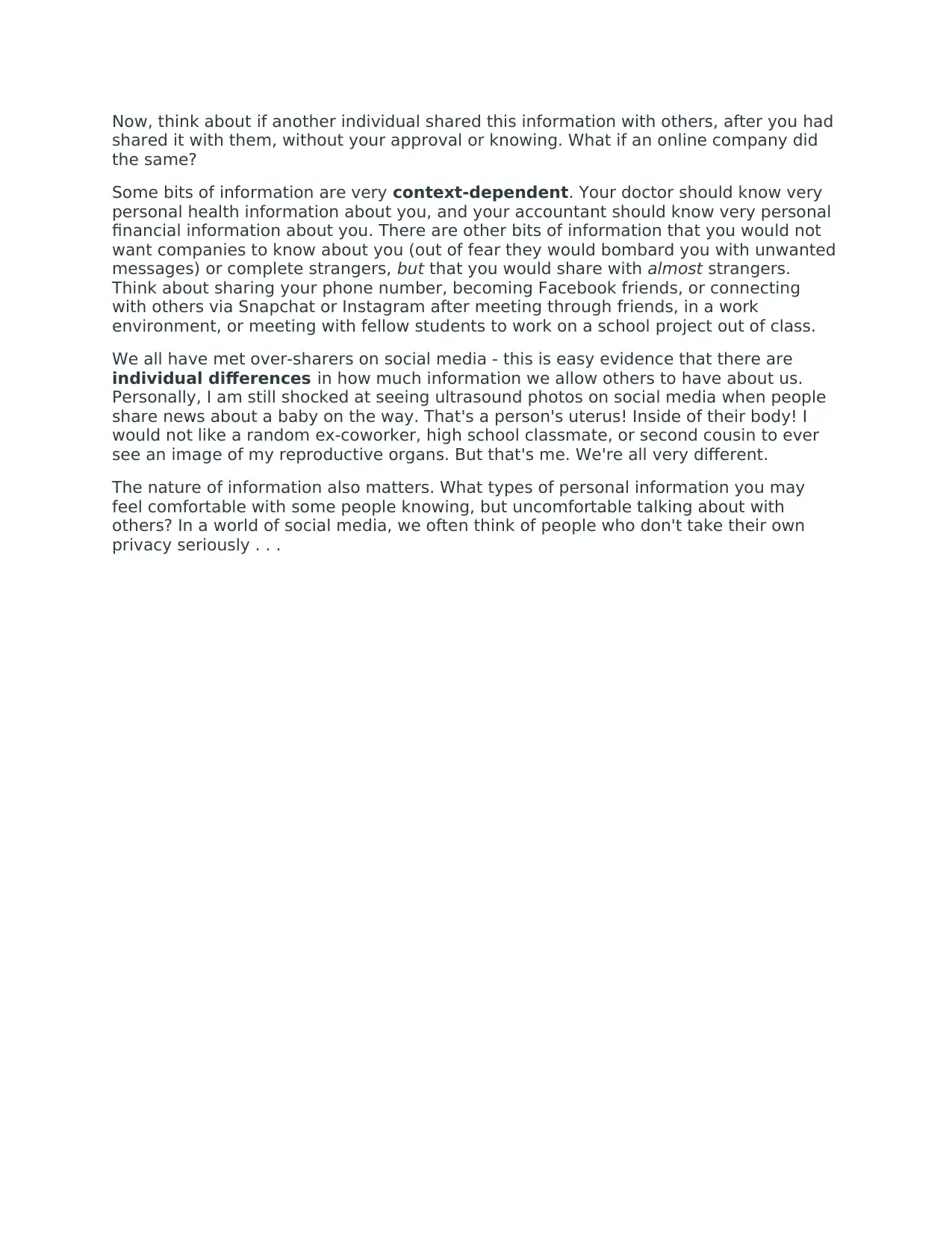
We all have met over-sharers on social media - this is easy evidence that there are
individual differences in how much information we allow others to have about us.
Personally, I am still shocked at seeing ultrasound photos on social media when people
share news about a baby on the way. That's a person's uterus! Inside of their body! I
would not like a random ex-coworker, high school classmate, or second cousin to ever
see an image of my reproductive organs. But that's me. We're all very different.
The nature of information also matters. What types of personal information you may
feel comfortable with some people knowing, but uncomfortable talking about with
others? In a world of social media, we often think of people who don't take their own
privacy seriously . . .
shared it with them, without your approval or knowing. What if an online company did
the same?
Some bits of information are very context-dependent. Your doctor should know very
personal health information about you, and your accountant should know very personal
financial information about you. There are other bits of information that you would not
want companies to know about you (out of fear they would bombard you with unwanted
messages) or complete strangers, but that you would share with almost strangers.
Think about sharing your phone number, becoming Facebook friends, or connecting
with others via Snapchat or Instagram after meeting through friends, in a work
environment, or meeting with fellow students to work on a school project out of class.
We all have met over-sharers on social media - this is easy evidence that there are
individual differences in how much information we allow others to have about us.
Personally, I am still shocked at seeing ultrasound photos on social media when people
share news about a baby on the way. That's a person's uterus! Inside of their body! I
would not like a random ex-coworker, high school classmate, or second cousin to ever
see an image of my reproductive organs. But that's me. We're all very different.
The nature of information also matters. What types of personal information you may
feel comfortable with some people knowing, but uncomfortable talking about with
others? In a world of social media, we often think of people who don't take their own
privacy seriously . . .
⊘ This is a preview!⊘
Do you want full access?
Subscribe today to unlock all pages.

Trusted by 1+ million students worldwide
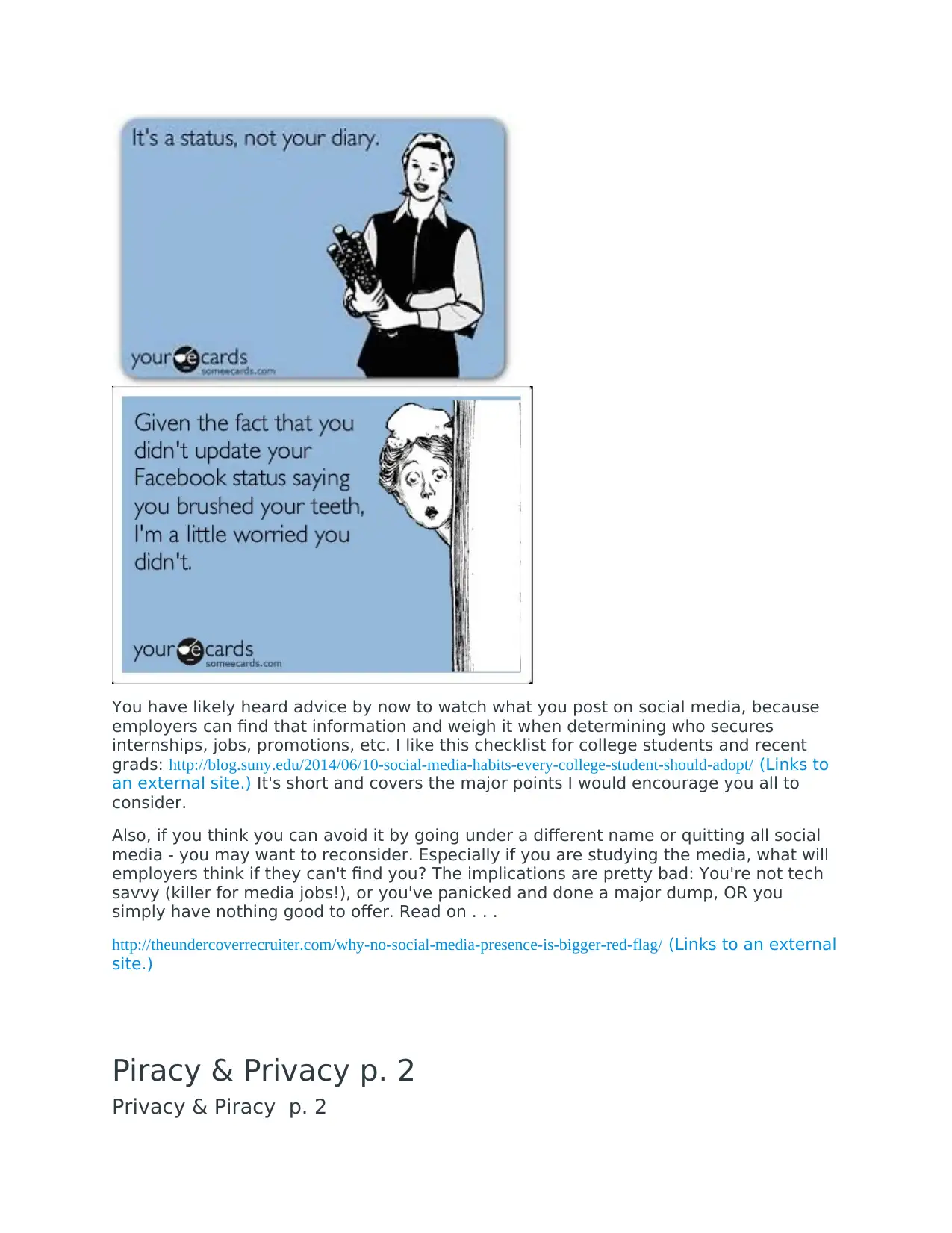
You have likely heard advice by now to watch what you post on social media, because
employers can find that information and weigh it when determining who secures
internships, jobs, promotions, etc. I like this checklist for college students and recent
grads: http://blog.suny.edu/2014/06/10-social-media-habits-every-college-student-should-adopt/ (Links to
an external site.) It's short and covers the major points I would encourage you all to
consider.
Also, if you think you can avoid it by going under a different name or quitting all social
media - you may want to reconsider. Especially if you are studying the media, what will
employers think if they can't find you? The implications are pretty bad: You're not tech
savvy (killer for media jobs!), or you've panicked and done a major dump, OR you
simply have nothing good to offer. Read on . . .
http://theundercoverrecruiter.com/why-no-social-media-presence-is-bigger-red-flag/ (Links to an external
site.)
Piracy & Privacy p. 2
Privacy & Piracy p. 2
employers can find that information and weigh it when determining who secures
internships, jobs, promotions, etc. I like this checklist for college students and recent
grads: http://blog.suny.edu/2014/06/10-social-media-habits-every-college-student-should-adopt/ (Links to
an external site.) It's short and covers the major points I would encourage you all to
consider.
Also, if you think you can avoid it by going under a different name or quitting all social
media - you may want to reconsider. Especially if you are studying the media, what will
employers think if they can't find you? The implications are pretty bad: You're not tech
savvy (killer for media jobs!), or you've panicked and done a major dump, OR you
simply have nothing good to offer. Read on . . .
http://theundercoverrecruiter.com/why-no-social-media-presence-is-bigger-red-flag/ (Links to an external
site.)
Piracy & Privacy p. 2
Privacy & Piracy p. 2
Paraphrase This Document
Need a fresh take? Get an instant paraphrase of this document with our AI Paraphraser
Invasions of Privacy
Private industries, other people, the media, and even the government can test the
boundaries of privacy in online environments. Why? Your text lays out three very
simple, very true reasons:
1. Digitization: Technological advances in digitized information and high speed
Internet means that it is much easier for all these entities to traffic in your personal
information.
2. Laws and regulations protect businesses who want to acquire your personal
information, not individuals who want to privatize their information.
3. Very low public awareness of the issues: Most consumers do not understand
when, and to what degree their privacy is compromised.
Next we'll review specific threats to individuals' privacy: Those which are commercial,
theft-related, or malicious in nature. While unwanted emails may seem like less of a
problem than identity theft, all of these invasions of our privacy continue to grow,
continue to overload our technology systems, and frustrate individuals to varying
degrees.
Commercial, Non-Criminal Threats to Your Privacy
There are many ways that businesses monitor your Internet activity and use that
information for profit. They do this by A.) Monitoring your activity and using it to their
own fiscal advantage, B.) Selling your information to other companies, or by C.)
Controlling what you see and where you go online by personalizing content and
manipulating search engines.
Monitoring
In perhaps the best argument for keeping some things private, your text states
"Everything you do online is recorded, put into all kinds of databases, and
distributed to all kinds of services." Programs that mine your browsing activity are
available. Cookies, small computer files hosted on your hard drive when you access
many websites, record what you do on specific sites. These can be helpful -- when
Brighthouse remembers my bank account information from month to month, it saves
me a little bit of typing.
But they are more helpful to the companies monitoring your information. Companies
can track what pages or items get the most views, or time spent looking. Companies
can use information about what you browsed, put into a shopping cart, or bought to
suggest new products to you. Companies can also compile information about your
browsing and compile various mailing lists with your information.
Some types of monitoring are much more aggressive than cookies. In addition to all of
the businesses hoping to profit from monitoring our Internet behavior, the U. S.
government and it's National Security Agency (the NSA) has a lot of legal room in terms
of surveillance (or spying, depending on your views) of non-citizens and citizens alike.
The after-effects of the Patriot Act are still widely held in place:
http://www.pbs.org/wgbh/pages/frontline/government-elections-politics/united-states-of-
secrets/with-or-without-the-patriot-act-heres-how-the-nsa-can-still-spy-on-americans/
Link (Links to an external site.)
Private industries, other people, the media, and even the government can test the
boundaries of privacy in online environments. Why? Your text lays out three very
simple, very true reasons:
1. Digitization: Technological advances in digitized information and high speed
Internet means that it is much easier for all these entities to traffic in your personal
information.
2. Laws and regulations protect businesses who want to acquire your personal
information, not individuals who want to privatize their information.
3. Very low public awareness of the issues: Most consumers do not understand
when, and to what degree their privacy is compromised.
Next we'll review specific threats to individuals' privacy: Those which are commercial,
theft-related, or malicious in nature. While unwanted emails may seem like less of a
problem than identity theft, all of these invasions of our privacy continue to grow,
continue to overload our technology systems, and frustrate individuals to varying
degrees.
Commercial, Non-Criminal Threats to Your Privacy
There are many ways that businesses monitor your Internet activity and use that
information for profit. They do this by A.) Monitoring your activity and using it to their
own fiscal advantage, B.) Selling your information to other companies, or by C.)
Controlling what you see and where you go online by personalizing content and
manipulating search engines.
Monitoring
In perhaps the best argument for keeping some things private, your text states
"Everything you do online is recorded, put into all kinds of databases, and
distributed to all kinds of services." Programs that mine your browsing activity are
available. Cookies, small computer files hosted on your hard drive when you access
many websites, record what you do on specific sites. These can be helpful -- when
Brighthouse remembers my bank account information from month to month, it saves
me a little bit of typing.
But they are more helpful to the companies monitoring your information. Companies
can track what pages or items get the most views, or time spent looking. Companies
can use information about what you browsed, put into a shopping cart, or bought to
suggest new products to you. Companies can also compile information about your
browsing and compile various mailing lists with your information.
Some types of monitoring are much more aggressive than cookies. In addition to all of
the businesses hoping to profit from monitoring our Internet behavior, the U. S.
government and it's National Security Agency (the NSA) has a lot of legal room in terms
of surveillance (or spying, depending on your views) of non-citizens and citizens alike.
The after-effects of the Patriot Act are still widely held in place:
http://www.pbs.org/wgbh/pages/frontline/government-elections-politics/united-states-of-
secrets/with-or-without-the-patriot-act-heres-how-the-nsa-can-still-spy-on-americans/
Link (Links to an external site.)
It's not just the U.S. government, either. Edward Snowden continues to be at the center
of a controversy about leaked documents that show the U.S. government's widespread
surveillance strategy, much of it concerning its own citizens. More recent developments
in the case have revealed video surveillance of the United Nations building and NSA
employees tracking information on previous, current, or hopeful romantic partners. In
the past, the government has also come under fire for tracking web users who request
information about drug-related information requests. These claims against countries
and hackers (dicussed next, get much more serious when it is "hacking," and not merely
surveillance).
Businesses and other entities must disclose what they have access to, as well as
property rights to consumers. This is what all the small print in user agreement policies
is: Disclosure on the part of the business entity of your rights and their rights in terms of
information and content creation. But you all probably know that well - from always
reading the small print and only agreeing with terms of service once you fully
understand it all ;)
These policies have taken a decidedly pro-business turn in recent years - when in
the past you may have been able to opt-out of policies that used your information or
creations for other purposes, consumer choice is at a seemingly all-time low.
If you don't like Google/ gmail's terms of service agreement, or Facebook's or
Instagram's - you have largely one viable option: Don't use them. There are constantly
news updates on changes in user agreements between email and social media
providers and their users - agreements, by the way, that businesses are at liberty to
change as they go along. I encourage you to look through one of these terms of service
agreements some time. They contain fascinating agreements you're signing up for,
likely without knowing. For instance, did you know that Facebook has ownership rights
to all of your photos and posts? There are some restrictions on what they can do with it
- but the idea of giving up creative control over your random thoughts and selfies is a
little jarring. Although it may help you see the perspective of professional media
creators who want copyright policy enforced to help curb piracy.
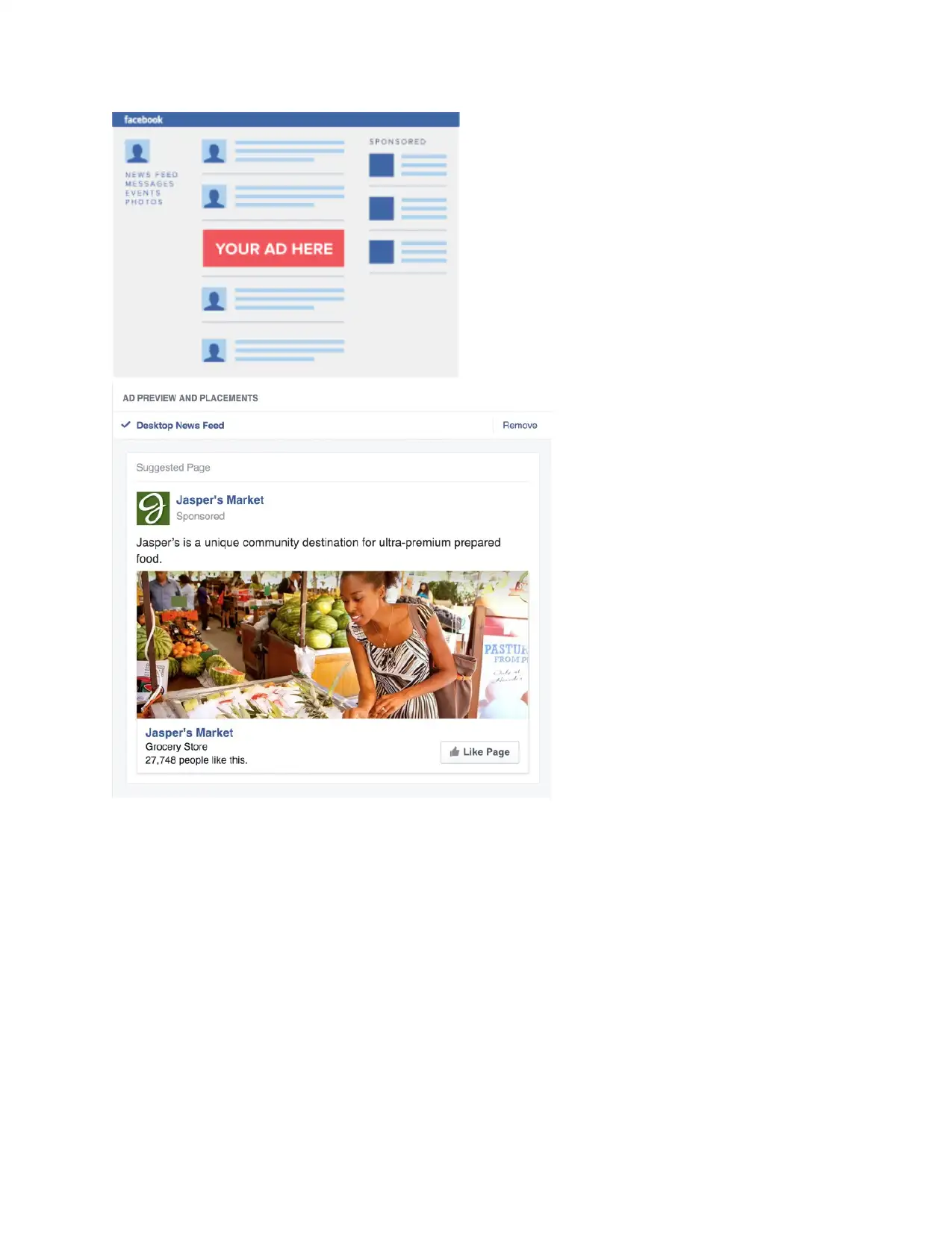
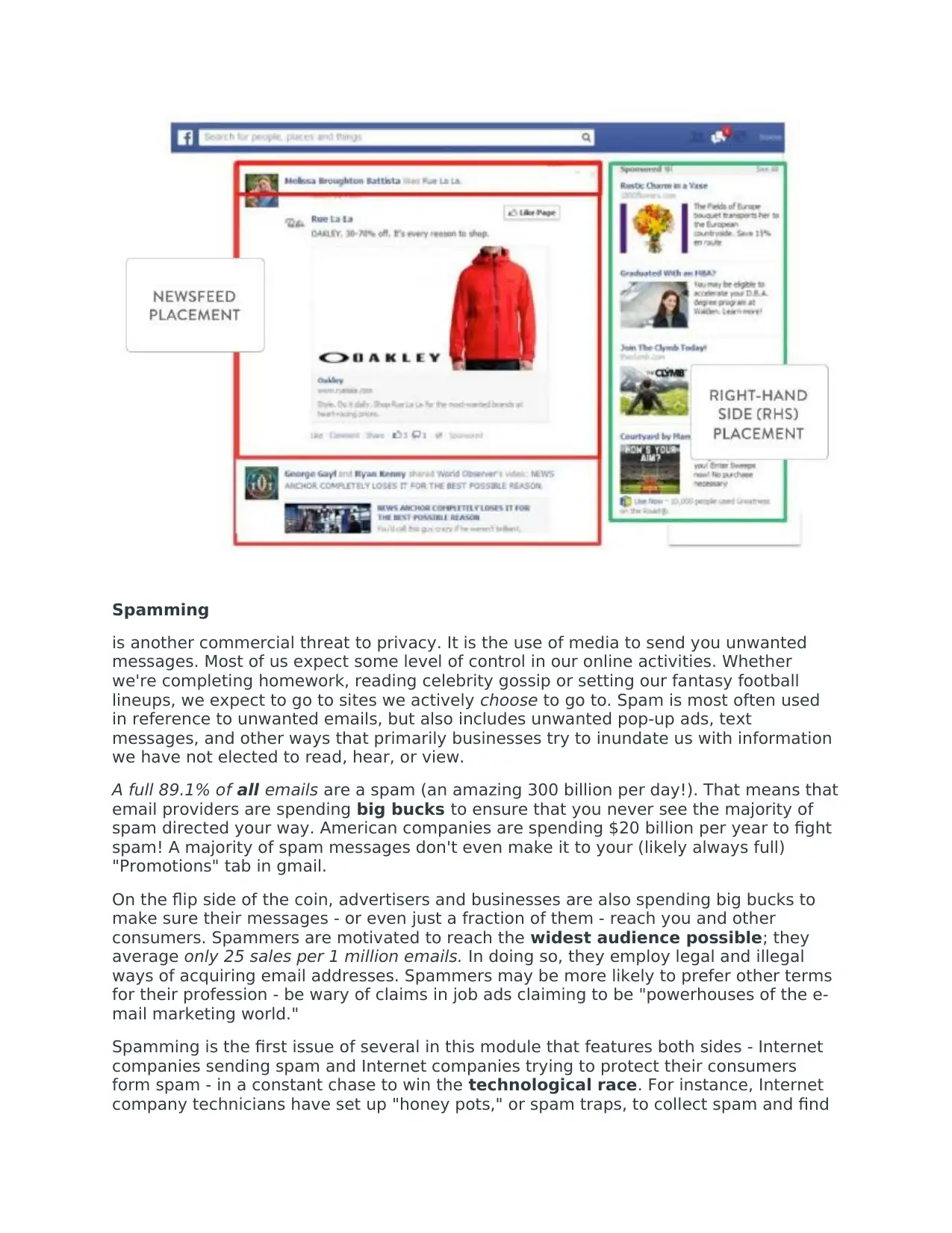
It should be clear that Facebook uses cookies and other tactics to tailor its advertising
to you. Have you ever been surprised to see very targeted ads after you did some
online shopping or browsing? Facebook has a lot of information to potential advertisers
(you can check it out here, if you're
interested: https://www.facebook.com/business/learn/facebook-ads-choose-audience (Links to an
external site.)) Currently, Madewell (a clothing company) keeps showing me a sweater
that I recently bought online - but in every other color that I didn't buy. Do you find
these targeted ads helpful? Annoying? Invasive? Or, do you not care or notice much?
of a controversy about leaked documents that show the U.S. government's widespread
surveillance strategy, much of it concerning its own citizens. More recent developments
in the case have revealed video surveillance of the United Nations building and NSA
employees tracking information on previous, current, or hopeful romantic partners. In
the past, the government has also come under fire for tracking web users who request
information about drug-related information requests. These claims against countries
and hackers (dicussed next, get much more serious when it is "hacking," and not merely
surveillance).
Businesses and other entities must disclose what they have access to, as well as
property rights to consumers. This is what all the small print in user agreement policies
is: Disclosure on the part of the business entity of your rights and their rights in terms of
information and content creation. But you all probably know that well - from always
reading the small print and only agreeing with terms of service once you fully
understand it all ;)
These policies have taken a decidedly pro-business turn in recent years - when in
the past you may have been able to opt-out of policies that used your information or
creations for other purposes, consumer choice is at a seemingly all-time low.
If you don't like Google/ gmail's terms of service agreement, or Facebook's or
Instagram's - you have largely one viable option: Don't use them. There are constantly
news updates on changes in user agreements between email and social media
providers and their users - agreements, by the way, that businesses are at liberty to
change as they go along. I encourage you to look through one of these terms of service
agreements some time. They contain fascinating agreements you're signing up for,
likely without knowing. For instance, did you know that Facebook has ownership rights
to all of your photos and posts? There are some restrictions on what they can do with it
- but the idea of giving up creative control over your random thoughts and selfies is a
little jarring. Although it may help you see the perspective of professional media
creators who want copyright policy enforced to help curb piracy.
It should be clear that Facebook uses cookies and other tactics to tailor its advertising
to you. Have you ever been surprised to see very targeted ads after you did some
online shopping or browsing? Facebook has a lot of information to potential advertisers
(you can check it out here, if you're
interested: https://www.facebook.com/business/learn/facebook-ads-choose-audience (Links to an
external site.)) Currently, Madewell (a clothing company) keeps showing me a sweater
that I recently bought online - but in every other color that I didn't buy. Do you find
these targeted ads helpful? Annoying? Invasive? Or, do you not care or notice much?
⊘ This is a preview!⊘
Do you want full access?
Subscribe today to unlock all pages.
Trusted by 1+ million students worldwide
Paraphrase This Document
Need a fresh take? Get an instant paraphrase of this document with our AI Paraphraser
Spamming
is another commercial threat to privacy. It is the use of media to send you unwanted
messages. Most of us expect some level of control in our online activities. Whether
we're completing homework, reading celebrity gossip or setting our fantasy football
lineups, we expect to go to sites we actively choose to go to. Spam is most often used
in reference to unwanted emails, but also includes unwanted pop-up ads, text
messages, and other ways that primarily businesses try to inundate us with information
we have not elected to read, hear, or view.
A full 89.1% of all emails are a spam (an amazing 300 billion per day!). That means that
email providers are spending big bucks to ensure that you never see the majority of
spam directed your way. American companies are spending $20 billion per year to fight
spam! A majority of spam messages don't even make it to your (likely always full)
"Promotions" tab in gmail.
On the flip side of the coin, advertisers and businesses are also spending big bucks to
make sure their messages - or even just a fraction of them - reach you and other
consumers. Spammers are motivated to reach the widest audience possible; they
average only 25 sales per 1 million emails. In doing so, they employ legal and illegal
ways of acquiring email addresses. Spammers may be more likely to prefer other terms
for their profession - be wary of claims in job ads claiming to be "powerhouses of the e-
mail marketing world."
Spamming is the first issue of several in this module that features both sides - Internet
companies sending spam and Internet companies trying to protect their consumers
form spam - in a constant chase to win the technological race. For instance, Internet
company technicians have set up "honey pots," or spam traps, to collect spam and find
is another commercial threat to privacy. It is the use of media to send you unwanted
messages. Most of us expect some level of control in our online activities. Whether
we're completing homework, reading celebrity gossip or setting our fantasy football
lineups, we expect to go to sites we actively choose to go to. Spam is most often used
in reference to unwanted emails, but also includes unwanted pop-up ads, text
messages, and other ways that primarily businesses try to inundate us with information
we have not elected to read, hear, or view.
A full 89.1% of all emails are a spam (an amazing 300 billion per day!). That means that
email providers are spending big bucks to ensure that you never see the majority of
spam directed your way. American companies are spending $20 billion per year to fight
spam! A majority of spam messages don't even make it to your (likely always full)
"Promotions" tab in gmail.
On the flip side of the coin, advertisers and businesses are also spending big bucks to
make sure their messages - or even just a fraction of them - reach you and other
consumers. Spammers are motivated to reach the widest audience possible; they
average only 25 sales per 1 million emails. In doing so, they employ legal and illegal
ways of acquiring email addresses. Spammers may be more likely to prefer other terms
for their profession - be wary of claims in job ads claiming to be "powerhouses of the e-
mail marketing world."
Spamming is the first issue of several in this module that features both sides - Internet
companies sending spam and Internet companies trying to protect their consumers
form spam - in a constant chase to win the technological race. For instance, Internet
company technicians have set up "honey pots," or spam traps, to collect spam and find
out what spammers are doing to get their messages through to consumers so that they
can develop anti-span software. Spammers, in turn, buy the anti-spam software and
devise ways to get around it. As you can see, the cycle perpetuates over time.
Make sure to review the details concerning Selling Information
and Controlling what you see online as detailed in text (pp. 474-476).
Piracy & Privacy p. 3
Piracy, Privacy, & Online Deception p. 3
Criminal Invasions of Your Privacy
A second way in which several invasions of privacy differ is that they are done with the
knowledge that you will incur consequences based on their actions. There's ill will, or
people generally being jerks on the part of those intruding on your privacy in both
Theft of private information, Identity Theft, Hijacking, Breaching Secure
Databases, Destroying Information, and Haktivism
Theft of Personal information
can take several forms, but all are illegal.
Spyware are small programs that remember keystrokes and entered information,
similar to cookies downloaded on your computer - but without your knowledge, harder
to detect, and its monitoring capabilities are not limited to the website from which the
program was downloaded. Both phishing and hijacking are mentioned in the textbook
as other forms of theft of private information. What do these types of theft entail?
Identity theft is perhaps the most recognizable among these types of theft that
constitute an invasion of our privacy. Identity theft victims spend, on average, 600
hours recovering from this crime, and $1,400 in out-of-pocket expenses trying to fix the
situation. Identity thieves often need nothing more than your name, birth date, and
social security number to rack up thousands in credit card purchases in your name. This
is obviously a severe invasion of privacy.
Hijacking is when your computer is hijacked and used by hackers without your
permission and often without your knowledge. Hijackers use botnets to allow spammers
to send out messages under your IP address.Another form of hijacking, which is done by
advertisers, is to take over your homepage with a browser or to implant a search engine
in your computer.
Check out the timeline in text about a series of Breaches of Secure
Databases. Keeping databases secure is becoming more difficult because of the
“cloud," whihc is really a large network of computers and storage devices for
information.
Lastly, and one of a lot of current relevance is the idea of Hacktivism. Hactivism is the
use of hackers’ techniques to break into organizations’ secure databases for the
purposes of either damaging those databases or using the information to publically
embarrass the organization. Foreign governments are engaging in cybercrime against
US businesses, individuals, and even the US government agencies. For instance, the
North Korean government hacked Sony’s database after the film company promoted the
can develop anti-span software. Spammers, in turn, buy the anti-spam software and
devise ways to get around it. As you can see, the cycle perpetuates over time.
Make sure to review the details concerning Selling Information
and Controlling what you see online as detailed in text (pp. 474-476).
Piracy & Privacy p. 3
Piracy, Privacy, & Online Deception p. 3
Criminal Invasions of Your Privacy
A second way in which several invasions of privacy differ is that they are done with the
knowledge that you will incur consequences based on their actions. There's ill will, or
people generally being jerks on the part of those intruding on your privacy in both
Theft of private information, Identity Theft, Hijacking, Breaching Secure
Databases, Destroying Information, and Haktivism
Theft of Personal information
can take several forms, but all are illegal.
Spyware are small programs that remember keystrokes and entered information,
similar to cookies downloaded on your computer - but without your knowledge, harder
to detect, and its monitoring capabilities are not limited to the website from which the
program was downloaded. Both phishing and hijacking are mentioned in the textbook
as other forms of theft of private information. What do these types of theft entail?
Identity theft is perhaps the most recognizable among these types of theft that
constitute an invasion of our privacy. Identity theft victims spend, on average, 600
hours recovering from this crime, and $1,400 in out-of-pocket expenses trying to fix the
situation. Identity thieves often need nothing more than your name, birth date, and
social security number to rack up thousands in credit card purchases in your name. This
is obviously a severe invasion of privacy.
Hijacking is when your computer is hijacked and used by hackers without your
permission and often without your knowledge. Hijackers use botnets to allow spammers
to send out messages under your IP address.Another form of hijacking, which is done by
advertisers, is to take over your homepage with a browser or to implant a search engine
in your computer.
Check out the timeline in text about a series of Breaches of Secure
Databases. Keeping databases secure is becoming more difficult because of the
“cloud," whihc is really a large network of computers and storage devices for
information.
Lastly, and one of a lot of current relevance is the idea of Hacktivism. Hactivism is the
use of hackers’ techniques to break into organizations’ secure databases for the
purposes of either damaging those databases or using the information to publically
embarrass the organization. Foreign governments are engaging in cybercrime against
US businesses, individuals, and even the US government agencies. For instance, the
North Korean government hacked Sony’s database after the film company promoted the
⊘ This is a preview!⊘
Do you want full access?
Subscribe today to unlock all pages.
Trusted by 1+ million students worldwide
movie The Interview. The U.S. government, press, and other entities are still
investigating the role of hacktivism in the scope of "fake news" perpetuated during the
last U.S. election cycle.
Maliciousness
refers to attacks on businesses or individuals done not for financial benefit, but purely
for the sake of trying to harm the business or individual. A major way that this type of
invasion of privacy happens online is by infecting computers/ systems with
viruses. Computer viruses are hidden elements of code that are extremely contagious,
i.e. you open one file with the virus written into its code and your computer is infected -
and extremely destructive. Over 50% of companies report virus attacks in the U.S.
Spreading computer viruses is one more example of the government or businesses
trying to keep up with technological advances, but those doing the illegal activity
typically manage to stay one step ahead.
A second form of maliciousness is trolling.
Trolling often becomes a problem on blogs and other sites that allow comments (trolling
has been defined as "posting of willfully inflammatory, off-topic or simply stupid
remarks"). It is important to note that this type of behavior - which can be found on
everything from game forums, to Kickstarter projects, to political blogs, to news sites,
and more - is a by-product of the anonymity that the Internet affords. When all
commenters have to do is make an account name and sign in, there is no
accountability for a person's actions on the website. One way of getting around this is
forcing people to use their real names or Facebook accounts to sign in and comment.
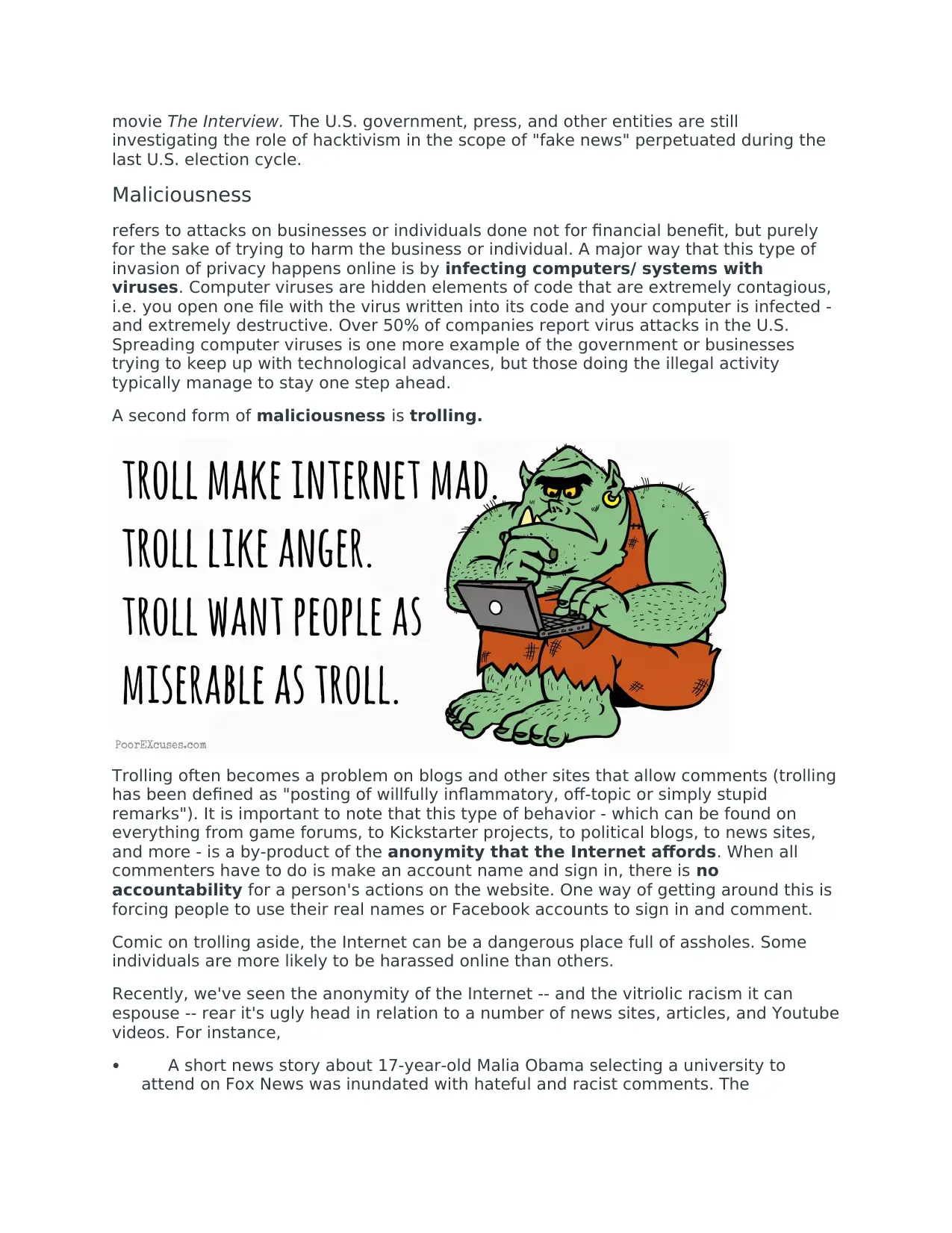
Comic on trolling aside, the Internet can be a dangerous place full of assholes. Some
individuals are more likely to be harassed online than others.
Recently, we've seen the anonymity of the Internet -- and the vitriolic racism it can
espouse -- rear it's ugly head in relation to a number of news sites, articles, and Youtube
videos. For instance,
A short news story about 17-year-old Malia Obama selecting a university to
attend on Fox News was inundated with hateful and racist comments. The
investigating the role of hacktivism in the scope of "fake news" perpetuated during the
last U.S. election cycle.
Maliciousness
refers to attacks on businesses or individuals done not for financial benefit, but purely
for the sake of trying to harm the business or individual. A major way that this type of
invasion of privacy happens online is by infecting computers/ systems with
viruses. Computer viruses are hidden elements of code that are extremely contagious,
i.e. you open one file with the virus written into its code and your computer is infected -
and extremely destructive. Over 50% of companies report virus attacks in the U.S.
Spreading computer viruses is one more example of the government or businesses
trying to keep up with technological advances, but those doing the illegal activity
typically manage to stay one step ahead.
A second form of maliciousness is trolling.
Trolling often becomes a problem on blogs and other sites that allow comments (trolling
has been defined as "posting of willfully inflammatory, off-topic or simply stupid
remarks"). It is important to note that this type of behavior - which can be found on
everything from game forums, to Kickstarter projects, to political blogs, to news sites,
and more - is a by-product of the anonymity that the Internet affords. When all
commenters have to do is make an account name and sign in, there is no
accountability for a person's actions on the website. One way of getting around this is
forcing people to use their real names or Facebook accounts to sign in and comment.
Comic on trolling aside, the Internet can be a dangerous place full of assholes. Some
individuals are more likely to be harassed online than others.
Recently, we've seen the anonymity of the Internet -- and the vitriolic racism it can
espouse -- rear it's ugly head in relation to a number of news sites, articles, and Youtube
videos. For instance,
A short news story about 17-year-old Malia Obama selecting a university to
attend on Fox News was inundated with hateful and racist comments. The
Paraphrase This Document
Need a fresh take? Get an instant paraphrase of this document with our AI Paraphraser
comments section was removed and closed: http://reverbpress.com/politics/vile-racism-forces-
fox-news-to-close-comments-on-malia-obama-article/ (Links to an external site.)
(Links to an external site.)npr did away with all comments sections this past
August in an effort to curb non-representative commentors who too often envoked
hate and bickered off-topic: http://www.npr.org/sections/ombudsman/2016/08/17/489516952/npr-
website-to-get-rid-of-comments (Links to an external site.)
A long list of news sites have followed suit: http://www.niemanlab.org/2015/09/what-
happened-after-7-news-sites-got-rid-of-reader-comments/ (Links to an external site.)
(Links to an external site.)
Giving up Privacy Online
Please make sure to review your text on ways to protect your privacy online. And
please check your basic security settings on social media - is there anything worse
than being a perfect job candidate right up until the point a potential employer googles
your name and gets the wrong/ a bad impression of you? The Strategies to protect
yourself from invasions of privacy that begin on p. 480 are important to review for
examing your online presence!
Why disclose online at all?
First, there are tradeoffs to disclosing some information online: Individuals get
something out of it. What do you think it is? Please read this short Q&A with the
engineers behind the Netflix algorithms that are responsible for creating specialized
recommendations for individuals.
http://www.wired.com/underwire/2013/08/qq_netflix-algorithm/ (Links to an external site.) (I find
this article fascinating!)
What percent of Netflix streaming viewing is based on recommendations? Why is
(viewing) behavior a better indicator of interest in other content than rating behavior?
The tradeoff of disclosing online -- in browsing and viewing behavior, as well as in what
you buy, what sites you go to, and what personal information you put out there --
is personalization. We get custom shopping experiences (Ex. Amazon's "People who
bought X also bought . . . ."), customized banking and bill pay (Thank goodness my
personal computer can remember my checking account information), customized social
media experiences (Ex. Twitter's "Do you now X and X on twitter . . . Facebook "Find
Friends app - in addition to customized Facebook News Feeds which feature people and
types of content that we're more likely to enjoy, based on previous clicking activity).
While I didn't buy that Madewell sweater in a different color, they did advertise some
sunglasses recently that I ordered last week. This isn't uncommon.
We even get customized google search results, based on previous browsing history,
where we're browsing from, and what sites we regularly visit. For instance, google
knows that I often search for recipes. It also knows that I'm more likely to visit
epicurious.com or the Food Network Channel, or to access recipes with one of those two
apps on my tablet. This means that when I type in "zucchini recipes," my top results will
more likely be from those sites I normally visit, and not the horribly-designed
cooks.com.
This Google filtering may give us a more customized search experience, but what is the
danger of only seeing results presented to you because they are similar to your
fox-news-to-close-comments-on-malia-obama-article/ (Links to an external site.)
(Links to an external site.)npr did away with all comments sections this past
August in an effort to curb non-representative commentors who too often envoked
hate and bickered off-topic: http://www.npr.org/sections/ombudsman/2016/08/17/489516952/npr-
website-to-get-rid-of-comments (Links to an external site.)
A long list of news sites have followed suit: http://www.niemanlab.org/2015/09/what-
happened-after-7-news-sites-got-rid-of-reader-comments/ (Links to an external site.)
(Links to an external site.)
Giving up Privacy Online
Please make sure to review your text on ways to protect your privacy online. And
please check your basic security settings on social media - is there anything worse
than being a perfect job candidate right up until the point a potential employer googles
your name and gets the wrong/ a bad impression of you? The Strategies to protect
yourself from invasions of privacy that begin on p. 480 are important to review for
examing your online presence!
Why disclose online at all?
First, there are tradeoffs to disclosing some information online: Individuals get
something out of it. What do you think it is? Please read this short Q&A with the
engineers behind the Netflix algorithms that are responsible for creating specialized
recommendations for individuals.
http://www.wired.com/underwire/2013/08/qq_netflix-algorithm/ (Links to an external site.) (I find
this article fascinating!)
What percent of Netflix streaming viewing is based on recommendations? Why is
(viewing) behavior a better indicator of interest in other content than rating behavior?
The tradeoff of disclosing online -- in browsing and viewing behavior, as well as in what
you buy, what sites you go to, and what personal information you put out there --
is personalization. We get custom shopping experiences (Ex. Amazon's "People who
bought X also bought . . . ."), customized banking and bill pay (Thank goodness my
personal computer can remember my checking account information), customized social
media experiences (Ex. Twitter's "Do you now X and X on twitter . . . Facebook "Find
Friends app - in addition to customized Facebook News Feeds which feature people and
types of content that we're more likely to enjoy, based on previous clicking activity).
While I didn't buy that Madewell sweater in a different color, they did advertise some
sunglasses recently that I ordered last week. This isn't uncommon.
We even get customized google search results, based on previous browsing history,
where we're browsing from, and what sites we regularly visit. For instance, google
knows that I often search for recipes. It also knows that I'm more likely to visit
epicurious.com or the Food Network Channel, or to access recipes with one of those two
apps on my tablet. This means that when I type in "zucchini recipes," my top results will
more likely be from those sites I normally visit, and not the horribly-designed
cooks.com.
This Google filtering may give us a more customized search experience, but what is the
danger of only seeing results presented to you because they are similar to your
past viewing behavior? Facebook has actually been criticized for tailoring individuals'
news feeds toward the political slant that they've determined you favor. During the
2012 election, if you "liked" Mitt Romney or Barack Obama, and if you shared articles
that leaned one way or another, Facebook made calculations and presented you with
more updates from your friends that meshed with your political views than posts by
friends that did not mesh with your views. Is that really doing us a favor, or is it
unnecessarily narrowing the range of content we're exposed to?
So, now that we've gone over changes in personal privacy that new media affords, let's
take a look at how the privacy, or rights of content-creators (i.e. TV producers,
Musicians, etc.) can also be violated online (namely, by people like you: audiences,
instead of businesses and the government)
Piracy & Privacy p. 4
Media Piracy Issues and Definitions
Again, we see that technology and the economic model employed in media
industries are key issues in pirating content. Piracy and privacy are both about
perspective and where you draw lines. Your personal information is deemed private by
you (and the government to some degree). If you create content, that content can be
copyrighted and therefore not treated as a public commodity or good. As individuals, we
get to draw lines about privacy. As content creators, we also do, however, these are
more formalized (like copyright, patented information, etc.) When you break the legal
standard of privacy of creators of content, that's pirating.
Piracy is defined simply as unauthorized use of things owned by other people. It
violates copyright.
Pirating content in the digital age is much different than before our media was so easily
stored and transferred between devices and platforms. Namely, it is much easier.
There certainly is some sentiment that pirating content is just not that big of a deal.
Check out this Onion spoof about pirating content:
news feeds toward the political slant that they've determined you favor. During the
2012 election, if you "liked" Mitt Romney or Barack Obama, and if you shared articles
that leaned one way or another, Facebook made calculations and presented you with
more updates from your friends that meshed with your political views than posts by
friends that did not mesh with your views. Is that really doing us a favor, or is it
unnecessarily narrowing the range of content we're exposed to?
So, now that we've gone over changes in personal privacy that new media affords, let's
take a look at how the privacy, or rights of content-creators (i.e. TV producers,
Musicians, etc.) can also be violated online (namely, by people like you: audiences,
instead of businesses and the government)
Piracy & Privacy p. 4
Media Piracy Issues and Definitions
Again, we see that technology and the economic model employed in media
industries are key issues in pirating content. Piracy and privacy are both about
perspective and where you draw lines. Your personal information is deemed private by
you (and the government to some degree). If you create content, that content can be
copyrighted and therefore not treated as a public commodity or good. As individuals, we
get to draw lines about privacy. As content creators, we also do, however, these are
more formalized (like copyright, patented information, etc.) When you break the legal
standard of privacy of creators of content, that's pirating.
Piracy is defined simply as unauthorized use of things owned by other people. It
violates copyright.
Pirating content in the digital age is much different than before our media was so easily
stored and transferred between devices and platforms. Namely, it is much easier.
There certainly is some sentiment that pirating content is just not that big of a deal.
Check out this Onion spoof about pirating content:
⊘ This is a preview!⊘
Do you want full access?
Subscribe today to unlock all pages.
Trusted by 1+ million students worldwide

1 out of 15


Related Documents


Your All-in-One AI-Powered Toolkit for Academic Success.
+13062052269
info@desklib.com
Available 24*7 on WhatsApp / Email
![[object Object]](/_next/static/media/star-bottom.7253800d.svg)
Unlock your academic potential
Copyright © 2020–2026 A2Z Services. All Rights Reserved. Developed and managed by ZUCOL.