Report on Australia's Online Safety Bill 2021: Key Features and Impact
VerifiedAdded on 2023/06/15
|9
|2160
|410
Report
AI Summary
This report provides a detailed analysis of the Online Safety Bill 2021 in Australia, focusing on its implications for online users and service providers. It examines the bill's measures to address cybercrime, cyber abuse, and cyberbullying, while also enhancing the powers of the e-Safety Commissioner. The report further explores the bill's engagement with human rights, particularly the right to freedom of expression and the protection of vulnerable groups. Additionally, it discusses the bill's impact on transnational corporations, highlighting concerns related to content removal and compliance. The analysis concludes that the Online Safety Bill 2021 serves as a safeguard against online abuse, promoting a safer online environment and protecting individuals' rights, while also imposing obligations on companies to ensure online safety.
Online Safety Bill
2021- Australia
2021- Australia

Paraphrase This Document
Need a fresh take? Get an instant paraphrase of this document with our AI Paraphraser
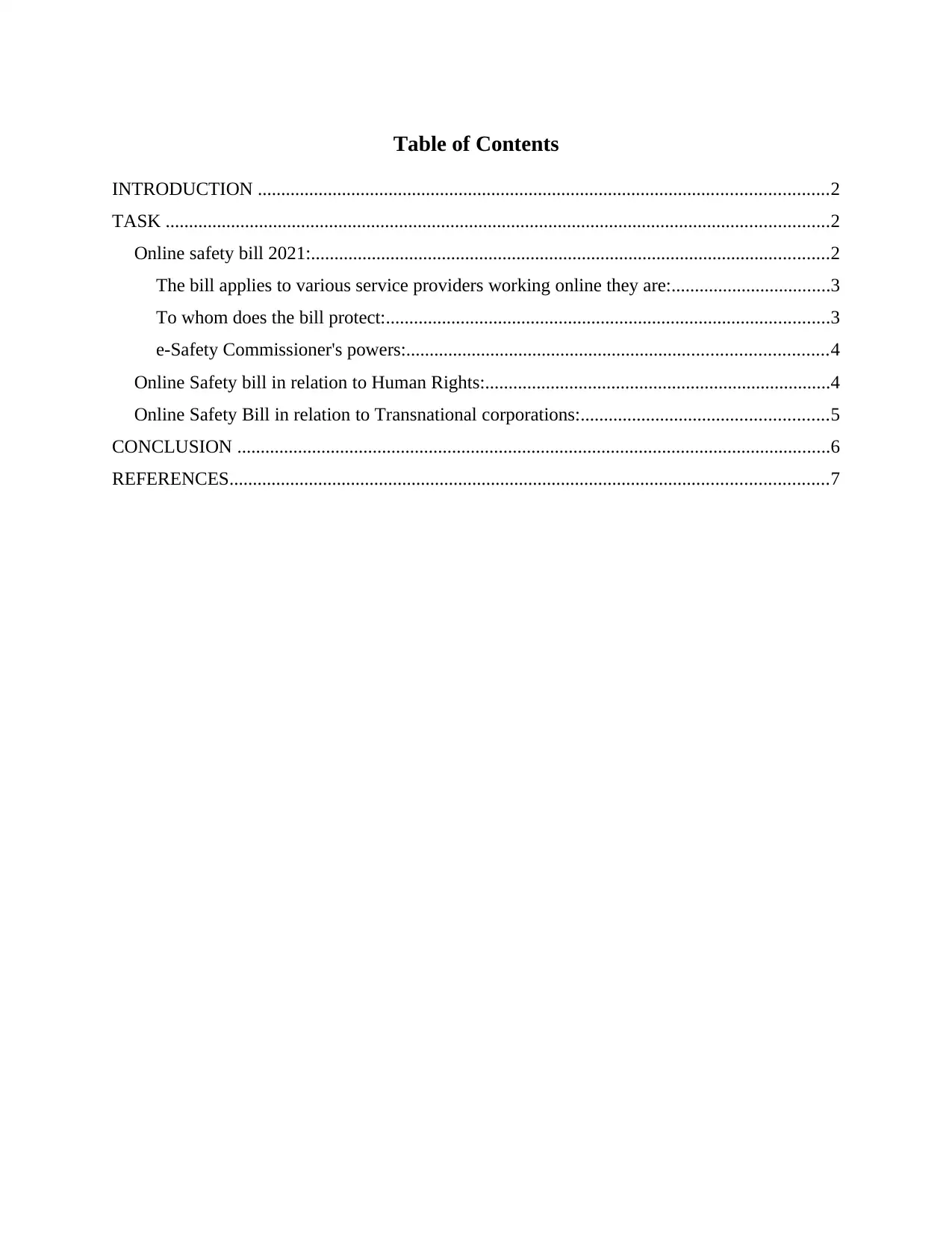
Table of Contents
INTRODUCTION ..........................................................................................................................2
TASK ..............................................................................................................................................2
Online safety bill 2021:...............................................................................................................2
The bill applies to various service providers working online they are:..................................3
To whom does the bill protect:...............................................................................................3
e-Safety Commissioner's powers:..........................................................................................4
Online Safety bill in relation to Human Rights:..........................................................................4
Online Safety Bill in relation to Transnational corporations:.....................................................5
CONCLUSION ...............................................................................................................................6
REFERENCES................................................................................................................................7
INTRODUCTION ..........................................................................................................................2
TASK ..............................................................................................................................................2
Online safety bill 2021:...............................................................................................................2
The bill applies to various service providers working online they are:..................................3
To whom does the bill protect:...............................................................................................3
e-Safety Commissioner's powers:..........................................................................................4
Online Safety bill in relation to Human Rights:..........................................................................4
Online Safety Bill in relation to Transnational corporations:.....................................................5
CONCLUSION ...............................................................................................................................6
REFERENCES................................................................................................................................7
INTRODUCTION
Each day in all the aspects of people and their lives there are thousands of interactions
which take place online. The online services provided are used for various purposes which
includes work, social media, web entertainment, education through educational platforms,
financial activities such as internet banking, etc. With the inclusion of the online medium in
almost all the works carried out each day, it becomes very essential to regulate the online
platform. Because it can harm a person in various ways and destruct their lives altogether. The
online safety bill of 2021 was introduced by the government of Australia to regulate the cyber
space and provide online safety to the people accessing the internet. This bill tries to unify and
strengthen different online safety laws and provide a legislation which is more regulatory in
nature(Davis, 2021). It expands the legislative framework of Australia in guiding online safety.
The following project will cover in detail about the Online Safety Bill, its features and aspects
and its reference with human rights and transnational corporations.
Each day in all the aspects of people and their lives there are thousands of interactions
which take place online. The online services provided are used for various purposes which
includes work, social media, web entertainment, education through educational platforms,
financial activities such as internet banking, etc. With the inclusion of the online medium in
almost all the works carried out each day, it becomes very essential to regulate the online
platform. Because it can harm a person in various ways and destruct their lives altogether. The
online safety bill of 2021 was introduced by the government of Australia to regulate the cyber
space and provide online safety to the people accessing the internet. This bill tries to unify and
strengthen different online safety laws and provide a legislation which is more regulatory in
nature(Davis, 2021). It expands the legislative framework of Australia in guiding online safety.
The following project will cover in detail about the Online Safety Bill, its features and aspects
and its reference with human rights and transnational corporations.
⊘ This is a preview!⊘
Do you want full access?
Subscribe today to unlock all pages.

Trusted by 1+ million students worldwide
TASK
Online safety bill 2021:
This bill has various implications and effects on the online users and service providers. It
tries to provide measures which are more transparent and which lead to accountability of online
industry while also enhancing powers of the commissioner of eSafety. This bill looks after the
issues of cybercrime, cyber trolls, cyber abuse and cyber bullying and thus provides a strict
mechanism against them. Under its legislation and regulation it tries to bring search engines and
app stores. Digital platforms and tech firms are guided towards implementation of standards and
protocols relating to safety. The bill mainly addresses the online harms faced by Australians and
also tries to block and regulate extremely sensitive content online (Dwyer, Wilding and Koskie,
2021).
The bill applies to various service providers working online they are:
Service providers of social media- They try to encourage social interactions online by
providing various social media apps like Facebook, Snapchat, Instagram that lead to
interaction between the end users (Flew, 2021) .
Service providers in electronics- These service providers encourage communication
between the people by various platforms like Whatsapp, Gmail service which maintain
interactions among the end users.
Service providers of Internet- These allow the users and the public to access the internet
for various materials and information by using search engines and internet carriage
service like Google.
App distributors- There are various service providers of apps who distribute them among
the users for their work by allowing them to download apps like Apple store, Google play
store.
Service providers of host- These providers enable users to access host material by storing
it on media like Amazon.
To whom does the bill protect:
It specifically protects online harms which includes-
Material relating to cyber bullying against the children of Australia
Online safety bill 2021:
This bill has various implications and effects on the online users and service providers. It
tries to provide measures which are more transparent and which lead to accountability of online
industry while also enhancing powers of the commissioner of eSafety. This bill looks after the
issues of cybercrime, cyber trolls, cyber abuse and cyber bullying and thus provides a strict
mechanism against them. Under its legislation and regulation it tries to bring search engines and
app stores. Digital platforms and tech firms are guided towards implementation of standards and
protocols relating to safety. The bill mainly addresses the online harms faced by Australians and
also tries to block and regulate extremely sensitive content online (Dwyer, Wilding and Koskie,
2021).
The bill applies to various service providers working online they are:
Service providers of social media- They try to encourage social interactions online by
providing various social media apps like Facebook, Snapchat, Instagram that lead to
interaction between the end users (Flew, 2021) .
Service providers in electronics- These service providers encourage communication
between the people by various platforms like Whatsapp, Gmail service which maintain
interactions among the end users.
Service providers of Internet- These allow the users and the public to access the internet
for various materials and information by using search engines and internet carriage
service like Google.
App distributors- There are various service providers of apps who distribute them among
the users for their work by allowing them to download apps like Apple store, Google play
store.
Service providers of host- These providers enable users to access host material by storing
it on media like Amazon.
To whom does the bill protect:
It specifically protects online harms which includes-
Material relating to cyber bullying against the children of Australia
Paraphrase This Document
Need a fresh take? Get an instant paraphrase of this document with our AI Paraphraser
Cyber abuse material against the children of Australia
Intimate images and their sharing
Depiction of violent content which shows violent conduct
e-Safety Commissioner's powers:
Obtaining information and identifying individuals with the help of service providers
online who provide information about people who use anonymous accounts to troll,
abuse and bully other people(Harris, Dragiewicz and Woodlock, 2021).
They are also given powers of removal and blockage of accounts online after giving
notices to the service providers about the same.
They can issue summons or notice for investigation to individuals to provide documents.
Online Safety bill in relation to Human Rights:
The bill engages with various Human Rights in Australia primarily with the Art 19 which
comprises Right to Freedom of Expression and the rights relating to child and persons with
Disabilities.
The bill basically protects the Right to privacy by restricting and stopping the
interference in it (Howie, 2018). It also tries to protect the people and their reputation by
prohibiting attacks on it. It is in line with the Universal Declaration of Human Rights document
which also works towards human right protection.
Right to freedom of speech and expression- This right is provided with certain restrictions
because people can exercise it only by not infringing in other's rights. It lays down that the
intimate pictures cannot be shared in a non-consensual way. It applies basically to people who
reside in Australia. It describes and lays down provisions relating to material of cyber abuse and
their removal, it restricts social media bullying of others by removing any of the services which
relate to this online. The commissioner is given the power of issuance of directions based on
remedies in these matters (Hrick, 2021) . It also provides ISPs with the power to take steps in the
direction of disabling any access to the types of material which depict, incite or lead to
promotion of violent content for a short period of time. These restrictions work towards the
protection of rights of others while using anything online.
The people who are more vulnerable to online abuse and harm are Children, teenage girls, Gay,
Lesbian, Bisexual, Transgender and person with disabilities. They face bullying and abuse on a
Intimate images and their sharing
Depiction of violent content which shows violent conduct
e-Safety Commissioner's powers:
Obtaining information and identifying individuals with the help of service providers
online who provide information about people who use anonymous accounts to troll,
abuse and bully other people(Harris, Dragiewicz and Woodlock, 2021).
They are also given powers of removal and blockage of accounts online after giving
notices to the service providers about the same.
They can issue summons or notice for investigation to individuals to provide documents.
Online Safety bill in relation to Human Rights:
The bill engages with various Human Rights in Australia primarily with the Art 19 which
comprises Right to Freedom of Expression and the rights relating to child and persons with
Disabilities.
The bill basically protects the Right to privacy by restricting and stopping the
interference in it (Howie, 2018). It also tries to protect the people and their reputation by
prohibiting attacks on it. It is in line with the Universal Declaration of Human Rights document
which also works towards human right protection.
Right to freedom of speech and expression- This right is provided with certain restrictions
because people can exercise it only by not infringing in other's rights. It lays down that the
intimate pictures cannot be shared in a non-consensual way. It applies basically to people who
reside in Australia. It describes and lays down provisions relating to material of cyber abuse and
their removal, it restricts social media bullying of others by removing any of the services which
relate to this online. The commissioner is given the power of issuance of directions based on
remedies in these matters (Hrick, 2021) . It also provides ISPs with the power to take steps in the
direction of disabling any access to the types of material which depict, incite or lead to
promotion of violent content for a short period of time. These restrictions work towards the
protection of rights of others while using anything online.
The people who are more vulnerable to online abuse and harm are Children, teenage girls, Gay,
Lesbian, Bisexual, Transgender and person with disabilities. They face bullying and abuse on a
daily basis thereby violating their rights of living with dignity. Recent cases in Australia depict
the same.
This freedom which is provided relating to speech and expression, it can cause severe
harm if not restricted i.e. if this right had been absolute it would violate the basic human rights of
all which would lead to harm on a large scale. To balance this part, these rights are given with
prohibitions where others are stopped from interfering in right to privacy of others and respecting
their reputations. This right of expression on online platform recognises the long lasting harms of
going against human rights(Milosevic, 2018). Thus, this bill will act as guidance to follow when
human rights are not protected online and the safety is at stake on these internet platforms. It
protects the rights of humans by ensuring that any material which bullies anyone on the cyber
space is removed on time after complaint has been filed against the service providers. Several
times notice is also given to the end users to refrain them from engaging in any form of cyber-
bullying which affects a child and leaves a devastating effect on them. These provisions are
essential and appropriate to respect other's rights. If any content seriously threatens or intimidates
anyone it can be directed for its removal from the online platform. The commissioner in this bill
is blessed with the powers of issuing a deletion notice if any link promotes violation of human
rights. These restrictions are reasonable in the matter that they ensure that nobody posts or does
anything online which affects the rights of an individual in Australia thereby ensuring that
human rights violation are not encouraged. Thus it protects people's rights against exploitation
and abuse.
Online Safety Bill in relation to Transnational corporations:
This legislation which is passed for the reduction of cyber abuse, affects and impacts the
big name companies, organisations and corporations as well. The law allows forceful removal of
material from various platforms of social media like Facebook within one day i.e. 24 hrs. or fine
can also be imposed on them depending on the situation and content. These big corporations and
multi national giants are several times also required to inquire, identify and provide information
about their platforms and list of abusers on them (Sifris and Belton, 2017).
It enhances the powers of the commissioners of e-Safety whereby they can block any
website of any corporation if it engages itself in abusive and violent content. These
commissioners can track down any content and material of any transnational corporation if they
post toxic content towards children or share any intimate images which invade other person's
the same.
This freedom which is provided relating to speech and expression, it can cause severe
harm if not restricted i.e. if this right had been absolute it would violate the basic human rights of
all which would lead to harm on a large scale. To balance this part, these rights are given with
prohibitions where others are stopped from interfering in right to privacy of others and respecting
their reputations. This right of expression on online platform recognises the long lasting harms of
going against human rights(Milosevic, 2018). Thus, this bill will act as guidance to follow when
human rights are not protected online and the safety is at stake on these internet platforms. It
protects the rights of humans by ensuring that any material which bullies anyone on the cyber
space is removed on time after complaint has been filed against the service providers. Several
times notice is also given to the end users to refrain them from engaging in any form of cyber-
bullying which affects a child and leaves a devastating effect on them. These provisions are
essential and appropriate to respect other's rights. If any content seriously threatens or intimidates
anyone it can be directed for its removal from the online platform. The commissioner in this bill
is blessed with the powers of issuing a deletion notice if any link promotes violation of human
rights. These restrictions are reasonable in the matter that they ensure that nobody posts or does
anything online which affects the rights of an individual in Australia thereby ensuring that
human rights violation are not encouraged. Thus it protects people's rights against exploitation
and abuse.
Online Safety Bill in relation to Transnational corporations:
This legislation which is passed for the reduction of cyber abuse, affects and impacts the
big name companies, organisations and corporations as well. The law allows forceful removal of
material from various platforms of social media like Facebook within one day i.e. 24 hrs. or fine
can also be imposed on them depending on the situation and content. These big corporations and
multi national giants are several times also required to inquire, identify and provide information
about their platforms and list of abusers on them (Sifris and Belton, 2017).
It enhances the powers of the commissioners of e-Safety whereby they can block any
website of any corporation if it engages itself in abusive and violent content. These
commissioners can track down any content and material of any transnational corporation if they
post toxic content towards children or share any intimate images which invade other person's
⊘ This is a preview!⊘
Do you want full access?
Subscribe today to unlock all pages.
Trusted by 1+ million students worldwide
rights. It requires organisations and companies to work towards online safety of users by keeping
a scheme based on Online content which is regularly updated. Large companies are expected to
comply with the rules and regulations of this framework. It raises concern among the companies
relating to cloud and web infrastructure. They are concerned that the request for removal of small
piece of content can lead to entire website removal of any customer by the service providers
online.
Thus, this bill created controversy among the MNCs due to its various provisions which
can do more harm than good to the users in the country because various domains and URLs can
suffer due to easier blockage of access to them. The bill lays down penalties of civil nature
which can be given by the commissioner to anybody who doesn't comply with the notice which
is given in written for going against the regulations of the bill (Taeihagh and Lim, 2019). This
bill in a way created obligations for the companies who work and provide their services online
for their business operations. Thus it can be said that the bill makes the commissioner of e-Safety
as chief censor of online content which is posted on various online platforms.
CONCLUSION
It can be concluded that Australian Parliament introduced this online safety bill with a
view to combat and resolve harmful content which is posted and put online. It keeps a sharp eye
on people who engage themselves in cyber bullying, cybercrime, cyber abuse and those who
post offensive and violent content online from anonymous accounts. It basically acts as a
safeguard measure towards the online abuse and works towards the protection of individuals
when they engage in online interactions. It gives protection to the basic human rights of people
and ensures that the vulnerable sections of society are treated with dignity and respect. It also
acts as a force which drives transnational corporations towards ensuring that no offensive content
is used online. It restricts them by giving civil penalties due to which they are forced to abide by
these new rules and regulations. This legislative framework can thus act as a strong measure to
ensure safety of all while using any online medium.
a scheme based on Online content which is regularly updated. Large companies are expected to
comply with the rules and regulations of this framework. It raises concern among the companies
relating to cloud and web infrastructure. They are concerned that the request for removal of small
piece of content can lead to entire website removal of any customer by the service providers
online.
Thus, this bill created controversy among the MNCs due to its various provisions which
can do more harm than good to the users in the country because various domains and URLs can
suffer due to easier blockage of access to them. The bill lays down penalties of civil nature
which can be given by the commissioner to anybody who doesn't comply with the notice which
is given in written for going against the regulations of the bill (Taeihagh and Lim, 2019). This
bill in a way created obligations for the companies who work and provide their services online
for their business operations. Thus it can be said that the bill makes the commissioner of e-Safety
as chief censor of online content which is posted on various online platforms.
CONCLUSION
It can be concluded that Australian Parliament introduced this online safety bill with a
view to combat and resolve harmful content which is posted and put online. It keeps a sharp eye
on people who engage themselves in cyber bullying, cybercrime, cyber abuse and those who
post offensive and violent content online from anonymous accounts. It basically acts as a
safeguard measure towards the online abuse and works towards the protection of individuals
when they engage in online interactions. It gives protection to the basic human rights of people
and ensures that the vulnerable sections of society are treated with dignity and respect. It also
acts as a force which drives transnational corporations towards ensuring that no offensive content
is used online. It restricts them by giving civil penalties due to which they are forced to abide by
these new rules and regulations. This legislative framework can thus act as a strong measure to
ensure safety of all while using any online medium.
Paraphrase This Document
Need a fresh take? Get an instant paraphrase of this document with our AI Paraphraser

REFERENCES
Books and Journals
Davis, M., 2021. The online anti-public sphere. European Journal of Cultural Studies, 24(1),
pp.143-159.
Dwyer, T., Wilding, D. and Koskie, T., 2021. Australia: Media concentration and deteriorating
conditions for investigative journalism.
Flew, T., et. al., 2021. Return of the regulatory state: A stakeholder analysis of Australia’s
Digital Platforms Inquiry and online news policy. The Information Society, 37(2),
pp.128-145.
Harris, B., Dragiewicz, M. and Woodlock, D., 2021. Harris, Dragiewicz and Woodlock
Submission on Online Safety Legislative Reform.
Howie, E., 2018. Protecting the human right to freedom of expression in international
law. International journal of speech-language pathology, 20(1), pp.12-15.
Hrick, P., 2021. The Potential of Centralized and Statutorily Empowered Bodies to Advance a
Survivor-Centered Approach to Technology-Facilitated Violence Against Women.
In The Emerald International Handbook of Technology Facilitated Violence and Abuse.
Emerald Publishing Limited.
Milosevic, T., 2018. Protecting children online?: Cyberbullying policies of social media
companies. The MIT Press.
Sifris, R. and Belton, S., 2017. Australia: abortion and human rights. Health and human
rights, 19(1), p.209.
Taeihagh, A. and Lim, H.S.M., 2019. Governing autonomous vehicles: emerging responses for
safety, liability, privacy, cybersecurity, and industry risks. Transport reviews, 39(1),
pp.103-128.
Books and Journals
Davis, M., 2021. The online anti-public sphere. European Journal of Cultural Studies, 24(1),
pp.143-159.
Dwyer, T., Wilding, D. and Koskie, T., 2021. Australia: Media concentration and deteriorating
conditions for investigative journalism.
Flew, T., et. al., 2021. Return of the regulatory state: A stakeholder analysis of Australia’s
Digital Platforms Inquiry and online news policy. The Information Society, 37(2),
pp.128-145.
Harris, B., Dragiewicz, M. and Woodlock, D., 2021. Harris, Dragiewicz and Woodlock
Submission on Online Safety Legislative Reform.
Howie, E., 2018. Protecting the human right to freedom of expression in international
law. International journal of speech-language pathology, 20(1), pp.12-15.
Hrick, P., 2021. The Potential of Centralized and Statutorily Empowered Bodies to Advance a
Survivor-Centered Approach to Technology-Facilitated Violence Against Women.
In The Emerald International Handbook of Technology Facilitated Violence and Abuse.
Emerald Publishing Limited.
Milosevic, T., 2018. Protecting children online?: Cyberbullying policies of social media
companies. The MIT Press.
Sifris, R. and Belton, S., 2017. Australia: abortion and human rights. Health and human
rights, 19(1), p.209.
Taeihagh, A. and Lim, H.S.M., 2019. Governing autonomous vehicles: emerging responses for
safety, liability, privacy, cybersecurity, and industry risks. Transport reviews, 39(1),
pp.103-128.
⊘ This is a preview!⊘
Do you want full access?
Subscribe today to unlock all pages.
Trusted by 1+ million students worldwide

1 out of 9


Related Documents


Your All-in-One AI-Powered Toolkit for Academic Success.
+13062052269
info@desklib.com
Available 24*7 on WhatsApp / Email
![[object Object]](/_next/static/media/star-bottom.7253800d.svg)
Unlock your academic potential
Copyright © 2020–2026 A2Z Services. All Rights Reserved. Developed and managed by ZUCOL.