Online vs. Traditional Shopping: A Sustainability Comparison Essay

Verified

Added on  2023/01/20

|4
|668
|43
Essay
AI Summary
This essay examines the environmental sustainability of online versus traditional shopping methods. It explores factors such as the distance products travel, packaging materials, and consumer behavior, including the impact of multiple trips to physical stores versus the logistics of online deliveries. The essay references studies indicating that while traditional shopping might seem eco-friendlier, online shopping's impact is increasing. It highlights the environmental costs associated with packaging and delivery, and discusses the rise of online grocery sales. The essay concludes by suggesting strategies for both online and traditional shoppers to reduce their environmental impact, such as opting for eco-friendly packaging, avoiding immediate delivery, and making fewer shopping trips.
Document Page
Running Head: ONLINE VS TRADITIONAL SHOPPING: WHICH IS MORE SUSTAINABLE?
Title: Online vs Traditional Shopping: Which is more sustainable?
Student name:
Institutional Affiliation(S):
Course Title:
tabler-icon-diamond-filled.svg

Paraphrase This Document

Need a fresh take? Get an instant paraphrase of this document with our AI Paraphraser
Document Page
2
ONLINE VS TRADITIONAL SHOPPING: WHICH IS MORE SUSTAINABLE?
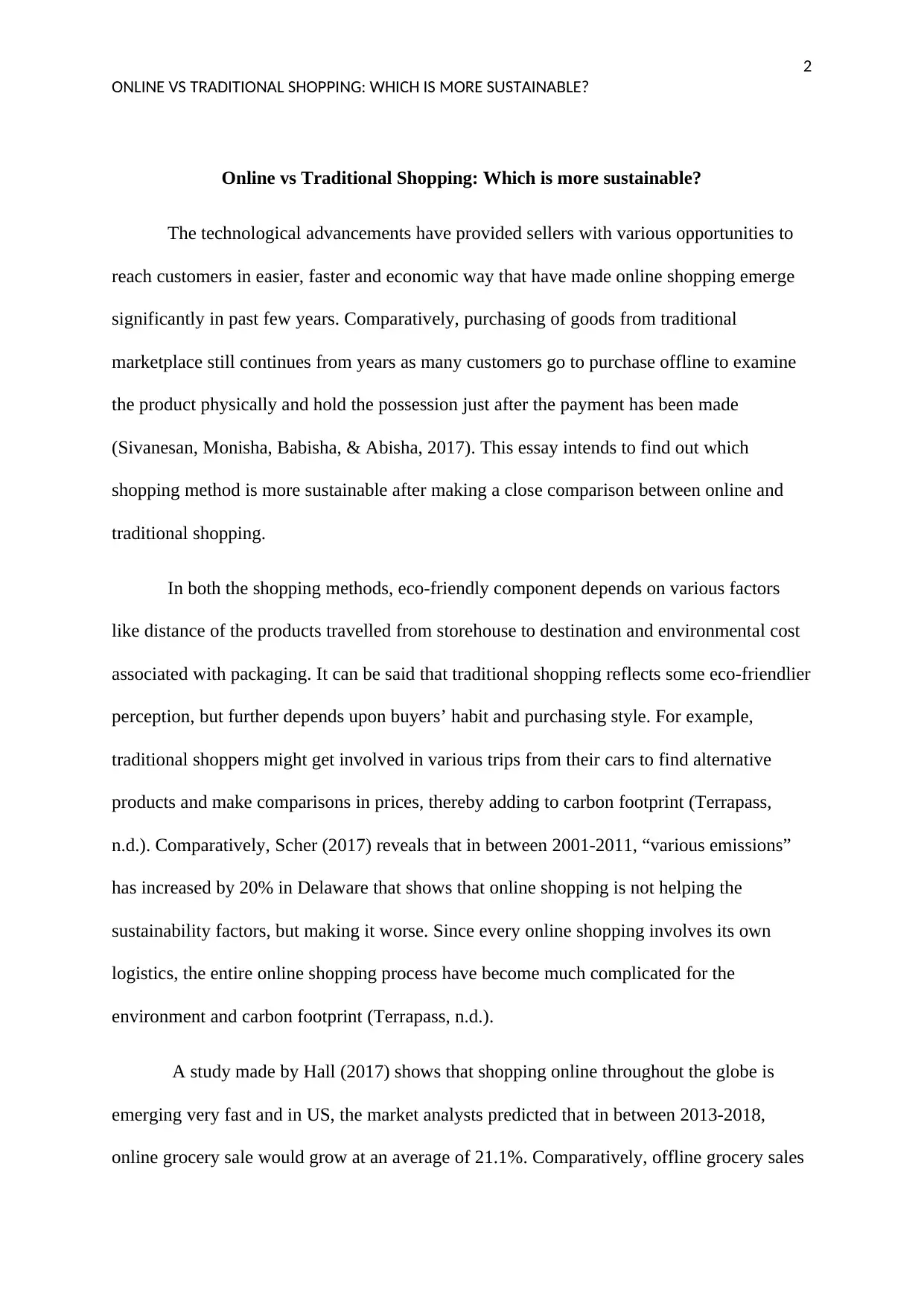
Online vs Traditional Shopping: Which is more sustainable?
The technological advancements have provided sellers with various opportunities to
reach customers in easier, faster and economic way that have made online shopping emerge
significantly in past few years. Comparatively, purchasing of goods from traditional
marketplace still continues from years as many customers go to purchase offline to examine
the product physically and hold the possession just after the payment has been made
(Sivanesan, Monisha, Babisha, & Abisha, 2017). This essay intends to find out which
shopping method is more sustainable after making a close comparison between online and
traditional shopping.
In both the shopping methods, eco-friendly component depends on various factors
like distance of the products travelled from storehouse to destination and environmental cost
associated with packaging. It can be said that traditional shopping reflects some eco-friendlier
perception, but further depends upon buyers’ habit and purchasing style. For example,
traditional shoppers might get involved in various trips from their cars to find alternative
products and make comparisons in prices, thereby adding to carbon footprint (Terrapass,
n.d.). Comparatively, Scher (2017) reveals that in between 2001-2011, “various emissions”
has increased by 20% in Delaware that shows that online shopping is not helping the
sustainability factors, but making it worse. Since every online shopping involves its own
logistics, the entire online shopping process have become much complicated for the
environment and carbon footprint (Terrapass, n.d.).
A study made by Hall (2017) shows that shopping online throughout the globe is
emerging very fast and in US, the market analysts predicted that in between 2013-2018,
online grocery sale would grow at an average of 21.1%. Comparatively, offline grocery sales
Document Page
3
ONLINE VS TRADITIONAL SHOPPING: WHICH IS MORE SUSTAINABLE?
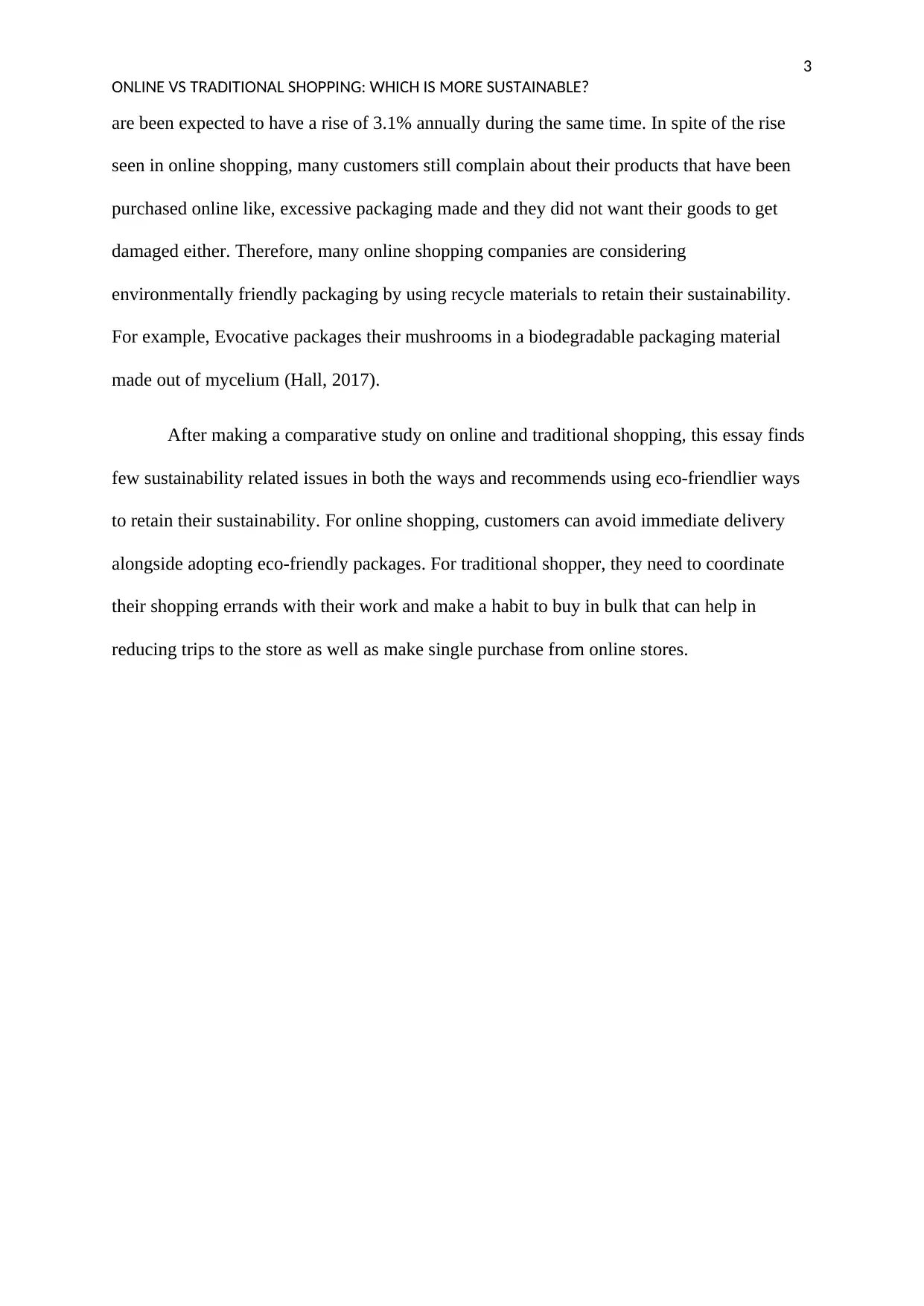
are been expected to have a rise of 3.1% annually during the same time. In spite of the rise
seen in online shopping, many customers still complain about their products that have been
purchased online like, excessive packaging made and they did not want their goods to get
damaged either. Therefore, many online shopping companies are considering
environmentally friendly packaging by using recycle materials to retain their sustainability.
For example, Evocative packages their mushrooms in a biodegradable packaging material
made out of mycelium (Hall, 2017).
After making a comparative study on online and traditional shopping, this essay finds
few sustainability related issues in both the ways and recommends using eco-friendlier ways
to retain their sustainability. For online shopping, customers can avoid immediate delivery
alongside adopting eco-friendly packages. For traditional shopper, they need to coordinate
their shopping errands with their work and make a habit to buy in bulk that can help in
reducing trips to the store as well as make single purchase from online stores.
Document Page
4
ONLINE VS TRADITIONAL SHOPPING: WHICH IS MORE SUSTAINABLE?
References
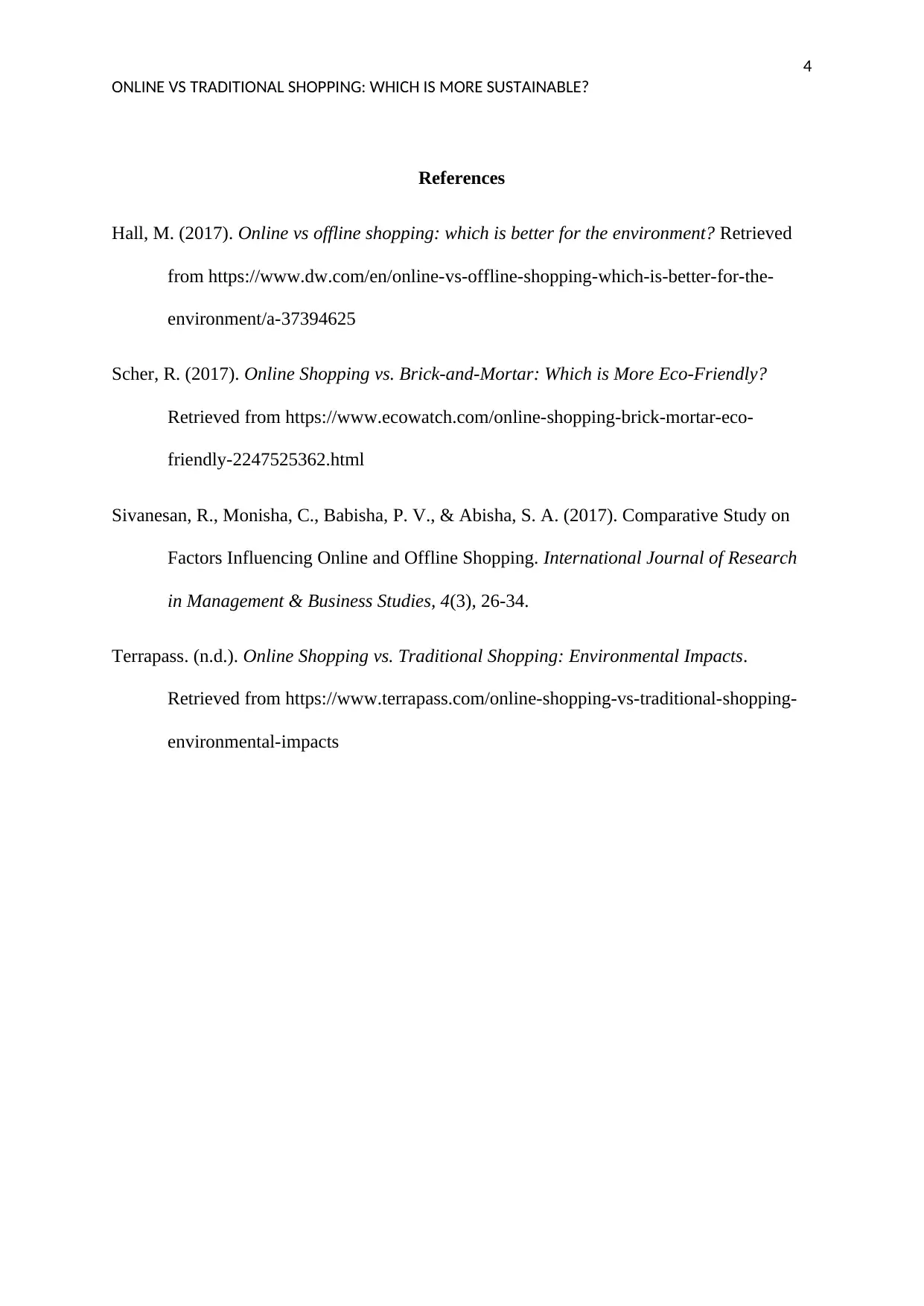
Hall, M. (2017). Online vs offline shopping: which is better for the environment? Retrieved
from https://www.dw.com/en/online-vs-offline-shopping-which-is-better-for-the-
environment/a-37394625
Scher, R. (2017). Online Shopping vs. Brick-and-Mortar: Which is More Eco-Friendly?
Retrieved from https://www.ecowatch.com/online-shopping-brick-mortar-eco-
friendly-2247525362.html
Sivanesan, R., Monisha, C., Babisha, P. V., & Abisha, S. A. (2017). Comparative Study on
Factors Influencing Online and Offline Shopping. International Journal of Research
in Management & Business Studies, 4(3), 26-34.
Terrapass. (n.d.). Online Shopping vs. Traditional Shopping: Environmental Impacts.
Retrieved from https://www.terrapass.com/online-shopping-vs-traditional-shopping-
environmental-impacts
chevron_up_icon
1 out of 4
circle_padding
hide_on_mobile
zoom_out_icon
[object Object]