Deputy Minister Briefing: Ontario's Health Priorities and Analysis

Verified

Added on  2022/10/12

|7
|1588
|100
Report
AI Summary
This briefing note analyzes Ontario's current top healthcare priorities for the Deputy Minister of Health and Long-Term Care. It identifies three key priorities: better value, better access to family health care, and better quality of care. The report provides background information on Ontario's action plan for health care, highlighting improvements since 2003. It examines the drivers of healthcare spending, accessibility issues, and the impact of an aging population. The analysis includes the pros and cons of each priority, supported by evidence-based research and statistics. Recommendations include promoting illness prevention, improving infrastructure, and increasing funding. The report references several sources to support its findings, and the goal is to guide the Ontario's health care policy agenda. The report emphasizes the need for strategic changes to improve the efficiency and effectiveness of the healthcare system.
Document Page
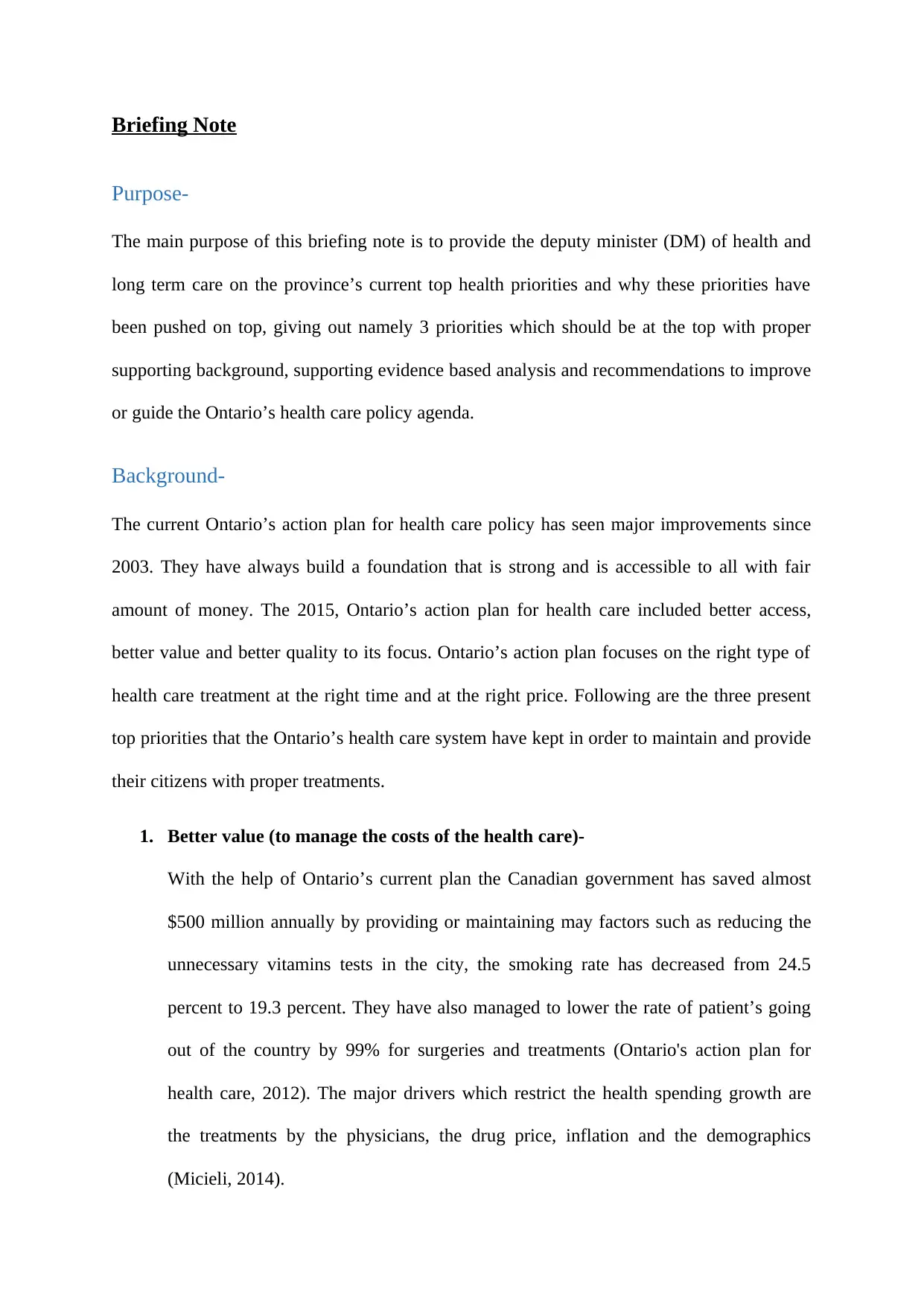
Briefing Note
Purpose-
The main purpose of this briefing note is to provide the deputy minister (DM) of health and
long term care on the province’s current top health priorities and why these priorities have
been pushed on top, giving out namely 3 priorities which should be at the top with proper
supporting background, supporting evidence based analysis and recommendations to improve
or guide the Ontario’s health care policy agenda.
Background-
The current Ontario’s action plan for health care policy has seen major improvements since
2003. They have always build a foundation that is strong and is accessible to all with fair
amount of money. The 2015, Ontario’s action plan for health care included better access,
better value and better quality to its focus. Ontario’s action plan focuses on the right type of
health care treatment at the right time and at the right price. Following are the three present
top priorities that the Ontario’s health care system have kept in order to maintain and provide
their citizens with proper treatments.
1. Better value (to manage the costs of the health care)-
With the help of Ontario’s current plan the Canadian government has saved almost
$500 million annually by providing or maintaining may factors such as reducing the
unnecessary vitamins tests in the city, the smoking rate has decreased from 24.5
percent to 19.3 percent. They have also managed to lower the rate of patient’s going
out of the country by 99% for surgeries and treatments (Ontario's action plan for
health care, 2012). The major drivers which restrict the health spending growth are
the treatments by the physicians, the drug price, inflation and the demographics
(Micieli, 2014).
tabler-icon-diamond-filled.svg

Paraphrase This Document

Need a fresh take? Get an instant paraphrase of this document with our AI Paraphraser
Document Page
2. Better access to family health care-
Ontario’s main health priority was to maintain the accessibility of the health care to
all the families. Ensuring that all the families must have at least one family doctor.
They have also cut the wait times in half for better accessibility and have also
expanded the role of nurses and other physicians in the health care area (Ontario's
action plan for health care, 2012). Ontario has also opened around 200 family health
teams which provide health care to around 2.3 million people in Ontario. Canada still
has a doctor patient ratio of 2.3 to 1000.
3. Better quality of care people receive-
The Ontario health care plan passed the ECFAA (Excellent Care for All Act) law to
focus on mainly the quality of care the people receive. It was improved by taking the
surveys and feedbacks of the patients at the hospital. An agency was created namely
health quality Ontario (HQO) to ensure the quality of services people get.
Analysis and Rankings-
1) Better access in primary health care and specialist-
A 10 year plan was established by the first ministers in 2003 in order to strengthen the health
care across the nation and also focussed on reducing the waiting times in the hospitals
("Family doctor availability | The Star", 2019). Improving access to health care primary
involves increasing the number of doctors, physicians and nurses in the city ("CHARTING A
PATH TO SUSTAINABLE HEALTH CARE IN ONTARIO 10 proposals to restrain cost
growth without compromising quality of care", 2019). This is very much necessary as
according to the reports given by ("Family doctor availability | The Star", 2019) almost 50.9
Document Page
percent of physicians are at the age of retirement ain Ontario. As more than half of physicians
are retiring the impact it is going to put in the near future is very serious. Improving access to
health care is of high importance for the people because according to the report by (Canadian
Medical Association", 2019) patients have complained about the long waiting hours and have
also analysed that the country stands last internationally in the accessibility of the doctors by
their patients and they are not satisfied that the health care management is not patient-centred.
CONS-
The major problem or the backdrop in putting the better access on the top of the list involves
more expenditure or more cost to be paid to the increasing health care practitioners. With
addition to this it places a high expenditure burden on the government. With an increase in
the health care professionals there is also increase in the infrastructure of the hospitals
(Micieli, 2014).
PROS-
Better accessibility and reduce waiting times at the hospitals by the patients. Interaction time
of the health care professionals and the patient increases leading to better output.
2) Better services to the patients-
The services given to the patients in the rural and the urban areas are quite different. The
patients in the urban areas receives better health coverage than the patients in the rural area
because of costs coverage. The funds required for the services may or may not reach to the
service provider (Regoli, 2019). The basic medical services such as MRI takes months to
schedule in Canada as given by (Regoli, 2019) and it increases the number of people going to
US for medical services.
Document Page
CONS-
Increasing or providing the patients with better services involve high maintenance or
increment in the cost production by the Canadian province. The increment in the cost
production by the government will lead to increase in the taxes for the people. The
involvement of the Canadian government in the health care system may have corruption.
PROS-
Better medical services will be available to the patients in the country itself. Patients do not
have to cross borders in order to get basic services done in the time of life threating situation.
3) Reduction in waiting times-
Reduce waiting time is linked to the accessibility of the health care services, which makes
both of them to top the priority list. Focusing on reduction in the waiting times is an
important way or a plan to deal with the growing age population of Ontario. Reducing
waiting times for the patients increases the number of patients a doctor sees or attends in a
day which will directly help the government in utilisation of the funds provided for the health
care systems (Micieli, 2014).
CONS-
The financial cost addition to the expenditure by the government is common in reducing
waiting times as well as in accessibility of services and health care professionals. In addition
to this, with the new laws doctors and health care professionals may be resistant to the
changes that occur while reducing the waiting times. As give in the TD Economics by Doctor
Jeff Turnbell who is the former president of the Canadian Medical association “in order to
reduce the waiting times the medical system of the Canada should be
tabler-icon-diamond-filled.svg

Paraphrase This Document

Need a fresh take? Get an instant paraphrase of this document with our AI Paraphraser
Document Page
reformed”("CHARTING A PATH TO SUSTAINABLE HEALTH CARE IN ONTARIO 10
proposals to restrain cost growth without compromising quality of care", 2019). Lack of
cooperation from the physicians to implement and change the infrastructure could lead to loss
for the government.
PROS-
Reduction in the waiting times may increase the doctor patient ratio from 2.3:1000 to
10:1000 as given by the ("CHARTING A PATH TO SUSTAINABLE HEALTH CARE IN
ONTARIO 10 proposals to restrain cost growth without compromising quality of care",
2019).
Recommendations-
The very first recommendation in improving the health care action plan is promote how to
prevent the illness rather than promoting the health care promotions in Ontario. Changing of
infrastructure of clinics or the hospitals can be helpful in the action plan as it can lead to
reduce waiting times and also better accessibility of the health care professionals to the
patients. Increased in the funding for the health care services can lead to better services in the
long term for the citizens.
Document Page
References
2019 CMA Annual General Meeting and General Council | Canadian Medical Association.
(2019). Retrieved 24 September 2019, from
https://www.cma.ca/2019-cma-annual-general-meeting-and-general-council
CHARTING A PATH TO SUSTAINABLE HEALTH CARE IN ONTARIO 10 proposals to
restrain cost growth without compromising quality of care. (2019). Retrieved 24
September 2019, from
https://www.td.com/document/PDF/economics/special/td-economics-special-db0510-
health-care.pdf
Family doctor availability: Only 41% of Canadians get quick appointments, report finds | The
Star. (2019). Retrieved 24 September 2019, from
Document Page
https://www.thestar.com/news/canada/2014/01/20/
family_doctor_availability_only_41_of_canadians_get_quick_appointments_report_fi
nds.html
Micieli, A. (2014). The challenges facing Ontario’s health care system moving forward: a
health policy perspective. University Of Ottawa Journal Of Medicine, 4(1). doi:
10.18192/uojm.v4i1.1038
https://uottawa.scholarsportal.info/ottawa/index.php/uojm-jmuo/article/view/1038
Ministry of Health and Long-Term Care. (2012). Ontario's action plan for health care.
Toronto, Ont.
http://www.health.gov.on.ca/en/ms/ecfa/healthy_change/docs/rep_healthychange.pdf
Regoli, N. (2019). 21 Canadian Medicare Pros and Cons. Retrieved 24 September 2019, from
https://vittana.org/21-canadian-medicare-pros-and-cons
chevron_up_icon
1 out of 7
circle_padding
hide_on_mobile
zoom_out_icon
[object Object]