Analysis of Open Innovation: Benefits, Limitations, and Strategies
VerifiedAdded on 2023/01/13
|11
|3284
|59
Report
AI Summary
This report delves into the concept of open innovation, examining its benefits and limitations within a business context. It explores how companies, particularly in the UK, utilize both internal and external resources to foster innovation, improve services, and drive business growth. The report highlights advantages such as cost reduction, risk sharing, knowledge acquisition, and the creation of new products and services, using examples like ASDA and Samsung. Conversely, it addresses the challenges, including the potential for revealing confidential information, risks associated with collaboration, and the importance of managing intellectual property. The methodology involves a critical evaluation of the theme, incorporating research reports and case studies to provide a comprehensive analysis of open innovation's impact on business success, with recommendations for making informed decisions and achieving organizational goals. The report also touches upon the cultural, structural, and motivational aspects of implementing open innovation, drawing examples from companies such as GlaxoSmithKline, Bentley Motors, and Coca-Cola, and emphasizing the importance of employee engagement and staying ahead of the competition.
Innovation Management
(journal report)
(journal report)

Paraphrase This Document
Need a fresh take? Get an instant paraphrase of this document with our AI Paraphraser

Table of Contents
INTRODUCTION.......................................................................................................................3
METHODOLOGY......................................................................................................................3
CRITICAL EVALUATION........................................................................................................3
CONCLUSION AND RECOMMENDATIONS........................................................................8
REFERENCES................................................................................................................................1
INTRODUCTION.......................................................................................................................3
METHODOLOGY......................................................................................................................3
CRITICAL EVALUATION........................................................................................................3
CONCLUSION AND RECOMMENDATIONS........................................................................8
REFERENCES................................................................................................................................1
Introduction
Innovation basically refers to the more effective ideas, products and processes. For
business, it refers to implementing innovating methods, practices, improving services etc. which
may help in delivering better products and services. The theme of the journal is 'Benefits and
Limitation of Open Innovation'. Open innovation is based on the belief that knowledgeable and
creative individuals can also contribute in achieving goals. In this organizations doesn't rely on
their internal resources for innovation but also uses many external sources to drive innovation.
The major advantage of open innovation process is the flow of knowledge and ideas which helps
in reduction in the time and cost of innovation projects. Particularly, small and medium
enterprises are gain advantages from open innovation.
Methodology
The report is based on the theme 'Benefits and Limitation of Open Innovation'. It is
mainly concerned with the effectiveness of open innovation in UK and the adoption of it within
UK. The openness of innovation is associated with various uncertainty which arises the need for
support within the decision making process. So, it becomes essential for companies to maintain a
balance between the positive and negative consequences. The goals of this report is to discuss the
potential open innovation projects that has been carried out and its importance to the
organizations. This report discusses the benefits and limitation of open innovation and its
implication on the business success. This report also considers the various research report
published by various authors in relation to the theme. This framework includes the internal and
external and integrated analysis. To ensure theoretical and practical relevant aspect covered in
this report, a critical evaluation of theme selected is done with reference to different company
examples which includes benefits and limitations of open communication, how it has helped
companies to survive, grow and achieving its goals. After a complete analysis, solutions are
recommendations which will help in taking proper decisions and in accomplishing business
goals.
Critical evaluation
According to West and Bogers (2017), open innovation is refers to combining the internal
and external resources to boost the innovation performance of the business. It encourages to get
connected with others to so that business can gain profits and opportunities in terms of getting
new talent and collaborating with others to come up with new and innovative ideas. According to
Innovation basically refers to the more effective ideas, products and processes. For
business, it refers to implementing innovating methods, practices, improving services etc. which
may help in delivering better products and services. The theme of the journal is 'Benefits and
Limitation of Open Innovation'. Open innovation is based on the belief that knowledgeable and
creative individuals can also contribute in achieving goals. In this organizations doesn't rely on
their internal resources for innovation but also uses many external sources to drive innovation.
The major advantage of open innovation process is the flow of knowledge and ideas which helps
in reduction in the time and cost of innovation projects. Particularly, small and medium
enterprises are gain advantages from open innovation.
Methodology
The report is based on the theme 'Benefits and Limitation of Open Innovation'. It is
mainly concerned with the effectiveness of open innovation in UK and the adoption of it within
UK. The openness of innovation is associated with various uncertainty which arises the need for
support within the decision making process. So, it becomes essential for companies to maintain a
balance between the positive and negative consequences. The goals of this report is to discuss the
potential open innovation projects that has been carried out and its importance to the
organizations. This report discusses the benefits and limitation of open innovation and its
implication on the business success. This report also considers the various research report
published by various authors in relation to the theme. This framework includes the internal and
external and integrated analysis. To ensure theoretical and practical relevant aspect covered in
this report, a critical evaluation of theme selected is done with reference to different company
examples which includes benefits and limitations of open communication, how it has helped
companies to survive, grow and achieving its goals. After a complete analysis, solutions are
recommendations which will help in taking proper decisions and in accomplishing business
goals.
Critical evaluation
According to West and Bogers (2017), open innovation is refers to combining the internal
and external resources to boost the innovation performance of the business. It encourages to get
connected with others to so that business can gain profits and opportunities in terms of getting
new talent and collaborating with others to come up with new and innovative ideas. According to
⊘ This is a preview!⊘
Do you want full access?
Subscribe today to unlock all pages.

Trusted by 1+ million students worldwide
different research reports, it has been identified that UK has successfully adopted open
innovation and it offers different advantages to different industries. There is a variation in the
model used by the companies in respect to employment model, patterns of knowledge transfer
and interaction. One example in relation to the establishment of the Centre of External Drug
Development by GlaxoSmithKline in 2005. The main objective was to raise research and
development spending not by increasing the number of researchers but by creating a network
with many other biotech companies. Companies can take different routes of innovation
depending upon the drive that leading them to adopt open innovation. According to Peris-Ortiz,
Devece-Carañana and Navarro-Garcia (2018), there are four main issues that company needs to
tackle. The first issue is culture, which is same for all organizations and a shift towards an open
approach requires the involvement of top management. This shift requires working with other
organization. The second issue is structure and procedures. Mostly in UK, independent open
innovation teams works within the already established company and moving people around in
the organization is improves and increases cross-functional working in the organization. The
third issue is skills, the lack of appropriate skills in the collaboration is seen as the major obstacle
in the implementation of open innovation in an organization. So, sometimes it is desirable to
provide training when preparing organization for open innovation. The forth and the final issue is
motivation. Merely implementing it will not be of any use unless employees feel motivated
towards it. So, it is important to make changes in the employees incentive structure to attract and
motivate them because will not do anything extra under the same pay scale.
The open innovation has come with the positive aspect as well as negative aspect. On the
positive side, the various motives of open innovation has been broken into 4 key objectives
which are cost reduction, risk sharing, resources availability and knowledge acquisition.
Knowledge acquisition is the major reason for external partnership and is is one of the advantage
of open innovation (Kylliäinen Julia, 2018). Open innovation provides a large pool of knowledge
to the company and helps in boosting the business potential to secure a better position and take
competitive advantage. Competitiveness is the major driver for innovation in a business which
makes the process flexible enough to involve external parties in its innovation process which
helps in expanding their investment in research and development so as to identify and grab the
new trends and ideas. Knowledge acquisition can also help in developing internal capabilities.
So, integrating with external sources helps in increasing the innovation pace. But every positive
innovation and it offers different advantages to different industries. There is a variation in the
model used by the companies in respect to employment model, patterns of knowledge transfer
and interaction. One example in relation to the establishment of the Centre of External Drug
Development by GlaxoSmithKline in 2005. The main objective was to raise research and
development spending not by increasing the number of researchers but by creating a network
with many other biotech companies. Companies can take different routes of innovation
depending upon the drive that leading them to adopt open innovation. According to Peris-Ortiz,
Devece-Carañana and Navarro-Garcia (2018), there are four main issues that company needs to
tackle. The first issue is culture, which is same for all organizations and a shift towards an open
approach requires the involvement of top management. This shift requires working with other
organization. The second issue is structure and procedures. Mostly in UK, independent open
innovation teams works within the already established company and moving people around in
the organization is improves and increases cross-functional working in the organization. The
third issue is skills, the lack of appropriate skills in the collaboration is seen as the major obstacle
in the implementation of open innovation in an organization. So, sometimes it is desirable to
provide training when preparing organization for open innovation. The forth and the final issue is
motivation. Merely implementing it will not be of any use unless employees feel motivated
towards it. So, it is important to make changes in the employees incentive structure to attract and
motivate them because will not do anything extra under the same pay scale.
The open innovation has come with the positive aspect as well as negative aspect. On the
positive side, the various motives of open innovation has been broken into 4 key objectives
which are cost reduction, risk sharing, resources availability and knowledge acquisition.
Knowledge acquisition is the major reason for external partnership and is is one of the advantage
of open innovation (Kylliäinen Julia, 2018). Open innovation provides a large pool of knowledge
to the company and helps in boosting the business potential to secure a better position and take
competitive advantage. Competitiveness is the major driver for innovation in a business which
makes the process flexible enough to involve external parties in its innovation process which
helps in expanding their investment in research and development so as to identify and grab the
new trends and ideas. Knowledge acquisition can also help in developing internal capabilities.
So, integrating with external sources helps in increasing the innovation pace. But every positive
Paraphrase This Document
Need a fresh take? Get an instant paraphrase of this document with our AI Paraphraser
aspect has a negative aspect too which are discussed here. On the negative side, open innovation
targets decrease in risk but with that it invites an increase of risk related to collaboration with
external parties. Collaboration itself brings risk and cost with it. Open innovation is hampered
related to technology risk, market risk, knowledge risk, intellectual property risk, workforce risk
etc. The reason for entering into partnership to get access to knowledge from outside, however,
sometimes it may be possible that insufficient knowledge in partnership may increase the cost
and act as a barrier in achieving the required outcomes in a specified period of time. Also,
collaboration has the potential to share the internal competencies of the business to the outsiders
or to the rival companies which may lead to losing the competitive edge. Knowledge sharing risk
is related to the lack of trust among partners. Also, firms seeks to have talented and skilled
through collaboration but due to geographical or cultural differences, the quality of labour
acquired may to inadequate for the firm. So, these are the some positive and negative aspects of
open innovation which are in some way beneficial for the business but it is required to take
relevant actions to reduce the risk associated with it.
As per Brem, Nylund and Hitchen (2017), there are some key benefits of open innovation
which are very useful for businesses in achieving its goals.
Creating new product and services: In a business, nothing is more exciting then getting a new
product or service. By investing in internal and external resources helps in creating something
and innovative which will help in bringing value to the business. This move even helps in
increasing profits and increase the brand image. For example, the common problem for
supermarket is importing products from other countries during off season. To overcome such
issue ASDA has come up with an ideas. It is employing innovative LED lights which can help in
extending the season for growing fresh tomatoes. This light will act as a supplement to the
sunshine required and helps in enabling fresh and delicious tomatoes to be supplied to its
customers whole year. ASDA is working in collaboration with UK growers.
Innovating old products and services: Sometimes it is better to modify the existing products
rather than creating the new ones if the older one has the potential to be improved and better and
is able to attract more customers. The main benefit of open innovation is that it is never ending
as organizations keeps on researching to make the product even more better. For example,
Access pay with its launch has changed the way business payment is done across the world. Its
targets decrease in risk but with that it invites an increase of risk related to collaboration with
external parties. Collaboration itself brings risk and cost with it. Open innovation is hampered
related to technology risk, market risk, knowledge risk, intellectual property risk, workforce risk
etc. The reason for entering into partnership to get access to knowledge from outside, however,
sometimes it may be possible that insufficient knowledge in partnership may increase the cost
and act as a barrier in achieving the required outcomes in a specified period of time. Also,
collaboration has the potential to share the internal competencies of the business to the outsiders
or to the rival companies which may lead to losing the competitive edge. Knowledge sharing risk
is related to the lack of trust among partners. Also, firms seeks to have talented and skilled
through collaboration but due to geographical or cultural differences, the quality of labour
acquired may to inadequate for the firm. So, these are the some positive and negative aspects of
open innovation which are in some way beneficial for the business but it is required to take
relevant actions to reduce the risk associated with it.
As per Brem, Nylund and Hitchen (2017), there are some key benefits of open innovation
which are very useful for businesses in achieving its goals.
Creating new product and services: In a business, nothing is more exciting then getting a new
product or service. By investing in internal and external resources helps in creating something
and innovative which will help in bringing value to the business. This move even helps in
increasing profits and increase the brand image. For example, the common problem for
supermarket is importing products from other countries during off season. To overcome such
issue ASDA has come up with an ideas. It is employing innovative LED lights which can help in
extending the season for growing fresh tomatoes. This light will act as a supplement to the
sunshine required and helps in enabling fresh and delicious tomatoes to be supplied to its
customers whole year. ASDA is working in collaboration with UK growers.
Innovating old products and services: Sometimes it is better to modify the existing products
rather than creating the new ones if the older one has the potential to be improved and better and
is able to attract more customers. The main benefit of open innovation is that it is never ending
as organizations keeps on researching to make the product even more better. For example,
Access pay with its launch has changed the way business payment is done across the world. Its
software has helped the business to automate the payment transaction and make the transaction
quickly and securely.
Keeping employees engaged: One of the major reason for employee dissatisfaction is that lack
of feeling of belongingness and ownership in the projects. Consequently, teams may not feel
comfortable to share their ideas and opinions. So, by bring open innovation in the workplace will
help in boosting the employee morale by making them involved in the projects. When employees
feels that they have contributed in achieving the goals of the organization, they feel more
responsible and excited in coming to work and works with full dedication. For example,
Burberry which is a British luxury fashion house. It has been known for bring tech revolution in
the the traditional British retailing. It has created a high skilled team to leverage digital media.
This helped in increasing engagement as each and every employee were the part of this tech
revolution.
Staying ahead of competition: By working in team and finding new ideas will help in
increasing employee engagement. Using open innovation will help in finding the area where
innovation could add value to the business (Cheng and et.al, 2018). For example, Bentley motors
is making efforts to make it vehicle 10-15% more efficient and competitive as compared to its
previous one, which will help it in gaining competitive advantage.
Helps in reducing risk and take competitive advantage: Open innovation helps in builds a
relation with external sources which allows company to share ideas, know-how which in other
way helps in minimizing the risk associated with technical and market aspects. For example:
Samsung has adopted open innovation to build its external innovation strength, for which it has
launched a program called Samsung Accelerator Program which focusses on collaborating with
designers, creative thinkers and innovators which can help in dealing with different types of
problems and finding solutions to it. It has provided capital and product support to develop
softwares and devices. All these investment brings revenue even in case of exits and helps in
reducing the risk.
As per NOVOSELTSEVA EKATERINA (2017), some of the other example of open
innovation is related to GE company. GE known for its open innovation models which mainly
focusses on the collaborating with experts and entrepreneurs to share ideas and solve problems.
GE had launched a program named the impossible mission for university students. This program
was targeted at students having creative minds and some technical skills. Through this, GE was
quickly and securely.
Keeping employees engaged: One of the major reason for employee dissatisfaction is that lack
of feeling of belongingness and ownership in the projects. Consequently, teams may not feel
comfortable to share their ideas and opinions. So, by bring open innovation in the workplace will
help in boosting the employee morale by making them involved in the projects. When employees
feels that they have contributed in achieving the goals of the organization, they feel more
responsible and excited in coming to work and works with full dedication. For example,
Burberry which is a British luxury fashion house. It has been known for bring tech revolution in
the the traditional British retailing. It has created a high skilled team to leverage digital media.
This helped in increasing engagement as each and every employee were the part of this tech
revolution.
Staying ahead of competition: By working in team and finding new ideas will help in
increasing employee engagement. Using open innovation will help in finding the area where
innovation could add value to the business (Cheng and et.al, 2018). For example, Bentley motors
is making efforts to make it vehicle 10-15% more efficient and competitive as compared to its
previous one, which will help it in gaining competitive advantage.
Helps in reducing risk and take competitive advantage: Open innovation helps in builds a
relation with external sources which allows company to share ideas, know-how which in other
way helps in minimizing the risk associated with technical and market aspects. For example:
Samsung has adopted open innovation to build its external innovation strength, for which it has
launched a program called Samsung Accelerator Program which focusses on collaborating with
designers, creative thinkers and innovators which can help in dealing with different types of
problems and finding solutions to it. It has provided capital and product support to develop
softwares and devices. All these investment brings revenue even in case of exits and helps in
reducing the risk.
As per NOVOSELTSEVA EKATERINA (2017), some of the other example of open
innovation is related to GE company. GE known for its open innovation models which mainly
focusses on the collaborating with experts and entrepreneurs to share ideas and solve problems.
GE had launched a program named the impossible mission for university students. This program
was targeted at students having creative minds and some technical skills. Through this, GE was
⊘ This is a preview!⊘
Do you want full access?
Subscribe today to unlock all pages.
Trusted by 1+ million students worldwide
able to get three students who were smart and creative to have their internship at GE. Another
interesting example is of Coca Cola company. It used to adopt open innovation at different
levels, that is, between team and entrepreneurs and between consumers and others. The freestyle
dispenser machine innovated by Coca Cola, allows user to mix the flavours they want and also
asks for suggestion for any new flavour for the Coca Cola product. This model of open
innovation has put the production process customer oriented as flavours are made as per
customers suggestions. Other successful, innovation example are Hydro industries in Wales, has
developed a ground breaking water purification system or technology which has been deployed
across the world. It has recently tied up with US which will help in bringing environmental and
recycling solution.
According to Hossain and Kauranen (2016), as everything has its pros and cons and the
same happens with open innovation. Some of its limitations are stated below.
Possibility of revealing confidential information: It can be possible that information provided
by organization to the outsiders may back fire the organization. Sometimes even if organization
does not want to reveal the information but unintentionally it happens then in that case it may
lead to loss and sharing of information to competitors.
Wrong collaboration: It may happen that companies collaborate with outsiders, thinking that
they may add value but things changes may be because organization is not working properly and
do not possess any unique skills that can help in taking competitive advantage (Amponsah and
Adams, 2017). For example, Xerox, it was the first to invent PC which was ahead of time but
management did not considered it as they thought it will be very expensive to go digital. At that
time, people with digital knowledge were less and Xerox failed to meet with the digital
disruption coming up. It should have collaborated with someone outside the organization to get
an idea and take better decisions.
Reputational risk: Implementing innovation is a good idea but if the innovation plan fails it will
affect the reputation of the organization. For example, the well known case of Volkswagen. It
has tried to make vehicles with reduced carbon emission but the company had fooled the
emission test of around 11 million vehicle. It has been found guilty and had to pay $4.3 billion in
criminal and civil penalties. This scandal has highly affected the brand reputation of the
company and its is becoming very hard to build the reputation all over again.
interesting example is of Coca Cola company. It used to adopt open innovation at different
levels, that is, between team and entrepreneurs and between consumers and others. The freestyle
dispenser machine innovated by Coca Cola, allows user to mix the flavours they want and also
asks for suggestion for any new flavour for the Coca Cola product. This model of open
innovation has put the production process customer oriented as flavours are made as per
customers suggestions. Other successful, innovation example are Hydro industries in Wales, has
developed a ground breaking water purification system or technology which has been deployed
across the world. It has recently tied up with US which will help in bringing environmental and
recycling solution.
According to Hossain and Kauranen (2016), as everything has its pros and cons and the
same happens with open innovation. Some of its limitations are stated below.
Possibility of revealing confidential information: It can be possible that information provided
by organization to the outsiders may back fire the organization. Sometimes even if organization
does not want to reveal the information but unintentionally it happens then in that case it may
lead to loss and sharing of information to competitors.
Wrong collaboration: It may happen that companies collaborate with outsiders, thinking that
they may add value but things changes may be because organization is not working properly and
do not possess any unique skills that can help in taking competitive advantage (Amponsah and
Adams, 2017). For example, Xerox, it was the first to invent PC which was ahead of time but
management did not considered it as they thought it will be very expensive to go digital. At that
time, people with digital knowledge were less and Xerox failed to meet with the digital
disruption coming up. It should have collaborated with someone outside the organization to get
an idea and take better decisions.
Reputational risk: Implementing innovation is a good idea but if the innovation plan fails it will
affect the reputation of the organization. For example, the well known case of Volkswagen. It
has tried to make vehicles with reduced carbon emission but the company had fooled the
emission test of around 11 million vehicle. It has been found guilty and had to pay $4.3 billion in
criminal and civil penalties. This scandal has highly affected the brand reputation of the
company and its is becoming very hard to build the reputation all over again.
Paraphrase This Document
Need a fresh take? Get an instant paraphrase of this document with our AI Paraphraser
Other example is Nokia which failed to innovate. Nokia was a global leader in the mobile
phones but it was not able to grasp the emerging concepts of software and kept on focussing on
hardware and the reason behind it was that management had a fear of losing its customer base if
they change. The only mistake of Nokia was not to accept the drastic change in the user
experience. This has lead to the bad user experiences which did not fit the market.
As per Naqshbandi, Tabche and Choudhary (2019), there are various ways of managing
the open innovation. First, companies should not directly jump onto the bandwagon just because
it is highly popular. Managers needs to develop strategies according to the organizational needs,
resources available as well as external environment such as competition. Managers need to
consider the both inbound and outbound activities related to open innovation. Collaboration
requires effective management as managers needs to evaluate values from it. Second is
identifying the functions which needs to be connected, according to which organizations may be
required to train group of people to who are carrying diverse professional skills. Organization
needs skilled employees to work in this system so as to access external capabilities and
opportunities. Third is demonstrating commitment and support. Organization needs to come up
with the plan to provide support to all those who less inclined towards achieving the and
accepting the change or new approach to change. Forth is providing effective training to research
and development professionals so that they can be effective in open innovation. Also,
organization needs to implement intellectual property system, that clearly states what can or
cannot be shared with the external parties. Organization should hire personnel to take care of the
confidentiality of the information provided to the external sources. So, all these factors need to
be taken into consideration for effective management of the open innovation.
All these pros and cons of open innovation along with relevant and real life examples
makes it clear the impact of open innovation on the organization totally depends on the way
organizations approaches it.
Conclusion and recommendations
After analysing the theme 'Benefits and Limitation of Open Innovation', it becomes very
clear that implementation of it has change the shape of organization. It has helped organization in
taking advantage of external capabilities to enhance the business. It is the linkage between the
experts and the entrepreneurs so experts will be asked about the methods to used and the
estimated appraisal. The benefits and drawbacks of open innovation can be used as an indicator
phones but it was not able to grasp the emerging concepts of software and kept on focussing on
hardware and the reason behind it was that management had a fear of losing its customer base if
they change. The only mistake of Nokia was not to accept the drastic change in the user
experience. This has lead to the bad user experiences which did not fit the market.
As per Naqshbandi, Tabche and Choudhary (2019), there are various ways of managing
the open innovation. First, companies should not directly jump onto the bandwagon just because
it is highly popular. Managers needs to develop strategies according to the organizational needs,
resources available as well as external environment such as competition. Managers need to
consider the both inbound and outbound activities related to open innovation. Collaboration
requires effective management as managers needs to evaluate values from it. Second is
identifying the functions which needs to be connected, according to which organizations may be
required to train group of people to who are carrying diverse professional skills. Organization
needs skilled employees to work in this system so as to access external capabilities and
opportunities. Third is demonstrating commitment and support. Organization needs to come up
with the plan to provide support to all those who less inclined towards achieving the and
accepting the change or new approach to change. Forth is providing effective training to research
and development professionals so that they can be effective in open innovation. Also,
organization needs to implement intellectual property system, that clearly states what can or
cannot be shared with the external parties. Organization should hire personnel to take care of the
confidentiality of the information provided to the external sources. So, all these factors need to
be taken into consideration for effective management of the open innovation.
All these pros and cons of open innovation along with relevant and real life examples
makes it clear the impact of open innovation on the organization totally depends on the way
organizations approaches it.
Conclusion and recommendations
After analysing the theme 'Benefits and Limitation of Open Innovation', it becomes very
clear that implementation of it has change the shape of organization. It has helped organization in
taking advantage of external capabilities to enhance the business. It is the linkage between the
experts and the entrepreneurs so experts will be asked about the methods to used and the
estimated appraisal. The benefits and drawbacks of open innovation can be used as an indicator
for measuring the effectiveness of it. Different example has been stated with respect to the
benefits and limitation stated which help an organization in identifying the area where other have
taken the wrong decision which can be connected with the current situation and proper decisions
can be taken. Four issues has been identified that organizations needs to tackle which increases
the demand for implementing open innovation. It is recommended that organization should
collect relevant information about the company with which it is entering into partnership.
Relevant and attractive incentive structure should be formed to motivate the employees to work
with other organization. Organization should announce the the change that will take place in
advance so that employees can set ready for it with required mind set. Organization should clear
the objective for open innovation and should link it with the corporate strategy. Also,
organization needs to identify the right people as every employee is not equally skilled or will be
comfortable in engaging and working with other people. The people who believe in open
innovation will help in building internal capabilities.
benefits and limitation stated which help an organization in identifying the area where other have
taken the wrong decision which can be connected with the current situation and proper decisions
can be taken. Four issues has been identified that organizations needs to tackle which increases
the demand for implementing open innovation. It is recommended that organization should
collect relevant information about the company with which it is entering into partnership.
Relevant and attractive incentive structure should be formed to motivate the employees to work
with other organization. Organization should announce the the change that will take place in
advance so that employees can set ready for it with required mind set. Organization should clear
the objective for open innovation and should link it with the corporate strategy. Also,
organization needs to identify the right people as every employee is not equally skilled or will be
comfortable in engaging and working with other people. The people who believe in open
innovation will help in building internal capabilities.
⊘ This is a preview!⊘
Do you want full access?
Subscribe today to unlock all pages.
Trusted by 1+ million students worldwide
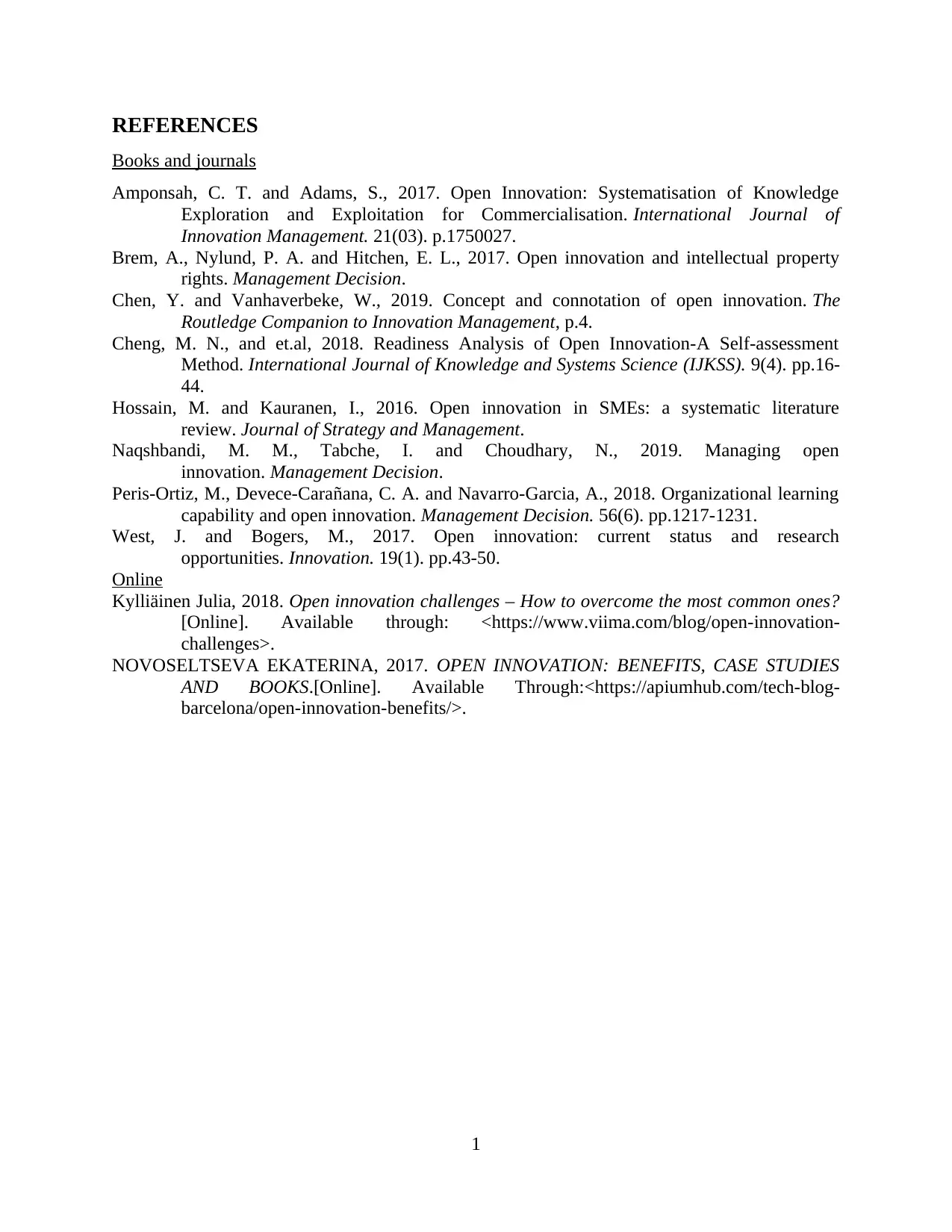
REFERENCES
Books and journals
Amponsah, C. T. and Adams, S., 2017. Open Innovation: Systematisation of Knowledge
Exploration and Exploitation for Commercialisation. International Journal of
Innovation Management. 21(03). p.1750027.
Brem, A., Nylund, P. A. and Hitchen, E. L., 2017. Open innovation and intellectual property
rights. Management Decision.
Chen, Y. and Vanhaverbeke, W., 2019. Concept and connotation of open innovation. The
Routledge Companion to Innovation Management, p.4.
Cheng, M. N., and et.al, 2018. Readiness Analysis of Open Innovation-A Self-assessment
Method. International Journal of Knowledge and Systems Science (IJKSS). 9(4). pp.16-
44.
Hossain, M. and Kauranen, I., 2016. Open innovation in SMEs: a systematic literature
review. Journal of Strategy and Management.
Naqshbandi, M. M., Tabche, I. and Choudhary, N., 2019. Managing open
innovation. Management Decision.
Peris-Ortiz, M., Devece-Carañana, C. A. and Navarro-Garcia, A., 2018. Organizational learning
capability and open innovation. Management Decision. 56(6). pp.1217-1231.
West, J. and Bogers, M., 2017. Open innovation: current status and research
opportunities. Innovation. 19(1). pp.43-50.
Online
Kylliäinen Julia, 2018. Open innovation challenges – How to overcome the most common ones?
[Online]. Available through: <https://www.viima.com/blog/open-innovation-
challenges>.
NOVOSELTSEVA EKATERINA, 2017. OPEN INNOVATION: BENEFITS, CASE STUDIES
AND BOOKS.[Online]. Available Through:<https://apiumhub.com/tech-blog-
barcelona/open-innovation-benefits/>.
1
Books and journals
Amponsah, C. T. and Adams, S., 2017. Open Innovation: Systematisation of Knowledge
Exploration and Exploitation for Commercialisation. International Journal of
Innovation Management. 21(03). p.1750027.
Brem, A., Nylund, P. A. and Hitchen, E. L., 2017. Open innovation and intellectual property
rights. Management Decision.
Chen, Y. and Vanhaverbeke, W., 2019. Concept and connotation of open innovation. The
Routledge Companion to Innovation Management, p.4.
Cheng, M. N., and et.al, 2018. Readiness Analysis of Open Innovation-A Self-assessment
Method. International Journal of Knowledge and Systems Science (IJKSS). 9(4). pp.16-
44.
Hossain, M. and Kauranen, I., 2016. Open innovation in SMEs: a systematic literature
review. Journal of Strategy and Management.
Naqshbandi, M. M., Tabche, I. and Choudhary, N., 2019. Managing open
innovation. Management Decision.
Peris-Ortiz, M., Devece-Carañana, C. A. and Navarro-Garcia, A., 2018. Organizational learning
capability and open innovation. Management Decision. 56(6). pp.1217-1231.
West, J. and Bogers, M., 2017. Open innovation: current status and research
opportunities. Innovation. 19(1). pp.43-50.
Online
Kylliäinen Julia, 2018. Open innovation challenges – How to overcome the most common ones?
[Online]. Available through: <https://www.viima.com/blog/open-innovation-
challenges>.
NOVOSELTSEVA EKATERINA, 2017. OPEN INNOVATION: BENEFITS, CASE STUDIES
AND BOOKS.[Online]. Available Through:<https://apiumhub.com/tech-blog-
barcelona/open-innovation-benefits/>.
1
Paraphrase This Document
Need a fresh take? Get an instant paraphrase of this document with our AI Paraphraser

2

1 out of 11


Related Documents


Your All-in-One AI-Powered Toolkit for Academic Success.
+13062052269
info@desklib.com
Available 24*7 on WhatsApp / Email
![[object Object]](/_next/static/media/star-bottom.7253800d.svg)
Unlock your academic potential
Copyright © 2020–2026 A2Z Services. All Rights Reserved. Developed and managed by ZUCOL.