College of Computing IT-241 Assignment 3: Operating Systems Concepts
VerifiedAdded on 2023/05/30
|6
|1101
|95
Homework Assignment
AI Summary
This document presents a solution to Assignment 3 for the IT-241 Operating Systems course. The assignment covers several key concepts, including buffering, the least privilege principle, disk scheduling algorithms (FCFS and SSTF), and the use of Direct Memory Access (DMA). The solution provides explanations for the purposes of buffering, emphasizing synchronization, data transfer size differences, and support for copying semantics. It defines the least privilege principle and explains its role in protection systems. The disk scheduling section demonstrates the calculation of total head movements using both FCFS and SSTF algorithms with a schematic diagram for a disk of 200 cylinders. Finally, the solution explains why DMA is used for large data transfers, highlighting its efficiency in reducing CPU cycles and increasing transfer rates. The document is a comprehensive resource for understanding and solving Operating Systems problems.
Assignmen
t 3
Instructions:
This Assignment must be submitted on Blackboard (WORD format only) via the allocated folder.
Email submission will not be accepted.
You are advised to make your work clear and well-presented, marks may be reduced for poor presentatio
You MUST show all your work, and text must not be converted into an image, unless specified otherwise
Late submission will result in ZERO marks being awarded.
The work should be your own, copying from students or other resources will result in ZERO marks.
Use Times New Roman font for all your answers.
College of Computing and Informatics
Student Details:
Name:###
CRN:###
ID:###
Operating Systems
IT-241
t 3
Instructions:
This Assignment must be submitted on Blackboard (WORD format only) via the allocated folder.
Email submission will not be accepted.
You are advised to make your work clear and well-presented, marks may be reduced for poor presentatio
You MUST show all your work, and text must not be converted into an image, unless specified otherwise
Late submission will result in ZERO marks being awarded.
The work should be your own, copying from students or other resources will result in ZERO marks.
Use Times New Roman font for all your answers.
College of Computing and Informatics
Student Details:
Name:###
CRN:###
ID:###
Operating Systems
IT-241
Paraphrase This Document
Need a fresh take? Get an instant paraphrase of this document with our AI Paraphraser

Pg. 1 Question FourQuestion Four
Question One
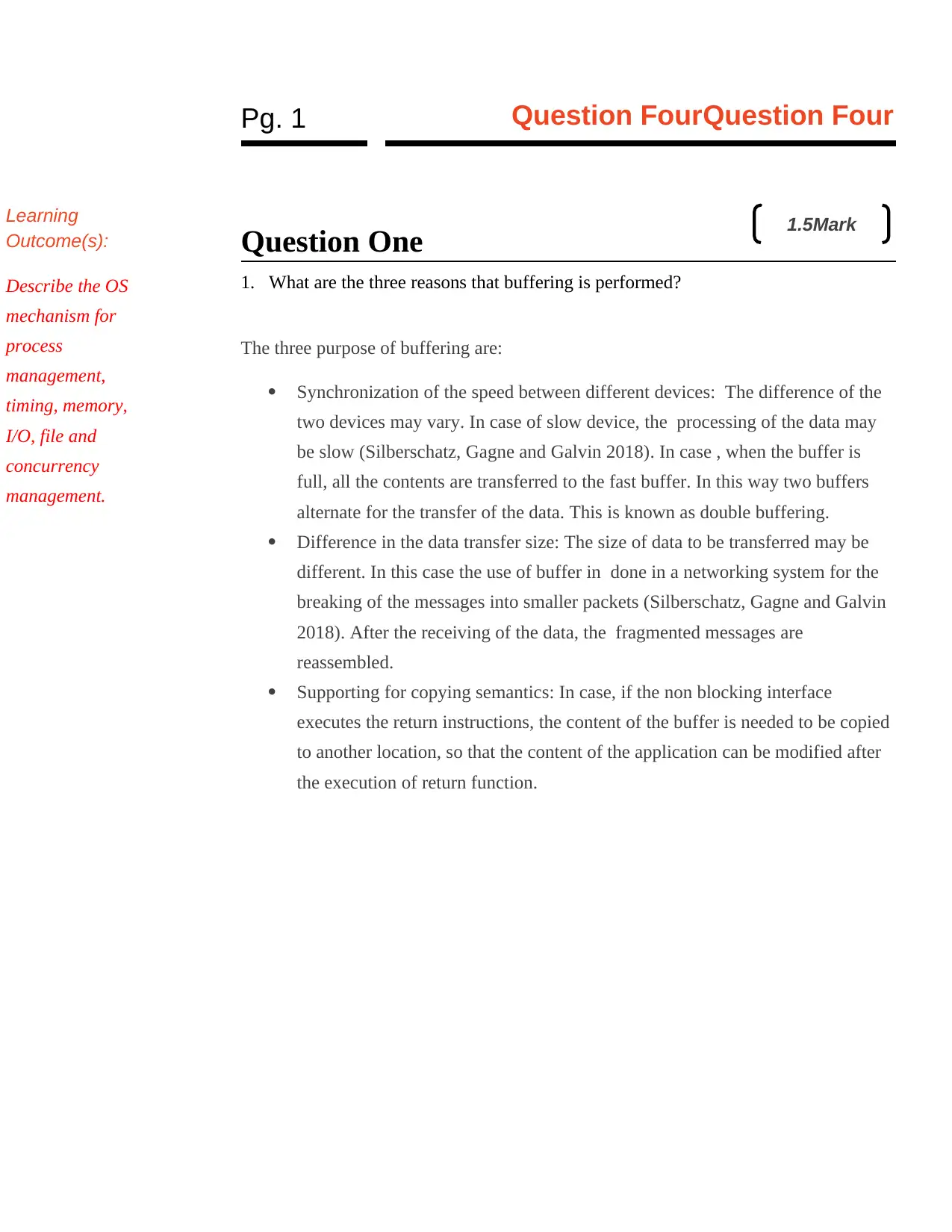
1. What are the three reasons that buffering is performed?
The three purpose of buffering are:
Synchronization of the speed between different devices: The difference of the
two devices may vary. In case of slow device, the processing of the data may
be slow (Silberschatz, Gagne and Galvin 2018). In case , when the buffer is
full, all the contents are transferred to the fast buffer. In this way two buffers
alternate for the transfer of the data. This is known as double buffering.
Difference in the data transfer size: The size of data to be transferred may be
different. In this case the use of buffer in done in a networking system for the
breaking of the messages into smaller packets (Silberschatz, Gagne and Galvin
2018). After the receiving of the data, the fragmented messages are
reassembled.
Supporting for copying semantics: In case, if the non blocking interface
executes the return instructions, the content of the buffer is needed to be copied
to another location, so that the content of the application can be modified after
the execution of return function.
Learning
Outcome(s):
Describe the OS
mechanism for
process
management,
timing, memory,
I/O, file and
concurrency
management.
1.5Mark
Question One
1. What are the three reasons that buffering is performed?
The three purpose of buffering are:
Synchronization of the speed between different devices: The difference of the
two devices may vary. In case of slow device, the processing of the data may
be slow (Silberschatz, Gagne and Galvin 2018). In case , when the buffer is
full, all the contents are transferred to the fast buffer. In this way two buffers
alternate for the transfer of the data. This is known as double buffering.
Difference in the data transfer size: The size of data to be transferred may be
different. In this case the use of buffer in done in a networking system for the
breaking of the messages into smaller packets (Silberschatz, Gagne and Galvin
2018). After the receiving of the data, the fragmented messages are
reassembled.
Supporting for copying semantics: In case, if the non blocking interface
executes the return instructions, the content of the buffer is needed to be copied
to another location, so that the content of the application can be modified after
the execution of return function.
Learning
Outcome(s):
Describe the OS
mechanism for
process
management,
timing, memory,
I/O, file and
concurrency
management.
1.5Mark

Pg. 2 Question FourQuestion Four
Question Two
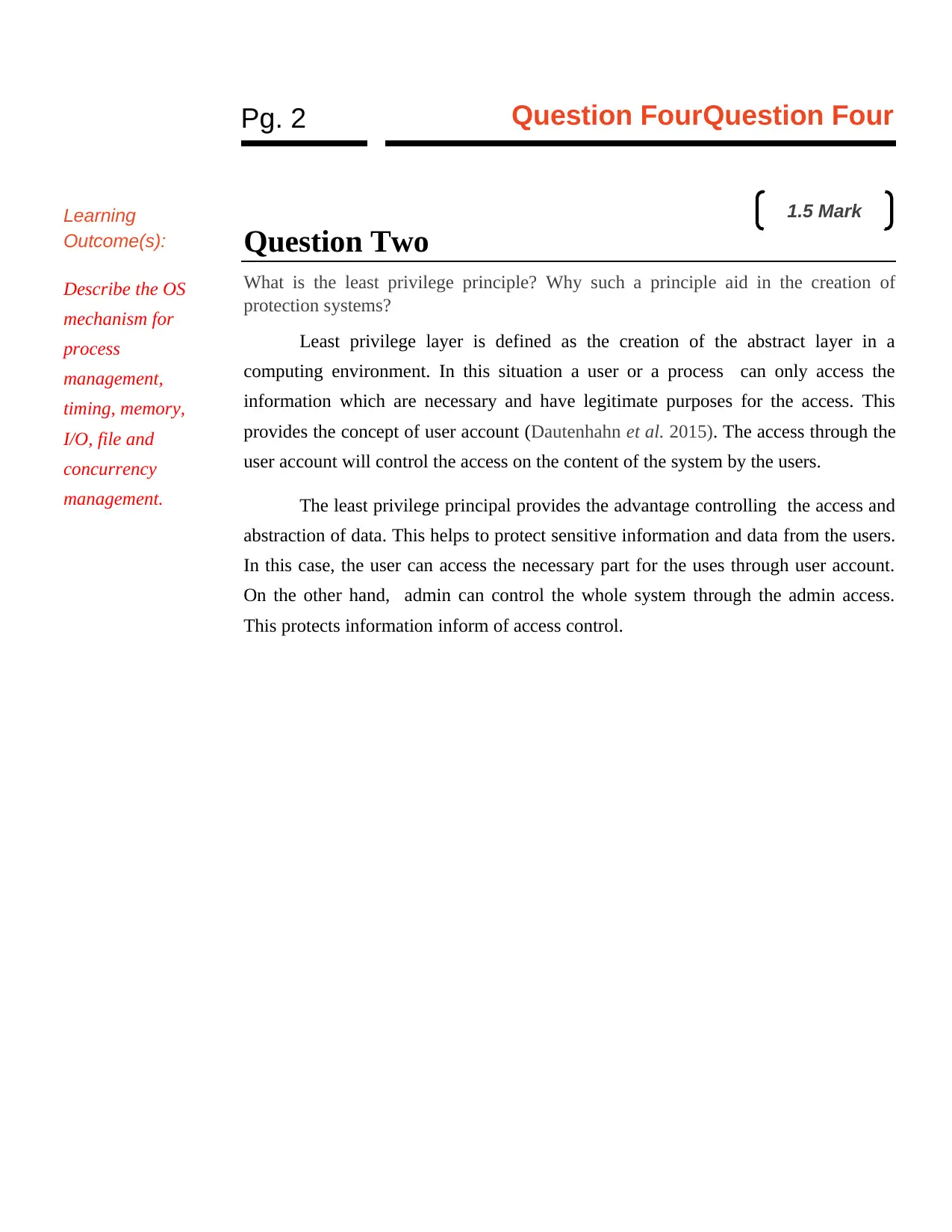
What is the least privilege principle? Why such a principle aid in the creation of
protection systems?
Least privilege layer is defined as the creation of the abstract layer in a
computing environment. In this situation a user or a process can only access the
information which are necessary and have legitimate purposes for the access. This
provides the concept of user account (Dautenhahn et al. 2015). The access through the
user account will control the access on the content of the system by the users.
The least privilege principal provides the advantage controlling the access and
abstraction of data. This helps to protect sensitive information and data from the users.
In this case, the user can access the necessary part for the uses through user account.
On the other hand, admin can control the whole system through the admin access.
This protects information inform of access control.
Learning
Outcome(s):
Describe the OS
mechanism for
process
management,
timing, memory,
I/O, file and
concurrency
management.
1.5 Mark
Question Two
What is the least privilege principle? Why such a principle aid in the creation of
protection systems?
Least privilege layer is defined as the creation of the abstract layer in a
computing environment. In this situation a user or a process can only access the
information which are necessary and have legitimate purposes for the access. This
provides the concept of user account (Dautenhahn et al. 2015). The access through the
user account will control the access on the content of the system by the users.
The least privilege principal provides the advantage controlling the access and
abstraction of data. This helps to protect sensitive information and data from the users.
In this case, the user can access the necessary part for the uses through user account.
On the other hand, admin can control the whole system through the admin access.
This protects information inform of access control.
Learning
Outcome(s):
Describe the OS
mechanism for
process
management,
timing, memory,
I/O, file and
concurrency
management.
1.5 Mark
⊘ This is a preview!⊘
Do you want full access?
Subscribe today to unlock all pages.

Trusted by 1+ million students worldwide

Pg. 3 Question FourQuestion Four
Question Three
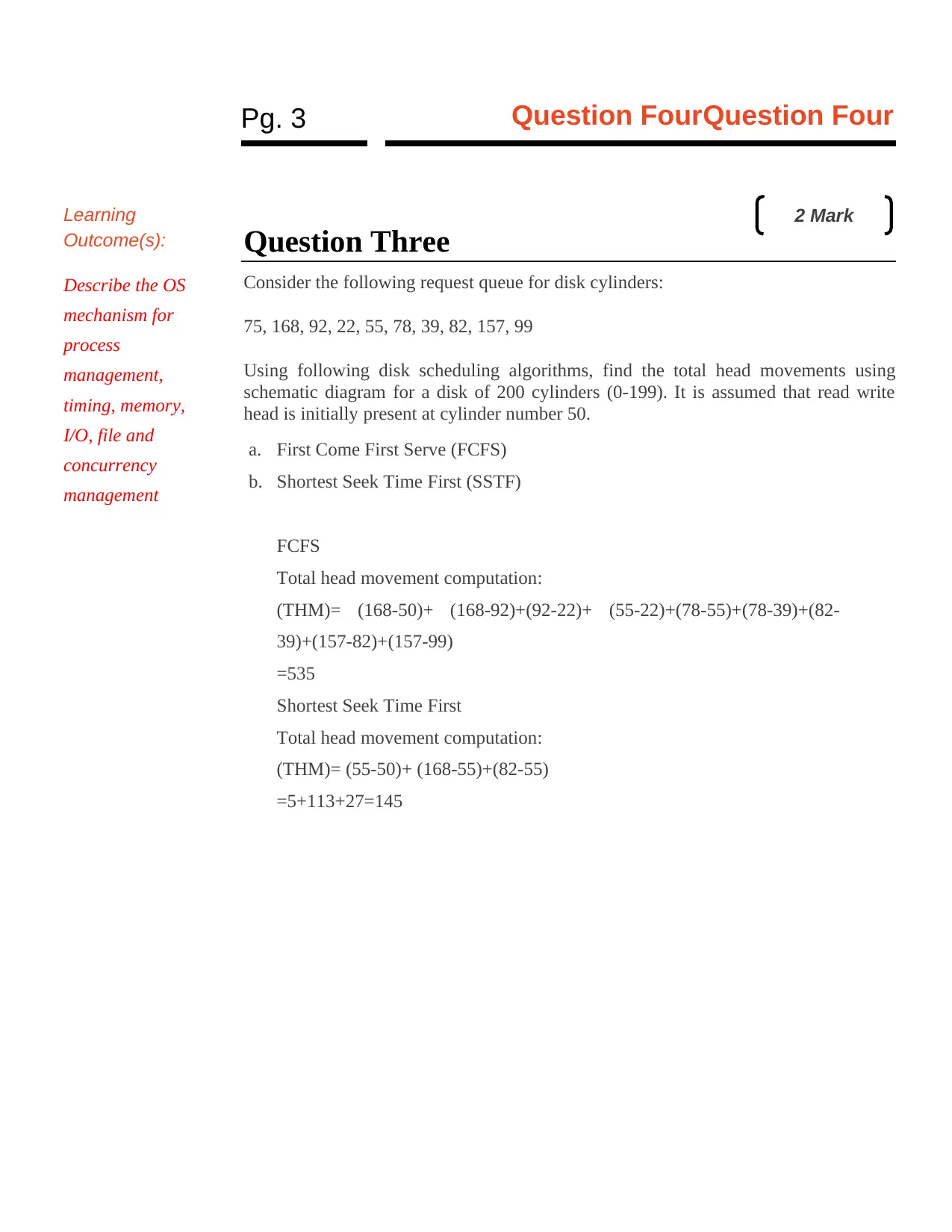
Consider the following request queue for disk cylinders:
75, 168, 92, 22, 55, 78, 39, 82, 157, 99
Using following disk scheduling algorithms, find the total head movements using
schematic diagram for a disk of 200 cylinders (0-199). It is assumed that read write
head is initially present at cylinder number 50.
a. First Come First Serve (FCFS)
b. Shortest Seek Time First (SSTF)
FCFS
Total head movement computation:
(THM)= (168-50)+ (168-92)+(92-22)+ (55-22)+(78-55)+(78-39)+(82-
39)+(157-82)+(157-99)
=535
Shortest Seek Time First
Total head movement computation:
(THM)= (55-50)+ (168-55)+(82-55)
=5+113+27=145
Learning
Outcome(s):
Describe the OS
mechanism for
process
management,
timing, memory,
I/O, file and
concurrency
management
2 Mark
Question Three
Consider the following request queue for disk cylinders:
75, 168, 92, 22, 55, 78, 39, 82, 157, 99
Using following disk scheduling algorithms, find the total head movements using
schematic diagram for a disk of 200 cylinders (0-199). It is assumed that read write
head is initially present at cylinder number 50.
a. First Come First Serve (FCFS)
b. Shortest Seek Time First (SSTF)
FCFS
Total head movement computation:
(THM)= (168-50)+ (168-92)+(92-22)+ (55-22)+(78-55)+(78-39)+(82-
39)+(157-82)+(157-99)
=535
Shortest Seek Time First
Total head movement computation:
(THM)= (55-50)+ (168-55)+(82-55)
=5+113+27=145
Learning
Outcome(s):
Describe the OS
mechanism for
process
management,
timing, memory,
I/O, file and
concurrency
management
2 Mark
Paraphrase This Document
Need a fresh take? Get an instant paraphrase of this document with our AI Paraphraser

Pg. 4 Question FourQuestion Four
Question Four
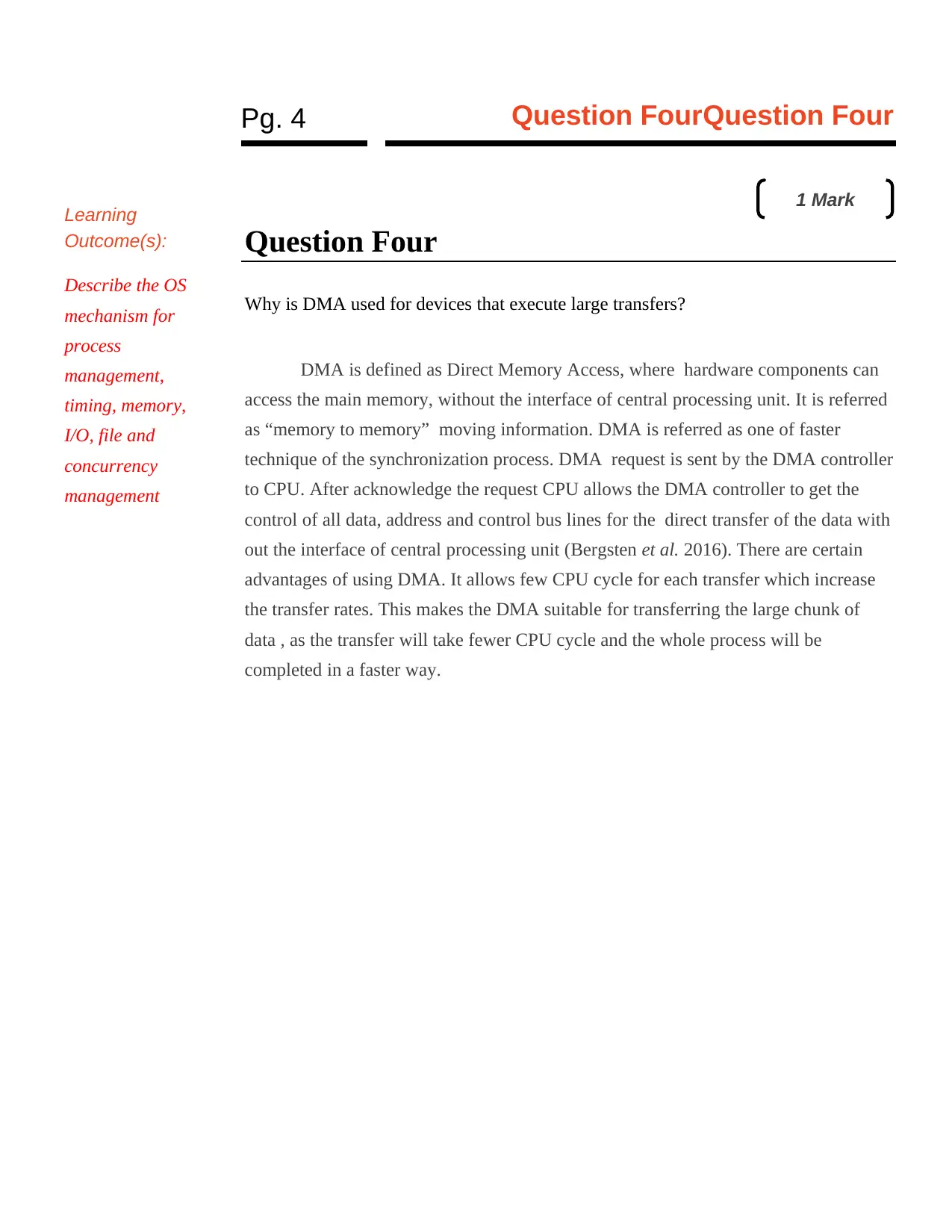
Why is DMA used for devices that execute large transfers?
DMA is defined as Direct Memory Access, where hardware components can
access the main memory, without the interface of central processing unit. It is referred
as “memory to memory” moving information. DMA is referred as one of faster
technique of the synchronization process. DMA request is sent by the DMA controller
to CPU. After acknowledge the request CPU allows the DMA controller to get the
control of all data, address and control bus lines for the direct transfer of the data with
out the interface of central processing unit (Bergsten et al. 2016). There are certain
advantages of using DMA. It allows few CPU cycle for each transfer which increase
the transfer rates. This makes the DMA suitable for transferring the large chunk of
data , as the transfer will take fewer CPU cycle and the whole process will be
completed in a faster way.
Learning
Outcome(s):
Describe the OS
mechanism for
process
management,
timing, memory,
I/O, file and
concurrency
management
1 Mark
Question Four
Why is DMA used for devices that execute large transfers?
DMA is defined as Direct Memory Access, where hardware components can
access the main memory, without the interface of central processing unit. It is referred
as “memory to memory” moving information. DMA is referred as one of faster
technique of the synchronization process. DMA request is sent by the DMA controller
to CPU. After acknowledge the request CPU allows the DMA controller to get the
control of all data, address and control bus lines for the direct transfer of the data with
out the interface of central processing unit (Bergsten et al. 2016). There are certain
advantages of using DMA. It allows few CPU cycle for each transfer which increase
the transfer rates. This makes the DMA suitable for transferring the large chunk of
data , as the transfer will take fewer CPU cycle and the whole process will be
completed in a faster way.
Learning
Outcome(s):
Describe the OS
mechanism for
process
management,
timing, memory,
I/O, file and
concurrency
management
1 Mark

Pg. 5 Question FourQuestion Four
References
Bergsten, J.R., Lomelino, L.W., Christ, C. and Lahr, S.R., APEIRON DATA
SYSTEMS, 2016. Method and apparatus for accessing multiple storage devices from
multiple hosts without use of remote direct memory access (RDMA). U.S. Patent
9,483,431.
Dautenhahn, N., Kasampalis, T., Dietz, W., Criswell, J. and Adve, V., 2015, March.
Nested kernel: An operating system architecture for intra-kernel privilege separation.
In ACM SIGPLAN Notices (Vol. 50, No. 4, pp. 191-206). ACM.
Silberschatz, A., Gagne, G. and Galvin, P.B., 2018. Operating system concepts. Wiley.
References
Bergsten, J.R., Lomelino, L.W., Christ, C. and Lahr, S.R., APEIRON DATA
SYSTEMS, 2016. Method and apparatus for accessing multiple storage devices from
multiple hosts without use of remote direct memory access (RDMA). U.S. Patent
9,483,431.
Dautenhahn, N., Kasampalis, T., Dietz, W., Criswell, J. and Adve, V., 2015, March.
Nested kernel: An operating system architecture for intra-kernel privilege separation.
In ACM SIGPLAN Notices (Vol. 50, No. 4, pp. 191-206). ACM.
Silberschatz, A., Gagne, G. and Galvin, P.B., 2018. Operating system concepts. Wiley.
⊘ This is a preview!⊘
Do you want full access?
Subscribe today to unlock all pages.

Trusted by 1+ million students worldwide
1 out of 6
Your All-in-One AI-Powered Toolkit for Academic Success.
+13062052269
info@desklib.com
Available 24*7 on WhatsApp / Email
Unlock your academic potential
Copyright © 2020–2025 A2Z Services. All Rights Reserved. Developed and managed by ZUCOL.