MIT BN104 Assignment 1: Operating Systems, Memory, Processes
VerifiedAdded on 2020/03/01
|9
|2069
|72
Report
AI Summary
This assignment report, prepared for MIT's BN104 Operating Systems course, explores key aspects of operating systems, memory management, and process scheduling. It includes a quiz summary, explanations of memory allocation policies (Best Fit, First Fit, and Worst Fit), and an analysis of memory replacement algorithms such as FIFO and a simplified version of LRU. The report also delves into process management and scheduling, presenting timelines for FCFS, SJN, SRT, and Round Robin algorithms, along with calculations of waiting time and turnaround time for each algorithm. The student provides detailed explanations and examples, adhering to IEEE referencing style and demonstrating a comprehensive understanding of the topics. The assignment aims to provide a strong understanding of OS structure and functionality, integration of hardware, operating systems and application software.
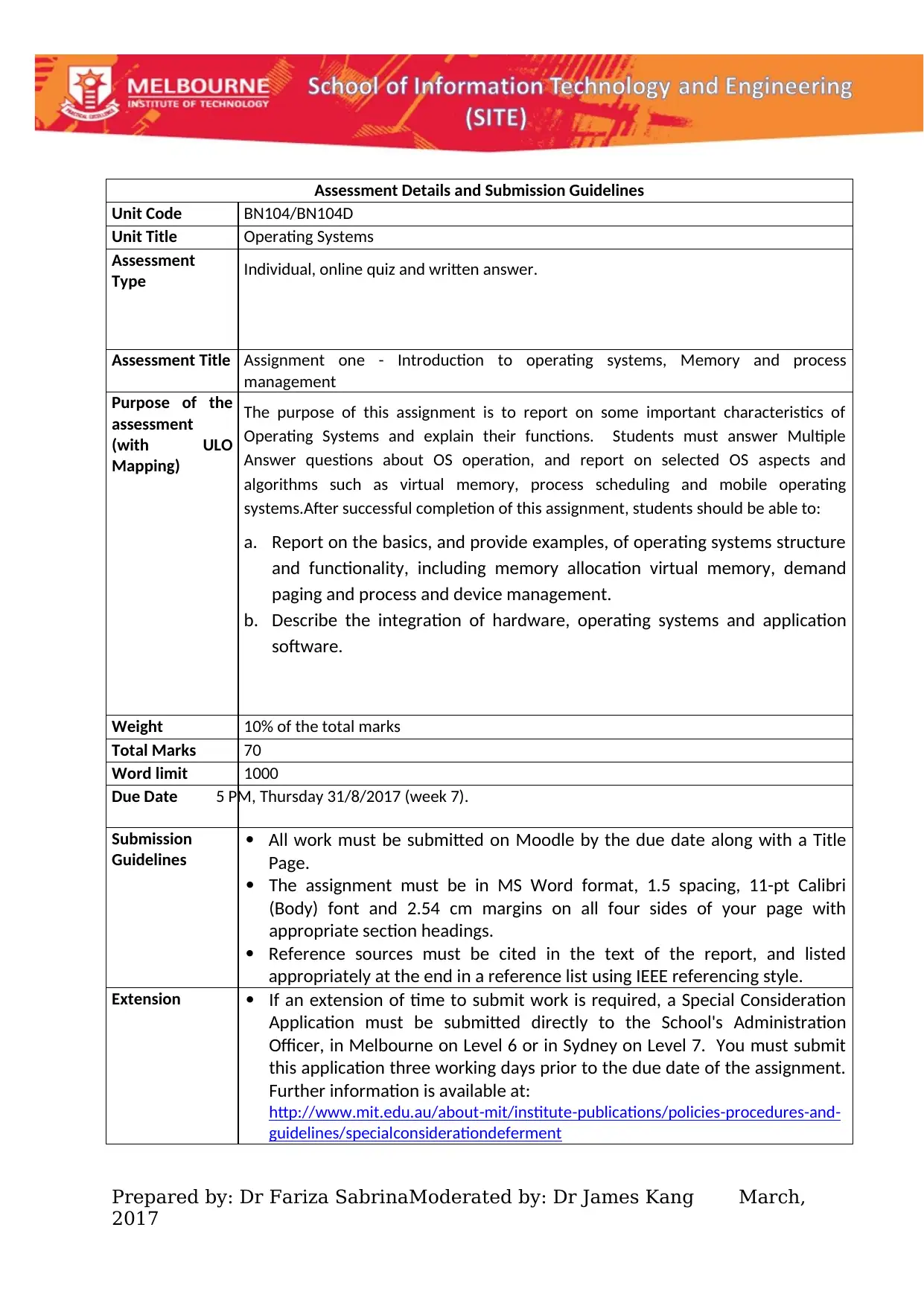
Assessment Details and Submission Guidelines
Unit Code BN104/BN104D
Unit Title Operating Systems
Assessment
Type Individual, online quiz and written answer.
Assessment Title Assignment one - Introduction to operating systems, Memory and process
management
Purpose of the
assessment
(with ULO
Mapping)
The purpose of this assignment is to report on some important characteristics of
Operating Systems and explain their functions. Students must answer Multiple
Answer questions about OS operation, and report on selected OS aspects and
algorithms such as virtual memory, process scheduling and mobile operating
systems.After successful completion of this assignment, students should be able to:
a. Report on the basics, and provide examples, of operating systems structure
and functionality, including memory allocation virtual memory, demand
paging and process and device management.
b. Describe the integration of hardware, operating systems and application
software.
Weight 10% of the total marks
Total Marks 70
Word limit 1000
Due Date 5 PM, Thursday 31/8/2017 (week 7).
Submission
Guidelines
All work must be submitted on Moodle by the due date along with a Title
Page.
The assignment must be in MS Word format, 1.5 spacing, 11-pt Calibri
(Body) font and 2.54 cm margins on all four sides of your page with
appropriate section headings.
Reference sources must be cited in the text of the report, and listed
appropriately at the end in a reference list using IEEE referencing style.
Extension If an extension of time to submit work is required, a Special Consideration
Application must be submitted directly to the School's Administration
Officer, in Melbourne on Level 6 or in Sydney on Level 7. You must submit
this application three working days prior to the due date of the assignment.
Further information is available at:
http://www.mit.edu.au/about-mit/institute-publications/policies-procedures-and-
guidelines/specialconsiderationdeferment
Prepared by: Dr Fariza SabrinaModerated by: Dr James Kang March,
2017
Unit Code BN104/BN104D
Unit Title Operating Systems
Assessment
Type Individual, online quiz and written answer.
Assessment Title Assignment one - Introduction to operating systems, Memory and process
management
Purpose of the
assessment
(with ULO
Mapping)
The purpose of this assignment is to report on some important characteristics of
Operating Systems and explain their functions. Students must answer Multiple
Answer questions about OS operation, and report on selected OS aspects and
algorithms such as virtual memory, process scheduling and mobile operating
systems.After successful completion of this assignment, students should be able to:
a. Report on the basics, and provide examples, of operating systems structure
and functionality, including memory allocation virtual memory, demand
paging and process and device management.
b. Describe the integration of hardware, operating systems and application
software.
Weight 10% of the total marks
Total Marks 70
Word limit 1000
Due Date 5 PM, Thursday 31/8/2017 (week 7).
Submission
Guidelines
All work must be submitted on Moodle by the due date along with a Title
Page.
The assignment must be in MS Word format, 1.5 spacing, 11-pt Calibri
(Body) font and 2.54 cm margins on all four sides of your page with
appropriate section headings.
Reference sources must be cited in the text of the report, and listed
appropriately at the end in a reference list using IEEE referencing style.
Extension If an extension of time to submit work is required, a Special Consideration
Application must be submitted directly to the School's Administration
Officer, in Melbourne on Level 6 or in Sydney on Level 7. You must submit
this application three working days prior to the due date of the assignment.
Further information is available at:
http://www.mit.edu.au/about-mit/institute-publications/policies-procedures-and-
guidelines/specialconsiderationdeferment
Prepared by: Dr Fariza SabrinaModerated by: Dr James Kang March,
2017

Paraphrase This Document
Need a fresh take? Get an instant paraphrase of this document with our AI Paraphraser
BN104/BN104D Operating Systems Page 2 of 9
Academic
Misconduct
Academic Misconduct is a serious offence. Depending on the seriousness of
the case, penalties can vary from a written warning or zero marks to
exclusion from the course or rescinding the degree. Students should make
themselves familiar with the full policy and procedure available
at:http://www.mit.edu.au/about-mit/institute-publications/policies-
procedures-and-guidelines/Plagiarism-Academic-Misconduct-Policy-
Procedure.For further information, please refer to the Academic Integrity
Section in your Unit Description.
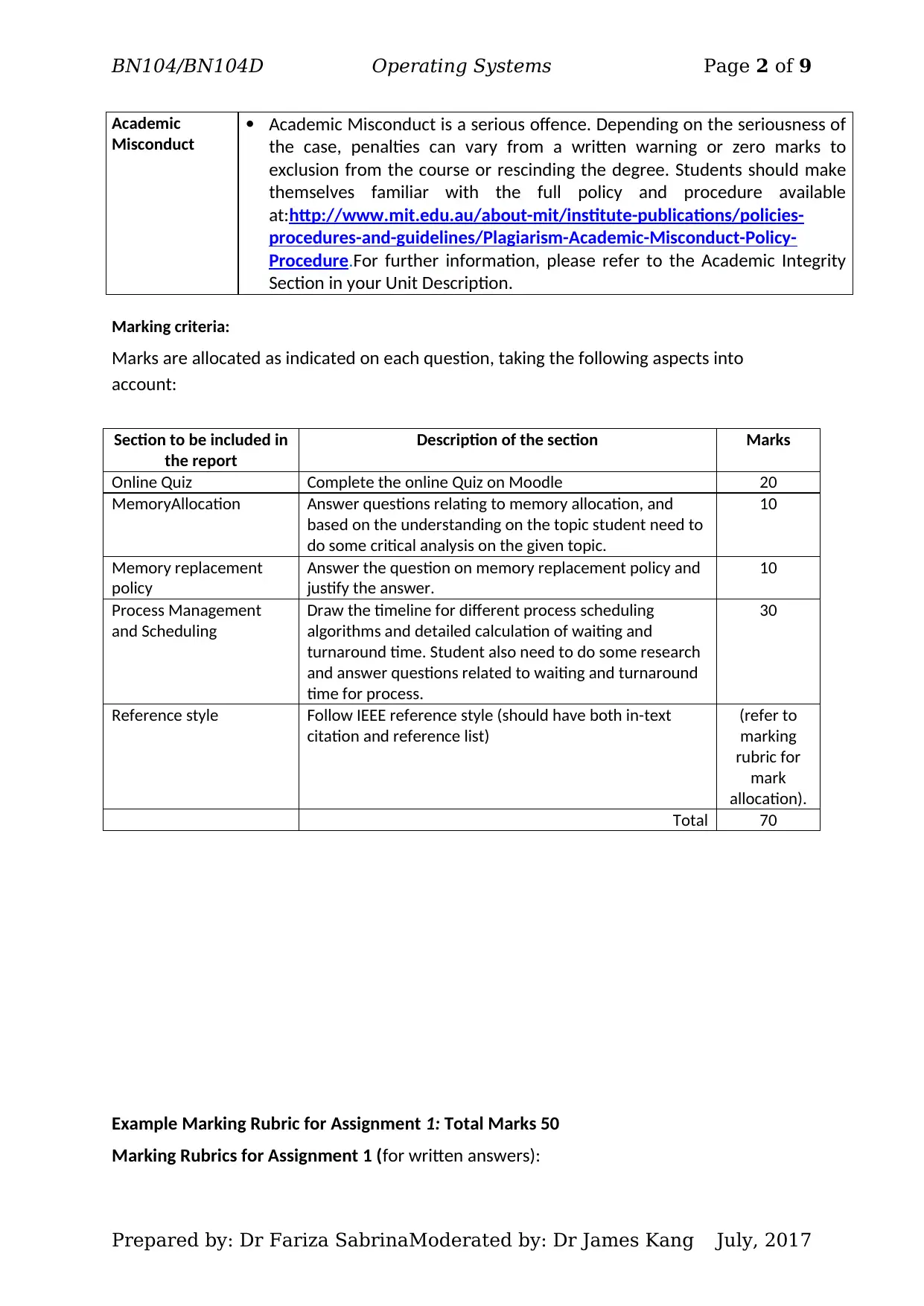
Marking criteria:
Marks are allocated as indicated on each question, taking the following aspects into
account:
Section to be included in
the report
Description of the section Marks
Online Quiz Complete the online Quiz on Moodle 20
MemoryAllocation Answer questions relating to memory allocation, and
based on the understanding on the topic student need to
do some critical analysis on the given topic.
10
Memory replacement
policy
Answer the question on memory replacement policy and
justify the answer.
10
Process Management
and Scheduling
Draw the timeline for different process scheduling
algorithms and detailed calculation of waiting and
turnaround time. Student also need to do some research
and answer questions related to waiting and turnaround
time for process.
30
Reference style Follow IEEE reference style (should have both in-text
citation and reference list)
(refer to
marking
rubric for
mark
allocation).
Total 70
Example Marking Rubric for Assignment 1: Total Marks 50
Marking Rubrics for Assignment 1 (for written answers):
Prepared by: Dr Fariza SabrinaModerated by: Dr James Kang July, 2017
Academic
Misconduct
Academic Misconduct is a serious offence. Depending on the seriousness of
the case, penalties can vary from a written warning or zero marks to
exclusion from the course or rescinding the degree. Students should make
themselves familiar with the full policy and procedure available
at:http://www.mit.edu.au/about-mit/institute-publications/policies-
procedures-and-guidelines/Plagiarism-Academic-Misconduct-Policy-
Procedure.For further information, please refer to the Academic Integrity
Section in your Unit Description.
Marking criteria:
Marks are allocated as indicated on each question, taking the following aspects into
account:
Section to be included in
the report
Description of the section Marks
Online Quiz Complete the online Quiz on Moodle 20
MemoryAllocation Answer questions relating to memory allocation, and
based on the understanding on the topic student need to
do some critical analysis on the given topic.
10
Memory replacement
policy
Answer the question on memory replacement policy and
justify the answer.
10
Process Management
and Scheduling
Draw the timeline for different process scheduling
algorithms and detailed calculation of waiting and
turnaround time. Student also need to do some research
and answer questions related to waiting and turnaround
time for process.
30
Reference style Follow IEEE reference style (should have both in-text
citation and reference list)
(refer to
marking
rubric for
mark
allocation).
Total 70
Example Marking Rubric for Assignment 1: Total Marks 50
Marking Rubrics for Assignment 1 (for written answers):
Prepared by: Dr Fariza SabrinaModerated by: Dr James Kang July, 2017
BN104/BN104D Operating Systems Page 3 of 9
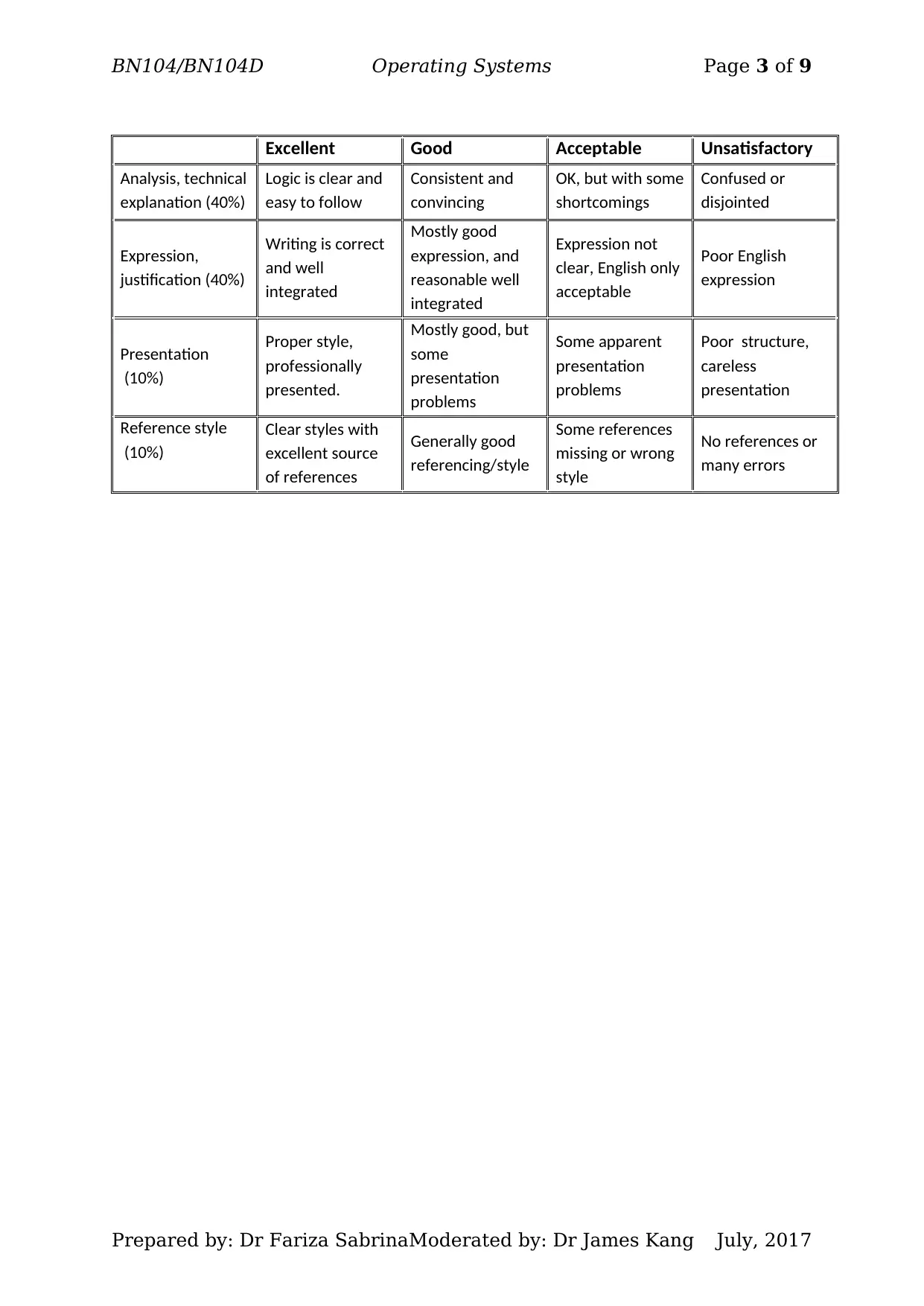
Excellent Good Acceptable Unsatisfactory
Analysis, technical
explanation (40%)
Logic is clear and
easy to follow
Consistent and
convincing
OK, but with some
shortcomings
Confused or
disjointed
Expression,
justification (40%)
Writing is correct
and well
integrated
Mostly good
expression, and
reasonable well
integrated
Expression not
clear, English only
acceptable
Poor English
expression
Presentation
(10%)
Proper style,
professionally
presented.
Mostly good, but
some
presentation
problems
Some apparent
presentation
problems
Poor structure,
careless
presentation
Reference style
(10%)
Clear styles with
excellent source
of references
Generally good
referencing/style
Some references
missing or wrong
style
No references or
many errors
Prepared by: Dr Fariza SabrinaModerated by: Dr James Kang July, 2017
Excellent Good Acceptable Unsatisfactory
Analysis, technical
explanation (40%)
Logic is clear and
easy to follow
Consistent and
convincing
OK, but with some
shortcomings
Confused or
disjointed
Expression,
justification (40%)
Writing is correct
and well
integrated
Mostly good
expression, and
reasonable well
integrated
Expression not
clear, English only
acceptable
Poor English
expression
Presentation
(10%)
Proper style,
professionally
presented.
Mostly good, but
some
presentation
problems
Some apparent
presentation
problems
Poor structure,
careless
presentation
Reference style
(10%)
Clear styles with
excellent source
of references
Generally good
referencing/style
Some references
missing or wrong
style
No references or
many errors
Prepared by: Dr Fariza SabrinaModerated by: Dr James Kang July, 2017
⊘ This is a preview!⊘
Do you want full access?
Subscribe today to unlock all pages.

Trusted by 1+ million students worldwide
BN104/BN104D Operating Systems Page 4 of 9
Assignment 1-Questions
A-QUIZ 20 marks
Attempt the Assignment 1 quiz after Week 6, and paste the summary of your quiz result
(from Moodle) in the assignment report.
B-Q1 10 marks
Memory Allocation
B-Q1a 6 marks
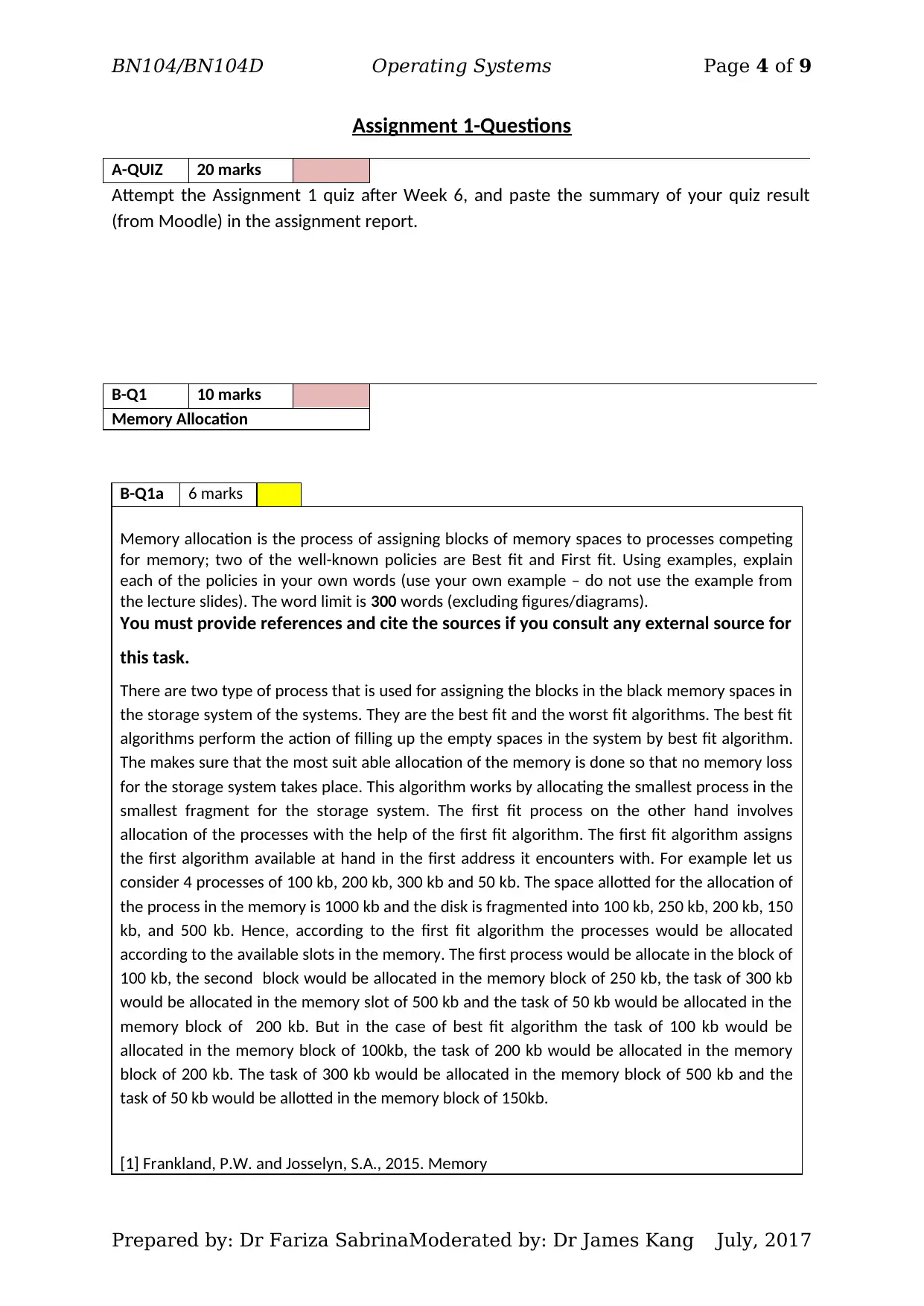
Memory allocation is the process of assigning blocks of memory spaces to processes competing
for memory; two of the well-known policies are Best fit and First fit. Using examples, explain
each of the policies in your own words (use your own example – do not use the example from
the lecture slides). The word limit is 300 words (excluding figures/diagrams).
You must provide references and cite the sources if you consult any external source for
this task.
There are two type of process that is used for assigning the blocks in the black memory spaces in
the storage system of the systems. They are the best fit and the worst fit algorithms. The best fit
algorithms perform the action of filling up the empty spaces in the system by best fit algorithm.
The makes sure that the most suit able allocation of the memory is done so that no memory loss
for the storage system takes place. This algorithm works by allocating the smallest process in the
smallest fragment for the storage system. The first fit process on the other hand involves
allocation of the processes with the help of the first fit algorithm. The first fit algorithm assigns
the first algorithm available at hand in the first address it encounters with. For example let us
consider 4 processes of 100 kb, 200 kb, 300 kb and 50 kb. The space allotted for the allocation of
the process in the memory is 1000 kb and the disk is fragmented into 100 kb, 250 kb, 200 kb, 150
kb, and 500 kb. Hence, according to the first fit algorithm the processes would be allocated
according to the available slots in the memory. The first process would be allocate in the block of
100 kb, the second block would be allocated in the memory block of 250 kb, the task of 300 kb
would be allocated in the memory slot of 500 kb and the task of 50 kb would be allocated in the
memory block of 200 kb. But in the case of best fit algorithm the task of 100 kb would be
allocated in the memory block of 100kb, the task of 200 kb would be allocated in the memory
block of 200 kb. The task of 300 kb would be allocated in the memory block of 500 kb and the
task of 50 kb would be allotted in the memory block of 150kb.
[1] Frankland, P.W. and Josselyn, S.A., 2015. Memory
Prepared by: Dr Fariza SabrinaModerated by: Dr James Kang July, 2017
Assignment 1-Questions
A-QUIZ 20 marks
Attempt the Assignment 1 quiz after Week 6, and paste the summary of your quiz result
(from Moodle) in the assignment report.
B-Q1 10 marks
Memory Allocation
B-Q1a 6 marks
Memory allocation is the process of assigning blocks of memory spaces to processes competing
for memory; two of the well-known policies are Best fit and First fit. Using examples, explain
each of the policies in your own words (use your own example – do not use the example from
the lecture slides). The word limit is 300 words (excluding figures/diagrams).
You must provide references and cite the sources if you consult any external source for
this task.
There are two type of process that is used for assigning the blocks in the black memory spaces in
the storage system of the systems. They are the best fit and the worst fit algorithms. The best fit
algorithms perform the action of filling up the empty spaces in the system by best fit algorithm.
The makes sure that the most suit able allocation of the memory is done so that no memory loss
for the storage system takes place. This algorithm works by allocating the smallest process in the
smallest fragment for the storage system. The first fit process on the other hand involves
allocation of the processes with the help of the first fit algorithm. The first fit algorithm assigns
the first algorithm available at hand in the first address it encounters with. For example let us
consider 4 processes of 100 kb, 200 kb, 300 kb and 50 kb. The space allotted for the allocation of
the process in the memory is 1000 kb and the disk is fragmented into 100 kb, 250 kb, 200 kb, 150
kb, and 500 kb. Hence, according to the first fit algorithm the processes would be allocated
according to the available slots in the memory. The first process would be allocate in the block of
100 kb, the second block would be allocated in the memory block of 250 kb, the task of 300 kb
would be allocated in the memory slot of 500 kb and the task of 50 kb would be allocated in the
memory block of 200 kb. But in the case of best fit algorithm the task of 100 kb would be
allocated in the memory block of 100kb, the task of 200 kb would be allocated in the memory
block of 200 kb. The task of 300 kb would be allocated in the memory block of 500 kb and the
task of 50 kb would be allotted in the memory block of 150kb.
[1] Frankland, P.W. and Josselyn, S.A., 2015. Memory
Prepared by: Dr Fariza SabrinaModerated by: Dr James Kang July, 2017
Paraphrase This Document
Need a fresh take? Get an instant paraphrase of this document with our AI Paraphraser
BN104/BN104D Operating Systems Page 5 of 9
allocation. Neuropsychopharmacology, 40(1), p.243.
B-Q1b 4 marks
Worst-fit is an allocation algorithm that allocates the largest free block to a new job. It is the
opposite of the best-fit algorithm. Compare it to best-fit conditions for the example that you
have given in the answer for B-Q1a and explain in your own words what advantages the worst-fit
algorithm could offer (Word limit: 200 words).
The worst fit algorithm for the task of allocating the tasks in the memory in the system is exactly
opposite to the best fit algorithm and also it is the worst techniques for allocation in contrast
with the best-fit condition and the first-fit algorithms. The worst fit algorithm assigns the largest
free block to the new job and hence, this is the worst algorithm for the allocation of the task sin
the memory of the blocks. The example that have been provided in the previous answer have
provided information about the segments into which the memory have been divided into 100 kb,
250 kb, 200 kb, 150 kb, and 500 kb each. The tasks that have been allocated to the system are of
100 kb, 200 kb, 300 kb and 50 kb. The worst fit algorithm would assign the task of 100 kb in the
segment of 500 kb, the task of 200 kb in the segment of 300 kb. After this process is done with
no further task can be allocated since there would be space for the remainder of the task. Hence,
this is the worst algorithm that would be used for allocating the memory for the processes.
[2] Wang, Y., Ma, X., Xu, M., Liu, Y. and Wang, Y., 2015. Two-echelon logistics distribution region
partitioning problem based on a hybrid particle swarm optimization–genetic algorithm. Expert
Systems with Applications, 42(12), pp.5019-5031.
B-Q2 10 marks
Memory Replacement Policies
B-Q2a 5 marks
Page Time when page was loaded into
memory
Page 3 55
Page 7 20
Page 9 110
Page 10 25
Page 13 100
Page 16 115
Page 17 30
Page 19 150
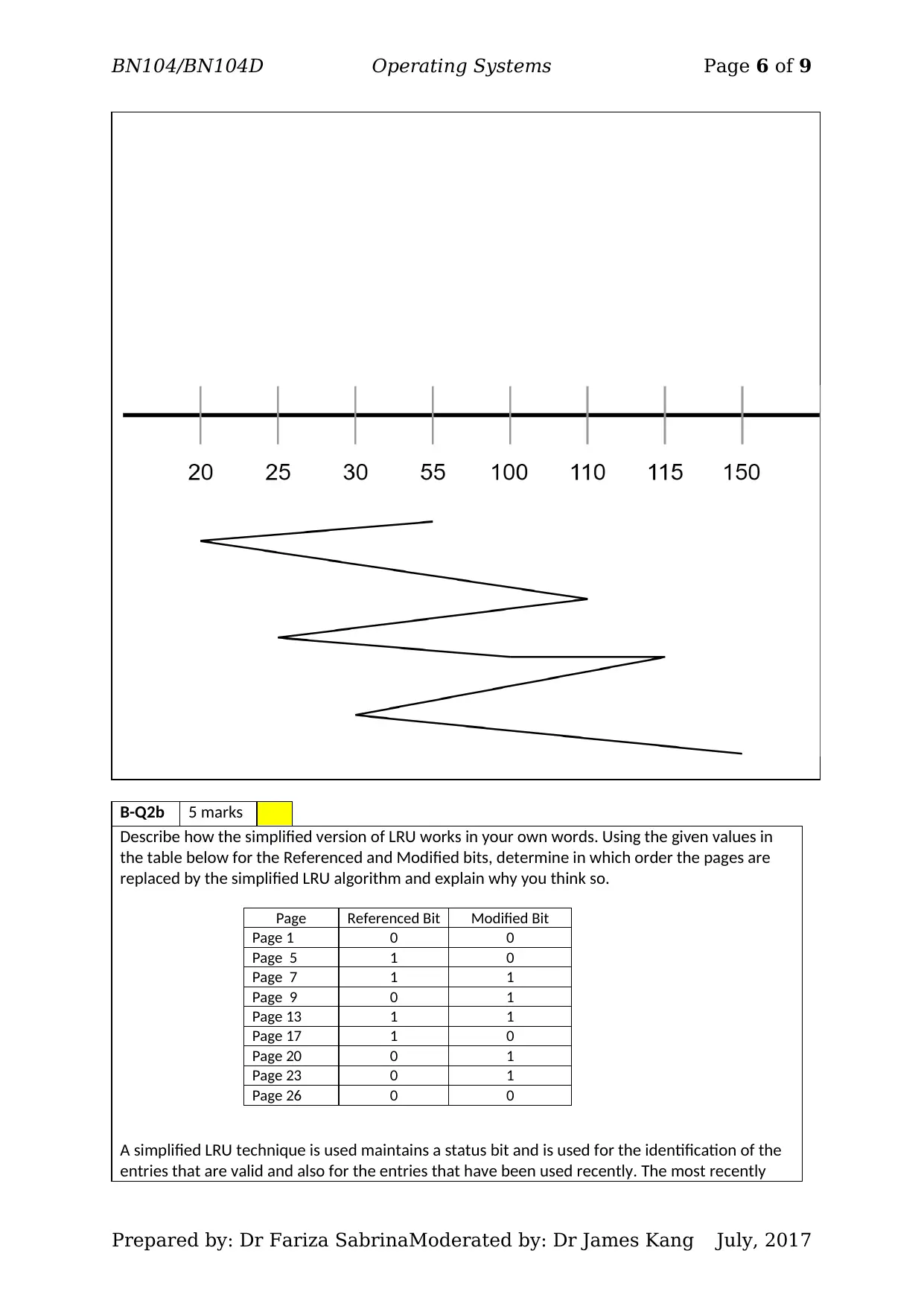
Given the following loading times, determine in which order the pages are replaced by the
FIFO algorithm (explain your reason in details).
Prepared by: Dr Fariza SabrinaModerated by: Dr James Kang July, 2017
allocation. Neuropsychopharmacology, 40(1), p.243.
B-Q1b 4 marks
Worst-fit is an allocation algorithm that allocates the largest free block to a new job. It is the
opposite of the best-fit algorithm. Compare it to best-fit conditions for the example that you
have given in the answer for B-Q1a and explain in your own words what advantages the worst-fit
algorithm could offer (Word limit: 200 words).
The worst fit algorithm for the task of allocating the tasks in the memory in the system is exactly
opposite to the best fit algorithm and also it is the worst techniques for allocation in contrast
with the best-fit condition and the first-fit algorithms. The worst fit algorithm assigns the largest
free block to the new job and hence, this is the worst algorithm for the allocation of the task sin
the memory of the blocks. The example that have been provided in the previous answer have
provided information about the segments into which the memory have been divided into 100 kb,
250 kb, 200 kb, 150 kb, and 500 kb each. The tasks that have been allocated to the system are of
100 kb, 200 kb, 300 kb and 50 kb. The worst fit algorithm would assign the task of 100 kb in the
segment of 500 kb, the task of 200 kb in the segment of 300 kb. After this process is done with
no further task can be allocated since there would be space for the remainder of the task. Hence,
this is the worst algorithm that would be used for allocating the memory for the processes.
[2] Wang, Y., Ma, X., Xu, M., Liu, Y. and Wang, Y., 2015. Two-echelon logistics distribution region
partitioning problem based on a hybrid particle swarm optimization–genetic algorithm. Expert
Systems with Applications, 42(12), pp.5019-5031.
B-Q2 10 marks
Memory Replacement Policies
B-Q2a 5 marks
Page Time when page was loaded into
memory
Page 3 55
Page 7 20
Page 9 110
Page 10 25
Page 13 100
Page 16 115
Page 17 30
Page 19 150
Given the following loading times, determine in which order the pages are replaced by the
FIFO algorithm (explain your reason in details).
Prepared by: Dr Fariza SabrinaModerated by: Dr James Kang July, 2017
BN104/BN104D Operating Systems Page 6 of 9
B-Q2b 5 marks
Describe how the simplified version of LRU works in your own words. Using the given values in
the table below for the Referenced and Modified bits, determine in which order the pages are
replaced by the simplified LRU algorithm and explain why you think so.
A simplified LRU technique is used maintains a status bit and is used for the identification of the
entries that are valid and also for the entries that have been used recently. The most recently
Prepared by: Dr Fariza SabrinaModerated by: Dr James Kang July, 2017
Page Referenced Bit Modified Bit
Page 1 0 0
Page 5 1 0
Page 7 1 1
Page 9 0 1
Page 13 1 1
Page 17 1 0
Page 20 0 1
Page 23 0 1
Page 26 0 0
B-Q2b 5 marks
Describe how the simplified version of LRU works in your own words. Using the given values in
the table below for the Referenced and Modified bits, determine in which order the pages are
replaced by the simplified LRU algorithm and explain why you think so.
A simplified LRU technique is used maintains a status bit and is used for the identification of the
entries that are valid and also for the entries that have been used recently. The most recently
Prepared by: Dr Fariza SabrinaModerated by: Dr James Kang July, 2017
Page Referenced Bit Modified Bit
Page 1 0 0
Page 5 1 0
Page 7 1 1
Page 9 0 1
Page 13 1 1
Page 17 1 0
Page 20 0 1
Page 23 0 1
Page 26 0 0
⊘ This is a preview!⊘
Do you want full access?
Subscribe today to unlock all pages.
Trusted by 1+ million students worldwide
BN104/BN104D Operating Systems Page 7 of 9
used bits in these techniques are replaced by the algorithm.
The order in which the page replacement technique are applied are:
5, 17, 7, 13, 9, 20, 23, 1, 26
B-Q3 30 marks
Process Management and Scheduling
B-Q3a 20 marks
In a multiprogramming environment, scheduling algorithms are used for better utilisation of
processor resources, maximising the system performance and to achieve fairness among difference
processes. There are a number of scheduling algorithms that could be used in a multiprogramming
environment, such as:
1. FCFS
2. SJN
3. SRT
4. Round Robin
Given the following arrival time and CPU
cycle times:
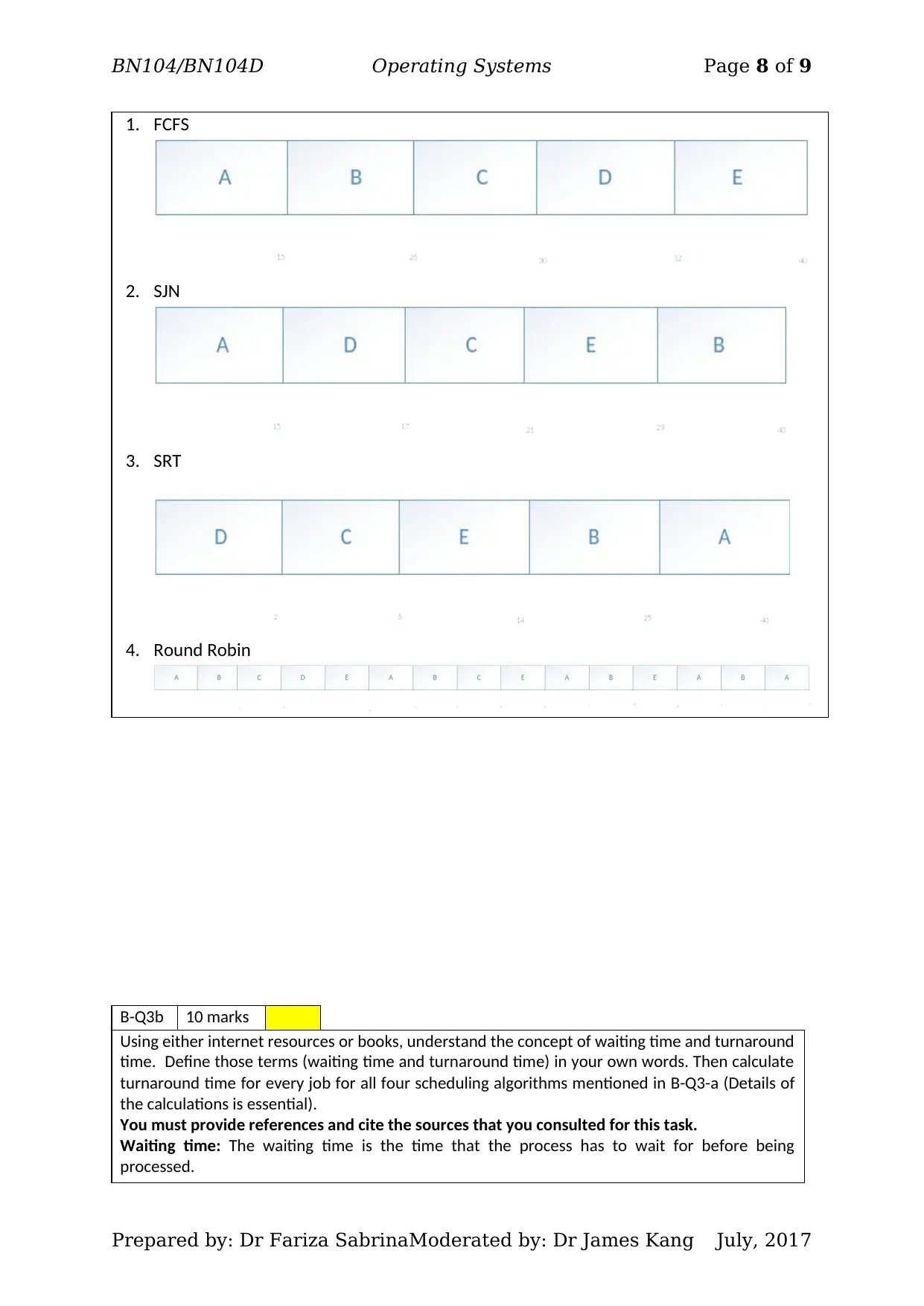
(i) Draw a timeline for each of the above scheduling algorithms and explain the
timeline in your own words. (3x4=12 marks)
(ii) Show the details of the ready queue formation during the time line. (2x4=8
marks)
For Round Robin use time quantum of 3.
Prepared by: Dr Fariza SabrinaModerated by: Dr James Kang July, 2017
Process Arrival Time
(sec)
CPU cycle
A 0 15
B 2 11
C 3 4
D 7 2
E 10 8
used bits in these techniques are replaced by the algorithm.
The order in which the page replacement technique are applied are:
5, 17, 7, 13, 9, 20, 23, 1, 26
B-Q3 30 marks
Process Management and Scheduling
B-Q3a 20 marks
In a multiprogramming environment, scheduling algorithms are used for better utilisation of
processor resources, maximising the system performance and to achieve fairness among difference
processes. There are a number of scheduling algorithms that could be used in a multiprogramming
environment, such as:
1. FCFS
2. SJN
3. SRT
4. Round Robin
Given the following arrival time and CPU
cycle times:
(i) Draw a timeline for each of the above scheduling algorithms and explain the
timeline in your own words. (3x4=12 marks)
(ii) Show the details of the ready queue formation during the time line. (2x4=8
marks)
For Round Robin use time quantum of 3.
Prepared by: Dr Fariza SabrinaModerated by: Dr James Kang July, 2017
Process Arrival Time
(sec)
CPU cycle
A 0 15
B 2 11
C 3 4
D 7 2
E 10 8
Paraphrase This Document
Need a fresh take? Get an instant paraphrase of this document with our AI Paraphraser
BN104/BN104D Operating Systems Page 8 of 9
1. FCFS
2. SJN
3. SRT
4. Round Robin
B-Q3b 10 marks
Using either internet resources or books, understand the concept of waiting time and turnaround
time. Define those terms (waiting time and turnaround time) in your own words. Then calculate
turnaround time for every job for all four scheduling algorithms mentioned in B-Q3-a (Details of
the calculations is essential).
You must provide references and cite the sources that you consulted for this task.
Waiting time: The waiting time is the time that the process has to wait for before being
processed.
Prepared by: Dr Fariza SabrinaModerated by: Dr James Kang July, 2017
1. FCFS
2. SJN
3. SRT
4. Round Robin
B-Q3b 10 marks
Using either internet resources or books, understand the concept of waiting time and turnaround
time. Define those terms (waiting time and turnaround time) in your own words. Then calculate
turnaround time for every job for all four scheduling algorithms mentioned in B-Q3-a (Details of
the calculations is essential).
You must provide references and cite the sources that you consulted for this task.
Waiting time: The waiting time is the time that the process has to wait for before being
processed.
Prepared by: Dr Fariza SabrinaModerated by: Dr James Kang July, 2017
BN104/BN104D Operating Systems Page 9 of 9
Turnaround time: Turnaround time is the total time required for the process to be completed.
[3] Panda, S.K. and Bhoi, S.K., 2014. An effective round robin algorithm using min-max
dispersion measure. arXiv preprint arXiv:1404.5869.
Prepared by: Dr Fariza SabrinaModerated by: Dr James Kang July, 2017
Turnaround time: Turnaround time is the total time required for the process to be completed.
[3] Panda, S.K. and Bhoi, S.K., 2014. An effective round robin algorithm using min-max
dispersion measure. arXiv preprint arXiv:1404.5869.
Prepared by: Dr Fariza SabrinaModerated by: Dr James Kang July, 2017
⊘ This is a preview!⊘
Do you want full access?
Subscribe today to unlock all pages.
Trusted by 1+ million students worldwide

1 out of 9


Related Documents


Your All-in-One AI-Powered Toolkit for Academic Success.
+13062052269
info@desklib.com
Available 24*7 on WhatsApp / Email
![[object Object]](/_next/static/media/star-bottom.7253800d.svg)
Unlock your academic potential
Copyright © 2020–2026 A2Z Services. All Rights Reserved. Developed and managed by ZUCOL.