UG2 Coursework: Analyzing Multilevel Queue & Feedback Queue Scheduling

Verified

Added on  2022/11/17

|5
|1031
|356
Homework Assignment
AI Summary
This assignment provides a comparative analysis of two CPU scheduling algorithms: Multilevel Queue Scheduling and Multilevel Feedback Queue Scheduling. The student's work delves into the core concepts of operating systems, focusing on how these algorithms manage processes and allocate CPU resources. The assignment begins with an overview of Multilevel Queue Scheduling, explaining how processes are categorized into different queues based on their characteristics, such as priority and type. It then describes the fixed priority preemptive scheduling or time slicing used to schedule processes among the queues, and how each queue is assigned its own scheduling algorithm. The assignment then transitions to Multilevel Feedback Queue Scheduling, illustrating how processes can move between queues based on their execution behavior and priority. The student discusses the time quantum adjustments for processes and how this can be utilized to make sure that higher priority processes are executed first. The assignment also reflects on the writing process, discussing the research and the selection of the scheduling algorithms, and the student's learning experience. The assignment concludes with references to the sources used in the research.
Document Page
Running head: OPERATING SYSTEMS UG2
Coursework Exercise Sheet 2
Name of the Student
Name of the University
Author’s Note
tabler-icon-diamond-filled.svg

Paraphrase This Document

Need a fresh take? Get an instant paraphrase of this document with our AI Paraphraser
Document Page
1
OPERATING SYSTEMS UG2
Comparison of Multilevel Queue Scheduling and Multilevel Feedback Queue Scheduling
Multilevel Queue Scheduling
In the blog I have compared Multilevel Queue scheduling and Multilevel Queue
scheduling after analyzing their behavior time and processes based on the priorities. With the use
of this algorithm the processes are classified into different groups. A division is made between
foreground process and background processes. There are different response time for the
processes and they also have different needs of scheduling (Serrano et al. 2016). The priority of
the foreground process may be more than the background processes. The algorithm partitions the
ready queue into different separate queues and the processes are permanently assigned to a queue
which is based on the property of the process for example memory size, priority of the process
and type. Each of the queue is assigned with its own scheduling algorithm. The multilevel queue
scheduling algorithm may have five queues such as system processes, interactive processes,
interactive editing processes, batch processing and student processing (Brown 2017). Each of the
queue has priority over the lower queue and none of the process in the batch queue can run
unless the queues for system processes, interactive processes, and interactive editing processes
are empty. In case an interactive editing process enters into ready queue and the batch process is
in running state the batch process is needed to be preempted. In case there are processes in each
of the queue the algorithm uses the fixed priority preemptive scheduling or time slicing for
determining the scheduling among the queues. In the first method an absolute priority is present
for each of the queue for the lower queue. If the order of priority for a queue is queue 1 > queue
2 > queue 3, the algorithm states that a process in a batch queue cannot run unless the above
queues are empty (Liu et al. 2019). For the second methodology I have found that a certain
proportion of time is allocated for the CPU time and it can be used for scheduling the processes.
Document Page
2
Queue 1
Queue 2
Queue 3
High Priority
Low Priority
OPERATING SYSTEMS UG2
For example queue 1 can take 50 percent of CPU time, queue 2 take 30 percent and queue 3 20
percent.
Multilevel Feedback Queue Scheduling
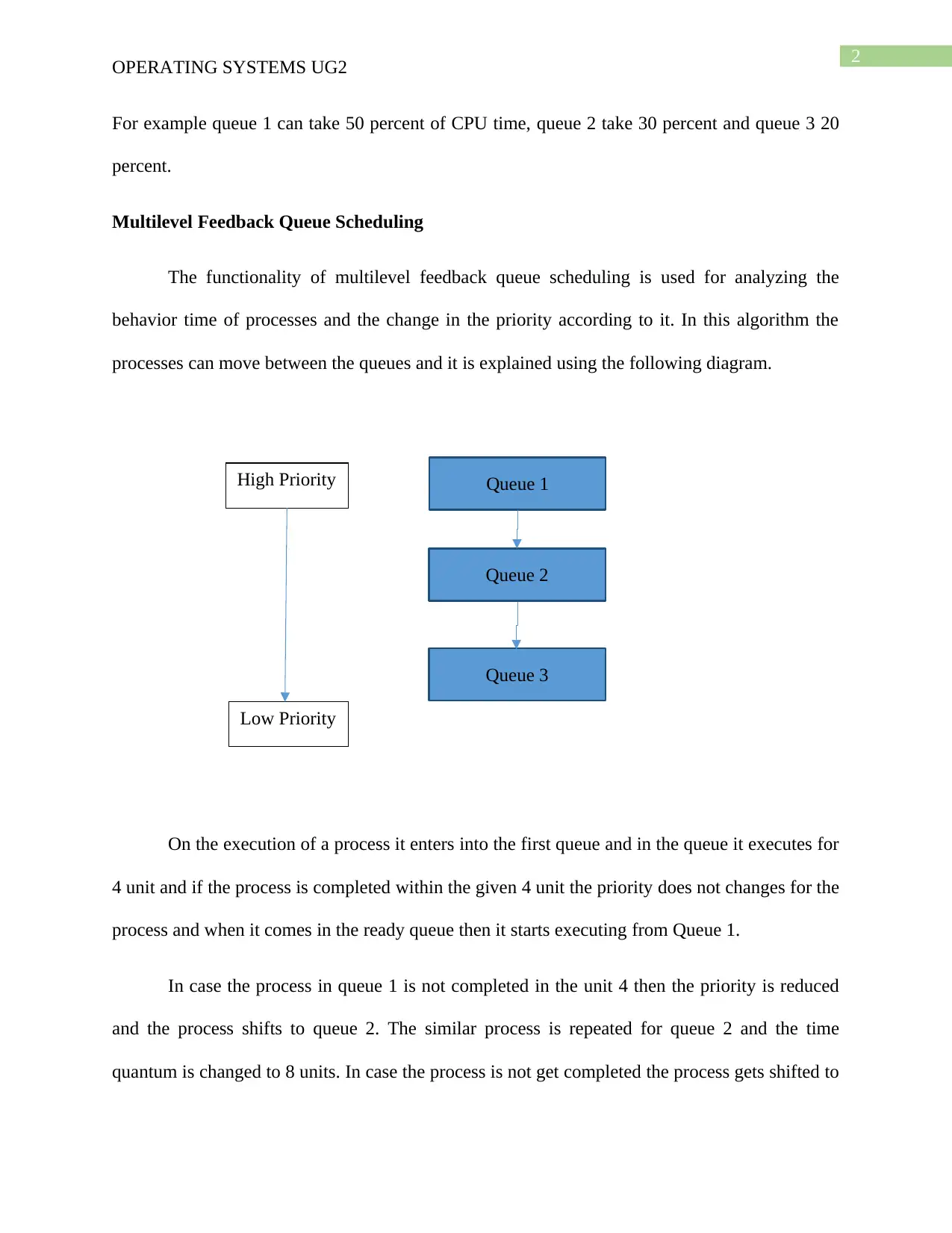
The functionality of multilevel feedback queue scheduling is used for analyzing the
behavior time of processes and the change in the priority according to it. In this algorithm the
processes can move between the queues and it is explained using the following diagram.
On the execution of a process it enters into the first queue and in the queue it executes for
4 unit and if the process is completed within the given 4 unit the priority does not changes for the
process and when it comes in the ready queue then it starts executing from Queue 1.
In case the process in queue 1 is not completed in the unit 4 then the priority is reduced
and the process shifts to queue 2. The similar process is repeated for queue 2 and the time
quantum is changed to 8 units. In case the process is not get completed the process gets shifted to
Document Page
3
OPERATING SYSTEMS UG2
a queue with lower priority (Thombare et al. 2016). For the last queue FCFS is used for
scheduling the process. With this algorithm the process in lower priority can be executed when
the process having higher priority is empty. The process with lower priority can be interrupted by
a higher priority process arriving at the queue.
There is a problem with the implementation because the process having lower priority
can suffer starvation if there are shorter processes taking the CPU time. The problem can be
solved by boosting the priority of the processes after a regular time interval and placing them in
the highest queue of priority.
Reflective Comments
I have no previous experience in writing blog post and researched on the writing style
that is needed to be followed. I then performed a research on the topic and selected the two
scheduling algorithms i.e. Multilevel Queue Scheduling, Multilevel Feedback-Queue Scheduling
from different sources available on the internet for completing the coursework.
I can learn to create a blog and use the coursework lessons learnt to write multiple blog
such that my juniors can learn from the blogs and improve their skills and knowledge.
I have gathered some knowledge about the scheduling algorithms and used it for
distinguishing the different scheduling and writing the blog post.
I have learned different scheduling algorithm and found its application in different field
of operating system for management of multiple tasks and allocation of resources for its
execution.
tabler-icon-diamond-filled.svg

Paraphrase This Document

Need a fresh take? Get an instant paraphrase of this document with our AI Paraphraser
Document Page
4
OPERATING SYSTEMS UG2
References
Brown, J.E., 2017. On Intelligent Mitigation of Process Starvation In Multilevel Feedback Queue
Scheduling.
Liu, S., Wang, Z., Wei, G. and Li, M., 2019. Distributed Set-Membership Filtering for Multirate
Systems Under the Round-Robin Scheduling Over Sensor Networks. IEEE transactions on
cybernetics.
Serrano, M.A., Melani, A., Bertogna, M. and Quinones, E., 2016, March. Response-time analysis
of DAG tasks under fixed priority scheduling with limited preemptions. In 2016 Design,
Automation & Test in Europe Conference & Exhibition (DATE) (pp. 1066-1071). IEEE.
Thombare, M., Sukhwani, R., Shah, P., Chaudhari, S. and Raundale, P., 2016, March. Efficient
implementation of Multilevel Feedback Queue Scheduling. In 2016 International Conference on
Wireless Communications, Signal Processing and Networking (WiSPNET) (pp. 1950-1954).
IEEE.
chevron_up_icon
1 out of 5
circle_padding
hide_on_mobile
zoom_out_icon
[object Object]