Strategic Operation Management Practices at IKEA: A Detailed Report
VerifiedAdded on 2020/06/06
|20
|5141
|98
Report
AI Summary
This report provides a comprehensive analysis of IKEA's operation management, exploring its significance, functions, and process models. It delves into the vital role of operation management in enhancing productivity, controlling inventory, and ensuring quality control. The report outlines IKEA's key operation functions, including planning, designing, managing, and coordinating, while also illustrating the process model with inputs, transformation processes, and outputs. Furthermore, the report examines the significance of the three E's—economy, efficiency, and effectiveness—in IKEA's operational success, highlighting strategies to minimize costs, optimize resource utilization, and achieve organizational goals. The report also explores the importance of supply chain management, and customer satisfaction in IKEA's operation.
Operation
Management In
organisation
Management In
organisation

Paraphrase This Document
Need a fresh take? Get an instant paraphrase of this document with our AI Paraphraser
INTRODUCTION
Operation management is the process of monitoring all the activities which starts from
procuring inventory to the delivering of goods and services to the customers. IKEA which is
serving broad range of well-fashioned, structural home furnishing goods at low prices so that
numerous people can able to afford them. The company focus is to minimise cost and maximise
quality which produce high tension in the company but they able to cope up with this by planning
various strategies that are reduced indirect cost, emphases on the investment to direct cost,
control over the overheads. The report describe their function that are planning, designing,
managing and coordinating. They have planned five objectives which includes durability,
flexibility etc. in order to maintain all the operations.
TASK 1
1.1 Significance of operation management for the success of IKEA
Operation management is the vital part for any company to improve the productivity in
order to improve the financial health of the venture as well as it helps to meet the consumer
competitive priorities.
Improves productivity: it is the ratio of output to input, it can be measure by the managers
and employees efficiency in order to use all the scare resources effectively and efficiently so that
quality goods and services can be produced. As the numerical value of the ratio is higher, the
efficiency is higher. The organisation main motive is to cut input cost and boost up the output of
the travelling cost (Wakui and Aki, 2017).
The firm's focus was on the supply chain because it is the main factor where the great
amount of capital is invested and it provides the catalyst for analysing the components of the
operation. Logistics improvement includes the change in how the goods are procured, stored and
transported which helps in reduce the inventory and increase the quality and speed of service, this
can be done through the proper order processing. Through implementation of the operation
management, the goods are now ordered centrally and direct shipped to the clients.
As the manufacturing company have more operations and orders which start from the
procurement of raw material till the products are sold to the customers. In the service industry the
operations are start from identifying the customers needs till getting feedback from the clients
about the quality of service and their satisfaction. So it is important to manage all these activities
1
Operation management is the process of monitoring all the activities which starts from
procuring inventory to the delivering of goods and services to the customers. IKEA which is
serving broad range of well-fashioned, structural home furnishing goods at low prices so that
numerous people can able to afford them. The company focus is to minimise cost and maximise
quality which produce high tension in the company but they able to cope up with this by planning
various strategies that are reduced indirect cost, emphases on the investment to direct cost,
control over the overheads. The report describe their function that are planning, designing,
managing and coordinating. They have planned five objectives which includes durability,
flexibility etc. in order to maintain all the operations.
TASK 1
1.1 Significance of operation management for the success of IKEA
Operation management is the vital part for any company to improve the productivity in
order to improve the financial health of the venture as well as it helps to meet the consumer
competitive priorities.
Improves productivity: it is the ratio of output to input, it can be measure by the managers
and employees efficiency in order to use all the scare resources effectively and efficiently so that
quality goods and services can be produced. As the numerical value of the ratio is higher, the
efficiency is higher. The organisation main motive is to cut input cost and boost up the output of
the travelling cost (Wakui and Aki, 2017).
The firm's focus was on the supply chain because it is the main factor where the great
amount of capital is invested and it provides the catalyst for analysing the components of the
operation. Logistics improvement includes the change in how the goods are procured, stored and
transported which helps in reduce the inventory and increase the quality and speed of service, this
can be done through the proper order processing. Through implementation of the operation
management, the goods are now ordered centrally and direct shipped to the clients.
As the manufacturing company have more operations and orders which start from the
procurement of raw material till the products are sold to the customers. In the service industry the
operations are start from identifying the customers needs till getting feedback from the clients
about the quality of service and their satisfaction. So it is important to manage all these activities
1
⊘ This is a preview!⊘
Do you want full access?
Subscribe today to unlock all pages.

Trusted by 1+ million students worldwide
which helps in effective use of resources and fulfilling the customer's needs. Proper operation
management helps in various aspects that are as follows:
Control over the inventory of the company where they have proper knowledge about
that how much raw materials are required to fulfil the demands of the customers, how
much inventory is kept with them and how many goods they will require satisfying the
future orders (Hennelly and Sra, 2017). Inventory includes different classification such as
raw material, work in progress, waste etc. organisation need to manage these inventory so
that they can able to use their resources in the proper way.
Proper supply chain management which start from the procuring the raw material till
the goods are served to clients. It includes purchasing, storage, transportation and delivery
of inventory and finished goods. It also includes the implementation of the technology
that helps the staff to continue the process as well as developing the professional
relationship with the suppliers and external stakeholders. It includes different
intermediaries such as suppliers, distributors, warehouse, transportation etc, these all
activities should be done in the co-ordinated way.
Quality control: Quality is more significant from the production, it helps in satisfying the
customers needs. It shows that the brand meets the expectations of clients. Quality is the
one factor which entail the overall excellence of all the operation and policies of the
organisation as the whole.
1.2 Operations functions of IKEA.
Operation management is the multidisciplinary field which focus on the all the aspects of
the organisation's operations. In as typical venture, there are lots of functions that are to be
performed by the operation manager and their subordinates. Their functions are as follows:
Planning: For cope upping with the various situation such as competition, governmental
rules and regulation, economic conditions etc. system planning helps the management to
utilise all the resources effectively and efficiently. Planning process helps the organisation
to met up with the competitors and adopt the changing environment such as technology,
policies and techniques. When there is increase and decrease in the demand of the
costumer, proper planning of the operations helps to set the priorities and cope with the
changing demands (Hedenstierna and Holmstr, 2016).
2
management helps in various aspects that are as follows:
Control over the inventory of the company where they have proper knowledge about
that how much raw materials are required to fulfil the demands of the customers, how
much inventory is kept with them and how many goods they will require satisfying the
future orders (Hennelly and Sra, 2017). Inventory includes different classification such as
raw material, work in progress, waste etc. organisation need to manage these inventory so
that they can able to use their resources in the proper way.
Proper supply chain management which start from the procuring the raw material till
the goods are served to clients. It includes purchasing, storage, transportation and delivery
of inventory and finished goods. It also includes the implementation of the technology
that helps the staff to continue the process as well as developing the professional
relationship with the suppliers and external stakeholders. It includes different
intermediaries such as suppliers, distributors, warehouse, transportation etc, these all
activities should be done in the co-ordinated way.
Quality control: Quality is more significant from the production, it helps in satisfying the
customers needs. It shows that the brand meets the expectations of clients. Quality is the
one factor which entail the overall excellence of all the operation and policies of the
organisation as the whole.
1.2 Operations functions of IKEA.
Operation management is the multidisciplinary field which focus on the all the aspects of
the organisation's operations. In as typical venture, there are lots of functions that are to be
performed by the operation manager and their subordinates. Their functions are as follows:
Planning: For cope upping with the various situation such as competition, governmental
rules and regulation, economic conditions etc. system planning helps the management to
utilise all the resources effectively and efficiently. Planning process helps the organisation
to met up with the competitors and adopt the changing environment such as technology,
policies and techniques. When there is increase and decrease in the demand of the
costumer, proper planning of the operations helps to set the priorities and cope with the
changing demands (Hedenstierna and Holmstr, 2016).
2
Paraphrase This Document
Need a fresh take? Get an instant paraphrase of this document with our AI Paraphraser
Designing: It is basically development of products and services, which includes the
specification and characteristics of the products. In this process the clients orders are
received and the detail analysis is done that what is their expectation for the product and
services and then they continue to the product development. Organisation maintains the
proper layout of all the facilities, proper management of machinery that are used for the
production, use of information system which helps the venture to improve the
performance and productivity (Hedenstierna and Holmstr, 2016).
Managing: To work in the team and take decision together is very important part of the
operation management. This encourage the employees to manage the system with
effective improvement and better performance. It includes providing training and
development and leadership to the workers so that they use all the resources of the
company and reduce wastage in order to meet all the strategies of the venture (Mestre,
2017).
Coordinating: It is the vital part of the operation management where all the activities are
interlinked with each other, they create the coordinating between all the responsibilities
and roles of the job with the operation team and the staff. There are two types of
integration reporting that are vertical where all the levels are organisation report to their
supervisor and horizontal where the same level mangers and workers report to each other
The core function of the organisation is planning, organising, directing and controlling
and the support function of the operation management is proper supply chain, quality control etc.
when the organisation is planning, they need to identify different resources that are required in
the operation management such as suppliers, warehouse, raw material etc. so that it helps to
reduce cost and enhance quality with the maximum production. After that organisation does the
organising process, all the resources is being collected which have been identified in the
planning. Further, they need to direct all the stakeholders of the organisation and assign them
duties in the effective manner and then coordinate the standard and actual output to find the
performance.
3
specification and characteristics of the products. In this process the clients orders are
received and the detail analysis is done that what is their expectation for the product and
services and then they continue to the product development. Organisation maintains the
proper layout of all the facilities, proper management of machinery that are used for the
production, use of information system which helps the venture to improve the
performance and productivity (Hedenstierna and Holmstr, 2016).
Managing: To work in the team and take decision together is very important part of the
operation management. This encourage the employees to manage the system with
effective improvement and better performance. It includes providing training and
development and leadership to the workers so that they use all the resources of the
company and reduce wastage in order to meet all the strategies of the venture (Mestre,
2017).
Coordinating: It is the vital part of the operation management where all the activities are
interlinked with each other, they create the coordinating between all the responsibilities
and roles of the job with the operation team and the staff. There are two types of
integration reporting that are vertical where all the levels are organisation report to their
supervisor and horizontal where the same level mangers and workers report to each other
The core function of the organisation is planning, organising, directing and controlling
and the support function of the operation management is proper supply chain, quality control etc.
when the organisation is planning, they need to identify different resources that are required in
the operation management such as suppliers, warehouse, raw material etc. so that it helps to
reduce cost and enhance quality with the maximum production. After that organisation does the
organising process, all the resources is being collected which have been identified in the
planning. Further, they need to direct all the stakeholders of the organisation and assign them
duties in the effective manner and then coordinate the standard and actual output to find the
performance.
3
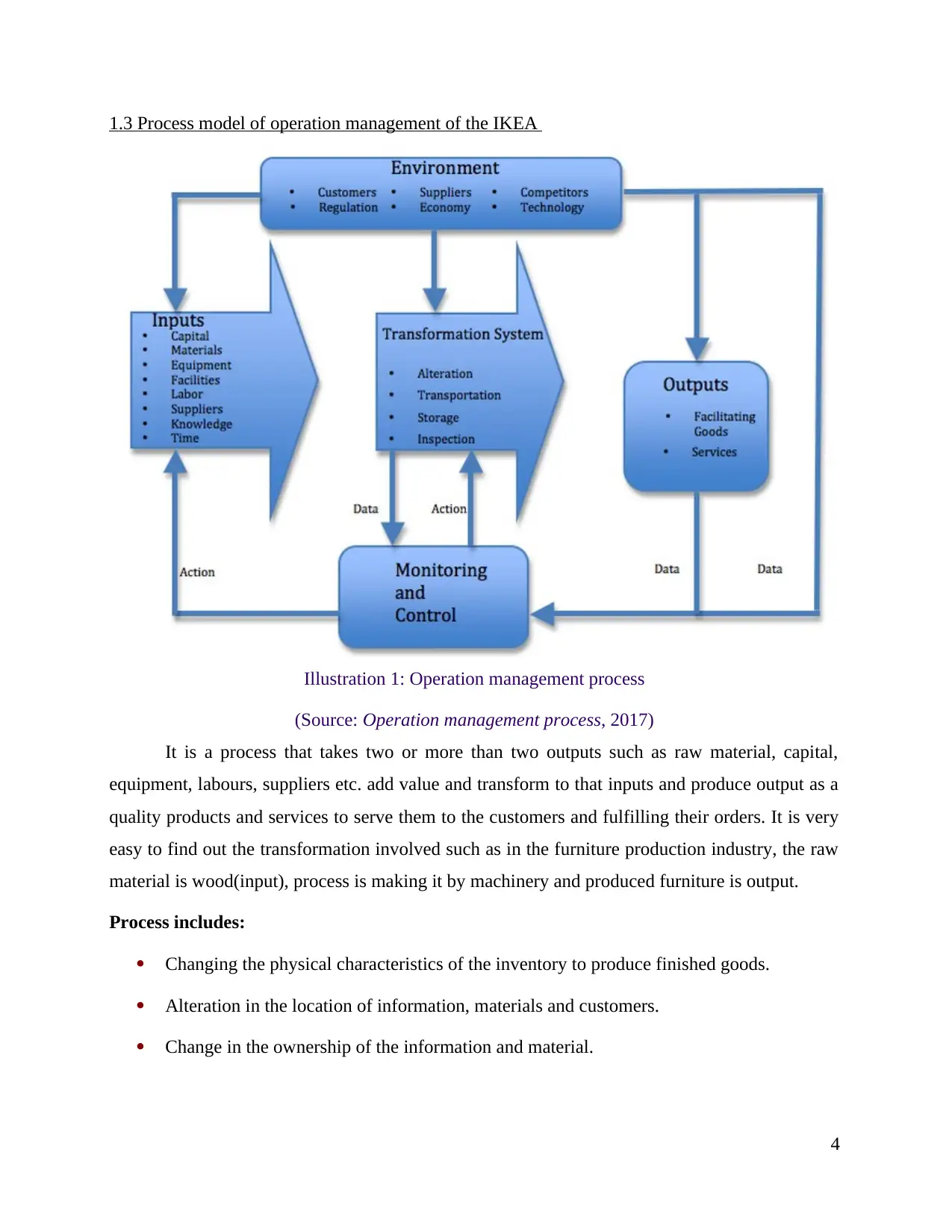
1.3 Process model of operation management of the IKEA
Illustration 1: Operation management process
(Source: Operation management process, 2017)
It is a process that takes two or more than two outputs such as raw material, capital,
equipment, labours, suppliers etc. add value and transform to that inputs and produce output as a
quality products and services to serve them to the customers and fulfilling their orders. It is very
easy to find out the transformation involved such as in the furniture production industry, the raw
material is wood(input), process is making it by machinery and produced furniture is output.
Process includes:
Changing the physical characteristics of the inventory to produce finished goods.
Alteration in the location of information, materials and customers.
Change in the ownership of the information and material.
4
Illustration 1: Operation management process
(Source: Operation management process, 2017)
It is a process that takes two or more than two outputs such as raw material, capital,
equipment, labours, suppliers etc. add value and transform to that inputs and produce output as a
quality products and services to serve them to the customers and fulfilling their orders. It is very
easy to find out the transformation involved such as in the furniture production industry, the raw
material is wood(input), process is making it by machinery and produced furniture is output.
Process includes:
Changing the physical characteristics of the inventory to produce finished goods.
Alteration in the location of information, materials and customers.
Change in the ownership of the information and material.
4
⊘ This is a preview!⊘
Do you want full access?
Subscribe today to unlock all pages.
Trusted by 1+ million students worldwide
Accommodation and storage of inventory and information (Hedenstierna and Holmstr,
2016).
Modification in the purpose of the data.
Alteration in the psychological state of the clients.
Different type of raw material
Generally there are three types of inventory that are raw material, customers and
information foe example if a person want to withdraw money then the account information is
required and materials are cheque and output is currency (Hennelly and Sra, 2017)..
(Source: Input output process model of operation management, 2016)
Another way of categorising the process are as follows:
Manufacturing: It is physical creation of goods
Transportation: It is the movement of goods and customers.
Supply: change in the ownership of the goods and materials.
Service: The storage of inventory and the treatment of the clients.
The operation management process are as follows:
Internal and external environment: The first stage of operation management in the
IEKA is the environment. It the internal and external environment is being defined in the proper
way then the organisation can develop their different activities in the effective and efficient
manner. In the environment process, internal and external factors include, from which internal
consist of customers, suppliers, competitors etc. and external includes social, political, legal,
economic, environmental etc. in the organisation, customers Is very important for them, so with
this they can collect the information related to th.e needs and wants of the customers, then with
the suppliers, they can main the positive bargaining.
Input: The next process is input, after the environment which includes inventory, land,
labour, capital, information, knowledge which help the organisation to analyse their input process
which can be described in all the data of IEKA.
5
2016).
Modification in the purpose of the data.
Alteration in the psychological state of the clients.
Different type of raw material
Generally there are three types of inventory that are raw material, customers and
information foe example if a person want to withdraw money then the account information is
required and materials are cheque and output is currency (Hennelly and Sra, 2017)..
(Source: Input output process model of operation management, 2016)
Another way of categorising the process are as follows:
Manufacturing: It is physical creation of goods
Transportation: It is the movement of goods and customers.
Supply: change in the ownership of the goods and materials.
Service: The storage of inventory and the treatment of the clients.
The operation management process are as follows:
Internal and external environment: The first stage of operation management in the
IEKA is the environment. It the internal and external environment is being defined in the proper
way then the organisation can develop their different activities in the effective and efficient
manner. In the environment process, internal and external factors include, from which internal
consist of customers, suppliers, competitors etc. and external includes social, political, legal,
economic, environmental etc. in the organisation, customers Is very important for them, so with
this they can collect the information related to th.e needs and wants of the customers, then with
the suppliers, they can main the positive bargaining.
Input: The next process is input, after the environment which includes inventory, land,
labour, capital, information, knowledge which help the organisation to analyse their input process
which can be described in all the data of IEKA.
5
Paraphrase This Document
Need a fresh take? Get an instant paraphrase of this document with our AI Paraphraser
Transformation process: The next step is transformation, there are several industrial
programs and programming language is done so that they can transform their raw data to the
information.
Output: This stage include the goods and services of the IEKA which is the output of
whole process which have taken place in the transformation
Monitoring and control: It is the final stage of the operation management where the
whole process is being monitored. The standard and actual performance is compared which help
to find that performance have been taken according to the planning.
Operation management is the process of transforming raw material into finished goods.
The transformation process includes change of physical characteristics of raw material into
finishes goods, change of location of raw material customer and information. The process starts
with the procurement of raw material or information from the vendor, send them to the
manufacturing place, them production of raw material or inventory to the finished goods and that
products is transferred to the end user.
The different issues that may arise in the process of the operation management such as in
the input when the organisation is collecting the different type of inventory from the vendors at
that time the supplier does not supply the quality inventory or the goods are not procured by the
company on time which increase the time of production etc. In the transformation process when
the machinery is not able to work, workers are not able to work effectively etc. and the time
when the finished goods is delivered to the customer on time then they will not able to satisfy
their needs.
TASK 2
2.1 Three E's significance in the IKEA
These three E's that are Economy. Efficiency and Effectiveness that helps the operation
management to do all the activities on time with the low cost and high profits. These there E are
as follows:
Economy: It is the process of doing operations and activities as cheap as possible with the
maintained quality and standard. This is strategy to avoid the cost that do not generate any
profits to the organisation and investing in those operations that leads to generate high
6
programs and programming language is done so that they can transform their raw data to the
information.
Output: This stage include the goods and services of the IEKA which is the output of
whole process which have taken place in the transformation
Monitoring and control: It is the final stage of the operation management where the
whole process is being monitored. The standard and actual performance is compared which help
to find that performance have been taken according to the planning.
Operation management is the process of transforming raw material into finished goods.
The transformation process includes change of physical characteristics of raw material into
finishes goods, change of location of raw material customer and information. The process starts
with the procurement of raw material or information from the vendor, send them to the
manufacturing place, them production of raw material or inventory to the finished goods and that
products is transferred to the end user.
The different issues that may arise in the process of the operation management such as in
the input when the organisation is collecting the different type of inventory from the vendors at
that time the supplier does not supply the quality inventory or the goods are not procured by the
company on time which increase the time of production etc. In the transformation process when
the machinery is not able to work, workers are not able to work effectively etc. and the time
when the finished goods is delivered to the customer on time then they will not able to satisfy
their needs.
TASK 2
2.1 Three E's significance in the IKEA
These three E's that are Economy. Efficiency and Effectiveness that helps the operation
management to do all the activities on time with the low cost and high profits. These there E are
as follows:
Economy: It is the process of doing operations and activities as cheap as possible with the
maintained quality and standard. This is strategy to avoid the cost that do not generate any
profits to the organisation and investing in those operations that leads to generate high
6
return on investment. The company need to identify the needs and wants of the customer
and the purchase the raw material and machinery in order to produce those goods that are
need by the clients. The venture have taken many measures that reduce the cost of
production such as management of supply chain, proper use of inventory and resources
and keeping cardinal relationship with the suppliers, customers, distributors and other
stakeholders so that orders can be fulfilled on the time and at the low cost (Mestre, 2017).
Effectiveness and efficiency: Effectiveness is the way where the organisation analyse
that the goals and objective are achieved properly by all the members of the venture. It
analyses that all the objective are accomplished or not? It is expected that the delivery of
quality goods and services at the right time is effectiveness. If the target are meet and the
employees are able to satisfy the customers demand and orders at the particular time than
the work is said to be effective. Whereas Efficiency the process where the effort are
allocated properly and right use of the resources to complete all the task. As the goal is
achieved it is viewed that the objective are accomplished which the least effort, time,
money and resources.
Excellence: As the standard are made, it is monitored that the deadlines are meet at the
standard way. It is the quality of being outstanding or extremely good at work so that the
objective are achieved effectively, efficiency and at less time, money and effort. All the
activities should be done in the proper way so that the efficiency of the human resource
increase and they will able to achieve excellence in their work.
2.2 Impact of the tension between cost minimisation and quality maximisation in organisations
Cost minimisation and
quality maximisation will be done when:
All the operation have to produce the optimum quality of products at the minimisation
cost.
Innovation which further improve the quality level with the low cost (Bask and Tinnilä,
2016)
Reduce the product defects which will reduce the cost to re-manufacture the products.
7
and the purchase the raw material and machinery in order to produce those goods that are
need by the clients. The venture have taken many measures that reduce the cost of
production such as management of supply chain, proper use of inventory and resources
and keeping cardinal relationship with the suppliers, customers, distributors and other
stakeholders so that orders can be fulfilled on the time and at the low cost (Mestre, 2017).
Effectiveness and efficiency: Effectiveness is the way where the organisation analyse
that the goals and objective are achieved properly by all the members of the venture. It
analyses that all the objective are accomplished or not? It is expected that the delivery of
quality goods and services at the right time is effectiveness. If the target are meet and the
employees are able to satisfy the customers demand and orders at the particular time than
the work is said to be effective. Whereas Efficiency the process where the effort are
allocated properly and right use of the resources to complete all the task. As the goal is
achieved it is viewed that the objective are accomplished which the least effort, time,
money and resources.
Excellence: As the standard are made, it is monitored that the deadlines are meet at the
standard way. It is the quality of being outstanding or extremely good at work so that the
objective are achieved effectively, efficiency and at less time, money and effort. All the
activities should be done in the proper way so that the efficiency of the human resource
increase and they will able to achieve excellence in their work.
2.2 Impact of the tension between cost minimisation and quality maximisation in organisations
Cost minimisation and
quality maximisation will be done when:
All the operation have to produce the optimum quality of products at the minimisation
cost.
Innovation which further improve the quality level with the low cost (Bask and Tinnilä,
2016)
Reduce the product defects which will reduce the cost to re-manufacture the products.
7
⊘ This is a preview!⊘
Do you want full access?
Subscribe today to unlock all pages.
Trusted by 1+ million students worldwide
Cost minimisation will put effort on the efficiency, high labour production and standardization
and the strategies which reduce the tension between the cost minimisation and quality
maximisation are
Increase in the assets turnover (Hennelly and Sra, 2017).
Reduce indirect cost
Emphases on the investment to direct cost.
Outsource non core operations.
Control over the overheads.
Use the organisation's bargaining power to negotiate best pricing with suppliers.
There is very big tension between these two, every organisation want to reduce their cost
and enhance their quality standard. These can be achieved only when the company use and
manage their resources such as financial, human resources, inventory, spare parts etc. IEKA can
overcome this tension by providing training to their employees to fulfil all the operations in the
proper way with the effective utilisation of resources.
2.3 Importance of the five performance objective on the operation management.
The main objective of organisation is to satisfy the customer need and to do that they nee
to maintain five elements.
Quality: The company need to make the defeats free products and services and produce the
goods of the right quality in order to satisfy the customer needs and wants. IKEA furniture
products are at the top in the market share because they are providing quality finished goods at
the low cost (Choi and Zhao, 2016).
Speed: The other aspect is speed which tell that the production and other operations are done as
fast as possible. For minimising the time of the order, availability of the products at the right time
will provide advantage to the company.
Dependability: It means the things should be done on time. IKEA adopt the Just In Time
technique where the in order to serve the products to customers on time by working in team.
8
and the strategies which reduce the tension between the cost minimisation and quality
maximisation are
Increase in the assets turnover (Hennelly and Sra, 2017).
Reduce indirect cost
Emphases on the investment to direct cost.
Outsource non core operations.
Control over the overheads.
Use the organisation's bargaining power to negotiate best pricing with suppliers.
There is very big tension between these two, every organisation want to reduce their cost
and enhance their quality standard. These can be achieved only when the company use and
manage their resources such as financial, human resources, inventory, spare parts etc. IEKA can
overcome this tension by providing training to their employees to fulfil all the operations in the
proper way with the effective utilisation of resources.
2.3 Importance of the five performance objective on the operation management.
The main objective of organisation is to satisfy the customer need and to do that they nee
to maintain five elements.
Quality: The company need to make the defeats free products and services and produce the
goods of the right quality in order to satisfy the customer needs and wants. IKEA furniture
products are at the top in the market share because they are providing quality finished goods at
the low cost (Choi and Zhao, 2016).
Speed: The other aspect is speed which tell that the production and other operations are done as
fast as possible. For minimising the time of the order, availability of the products at the right time
will provide advantage to the company.
Dependability: It means the things should be done on time. IKEA adopt the Just In Time
technique where the in order to serve the products to customers on time by working in team.
8
Paraphrase This Document
Need a fresh take? Get an instant paraphrase of this document with our AI Paraphraser
Flexibility: There are many changes which is taking place internally as well as externally which
affect the organisation performance. To cope with that changes, IKEA is giving training to their
employees.
Cost: IKEA sustainable competitive advantage is they are serving wide range of products at low
prices so that different people can able to afford them..
TASK 3
3.1 How linear programming enhance the value in the production process.
Linear programming or LP is the method to work in most productive manner. It is the
master key to solve various problems related with transportation, pricing and production. It helps
in sorting out issues that relate to production and pricing. It is monotonous in nature for most
cases, as it works with mathematical equations. It helps to determine the process of flow that
would help to yield the biggest margins in profits and minimizing cost. Also, this method is
proven the way to make the work more effective and efficient. Applying the equations of LP,
IKEA will be benefited hugely in terms of cost efficiency, market competency, infrastructure
standards and brand value.
When a company like IKEA introduces LP in its working method, it works by putting
numbers of resources such as labour (number/hours), machines, finished products, time, raw
materials, and cost into its equations in the place of variables for determining the optimum
production circle in order to achieve the desired demand for volume or cost effectiveness. Its sole
purpose is maximising production, boosts productivity and sets an order of working in industry.
In other words it is simply a great method to work with if IKEA wants to maintain its company's
worth and corporate culture.
One another reason to involve LP is IKEA deals in a lot of custom orders, so to make
these products on time in accordance with other orders and wholesale products, linear
programming would serve as an integral part as it is a tried and tested system of working applied
to all big production companies. It simply helps to use the best out of the resources to maintain an
efficient flow of production.
9
affect the organisation performance. To cope with that changes, IKEA is giving training to their
employees.
Cost: IKEA sustainable competitive advantage is they are serving wide range of products at low
prices so that different people can able to afford them..
TASK 3
3.1 How linear programming enhance the value in the production process.
Linear programming or LP is the method to work in most productive manner. It is the
master key to solve various problems related with transportation, pricing and production. It helps
in sorting out issues that relate to production and pricing. It is monotonous in nature for most
cases, as it works with mathematical equations. It helps to determine the process of flow that
would help to yield the biggest margins in profits and minimizing cost. Also, this method is
proven the way to make the work more effective and efficient. Applying the equations of LP,
IKEA will be benefited hugely in terms of cost efficiency, market competency, infrastructure
standards and brand value.
When a company like IKEA introduces LP in its working method, it works by putting
numbers of resources such as labour (number/hours), machines, finished products, time, raw
materials, and cost into its equations in the place of variables for determining the optimum
production circle in order to achieve the desired demand for volume or cost effectiveness. Its sole
purpose is maximising production, boosts productivity and sets an order of working in industry.
In other words it is simply a great method to work with if IKEA wants to maintain its company's
worth and corporate culture.
One another reason to involve LP is IKEA deals in a lot of custom orders, so to make
these products on time in accordance with other orders and wholesale products, linear
programming would serve as an integral part as it is a tried and tested system of working applied
to all big production companies. It simply helps to use the best out of the resources to maintain an
efficient flow of production.
9
3.2 what is network planning and critical path analysis
IKEA deals with lots of big projects that are complex in nature and are involved taking
risk. As these projects increases, it becomes mandatory to have knowledge about the processes
involved and to get the most efficient result on project completion.
The essential technique for using IKEA is to construct a model of the project with the use
of critical path analysis that includes different list, that are as follows:
A list of operation the need completion
Fixing the time for each activity that would complete.
The inter-dependency between the operations.
By sing the above information, IKEA can calculates
The longest path of planned operations to end the project.
The project should not be longer, each operation should complete as soon as possible.
This procedure would bring forth the activities which would be termed as 'critical' on the
extended path and those that are 'total float' or can be postponed without effecting the project
duration.
In a work flow using CPA, IKEA follows chain of order that begins with conducting
customer research, followed by designing product concept, product testing in laboratory
conditions and real life, production tooling, ordering supplies, beginning production of product
and organising launch promotions.
Network planning is the method to govern all this mass production. Over a long duration
handling big projects, working on new ventures and varying market conditions are accounted. It
holds accountable for deciding reserve flow and marketing process to be put in play. It keep the
business running and acts as a well described layout for prediction of future endeavours.
IKEA would always have to maintain its high reserves as these factors deal with many
variables as margins for errors and environment conditions, and customer demographic
preferences. It simply is a layout plan but does not grantee the success of projects or strategies
being heavily funded. A heavy shift in market conditions or rival company's strategy would make
10
IKEA deals with lots of big projects that are complex in nature and are involved taking
risk. As these projects increases, it becomes mandatory to have knowledge about the processes
involved and to get the most efficient result on project completion.
The essential technique for using IKEA is to construct a model of the project with the use
of critical path analysis that includes different list, that are as follows:
A list of operation the need completion
Fixing the time for each activity that would complete.
The inter-dependency between the operations.
By sing the above information, IKEA can calculates
The longest path of planned operations to end the project.
The project should not be longer, each operation should complete as soon as possible.
This procedure would bring forth the activities which would be termed as 'critical' on the
extended path and those that are 'total float' or can be postponed without effecting the project
duration.
In a work flow using CPA, IKEA follows chain of order that begins with conducting
customer research, followed by designing product concept, product testing in laboratory
conditions and real life, production tooling, ordering supplies, beginning production of product
and organising launch promotions.
Network planning is the method to govern all this mass production. Over a long duration
handling big projects, working on new ventures and varying market conditions are accounted. It
holds accountable for deciding reserve flow and marketing process to be put in play. It keep the
business running and acts as a well described layout for prediction of future endeavours.
IKEA would always have to maintain its high reserves as these factors deal with many
variables as margins for errors and environment conditions, and customer demographic
preferences. It simply is a layout plan but does not grantee the success of projects or strategies
being heavily funded. A heavy shift in market conditions or rival company's strategy would make
10
⊘ This is a preview!⊘
Do you want full access?
Subscribe today to unlock all pages.
Trusted by 1+ million students worldwide

1 out of 20


Related Documents


Your All-in-One AI-Powered Toolkit for Academic Success.
+13062052269
info@desklib.com
Available 24*7 on WhatsApp / Email
![[object Object]](/_next/static/media/star-bottom.7253800d.svg)
Unlock your academic potential
Copyright © 2020–2026 A2Z Services. All Rights Reserved. Developed and managed by ZUCOL.