Operation Management Report
VerifiedAdded on 2020/01/15
|11
|3267
|177
Report
AI Summary
This report provides a comprehensive analysis of operation management principles, focusing on their application within IKEA and Hilton. It covers key areas such as the link between operational management and other organizational functions, the strategic role of operations, layout types, process design, material and supply chain management, quality management, performance measurement, and problem-solving techniques. The report also discusses the challenges faced by operational managers in maintaining quality and suggests practical solutions using various management tools and concepts. The conclusion highlights the interconnectedness of operational functions and their importance in achieving organizational success.
Operation Management
1
1

Paraphrase This Document
Need a fresh take? Get an instant paraphrase of this document with our AI Paraphraser
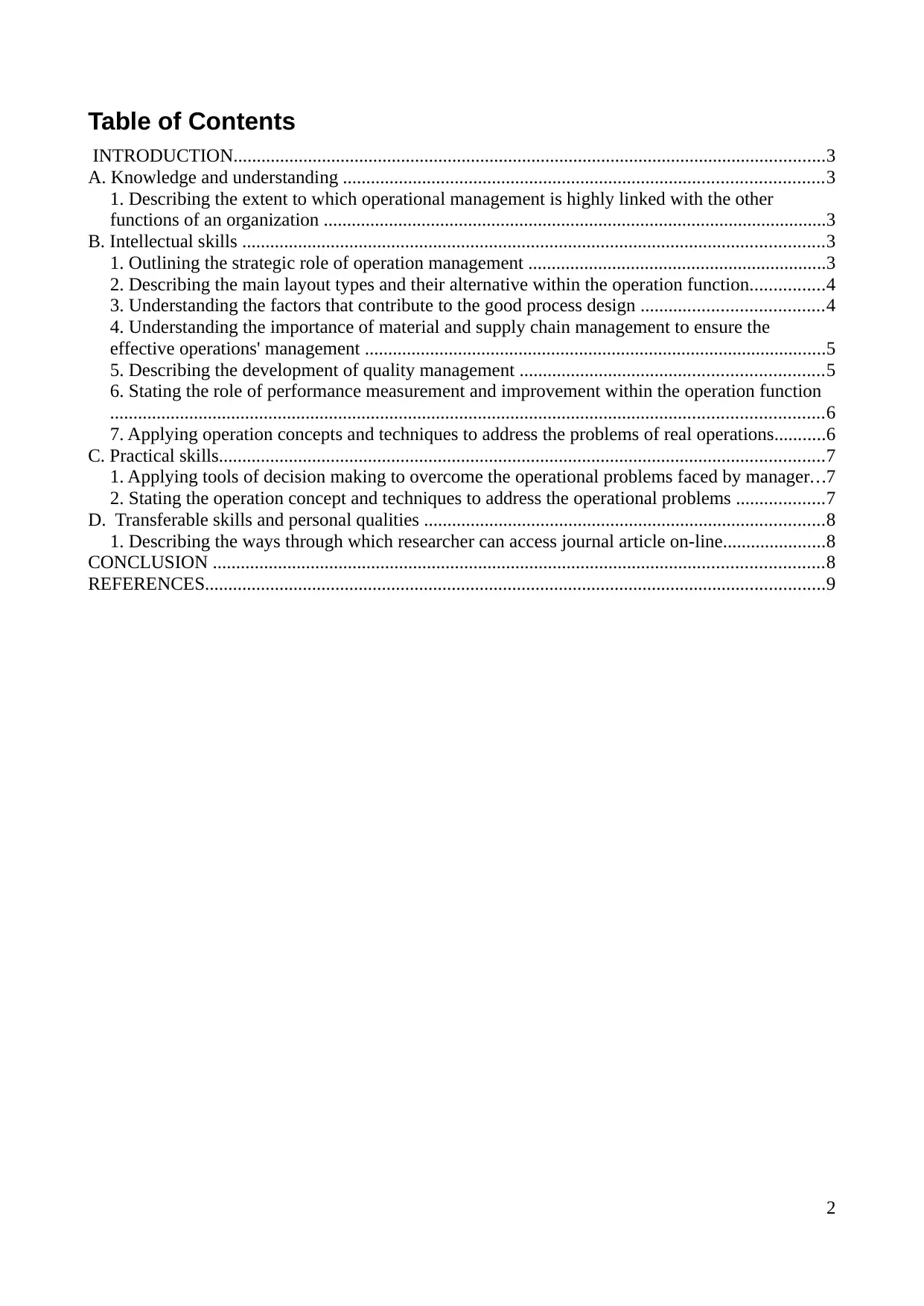
Table of Contents
INTRODUCTION...............................................................................................................................3
A. Knowledge and understanding .......................................................................................................3
1. Describing the extent to which operational management is highly linked with the other
functions of an organization ............................................................................................................3
B. Intellectual skills .............................................................................................................................3
1. Outlining the strategic role of operation management ................................................................3
2. Describing the main layout types and their alternative within the operation function................4
3. Understanding the factors that contribute to the good process design .......................................4
4. Understanding the importance of material and supply chain management to ensure the
effective operations' management ...................................................................................................5
5. Describing the development of quality management .................................................................5
6. Stating the role of performance measurement and improvement within the operation function
.........................................................................................................................................................6
7. Applying operation concepts and techniques to address the problems of real operations...........6
C. Practical skills..................................................................................................................................7
1. Applying tools of decision making to overcome the operational problems faced by manager...7
2. Stating the operation concept and techniques to address the operational problems ...................7
D. Transferable skills and personal qualities ......................................................................................8
1. Describing the ways through which researcher can access journal article on-line......................8
CONCLUSION ...................................................................................................................................8
REFERENCES.....................................................................................................................................9
2
INTRODUCTION...............................................................................................................................3
A. Knowledge and understanding .......................................................................................................3
1. Describing the extent to which operational management is highly linked with the other
functions of an organization ............................................................................................................3
B. Intellectual skills .............................................................................................................................3
1. Outlining the strategic role of operation management ................................................................3
2. Describing the main layout types and their alternative within the operation function................4
3. Understanding the factors that contribute to the good process design .......................................4
4. Understanding the importance of material and supply chain management to ensure the
effective operations' management ...................................................................................................5
5. Describing the development of quality management .................................................................5
6. Stating the role of performance measurement and improvement within the operation function
.........................................................................................................................................................6
7. Applying operation concepts and techniques to address the problems of real operations...........6
C. Practical skills..................................................................................................................................7
1. Applying tools of decision making to overcome the operational problems faced by manager...7
2. Stating the operation concept and techniques to address the operational problems ...................7
D. Transferable skills and personal qualities ......................................................................................8
1. Describing the ways through which researcher can access journal article on-line......................8
CONCLUSION ...................................................................................................................................8
REFERENCES.....................................................................................................................................9
2
INTRODUCTION
Operation management is the process which is highly concerned with the designing and
controlling the process of production (Tweedale and Howlett, 2015). Along with this, such area of
management also places high level of emphasis on redesigning the business operations with the aim
to get the desired level of outcome or success. It also makes focus on converting material and labour
into goods more effectively and efficiently to achieve the objective of profit maximization. The
present report is based on IKEA which design and sells furniture and other home accessories.
Along with this, Hilton also has been selected for this assignment which is one of the leading
hospitality firm of UK operates in the service sector. In this regard, report will describe the role of
operation management and the factors that helps in designing the good process. Further, it will
develop understanding about the extent to which effective supply and material chain management is
essential for the growth of firm.
Critically discuss the challenges that operational level managers face in relation to managing the
quality aspect
According to the view points of Waters and Rinsler (2014) business unit operates in
manufacturing sector face difficulty in managing the quality aspect if it does not have enough tools
and equipments. For instance: IKEA will face difficulty in managing the quality aspect if they do
not high-tech machineries for designing and manufacturing the clothes. In the situation of lack of
proper tools operational level personnel face difficulty in maintaining the high quality. However, on
the critical note, Christopher (2016) said that if operational level personnel fails to approach to the
best supplier of raw material then it company would not able to manufacture and offer high quality
services to the customers.
Along with this, Ellram and Weber (2013) found from their study that if service firm fails to
employ highly skilled and competent workforce then it would not able to deliver high quality
services. For instance: If Hilton does not have enough inventory of human resources then it would
not in the condition to deliver high quality and satisfactorily services to the customers. However,
Dyckhoff, Lackes and Reese (2013) argued that business unit is also not able to maintain effectual
data base of the customers and other events if there is lack of high tech software within the firm. In
3
Operation management is the process which is highly concerned with the designing and
controlling the process of production (Tweedale and Howlett, 2015). Along with this, such area of
management also places high level of emphasis on redesigning the business operations with the aim
to get the desired level of outcome or success. It also makes focus on converting material and labour
into goods more effectively and efficiently to achieve the objective of profit maximization. The
present report is based on IKEA which design and sells furniture and other home accessories.
Along with this, Hilton also has been selected for this assignment which is one of the leading
hospitality firm of UK operates in the service sector. In this regard, report will describe the role of
operation management and the factors that helps in designing the good process. Further, it will
develop understanding about the extent to which effective supply and material chain management is
essential for the growth of firm.
Critically discuss the challenges that operational level managers face in relation to managing the
quality aspect
According to the view points of Waters and Rinsler (2014) business unit operates in
manufacturing sector face difficulty in managing the quality aspect if it does not have enough tools
and equipments. For instance: IKEA will face difficulty in managing the quality aspect if they do
not high-tech machineries for designing and manufacturing the clothes. In the situation of lack of
proper tools operational level personnel face difficulty in maintaining the high quality. However, on
the critical note, Christopher (2016) said that if operational level personnel fails to approach to the
best supplier of raw material then it company would not able to manufacture and offer high quality
services to the customers.
Along with this, Ellram and Weber (2013) found from their study that if service firm fails to
employ highly skilled and competent workforce then it would not able to deliver high quality
services. For instance: If Hilton does not have enough inventory of human resources then it would
not in the condition to deliver high quality and satisfactorily services to the customers. However,
Dyckhoff, Lackes and Reese (2013) argued that business unit is also not able to maintain effectual
data base of the customers and other events if there is lack of high tech software within the firm. In
3
⊘ This is a preview!⊘
Do you want full access?
Subscribe today to unlock all pages.

Trusted by 1+ million students worldwide
this way, all such aspects create difficulty in front of the operational level manager in maintaining
the quality level.
A. KNOWLEDGE AND UNDERSTANDING
1. Describing the extent to which operational management is highly linked with the other functions
of an organization
High level of interrelationship exist between operational management and other functions of
an organization. In all kind of organizations such as public, private (IKEA) and voluntary
operational management is highly co-ordinated with the other aspects. Besides this, operational
management professionals also provide other decision making authorities with the valuable input
for decision making (Christopher, 2016). For instance: Operational manager of all the organizations
provides information to the high management about the availability of high-tech equipments and
skilled workforce. Hence, by taking into consideration such aspect higher management become able
to frame suitable strategy for the long term growth and success. Along with this, such input also
enables finance manager to prepare suitable budgeting framework regarding the equipments. In this
way, operational management is highly linked with the other departments of the firm to the large
extent.
B. INTELLECTUAL SKILLS
1. Outlining the strategic role of operation management
In the business organization, operational manager is assigned with the role and responsibility
to ensure proper management both material and human resources. Hence, in IKEA, operation
manager plays a vital role in ensuring smooth functioning of the business operations and activities
by framing competent strategic framework (Christopher, Magrill and Wills, 2013). Moreover,
operation management of manufacturing company includes designing of efficient process of
production, acquisition of raw material, contaminate of equipments and ensuring that trained
workers are available with the firm. On the basis of this aspect, by undertaking all the aspects of
operation management IKEA can make contribution in the attainment of organizational goals and
objectives. Moreover, company can design furnitures more effectively only when they have highly
skilled and competent workforce (Dekker, Bloemhof and Mallidis, 2012.). Further, to increase the
4
the quality level.
A. KNOWLEDGE AND UNDERSTANDING
1. Describing the extent to which operational management is highly linked with the other functions
of an organization
High level of interrelationship exist between operational management and other functions of
an organization. In all kind of organizations such as public, private (IKEA) and voluntary
operational management is highly co-ordinated with the other aspects. Besides this, operational
management professionals also provide other decision making authorities with the valuable input
for decision making (Christopher, 2016). For instance: Operational manager of all the organizations
provides information to the high management about the availability of high-tech equipments and
skilled workforce. Hence, by taking into consideration such aspect higher management become able
to frame suitable strategy for the long term growth and success. Along with this, such input also
enables finance manager to prepare suitable budgeting framework regarding the equipments. In this
way, operational management is highly linked with the other departments of the firm to the large
extent.
B. INTELLECTUAL SKILLS
1. Outlining the strategic role of operation management
In the business organization, operational manager is assigned with the role and responsibility
to ensure proper management both material and human resources. Hence, in IKEA, operation
manager plays a vital role in ensuring smooth functioning of the business operations and activities
by framing competent strategic framework (Christopher, Magrill and Wills, 2013). Moreover,
operation management of manufacturing company includes designing of efficient process of
production, acquisition of raw material, contaminate of equipments and ensuring that trained
workers are available with the firm. On the basis of this aspect, by undertaking all the aspects of
operation management IKEA can make contribution in the attainment of organizational goals and
objectives. Moreover, company can design furnitures more effectively only when they have highly
skilled and competent workforce (Dekker, Bloemhof and Mallidis, 2012.). Further, to increase the
4
Paraphrase This Document
Need a fresh take? Get an instant paraphrase of this document with our AI Paraphraser
production company must have latest and effective equipments. Along with this, operational
manager also ensures that there is enough material is available within the firm for production
purpose. In this way, operation management helps company in getting the desired level of outcome
or success.
2. Describing the main layout types and their alternative within the operation function
Product, process, fixed position, combination and cellular are the main layouts which
business unit can use for the effective operation management (Waters and Rinsler, 2014). IKEA
operates in the furniture sector and follows product layout to offer standardized products or
services to the customers. In such layout, all the parts of the furnitures are manufactured separately.
Thereafter, business unit assessable all such parts to get the finished product (LAYOUT, 2016).
Besides this, IKEA can also consider process layout as an alternative option for manufacturing the
furnitures more effectively (Gilmour, 2013). Moreover, process layout ensures flexibility and
reduces the transportation cost to the large extent. Hence, by using such layouts company can attain
success to the significant level.
3. Understanding the factors that contribute to the good process design
There are several factors which IKEA needs to consider while designing the process are:
Ease of future expansion and change: IKEA should design process in such a manner which
facilitate changes with the ease. Moreover, in the present era, to meet the expectation and
demand of the customers business unit has to make changes (Ellram and Weber, 2013). In
this regard, by developing flexible process design IKEA can make changes on it more
quickly.
Flow of movement: Business unit needs to undertake U shaped and parallel flow for
converting raw material into finished product. Moreover, effective conversion of raw
material into product is highly required for meeting the customers demand on time
(Dyckhoff, Lackes and Reese, 2013).
Hence, by following all such aspects IKEA can design good process and thereby fulfil their
aims and objectives.
5
manager also ensures that there is enough material is available within the firm for production
purpose. In this way, operation management helps company in getting the desired level of outcome
or success.
2. Describing the main layout types and their alternative within the operation function
Product, process, fixed position, combination and cellular are the main layouts which
business unit can use for the effective operation management (Waters and Rinsler, 2014). IKEA
operates in the furniture sector and follows product layout to offer standardized products or
services to the customers. In such layout, all the parts of the furnitures are manufactured separately.
Thereafter, business unit assessable all such parts to get the finished product (LAYOUT, 2016).
Besides this, IKEA can also consider process layout as an alternative option for manufacturing the
furnitures more effectively (Gilmour, 2013). Moreover, process layout ensures flexibility and
reduces the transportation cost to the large extent. Hence, by using such layouts company can attain
success to the significant level.
3. Understanding the factors that contribute to the good process design
There are several factors which IKEA needs to consider while designing the process are:
Ease of future expansion and change: IKEA should design process in such a manner which
facilitate changes with the ease. Moreover, in the present era, to meet the expectation and
demand of the customers business unit has to make changes (Ellram and Weber, 2013). In
this regard, by developing flexible process design IKEA can make changes on it more
quickly.
Flow of movement: Business unit needs to undertake U shaped and parallel flow for
converting raw material into finished product. Moreover, effective conversion of raw
material into product is highly required for meeting the customers demand on time
(Dyckhoff, Lackes and Reese, 2013).
Hence, by following all such aspects IKEA can design good process and thereby fulfil their
aims and objectives.
5
4. Understanding the importance of material and supply chain management to ensure the effective
operations' management
In the manufacturing sector, effectual material management is highly required for
performing the business functions more efficiently (Jaber, 2016). Moreover, in the absence of
enough raw material such as wood IKEA would not able to design and sells furniture within the
suitable time frame. In this way, lack of enough raw material may result into loss of productivity
and profitability to the great extent. Hence, operational manager of IKEA is required to ensure that
enough inventory is available within the firm for production purpose.
Thus, by making use of inventory control techniques such as economic order quantity etc.
manager of the firm can facilitate proper material management. This in turn enables business unit to
maximize the profitability by making effectual utilization of the resources (Seuring, 2013). Along
with this, effective supply chain management is also needed for organizational growth. Moreover,
personnel involved in supply chain plays a vital role in making delivery of furniture to suppliers. In
this way, by offering the designer furnitures on time IKEA can develop high level of satisfaction
and loyalty among the customers.
5. Describing the development of quality management
Quality management is highly essential for making improvements in the operational aspects
on a continuous basis (Stadtler, 2015). In this regard, manager of IKEA can build and maintain high
level of quality by using benchmarking as well as total quality management (TQM) technique.
Moreover, benchmarking technique offers opportunity to operational manager to find out the
deviations take place in performance aspects. For instance: By comparing the actual production of
human resources with the standard aspect manager of IKEA can find out the deviations. It enables
manager to take strategic action for improvement within the suitable time frame and thereby
enhance the quality aspect (Dekker, Bloemhof and Mallidis, 2012). Along with this, IKEA also
makes use of TQM technique with the aim to offering the high quality furnitures to the customers.
For this purpose, IKEA makes evaluation of the quality aspect at each stage of manufacturing. This
in turn provides opportunity to remove the deviations at early stage of production and thereby
maintain high quality.
6
operations' management
In the manufacturing sector, effectual material management is highly required for
performing the business functions more efficiently (Jaber, 2016). Moreover, in the absence of
enough raw material such as wood IKEA would not able to design and sells furniture within the
suitable time frame. In this way, lack of enough raw material may result into loss of productivity
and profitability to the great extent. Hence, operational manager of IKEA is required to ensure that
enough inventory is available within the firm for production purpose.
Thus, by making use of inventory control techniques such as economic order quantity etc.
manager of the firm can facilitate proper material management. This in turn enables business unit to
maximize the profitability by making effectual utilization of the resources (Seuring, 2013). Along
with this, effective supply chain management is also needed for organizational growth. Moreover,
personnel involved in supply chain plays a vital role in making delivery of furniture to suppliers. In
this way, by offering the designer furnitures on time IKEA can develop high level of satisfaction
and loyalty among the customers.
5. Describing the development of quality management
Quality management is highly essential for making improvements in the operational aspects
on a continuous basis (Stadtler, 2015). In this regard, manager of IKEA can build and maintain high
level of quality by using benchmarking as well as total quality management (TQM) technique.
Moreover, benchmarking technique offers opportunity to operational manager to find out the
deviations take place in performance aspects. For instance: By comparing the actual production of
human resources with the standard aspect manager of IKEA can find out the deviations. It enables
manager to take strategic action for improvement within the suitable time frame and thereby
enhance the quality aspect (Dekker, Bloemhof and Mallidis, 2012). Along with this, IKEA also
makes use of TQM technique with the aim to offering the high quality furnitures to the customers.
For this purpose, IKEA makes evaluation of the quality aspect at each stage of manufacturing. This
in turn provides opportunity to remove the deviations at early stage of production and thereby
maintain high quality.
6
⊘ This is a preview!⊘
Do you want full access?
Subscribe today to unlock all pages.
Trusted by 1+ million students worldwide
6. Stating the role of performance measurement and improvement within the operation function
Performance measurement system is highly required within the firm to exert control on
undesirable activities that take place at operational level (Fernie and Sparks, 2014). In this context,
IKEA can measure its operational performance by taking into consideration the five factors namely
money, output, customer emphasis, innovation and human resources. All these are the main
elements which exhibits the effectiveness of operation performance (Performance mesurement,
2016.). Hence, IKEA monitors its monetary performance by comparing the actual profit with
standard amount. For instance: By giving target to the human resources IKEA measures the
performance level of employees. In this, by assessing the deviations and their causes business
enterprise organizes training event for the personnel (Waters and Rinsler, 2014). This aspect clearly
shows that performance measurement system enables firm to enhance employee productivity by
undertaking corrective managers within the suitable time frame.
7. Applying operation concepts and techniques to address the problems of real operations
In the present time, customers prefer to purchase the furnitures and home appliances from
the retailer who maintains high level of quality of the products or services (Christopher, 2016).
Usually, at operational level personnel face difficulty in maintaining the standard quality aspect. In
this regarding by adopting both TQM and Kaizen process operational level professionals of IKEA
can raise and maintain the quality of furnitures to the large level. Moreover, under TQM business
unit places high level of emphasis on making close monitoring of the every stage of production.
This in turn helps company in removing the deficiencies within the suitable time period. Along
with this, Kaizen is also one of the most effectual techniques which can be undertaken by IKEA for
the continuous improvement (Tweedale and Howlett, 2015). Moreover, in this, business unit
involves their employees and encourage them to assess the deviations take place in the
manufacturing aspects. In this way, by taking strategic competent action of time IKEA can enhance
and maintain the quality aspect to the significant level.
C. PRACTICAL SKILLS
1. Applying tools of decision making to overcome the operational problems faced by manager
There are several decision making tools which can be applied by IKEA to overcome the
7
Performance measurement system is highly required within the firm to exert control on
undesirable activities that take place at operational level (Fernie and Sparks, 2014). In this context,
IKEA can measure its operational performance by taking into consideration the five factors namely
money, output, customer emphasis, innovation and human resources. All these are the main
elements which exhibits the effectiveness of operation performance (Performance mesurement,
2016.). Hence, IKEA monitors its monetary performance by comparing the actual profit with
standard amount. For instance: By giving target to the human resources IKEA measures the
performance level of employees. In this, by assessing the deviations and their causes business
enterprise organizes training event for the personnel (Waters and Rinsler, 2014). This aspect clearly
shows that performance measurement system enables firm to enhance employee productivity by
undertaking corrective managers within the suitable time frame.
7. Applying operation concepts and techniques to address the problems of real operations
In the present time, customers prefer to purchase the furnitures and home appliances from
the retailer who maintains high level of quality of the products or services (Christopher, 2016).
Usually, at operational level personnel face difficulty in maintaining the standard quality aspect. In
this regarding by adopting both TQM and Kaizen process operational level professionals of IKEA
can raise and maintain the quality of furnitures to the large level. Moreover, under TQM business
unit places high level of emphasis on making close monitoring of the every stage of production.
This in turn helps company in removing the deficiencies within the suitable time period. Along
with this, Kaizen is also one of the most effectual techniques which can be undertaken by IKEA for
the continuous improvement (Tweedale and Howlett, 2015). Moreover, in this, business unit
involves their employees and encourage them to assess the deviations take place in the
manufacturing aspects. In this way, by taking strategic competent action of time IKEA can enhance
and maintain the quality aspect to the significant level.
C. PRACTICAL SKILLS
1. Applying tools of decision making to overcome the operational problems faced by manager
There are several decision making tools which can be applied by IKEA to overcome the
7
Paraphrase This Document
Need a fresh take? Get an instant paraphrase of this document with our AI Paraphraser
problem which is facing by the manager. Hence, to overcome to issues like material inadequacy
inventory control techniques such as just in time, economic order quantity etc. can be used by IKEA
to resolve it (Dekker, Bloemhof and Mallidis, 2012). Further, by making use of simulation
technique and drawing decision tree business unit can make suitable decision in an appropriate
manner. For instance: by undertaking simulation technique IKEA can assess the difficulties or
issues which they will face in the near future while manufacturing the furniture according to the
unique designs. Thus, such technique provides information to the personnel at operational about the
arrangements which they need to make for overcome the issues. Hence, by applying such tools and
techniques business enterprise can make suitable decision.
2. Stating the operation concept and techniques to address the operational problems
Operational concept and techniques include TQM, Kaizen process, benchmarking etc. which
helps in reducing the operational problems to the large extent. For instance: IKEA is facing problem
in relation to making optimum utilization of the material (Stadtler, 2015). Due to the high wastage
of material business unit is suffering from the issue of high cost. Hence, manager of IKEA can
address such problem by taking into account the benchmarking technique. In accordance with such
aspect, by preparing the suitable budgeting framework and making comparison of the actual
performance in against to it operational level manager can assess the deviations take place in
performance level (McKinnon and Piecyk, 2015). Further, if low level of motivation and lack of
competencies among the personnel are the main causes then business unit can take corrective action
for making improvement on it. Hence, in this by giving training to the personnel business unit can
motivate them to make their best efforts while performing the business activities and functions.
Along with this, by conducting training session IKEA would also become able to raise the
competency level of personnel to the large extent. Hence, by adopting such measure business unit
can reduce the level of material wastage and thereby become able to manage the cost more
effectively.
D. TRANSFERABLE SKILLS AND PERSONAL QUALITIES
1. Describing the ways through which researcher can access journal article on-line
Researcher can access the journal articles through the means of on-line by writing the
8
inventory control techniques such as just in time, economic order quantity etc. can be used by IKEA
to resolve it (Dekker, Bloemhof and Mallidis, 2012). Further, by making use of simulation
technique and drawing decision tree business unit can make suitable decision in an appropriate
manner. For instance: by undertaking simulation technique IKEA can assess the difficulties or
issues which they will face in the near future while manufacturing the furniture according to the
unique designs. Thus, such technique provides information to the personnel at operational about the
arrangements which they need to make for overcome the issues. Hence, by applying such tools and
techniques business enterprise can make suitable decision.
2. Stating the operation concept and techniques to address the operational problems
Operational concept and techniques include TQM, Kaizen process, benchmarking etc. which
helps in reducing the operational problems to the large extent. For instance: IKEA is facing problem
in relation to making optimum utilization of the material (Stadtler, 2015). Due to the high wastage
of material business unit is suffering from the issue of high cost. Hence, manager of IKEA can
address such problem by taking into account the benchmarking technique. In accordance with such
aspect, by preparing the suitable budgeting framework and making comparison of the actual
performance in against to it operational level manager can assess the deviations take place in
performance level (McKinnon and Piecyk, 2015). Further, if low level of motivation and lack of
competencies among the personnel are the main causes then business unit can take corrective action
for making improvement on it. Hence, in this by giving training to the personnel business unit can
motivate them to make their best efforts while performing the business activities and functions.
Along with this, by conducting training session IKEA would also become able to raise the
competency level of personnel to the large extent. Hence, by adopting such measure business unit
can reduce the level of material wastage and thereby become able to manage the cost more
effectively.
D. TRANSFERABLE SKILLS AND PERSONAL QUALITIES
1. Describing the ways through which researcher can access journal article on-line
Researcher can access the journal articles through the means of on-line by writing the
8
keywords on Google (Stadtler, 2015). Further, researcher can also search the article with the title
name. For instance: Researcher requires article on operation management for getting deeper insight
about the varied aspects such as inventory, quality, material and supply chain management. In this
regard, by writing the topic such as operation management in manufacturing sector and other
keywords such as inventory, quality management etc. researcher can access the suitable journal of
the latest years. This in turn helps scholar or learning in getting deeper insight about topic which
is searched them.
CONCLUSION
From the above report, it has been concluded that operational and other functions of an
organization are highly related with each other. Further, it can be revealed from the report that
operational level manager play a crucial role in ensuring the effective functioning. Besides this, it
can be inferred that manager of IKEA needs to undertake variety of factors for making good process
design. It also has been articulated that by making effectual arrangement of material and supply
chain IKEA can build and sustain competition position at marketplace. It can be seen in the report
that performance management system is highly significant which helps company in enhancing both
productivity and profitability.
9
name. For instance: Researcher requires article on operation management for getting deeper insight
about the varied aspects such as inventory, quality, material and supply chain management. In this
regard, by writing the topic such as operation management in manufacturing sector and other
keywords such as inventory, quality management etc. researcher can access the suitable journal of
the latest years. This in turn helps scholar or learning in getting deeper insight about topic which
is searched them.
CONCLUSION
From the above report, it has been concluded that operational and other functions of an
organization are highly related with each other. Further, it can be revealed from the report that
operational level manager play a crucial role in ensuring the effective functioning. Besides this, it
can be inferred that manager of IKEA needs to undertake variety of factors for making good process
design. It also has been articulated that by making effectual arrangement of material and supply
chain IKEA can build and sustain competition position at marketplace. It can be seen in the report
that performance management system is highly significant which helps company in enhancing both
productivity and profitability.
9
⊘ This is a preview!⊘
Do you want full access?
Subscribe today to unlock all pages.
Trusted by 1+ million students worldwide
REFERENCES
Books and journals
Christopher, M., 2016. Logistics & supply chain management. Pearson Higher Ed.
Christopher, M., Magrill, L. and Wills, G., 2013. Educational development for marketing logistics.
International Journal of Physical Distribution & Logistics Management.
Dekker, R., Bloemhof, J. and Mallidis, I., 2012. Operations Research for green logistics–An
overview of aspects, issues, contributions and challenges. European Journal of Operational
Research. 219(3). pp.671-679.
Dyckhoff, H., Lackes, R. and Reese, J., 2013. Supply chain management and reverse logistics.
Springer Science & Business Media.
Ellram, L.M. and Weber, M.M., 2013. Retail logistics. International Journal of Physical
Distribution & Logistics Management.
Fernie, J. and Sparks, L., 2014. Logistics and retail management: emerging issues and new
challenges in the retail supply chain. Kogan Page Publishers.
Galindo, G. and Batta, R., 2013. Review of recent developments in OR/MS research in disaster
operations management. European Journal of Operational Research. 230(2). pp.201-211.
Gilmour, P., 2013. Benchmarking supply chain operations. International Journal of Physical
Distribution & Logistics Management.
Jaber, M.Y. ed., 2016. Learning curves: Theory, models, and applications. CRC Press.
McKinnon and Piecyk, M., 2015. Green logistics: Improving the environmental sustainability of
logistics. Kogan Page Publishers.
Seuring, S., 2013. A review of modeling approaches for sustainable supply chain management.
Decision support systems. 54(4). pp.1513-1520.
Stadtler, H., 2015. Supply chain management: An overview. In Supply chain management and
advanced planning (pp. 3-28). Springer Berlin Heidelberg.
Tweedale and Howlett, R.J., 2015. Knowledge-Based Information Systems in Practice. Springer
International Publishing.
Waters, D. and Rinsler, S., 2014. Global logistics: New directions in supply chain management.
Kogan Page Publishers.
10
Books and journals
Christopher, M., 2016. Logistics & supply chain management. Pearson Higher Ed.
Christopher, M., Magrill, L. and Wills, G., 2013. Educational development for marketing logistics.
International Journal of Physical Distribution & Logistics Management.
Dekker, R., Bloemhof, J. and Mallidis, I., 2012. Operations Research for green logistics–An
overview of aspects, issues, contributions and challenges. European Journal of Operational
Research. 219(3). pp.671-679.
Dyckhoff, H., Lackes, R. and Reese, J., 2013. Supply chain management and reverse logistics.
Springer Science & Business Media.
Ellram, L.M. and Weber, M.M., 2013. Retail logistics. International Journal of Physical
Distribution & Logistics Management.
Fernie, J. and Sparks, L., 2014. Logistics and retail management: emerging issues and new
challenges in the retail supply chain. Kogan Page Publishers.
Galindo, G. and Batta, R., 2013. Review of recent developments in OR/MS research in disaster
operations management. European Journal of Operational Research. 230(2). pp.201-211.
Gilmour, P., 2013. Benchmarking supply chain operations. International Journal of Physical
Distribution & Logistics Management.
Jaber, M.Y. ed., 2016. Learning curves: Theory, models, and applications. CRC Press.
McKinnon and Piecyk, M., 2015. Green logistics: Improving the environmental sustainability of
logistics. Kogan Page Publishers.
Seuring, S., 2013. A review of modeling approaches for sustainable supply chain management.
Decision support systems. 54(4). pp.1513-1520.
Stadtler, H., 2015. Supply chain management: An overview. In Supply chain management and
advanced planning (pp. 3-28). Springer Berlin Heidelberg.
Tweedale and Howlett, R.J., 2015. Knowledge-Based Information Systems in Practice. Springer
International Publishing.
Waters, D. and Rinsler, S., 2014. Global logistics: New directions in supply chain management.
Kogan Page Publishers.
10
Paraphrase This Document
Need a fresh take? Get an instant paraphrase of this document with our AI Paraphraser
Online
LAYOUT. 2016. Online. Available through:
<http://www.referenceforbusiness.com/management/Int-Loc/Layout.html>. [Accessed on
26th October 2016].
Performance mesurement. 2016. Online. Available through:
<http://www.referenceforbusiness.com/management/Or-Pr/Performance-
Measurement.html>. [Accessed on 26th October 2016].
11
LAYOUT. 2016. Online. Available through:
<http://www.referenceforbusiness.com/management/Int-Loc/Layout.html>. [Accessed on
26th October 2016].
Performance mesurement. 2016. Online. Available through:
<http://www.referenceforbusiness.com/management/Or-Pr/Performance-
Measurement.html>. [Accessed on 26th October 2016].
11

1 out of 11


Related Documents


Your All-in-One AI-Powered Toolkit for Academic Success.
+13062052269
info@desklib.com
Available 24*7 on WhatsApp / Email
![[object Object]](/_next/static/media/star-bottom.7253800d.svg)
Unlock your academic potential
Copyright © 2020–2026 A2Z Services. All Rights Reserved. Developed and managed by ZUCOL.