Report on Operational Management, Leadership, and M&S Case Study
VerifiedAdded on 2020/09/08
|14
|4452
|323
Report
AI Summary
This report provides a comprehensive analysis of operational management within Marks & Spencer (M&S), a UK-based retail company. It begins by defining the roles of leaders and managers, highlighting their characteristics and differentiating their functions within an organization. The report then examines how leaders and managers handle various organizational situations, incorporating management theories such as classical, task-oriented, administrative, and behavioral theories. Furthermore, it explores different leadership theories, including system, situational, and contingency leadership, assessing their strengths and weaknesses in the context of M&S. The report delves into key approaches of operational management, such as process redesign, and analyzes the roles of leaders and managers in achieving operational efficiencies and sustainability. Finally, it discusses how environmental factors influence management and decision-making at M&S, offering insights into the company's strategies to improve profitability and maintain a competitive edge in the retail sector. The report emphasizes the importance of effective leadership and management in driving organizational success and adapting to market changes.
MANAGEMENT AND
OPERATIONS
OPERATIONS

Paraphrase This Document
Need a fresh take? Get an instant paraphrase of this document with our AI Paraphraser
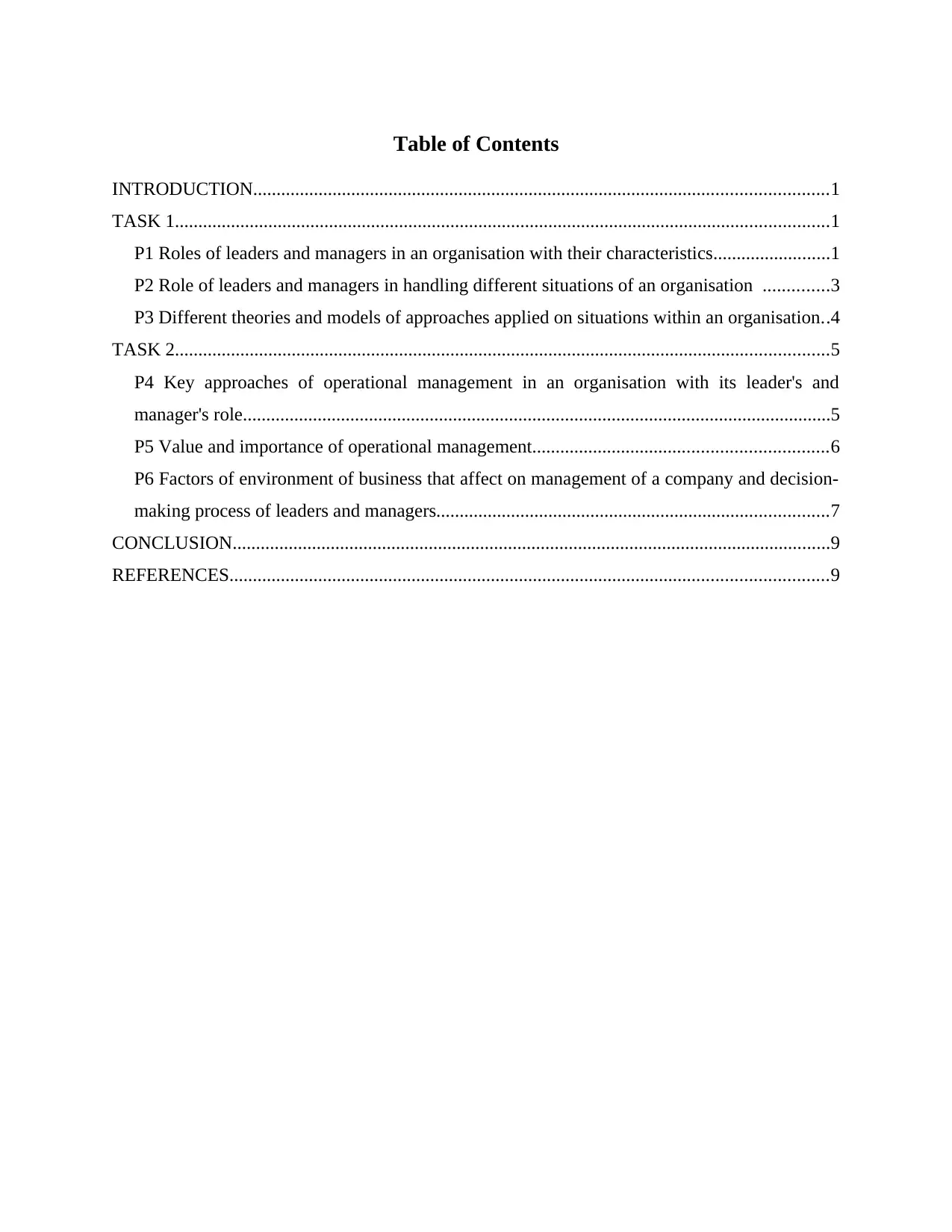
Table of Contents
INTRODUCTION...........................................................................................................................1
TASK 1............................................................................................................................................1
P1 Roles of leaders and managers in an organisation with their characteristics.........................1
P2 Role of leaders and managers in handling different situations of an organisation ..............3
P3 Different theories and models of approaches applied on situations within an organisation..4
TASK 2............................................................................................................................................5
P4 Key approaches of operational management in an organisation with its leader's and
manager's role..............................................................................................................................5
P5 Value and importance of operational management...............................................................6
P6 Factors of environment of business that affect on management of a company and decision-
making process of leaders and managers....................................................................................7
CONCLUSION................................................................................................................................9
REFERENCES................................................................................................................................9
INTRODUCTION...........................................................................................................................1
TASK 1............................................................................................................................................1
P1 Roles of leaders and managers in an organisation with their characteristics.........................1
P2 Role of leaders and managers in handling different situations of an organisation ..............3
P3 Different theories and models of approaches applied on situations within an organisation..4
TASK 2............................................................................................................................................5
P4 Key approaches of operational management in an organisation with its leader's and
manager's role..............................................................................................................................5
P5 Value and importance of operational management...............................................................6
P6 Factors of environment of business that affect on management of a company and decision-
making process of leaders and managers....................................................................................7
CONCLUSION................................................................................................................................9
REFERENCES................................................................................................................................9
INTRODUCTION
Operations management belongs to administration of a business practices which creates
highest level of efficiencies in an organisation by managing its entire process. It involves in
utilising resources from staff, materials and technologies. It involves in management of
inventories, quality control, materials handling, maintenance policies and raw materials
acquisition. It mainly concerns in converting materials into finished or semi-finished products
with efficiency to maximize the company's profit (Lindström and et. al., 2012). It takes all
responsibilities regarding business process as well as making strategies, planning and designing
products etc. This present report discussing all matters regarding operational management in
Marks & Spencer (M&S) Company of the UK which deals in retailing sector. It also shows role
of managers and leaders in an organisation and how their functions differentiate them. This
report also focuses on various theories of operational management that use to improve
performance of organisation and its employees in order to achieve goals.
TASK 1
P1 Roles of leaders and managers in an organisation with their characteristics
Leaders: They are those persons of organisations who lead a group or team in specific
direction. Their main responsibility is to encourage, motivates or influence a team towards
achievement of company's objectives. They also focusing on performance of people who are
working around them and try to make improvement also.
Managers: Persons who always engage in designing, creating, managing and controlling
the operations of organisation are known as managers. Their main responsibility is to develop
and establish strategies and policies which is use to maximise profit of a company. They also
focuses on providing benefits of employees with their appraisals of performance.
Role of Leaders: To lead an organisation is a different work than to manage it by
leaders. They help to fulfil achievements of a firm (Jacobs, Chase and Lummus, 2014).
Communication: Main role of leader in an organisation is to communicate all its
objectives, plan and about diversities to employees who will work on it. An effective
communication skills makes a leader impressive in front of his team members.
1
Operations management belongs to administration of a business practices which creates
highest level of efficiencies in an organisation by managing its entire process. It involves in
utilising resources from staff, materials and technologies. It involves in management of
inventories, quality control, materials handling, maintenance policies and raw materials
acquisition. It mainly concerns in converting materials into finished or semi-finished products
with efficiency to maximize the company's profit (Lindström and et. al., 2012). It takes all
responsibilities regarding business process as well as making strategies, planning and designing
products etc. This present report discussing all matters regarding operational management in
Marks & Spencer (M&S) Company of the UK which deals in retailing sector. It also shows role
of managers and leaders in an organisation and how their functions differentiate them. This
report also focuses on various theories of operational management that use to improve
performance of organisation and its employees in order to achieve goals.
TASK 1
P1 Roles of leaders and managers in an organisation with their characteristics
Leaders: They are those persons of organisations who lead a group or team in specific
direction. Their main responsibility is to encourage, motivates or influence a team towards
achievement of company's objectives. They also focusing on performance of people who are
working around them and try to make improvement also.
Managers: Persons who always engage in designing, creating, managing and controlling
the operations of organisation are known as managers. Their main responsibility is to develop
and establish strategies and policies which is use to maximise profit of a company. They also
focuses on providing benefits of employees with their appraisals of performance.
Role of Leaders: To lead an organisation is a different work than to manage it by
leaders. They help to fulfil achievements of a firm (Jacobs, Chase and Lummus, 2014).
Communication: Main role of leader in an organisation is to communicate all its
objectives, plan and about diversities to employees who will work on it. An effective
communication skills makes a leader impressive in front of his team members.
1
⊘ This is a preview!⊘
Do you want full access?
Subscribe today to unlock all pages.

Trusted by 1+ million students worldwide
Strategies: To execute an strategy successfully is the responsibility of a company's
leader. With help of management, leaders use to develop effective strategies for improving
performance of organisation.
Support: Leaders support their team in executing a plan successfully or to help them in
completing a task in a specific duration of time.
Policy: They are also responsible for redirecting company's policy on employment,
diversity etc.
Role of Managers: Role of managers affect the complete process of an organisation.
They are performing so many responsibilities like:-
Administration: To ensure that all requirements of an organisation are met on time, is a
basic responsibility of managers (Loucks and Van Beek, 2017). They are able to administer all
operations of a company.
Delegation: Managers are always able to delegate workload of a company in an effective
manner by monitoring its progress towards completing.
Leadership: They are able to set a vision for his organisation in employees through their
effective leadership quality.
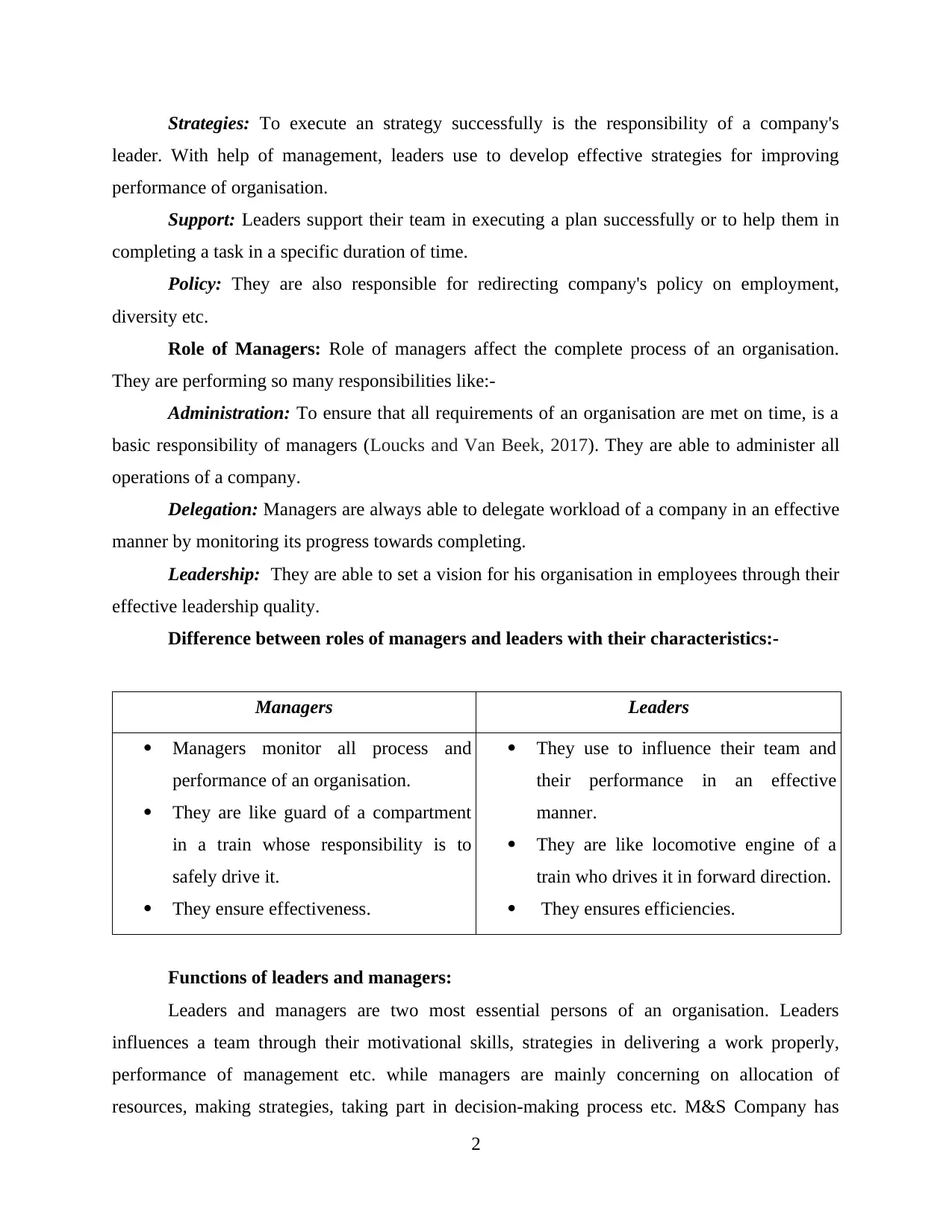
Difference between roles of managers and leaders with their characteristics:-
Managers Leaders
Managers monitor all process and
performance of an organisation.
They are like guard of a compartment
in a train whose responsibility is to
safely drive it.
They ensure effectiveness.
They use to influence their team and
their performance in an effective
manner.
They are like locomotive engine of a
train who drives it in forward direction.
They ensures efficiencies.
Functions of leaders and managers:
Leaders and managers are two most essential persons of an organisation. Leaders
influences a team through their motivational skills, strategies in delivering a work properly,
performance of management etc. while managers are mainly concerning on allocation of
resources, making strategies, taking part in decision-making process etc. M&S Company has
2
leader. With help of management, leaders use to develop effective strategies for improving
performance of organisation.
Support: Leaders support their team in executing a plan successfully or to help them in
completing a task in a specific duration of time.
Policy: They are also responsible for redirecting company's policy on employment,
diversity etc.
Role of Managers: Role of managers affect the complete process of an organisation.
They are performing so many responsibilities like:-
Administration: To ensure that all requirements of an organisation are met on time, is a
basic responsibility of managers (Loucks and Van Beek, 2017). They are able to administer all
operations of a company.
Delegation: Managers are always able to delegate workload of a company in an effective
manner by monitoring its progress towards completing.
Leadership: They are able to set a vision for his organisation in employees through their
effective leadership quality.
Difference between roles of managers and leaders with their characteristics:-
Managers Leaders
Managers monitor all process and
performance of an organisation.
They are like guard of a compartment
in a train whose responsibility is to
safely drive it.
They ensure effectiveness.
They use to influence their team and
their performance in an effective
manner.
They are like locomotive engine of a
train who drives it in forward direction.
They ensures efficiencies.
Functions of leaders and managers:
Leaders and managers are two most essential persons of an organisation. Leaders
influences a team through their motivational skills, strategies in delivering a work properly,
performance of management etc. while managers are mainly concerning on allocation of
resources, making strategies, taking part in decision-making process etc. M&S Company has
2
Paraphrase This Document
Need a fresh take? Get an instant paraphrase of this document with our AI Paraphraser
specially known for its effective leadership and qualities of management (Nong and et. al.,
2013). Its leaders and managers play an effective role in its operation management, some of that
are describing as below:-
Planning: To plan and set a goal is main function done by managers and leaders of M&S
Company.
Organising & Directing:Managers of this firm organising all processes whereas leaders
use to execute these successfully within there.
Coordinating & Controlling: Both of them coordinates with stakeholders, clients or
vendors of this company to maximise its efficiencies as well as control all activities also.
P2 Role of leaders and managers in handling different situations of an organisation
In order to improve operational process of a company as well as reducing its cost of
manufacturing a manger use to manage all these by adopting effective styles of leadership.
Managers and leaders of a company coordinates each other in completing a task successfully on
time. There are various functions of management use by M&S Company including different
traits and style of leadership that helps it in proper functioning. Today, this company is facing
many situations arise due to limited resource available in market or rise in purchasing power of
raw materials affects its production badly (Singh, Padhy and Sharma, 2011). Some more
situations facing by this company are:-
Situation 1: M&S has assigned a new task to its managers and leaders which they have to
execute with their team members in a certain period of time. So its managers and leaders use
many strategies to overcome from this situation. They adopt different theories of management
including effective leadership skills also that can be described as:-
Classical theory of management-This theory of management helps in enhancing the
employees productivity so that an organisation can achieve best result from them. Managers of
M&S applies this theory of management to develop job skills and abilities in employees. In order
to complete the given task, managers should plan working activity and operations in their
management. They should provide incentives for encouraging the morale of employees which
generate desired output.
Task oriented theory: It is an approach of leadership which focuses on given task and
performance as per requirement to achieve the desired result. Through this theory, leaders can
3
2013). Its leaders and managers play an effective role in its operation management, some of that
are describing as below:-
Planning: To plan and set a goal is main function done by managers and leaders of M&S
Company.
Organising & Directing:Managers of this firm organising all processes whereas leaders
use to execute these successfully within there.
Coordinating & Controlling: Both of them coordinates with stakeholders, clients or
vendors of this company to maximise its efficiencies as well as control all activities also.
P2 Role of leaders and managers in handling different situations of an organisation
In order to improve operational process of a company as well as reducing its cost of
manufacturing a manger use to manage all these by adopting effective styles of leadership.
Managers and leaders of a company coordinates each other in completing a task successfully on
time. There are various functions of management use by M&S Company including different
traits and style of leadership that helps it in proper functioning. Today, this company is facing
many situations arise due to limited resource available in market or rise in purchasing power of
raw materials affects its production badly (Singh, Padhy and Sharma, 2011). Some more
situations facing by this company are:-
Situation 1: M&S has assigned a new task to its managers and leaders which they have to
execute with their team members in a certain period of time. So its managers and leaders use
many strategies to overcome from this situation. They adopt different theories of management
including effective leadership skills also that can be described as:-
Classical theory of management-This theory of management helps in enhancing the
employees productivity so that an organisation can achieve best result from them. Managers of
M&S applies this theory of management to develop job skills and abilities in employees. In order
to complete the given task, managers should plan working activity and operations in their
management. They should provide incentives for encouraging the morale of employees which
generate desired output.
Task oriented theory: It is an approach of leadership which focuses on given task and
performance as per requirement to achieve the desired result. Through this theory, leaders can
3
engage the employees in completing the given task on time. Leaders can generate the desired
output by improving performance of employees and direct them towards achievement of goal.
Situation 2- Build the strong brand image of products of M&S, managers and leaders
need to concern on retaining their productive, efficient and loyal employees.
Administrative theory: This theory is mainly based on concept of division that describes
that in an organisation, different activities are to be performed by its various departments with a
common purpose to achieve organisational goals. It focuses on efficiency of management.
Managers of M&S use this theory in concerning the present scenario of this firm so that process
can be done and moves to operational level, where workers need to improve their performance.
Leaders help to organise these in reducing cost of manufacturing as well as increasing its
products. Managers can apply this theory by explaining the given task to employees. It would
enhance productivity and maximise the efficiency of M&S as well as creates strong brand image
of product at marketplace.
Behavioural theory: It focuses on what workers need in completing a task while
working in an organisation. Managers of M&S use this theory for work-related satisfaction of its
workers, through this they can utilise their work in an efficient manner. Leaders use
communicative skills of them in order to know all needs of workers. Managers are required to
identify and retain best employees.
P3 Different theories and models of approaches applied on situations within an organisation
Management in an organisation takes place within a structured setting having different
roles. It always directed the efforts of employees in achieving company's goals and objectives.
Thus, it needs to adopt an effective leadership theories by leaders and managers to manage all
employees in a desired way (Different theories of leadership applied on situations within an
organisation, 2017). Success of leadership theories adopt by a leader or manager depends on
how he execute these in influencing the employees. On regarding this, a leader or manager who
leads a team has to recognise:
He should make efforts in getting willingness of employees by trying to know their level
of interest as well as by developing needs in them that they want while performing a task.
He has to monitor performance of all workers in order to know their weaknesses and
strengths.
4
output by improving performance of employees and direct them towards achievement of goal.
Situation 2- Build the strong brand image of products of M&S, managers and leaders
need to concern on retaining their productive, efficient and loyal employees.
Administrative theory: This theory is mainly based on concept of division that describes
that in an organisation, different activities are to be performed by its various departments with a
common purpose to achieve organisational goals. It focuses on efficiency of management.
Managers of M&S use this theory in concerning the present scenario of this firm so that process
can be done and moves to operational level, where workers need to improve their performance.
Leaders help to organise these in reducing cost of manufacturing as well as increasing its
products. Managers can apply this theory by explaining the given task to employees. It would
enhance productivity and maximise the efficiency of M&S as well as creates strong brand image
of product at marketplace.
Behavioural theory: It focuses on what workers need in completing a task while
working in an organisation. Managers of M&S use this theory for work-related satisfaction of its
workers, through this they can utilise their work in an efficient manner. Leaders use
communicative skills of them in order to know all needs of workers. Managers are required to
identify and retain best employees.
P3 Different theories and models of approaches applied on situations within an organisation
Management in an organisation takes place within a structured setting having different
roles. It always directed the efforts of employees in achieving company's goals and objectives.
Thus, it needs to adopt an effective leadership theories by leaders and managers to manage all
employees in a desired way (Different theories of leadership applied on situations within an
organisation, 2017). Success of leadership theories adopt by a leader or manager depends on
how he execute these in influencing the employees. On regarding this, a leader or manager who
leads a team has to recognise:
He should make efforts in getting willingness of employees by trying to know their level
of interest as well as by developing needs in them that they want while performing a task.
He has to monitor performance of all workers in order to know their weaknesses and
strengths.
4
⊘ This is a preview!⊘
Do you want full access?
Subscribe today to unlock all pages.
Trusted by 1+ million students worldwide
He must influences them through his effective leadership style in a positive way as well
as try to resolve all conflicts between them.
Leadership theories along with approaches: Leadership theories helps the management
in bringing morale of employees towards achievement of company's goals (Wu, 2012). M&S
company uses various approaches of leadership in its management for motivating its employees.
Some of these approaches are describing here as:
System leadership: This leadership refers to control working of employees by
communicating them about situations of a company. M&S use this approach for making its
employees to work according to company's need. Its managers communicate with employees
about all changes in its operations, how they should be work on that as well as by explaining all
benefits regarding the same in their performance.
Situational leadership: In this leadership, a leader can change his style according to
situation arise in organisation. M&S are so much affected with this kind of leadership, as many
situations are arising in this company with its business expansions. So, its leaders required to
adopt an effective style in his leadership to deal in such type of situation (Cruz and Rincon,
2012).
Contingency leadership: It is helpful when a company is making decisions and
strategies. This theory provides effective way in organising a culture in a firm. The strategies
used in leadership of a person are dependent on internal or external situations of a company. As
this theory concerns on external situations also, therefore, M&S use this while dealing with
customer's need. It influences employees of this firm to get their work in an effective way to
meet customer's demand on time.
Strengths and weaknesses of these theories- Since all theories have its own benefits
that an organisation adopts while dealing with different situations. All have their own strengths
and weaknesses. On examining these theories, it has concluded that situational leadership proves
beneficial when many situations arise in the workplace of an organisation and all needs different
techniques to handle. In context to system leadership, it's main aim is to enable an appropriate
leadership to flourish while working in an organisation which is helpful in leading the workers
well.
5
as try to resolve all conflicts between them.
Leadership theories along with approaches: Leadership theories helps the management
in bringing morale of employees towards achievement of company's goals (Wu, 2012). M&S
company uses various approaches of leadership in its management for motivating its employees.
Some of these approaches are describing here as:
System leadership: This leadership refers to control working of employees by
communicating them about situations of a company. M&S use this approach for making its
employees to work according to company's need. Its managers communicate with employees
about all changes in its operations, how they should be work on that as well as by explaining all
benefits regarding the same in their performance.
Situational leadership: In this leadership, a leader can change his style according to
situation arise in organisation. M&S are so much affected with this kind of leadership, as many
situations are arising in this company with its business expansions. So, its leaders required to
adopt an effective style in his leadership to deal in such type of situation (Cruz and Rincon,
2012).
Contingency leadership: It is helpful when a company is making decisions and
strategies. This theory provides effective way in organising a culture in a firm. The strategies
used in leadership of a person are dependent on internal or external situations of a company. As
this theory concerns on external situations also, therefore, M&S use this while dealing with
customer's need. It influences employees of this firm to get their work in an effective way to
meet customer's demand on time.
Strengths and weaknesses of these theories- Since all theories have its own benefits
that an organisation adopts while dealing with different situations. All have their own strengths
and weaknesses. On examining these theories, it has concluded that situational leadership proves
beneficial when many situations arise in the workplace of an organisation and all needs different
techniques to handle. In context to system leadership, it's main aim is to enable an appropriate
leadership to flourish while working in an organisation which is helpful in leading the workers
well.
5
Paraphrase This Document
Need a fresh take? Get an instant paraphrase of this document with our AI Paraphraser
TASK 2
P4 Key approaches of operational management in an organisation with its leader's and manager's
role
Management and operations in an organisation monitors all functions of its various
departments in order to get efficiencies in their work. It mainly concern on utilisation of
resources, employees and other factors that lead to increase production of a company at high
rate. Role of leaders and managers help them in achieving these objectives as well as to bring
sustainability within in workforce (Slack, 2015). Management of M&S uses various approaches
to increase its profitability, some of them are describing here as:-
Redesign process: Today, changes in marketplace needs an organisation to modify or
redesign its structure or operational process in order to stay on a good position from its
competitors. M&S is in retailing sector so, it needs to accept market changes and redesign its
management in an effective way.
Development process: To redesign structure or operational process needs a development
process in skills of workers so that, they can execute these changes successfully in their
organisation. M&S also uses various techniques to develop skills and knowledges of its
employees.
Leadership process: M&S needs an effective leadership qualities in its managers and
leaders to execute the changes in working environment effectively.
Approaches of Management:
Total quality-management: This approach is use to get long-term success in a company.
It includes efforts of all members belong in production to till delivering of products at
marketplace in improving processes, services or culture in which they work (Peng and et. al.,
2015).
Just-in-Time management: It mainly aims to reduce flow times of production as well as
from suppliers to customers in a company. In short, it includes an inventory strategy which
employ in increasing efficiency by reducing wastage. It informs a company when their products
are keep on inventory according to demand of customers.
6-sigma approaches: This approach is used to eliminates or wastages of productions in
a company that includes transportation, inventories, over processing, wait, motion and defects.
Therefore, M&S use it in while planning and production.
6
P4 Key approaches of operational management in an organisation with its leader's and manager's
role
Management and operations in an organisation monitors all functions of its various
departments in order to get efficiencies in their work. It mainly concern on utilisation of
resources, employees and other factors that lead to increase production of a company at high
rate. Role of leaders and managers help them in achieving these objectives as well as to bring
sustainability within in workforce (Slack, 2015). Management of M&S uses various approaches
to increase its profitability, some of them are describing here as:-
Redesign process: Today, changes in marketplace needs an organisation to modify or
redesign its structure or operational process in order to stay on a good position from its
competitors. M&S is in retailing sector so, it needs to accept market changes and redesign its
management in an effective way.
Development process: To redesign structure or operational process needs a development
process in skills of workers so that, they can execute these changes successfully in their
organisation. M&S also uses various techniques to develop skills and knowledges of its
employees.
Leadership process: M&S needs an effective leadership qualities in its managers and
leaders to execute the changes in working environment effectively.
Approaches of Management:
Total quality-management: This approach is use to get long-term success in a company.
It includes efforts of all members belong in production to till delivering of products at
marketplace in improving processes, services or culture in which they work (Peng and et. al.,
2015).
Just-in-Time management: It mainly aims to reduce flow times of production as well as
from suppliers to customers in a company. In short, it includes an inventory strategy which
employ in increasing efficiency by reducing wastage. It informs a company when their products
are keep on inventory according to demand of customers.
6-sigma approaches: This approach is used to eliminates or wastages of productions in
a company that includes transportation, inventories, over processing, wait, motion and defects.
Therefore, M&S use it in while planning and production.
6
P5 Value and importance of operational management
Management and operations are important in all type of organisations whether it belongs
to manufacturing, retailing or any other sector. These are taking care of all processes by
managing operations within an organisation as well as make sure that products or services
offering by its firm are met on customer’s need and demand on time. It includes a set of activities
including planning, staffing, organising, managing and controlling processes as well as leading
people to ensure for better working. In manufacturing sector, operational management holds all
responsibilities from allocating the resources, manufacturing them into products to till it delivery
at marketplace. In service sector, it monitors all processes including customer's need and their
feedback. In M&S Company, management and operations play an important role. As this
company belongs from retailing sector who sells products like clothing, home decors and
luxuries food in marketplace of UK and other countries. Its management and operations concerns
on increasing its production by reducing wastages. At stores, it takes care of marketing and
selling the products. This firm aims to make sure that its warehouses should be used properly as
well as details of products are explained properly to customers so that it can be delivered without
arising any issues which makes shifting cost low (Rushton, Croucher and Baker, 2014).
Operational management also useful as it helps in:-
Profit maximisation: Management and operations helps M&S in reducing its shifting
cost that indirectly increases its profitability. Some other parts like allocating of resources, raw
materials, maintenance of workforce environment and workers, consumer's satisfaction etc. helps
this firm in getting its achievement with high rate of success.
Optimization of utilising resources: Since, in today's global market, available of
resources are getting limited so, management needs to utilize them as maximum as possible by
reducing the wastage. This would affect environment also.
Leaders and manager's role in improving efficiencies of operational management:
Main role of leaders and managers is to transform the raw materials into finished products and
services in a specific time period. This would be done after properly analysing all activities
behind production. Leaders enhance the process design also which improves effectiveness of
operational management. Work of managers mainly concerns on basis of logics and inventory
management as well as implementation of inventory plan. This inventory plan transform the
7
Management and operations are important in all type of organisations whether it belongs
to manufacturing, retailing or any other sector. These are taking care of all processes by
managing operations within an organisation as well as make sure that products or services
offering by its firm are met on customer’s need and demand on time. It includes a set of activities
including planning, staffing, organising, managing and controlling processes as well as leading
people to ensure for better working. In manufacturing sector, operational management holds all
responsibilities from allocating the resources, manufacturing them into products to till it delivery
at marketplace. In service sector, it monitors all processes including customer's need and their
feedback. In M&S Company, management and operations play an important role. As this
company belongs from retailing sector who sells products like clothing, home decors and
luxuries food in marketplace of UK and other countries. Its management and operations concerns
on increasing its production by reducing wastages. At stores, it takes care of marketing and
selling the products. This firm aims to make sure that its warehouses should be used properly as
well as details of products are explained properly to customers so that it can be delivered without
arising any issues which makes shifting cost low (Rushton, Croucher and Baker, 2014).
Operational management also useful as it helps in:-
Profit maximisation: Management and operations helps M&S in reducing its shifting
cost that indirectly increases its profitability. Some other parts like allocating of resources, raw
materials, maintenance of workforce environment and workers, consumer's satisfaction etc. helps
this firm in getting its achievement with high rate of success.
Optimization of utilising resources: Since, in today's global market, available of
resources are getting limited so, management needs to utilize them as maximum as possible by
reducing the wastage. This would affect environment also.
Leaders and manager's role in improving efficiencies of operational management:
Main role of leaders and managers is to transform the raw materials into finished products and
services in a specific time period. This would be done after properly analysing all activities
behind production. Leaders enhance the process design also which improves effectiveness of
operational management. Work of managers mainly concerns on basis of logics and inventory
management as well as implementation of inventory plan. This inventory plan transform the
7
⊘ This is a preview!⊘
Do you want full access?
Subscribe today to unlock all pages.
Trusted by 1+ million students worldwide
value of enhancement through preventing customer's problem. Managers and leaders are
responsible for controlling the inventories as well as maintain the stability of the organisation.
P6 Factors of environment of business that affect on management of a company and decision-
making process of leaders and managers
Today, all organisations are focusing on maintaining values, ethics and sustainability in
their management and operations that improve their relationship with customers as well as
provide satisfaction to them with its services or products. Managers and leaders in M&S, play an
effective role with their relationship in corporation of social responsibilities. They adopt the
concept of developing sustainable business of this firm (Ziogou and et. al., 2011). Managers
make policies regarding factors that affect business of this firm and leaders executed them
successfully on its employees. Some factors are describing here that affects business
environment of M&S along with decision-making of its leaders and managers. These factors
either impact internally or externally (Factors of environment of business that affect on
management of a company, 2016).
Internal Factors: These factors affect internally on an organisation, so it is under control
of management. These are present within workforce of a company that indirectly or directly
impacts its business, some of them are-
Employees:They are the persons who impacts directly on production of a company, as
without them a company can't manufacture its products. They are most valuable assets
for a company who work under contract of their employment. Thus, M&S provides all
benefits including compensation, bonus and incentives as well as appraisals of
performance to them in order to utilise the work (Fang and et. al., 2012).
Training and development: With introducing new technologies, employees need to
develop skills and knowledges to work on that. The companies including M&S have
to provide necessary training program for them. Thus, these program impacts
financially on business of a company as it need time and money both to train
employees.
Innovation and Commercialisation: Innovative ideas, techniques and
commercialisation brings a company one step forward at marketplace as it makes
easier to do the operations well.
8
responsible for controlling the inventories as well as maintain the stability of the organisation.
P6 Factors of environment of business that affect on management of a company and decision-
making process of leaders and managers
Today, all organisations are focusing on maintaining values, ethics and sustainability in
their management and operations that improve their relationship with customers as well as
provide satisfaction to them with its services or products. Managers and leaders in M&S, play an
effective role with their relationship in corporation of social responsibilities. They adopt the
concept of developing sustainable business of this firm (Ziogou and et. al., 2011). Managers
make policies regarding factors that affect business of this firm and leaders executed them
successfully on its employees. Some factors are describing here that affects business
environment of M&S along with decision-making of its leaders and managers. These factors
either impact internally or externally (Factors of environment of business that affect on
management of a company, 2016).
Internal Factors: These factors affect internally on an organisation, so it is under control
of management. These are present within workforce of a company that indirectly or directly
impacts its business, some of them are-
Employees:They are the persons who impacts directly on production of a company, as
without them a company can't manufacture its products. They are most valuable assets
for a company who work under contract of their employment. Thus, M&S provides all
benefits including compensation, bonus and incentives as well as appraisals of
performance to them in order to utilise the work (Fang and et. al., 2012).
Training and development: With introducing new technologies, employees need to
develop skills and knowledges to work on that. The companies including M&S have
to provide necessary training program for them. Thus, these program impacts
financially on business of a company as it need time and money both to train
employees.
Innovation and Commercialisation: Innovative ideas, techniques and
commercialisation brings a company one step forward at marketplace as it makes
easier to do the operations well.
8
Paraphrase This Document
Need a fresh take? Get an instant paraphrase of this document with our AI Paraphraser
External Factors: These factors are present outside of a company so these are beyond
control of management. These directly affect on business, that are describing as-
Trade laws: It provides a wide range of services including commercial legislation for all
organisations. These laws regulate the international trade in UK, including trends,
agreements, negotiations, rules related to supply of services, import and export etc. Thus,
it impacts on trading of all companies.
Competitors: Companies having same products and services present in a same market
compete each other effectively. All try to sell their products in a bulk by making different
price strategies in order to gain customer’s loyalty and satisfaction. So, competitors affect
businesses and strategies of other companies (Qi, Liu and Christofides, 2011).
Economy: A country's economy affect all companies in its businesses. If economic
conditions of a country is good then it provides benefit for both organisations and
purchasing power of customers too otherwise makes losses only.
Customers: Rapid changing in fashion world, effects choice of customers, their life
styles and preferences. Thus, organisations use to modify its existing products or change
in its production to retain customers.
Suppliers and Distributors: Both of them affects business of an organisation. Suppliers
supplies raw materials in a company while distributor helps in distributing its products in
marketplace. Changes in their pricing strategies affects business of a company also.
Corporate Social responsibilities (CSR): CSR contributes with sustainability of an
organisation. This will be done by delivering economic, environmental and social
benefits to all its stakeholders of M&S. CSR policy affects decision-making system of the
organisation. It demands M&S to make decision-making which are ethical in nature.
Leaders and managers of this firm must ensure to follow all ethics in order to promote
welfare of stakeholders.
Business ethics: M&S should follow all business ethics in order to provide welfare all its
stakeholders through its activities. In M&S, role of leaders and managers are mainly
concern to follow proper ethics of work, behaviour and its business. This would help in
motivating employees towards hard work as well as create a sense of equality among
them.
9
control of management. These directly affect on business, that are describing as-
Trade laws: It provides a wide range of services including commercial legislation for all
organisations. These laws regulate the international trade in UK, including trends,
agreements, negotiations, rules related to supply of services, import and export etc. Thus,
it impacts on trading of all companies.
Competitors: Companies having same products and services present in a same market
compete each other effectively. All try to sell their products in a bulk by making different
price strategies in order to gain customer’s loyalty and satisfaction. So, competitors affect
businesses and strategies of other companies (Qi, Liu and Christofides, 2011).
Economy: A country's economy affect all companies in its businesses. If economic
conditions of a country is good then it provides benefit for both organisations and
purchasing power of customers too otherwise makes losses only.
Customers: Rapid changing in fashion world, effects choice of customers, their life
styles and preferences. Thus, organisations use to modify its existing products or change
in its production to retain customers.
Suppliers and Distributors: Both of them affects business of an organisation. Suppliers
supplies raw materials in a company while distributor helps in distributing its products in
marketplace. Changes in their pricing strategies affects business of a company also.
Corporate Social responsibilities (CSR): CSR contributes with sustainability of an
organisation. This will be done by delivering economic, environmental and social
benefits to all its stakeholders of M&S. CSR policy affects decision-making system of the
organisation. It demands M&S to make decision-making which are ethical in nature.
Leaders and managers of this firm must ensure to follow all ethics in order to promote
welfare of stakeholders.
Business ethics: M&S should follow all business ethics in order to provide welfare all its
stakeholders through its activities. In M&S, role of leaders and managers are mainly
concern to follow proper ethics of work, behaviour and its business. This would help in
motivating employees towards hard work as well as create a sense of equality among
them.
9
CONCLUSION
Present report has been prepared to describes the importance of management and its
operations in an organisation. It has discussed that operational management holds all
responsibilities within an organisation including planning, organising, making strategies etc. This
report also enhances roles and responsibilities of leaders and managers as well as how their
functions differentiate them in an organisation. It focuses on various theories of leadership and
management that an organisation adopts in increasing its efficiencies, productivity and
profitability.
10
Present report has been prepared to describes the importance of management and its
operations in an organisation. It has discussed that operational management holds all
responsibilities within an organisation including planning, organising, making strategies etc. This
report also enhances roles and responsibilities of leaders and managers as well as how their
functions differentiate them in an organisation. It focuses on various theories of leadership and
management that an organisation adopts in increasing its efficiencies, productivity and
profitability.
10
⊘ This is a preview!⊘
Do you want full access?
Subscribe today to unlock all pages.
Trusted by 1+ million students worldwide

1 out of 14


Related Documents


Your All-in-One AI-Powered Toolkit for Academic Success.
+13062052269
info@desklib.com
Available 24*7 on WhatsApp / Email
![[object Object]](/_next/static/media/star-bottom.7253800d.svg)
Unlock your academic potential
Copyright © 2020–2026 A2Z Services. All Rights Reserved. Developed and managed by ZUCOL.