Strategic Management: Operational Overhaul for The Business
VerifiedAdded on 2022/08/25
|18
|3640
|19
Report
AI Summary
This report presents a comprehensive analysis of 'The Business,' a home improvement and outdoor living retailer, focusing on a strategic management system to improve its operations. The report begins with a strategy map and SWOT analysis, identifying strengths, weaknesses, opportunities, and threats. It then defines key objectives, including marketing superior products, giving positive returns on investments, empowering employees, and generating higher profits. The report proposes a balance scorecard with specific measures, targets, and initiatives. It details action plans for strategy development and explains how the balance scorecard will help achieve the overall strategies and promote goal congruence. Finally, it includes a memorandum to John Clarkson summarizing the recommendations for operational overhaul and strategic improvements to achieve the five-year goals of increased sales, positive operating income, and increased market share.

Running head: OPERATIONAL OVERHAUL
Operational Overhaul
Name of the student
Name of the university
Author Note:
Operational Overhaul
Name of the student
Name of the university
Author Note:

Paraphrase This Document
Need a fresh take? Get an instant paraphrase of this document with our AI Paraphraser
1
OPERATIONAL OVERHAUL
Table of Contents
Part 1................................................................................................................................................1
Part 1.1. Strategy map of The Business:..........................................................................................1
Part 1.2. SWOT analysis of The Business:......................................................................................1
Strengths:.....................................................................................................................................2
Listed on the ASX:..................................................................................................................2
Autonomy to take business decisions:.....................................................................................2
Present in multiple locations:...................................................................................................2
Weaknesses:.................................................................................................................................2
Subsidiary status:.....................................................................................................................2
Lack of financial planning:......................................................................................................3
Weak product strategy:............................................................................................................3
Weak human resource management:.......................................................................................3
Opportunities:..........................................................................................................................4
Restructuring of the floor management:..................................................................................4
Product innovation:..................................................................................................................4
Threats:........................................................................................................................................5
Lack of development in the industry:......................................................................................5
Part 2. Defining the objectives including in the strategy map and explanation of their importance:
.........................................................................................................................................................5
OPERATIONAL OVERHAUL
Table of Contents
Part 1................................................................................................................................................1
Part 1.1. Strategy map of The Business:..........................................................................................1
Part 1.2. SWOT analysis of The Business:......................................................................................1
Strengths:.....................................................................................................................................2
Listed on the ASX:..................................................................................................................2
Autonomy to take business decisions:.....................................................................................2
Present in multiple locations:...................................................................................................2
Weaknesses:.................................................................................................................................2
Subsidiary status:.....................................................................................................................2
Lack of financial planning:......................................................................................................3
Weak product strategy:............................................................................................................3
Weak human resource management:.......................................................................................3
Opportunities:..........................................................................................................................4
Restructuring of the floor management:..................................................................................4
Product innovation:..................................................................................................................4
Threats:........................................................................................................................................5
Lack of development in the industry:......................................................................................5
Part 2. Defining the objectives including in the strategy map and explanation of their importance:
.........................................................................................................................................................5
2
OPERATIONAL OVERHAUL
Marketing superior products aligned with the expectations of the customers:...........................5
Giving positive returns on investments to the investors:.............................................................6
Empowerment of employees:......................................................................................................7
Generating higher profits:............................................................................................................7
Part 3................................................................................................................................................9
Part 3.1. Balance score card with measures, targets and initiatives:...............................................9
Part 3.2. Action for the strategy development:................................................................................9
Part 4. How the balance scorecard will help achieving the overall strategies:..............................11
Part 5. Evaluation of how the BSC will promote goal congruence:..............................................12
Part 6. Memorandum to John Clarkson:........................................................................................12
References:....................................................................................................................................14
OPERATIONAL OVERHAUL
Marketing superior products aligned with the expectations of the customers:...........................5
Giving positive returns on investments to the investors:.............................................................6
Empowerment of employees:......................................................................................................7
Generating higher profits:............................................................................................................7
Part 3................................................................................................................................................9
Part 3.1. Balance score card with measures, targets and initiatives:...............................................9
Part 3.2. Action for the strategy development:................................................................................9
Part 4. How the balance scorecard will help achieving the overall strategies:..............................11
Part 5. Evaluation of how the BSC will promote goal congruence:..............................................12
Part 6. Memorandum to John Clarkson:........................................................................................12
References:....................................................................................................................................14
⊘ This is a preview!⊘
Do you want full access?
Subscribe today to unlock all pages.

Trusted by 1+ million students worldwide
3
OPERATIONAL OVERHAUL
Goods are marketed as per the
expectations of the customers
and provision of superior
customer services
Customer
sattisfaction The business generates
higher revenue
Higher ROI
Restructuring of
operations,
empowerment of
employees through
training
Employees provide
better customer services
More investments
Stronger
operationsHigher market
position
Part 1.
Part 1.1. Strategy map of The Business:
Part 1.2. SWOT analysis of The Business:
The following is the SWOT analysis of the company under study, The Business:
OPERATIONAL OVERHAUL
Goods are marketed as per the
expectations of the customers
and provision of superior
customer services
Customer
sattisfaction The business generates
higher revenue
Higher ROI
Restructuring of
operations,
empowerment of
employees through
training
Employees provide
better customer services
More investments
Stronger
operationsHigher market
position
Part 1.
Part 1.1. Strategy map of The Business:
Part 1.2. SWOT analysis of The Business:
The following is the SWOT analysis of the company under study, The Business:
Paraphrase This Document
Need a fresh take? Get an instant paraphrase of this document with our AI Paraphraser
4
OPERATIONAL OVERHAUL
Strengths:
Listed on the ASX:
The Business is owned by a company which is listed on the ASX. Mahdaleta (2016)
mentions that the listing on stock exchanges enable the listed firms to generate capital from the
securities market by issuing shares. As far as The Business is concerned, the holding company is
listed on the ASX which means the former is able to obtain capital from the latter.
Autonomy to take business decisions:
The Business, though owned by a grocery and liquor retailing chain, the company is
allowed to maintain its autonomous position. The company is allowed to maintain its brands and
identity. This means that the management body of The Business is allowed to take business
decisions which would enable them to strengthen the operations of the company (Szałucka
2016).
Present in multiple locations:
The Business is present in multiple locations in Australia like Victoria, New South Wales
and Queensland. This enables the company to gain access to a huge customer base to market its
products and generate revenue.
Weaknesses:
Subsidiary status:
The Business is a subsidiary company and is subjected to control of the grocery and
liquor retail company owning it. The company owing to its subsidiary status does not have any
direct access to the capital market and cannot raise capital directly. In fact, it is dependent on the
funds allocated by the mother company. This dependency on the fund allocations by the mother
OPERATIONAL OVERHAUL
Strengths:
Listed on the ASX:
The Business is owned by a company which is listed on the ASX. Mahdaleta (2016)
mentions that the listing on stock exchanges enable the listed firms to generate capital from the
securities market by issuing shares. As far as The Business is concerned, the holding company is
listed on the ASX which means the former is able to obtain capital from the latter.
Autonomy to take business decisions:
The Business, though owned by a grocery and liquor retailing chain, the company is
allowed to maintain its autonomous position. The company is allowed to maintain its brands and
identity. This means that the management body of The Business is allowed to take business
decisions which would enable them to strengthen the operations of the company (Szałucka
2016).
Present in multiple locations:
The Business is present in multiple locations in Australia like Victoria, New South Wales
and Queensland. This enables the company to gain access to a huge customer base to market its
products and generate revenue.
Weaknesses:
Subsidiary status:
The Business is a subsidiary company and is subjected to control of the grocery and
liquor retail company owning it. The company owing to its subsidiary status does not have any
direct access to the capital market and cannot raise capital directly. In fact, it is dependent on the
funds allocated by the mother company. This dependency on the fund allocations by the mother
5
OPERATIONAL OVERHAUL
company restricted the capacity of the management of The Business to take decisions and
implement them. Thus, in order word, the subsidiary status to a great extent limited the capacity
of The Business to make strategic business decisions.
Lack of financial planning:
The Business suffers from gross lack of financial planning. The key financial data
provided shows that the total asset of the company is A$ 1700 while the total liability is A$ 372.
This means that A$ 1328 is the equity capital. The firm is expected to give 12% return to the
investors on their investment. However, the firm fails to give any return to its investors or in
other words, the firm is generating negative returns on investment. The operating profit of the
firm is $ 1000 but generated a net profit before tax of $0. This means that the firm is not able to
manage its expenses in order to generate sufficient net profits to cover at least the cost of capital.
This analysis of the financial statement shows that the company lacks in financial planning.
Weak product strategy:
The Business has a very weak product strategy. This is evident from the fact that products
which the firm markets were not aligned with the preferences of the customers. The firm does
not order modern products and charges very high prices for its products. The rate of discount
which is offered are as low as 5% while the higher rate of discount of 20% is limited to a few
products so that they could be sold. Thus, one the point out that the products strategy of the firm
is not customer centric.
Weak human resource management:
The Business suffered from a very weak human resource management system. This is
evident from the fact that the employees are not provided training on products. They as a result
lack the knowledge about the products required to serve customers. In fact, the management of
OPERATIONAL OVERHAUL
company restricted the capacity of the management of The Business to take decisions and
implement them. Thus, in order word, the subsidiary status to a great extent limited the capacity
of The Business to make strategic business decisions.
Lack of financial planning:
The Business suffers from gross lack of financial planning. The key financial data
provided shows that the total asset of the company is A$ 1700 while the total liability is A$ 372.
This means that A$ 1328 is the equity capital. The firm is expected to give 12% return to the
investors on their investment. However, the firm fails to give any return to its investors or in
other words, the firm is generating negative returns on investment. The operating profit of the
firm is $ 1000 but generated a net profit before tax of $0. This means that the firm is not able to
manage its expenses in order to generate sufficient net profits to cover at least the cost of capital.
This analysis of the financial statement shows that the company lacks in financial planning.
Weak product strategy:
The Business has a very weak product strategy. This is evident from the fact that products
which the firm markets were not aligned with the preferences of the customers. The firm does
not order modern products and charges very high prices for its products. The rate of discount
which is offered are as low as 5% while the higher rate of discount of 20% is limited to a few
products so that they could be sold. Thus, one the point out that the products strategy of the firm
is not customer centric.
Weak human resource management:
The Business suffered from a very weak human resource management system. This is
evident from the fact that the employees are not provided training on products. They as a result
lack the knowledge about the products required to serve customers. In fact, the management of
⊘ This is a preview!⊘
Do you want full access?
Subscribe today to unlock all pages.
Trusted by 1+ million students worldwide
6
OPERATIONAL OVERHAUL
the company deploys insufficient number of staff to assist the customers locate products in the
store. Thus, one can point out that weak human resource management strategies of The Business
ultimately results in low level of customer satisfaction which finally proves detrimental for the
revenue generation of the firm.
Opportunities:
Restructuring of the floor management:
The company should restructure its floor management strategies to ensure more efficient
operations. First of all, the management should install modern lighting systems which would
illuminate larger floor areas but consume less energy compared to their older counterparts. This
would enable the company reduce its floor expenses. Similarly, the firm should have placards or
boards mentioning the names of specific products installed in specific places. This would enable
the customers locate products more quickly. Thus, restructuring the floor management strategies
would enable the company reduce its expenses like electricity expenses and floor management
expenses.
Product innovation:
The company should carry out product innovation to market more customer aligned
ranges of products. For example, it should offer modern hardware products at legitimate prices
and discounts rates. This would enable the company to offer products which would be more
aligned to the preferences of customers and generate higher revenue.
OPERATIONAL OVERHAUL
the company deploys insufficient number of staff to assist the customers locate products in the
store. Thus, one can point out that weak human resource management strategies of The Business
ultimately results in low level of customer satisfaction which finally proves detrimental for the
revenue generation of the firm.
Opportunities:
Restructuring of the floor management:
The company should restructure its floor management strategies to ensure more efficient
operations. First of all, the management should install modern lighting systems which would
illuminate larger floor areas but consume less energy compared to their older counterparts. This
would enable the company reduce its floor expenses. Similarly, the firm should have placards or
boards mentioning the names of specific products installed in specific places. This would enable
the customers locate products more quickly. Thus, restructuring the floor management strategies
would enable the company reduce its expenses like electricity expenses and floor management
expenses.
Product innovation:
The company should carry out product innovation to market more customer aligned
ranges of products. For example, it should offer modern hardware products at legitimate prices
and discounts rates. This would enable the company to offer products which would be more
aligned to the preferences of customers and generate higher revenue.
Paraphrase This Document
Need a fresh take? Get an instant paraphrase of this document with our AI Paraphraser
7
OPERATIONAL OVERHAUL
Threats:
Lack of development in the industry:
The case study mentions that the most of the firms operating in the Australian hardware
industry are small scale firms. This lack of development in the industry limits the ability of The
Business to collaborate with other firms to carry out open innovation.
Part 2. Defining the objectives including in the strategy map and explanation of their
importance:
The following are the main objectives of the strategy map:
Marketing superior products aligned with the expectations of the customers:
The first objective of the firm should be offering superior quality modern products which
would be aligned to the expectations of the customers. The importance of this strategy is that
providing superior quality products would ensure customer satisfaction and enable the firm
acquire a loyal base of customers who would purchase products from the firm on repeated basis.
Hamilton, Rust and Dev (2017) mention that business organisations should consider the aspects
of customer satisfaction and investors capital maximisation while forming product strategies.
This is because creation of customer satisfaction generates high revenue which ultimately leads
to giving high ROI to investors. In other words, marketing superior products to customers results
in customer satisfaction which is directly linked to attract more capital. However, the case study
clearly mentions that The Business markets old fashioned products at illegitimately high prices
which results in customer resentment instead of gaining customer satisfaction. This results in
generation of poor revenue which means that the company is not able to giving high ROI to
investors. This is evident from the fact the company in spite of generating revenue, is not able to
give ROI to investors. Haverila and Fehr (2016) stress on the importance of offering superior
OPERATIONAL OVERHAUL
Threats:
Lack of development in the industry:
The case study mentions that the most of the firms operating in the Australian hardware
industry are small scale firms. This lack of development in the industry limits the ability of The
Business to collaborate with other firms to carry out open innovation.
Part 2. Defining the objectives including in the strategy map and explanation of their
importance:
The following are the main objectives of the strategy map:
Marketing superior products aligned with the expectations of the customers:
The first objective of the firm should be offering superior quality modern products which
would be aligned to the expectations of the customers. The importance of this strategy is that
providing superior quality products would ensure customer satisfaction and enable the firm
acquire a loyal base of customers who would purchase products from the firm on repeated basis.
Hamilton, Rust and Dev (2017) mention that business organisations should consider the aspects
of customer satisfaction and investors capital maximisation while forming product strategies.
This is because creation of customer satisfaction generates high revenue which ultimately leads
to giving high ROI to investors. In other words, marketing superior products to customers results
in customer satisfaction which is directly linked to attract more capital. However, the case study
clearly mentions that The Business markets old fashioned products at illegitimately high prices
which results in customer resentment instead of gaining customer satisfaction. This results in
generation of poor revenue which means that the company is not able to giving high ROI to
investors. This is evident from the fact the company in spite of generating revenue, is not able to
give ROI to investors. Haverila and Fehr (2016) stress on the importance of offering superior
8
OPERATIONAL OVERHAUL
products by pointing out that companies instead of offering superior products only to generate
revenue in the short term, should aim to gain their continuous support by building long term
relationships. One can point out in the light of the case study that The Business markets inferior
products at very high prices, thus resulting in customer resentment. The company earns low
revenue and eventually undermines the interests of the investors. This means that the company
would go on to lose support of investors in the due course if its management does not set
objectives to deal with the situation on highest priority. Thus, The Business should market
superior quality products as per the customer preferences at legitimate prices. Thus, The
Business, by achieving this objective would be able to source a steady stream of revenue from
this existing customer base. This would provide the firm the financial base which would support
its marketing strategies to acquire new customers.
Giving positive returns on investments to the investors:
The second objective of The Business would be gaining positive return on the
investments to the investors. Hoffmann, Brønn and Fieseler (2016) mention that the ability of
giving ROI enables the companies to building up strong goodwill among the investors which
enable them to attract more capital. Holderness (2018) points out that shareholders’ support
enables the companies lower their respective stock issuance costs. Thus, it transpires from the
discussion that The Business should aim to give higher returns on investors to attract more
capital at lower issuance costs. However, the financial statement clearly shows that the firm fails
to give ROI to investors which means that the investors would divest in its shares in future. This
would mean that the firm would generate low capital which would ultimately jeopardise its
operations. Thus, it can established that the firm should aim at giving high ROI to the investors
because it would enable the firm attract more investments which would in turn strengthen its
OPERATIONAL OVERHAUL
products by pointing out that companies instead of offering superior products only to generate
revenue in the short term, should aim to gain their continuous support by building long term
relationships. One can point out in the light of the case study that The Business markets inferior
products at very high prices, thus resulting in customer resentment. The company earns low
revenue and eventually undermines the interests of the investors. This means that the company
would go on to lose support of investors in the due course if its management does not set
objectives to deal with the situation on highest priority. Thus, The Business should market
superior quality products as per the customer preferences at legitimate prices. Thus, The
Business, by achieving this objective would be able to source a steady stream of revenue from
this existing customer base. This would provide the firm the financial base which would support
its marketing strategies to acquire new customers.
Giving positive returns on investments to the investors:
The second objective of The Business would be gaining positive return on the
investments to the investors. Hoffmann, Brønn and Fieseler (2016) mention that the ability of
giving ROI enables the companies to building up strong goodwill among the investors which
enable them to attract more capital. Holderness (2018) points out that shareholders’ support
enables the companies lower their respective stock issuance costs. Thus, it transpires from the
discussion that The Business should aim to give higher returns on investors to attract more
capital at lower issuance costs. However, the financial statement clearly shows that the firm fails
to give ROI to investors which means that the investors would divest in its shares in future. This
would mean that the firm would generate low capital which would ultimately jeopardise its
operations. Thus, it can established that the firm should aim at giving high ROI to the investors
because it would enable the firm attract more investments which would in turn strengthen its
⊘ This is a preview!⊘
Do you want full access?
Subscribe today to unlock all pages.
Trusted by 1+ million students worldwide
9
OPERATIONAL OVERHAUL
operations. In fact, this would bring down capital issuance costs which would ultimately boost its
net profit.
Empowerment of employees:
The third objective of strategy map of The Business would be empowerment of
employees. Loy et al. (2019) mention that employees with critical thinking skills and decision
making capabilities have the ability to offering superior customer services which leads to
customer satisfaction (objective 1). The case study clearly mentions that the employees of The
Business lack product knowledge and are not able to superior customer services which
eventually leads to poor customer satisfaction. Thus, the management should set empowerment
of employees as its third important objective. This means that the firm would have to provide the
employees training and mentoring in order to improve their skills as well as knowledge. The
importance of the strategy lies in the fact that empowerment would enable the employees would
enable them to provide superior services to customers would in turn create higher level of
customer satisfaction. This would ultimately pave ways for generating high revenue.
Generating higher profits:
The ultimate aim of the company should be generating higher profits. Vo et al (2017)
while stressing on the interdependent relationship between customer satisfaction and profit
generation mentions, ‘a high level of customer happiness should generate high customer
base, resulting in high expected cash flows as well as expansion opportunities for the firm
in the future.’ This means that just like customer satisfaction is important profit generation,
firms in order create customer satisfaction need to generate high profits. The case study clearly
mentions that The Business generates revenue but is not able to generate net profits. This means
the revenue of the company is just enough to cover its expenses. Thus, it transpires from
OPERATIONAL OVERHAUL
operations. In fact, this would bring down capital issuance costs which would ultimately boost its
net profit.
Empowerment of employees:
The third objective of strategy map of The Business would be empowerment of
employees. Loy et al. (2019) mention that employees with critical thinking skills and decision
making capabilities have the ability to offering superior customer services which leads to
customer satisfaction (objective 1). The case study clearly mentions that the employees of The
Business lack product knowledge and are not able to superior customer services which
eventually leads to poor customer satisfaction. Thus, the management should set empowerment
of employees as its third important objective. This means that the firm would have to provide the
employees training and mentoring in order to improve their skills as well as knowledge. The
importance of the strategy lies in the fact that empowerment would enable the employees would
enable them to provide superior services to customers would in turn create higher level of
customer satisfaction. This would ultimately pave ways for generating high revenue.
Generating higher profits:
The ultimate aim of the company should be generating higher profits. Vo et al (2017)
while stressing on the interdependent relationship between customer satisfaction and profit
generation mentions, ‘a high level of customer happiness should generate high customer
base, resulting in high expected cash flows as well as expansion opportunities for the firm
in the future.’ This means that just like customer satisfaction is important profit generation,
firms in order create customer satisfaction need to generate high profits. The case study clearly
mentions that The Business generates revenue but is not able to generate net profits. This means
the revenue of the company is just enough to cover its expenses. Thus, it transpires from
Paraphrase This Document
Need a fresh take? Get an instant paraphrase of this document with our AI Paraphraser

10
OPERATIONAL OVERHAUL
discussion that the firm should obtain the objective to generate higher revenue so that it would be
able to generate high net profits after covering all the expenses. This would in turn enable it
support its previous objectives by providing them with a strong financial base.
OPERATIONAL OVERHAUL
discussion that the firm should obtain the objective to generate higher revenue so that it would be
able to generate high net profits after covering all the expenses. This would in turn enable it
support its previous objectives by providing them with a strong financial base.
11
OPERATIONAL OVERHAUL
Part 3.
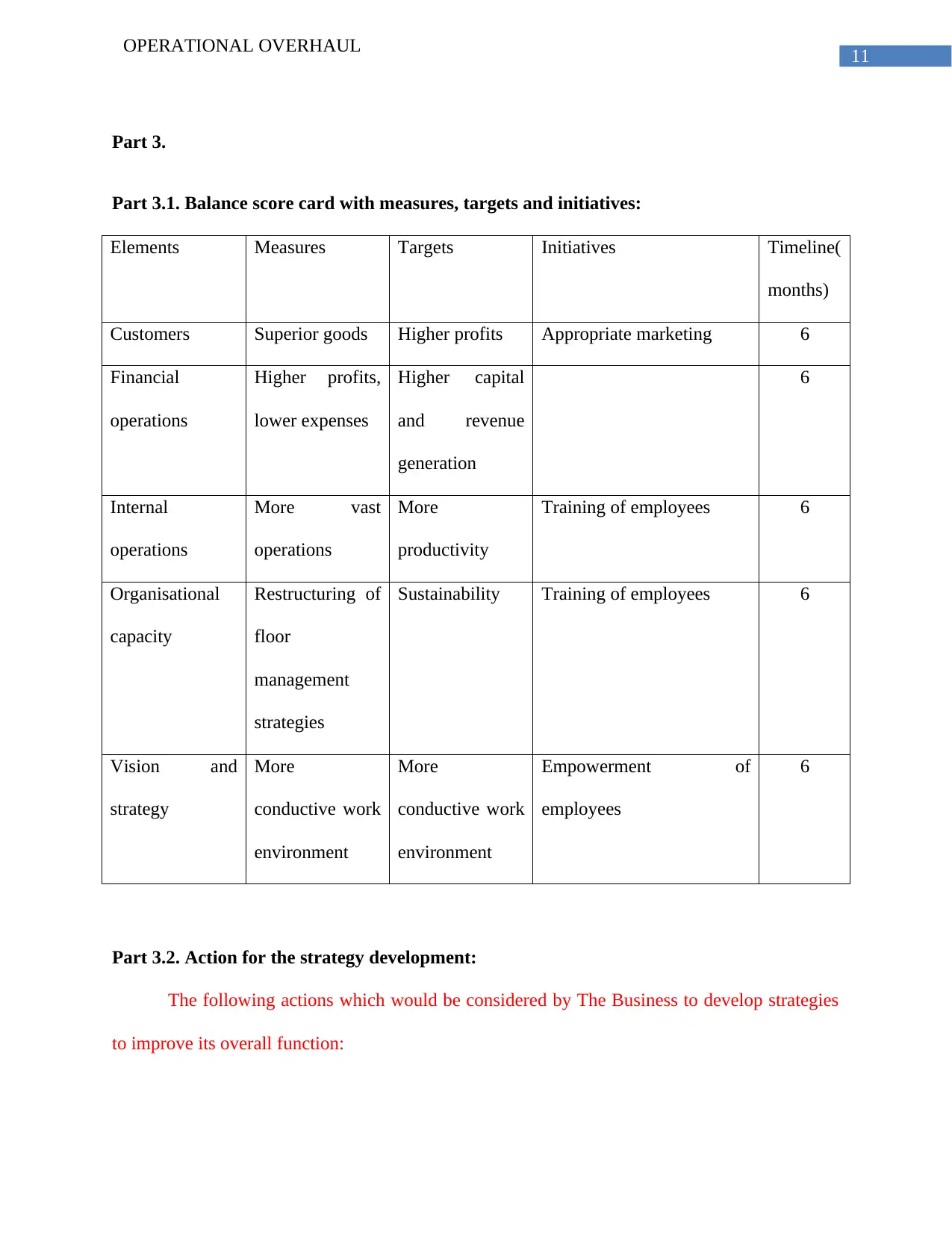
Part 3.1. Balance score card with measures, targets and initiatives:
Elements Measures Targets Initiatives Timeline(
months)
Customers Superior goods Higher profits Appropriate marketing 6
Financial
operations
Higher profits,
lower expenses
Higher capital
and revenue
generation
6
Internal
operations
More vast
operations
More
productivity
Training of employees 6
Organisational
capacity
Restructuring of
floor
management
strategies
Sustainability Training of employees 6
Vision and
strategy
More
conductive work
environment
More
conductive work
environment
Empowerment of
employees
6
Part 3.2. Action for the strategy development:
The following actions which would be considered by The Business to develop strategies
to improve its overall function:
OPERATIONAL OVERHAUL
Part 3.
Part 3.1. Balance score card with measures, targets and initiatives:
Elements Measures Targets Initiatives Timeline(
months)
Customers Superior goods Higher profits Appropriate marketing 6
Financial
operations
Higher profits,
lower expenses
Higher capital
and revenue
generation
6
Internal
operations
More vast
operations
More
productivity
Training of employees 6
Organisational
capacity
Restructuring of
floor
management
strategies
Sustainability Training of employees 6
Vision and
strategy
More
conductive work
environment
More
conductive work
environment
Empowerment of
employees
6
Part 3.2. Action for the strategy development:
The following actions which would be considered by The Business to develop strategies
to improve its overall function:
⊘ This is a preview!⊘
Do you want full access?
Subscribe today to unlock all pages.
Trusted by 1+ million students worldwide

1 out of 18


Related Documents


Your All-in-One AI-Powered Toolkit for Academic Success.
+13062052269
info@desklib.com
Available 24*7 on WhatsApp / Email
![[object Object]](/_next/static/media/star-bottom.7253800d.svg)
Unlock your academic potential
Copyright © 2020–2026 A2Z Services. All Rights Reserved. Developed and managed by ZUCOL.