M&S Leadership, Management, and Operational Analysis: Unit 4 Report
VerifiedAdded on 2020/09/17
|14
|4427
|374
Report
AI Summary
This report delves into the core concepts of leadership and management, specifically within the context of Marks & Spencer (M&S). It begins by defining and comparing the roles and characteristics of leaders and managers, highlighting their distinct functions and responsibilities in an organizational setting. The report then examines how these roles are applied in different situational contexts, particularly addressing the challenges M&S faces, such as declining sales and supply chain issues. Various leadership models and theories, including trait theory, skills theory, situational theory, contingency theory, transformational theory, and transactional theory, are explored to understand their practical applications. The report also analyzes major approaches to operations management, such as supply chain management, organizational resource planning, and customer relationship management, and their significance in achieving organizational objectives. Finally, it assesses the factors within the business environment that influence operational management, providing a comprehensive overview of leadership and management strategies in a real-world business scenario.

UNIT 4 MO

Paraphrase This Document
Need a fresh take? Get an instant paraphrase of this document with our AI Paraphraser
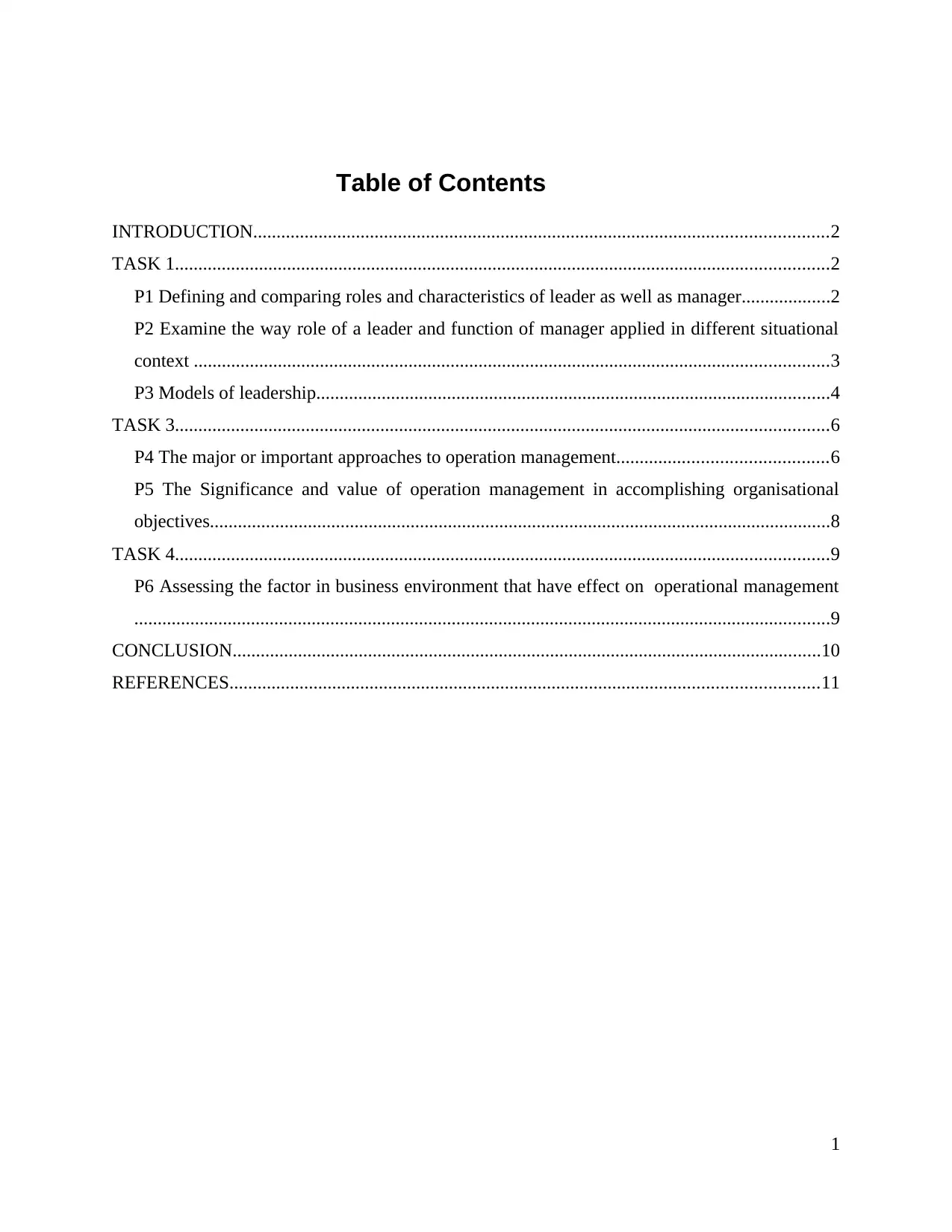
Table of Contents
INTRODUCTION...........................................................................................................................2
TASK 1............................................................................................................................................2
P1 Defining and comparing roles and characteristics of leader as well as manager...................2
P2 Examine the way role of a leader and function of manager applied in different situational
context ........................................................................................................................................3
P3 Models of leadership..............................................................................................................4
TASK 3............................................................................................................................................6
P4 The major or important approaches to operation management.............................................6
P5 The Significance and value of operation management in accomplishing organisational
objectives.....................................................................................................................................8
TASK 4............................................................................................................................................9
P6 Assessing the factor in business environment that have effect on operational management
.....................................................................................................................................................9
CONCLUSION..............................................................................................................................10
REFERENCES..............................................................................................................................11
1
INTRODUCTION...........................................................................................................................2
TASK 1............................................................................................................................................2
P1 Defining and comparing roles and characteristics of leader as well as manager...................2
P2 Examine the way role of a leader and function of manager applied in different situational
context ........................................................................................................................................3
P3 Models of leadership..............................................................................................................4
TASK 3............................................................................................................................................6
P4 The major or important approaches to operation management.............................................6
P5 The Significance and value of operation management in accomplishing organisational
objectives.....................................................................................................................................8
TASK 4............................................................................................................................................9
P6 Assessing the factor in business environment that have effect on operational management
.....................................................................................................................................................9
CONCLUSION..............................................................................................................................10
REFERENCES..............................................................................................................................11
1
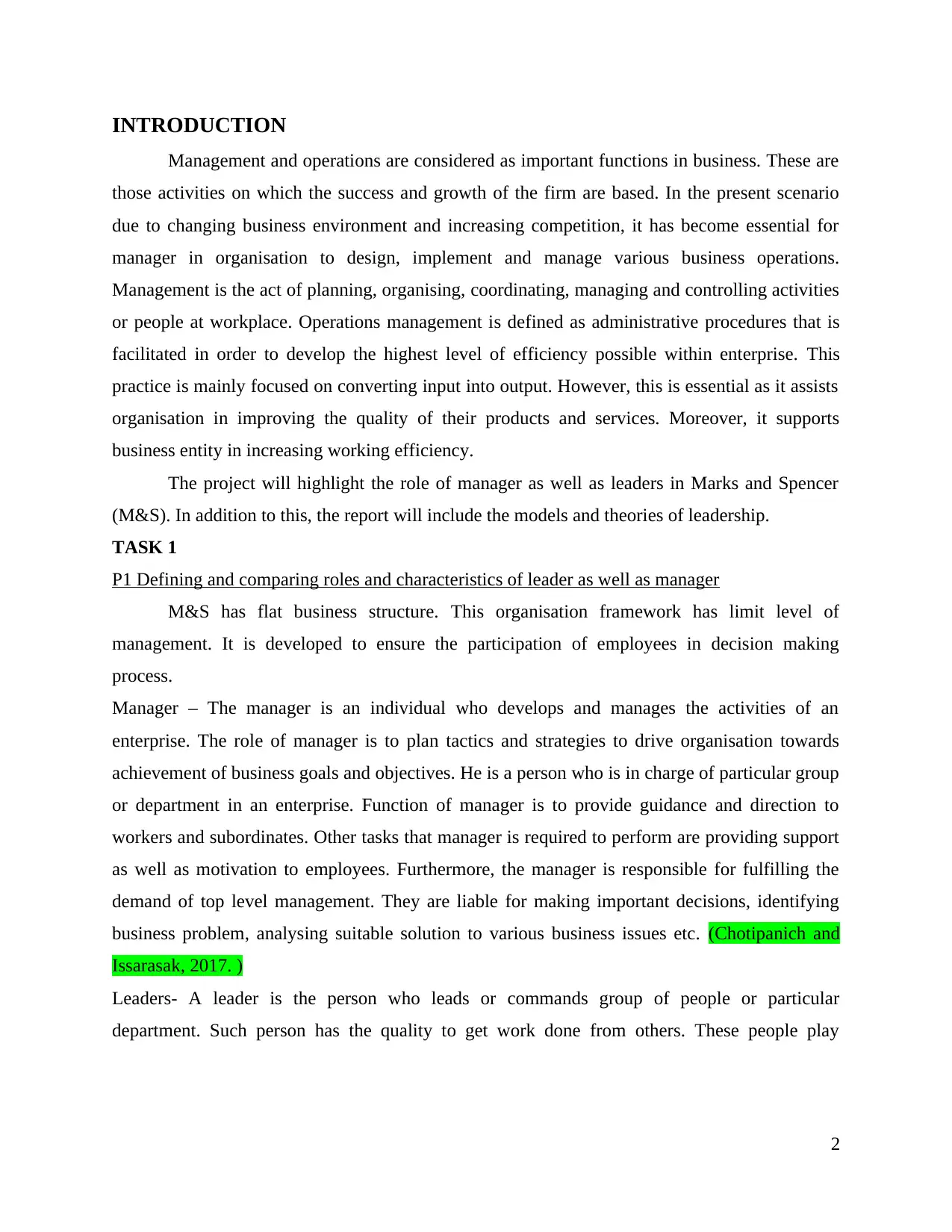
INTRODUCTION
Management and operations are considered as important functions in business. These are
those activities on which the success and growth of the firm are based. In the present scenario
due to changing business environment and increasing competition, it has become essential for
manager in organisation to design, implement and manage various business operations.
Management is the act of planning, organising, coordinating, managing and controlling activities
or people at workplace. Operations management is defined as administrative procedures that is
facilitated in order to develop the highest level of efficiency possible within enterprise. This
practice is mainly focused on converting input into output. However, this is essential as it assists
organisation in improving the quality of their products and services. Moreover, it supports
business entity in increasing working efficiency.
The project will highlight the role of manager as well as leaders in Marks and Spencer
(M&S). In addition to this, the report will include the models and theories of leadership.
TASK 1
P1 Defining and comparing roles and characteristics of leader as well as manager
M&S has flat business structure. This organisation framework has limit level of
management. It is developed to ensure the participation of employees in decision making
process.
Manager – The manager is an individual who develops and manages the activities of an
enterprise. The role of manager is to plan tactics and strategies to drive organisation towards
achievement of business goals and objectives. He is a person who is in charge of particular group
or department in an enterprise. Function of manager is to provide guidance and direction to
workers and subordinates. Other tasks that manager is required to perform are providing support
as well as motivation to employees. Furthermore, the manager is responsible for fulfilling the
demand of top level management. They are liable for making important decisions, identifying
business problem, analysing suitable solution to various business issues etc. (Chotipanich and
Issarasak, 2017. )
Leaders- A leader is the person who leads or commands group of people or particular
department. Such person has the quality to get work done from others. These people play
2
Management and operations are considered as important functions in business. These are
those activities on which the success and growth of the firm are based. In the present scenario
due to changing business environment and increasing competition, it has become essential for
manager in organisation to design, implement and manage various business operations.
Management is the act of planning, organising, coordinating, managing and controlling activities
or people at workplace. Operations management is defined as administrative procedures that is
facilitated in order to develop the highest level of efficiency possible within enterprise. This
practice is mainly focused on converting input into output. However, this is essential as it assists
organisation in improving the quality of their products and services. Moreover, it supports
business entity in increasing working efficiency.
The project will highlight the role of manager as well as leaders in Marks and Spencer
(M&S). In addition to this, the report will include the models and theories of leadership.
TASK 1
P1 Defining and comparing roles and characteristics of leader as well as manager
M&S has flat business structure. This organisation framework has limit level of
management. It is developed to ensure the participation of employees in decision making
process.
Manager – The manager is an individual who develops and manages the activities of an
enterprise. The role of manager is to plan tactics and strategies to drive organisation towards
achievement of business goals and objectives. He is a person who is in charge of particular group
or department in an enterprise. Function of manager is to provide guidance and direction to
workers and subordinates. Other tasks that manager is required to perform are providing support
as well as motivation to employees. Furthermore, the manager is responsible for fulfilling the
demand of top level management. They are liable for making important decisions, identifying
business problem, analysing suitable solution to various business issues etc. (Chotipanich and
Issarasak, 2017. )
Leaders- A leader is the person who leads or commands group of people or particular
department. Such person has the quality to get work done from others. These people play
2
⊘ This is a preview!⊘
Do you want full access?
Subscribe today to unlock all pages.

Trusted by 1+ million students worldwide
significant role in encouraging employees or group of people to increase their participation in
achievement of business goals and objectives.
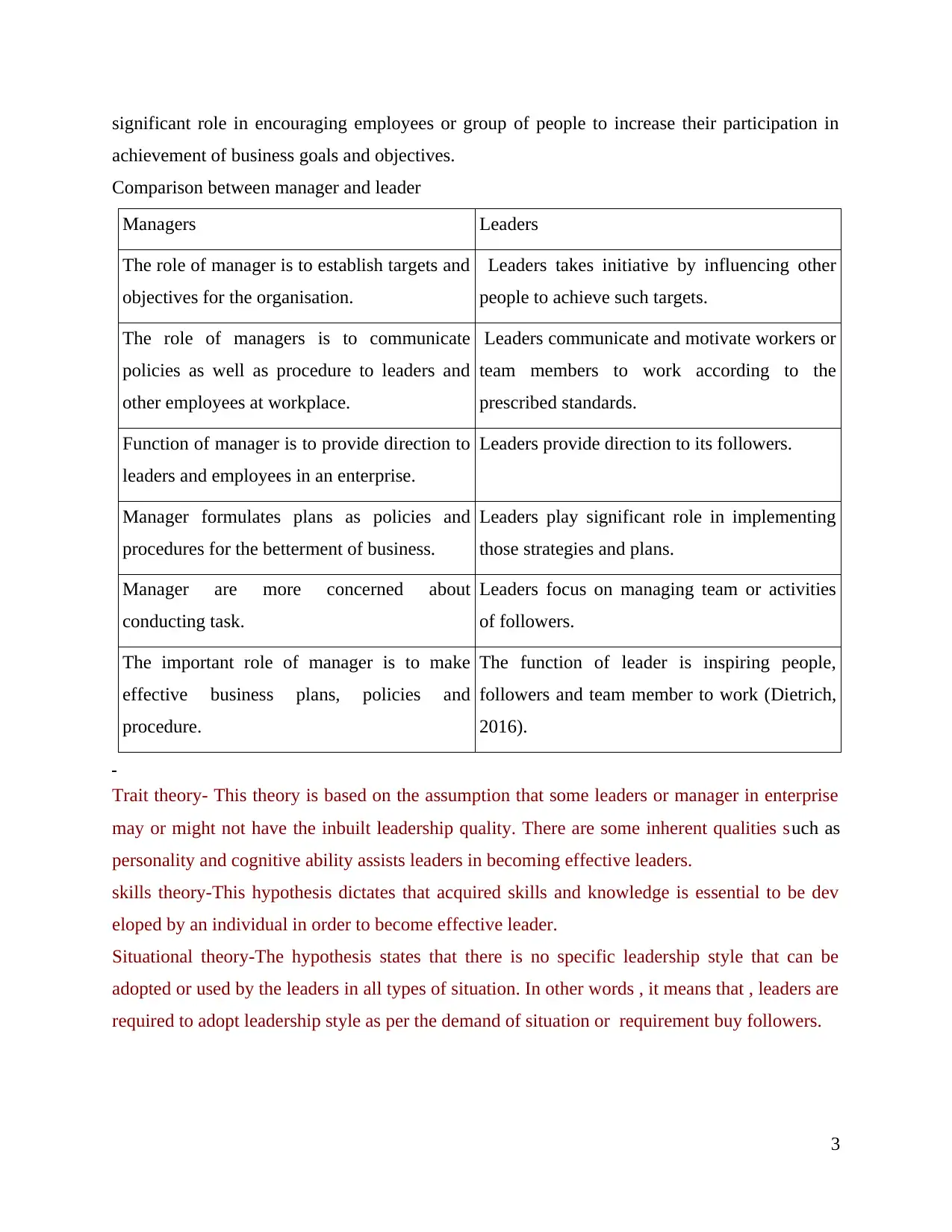
Comparison between manager and leader
Managers Leaders
The role of manager is to establish targets and
objectives for the organisation.
Leaders takes initiative by influencing other
people to achieve such targets.
The role of managers is to communicate
policies as well as procedure to leaders and
other employees at workplace.
Leaders communicate and motivate workers or
team members to work according to the
prescribed standards.
Function of manager is to provide direction to
leaders and employees in an enterprise.
Leaders provide direction to its followers.
Manager formulates plans as policies and
procedures for the betterment of business.
Leaders play significant role in implementing
those strategies and plans.
Manager are more concerned about
conducting task.
Leaders focus on managing team or activities
of followers.
The important role of manager is to make
effective business plans, policies and
procedure.
The function of leader is inspiring people,
followers and team member to work (Dietrich,
2016).
Trait theory- This theory is based on the assumption that some leaders or manager in enterprise
may or might not have the inbuilt leadership quality. There are some inherent qualities such as
personality and cognitive ability assists leaders in becoming effective leaders.
skills theory-This hypothesis dictates that acquired skills and knowledge is essential to be dev
eloped by an individual in order to become effective leader.
Situational theory-The hypothesis states that there is no specific leadership style that can be
adopted or used by the leaders in all types of situation. In other words , it means that , leaders are
required to adopt leadership style as per the demand of situation or requirement buy followers.
3
achievement of business goals and objectives.
Comparison between manager and leader
Managers Leaders
The role of manager is to establish targets and
objectives for the organisation.
Leaders takes initiative by influencing other
people to achieve such targets.
The role of managers is to communicate
policies as well as procedure to leaders and
other employees at workplace.
Leaders communicate and motivate workers or
team members to work according to the
prescribed standards.
Function of manager is to provide direction to
leaders and employees in an enterprise.
Leaders provide direction to its followers.
Manager formulates plans as policies and
procedures for the betterment of business.
Leaders play significant role in implementing
those strategies and plans.
Manager are more concerned about
conducting task.
Leaders focus on managing team or activities
of followers.
The important role of manager is to make
effective business plans, policies and
procedure.
The function of leader is inspiring people,
followers and team member to work (Dietrich,
2016).
Trait theory- This theory is based on the assumption that some leaders or manager in enterprise
may or might not have the inbuilt leadership quality. There are some inherent qualities such as
personality and cognitive ability assists leaders in becoming effective leaders.
skills theory-This hypothesis dictates that acquired skills and knowledge is essential to be dev
eloped by an individual in order to become effective leader.
Situational theory-The hypothesis states that there is no specific leadership style that can be
adopted or used by the leaders in all types of situation. In other words , it means that , leaders are
required to adopt leadership style as per the demand of situation or requirement buy followers.
3
Paraphrase This Document
Need a fresh take? Get an instant paraphrase of this document with our AI Paraphraser
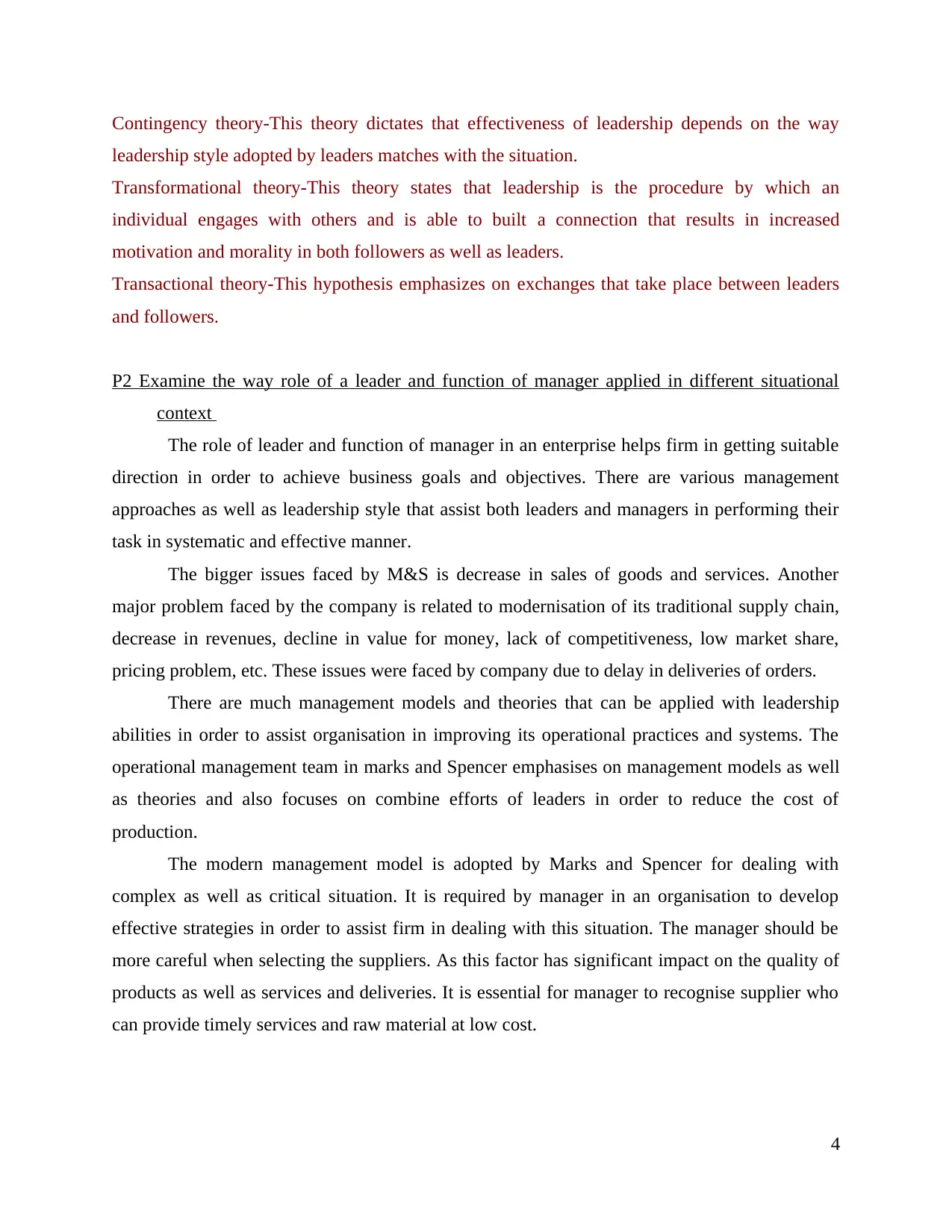
Contingency theory-This theory dictates that effectiveness of leadership depends on the way
leadership style adopted by leaders matches with the situation.
Transformational theory-This theory states that leadership is the procedure by which an
individual engages with others and is able to built a connection that results in increased
motivation and morality in both followers as well as leaders.
Transactional theory-This hypothesis emphasizes on exchanges that take place between leaders
and followers.
P2 Examine the way role of a leader and function of manager applied in different situational
context
The role of leader and function of manager in an enterprise helps firm in getting suitable
direction in order to achieve business goals and objectives. There are various management
approaches as well as leadership style that assist both leaders and managers in performing their
task in systematic and effective manner.
The bigger issues faced by M&S is decrease in sales of goods and services. Another
major problem faced by the company is related to modernisation of its traditional supply chain,
decrease in revenues, decline in value for money, lack of competitiveness, low market share,
pricing problem, etc. These issues were faced by company due to delay in deliveries of orders.
There are much management models and theories that can be applied with leadership
abilities in order to assist organisation in improving its operational practices and systems. The
operational management team in marks and Spencer emphasises on management models as well
as theories and also focuses on combine efforts of leaders in order to reduce the cost of
production.
The modern management model is adopted by Marks and Spencer for dealing with
complex as well as critical situation. It is required by manager in an organisation to develop
effective strategies in order to assist firm in dealing with this situation. The manager should be
more careful when selecting the suppliers. As this factor has significant impact on the quality of
products as well as services and deliveries. It is essential for manager to recognise supplier who
can provide timely services and raw material at low cost.
4
leadership style adopted by leaders matches with the situation.
Transformational theory-This theory states that leadership is the procedure by which an
individual engages with others and is able to built a connection that results in increased
motivation and morality in both followers as well as leaders.
Transactional theory-This hypothesis emphasizes on exchanges that take place between leaders
and followers.
P2 Examine the way role of a leader and function of manager applied in different situational
context
The role of leader and function of manager in an enterprise helps firm in getting suitable
direction in order to achieve business goals and objectives. There are various management
approaches as well as leadership style that assist both leaders and managers in performing their
task in systematic and effective manner.
The bigger issues faced by M&S is decrease in sales of goods and services. Another
major problem faced by the company is related to modernisation of its traditional supply chain,
decrease in revenues, decline in value for money, lack of competitiveness, low market share,
pricing problem, etc. These issues were faced by company due to delay in deliveries of orders.
There are much management models and theories that can be applied with leadership
abilities in order to assist organisation in improving its operational practices and systems. The
operational management team in marks and Spencer emphasises on management models as well
as theories and also focuses on combine efforts of leaders in order to reduce the cost of
production.
The modern management model is adopted by Marks and Spencer for dealing with
complex as well as critical situation. It is required by manager in an organisation to develop
effective strategies in order to assist firm in dealing with this situation. The manager should be
more careful when selecting the suppliers. As this factor has significant impact on the quality of
products as well as services and deliveries. It is essential for manager to recognise supplier who
can provide timely services and raw material at low cost.
4
The managers as well as leaders in M&S are required to conduct training for employees
in order to assist them in increasing their working efficiency. It also allows workers to develop
various skills that will help them in generating outcome. The manager in cited venture need to
develop effective policies, environment and policies. As this activity will help leader in
motivating employees to increase their participation in achievement of business goals and
objectives. The appropriate leadership style can be adopted by leaders in order to positively
influence people to work with dedication at workplace.
Behavioural theory has been adopted by manager in marks and Spencer. As per this
hypothesis, manager develop policies and delegate authorities on the basis of the quality and
abilities of employees. Transformational leadership style is adopted by leaders in marks and
Spencer. The leaders with this type of leadership style communicates with their followers. Such
person develops strategies and policies based on discussions with team.
Contingency model emphasises on implementing the changes in strategies based on the
need of present situation. Considering this concept, leaders in marks and Spencer play important
role in inspiring or motivating their followers to bring drastic improvement in operational
activities and system. This function of leader helps firm in giving effective as well as appropriate
response to situation (Ricard, Klijn, Lewis and Ysa, 2017)
P3 Models of leadership
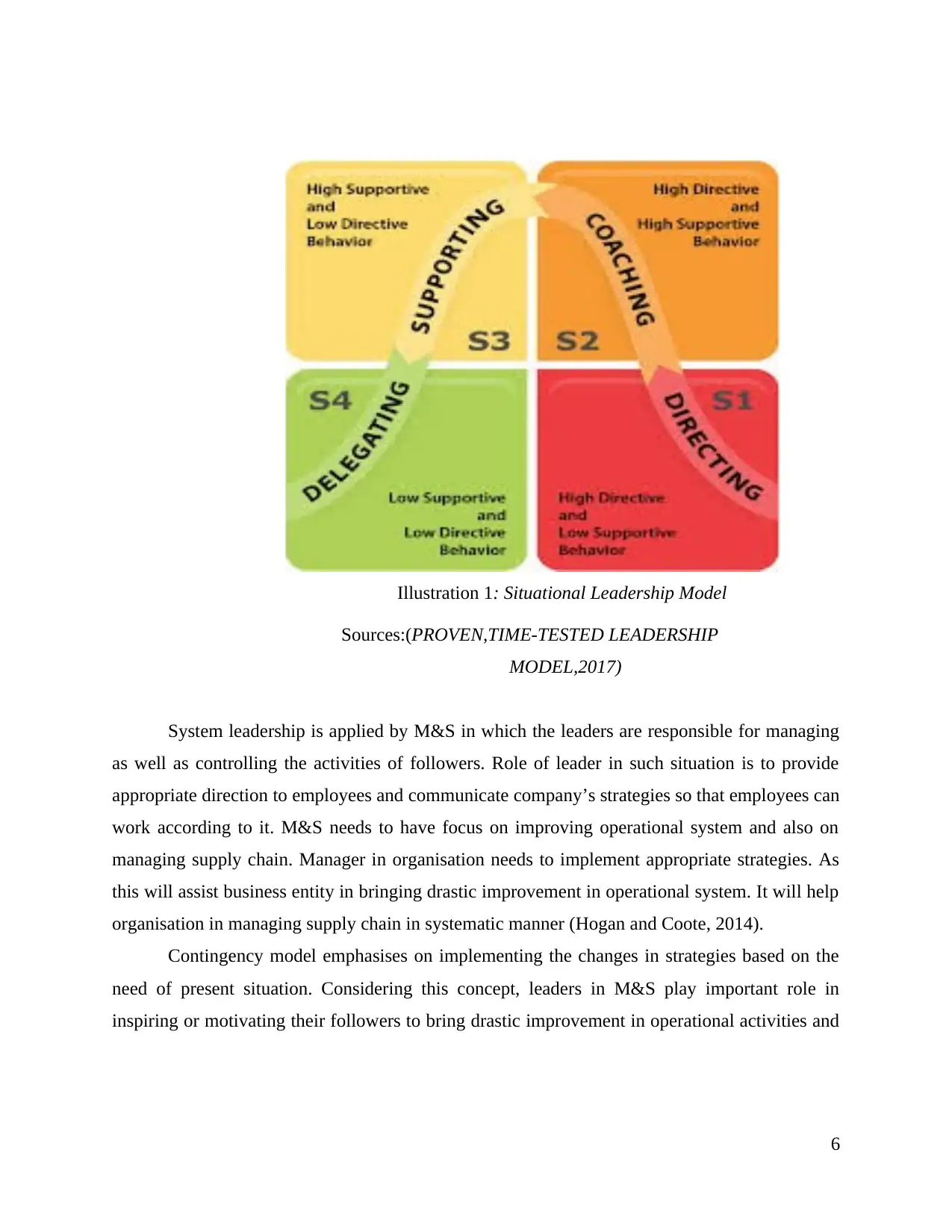
Situational leadership is defined as form of leadership in which the appropriate styles are
adopted by leader considering the abilities as well as c abilities of followers. As the role of leader
is to influence people to complete their task in systematic and effective manner. Operations
management is the field which is greatly impacted by the leadership style. The leaders are
required to adopt style according to the need of situation and demand of followers. As M&S
company is facing complex and difficult situation, in such case the leaders can play significant
role in assisting organisation to deal with such issues.
5
in order to assist them in increasing their working efficiency. It also allows workers to develop
various skills that will help them in generating outcome. The manager in cited venture need to
develop effective policies, environment and policies. As this activity will help leader in
motivating employees to increase their participation in achievement of business goals and
objectives. The appropriate leadership style can be adopted by leaders in order to positively
influence people to work with dedication at workplace.
Behavioural theory has been adopted by manager in marks and Spencer. As per this
hypothesis, manager develop policies and delegate authorities on the basis of the quality and
abilities of employees. Transformational leadership style is adopted by leaders in marks and
Spencer. The leaders with this type of leadership style communicates with their followers. Such
person develops strategies and policies based on discussions with team.
Contingency model emphasises on implementing the changes in strategies based on the
need of present situation. Considering this concept, leaders in marks and Spencer play important
role in inspiring or motivating their followers to bring drastic improvement in operational
activities and system. This function of leader helps firm in giving effective as well as appropriate
response to situation (Ricard, Klijn, Lewis and Ysa, 2017)
P3 Models of leadership
Situational leadership is defined as form of leadership in which the appropriate styles are
adopted by leader considering the abilities as well as c abilities of followers. As the role of leader
is to influence people to complete their task in systematic and effective manner. Operations
management is the field which is greatly impacted by the leadership style. The leaders are
required to adopt style according to the need of situation and demand of followers. As M&S
company is facing complex and difficult situation, in such case the leaders can play significant
role in assisting organisation to deal with such issues.
5
⊘ This is a preview!⊘
Do you want full access?
Subscribe today to unlock all pages.
Trusted by 1+ million students worldwide
System leadership is applied by M&S in which the leaders are responsible for managing
as well as controlling the activities of followers. Role of leader in such situation is to provide
appropriate direction to employees and communicate company’s strategies so that employees can
work according to it. M&S needs to have focus on improving operational system and also on
managing supply chain. Manager in organisation needs to implement appropriate strategies. As
this will assist business entity in bringing drastic improvement in operational system. It will help
organisation in managing supply chain in systematic manner (Hogan and Coote, 2014).
Contingency model emphasises on implementing the changes in strategies based on the
need of present situation. Considering this concept, leaders in M&S play important role in
inspiring or motivating their followers to bring drastic improvement in operational activities and
6
Illustration 1: Situational Leadership Model
Sources:(PROVEN,TIME-TESTED LEADERSHIP
MODEL,2017)
as well as controlling the activities of followers. Role of leader in such situation is to provide
appropriate direction to employees and communicate company’s strategies so that employees can
work according to it. M&S needs to have focus on improving operational system and also on
managing supply chain. Manager in organisation needs to implement appropriate strategies. As
this will assist business entity in bringing drastic improvement in operational system. It will help
organisation in managing supply chain in systematic manner (Hogan and Coote, 2014).
Contingency model emphasises on implementing the changes in strategies based on the
need of present situation. Considering this concept, leaders in M&S play important role in
inspiring or motivating their followers to bring drastic improvement in operational activities and
6
Illustration 1: Situational Leadership Model
Sources:(PROVEN,TIME-TESTED LEADERSHIP
MODEL,2017)
Paraphrase This Document
Need a fresh take? Get an instant paraphrase of this document with our AI Paraphraser
system. The manager in M&S has identified the root cause of such problems and they have
made changes accordingly in strategies, policies related to production and operational activities.
As per Drucker Management By Objective (MBO) model, managers should “avoid the
activity trap”, getting so involved in their day to day activities that they forget their main
objective.
MBO plays significant role in resolving various issues related to operational problems by
encouraging the employees to participate in decision making procedure. It also supports manager
in ensuring positive outcomes. This approach assists manager in motivating workers to increase
their working efficiency and their participation in solving various business issue.
The chaos Hypothesis emphasises on the changes in market situation. It also supports top
level management in identifying the method adopted by leaders as well as manager in order to
deal with complex situations (Norris, 2017).
TASK 3
P4 The major or important approaches to operations management
Operational procedure includes transformation of input into outputs. Input includes
labour, equipment, raw material, information and other useful resources. Output involves
services or products that are produced through processing of raw material.
Procedure designed by manager in M&S in order to produce desired outcome are:
Supply Chain Management (SCM)- It is considered as set of relationship among manufacturer,
distributor and supplier that execute the transformation of input into output. It is the
responsibility of manager to ensure the proper flow of these elements. The effective as well as
successful supply chain procedure require a change managing people, functions to integrating
activities into supply chain management procedure.
Organisational Resource Planning- It involves use of integrated computer based system for
managing internal as well as external resources. The various required to implement and manage
operational activities are tangible assets that is technology, equipment, machinery, material,
financial and human resource. The objective of this process is to facilitate flow of information
between all business functions. The role of manager is to analyse the present material and
identify the further requirement of resources. The function of manager is to allocate resources in
7
made changes accordingly in strategies, policies related to production and operational activities.
As per Drucker Management By Objective (MBO) model, managers should “avoid the
activity trap”, getting so involved in their day to day activities that they forget their main
objective.
MBO plays significant role in resolving various issues related to operational problems by
encouraging the employees to participate in decision making procedure. It also supports manager
in ensuring positive outcomes. This approach assists manager in motivating workers to increase
their working efficiency and their participation in solving various business issue.
The chaos Hypothesis emphasises on the changes in market situation. It also supports top
level management in identifying the method adopted by leaders as well as manager in order to
deal with complex situations (Norris, 2017).
TASK 3
P4 The major or important approaches to operations management
Operational procedure includes transformation of input into outputs. Input includes
labour, equipment, raw material, information and other useful resources. Output involves
services or products that are produced through processing of raw material.
Procedure designed by manager in M&S in order to produce desired outcome are:
Supply Chain Management (SCM)- It is considered as set of relationship among manufacturer,
distributor and supplier that execute the transformation of input into output. It is the
responsibility of manager to ensure the proper flow of these elements. The effective as well as
successful supply chain procedure require a change managing people, functions to integrating
activities into supply chain management procedure.
Organisational Resource Planning- It involves use of integrated computer based system for
managing internal as well as external resources. The various required to implement and manage
operational activities are tangible assets that is technology, equipment, machinery, material,
financial and human resource. The objective of this process is to facilitate flow of information
between all business functions. The role of manager is to analyse the present material and
identify the further requirement of resources. The function of manager is to allocate resources in
7
an effective and efficient manner. Leader is accountable for ensuring the optimum utilisation of
resources.
Customer Relationship Management- This is the big effort that is facilitated by manager to assist
firm in retaining customer and in increasing profitability. In this process, manager emphasises on
building long term and sustainable customer relationships that add value for both the customer
and the organisation. The role of manager is to formulate effective strategy as this will help them
in managing enterprise interactions with customers or clients. It assists business entity in
increasing sales. The function of leader is to provide training to workers and allow them to
develop various skills that can be used by them in providing quality as well as professional
services to clients. This activity will enable firm to gain customer loyalty and develop wide client
base (Oyinlade and Ajuwon, 2017).
The various approaches to operational management are Lean production, Total Quality
Management (TQM), Just In Time (JIT) and continuous improvement. The procedures of SCM
involves flow of information, resources, materials and services from supplier to factories and
then in warehouse.
Lean system- The lean system utilises the Just in time technique. This approach or process
assists employees in providing timely as well as quick services to customers. It also supports
firm in developing as well as maintaining healthy relationship with suppliers. Lean approach
assists employees in improving their performance at workplace. This operational management
approach is a systematic method of waste minimisation in a manufacturing system without
compromising with the productivity and quality of product as well as services. Lean approach
focusses on business model over the organisational plan. It also promotes a procedure of
customer discovery as well as development. This model supports the concept of continuous
improvement. Lean concept is a long-term approach to work that systematically seeks to achieve
incremental changes in processes in order to improve efficiency and quality.
Total quality management approach- This is the long-term approach that assists firm in
achieving success and fostering growth. It encourages the participation of internal and external
stakeholder in bringing positive as well as drastic improvement in business policies, procedures
and system. This approach can be used by M&S for enhancing the quality of product as well as
8
resources.
Customer Relationship Management- This is the big effort that is facilitated by manager to assist
firm in retaining customer and in increasing profitability. In this process, manager emphasises on
building long term and sustainable customer relationships that add value for both the customer
and the organisation. The role of manager is to formulate effective strategy as this will help them
in managing enterprise interactions with customers or clients. It assists business entity in
increasing sales. The function of leader is to provide training to workers and allow them to
develop various skills that can be used by them in providing quality as well as professional
services to clients. This activity will enable firm to gain customer loyalty and develop wide client
base (Oyinlade and Ajuwon, 2017).
The various approaches to operational management are Lean production, Total Quality
Management (TQM), Just In Time (JIT) and continuous improvement. The procedures of SCM
involves flow of information, resources, materials and services from supplier to factories and
then in warehouse.
Lean system- The lean system utilises the Just in time technique. This approach or process
assists employees in providing timely as well as quick services to customers. It also supports
firm in developing as well as maintaining healthy relationship with suppliers. Lean approach
assists employees in improving their performance at workplace. This operational management
approach is a systematic method of waste minimisation in a manufacturing system without
compromising with the productivity and quality of product as well as services. Lean approach
focusses on business model over the organisational plan. It also promotes a procedure of
customer discovery as well as development. This model supports the concept of continuous
improvement. Lean concept is a long-term approach to work that systematically seeks to achieve
incremental changes in processes in order to improve efficiency and quality.
Total quality management approach- This is the long-term approach that assists firm in
achieving success and fostering growth. It encourages the participation of internal and external
stakeholder in bringing positive as well as drastic improvement in business policies, procedures
and system. This approach can be used by M&S for enhancing the quality of product as well as
8
⊘ This is a preview!⊘
Do you want full access?
Subscribe today to unlock all pages.
Trusted by 1+ million students worldwide
services. It has focus on identifying the needs and demands of customer in the market. TQM
approach promotes mutual respect and team work.
Just in Time- This is considered as strategy related to inventory management. This approach or
method is adopted by M&S to increase its working efficiency and minimising waste by receiving
raw material only as they are needed in the production procedure. Just in Time strategy assists
firm in reducing inventory cost.
In addition to this, the role of manager is to take important as well as major decision.
Managers need to take decision regarding resources' allocation, suppliers, transportation,
production and other activities as well.
The role of leader is same as the function of manager in organisation. Both the person has
to facilitate their task on the basis of the business goals and objectives. The role of leader is same
as the function of manager which is to assist firm in achieving its mission and vision. The
function of leader is to develop high performance team and provide them suitable guidance.
Managers are responsible for interacting with suppliers, employees and customers. This activity
helps
M&S company in identifying the needs of these stakeholders and providing them satisfaction
(Park and el.al.,2014)
P5 The Significance and value of operations management in accomplishing organisational
objectives
Operations management is concerned with the way business entity produces products and
services. This management system plays significant role in an enterprise as it helps firm in
developing professional managers those who are capable to support organisation in achievement
of business goal and objectives. Operations management is very important in business unit as it
assists manager in controlling as well as managing various operational activities. This process
handles various issues related to designing of activities, operation as well as maintenance and
improvement of system, procedures. It also assists business entity in improving the quality of
product and service. Due to the effective operational management system, the business unit will
be able to make effective as well as efficient use of their resources. It also assists M&S company
in achievement of business goals mainly increasing sales and profitability. Operations
management supports enterprise in identifying appropriate technique or method for reducing cost
9
approach promotes mutual respect and team work.
Just in Time- This is considered as strategy related to inventory management. This approach or
method is adopted by M&S to increase its working efficiency and minimising waste by receiving
raw material only as they are needed in the production procedure. Just in Time strategy assists
firm in reducing inventory cost.
In addition to this, the role of manager is to take important as well as major decision.
Managers need to take decision regarding resources' allocation, suppliers, transportation,
production and other activities as well.
The role of leader is same as the function of manager in organisation. Both the person has
to facilitate their task on the basis of the business goals and objectives. The role of leader is same
as the function of manager which is to assist firm in achieving its mission and vision. The
function of leader is to develop high performance team and provide them suitable guidance.
Managers are responsible for interacting with suppliers, employees and customers. This activity
helps
M&S company in identifying the needs of these stakeholders and providing them satisfaction
(Park and el.al.,2014)
P5 The Significance and value of operations management in accomplishing organisational
objectives
Operations management is concerned with the way business entity produces products and
services. This management system plays significant role in an enterprise as it helps firm in
developing professional managers those who are capable to support organisation in achievement
of business goal and objectives. Operations management is very important in business unit as it
assists manager in controlling as well as managing various operational activities. This process
handles various issues related to designing of activities, operation as well as maintenance and
improvement of system, procedures. It also assists business entity in improving the quality of
product and service. Due to the effective operational management system, the business unit will
be able to make effective as well as efficient use of their resources. It also assists M&S company
in achievement of business goals mainly increasing sales and profitability. Operations
management supports enterprise in identifying appropriate technique or method for reducing cost
9
Paraphrase This Document
Need a fresh take? Get an instant paraphrase of this document with our AI Paraphraser
of production. It also aids cited venture in reducing waste that is produced through processing of
raw material or during operational activities. Other aspect of operations management is quality.
It provides organisation an opportunity to analyse the method for improving the quality of goods
and services. Quality management is very important aspect that is required to be considered by
M&S. As this activity will help firm in developing and maintaining healthy relationship with
customers. It also provides business entity an opportunity to gain customer loyalty and attract
more number of consumers. The more the operations management will be strict the production
increase in an enterprise.
The operations management add value to organisation product or services through
ensuring the quality control through effective production system. The operations manager should
focus on producing goods efficiently with wasting the resources of organisation. The role of
operations manager is to ensure completely priced products are reached to end user. Manager or
leader is accountable for controlling as well as monitoring production of goods (Bonanni and
Cafazzo, 2014).
The manager or leader can improve operational efficiency by ensuring the effective
involvement as well as utilisation of resources and manpower. Role of manager or leaders is to
develop attractive policies that will help them in motivating employees to increase their
participation in operational activities. It is required by manager or leader to make training
arrangement for workers as this will assist workers in increasing their working efficiency.
Function of manager or leader is to develop performance standards. As this activity will support
employees in recognising the performance gap and identifying the suitable ways for improve the
same.
TASK 4
P6 Assessing the factor in business environment that have effect on operational management
The business environment factors are those internal and external elements that have great
effect on operational management procedures. These variables have great influence on decision
of manager. The internal factors are controllable and these elements have less impact on
company’s performance. Some internal forces are employees, organisation culture, business
structure resources etc. The external forces that have great influence on decision of manager as
well as operational management are political, economic, social, technological, legal and
10
raw material or during operational activities. Other aspect of operations management is quality.
It provides organisation an opportunity to analyse the method for improving the quality of goods
and services. Quality management is very important aspect that is required to be considered by
M&S. As this activity will help firm in developing and maintaining healthy relationship with
customers. It also provides business entity an opportunity to gain customer loyalty and attract
more number of consumers. The more the operations management will be strict the production
increase in an enterprise.
The operations management add value to organisation product or services through
ensuring the quality control through effective production system. The operations manager should
focus on producing goods efficiently with wasting the resources of organisation. The role of
operations manager is to ensure completely priced products are reached to end user. Manager or
leader is accountable for controlling as well as monitoring production of goods (Bonanni and
Cafazzo, 2014).
The manager or leader can improve operational efficiency by ensuring the effective
involvement as well as utilisation of resources and manpower. Role of manager or leaders is to
develop attractive policies that will help them in motivating employees to increase their
participation in operational activities. It is required by manager or leader to make training
arrangement for workers as this will assist workers in increasing their working efficiency.
Function of manager or leader is to develop performance standards. As this activity will support
employees in recognising the performance gap and identifying the suitable ways for improve the
same.
TASK 4
P6 Assessing the factor in business environment that have effect on operational management
The business environment factors are those internal and external elements that have great
effect on operational management procedures. These variables have great influence on decision
of manager. The internal factors are controllable and these elements have less impact on
company’s performance. Some internal forces are employees, organisation culture, business
structure resources etc. The external forces that have great influence on decision of manager as
well as operational management are political, economic, social, technological, legal and
10
environmental elements. These variables have high potential to create barriers for an enterprise
to achieve success and growth (Khan, Asghar and Zaheer, 2014).
During the decision-making procedure, it is very essential for manager or leader to
consider following factors such as Corporate Social Responsibility (CSR), consumer needs as
well as demand, current market trend etc. This activity will assist manager in making suitable as
well as appropriate decision. It is essential for marketing manager to facilitate market research as
this will support firm in identifying the latest business trend and recognising the demand of
consumer in the market. This will also support manager in formulating appropriate strategy.
Market research can be the important factor to save the revenue loss for the organisation in
which the M&S had done in their business. The M&S needs to adopt recycling system as this
will help organisation in fulfilling the corporate social responsibility and reducing waste. The
human resource manager in business entity needs to develop effective working environment. As
this will help leader in encouraging employees and other stakeholder to contribute in bringing
positive change at workplace. It is essential for human resource manager to establish some
standards or regulations as this will help manager in ensuring ethical practices in an organisation.
Stakeholder matrix mapping is the tool that can be used by manager in M&S for identifying the
important stakeholder those who have power and great influence on operation management and
decision made by leader.
Economic forces- In decision related to operational management, economic issues play
significant role. As the changes in economic system in the country are the major factors due to
which the M&S have to face short or long-term issue.
Technological forces- These variables have great impact on decision making process related to
operational management system. Technology changes frequently in current scenario and this
may cause the organisation like M&S which the every changes brings some loss (Mahembe and
Engelbrecht, 2014).
Business ethics -This factors has direct effect on the working environment and business culture.
It has major impact on motivational level and performance of employees at workplace.
Corporate social responsibility- This is the significant concept that is required to be considered
by firm. As this activity will help organisation in increasing sales and profitability. Corporate
social responsibility have direct effect on business stability and performance. It has great
11
to achieve success and growth (Khan, Asghar and Zaheer, 2014).
During the decision-making procedure, it is very essential for manager or leader to
consider following factors such as Corporate Social Responsibility (CSR), consumer needs as
well as demand, current market trend etc. This activity will assist manager in making suitable as
well as appropriate decision. It is essential for marketing manager to facilitate market research as
this will support firm in identifying the latest business trend and recognising the demand of
consumer in the market. This will also support manager in formulating appropriate strategy.
Market research can be the important factor to save the revenue loss for the organisation in
which the M&S had done in their business. The M&S needs to adopt recycling system as this
will help organisation in fulfilling the corporate social responsibility and reducing waste. The
human resource manager in business entity needs to develop effective working environment. As
this will help leader in encouraging employees and other stakeholder to contribute in bringing
positive change at workplace. It is essential for human resource manager to establish some
standards or regulations as this will help manager in ensuring ethical practices in an organisation.
Stakeholder matrix mapping is the tool that can be used by manager in M&S for identifying the
important stakeholder those who have power and great influence on operation management and
decision made by leader.
Economic forces- In decision related to operational management, economic issues play
significant role. As the changes in economic system in the country are the major factors due to
which the M&S have to face short or long-term issue.
Technological forces- These variables have great impact on decision making process related to
operational management system. Technology changes frequently in current scenario and this
may cause the organisation like M&S which the every changes brings some loss (Mahembe and
Engelbrecht, 2014).
Business ethics -This factors has direct effect on the working environment and business culture.
It has major impact on motivational level and performance of employees at workplace.
Corporate social responsibility- This is the significant concept that is required to be considered
by firm. As this activity will help organisation in increasing sales and profitability. Corporate
social responsibility have direct effect on business stability and performance. It has great
11
⊘ This is a preview!⊘
Do you want full access?
Subscribe today to unlock all pages.
Trusted by 1+ million students worldwide

1 out of 14


Related Documents


Your All-in-One AI-Powered Toolkit for Academic Success.
+13062052269
info@desklib.com
Available 24*7 on WhatsApp / Email
![[object Object]](/_next/static/media/star-bottom.7253800d.svg)
Unlock your academic potential
Copyright © 2020–2026 A2Z Services. All Rights Reserved. Developed and managed by ZUCOL.