Operations and Supply Chain Management: Aggregate Planning Solutions

Verified

Added on  2022/09/09

|6
|806
|16
Homework Assignment
AI Summary
This assignment provides a detailed analysis of aggregate planning strategies, specifically focusing on level and chase plans. The solution begins by calculating the production costs using a level plan, considering factors such as inventory carrying costs, labor costs, stockout costs, and material costs. It then explores the chase plan, which involves adjusting the workforce based on demand fluctuations, and calculates the associated costs of hiring, firing, and labor. The analysis further optimizes the level plan by adjusting the workforce to reduce labor costs and compares the total costs of both strategies. The assignment concludes that the chase method is the best approach because it yields lower overall production costs compared to the optimized level method. References to relevant academic sources support the analysis.
Document Page
Aggregate Planning 1
AGGREGATE PLANNING
By (Name)
Course
Professor’s Name
Institution
Date
tabler-icon-diamond-filled.svg

Paraphrase This Document

Need a fresh take? Get an instant paraphrase of this document with our AI Paraphraser
Document Page
Aggregate Planning 2
Aggregate Planning
Production Cost Using Level Plan
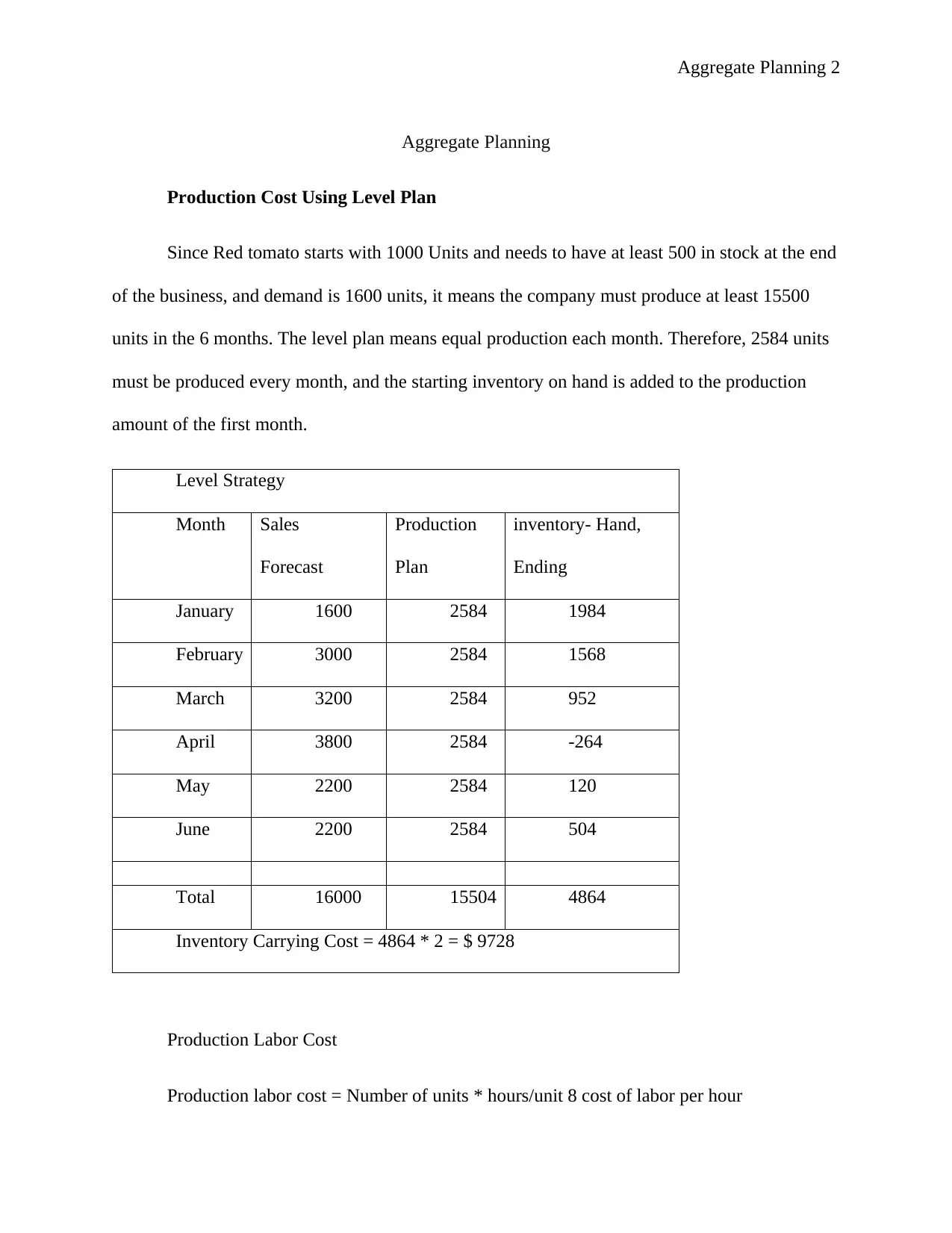
Since Red tomato starts with 1000 Units and needs to have at least 500 in stock at the end
of the business, and demand is 1600 units, it means the company must produce at least 15500
units in the 6 months. The level plan means equal production each month. Therefore, 2584 units
must be produced every month, and the starting inventory on hand is added to the production
amount of the first month.
Level Strategy
Month Sales
Forecast
Production
Plan
inventory- Hand,
Ending
January 1600 2584 1984
February 3000 2584 1568
March 3200 2584 952
April 3800 2584 -264
May 2200 2584 120
June 2200 2584 504
Total 16000 15504 4864
Inventory Carrying Cost = 4864 * 2 = $ 9728
Production Labor Cost
Production labor cost = Number of units * hours/unit 8 cost of labor per hour
Document Page
Aggregate Planning 3
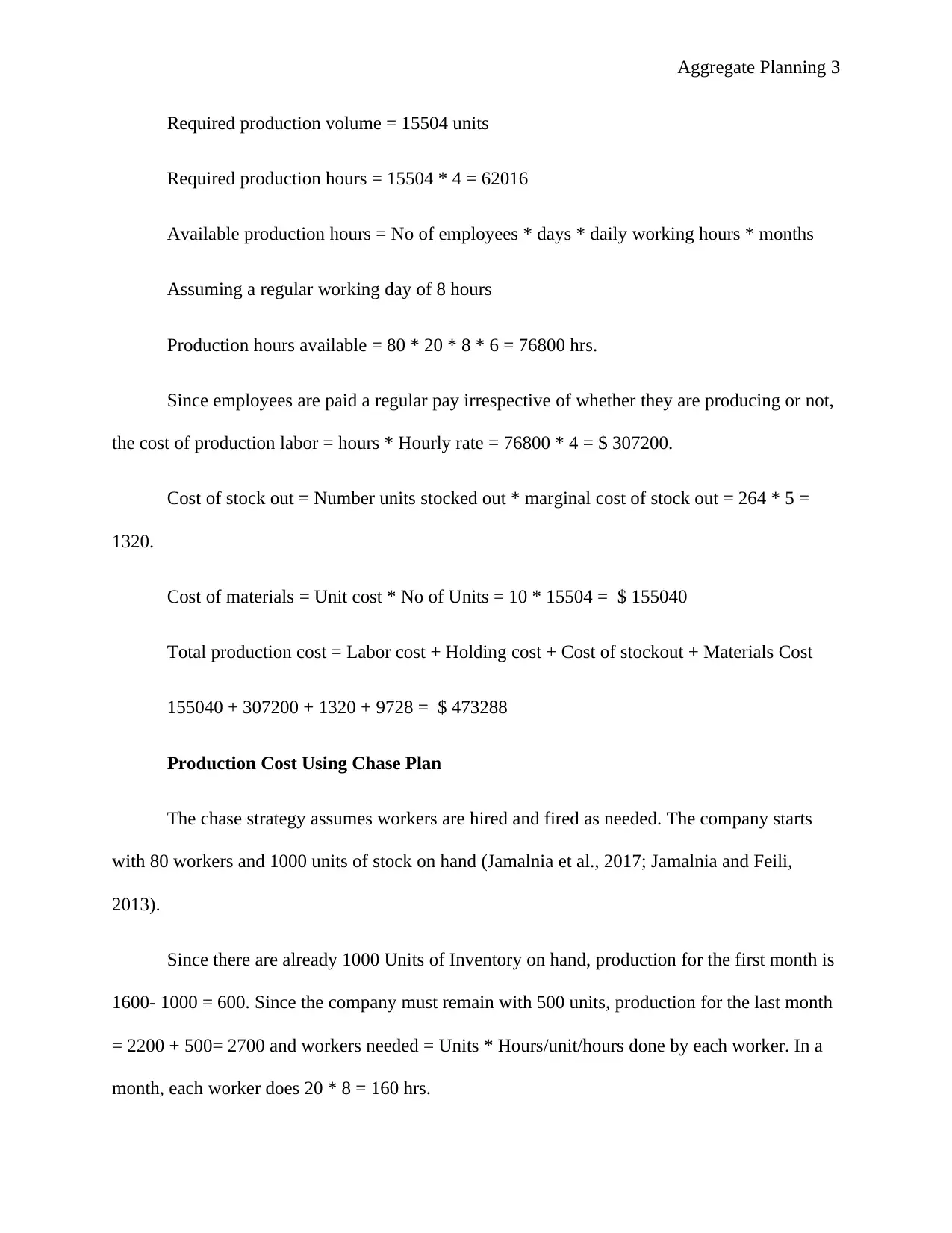
Required production volume = 15504 units
Required production hours = 15504 * 4 = 62016
Available production hours = No of employees * days * daily working hours * months
Assuming a regular working day of 8 hours
Production hours available = 80 * 20 * 8 * 6 = 76800 hrs.
Since employees are paid a regular pay irrespective of whether they are producing or not,
the cost of production labor = hours * Hourly rate = 76800 * 4 = $ 307200.
Cost of stock out = Number units stocked out * marginal cost of stock out = 264 * 5 =
1320.
Cost of materials = Unit cost * No of Units = 10 * 15504 = $ 155040
Total production cost = Labor cost + Holding cost + Cost of stockout + Materials Cost
155040 + 307200 + 1320 + 9728 = $ 473288
Production Cost Using Chase Plan
The chase strategy assumes workers are hired and fired as needed. The company starts
with 80 workers and 1000 units of stock on hand (Jamalnia et al., 2017; Jamalnia and Feili,
2013).
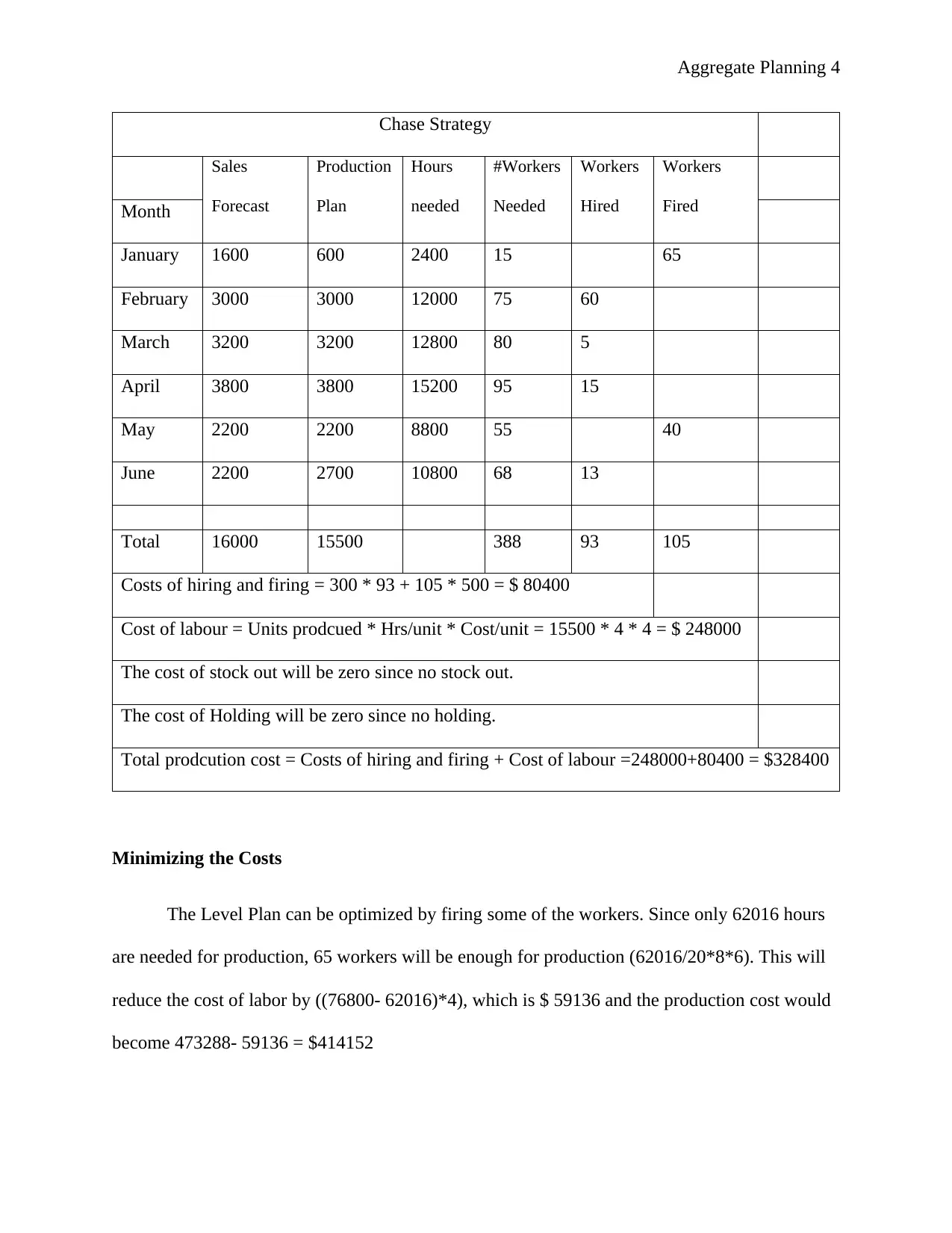
Since there are already 1000 Units of Inventory on hand, production for the first month is
1600- 1000 = 600. Since the company must remain with 500 units, production for the last month
= 2200 + 500= 2700 and workers needed = Units * Hours/unit/hours done by each worker. In a
month, each worker does 20 * 8 = 160 hrs.
Document Page
Aggregate Planning 4
Chase Strategy
Sales
Forecast
Production
Plan
Hours
needed
#Workers
Needed
Workers
Hired
Workers
FiredMonth
January 1600 600 2400 15 65
February 3000 3000 12000 75 60
March 3200 3200 12800 80 5
April 3800 3800 15200 95 15
May 2200 2200 8800 55 40
June 2200 2700 10800 68 13
Total 16000 15500 388 93 105
Costs of hiring and firing = 300 * 93 + 105 * 500 = $ 80400
Cost of labour = Units prodcued * Hrs/unit * Cost/unit = 15500 * 4 * 4 = $ 248000
The cost of stock out will be zero since no stock out.
The cost of Holding will be zero since no holding.
Total prodcution cost = Costs of hiring and firing + Cost of labour =248000+80400 = $328400
Minimizing the Costs
The Level Plan can be optimized by firing some of the workers. Since only 62016 hours
are needed for production, 65 workers will be enough for production (62016/20*8*6). This will
reduce the cost of labor by ((76800- 62016)*4), which is $ 59136 and the production cost would
become 473288- 59136 = $414152
tabler-icon-diamond-filled.svg

Paraphrase This Document

Need a fresh take? Get an instant paraphrase of this document with our AI Paraphraser
Document Page
Aggregate Planning 5
The chase model cannot be optimized by either overtime or subcontracting, either of the
two ways result in higher costs for production.
Optimal Way
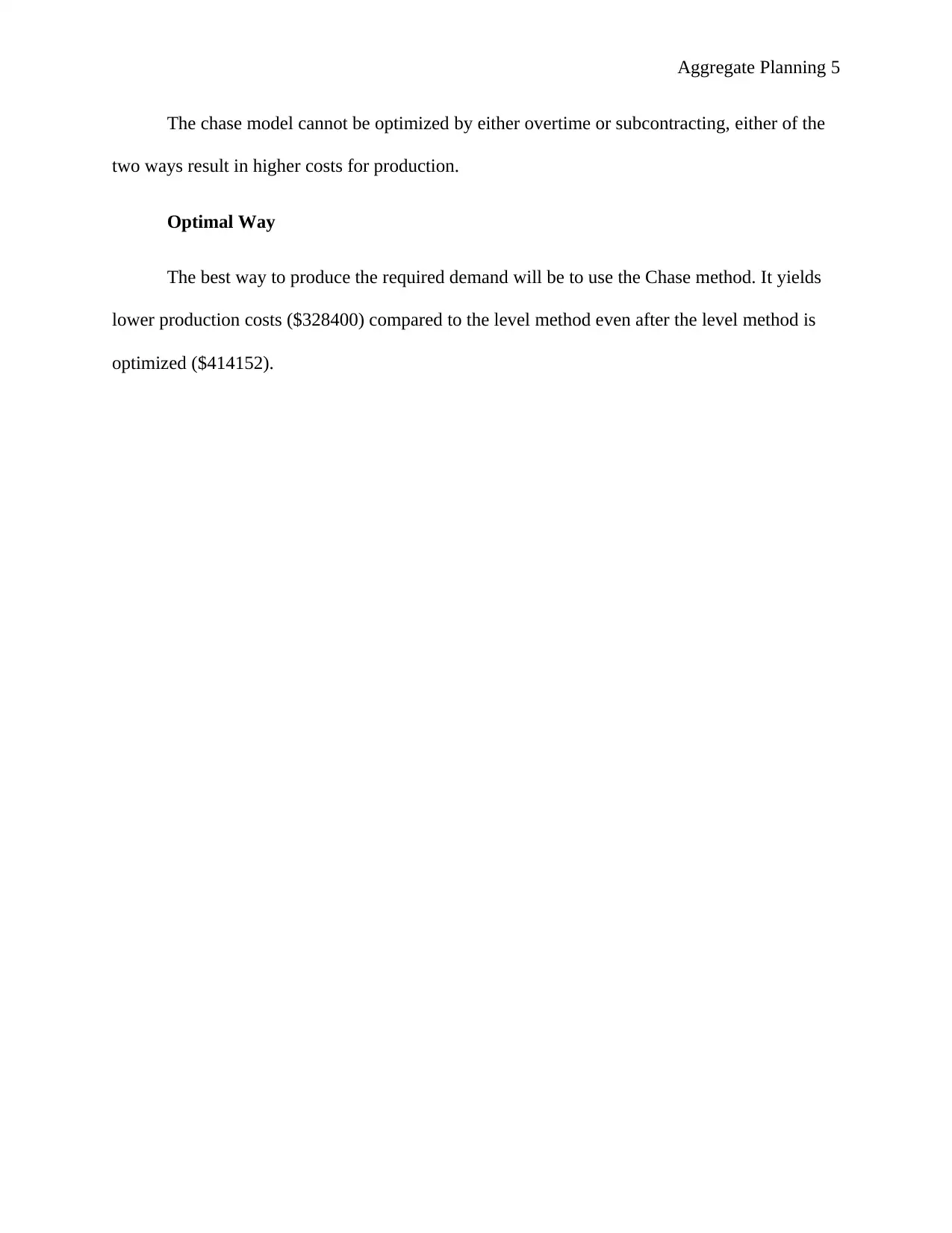
The best way to produce the required demand will be to use the Chase method. It yields
lower production costs ($328400) compared to the level method even after the level method is
optimized ($414152).
Document Page
Aggregate Planning 6
References
Jamalnia, A. and Feili, A. (2013) 'A simulation testing and analysis of aggregate production
planning strategies,' Production Planning & Control, vol. 24, no. 6, pp. 423-448.
Jamalnia, A., Yang, J.-B., Xu, D.-L. And Feili, A. (2017) 'Novel decision model based on mixed
chase and level strategy for aggregate production planning under uncertainty: Case study in
beverage industry', Computers & Industrial Engineering, vol. 114, pp. 54-68.
chevron_up_icon
1 out of 6
circle_padding
hide_on_mobile
zoom_out_icon
[object Object]