Skyline University: MGM 5007 Operations Management Assignment Solution

Verified

Added on  2023/01/19

|7
|1208
|1
Homework Assignment
AI Summary
This document provides a detailed solution to an operations management assignment (MGM 5007) from Skyline University. The assignment is divided into three sections: Section A explores operation management layers within the service sector, specifically the airline industry, and delves into capacity planning, outlining the steps involved and the identification of bottlenecks. Section B focuses on inventory planning techniques, such as Economic Order Quantity and Minimum Order Quantity, and contrasts various tools and techniques for efficient and responsive supply chain management. Section C presents a case study on Emirates Airlines, analyzing how the internet impacted service quality and the strategies implemented using the six-sigma strategy to improve productivity through initiatives such as inflight connectivity, CRM, baggage management, and cloud infrastructure. The solution demonstrates a comprehensive understanding of the core concepts of operations management, inventory, and supply chain, providing a valuable resource for students studying business management.
Document Page
Running head: BUSINESS MANAGEMENT
Business management
Name of the student:
Name of the university:
Author note:
tabler-icon-diamond-filled.svg

Paraphrase This Document

Need a fresh take? Get an instant paraphrase of this document with our AI Paraphraser
Document Page
1
BUSINESS MANAGEMENT
Section-A
Response to Question No-1
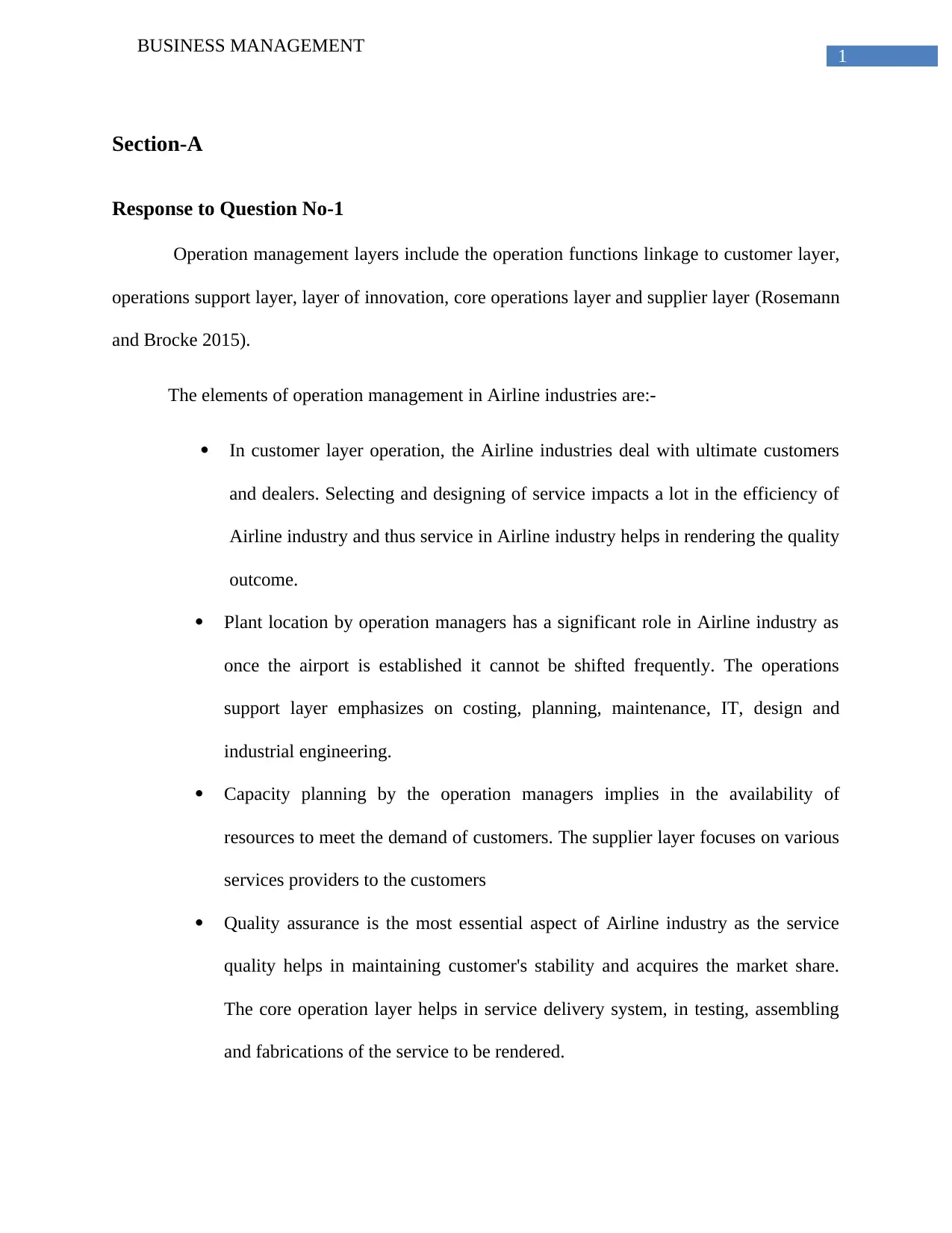
Operation management layers include the operation functions linkage to customer layer,
operations support layer, layer of innovation, core operations layer and supplier layer (Rosemann
and Brocke 2015).
The elements of operation management in Airline industries are:-
In customer layer operation, the Airline industries deal with ultimate customers
and dealers. Selecting and designing of service impacts a lot in the efficiency of
Airline industry and thus service in Airline industry helps in rendering the quality
outcome.
Plant location by operation managers has a significant role in Airline industry as
once the airport is established it cannot be shifted frequently. The operations
support layer emphasizes on costing, planning, maintenance, IT, design and
industrial engineering.
Capacity planning by the operation managers implies in the availability of
resources to meet the demand of customers. The supplier layer focuses on various
services providers to the customers
Quality assurance is the most essential aspect of Airline industry as the service
quality helps in maintaining customer's stability and acquires the market share.
The core operation layer helps in service delivery system, in testing, assembling
and fabrications of the service to be rendered.
Document Page
2
BUSINESS MANAGEMENT
Production planning and control specifies to achieve the desired output with the
help of layer of innovation, which includes innovation strategy and research &
development.
Response to Question No-2
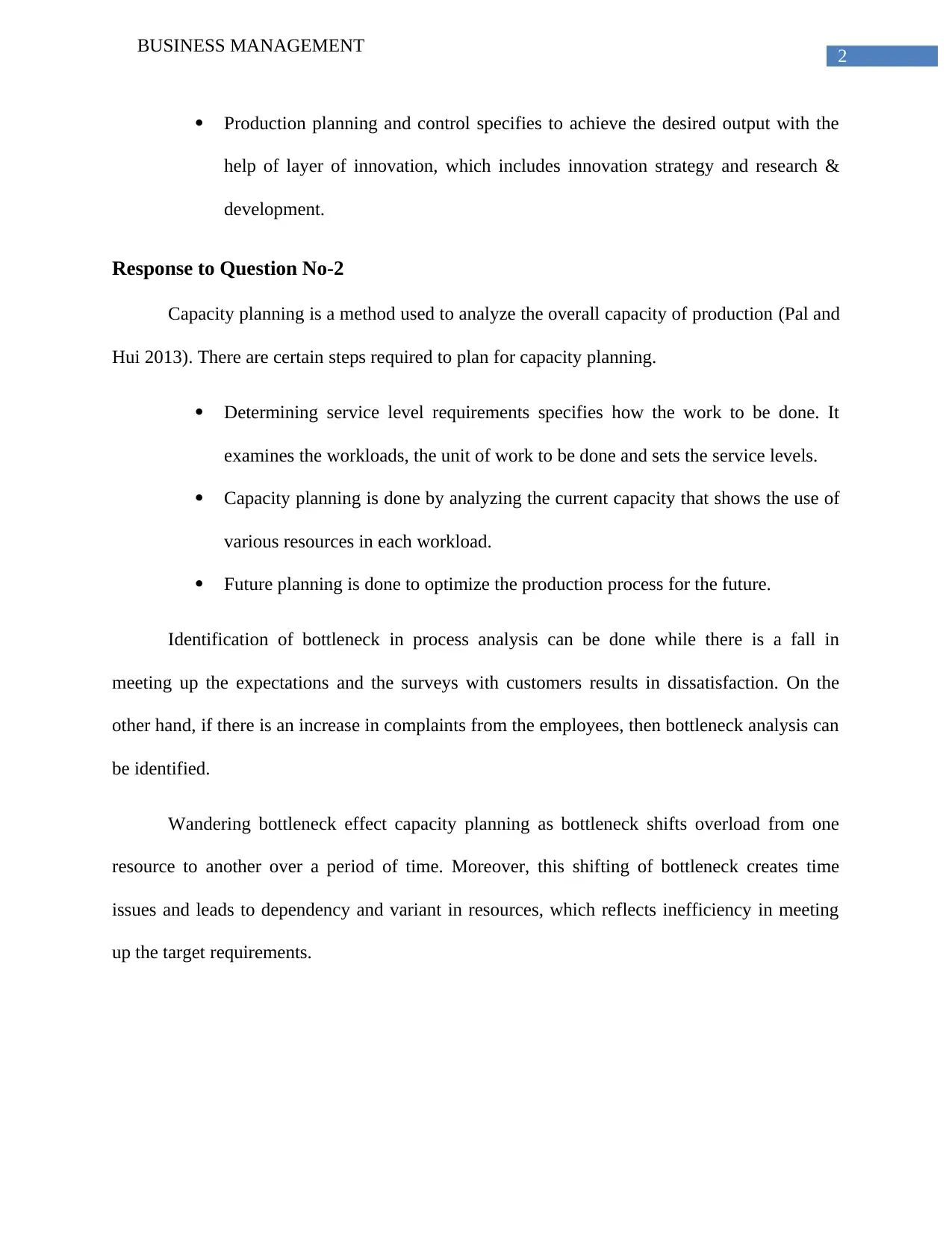
Capacity planning is a method used to analyze the overall capacity of production (Pal and
Hui 2013). There are certain steps required to plan for capacity planning.
Determining service level requirements specifies how the work to be done. It
examines the workloads, the unit of work to be done and sets the service levels.
Capacity planning is done by analyzing the current capacity that shows the use of
various resources in each workload.
Future planning is done to optimize the production process for the future.
Identification of bottleneck in process analysis can be done while there is a fall in
meeting up the expectations and the surveys with customers results in dissatisfaction. On the
other hand, if there is an increase in complaints from the employees, then bottleneck analysis can
be identified.
Wandering bottleneck effect capacity planning as bottleneck shifts overload from one
resource to another over a period of time. Moreover, this shifting of bottleneck creates time
issues and leads to dependency and variant in resources, which reflects inefficiency in meeting
up the target requirements.
Document Page
3
BUSINESS MANAGEMENT
Section-B
Response to Question No-1
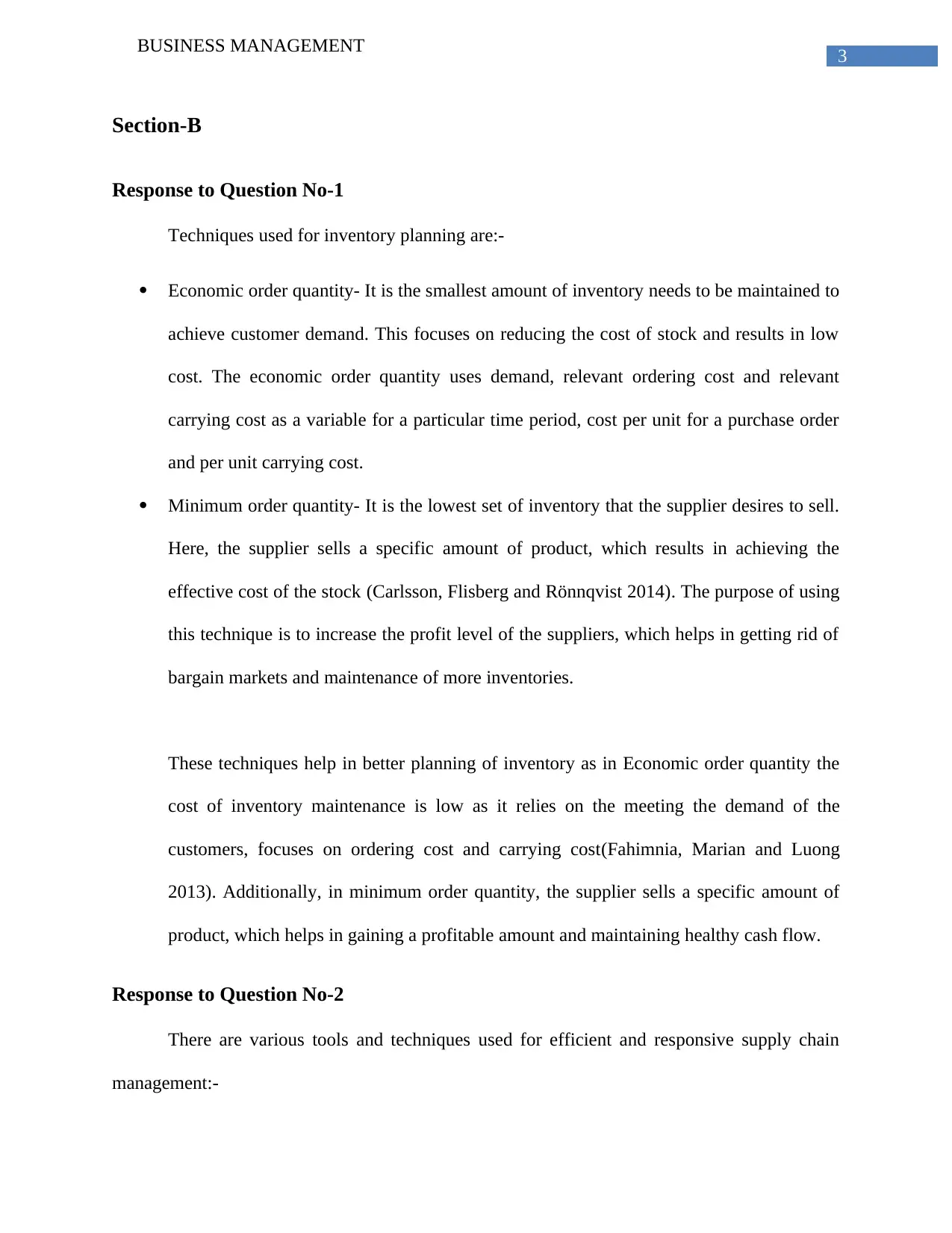
Techniques used for inventory planning are:-
Economic order quantity- It is the smallest amount of inventory needs to be maintained to
achieve customer demand. This focuses on reducing the cost of stock and results in low
cost. The economic order quantity uses demand, relevant ordering cost and relevant
carrying cost as a variable for a particular time period, cost per unit for a purchase order
and per unit carrying cost.
Minimum order quantity- It is the lowest set of inventory that the supplier desires to sell.
Here, the supplier sells a specific amount of product, which results in achieving the
effective cost of the stock (Carlsson, Flisberg and Rönnqvist 2014). The purpose of using
this technique is to increase the profit level of the suppliers, which helps in getting rid of
bargain markets and maintenance of more inventories.
These techniques help in better planning of inventory as in Economic order quantity the
cost of inventory maintenance is low as it relies on the meeting the demand of the
customers, focuses on ordering cost and carrying cost(Fahimnia, Marian and Luong
2013). Additionally, in minimum order quantity, the supplier sells a specific amount of
product, which helps in gaining a profitable amount and maintaining healthy cash flow.
Response to Question No-2
There are various tools and techniques used for efficient and responsive supply chain
management:-
tabler-icon-diamond-filled.svg

Paraphrase This Document

Need a fresh take? Get an instant paraphrase of this document with our AI Paraphraser
Document Page
4
BUSINESS MANAGEMENT
Data collection- It is one of the most important aspects for quality improvement
and decision-making step for the supply chain. This technique of supply chain
helps in the analysis of effective flow in the process of production (Christopher
2016).
Creating efficiency- It creates a platform to process the business and organize in a
way to have optimum utilization of resources and minimum cost required for the
production of a product(Hugos 2018).
Software integration- This technique of supply chain helps to integrate business
networks and connections in order to establish an E-commerce business relation.
Open platform- This provides a space for keeping the applications and data safe
for service orientation.
Case study
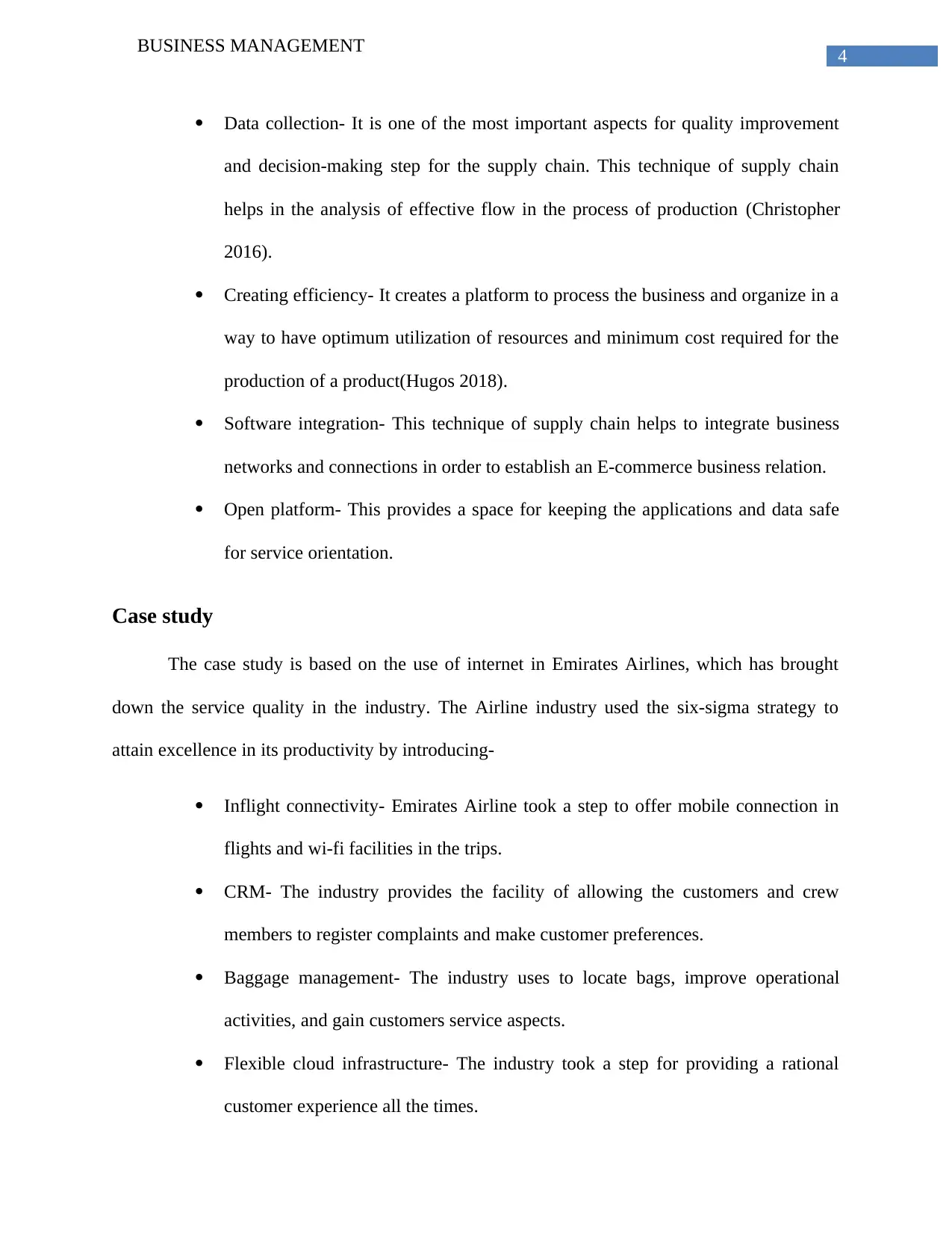
The case study is based on the use of internet in Emirates Airlines, which has brought
down the service quality in the industry. The Airline industry used the six-sigma strategy to
attain excellence in its productivity by introducing-
Inflight connectivity- Emirates Airline took a step to offer mobile connection in
flights and wi-fi facilities in the trips.
CRM- The industry provides the facility of allowing the customers and crew
members to register complaints and make customer preferences.
Baggage management- The industry uses to locate bags, improve operational
activities, and gain customers service aspects.
Flexible cloud infrastructure- The industry took a step for providing a rational
customer experience all the times.
Document Page
5
BUSINESS MANAGEMENT
The strategies adopted for the increment in the productivity level of the Emirate
Airline industry expected to have growth in the industry itself by having better price
discrimination and better use of mobile platforms in enabling online purchasing of
tickets.
Document Page
6
BUSINESS MANAGEMENT
References
Carlsson, D., Flisberg, P. and Rönnqvist, M., 2014. Using robust optimization for distribution
and inventory planning for a large pulp producer. Computers & Operations Research, 44,
pp.214-225.
Christopher, M., 2016. Logistics & supply chain management. Pearson UK.
Fahimnia, B., Farahani, R.Z., Marian, R. and Luong, L., 2013. A review and critique on
integrated production–distribution planning models and techniques. Journal of Manufacturing
Systems, 32(1), pp.1-19.
Hugos, M.H., 2018. Essentials of supply chain management. John Wiley & Sons.
Pal, R. and Hui, P., 2013. Economic models for cloud service markets: Pricing and capacity
planning. Theoretical Computer Science, 496, pp.113-124.
Rosemann, M. and vom Brocke, J., 2015. The six core elements of business process
management. In Handbook on business process management 1 (pp. 105-122). Springer, Berlin,
Heidelberg.
chevron_up_icon
1 out of 7
circle_padding
hide_on_mobile
zoom_out_icon
[object Object]