Analyzing Operations Management Challenges for Business Success
VerifiedAdded on 2023/01/17
|13
|3092
|1
Report
AI Summary
This report examines the challenges facing the clothing manufacturing business within an operations management framework. The analysis begins with an introduction defining the industry and highlighting key challenges such as technological advancements, market globalization, quality management, global manufacturing practices, changing job designs, and evolving consumer expectations. The report then delves into the impact of these challenges on the business's future, including potential declines in profits due to technology investments, unemployment due to automation, and complexities in quality management and supply chains. The second part of the report focuses on how the business can address these challenges through effective operational management, specifically in goods and service design, quality management, and capacity management. It discusses the use of forecasting, market research, and the importance of employee training and cost management in ensuring the business's success. The report concludes by emphasizing the need for adaptability and strategic planning to navigate the complex landscape of modern operations management.

Running head: OPERATION MANAGEMENT
1
Operation management:
Name:
Institution:
1
Operation management:
Name:
Institution:

Paraphrase This Document
Need a fresh take? Get an instant paraphrase of this document with our AI Paraphraser
OPERATION MANAGEMENT
2
Operation management
QUESTION 1
Introduction
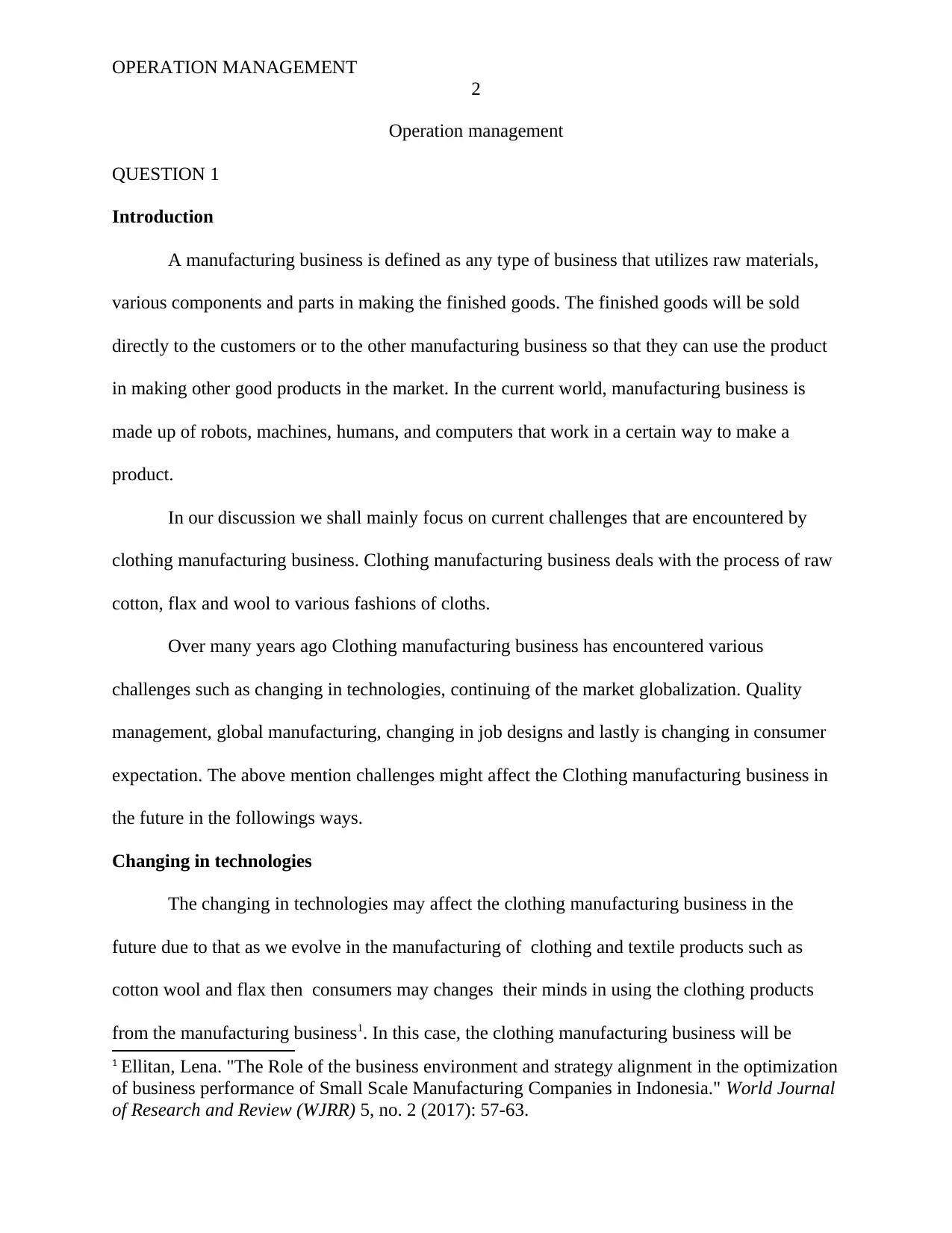
A manufacturing business is defined as any type of business that utilizes raw materials,
various components and parts in making the finished goods. The finished goods will be sold
directly to the customers or to the other manufacturing business so that they can use the product
in making other good products in the market. In the current world, manufacturing business is
made up of robots, machines, humans, and computers that work in a certain way to make a
product.
In our discussion we shall mainly focus on current challenges that are encountered by
clothing manufacturing business. Clothing manufacturing business deals with the process of raw
cotton, flax and wool to various fashions of cloths.
Over many years ago Clothing manufacturing business has encountered various
challenges such as changing in technologies, continuing of the market globalization. Quality
management, global manufacturing, changing in job designs and lastly is changing in consumer
expectation. The above mention challenges might affect the Clothing manufacturing business in
the future in the followings ways.
Changing in technologies
The changing in technologies may affect the clothing manufacturing business in the
future due to that as we evolve in the manufacturing of clothing and textile products such as
cotton wool and flax then consumers may changes their minds in using the clothing products
from the manufacturing business1. In this case, the clothing manufacturing business will be
1 Ellitan, Lena. "The Role of the business environment and strategy alignment in the optimization
of business performance of Small Scale Manufacturing Companies in Indonesia." World Journal
of Research and Review (WJRR) 5, no. 2 (2017): 57-63.
2
Operation management
QUESTION 1
Introduction
A manufacturing business is defined as any type of business that utilizes raw materials,
various components and parts in making the finished goods. The finished goods will be sold
directly to the customers or to the other manufacturing business so that they can use the product
in making other good products in the market. In the current world, manufacturing business is
made up of robots, machines, humans, and computers that work in a certain way to make a
product.
In our discussion we shall mainly focus on current challenges that are encountered by
clothing manufacturing business. Clothing manufacturing business deals with the process of raw
cotton, flax and wool to various fashions of cloths.
Over many years ago Clothing manufacturing business has encountered various
challenges such as changing in technologies, continuing of the market globalization. Quality
management, global manufacturing, changing in job designs and lastly is changing in consumer
expectation. The above mention challenges might affect the Clothing manufacturing business in
the future in the followings ways.
Changing in technologies
The changing in technologies may affect the clothing manufacturing business in the
future due to that as we evolve in the manufacturing of clothing and textile products such as
cotton wool and flax then consumers may changes their minds in using the clothing products
from the manufacturing business1. In this case, the clothing manufacturing business will be
1 Ellitan, Lena. "The Role of the business environment and strategy alignment in the optimization
of business performance of Small Scale Manufacturing Companies in Indonesia." World Journal
of Research and Review (WJRR) 5, no. 2 (2017): 57-63.
OPERATION MANAGEMENT
3
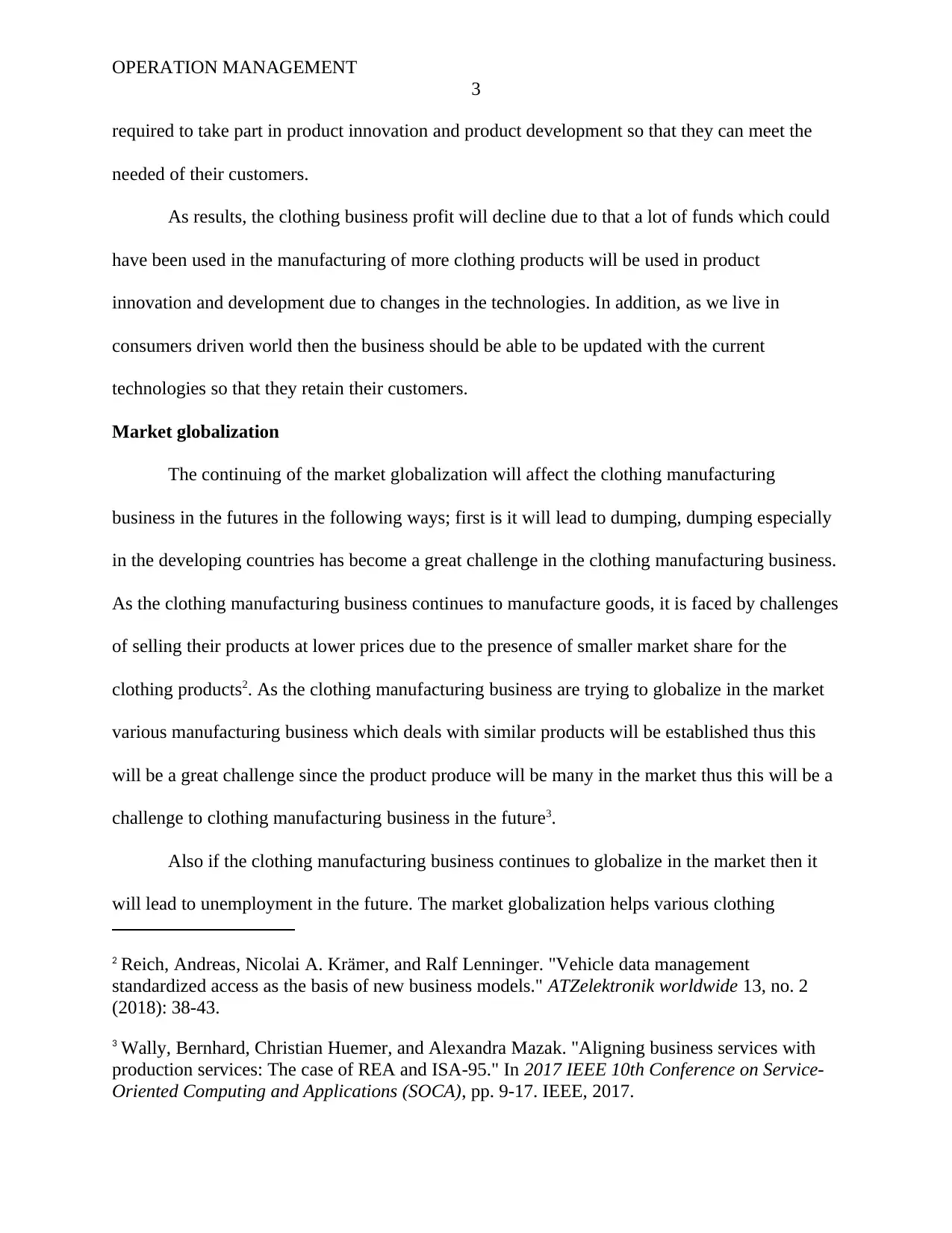
required to take part in product innovation and product development so that they can meet the
needed of their customers.
As results, the clothing business profit will decline due to that a lot of funds which could
have been used in the manufacturing of more clothing products will be used in product
innovation and development due to changes in the technologies. In addition, as we live in
consumers driven world then the business should be able to be updated with the current
technologies so that they retain their customers.
Market globalization
The continuing of the market globalization will affect the clothing manufacturing
business in the futures in the following ways; first is it will lead to dumping, dumping especially
in the developing countries has become a great challenge in the clothing manufacturing business.
As the clothing manufacturing business continues to manufacture goods, it is faced by challenges
of selling their products at lower prices due to the presence of smaller market share for the
clothing products2. As the clothing manufacturing business are trying to globalize in the market
various manufacturing business which deals with similar products will be established thus this
will be a great challenge since the product produce will be many in the market thus this will be a
challenge to clothing manufacturing business in the future3.
Also if the clothing manufacturing business continues to globalize in the market then it
will lead to unemployment in the future. The market globalization helps various clothing
2 Reich, Andreas, Nicolai A. Krämer, and Ralf Lenninger. "Vehicle data management
standardized access as the basis of new business models." ATZelektronik worldwide 13, no. 2
(2018): 38-43.
3 Wally, Bernhard, Christian Huemer, and Alexandra Mazak. "Aligning business services with
production services: The case of REA and ISA-95." In 2017 IEEE 10th Conference on Service-
Oriented Computing and Applications (SOCA), pp. 9-17. IEEE, 2017.
3
required to take part in product innovation and product development so that they can meet the
needed of their customers.
As results, the clothing business profit will decline due to that a lot of funds which could
have been used in the manufacturing of more clothing products will be used in product
innovation and development due to changes in the technologies. In addition, as we live in
consumers driven world then the business should be able to be updated with the current
technologies so that they retain their customers.
Market globalization
The continuing of the market globalization will affect the clothing manufacturing
business in the futures in the following ways; first is it will lead to dumping, dumping especially
in the developing countries has become a great challenge in the clothing manufacturing business.
As the clothing manufacturing business continues to manufacture goods, it is faced by challenges
of selling their products at lower prices due to the presence of smaller market share for the
clothing products2. As the clothing manufacturing business are trying to globalize in the market
various manufacturing business which deals with similar products will be established thus this
will be a great challenge since the product produce will be many in the market thus this will be a
challenge to clothing manufacturing business in the future3.
Also if the clothing manufacturing business continues to globalize in the market then it
will lead to unemployment in the future. The market globalization helps various clothing
2 Reich, Andreas, Nicolai A. Krämer, and Ralf Lenninger. "Vehicle data management
standardized access as the basis of new business models." ATZelektronik worldwide 13, no. 2
(2018): 38-43.
3 Wally, Bernhard, Christian Huemer, and Alexandra Mazak. "Aligning business services with
production services: The case of REA and ISA-95." In 2017 IEEE 10th Conference on Service-
Oriented Computing and Applications (SOCA), pp. 9-17. IEEE, 2017.
⊘ This is a preview!⊘
Do you want full access?
Subscribe today to unlock all pages.

Trusted by 1+ million students worldwide
OPERATION MANAGEMENT
4
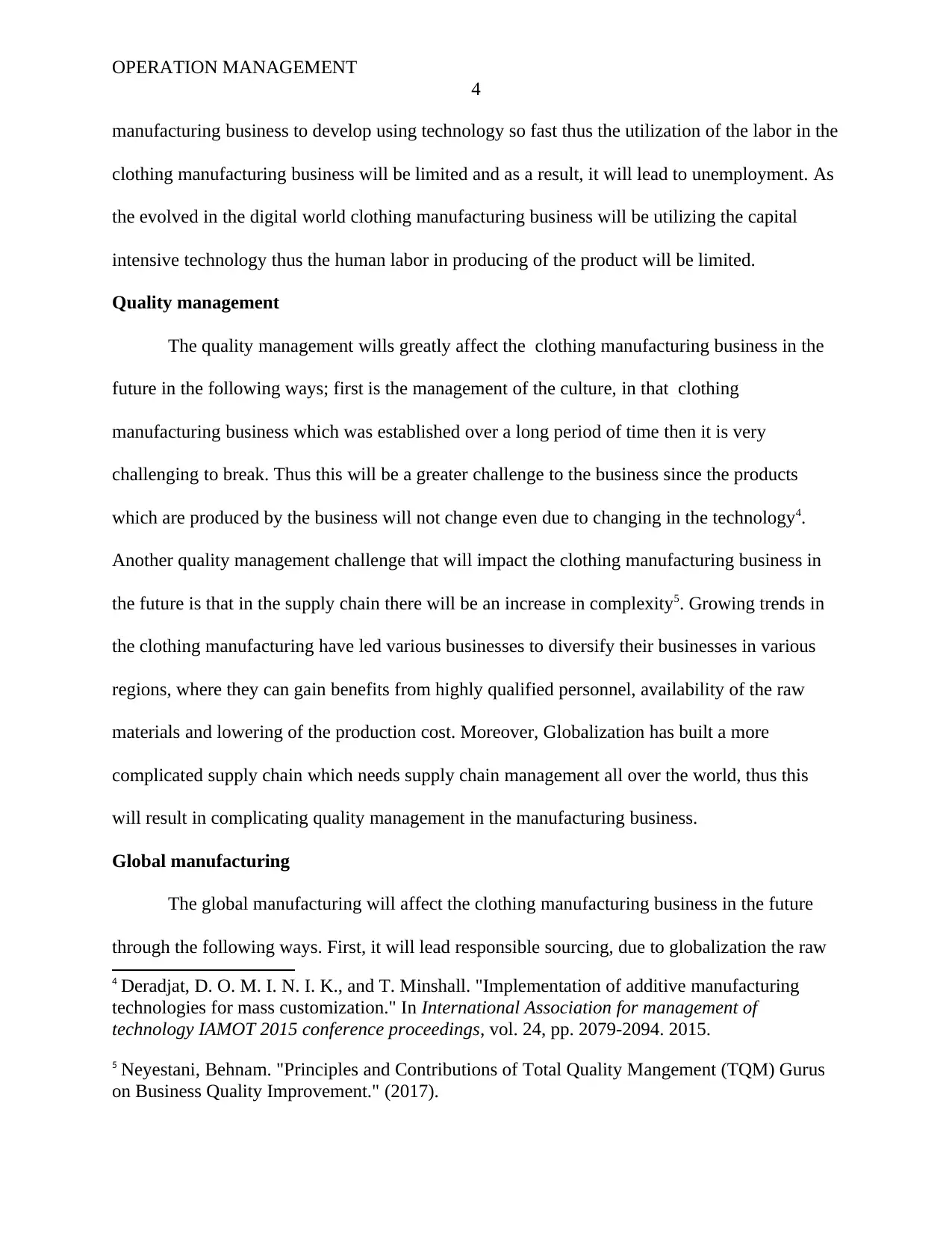
manufacturing business to develop using technology so fast thus the utilization of the labor in the
clothing manufacturing business will be limited and as a result, it will lead to unemployment. As
the evolved in the digital world clothing manufacturing business will be utilizing the capital
intensive technology thus the human labor in producing of the product will be limited.
Quality management
The quality management wills greatly affect the clothing manufacturing business in the
future in the following ways; first is the management of the culture, in that clothing
manufacturing business which was established over a long period of time then it is very
challenging to break. Thus this will be a greater challenge to the business since the products
which are produced by the business will not change even due to changing in the technology4.
Another quality management challenge that will impact the clothing manufacturing business in
the future is that in the supply chain there will be an increase in complexity5. Growing trends in
the clothing manufacturing have led various businesses to diversify their businesses in various
regions, where they can gain benefits from highly qualified personnel, availability of the raw
materials and lowering of the production cost. Moreover, Globalization has built a more
complicated supply chain which needs supply chain management all over the world, thus this
will result in complicating quality management in the manufacturing business.
Global manufacturing
The global manufacturing will affect the clothing manufacturing business in the future
through the following ways. First, it will lead responsible sourcing, due to globalization the raw
4 Deradjat, D. O. M. I. N. I. K., and T. Minshall. "Implementation of additive manufacturing
technologies for mass customization." In International Association for management of
technology IAMOT 2015 conference proceedings, vol. 24, pp. 2079-2094. 2015.
5 Neyestani, Behnam. "Principles and Contributions of Total Quality Mangement (TQM) Gurus
on Business Quality Improvement." (2017).
4
manufacturing business to develop using technology so fast thus the utilization of the labor in the
clothing manufacturing business will be limited and as a result, it will lead to unemployment. As
the evolved in the digital world clothing manufacturing business will be utilizing the capital
intensive technology thus the human labor in producing of the product will be limited.
Quality management
The quality management wills greatly affect the clothing manufacturing business in the
future in the following ways; first is the management of the culture, in that clothing
manufacturing business which was established over a long period of time then it is very
challenging to break. Thus this will be a greater challenge to the business since the products
which are produced by the business will not change even due to changing in the technology4.
Another quality management challenge that will impact the clothing manufacturing business in
the future is that in the supply chain there will be an increase in complexity5. Growing trends in
the clothing manufacturing have led various businesses to diversify their businesses in various
regions, where they can gain benefits from highly qualified personnel, availability of the raw
materials and lowering of the production cost. Moreover, Globalization has built a more
complicated supply chain which needs supply chain management all over the world, thus this
will result in complicating quality management in the manufacturing business.
Global manufacturing
The global manufacturing will affect the clothing manufacturing business in the future
through the following ways. First, it will lead responsible sourcing, due to globalization the raw
4 Deradjat, D. O. M. I. N. I. K., and T. Minshall. "Implementation of additive manufacturing
technologies for mass customization." In International Association for management of
technology IAMOT 2015 conference proceedings, vol. 24, pp. 2079-2094. 2015.
5 Neyestani, Behnam. "Principles and Contributions of Total Quality Mangement (TQM) Gurus
on Business Quality Improvement." (2017).
Paraphrase This Document
Need a fresh take? Get an instant paraphrase of this document with our AI Paraphraser
OPERATION MANAGEMENT
5
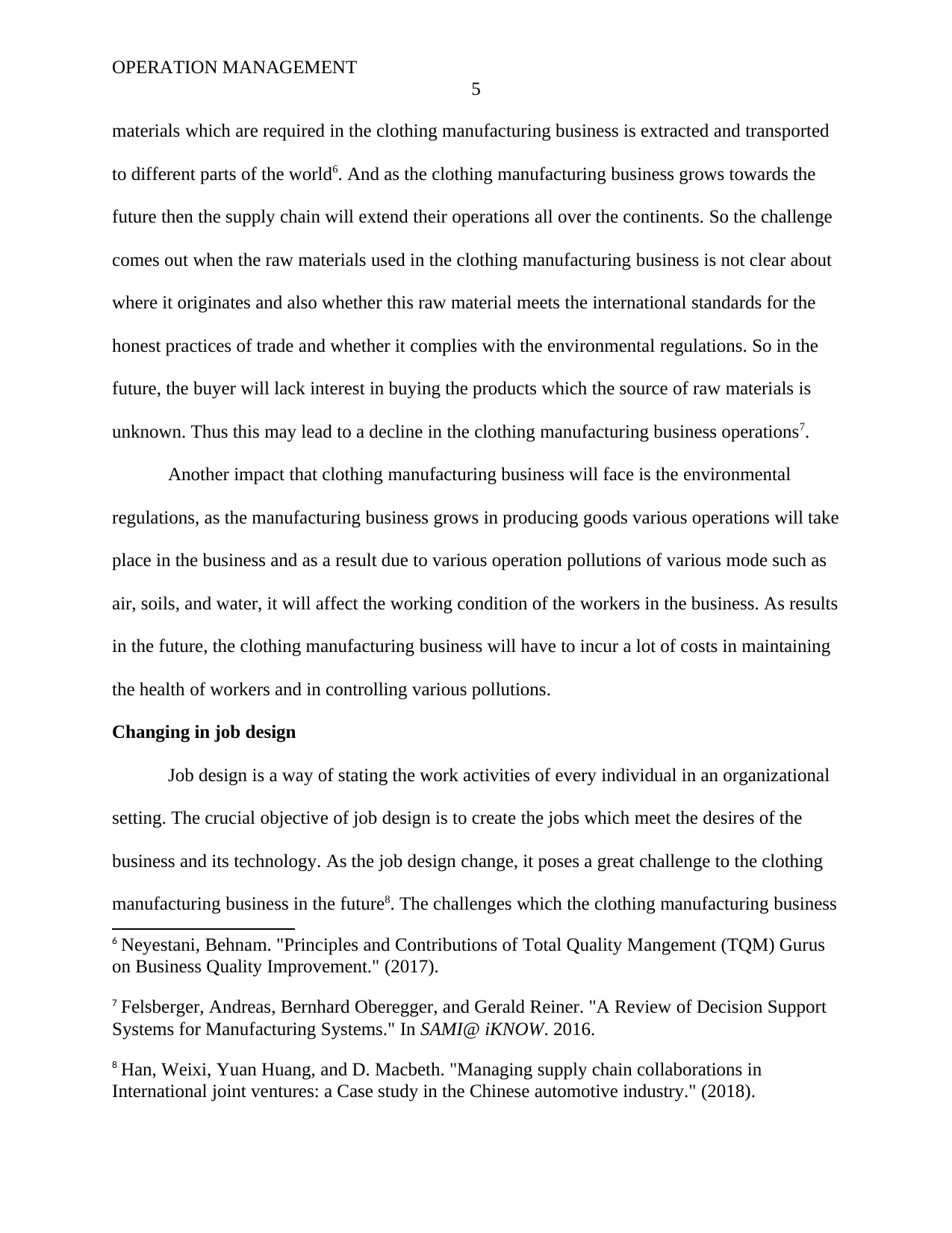
materials which are required in the clothing manufacturing business is extracted and transported
to different parts of the world6. And as the clothing manufacturing business grows towards the
future then the supply chain will extend their operations all over the continents. So the challenge
comes out when the raw materials used in the clothing manufacturing business is not clear about
where it originates and also whether this raw material meets the international standards for the
honest practices of trade and whether it complies with the environmental regulations. So in the
future, the buyer will lack interest in buying the products which the source of raw materials is
unknown. Thus this may lead to a decline in the clothing manufacturing business operations7.
Another impact that clothing manufacturing business will face is the environmental
regulations, as the manufacturing business grows in producing goods various operations will take
place in the business and as a result due to various operation pollutions of various mode such as
air, soils, and water, it will affect the working condition of the workers in the business. As results
in the future, the clothing manufacturing business will have to incur a lot of costs in maintaining
the health of workers and in controlling various pollutions.
Changing in job design
Job design is a way of stating the work activities of every individual in an organizational
setting. The crucial objective of job design is to create the jobs which meet the desires of the
business and its technology. As the job design change, it poses a great challenge to the clothing
manufacturing business in the future8. The challenges which the clothing manufacturing business
6 Neyestani, Behnam. "Principles and Contributions of Total Quality Mangement (TQM) Gurus
on Business Quality Improvement." (2017).
7 Felsberger, Andreas, Bernhard Oberegger, and Gerald Reiner. "A Review of Decision Support
Systems for Manufacturing Systems." In SAMI@ iKNOW. 2016.
8 Han, Weixi, Yuan Huang, and D. Macbeth. "Managing supply chain collaborations in
International joint ventures: a Case study in the Chinese automotive industry." (2018).
5
materials which are required in the clothing manufacturing business is extracted and transported
to different parts of the world6. And as the clothing manufacturing business grows towards the
future then the supply chain will extend their operations all over the continents. So the challenge
comes out when the raw materials used in the clothing manufacturing business is not clear about
where it originates and also whether this raw material meets the international standards for the
honest practices of trade and whether it complies with the environmental regulations. So in the
future, the buyer will lack interest in buying the products which the source of raw materials is
unknown. Thus this may lead to a decline in the clothing manufacturing business operations7.
Another impact that clothing manufacturing business will face is the environmental
regulations, as the manufacturing business grows in producing goods various operations will take
place in the business and as a result due to various operation pollutions of various mode such as
air, soils, and water, it will affect the working condition of the workers in the business. As results
in the future, the clothing manufacturing business will have to incur a lot of costs in maintaining
the health of workers and in controlling various pollutions.
Changing in job design
Job design is a way of stating the work activities of every individual in an organizational
setting. The crucial objective of job design is to create the jobs which meet the desires of the
business and its technology. As the job design change, it poses a great challenge to the clothing
manufacturing business in the future8. The challenges which the clothing manufacturing business
6 Neyestani, Behnam. "Principles and Contributions of Total Quality Mangement (TQM) Gurus
on Business Quality Improvement." (2017).
7 Felsberger, Andreas, Bernhard Oberegger, and Gerald Reiner. "A Review of Decision Support
Systems for Manufacturing Systems." In SAMI@ iKNOW. 2016.
8 Han, Weixi, Yuan Huang, and D. Macbeth. "Managing supply chain collaborations in
International joint ventures: a Case study in the Chinese automotive industry." (2018).
OPERATION MANAGEMENT
6
will face in the future include; First is the environmental factors, the environmental factors will
greatly affect the job design in clothing business this factors can be internal or external. These
factors include the skills of the employees, their availability and skills and the employee social
economic and cultural. In the clothing manufacturing business the employee’s abilities, time of
availability and their skills are very important in designing various jobs9. And due to changing in
the job design then it will leads into designing a job which is that is more demanding and that is
above the skills of the workers and as a results in decline in employees satisfaction and the
productivity in the business will also decrease as a reduce the clothing manufacturing business
will also decline and they have to spend a lot in getting the qualified employees to fill the job due
to new job designs in the business10.
Changing in the consumer expectation
Changing in the customer expectation will affect the clothing manufacturing business in
the future in the following ways, first is that due to technological advancement the customers are
expected clothing of high quality and also in large quantity and if the business fails to evolve in
using the upcoming technology in manufacturing of their clothing products then it will leads to
loss of the business due to that the consumers will lose interest in buying some clothing as
clothing manufacturing business will be hard for them to attain their required future goals11.
Another future challenge which will be experienced by changing in the consumer
expectation is understanding the customers’ expectations, the clothing manufacturing business
9 Smith, Don C., and Jessica M. Richards. "Social license to operate: hydraulic fracturing-related
challenges facing the oil & gas industry." ONE J 1 (2015): 81.
10 Riis, Jens O., ed. Simulation games and learning in production management. Springer, 2016.
11 Ingram, Thomas N., Raymond W. LaForge, Michael R. Williams, and Charles H. Schwepker
Jr. Sales management: Analysis and decision making. Routledge, 2015.
6
will face in the future include; First is the environmental factors, the environmental factors will
greatly affect the job design in clothing business this factors can be internal or external. These
factors include the skills of the employees, their availability and skills and the employee social
economic and cultural. In the clothing manufacturing business the employee’s abilities, time of
availability and their skills are very important in designing various jobs9. And due to changing in
the job design then it will leads into designing a job which is that is more demanding and that is
above the skills of the workers and as a results in decline in employees satisfaction and the
productivity in the business will also decrease as a reduce the clothing manufacturing business
will also decline and they have to spend a lot in getting the qualified employees to fill the job due
to new job designs in the business10.
Changing in the consumer expectation
Changing in the customer expectation will affect the clothing manufacturing business in
the future in the following ways, first is that due to technological advancement the customers are
expected clothing of high quality and also in large quantity and if the business fails to evolve in
using the upcoming technology in manufacturing of their clothing products then it will leads to
loss of the business due to that the consumers will lose interest in buying some clothing as
clothing manufacturing business will be hard for them to attain their required future goals11.
Another future challenge which will be experienced by changing in the consumer
expectation is understanding the customers’ expectations, the clothing manufacturing business
9 Smith, Don C., and Jessica M. Richards. "Social license to operate: hydraulic fracturing-related
challenges facing the oil & gas industry." ONE J 1 (2015): 81.
10 Riis, Jens O., ed. Simulation games and learning in production management. Springer, 2016.
11 Ingram, Thomas N., Raymond W. LaForge, Michael R. Williams, and Charles H. Schwepker
Jr. Sales management: Analysis and decision making. Routledge, 2015.
⊘ This is a preview!⊘
Do you want full access?
Subscribe today to unlock all pages.
Trusted by 1+ million students worldwide
OPERATION MANAGEMENT
7
will not be able to predict what the customers needed for the future and as a required the business
may produce their own clothing which cannot satisfied the needed of the customers thus it will
create a big challenge to the company in acquiring their future goals. In addition, the business
will face challenges in trying to make sure that they find the consumer's preferences, needed and
their opinion on how the product will satisfy they are needed in the future.
QUESTION 2
Design of goods and services
Clothing manufacturing business product design involves various teams for the business
for several products. This kind of operational management is applied to trends, forecasting and
market research. For instance, the clothing manufacturing business is now using focus as a major
tool for designing clothing products. At some point, if the clothing manufacturing business does
not acquire the necessary tools for forecasting then it may pose the business a great challenge
since they will not be in a position of predicting what the customers are expecting before
designing for clothing. Furthermore if the clothing manufacturing business fails to monitor the
trends before designing clothing productsit may be a challenge to the business since they will not
be sure which product will they produce which can gather the needed of the consumers and as a
required this has posed a great challenge to the business as they are trying to observe the trends
in the market before designing for the required products. When the clothing manufacturing
company is opting to design goods and services then they have to make sure that they do a
thorough market research, as they do market research they will encounter a lot of constraints
such as the research cost and also how they will research which clothing products are needed in
the market and also in determining who are competitors in the market. Thus if the business fails
7
will not be able to predict what the customers needed for the future and as a required the business
may produce their own clothing which cannot satisfied the needed of the customers thus it will
create a big challenge to the company in acquiring their future goals. In addition, the business
will face challenges in trying to make sure that they find the consumer's preferences, needed and
their opinion on how the product will satisfy they are needed in the future.
QUESTION 2
Design of goods and services
Clothing manufacturing business product design involves various teams for the business
for several products. This kind of operational management is applied to trends, forecasting and
market research. For instance, the clothing manufacturing business is now using focus as a major
tool for designing clothing products. At some point, if the clothing manufacturing business does
not acquire the necessary tools for forecasting then it may pose the business a great challenge
since they will not be in a position of predicting what the customers are expecting before
designing for clothing. Furthermore if the clothing manufacturing business fails to monitor the
trends before designing clothing productsit may be a challenge to the business since they will not
be sure which product will they produce which can gather the needed of the consumers and as a
required this has posed a great challenge to the business as they are trying to observe the trends
in the market before designing for the required products. When the clothing manufacturing
company is opting to design goods and services then they have to make sure that they do a
thorough market research, as they do market research they will encounter a lot of constraints
such as the research cost and also how they will research which clothing products are needed in
the market and also in determining who are competitors in the market. Thus if the business fails
Paraphrase This Document
Need a fresh take? Get an instant paraphrase of this document with our AI Paraphraser
OPERATION MANAGEMENT
8
to do proper market research it will result in designing of products and services which are
outdated in the market.
Quality management
The quality management will impact the success of clothing manufacturing business in
the following ways, first is that it can lead to production disruption- as the business is
implementing the quality management in the business then they need a detailed training of the
employees which will take a lot of time12. As a result in the clothing manufacturing business due
to the implementation of quality control then the business workers output will reduce due to that
a lot of time will be wasted as they try to train the workers.
Another effect is that quality management is very expensive to implement when the
clothing manufacturing business is trying to implement quality management then a lot of costs
such as training cost, team development cost, consultant fees, and infrastructural improvement
cost. Employees resistance is another challenge that can impact the success of clothing
manufacturing business, quality controls need the total change in the attitude, mindsets, and
approaches for performing different jobs. And when the management in the business does not
communicate the quality management strategies to the workers may become resistant to the
program of manufacturing and as a result, the business productivity will decline and employees
will have little morale.
Capacity management
Capacity management is the act of making sure that the company maximizes its possible
activities and production output every time under different condition13. But at some point the
12 Kerzner, Harold, and Harold R. Kerzner. Project management: a systems approach to
planning, scheduling, and controlling. John Wiley & Sons, 2017.
13 Litterer, Joseph. The emergence of systematic management as shown by the literature of
management from 1870-1900. Routledge, 2018.
8
to do proper market research it will result in designing of products and services which are
outdated in the market.
Quality management
The quality management will impact the success of clothing manufacturing business in
the following ways, first is that it can lead to production disruption- as the business is
implementing the quality management in the business then they need a detailed training of the
employees which will take a lot of time12. As a result in the clothing manufacturing business due
to the implementation of quality control then the business workers output will reduce due to that
a lot of time will be wasted as they try to train the workers.
Another effect is that quality management is very expensive to implement when the
clothing manufacturing business is trying to implement quality management then a lot of costs
such as training cost, team development cost, consultant fees, and infrastructural improvement
cost. Employees resistance is another challenge that can impact the success of clothing
manufacturing business, quality controls need the total change in the attitude, mindsets, and
approaches for performing different jobs. And when the management in the business does not
communicate the quality management strategies to the workers may become resistant to the
program of manufacturing and as a result, the business productivity will decline and employees
will have little morale.
Capacity management
Capacity management is the act of making sure that the company maximizes its possible
activities and production output every time under different condition13. But at some point the
12 Kerzner, Harold, and Harold R. Kerzner. Project management: a systems approach to
planning, scheduling, and controlling. John Wiley & Sons, 2017.
13 Litterer, Joseph. The emergence of systematic management as shown by the literature of
management from 1870-1900. Routledge, 2018.
OPERATION MANAGEMENT
9
business fails to make a suitable arrangement in maximizing the production output due to the
following reason so times capacity changes due to the various influences which includes
unexpected macro-economic events, seasonal demand, business changes this will become a great
challenge if the clothing manufacturing business fails to meet the requirement in a cost-effective
manner. For instance, the business sometimes lacks flexibility in the adjusting of the required
raw materials due to that it requires a lot of money.
Also implementing the capacity management in the clothing manufacturing business
requires various things which include working overtime for the workers, buying additional
equipment, selling or leasing of the property and lastly outsourcing business operations. If the
clothing manufacturing business fails to keenly execute the capacity management then their
revenues will be reduced due to a decline in market share, unfulfilled order. On the other hand
the business can decide to allocate its labor resources to absolutely the 2 floors and terminate
leasing the floor which is unused due to high expenses on rent, utility cost and insurance14.
Resource management
Resource management is the effective and efficient development of the resources of the
business when they are required. Such resources include inventory, production resources, natural
resources, and human skills. But at some point, the management of the resources may impact the
clothing manufacturing business in the following ways. In managing the resources especially
human skills it is difficult for the manager in the business to recognize the right skills in the
business. In the clothing manufacturing business for it to yield more revenue then a lot then
employees with the necessary skills are required, this will take business some years to recognize
14 Srai, Jagjit Singh, Mukesh Kumar, Gary Graham, Wendy Phillips, James Tooze, Simon Ford,
Paul Beecher et al. "Distributed manufacturing: scope, challenges and opportunities."
International Journal of Production Research 54, no. 23 (2016): 6917-6935.
9
business fails to make a suitable arrangement in maximizing the production output due to the
following reason so times capacity changes due to the various influences which includes
unexpected macro-economic events, seasonal demand, business changes this will become a great
challenge if the clothing manufacturing business fails to meet the requirement in a cost-effective
manner. For instance, the business sometimes lacks flexibility in the adjusting of the required
raw materials due to that it requires a lot of money.
Also implementing the capacity management in the clothing manufacturing business
requires various things which include working overtime for the workers, buying additional
equipment, selling or leasing of the property and lastly outsourcing business operations. If the
clothing manufacturing business fails to keenly execute the capacity management then their
revenues will be reduced due to a decline in market share, unfulfilled order. On the other hand
the business can decide to allocate its labor resources to absolutely the 2 floors and terminate
leasing the floor which is unused due to high expenses on rent, utility cost and insurance14.
Resource management
Resource management is the effective and efficient development of the resources of the
business when they are required. Such resources include inventory, production resources, natural
resources, and human skills. But at some point, the management of the resources may impact the
clothing manufacturing business in the following ways. In managing the resources especially
human skills it is difficult for the manager in the business to recognize the right skills in the
business. In the clothing manufacturing business for it to yield more revenue then a lot then
employees with the necessary skills are required, this will take business some years to recognize
14 Srai, Jagjit Singh, Mukesh Kumar, Gary Graham, Wendy Phillips, James Tooze, Simon Ford,
Paul Beecher et al. "Distributed manufacturing: scope, challenges and opportunities."
International Journal of Production Research 54, no. 23 (2016): 6917-6935.
⊘ This is a preview!⊘
Do you want full access?
Subscribe today to unlock all pages.
Trusted by 1+ million students worldwide
OPERATION MANAGEMENT
10
the right people to work in the company. Also, recognizing the required skills for workers in the
business are very procedural skills RACI chart is needed to be analyzed well.
Another challenge is that managing the availability, their capacity and their ability is a
procedural and complicated way. Since this process entails managing of the risks while trying to
reduce the risks,
Another challenge that can prevent the success of the clothing manufacturing business is
how to manage the workload without the resources hogging, the business will experience the
difficulty of planning for the work and then keenly monitoring it to make sure that the resources
are not underutilized and overutilize. At times the workload for the employees will lead them
feeling the burn and thus, as a result, they will lack to be productive in the business. In addition
manufacturing business will have difficulty in making sure that adjust the workload so that the
resources are really being minimized in the organization15.
Conclusion
In conclusion its various clears that clothing manufacturing business faces various challenges in
their day to day operations which have resource management, quality management, design of
goods and services and capacity management, in addition, there are challenges which will affect
the clothing manufacturing business in the future which includes, changing in technologies,
continue globalization, changing job designs, quality management, global manufacturing,
changing customers’ expectations
15 Zhong, Ray Y., Stephen T. Newman, George Q. Huang, and Shulin Lan. "Big Data for supply
chain management in the service and manufacturing sectors: Challenges, opportunities, and
future perspectives." Computers & Industrial Engineering 101 (2016): 572-591.
10
the right people to work in the company. Also, recognizing the required skills for workers in the
business are very procedural skills RACI chart is needed to be analyzed well.
Another challenge is that managing the availability, their capacity and their ability is a
procedural and complicated way. Since this process entails managing of the risks while trying to
reduce the risks,
Another challenge that can prevent the success of the clothing manufacturing business is
how to manage the workload without the resources hogging, the business will experience the
difficulty of planning for the work and then keenly monitoring it to make sure that the resources
are not underutilized and overutilize. At times the workload for the employees will lead them
feeling the burn and thus, as a result, they will lack to be productive in the business. In addition
manufacturing business will have difficulty in making sure that adjust the workload so that the
resources are really being minimized in the organization15.
Conclusion
In conclusion its various clears that clothing manufacturing business faces various challenges in
their day to day operations which have resource management, quality management, design of
goods and services and capacity management, in addition, there are challenges which will affect
the clothing manufacturing business in the future which includes, changing in technologies,
continue globalization, changing job designs, quality management, global manufacturing,
changing customers’ expectations
15 Zhong, Ray Y., Stephen T. Newman, George Q. Huang, and Shulin Lan. "Big Data for supply
chain management in the service and manufacturing sectors: Challenges, opportunities, and
future perspectives." Computers & Industrial Engineering 101 (2016): 572-591.
Paraphrase This Document
Need a fresh take? Get an instant paraphrase of this document with our AI Paraphraser
OPERATION MANAGEMENT
11
Bibliography
Ellitan, Lena. "The Role of the business environment and strategy alignment in the optimization
of business performance of Small Scale Manufacturing Companies in Indonesia." World Journal
of Research and Review (WJRR) 5, no. 2 (2017): 57-63.
Reich, Andreas, Nicolai A. Krämer, and Ralf Lenninger. "Vehicle data management
standardized access as the basis of new business models." ATZelektronik worldwide 13, no. 2
(2018): 38-43.
Wally, Bernhard, Christian Huemer, and Alexandra Mazak. "Aligning business services with
production services: The case of REA and ISA-95." In 2017 IEEE 10th Conference on Service-
Oriented Computing and Applications (SOCA), pp. 9-17. IEEE, 2017.
Uçaktürk, Ahmet, Tülay Uçaktürk, and Halil Yavuz. "Possibilities of usage of strategic business
intelligence systems based on databases in agile manufacturing." Procedia-Social and
Behavioral Sciences 207 (2015): 234-241.
11
Bibliography
Ellitan, Lena. "The Role of the business environment and strategy alignment in the optimization
of business performance of Small Scale Manufacturing Companies in Indonesia." World Journal
of Research and Review (WJRR) 5, no. 2 (2017): 57-63.
Reich, Andreas, Nicolai A. Krämer, and Ralf Lenninger. "Vehicle data management
standardized access as the basis of new business models." ATZelektronik worldwide 13, no. 2
(2018): 38-43.
Wally, Bernhard, Christian Huemer, and Alexandra Mazak. "Aligning business services with
production services: The case of REA and ISA-95." In 2017 IEEE 10th Conference on Service-
Oriented Computing and Applications (SOCA), pp. 9-17. IEEE, 2017.
Uçaktürk, Ahmet, Tülay Uçaktürk, and Halil Yavuz. "Possibilities of usage of strategic business
intelligence systems based on databases in agile manufacturing." Procedia-Social and
Behavioral Sciences 207 (2015): 234-241.
OPERATION MANAGEMENT
12
Deradjat, D. O. M. I. N. I. K., and T. Minshall. "Implementation of additive manufacturing
technologies for mass customization." In International Association for management of
technology IAMOT 2015 conference proceedings, vol. 24, pp. 2079-2094. 2015.
Neyestani, Behnam. "Principles and Contributions of Total Quality Mangement (TQM) Gurus on
Business Quality Improvement." (2017).
Felsberger, Andreas, Bernhard Oberegger, and Gerald Reiner. "A Review of Decision Support
Systems for Manufacturing Systems." In SAMI@ iKNOW. 2016.
Han, Weixi, Yuan Huang, and D. Macbeth. "Managing supply chain collaborations in
International joint ventures: a Case study in the Chinese automotive industry." (2018).
Smith, Don C., and Jessica M. Richards. "Social license to operate: hydraulic fracturing-related
challenges facing the oil & gas industry." ONE J 1 (2015): 81.
Riis, Jens O., ed. Simulation games and learning in production management. Springer, 2016.
Ingram, Thomas N., Raymond W. LaForge, Michael R. Williams, and Charles H. Schwepker Jr.
Sales management: Analysis and decision making. Routledge, 2015.
Kerzner, Harold, and Harold R. Kerzner. Project management: a systems approach to planning,
scheduling, and controlling. John Wiley & Sons, 2017.
Litterer, Joseph. The emergence of systematic management as shown by the literature of
management from 1870-1900. Routledge, 2018.
Sri, Jagjit Singh, Mukesh Kumar, Gary Graham, Wendy Phillips, James Tooze, Simon Ford,
Paul Beecher, et al. "Distributed manufacturing: scope, challenges, and opportunities."
International Journal of Production Research 54, no. 23 (2016): 6917-6935.
12
Deradjat, D. O. M. I. N. I. K., and T. Minshall. "Implementation of additive manufacturing
technologies for mass customization." In International Association for management of
technology IAMOT 2015 conference proceedings, vol. 24, pp. 2079-2094. 2015.
Neyestani, Behnam. "Principles and Contributions of Total Quality Mangement (TQM) Gurus on
Business Quality Improvement." (2017).
Felsberger, Andreas, Bernhard Oberegger, and Gerald Reiner. "A Review of Decision Support
Systems for Manufacturing Systems." In SAMI@ iKNOW. 2016.
Han, Weixi, Yuan Huang, and D. Macbeth. "Managing supply chain collaborations in
International joint ventures: a Case study in the Chinese automotive industry." (2018).
Smith, Don C., and Jessica M. Richards. "Social license to operate: hydraulic fracturing-related
challenges facing the oil & gas industry." ONE J 1 (2015): 81.
Riis, Jens O., ed. Simulation games and learning in production management. Springer, 2016.
Ingram, Thomas N., Raymond W. LaForge, Michael R. Williams, and Charles H. Schwepker Jr.
Sales management: Analysis and decision making. Routledge, 2015.
Kerzner, Harold, and Harold R. Kerzner. Project management: a systems approach to planning,
scheduling, and controlling. John Wiley & Sons, 2017.
Litterer, Joseph. The emergence of systematic management as shown by the literature of
management from 1870-1900. Routledge, 2018.
Sri, Jagjit Singh, Mukesh Kumar, Gary Graham, Wendy Phillips, James Tooze, Simon Ford,
Paul Beecher, et al. "Distributed manufacturing: scope, challenges, and opportunities."
International Journal of Production Research 54, no. 23 (2016): 6917-6935.
⊘ This is a preview!⊘
Do you want full access?
Subscribe today to unlock all pages.
Trusted by 1+ million students worldwide

1 out of 13


Related Documents


Your All-in-One AI-Powered Toolkit for Academic Success.
+13062052269
info@desklib.com
Available 24*7 on WhatsApp / Email
![[object Object]](/_next/static/media/star-bottom.7253800d.svg)
Unlock your academic potential
Copyright © 2020–2025 A2Z Services. All Rights Reserved. Developed and managed by ZUCOL.