University Operations Management Report: IKEA Case Study Analysis
VerifiedAdded on 2022/11/24
|15
|4144
|211
Report
AI Summary
This report provides a comprehensive analysis of IKEA's operations management, exploring how its operations strategy aligns with its overall business objectives. It examines IKEA's operational processes, including centralized planning and design, to understand how the company manages various facets of its operations, such as quality, speed, dependability, flexibility, and cost. The report delves into the company's performance objectives and their contribution to overall company performance, analyzing the 'four V's' model (Volume, Variety, Variation, and Visibility) to evaluate IKEA's operational efficiency. Furthermore, the report identifies potential shortcomings and proposes operations strategies for improvement, including recommendations and required resources for successful implementation. The report also highlights IKEA's approach to customer interaction, supply chain management, and its ability to adapt to market demands.
managing operations
IKEA
Rashmi Poddar
[Email address]
Institutional Affiliation(S)
IKEA
Rashmi Poddar
[Email address]
Institutional Affiliation(S)

Paraphrase This Document
Need a fresh take? Get an instant paraphrase of this document with our AI Paraphraser
P a g e | 1
Abstract
The following report has been prepared to identify and analyse how operations strategy fits
within an organisation and how various factors in operation process can be managed after applying it
in a practical scenario. For the same, this report will use case analysis of IKEA to analyse the firm’
operation process and find out how the company achieves its operation performance objectives. This
report will find whether the operation performance in IKEA meets with the requirements of other
business or corporate level strategies or not. After undertaking an evaluation of present operation
process of the company, this report will find any issues present within its operation management to
make appropriate recommendation along with mentioning required resources for successful
implementation of the proposed strategy.
Abstract
The following report has been prepared to identify and analyse how operations strategy fits
within an organisation and how various factors in operation process can be managed after applying it
in a practical scenario. For the same, this report will use case analysis of IKEA to analyse the firm’
operation process and find out how the company achieves its operation performance objectives. This
report will find whether the operation performance in IKEA meets with the requirements of other
business or corporate level strategies or not. After undertaking an evaluation of present operation
process of the company, this report will find any issues present within its operation management to
make appropriate recommendation along with mentioning required resources for successful
implementation of the proposed strategy.
P a g e | 2
Table of Contents
1. Introduction..............................................................................................................................3
2. Description of the organisation..........................................................................................................3
3. Description of the process or operation.............................................................................................4
3.1 Performance objectives................................................................................................................5
3.2.Contribution to company performance........................................................................................7
4. Analysis of IKEA’s operation management.......................................................................................8
5. Identified issues in IKEA’s operation management...........................................................................9
6. Proposed strategy.............................................................................................................................10
7. Required resources for implementing proposed strategy.................................................................10
8. Conclusion.......................................................................................................................................11
References...........................................................................................................................................13
Table of Contents
1. Introduction..............................................................................................................................3
2. Description of the organisation..........................................................................................................3
3. Description of the process or operation.............................................................................................4
3.1 Performance objectives................................................................................................................5
3.2.Contribution to company performance........................................................................................7
4. Analysis of IKEA’s operation management.......................................................................................8
5. Identified issues in IKEA’s operation management...........................................................................9
6. Proposed strategy.............................................................................................................................10
7. Required resources for implementing proposed strategy.................................................................10
8. Conclusion.......................................................................................................................................11
References...........................................................................................................................................13
⊘ This is a preview!⊘
Do you want full access?
Subscribe today to unlock all pages.

Trusted by 1+ million students worldwide
P a g e | 3
1. Introduction
Operations management is one of the disciplines in organisation’s management that have
been originated to solve business issues within factory environment, however, since past few years,
many researchers and business practitioners have starting implementing it in the field of service
operations also (Kachru, 2011). From theoretical perspective, operations processes can be justified
through gaining of increased knowledge regarding specific fields from operation management to
business practice that can potentially guide new efforts through deepening of theoretical knowledge
and advanced operation management practice. From practical point of view, dissemination and
identification of various fields in operations process that are given more value by companies can assist
business managers and researchers to comprehend what is required the most that can align their
efforts in making difference to everyday business activity (Peinado, Graeml, & Vianna, 2018).
Nowadays, organisations need to operate in competitive environment where the key sources
remain scarce and uncertainty in businesses is common. Furthermore, the market imposes various
efficiency standards which often makes firms face failures and are quickly been marginalized. Under
such conditions, careful optimisation of firm’s resources is a must that can enable competitive edge
within firms along with recognising enhanced business performance (Battistoni, Bonacelli, Colladon,
& Schiraldi, 2013). Since operational practices consists of internal factors contributing competence
development in firms, they can offer superior performance metrics. According to (Duarte, DiSerio, &
Brito, 2009), both operations strategy and firm’s resource based view is been supported by the notion
that operation practices can be utilised in the firm of weapon to secure competitive advantage and to
increase organisational performance. With this note, this report proposes to explain how operations
related objectives and strategies fits within organisations by analysing IKEA operation strategy to find
out how different facets of operation process are managed by the firm and to evaluate practical
operation management scenario.
2. Description of the organisation
IKEA is one the most successful furniture manufacturer and retailer which operates in around
36 countries with over 423 stores (Inter IKEA Systems B.V., 2017). The organisation is capable
enough to manage and develop its own special way to sell its products and perform effectively. The
stores layout is designed in a way that considers giving enough space to the customers who often
spends more than two hours’ time in IKEA stores, far longer than other rivalry companies. The
business philosophy adopted by IKEA can be compared to the traditional philosophy adopted during
the time when the company was originated in 1950 by Ingvar Kamprad, a Swedish retailer. The
increase in company sales made IKEA start manufacturing furniture of its own with the help of local
manufacturers and soon, innovation in its operation processes dramatically reduced selling costs for
1. Introduction
Operations management is one of the disciplines in organisation’s management that have
been originated to solve business issues within factory environment, however, since past few years,
many researchers and business practitioners have starting implementing it in the field of service
operations also (Kachru, 2011). From theoretical perspective, operations processes can be justified
through gaining of increased knowledge regarding specific fields from operation management to
business practice that can potentially guide new efforts through deepening of theoretical knowledge
and advanced operation management practice. From practical point of view, dissemination and
identification of various fields in operations process that are given more value by companies can assist
business managers and researchers to comprehend what is required the most that can align their
efforts in making difference to everyday business activity (Peinado, Graeml, & Vianna, 2018).
Nowadays, organisations need to operate in competitive environment where the key sources
remain scarce and uncertainty in businesses is common. Furthermore, the market imposes various
efficiency standards which often makes firms face failures and are quickly been marginalized. Under
such conditions, careful optimisation of firm’s resources is a must that can enable competitive edge
within firms along with recognising enhanced business performance (Battistoni, Bonacelli, Colladon,
& Schiraldi, 2013). Since operational practices consists of internal factors contributing competence
development in firms, they can offer superior performance metrics. According to (Duarte, DiSerio, &
Brito, 2009), both operations strategy and firm’s resource based view is been supported by the notion
that operation practices can be utilised in the firm of weapon to secure competitive advantage and to
increase organisational performance. With this note, this report proposes to explain how operations
related objectives and strategies fits within organisations by analysing IKEA operation strategy to find
out how different facets of operation process are managed by the firm and to evaluate practical
operation management scenario.
2. Description of the organisation
IKEA is one the most successful furniture manufacturer and retailer which operates in around
36 countries with over 423 stores (Inter IKEA Systems B.V., 2017). The organisation is capable
enough to manage and develop its own special way to sell its products and perform effectively. The
stores layout is designed in a way that considers giving enough space to the customers who often
spends more than two hours’ time in IKEA stores, far longer than other rivalry companies. The
business philosophy adopted by IKEA can be compared to the traditional philosophy adopted during
the time when the company was originated in 1950 by Ingvar Kamprad, a Swedish retailer. The
increase in company sales made IKEA start manufacturing furniture of its own with the help of local
manufacturers and soon, innovation in its operation processes dramatically reduced selling costs for
Paraphrase This Document
Need a fresh take? Get an instant paraphrase of this document with our AI Paraphraser
P a g e | 4
the company. IKEA planning primarily focussed on flat-pack furniture that reduced transportation and
production costs for the company. The store house of the firm follows the concept through which
customers can easily pick their purchased furniture all by themselves that again brought cost effective
measurements in the firm. IKEA’s operating principles are based upon IKEA’s retail operation
process and therefore all its stores are controlled in a way that facilitates smooth flow for its
customers. Supply network are also significant aspect considered by IKEA and thus from purchasing
correct raw material through finished products arriving at its customer places, IKEA relies upon close
partnership with third-party suppliers which not only brings ongoing supply chain efficiency, but also
helps the firm in developing new and innovative products (Inter IKEA Holding B.V. , 2018).
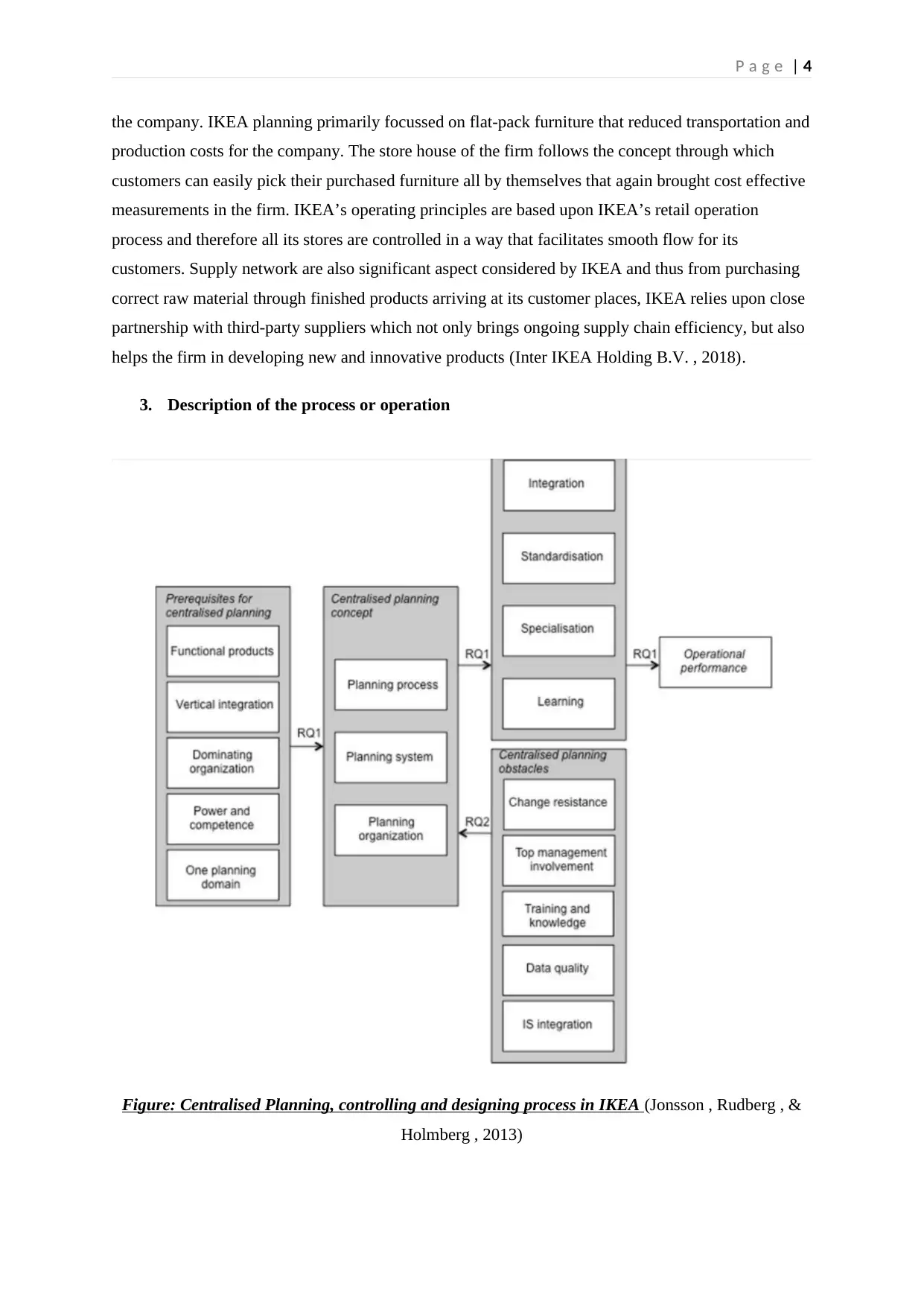
3. Description of the process or operation
Figure: Centralised Planning, controlling and designing process in IKEA (Jonsson , Rudberg , &
Holmberg , 2013)
the company. IKEA planning primarily focussed on flat-pack furniture that reduced transportation and
production costs for the company. The store house of the firm follows the concept through which
customers can easily pick their purchased furniture all by themselves that again brought cost effective
measurements in the firm. IKEA’s operating principles are based upon IKEA’s retail operation
process and therefore all its stores are controlled in a way that facilitates smooth flow for its
customers. Supply network are also significant aspect considered by IKEA and thus from purchasing
correct raw material through finished products arriving at its customer places, IKEA relies upon close
partnership with third-party suppliers which not only brings ongoing supply chain efficiency, but also
helps the firm in developing new and innovative products (Inter IKEA Holding B.V. , 2018).
3. Description of the process or operation
Figure: Centralised Planning, controlling and designing process in IKEA (Jonsson , Rudberg , &
Holmberg , 2013)
P a g e | 5
The Annual report and operation process analysis of IKEA reveals that to fulfil the mission
and vision of the company, IKEA offers wider range of domestic furniture enabled with good and
innovative designs, excellent durability and quality and that to in low prices so that maximum number
of people can afford to buy IKEA’s products. The founders of the company innovative strategy
considered in designing functional products that remains cost effective and easier to build. IKEA
distinguishes from its competitors through the way its stores are been designed and operated. Every
IKEA store are as double as its warehouses that makes shopping at IKEA an experience itself. The
furniture is laid in a way that can be browsed easily by the customers and shoppers can usually see all
the available products under one roof. Though IKEA stores comprises many sales persons whom
which customers can contact for any query, but most of the times they choose the products of their
own, pick themselves and assembles in their own selected way (IKEA Group, 2015).
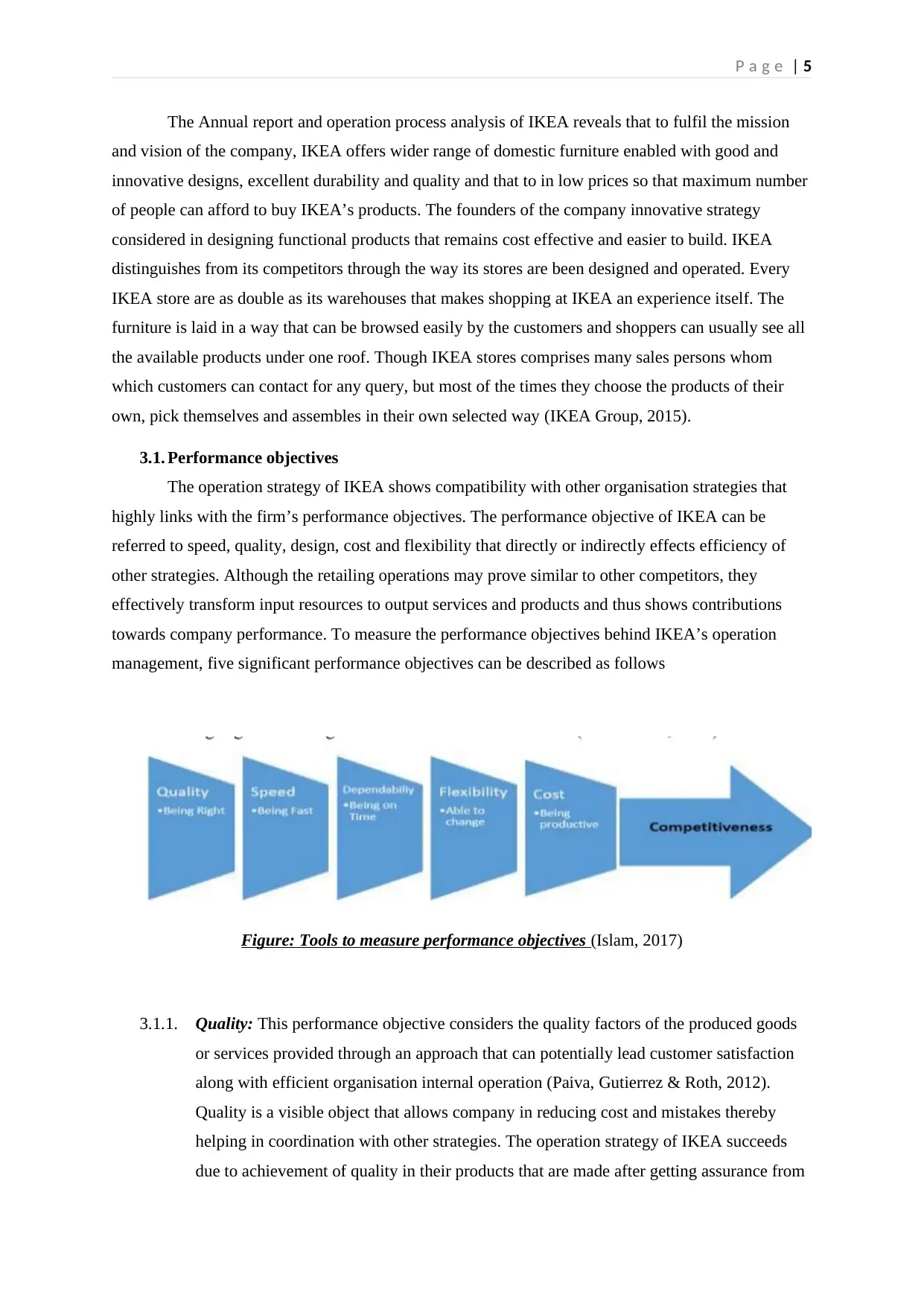
3.1. Performance objectives
The operation strategy of IKEA shows compatibility with other organisation strategies that
highly links with the firm’s performance objectives. The performance objective of IKEA can be
referred to speed, quality, design, cost and flexibility that directly or indirectly effects efficiency of
other strategies. Although the retailing operations may prove similar to other competitors, they
effectively transform input resources to output services and products and thus shows contributions
towards company performance. To measure the performance objectives behind IKEA’s operation
management, five significant performance objectives can be described as follows
Figure: Tools to measure performance objectives (Islam, 2017)
3.1.1. Quality: This performance objective considers the quality factors of the produced goods
or services provided through an approach that can potentially lead customer satisfaction
along with efficient organisation internal operation (Paiva, Gutierrez & Roth, 2012).
Quality is a visible object that allows company in reducing cost and mistakes thereby
helping in coordination with other strategies. The operation strategy of IKEA succeeds
due to achievement of quality in their products that are made after getting assurance from
The Annual report and operation process analysis of IKEA reveals that to fulfil the mission
and vision of the company, IKEA offers wider range of domestic furniture enabled with good and
innovative designs, excellent durability and quality and that to in low prices so that maximum number
of people can afford to buy IKEA’s products. The founders of the company innovative strategy
considered in designing functional products that remains cost effective and easier to build. IKEA
distinguishes from its competitors through the way its stores are been designed and operated. Every
IKEA store are as double as its warehouses that makes shopping at IKEA an experience itself. The
furniture is laid in a way that can be browsed easily by the customers and shoppers can usually see all
the available products under one roof. Though IKEA stores comprises many sales persons whom
which customers can contact for any query, but most of the times they choose the products of their
own, pick themselves and assembles in their own selected way (IKEA Group, 2015).
3.1. Performance objectives
The operation strategy of IKEA shows compatibility with other organisation strategies that
highly links with the firm’s performance objectives. The performance objective of IKEA can be
referred to speed, quality, design, cost and flexibility that directly or indirectly effects efficiency of
other strategies. Although the retailing operations may prove similar to other competitors, they
effectively transform input resources to output services and products and thus shows contributions
towards company performance. To measure the performance objectives behind IKEA’s operation
management, five significant performance objectives can be described as follows
Figure: Tools to measure performance objectives (Islam, 2017)
3.1.1. Quality: This performance objective considers the quality factors of the produced goods
or services provided through an approach that can potentially lead customer satisfaction
along with efficient organisation internal operation (Paiva, Gutierrez & Roth, 2012).
Quality is a visible object that allows company in reducing cost and mistakes thereby
helping in coordination with other strategies. The operation strategy of IKEA succeeds
due to achievement of quality in their products that are made after getting assurance from
⊘ This is a preview!⊘
Do you want full access?
Subscribe today to unlock all pages.
Trusted by 1+ million students worldwide
P a g e | 6
specialised teams. Even, the stores of IKEA are designed in unique and cleaner way that
matches with the brand identity. The staff contacts with the customers whenever required
and show helping attitude (Inter IKEA Holding B.V. , 2018).
3.1.2. Speed: This factor considers time frame between operations execution and customer
order placement. The objective of speed has huge impact on overall operational process
especially while performing decision making and input-output strategies. The operation
process of the firm provides with speedy work alongside providing its stores with proper
facilities that can enable faster shopping for the customers. The products in IKEA’s store
ranges from about 10,000 to 14,000 products that allows immediate availability of
products. Even, the technological implementation of the company allows flat packing
along with provided unique code to each product that further supports easier inventory
management (Hultman, Johnsen, Johnsen, & Hertz, 2012).
3.1.3. Dependability: This factor in operations management means scheduling of overall
organisation process to deliver goods or services in time and whenever customers need
them. While considering dependability factor, the value of speed and costs does not
impact operation performance since its only scope remains in satisfying end consumers.
However, the impact of dependability in operations can be highly relevant for measuring
efficiency of entire operation processes (Battistoni, Bonacelli, Colladon, & Schiraldi,
2013). IKEA operation are dependent on other business strategies as it follows
predictable opening hours. Again, the products that remains out-of-order has to be kept by
simple reorder system so that new stock can be accelerated easily and older stock can be
reviewed to verify reorder quantity. Dependability factor of IKEA’s operation
performance is compatible with target groups since they majorly belong to working class
who values time and costs while making purchases (Jonsson , Rudberg & Holmberg,
2013).
3.1.4. Flexibility: This objective describes the ability to manage or change operational plans
according to the customers need. By developing a flexible operation process, firms
benefit in terms of time optimisation, response and high level of dependability. The
operation strategy of IKEA has the scope of managing flexibility and changes with
customers requirements thereby enabling performance objectives effectively. The
operation in the firm allows mixed flexibility by enabling wider range of product mix
from home to office furniture along with many other accessories. The operations
performance of the company also supports volume flexibility since they change output
and input levels as per needs. the global outsourcing followed by IKEA helps the firm to
make adjustments in its volume which means they are very responsive while considering
changes within furniture market (IKEA Group, 2015).
specialised teams. Even, the stores of IKEA are designed in unique and cleaner way that
matches with the brand identity. The staff contacts with the customers whenever required
and show helping attitude (Inter IKEA Holding B.V. , 2018).
3.1.2. Speed: This factor considers time frame between operations execution and customer
order placement. The objective of speed has huge impact on overall operational process
especially while performing decision making and input-output strategies. The operation
process of the firm provides with speedy work alongside providing its stores with proper
facilities that can enable faster shopping for the customers. The products in IKEA’s store
ranges from about 10,000 to 14,000 products that allows immediate availability of
products. Even, the technological implementation of the company allows flat packing
along with provided unique code to each product that further supports easier inventory
management (Hultman, Johnsen, Johnsen, & Hertz, 2012).
3.1.3. Dependability: This factor in operations management means scheduling of overall
organisation process to deliver goods or services in time and whenever customers need
them. While considering dependability factor, the value of speed and costs does not
impact operation performance since its only scope remains in satisfying end consumers.
However, the impact of dependability in operations can be highly relevant for measuring
efficiency of entire operation processes (Battistoni, Bonacelli, Colladon, & Schiraldi,
2013). IKEA operation are dependent on other business strategies as it follows
predictable opening hours. Again, the products that remains out-of-order has to be kept by
simple reorder system so that new stock can be accelerated easily and older stock can be
reviewed to verify reorder quantity. Dependability factor of IKEA’s operation
performance is compatible with target groups since they majorly belong to working class
who values time and costs while making purchases (Jonsson , Rudberg & Holmberg,
2013).
3.1.4. Flexibility: This objective describes the ability to manage or change operational plans
according to the customers need. By developing a flexible operation process, firms
benefit in terms of time optimisation, response and high level of dependability. The
operation strategy of IKEA has the scope of managing flexibility and changes with
customers requirements thereby enabling performance objectives effectively. The
operation in the firm allows mixed flexibility by enabling wider range of product mix
from home to office furniture along with many other accessories. The operations
performance of the company also supports volume flexibility since they change output
and input levels as per needs. the global outsourcing followed by IKEA helps the firm to
make adjustments in its volume which means they are very responsive while considering
changes within furniture market (IKEA Group, 2015).
Paraphrase This Document
Need a fresh take? Get an instant paraphrase of this document with our AI Paraphraser
P a g e | 7
3.1.5. Cost objectives: This objective is another significant factor for the firms which are more
depended on price competition. In furniture industry, cost drivers act as a significant
factor as lower costs attracts more customers along with enhancing potential target and
improving organisational structure. For IKEA, cost objective is very clear as every
strategy followed by the firm showcases their cost reduction measurements. Other
performance factors like speed, dependability, quality and flexibility are also affected by
cost objectives of the firm. IKEA’s cost objective is achieved by other measurements like
central warehouse in its home country i.e. Sweden which is highly automated with
functional management. The stock controlling system is used as management information
system by the firm that helps operation management in determining sales pattern to react
promptly. Prompt reaction further saves costs for the firm along with assisting in
arrangements of required resources during unexpected circumstances (Hultman, Johnsen,
Johnsen, & Hertz, 2012).
3.2. Contribution to company performance
IKEA operation strategy reflects its capabilities in providing the firm with enhanced
performance as it copes with larger volumes of processes through provision of specialised assessment,
starting from raw material purchases till the sale of finished products. The variety of products dealt by
the company operations management ranges from standardised to low defined ones and thus
operations team creates different variation, low to medium that can cope up with sales volume and
maintain a steady flow throughout the year. The degrees of customer interactions are quite low in the
company and thus operation strategy of IKEA focuses more upon cost effective measures. IKEA
targets at two segments of customers. The first one being young adults who comes under middle
income group and may or may not have a family of their own. Other targeted segment includes
business customers who usually runs small to medium sized business offices. This shows that IKEA
designs its products after predicting its customer segments so that their needs and preferences are
fulfilled by product design alongside supporting and providing services post sales of the products.
Thereby revealing how different operation processes supports company performance like marketing,
sales, supply chain networks, distribution, pricing etc. (IKEA Group, 2015)
3.1.5. Cost objectives: This objective is another significant factor for the firms which are more
depended on price competition. In furniture industry, cost drivers act as a significant
factor as lower costs attracts more customers along with enhancing potential target and
improving organisational structure. For IKEA, cost objective is very clear as every
strategy followed by the firm showcases their cost reduction measurements. Other
performance factors like speed, dependability, quality and flexibility are also affected by
cost objectives of the firm. IKEA’s cost objective is achieved by other measurements like
central warehouse in its home country i.e. Sweden which is highly automated with
functional management. The stock controlling system is used as management information
system by the firm that helps operation management in determining sales pattern to react
promptly. Prompt reaction further saves costs for the firm along with assisting in
arrangements of required resources during unexpected circumstances (Hultman, Johnsen,
Johnsen, & Hertz, 2012).
3.2. Contribution to company performance
IKEA operation strategy reflects its capabilities in providing the firm with enhanced
performance as it copes with larger volumes of processes through provision of specialised assessment,
starting from raw material purchases till the sale of finished products. The variety of products dealt by
the company operations management ranges from standardised to low defined ones and thus
operations team creates different variation, low to medium that can cope up with sales volume and
maintain a steady flow throughout the year. The degrees of customer interactions are quite low in the
company and thus operation strategy of IKEA focuses more upon cost effective measures. IKEA
targets at two segments of customers. The first one being young adults who comes under middle
income group and may or may not have a family of their own. Other targeted segment includes
business customers who usually runs small to medium sized business offices. This shows that IKEA
designs its products after predicting its customer segments so that their needs and preferences are
fulfilled by product design alongside supporting and providing services post sales of the products.
Thereby revealing how different operation processes supports company performance like marketing,
sales, supply chain networks, distribution, pricing etc. (IKEA Group, 2015)
P a g e | 8
4. Analysis of IKEA’s operation management
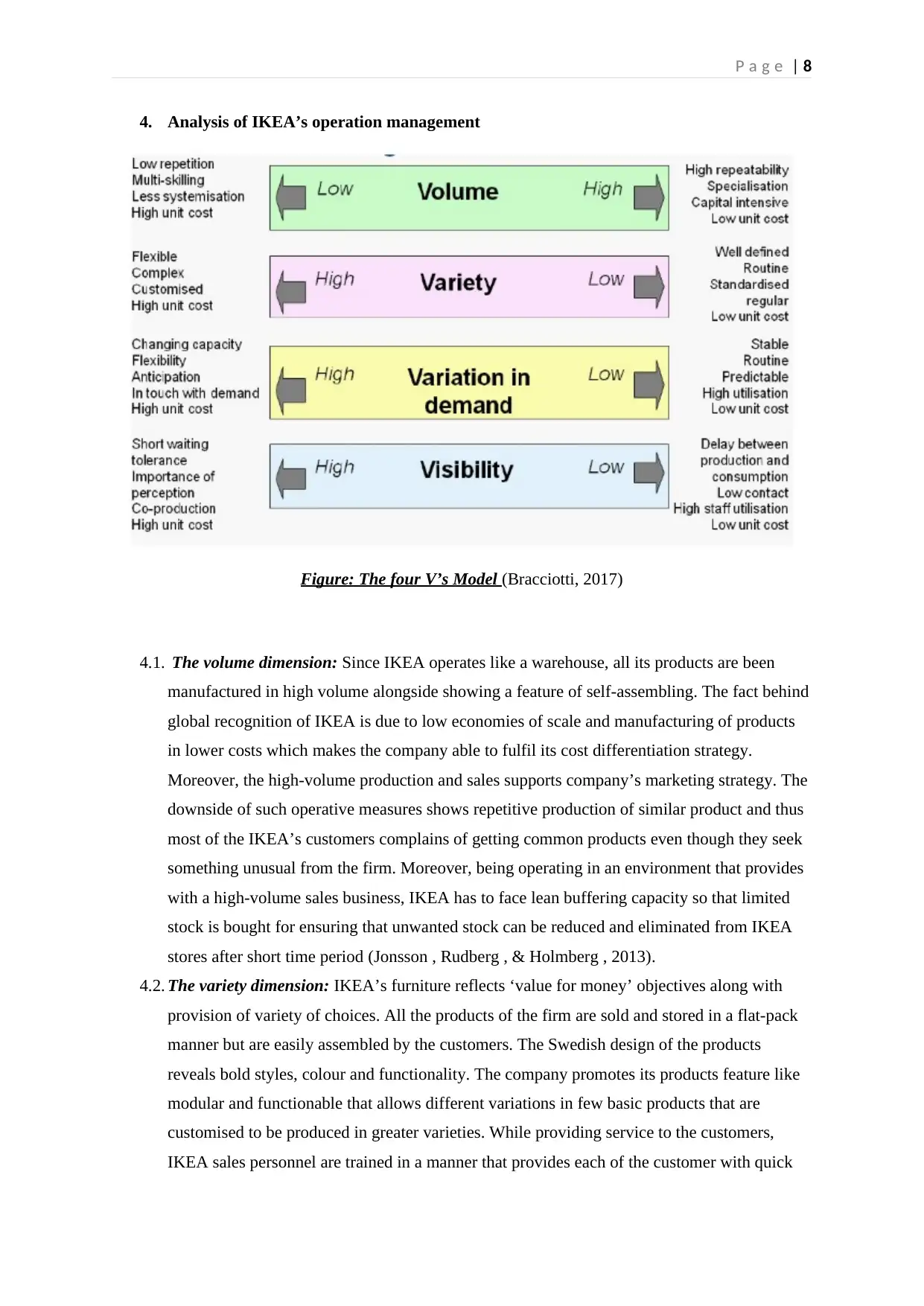
Figure: The four V’s Model (Bracciotti, 2017)
4.1. The volume dimension: Since IKEA operates like a warehouse, all its products are been
manufactured in high volume alongside showing a feature of self-assembling. The fact behind
global recognition of IKEA is due to low economies of scale and manufacturing of products
in lower costs which makes the company able to fulfil its cost differentiation strategy.
Moreover, the high-volume production and sales supports company’s marketing strategy. The
downside of such operative measures shows repetitive production of similar product and thus
most of the IKEA’s customers complains of getting common products even though they seek
something unusual from the firm. Moreover, being operating in an environment that provides
with a high-volume sales business, IKEA has to face lean buffering capacity so that limited
stock is bought for ensuring that unwanted stock can be reduced and eliminated from IKEA
stores after short time period (Jonsson , Rudberg , & Holmberg , 2013).
4.2. The variety dimension: IKEA’s furniture reflects ‘value for money’ objectives along with
provision of variety of choices. All the products of the firm are sold and stored in a flat-pack
manner but are easily assembled by the customers. The Swedish design of the products
reveals bold styles, colour and functionality. The company promotes its products feature like
modular and functionable that allows different variations in few basic products that are
customised to be produced in greater varieties. While providing service to the customers,
IKEA sales personnel are trained in a manner that provides each of the customer with quick
4. Analysis of IKEA’s operation management
Figure: The four V’s Model (Bracciotti, 2017)
4.1. The volume dimension: Since IKEA operates like a warehouse, all its products are been
manufactured in high volume alongside showing a feature of self-assembling. The fact behind
global recognition of IKEA is due to low economies of scale and manufacturing of products
in lower costs which makes the company able to fulfil its cost differentiation strategy.
Moreover, the high-volume production and sales supports company’s marketing strategy. The
downside of such operative measures shows repetitive production of similar product and thus
most of the IKEA’s customers complains of getting common products even though they seek
something unusual from the firm. Moreover, being operating in an environment that provides
with a high-volume sales business, IKEA has to face lean buffering capacity so that limited
stock is bought for ensuring that unwanted stock can be reduced and eliminated from IKEA
stores after short time period (Jonsson , Rudberg , & Holmberg , 2013).
4.2. The variety dimension: IKEA’s furniture reflects ‘value for money’ objectives along with
provision of variety of choices. All the products of the firm are sold and stored in a flat-pack
manner but are easily assembled by the customers. The Swedish design of the products
reveals bold styles, colour and functionality. The company promotes its products feature like
modular and functionable that allows different variations in few basic products that are
customised to be produced in greater varieties. While providing service to the customers,
IKEA sales personnel are trained in a manner that provides each of the customer with quick
⊘ This is a preview!⊘
Do you want full access?
Subscribe today to unlock all pages.
Trusted by 1+ million students worldwide
P a g e | 9
glance and suggestions along with providing them with flexibility to move around and pick
products as per requirements. This feature of IKEA’s operations process support firm’s sales
management strategy through which IKEA realises effective and hassle-free sales of its
products in the stores (Ko, n.d.).
4.3. Variation in demand: IKEA remains moderate in variable demand pattern though significant
factors like peak or off seasons does not influences the demand factors for its products.
However, other factors that may enable variation on product demand like stores located away
from metropolitan cities. This factor can make difficult to reach IKEA stores especially for
the ones who do not drive. IKEA’s location in suburban regions though supports other
strategies like cost effective way to access bigger space away from rivalry company store
areas that focuses more on metropolitan cities (Inter IKEA Systems B.V., 2017).
4.4. The visibility dimension: This factor ensures how operations strategy effects customer
experience or how operation is exposed in front of the customers. In IKEA’s case, although
the company follows self-assembling and self-picking strategies, it maintains high level of
communication with its customers. to enable facilitation while shopping, IKEA provides free
catalogues and shopping lists alongside assisting customers regarding latest designs and
illustrations for different products. Additionally, the operation management for the firm are
designed in such a way that provides its customers with family shopping experience through
provision of in-house restaurant and a special play area for children (Inter IKEA Systems
B.V., 2017).
5. Identified issues in IKEA’s operation management
Although IKEA’s corporate and business level strategies provides goods and services at
reasonable rates, providing in prices lower than expected may reduce company’s overall profitability.
In fact, in the market where customers demand for new and exclusive products of higher quality,
IKEA’s low-cost strategy may not work effectively. Concerning operations process, to prevent stock
from getting obsolete, IKEA orders only those products which remains low in their stock (Jonsson ,
Rudberg , & Holmberg , 2013). This lean buffering capacity may lead IKEA to encounter stock-outs
due to quick selling of popular items. The distribution seen in warehouse-products also seems to add
difficulty to maintain supply and demand especially for running items. Since IKEA believes in self
service approach, many customers face problems while selecting, picking, transporting and
assembling the furniture of their own. Since IKEA remains popular among family shoppers more, it
can expect by its customers to ensure personalised and better service options like development in
other service area of its restaurant concept. Nevertheless, value-added service can lead to cost
implementation for the company and such costs may be applied for accomplishing other necessary
resources like lower-priced goods or increasing brand image through marketing and advertising.
glance and suggestions along with providing them with flexibility to move around and pick
products as per requirements. This feature of IKEA’s operations process support firm’s sales
management strategy through which IKEA realises effective and hassle-free sales of its
products in the stores (Ko, n.d.).
4.3. Variation in demand: IKEA remains moderate in variable demand pattern though significant
factors like peak or off seasons does not influences the demand factors for its products.
However, other factors that may enable variation on product demand like stores located away
from metropolitan cities. This factor can make difficult to reach IKEA stores especially for
the ones who do not drive. IKEA’s location in suburban regions though supports other
strategies like cost effective way to access bigger space away from rivalry company store
areas that focuses more on metropolitan cities (Inter IKEA Systems B.V., 2017).
4.4. The visibility dimension: This factor ensures how operations strategy effects customer
experience or how operation is exposed in front of the customers. In IKEA’s case, although
the company follows self-assembling and self-picking strategies, it maintains high level of
communication with its customers. to enable facilitation while shopping, IKEA provides free
catalogues and shopping lists alongside assisting customers regarding latest designs and
illustrations for different products. Additionally, the operation management for the firm are
designed in such a way that provides its customers with family shopping experience through
provision of in-house restaurant and a special play area for children (Inter IKEA Systems
B.V., 2017).
5. Identified issues in IKEA’s operation management
Although IKEA’s corporate and business level strategies provides goods and services at
reasonable rates, providing in prices lower than expected may reduce company’s overall profitability.
In fact, in the market where customers demand for new and exclusive products of higher quality,
IKEA’s low-cost strategy may not work effectively. Concerning operations process, to prevent stock
from getting obsolete, IKEA orders only those products which remains low in their stock (Jonsson ,
Rudberg , & Holmberg , 2013). This lean buffering capacity may lead IKEA to encounter stock-outs
due to quick selling of popular items. The distribution seen in warehouse-products also seems to add
difficulty to maintain supply and demand especially for running items. Since IKEA believes in self
service approach, many customers face problems while selecting, picking, transporting and
assembling the furniture of their own. Since IKEA remains popular among family shoppers more, it
can expect by its customers to ensure personalised and better service options like development in
other service area of its restaurant concept. Nevertheless, value-added service can lead to cost
implementation for the company and such costs may be applied for accomplishing other necessary
resources like lower-priced goods or increasing brand image through marketing and advertising.
Paraphrase This Document
Need a fresh take? Get an instant paraphrase of this document with our AI Paraphraser
P a g e | 10
Furthermore, new competitors can easily emerge with similar operations objectives like IKEA for
offering low-prices goods and thus more advanced operation management can be recommended to the
firm for avoiding issues within its operation processes.
6. Proposed strategy
Since the above report identified few issues in IKEA’s operation process, it would
recommend improvement in its capacity measuring system that can potentially predict future
demands. Since operations in manufacturing and retail sector are considerably changing ways for
enabling successful inputs to outputs, using input-transformation-output process in case of IKEA can
assist in the company in maximising its operational values. Although every operation confirms being
generally based upon input-transformation-output model, it differs in the way products or services are
delivered by transforming its inputs into outputs. Therefore, input-transformation-output model can be
applied in IKEA’s case as this new model will achieve a balance between appropriate quantity of
outputs with delivery of goods through store inventory, thereby avoiding overstock or understock in
IKREA’s retail stores.
7. Required resources for implementing proposed strategy
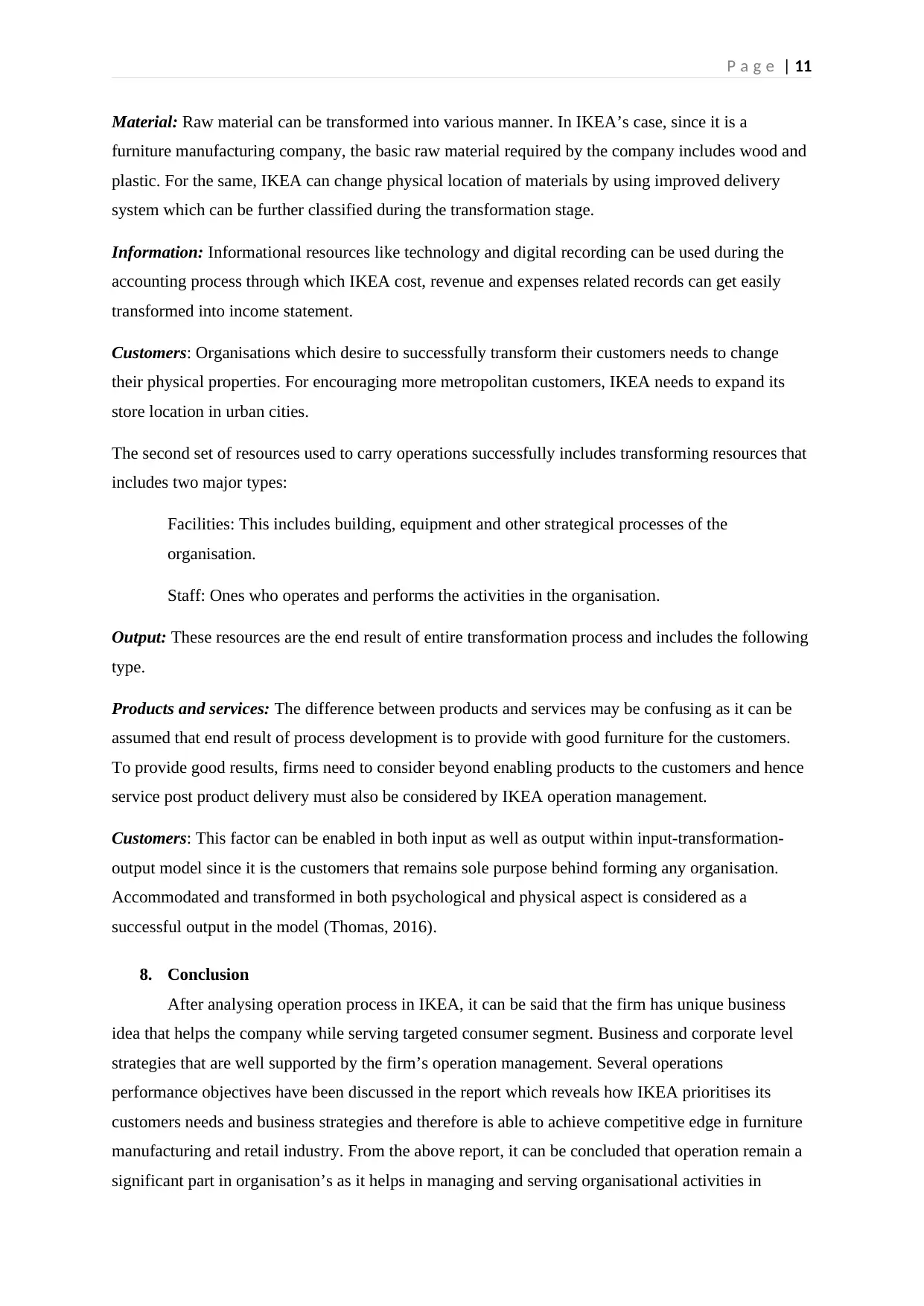
Figure: (Thomas, 2016)
Inputs: Transformed resources are considered as one set of inputs which can be converted during the
transformation stage into output. These includes the following resources:
Furthermore, new competitors can easily emerge with similar operations objectives like IKEA for
offering low-prices goods and thus more advanced operation management can be recommended to the
firm for avoiding issues within its operation processes.
6. Proposed strategy
Since the above report identified few issues in IKEA’s operation process, it would
recommend improvement in its capacity measuring system that can potentially predict future
demands. Since operations in manufacturing and retail sector are considerably changing ways for
enabling successful inputs to outputs, using input-transformation-output process in case of IKEA can
assist in the company in maximising its operational values. Although every operation confirms being
generally based upon input-transformation-output model, it differs in the way products or services are
delivered by transforming its inputs into outputs. Therefore, input-transformation-output model can be
applied in IKEA’s case as this new model will achieve a balance between appropriate quantity of
outputs with delivery of goods through store inventory, thereby avoiding overstock or understock in
IKREA’s retail stores.
7. Required resources for implementing proposed strategy
Figure: (Thomas, 2016)
Inputs: Transformed resources are considered as one set of inputs which can be converted during the
transformation stage into output. These includes the following resources:
P a g e | 11
Material: Raw material can be transformed into various manner. In IKEA’s case, since it is a
furniture manufacturing company, the basic raw material required by the company includes wood and
plastic. For the same, IKEA can change physical location of materials by using improved delivery
system which can be further classified during the transformation stage.
Information: Informational resources like technology and digital recording can be used during the
accounting process through which IKEA cost, revenue and expenses related records can get easily
transformed into income statement.
Customers: Organisations which desire to successfully transform their customers needs to change
their physical properties. For encouraging more metropolitan customers, IKEA needs to expand its
store location in urban cities.
The second set of resources used to carry operations successfully includes transforming resources that
includes two major types:
Facilities: This includes building, equipment and other strategical processes of the
organisation.
Staff: Ones who operates and performs the activities in the organisation.
Output: These resources are the end result of entire transformation process and includes the following
type.
Products and services: The difference between products and services may be confusing as it can be
assumed that end result of process development is to provide with good furniture for the customers.
To provide good results, firms need to consider beyond enabling products to the customers and hence
service post product delivery must also be considered by IKEA operation management.
Customers: This factor can be enabled in both input as well as output within input-transformation-
output model since it is the customers that remains sole purpose behind forming any organisation.
Accommodated and transformed in both psychological and physical aspect is considered as a
successful output in the model (Thomas, 2016).
8. Conclusion
After analysing operation process in IKEA, it can be said that the firm has unique business
idea that helps the company while serving targeted consumer segment. Business and corporate level
strategies that are well supported by the firm’s operation management. Several operations
performance objectives have been discussed in the report which reveals how IKEA prioritises its
customers needs and business strategies and therefore is able to achieve competitive edge in furniture
manufacturing and retail industry. From the above report, it can be concluded that operation remain a
significant part in organisation’s as it helps in managing and serving organisational activities in
Material: Raw material can be transformed into various manner. In IKEA’s case, since it is a
furniture manufacturing company, the basic raw material required by the company includes wood and
plastic. For the same, IKEA can change physical location of materials by using improved delivery
system which can be further classified during the transformation stage.
Information: Informational resources like technology and digital recording can be used during the
accounting process through which IKEA cost, revenue and expenses related records can get easily
transformed into income statement.
Customers: Organisations which desire to successfully transform their customers needs to change
their physical properties. For encouraging more metropolitan customers, IKEA needs to expand its
store location in urban cities.
The second set of resources used to carry operations successfully includes transforming resources that
includes two major types:
Facilities: This includes building, equipment and other strategical processes of the
organisation.
Staff: Ones who operates and performs the activities in the organisation.
Output: These resources are the end result of entire transformation process and includes the following
type.
Products and services: The difference between products and services may be confusing as it can be
assumed that end result of process development is to provide with good furniture for the customers.
To provide good results, firms need to consider beyond enabling products to the customers and hence
service post product delivery must also be considered by IKEA operation management.
Customers: This factor can be enabled in both input as well as output within input-transformation-
output model since it is the customers that remains sole purpose behind forming any organisation.
Accommodated and transformed in both psychological and physical aspect is considered as a
successful output in the model (Thomas, 2016).
8. Conclusion
After analysing operation process in IKEA, it can be said that the firm has unique business
idea that helps the company while serving targeted consumer segment. Business and corporate level
strategies that are well supported by the firm’s operation management. Several operations
performance objectives have been discussed in the report which reveals how IKEA prioritises its
customers needs and business strategies and therefore is able to achieve competitive edge in furniture
manufacturing and retail industry. From the above report, it can be concluded that operation remain a
significant part in organisation’s as it helps in managing and serving organisational activities in
⊘ This is a preview!⊘
Do you want full access?
Subscribe today to unlock all pages.
Trusted by 1+ million students worldwide

1 out of 15


Related Documents


Your All-in-One AI-Powered Toolkit for Academic Success.
+13062052269
info@desklib.com
Available 24*7 on WhatsApp / Email
![[object Object]](/_next/static/media/star-bottom.7253800d.svg)
Unlock your academic potential
Copyright © 2020–2026 A2Z Services. All Rights Reserved. Developed and managed by ZUCOL.