Report on Management and Operations at Levi Strauss & Co. Analysis
VerifiedAdded on 2021/01/02
|12
|3935
|202
Report
AI Summary
This report offers a comprehensive analysis of the management and operational strategies employed by Levi Strauss & Co. It begins by defining operations management and its significance within an organization, then provides an overview of the company. The report evaluates the roles and characteristics of both managers and leaders, highlighting their distinct responsibilities and contributions. It then examines how leadership roles and managerial functions are applied in various situational contexts within Levi Strauss & Co. including planning, coordinating, organizing and structuring. The report also investigates different leadership theories, such as situational, system, and contingency theories, and their practical applications. Furthermore, the report delves into the methods of operational management, including Just-in-Time, Total Quality Management, Six Sigma, and Lean Production, and their impact on achieving business objectives. The report concludes by assessing the factors that influence operational management and decision-making at Levi Strauss & Co. The report provides a thorough examination of the company's management and operations and their impacts on success.
MANAGEMENT AND
OPERATIONS
OPERATIONS

Paraphrase This Document
Need a fresh take? Get an instant paraphrase of this document with our AI Paraphraser
Table of Contents
INTRODUCTION...........................................................................................................................1
TASK 1............................................................................................................................................1
P1 Roles and characteristics of manager and leader...................................................................1
TASK 2............................................................................................................................................3
P2 Leaders roles and manager functions apply in various situational context...........................3
P3 Different theories and leadership models..............................................................................5
TASK 3............................................................................................................................................5
P4 Methods of operational management and roles of managers and leaders .............................5
P5 Value and importance of operations management in meeting business objectives...............7
TASK 4............................................................................................................................................9
P6 Factors that influence on operational management and decision making.............................9
CONCLUSION................................................................................................................................9
REFERENCES..............................................................................................................................10
INTRODUCTION...........................................................................................................................1
TASK 1............................................................................................................................................1
P1 Roles and characteristics of manager and leader...................................................................1
TASK 2............................................................................................................................................3
P2 Leaders roles and manager functions apply in various situational context...........................3
P3 Different theories and leadership models..............................................................................5
TASK 3............................................................................................................................................5
P4 Methods of operational management and roles of managers and leaders .............................5
P5 Value and importance of operations management in meeting business objectives...............7
TASK 4............................................................................................................................................9
P6 Factors that influence on operational management and decision making.............................9
CONCLUSION................................................................................................................................9
REFERENCES..............................................................................................................................10
INTRODUCTION
Operations management is defined as a paramount part of an company. It is a set of
activities which convert desired inputs to outputs. It aid in making firms value and assist buyers.
Management of operations explain several functions of operations which are homogeneous traits
such as producing, controlling, organising, location, layouts and techniques of operations which
are related with enterprise techniques (Bahmani-Firouzi and Azizipanah-Abarghooee, 2014). In
this report selected organisation is Levi Strauss & CO. is a clothing industry. It was founded in
1st May, 1853 by Levi Strauss. They give employment approx 15,000 employees in 2013.
Various numbers of locations of organisation operated stores are 2,800. In this assignment will
evaluate roles and functions of manager as well as leaders also. In this, various methods and
leadership theories are investigated in the term of business along with that also discuss the
importance as well as value of operations management in meeting enterprise objectives.
TASK 1
P1 Roles and characteristics of manager and leader
Management operations is defined as a manufacturing, planning, layouts, organising and
supervising various processes as well as functions for achieving determined results as well as
changes in business activities for profits increment.
Leader
It is define as those entities who are having skills, vision and power of persuading as well
as directing employees for achieving goals and aims. They also motivate employees by
leadership as well as communication skills in their business (DeAnna and et. al., 2010). Initial
team purpose is to head operations for meeting the set missions efficiency as well as productivity
which aid in raising in a proper way.
Characteristics of Leader Honest: Another leadership traits is honesty as well as credibility as a whole group is
liable over leader. If leaders more concern about their choices and advantages of
employees will be a very effective leader. Ability to communicate: If leaders are able to describe their ideas to their team it will aid
in creating a sense of ease as well as understand their employees. If each team member
will focus on meeting targets then they can effectively accomplish their goals.
1
Operations management is defined as a paramount part of an company. It is a set of
activities which convert desired inputs to outputs. It aid in making firms value and assist buyers.
Management of operations explain several functions of operations which are homogeneous traits
such as producing, controlling, organising, location, layouts and techniques of operations which
are related with enterprise techniques (Bahmani-Firouzi and Azizipanah-Abarghooee, 2014). In
this report selected organisation is Levi Strauss & CO. is a clothing industry. It was founded in
1st May, 1853 by Levi Strauss. They give employment approx 15,000 employees in 2013.
Various numbers of locations of organisation operated stores are 2,800. In this assignment will
evaluate roles and functions of manager as well as leaders also. In this, various methods and
leadership theories are investigated in the term of business along with that also discuss the
importance as well as value of operations management in meeting enterprise objectives.
TASK 1
P1 Roles and characteristics of manager and leader
Management operations is defined as a manufacturing, planning, layouts, organising and
supervising various processes as well as functions for achieving determined results as well as
changes in business activities for profits increment.
Leader
It is define as those entities who are having skills, vision and power of persuading as well
as directing employees for achieving goals and aims. They also motivate employees by
leadership as well as communication skills in their business (DeAnna and et. al., 2010). Initial
team purpose is to head operations for meeting the set missions efficiency as well as productivity
which aid in raising in a proper way.
Characteristics of Leader Honest: Another leadership traits is honesty as well as credibility as a whole group is
liable over leader. If leaders more concern about their choices and advantages of
employees will be a very effective leader. Ability to communicate: If leaders are able to describe their ideas to their team it will aid
in creating a sense of ease as well as understand their employees. If each team member
will focus on meeting targets then they can effectively accomplish their goals.
1
⊘ This is a preview!⊘
Do you want full access?
Subscribe today to unlock all pages.

Trusted by 1+ million students worldwide
Delegation of power: Every member within group have something different and leader
should work with every employees weaknesses and strength for bringing out best within
all members of team.
Role of leader Needed at all levels: It is required at each level of management within the organisations.
Leaders can be exercised by counselling as well as guidance of their employees at a time
of applying plans. Representative of company: Leaders role is to interact the rational of business to outside
persons or public (Eyal, P.O.S.T and Haim, Clarizen Ltd., 2014). He is a representative of
own division leaders id leading. He solicits support: Leader is who invites support, entertains and co-operations of
employees. It can be done by his experience, maturity, intelligence and personality which
give him positive outcomes.
Manager
It refers to particular person of an company who is able to design as well as manage work
in a same direction for predetermine the targets as well as objectives of organisation to meet their
set vision. Employees are allotted work of firms on various levels so that organisation should
prefer, whole task properly. Besides this, manager of firms are concerned for workers
performance appraisal. Organisation manager is responsible for presentation of employees in
meeting goals and objectives. Some of functions are carried out within a given period of time.
Characteristics of Manager Goal oriented: It is a very important characteristics which lead whole employees for
achieving aims and objectives. They conduct different activities or operations for meeting
enterprise objectives. Persuasive: Manager are much persuasive within nature for the aim of leading whole
employees for achieving some goals within a given period of time (Hammill and Tanner,
2011). Patience: It is an one important traits of manager as they have to be much patient for
monitoring as well as controlling the functions according to their needs. Multidimensional process: They sometimes versatile their personality for enabling in
managing activities and operations, people and work of company.
2
should work with every employees weaknesses and strength for bringing out best within
all members of team.
Role of leader Needed at all levels: It is required at each level of management within the organisations.
Leaders can be exercised by counselling as well as guidance of their employees at a time
of applying plans. Representative of company: Leaders role is to interact the rational of business to outside
persons or public (Eyal, P.O.S.T and Haim, Clarizen Ltd., 2014). He is a representative of
own division leaders id leading. He solicits support: Leader is who invites support, entertains and co-operations of
employees. It can be done by his experience, maturity, intelligence and personality which
give him positive outcomes.
Manager
It refers to particular person of an company who is able to design as well as manage work
in a same direction for predetermine the targets as well as objectives of organisation to meet their
set vision. Employees are allotted work of firms on various levels so that organisation should
prefer, whole task properly. Besides this, manager of firms are concerned for workers
performance appraisal. Organisation manager is responsible for presentation of employees in
meeting goals and objectives. Some of functions are carried out within a given period of time.
Characteristics of Manager Goal oriented: It is a very important characteristics which lead whole employees for
achieving aims and objectives. They conduct different activities or operations for meeting
enterprise objectives. Persuasive: Manager are much persuasive within nature for the aim of leading whole
employees for achieving some goals within a given period of time (Hammill and Tanner,
2011). Patience: It is an one important traits of manager as they have to be much patient for
monitoring as well as controlling the functions according to their needs. Multidimensional process: They sometimes versatile their personality for enabling in
managing activities and operations, people and work of company.
2
Paraphrase This Document
Need a fresh take? Get an instant paraphrase of this document with our AI Paraphraser
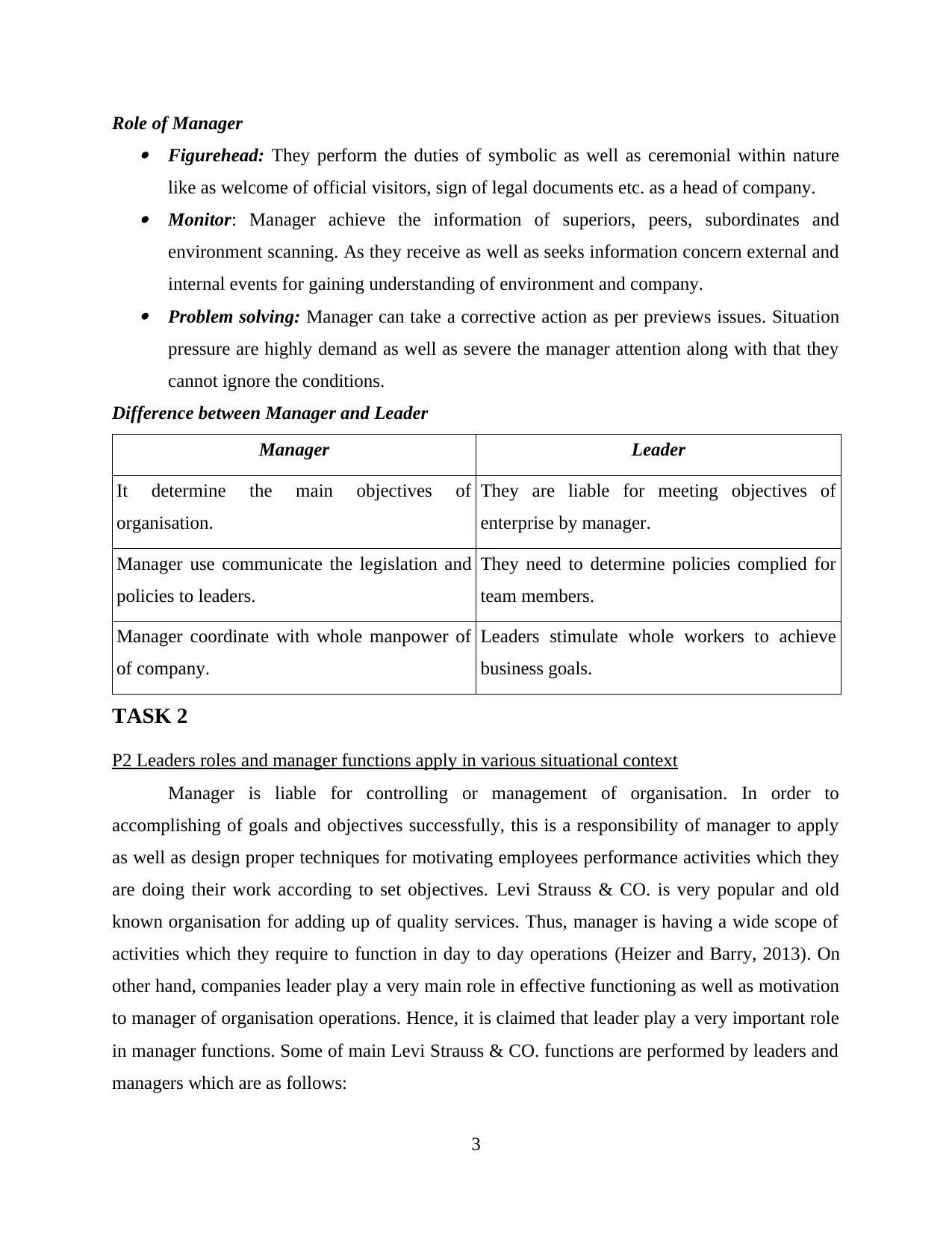
Role of Manager Figurehead: They perform the duties of symbolic as well as ceremonial within nature
like as welcome of official visitors, sign of legal documents etc. as a head of company. Monitor: Manager achieve the information of superiors, peers, subordinates and
environment scanning. As they receive as well as seeks information concern external and
internal events for gaining understanding of environment and company. Problem solving: Manager can take a corrective action as per previews issues. Situation
pressure are highly demand as well as severe the manager attention along with that they
cannot ignore the conditions.
Difference between Manager and Leader
Manager Leader
It determine the main objectives of
organisation.
They are liable for meeting objectives of
enterprise by manager.
Manager use communicate the legislation and
policies to leaders.
They need to determine policies complied for
team members.
Manager coordinate with whole manpower of
of company.
Leaders stimulate whole workers to achieve
business goals.
TASK 2
P2 Leaders roles and manager functions apply in various situational context
Manager is liable for controlling or management of organisation. In order to
accomplishing of goals and objectives successfully, this is a responsibility of manager to apply
as well as design proper techniques for motivating employees performance activities which they
are doing their work according to set objectives. Levi Strauss & CO. is very popular and old
known organisation for adding up of quality services. Thus, manager is having a wide scope of
activities which they require to function in day to day operations (Heizer and Barry, 2013). On
other hand, companies leader play a very main role in effective functioning as well as motivation
to manager of organisation operations. Hence, it is claimed that leader play a very important role
in manager functions. Some of main Levi Strauss & CO. functions are performed by leaders and
managers which are as follows:
3
like as welcome of official visitors, sign of legal documents etc. as a head of company. Monitor: Manager achieve the information of superiors, peers, subordinates and
environment scanning. As they receive as well as seeks information concern external and
internal events for gaining understanding of environment and company. Problem solving: Manager can take a corrective action as per previews issues. Situation
pressure are highly demand as well as severe the manager attention along with that they
cannot ignore the conditions.
Difference between Manager and Leader
Manager Leader
It determine the main objectives of
organisation.
They are liable for meeting objectives of
enterprise by manager.
Manager use communicate the legislation and
policies to leaders.
They need to determine policies complied for
team members.
Manager coordinate with whole manpower of
of company.
Leaders stimulate whole workers to achieve
business goals.
TASK 2
P2 Leaders roles and manager functions apply in various situational context
Manager is liable for controlling or management of organisation. In order to
accomplishing of goals and objectives successfully, this is a responsibility of manager to apply
as well as design proper techniques for motivating employees performance activities which they
are doing their work according to set objectives. Levi Strauss & CO. is very popular and old
known organisation for adding up of quality services. Thus, manager is having a wide scope of
activities which they require to function in day to day operations (Heizer and Barry, 2013). On
other hand, companies leader play a very main role in effective functioning as well as motivation
to manager of organisation operations. Hence, it is claimed that leader play a very important role
in manager functions. Some of main Levi Strauss & CO. functions are performed by leaders and
managers which are as follows:
3
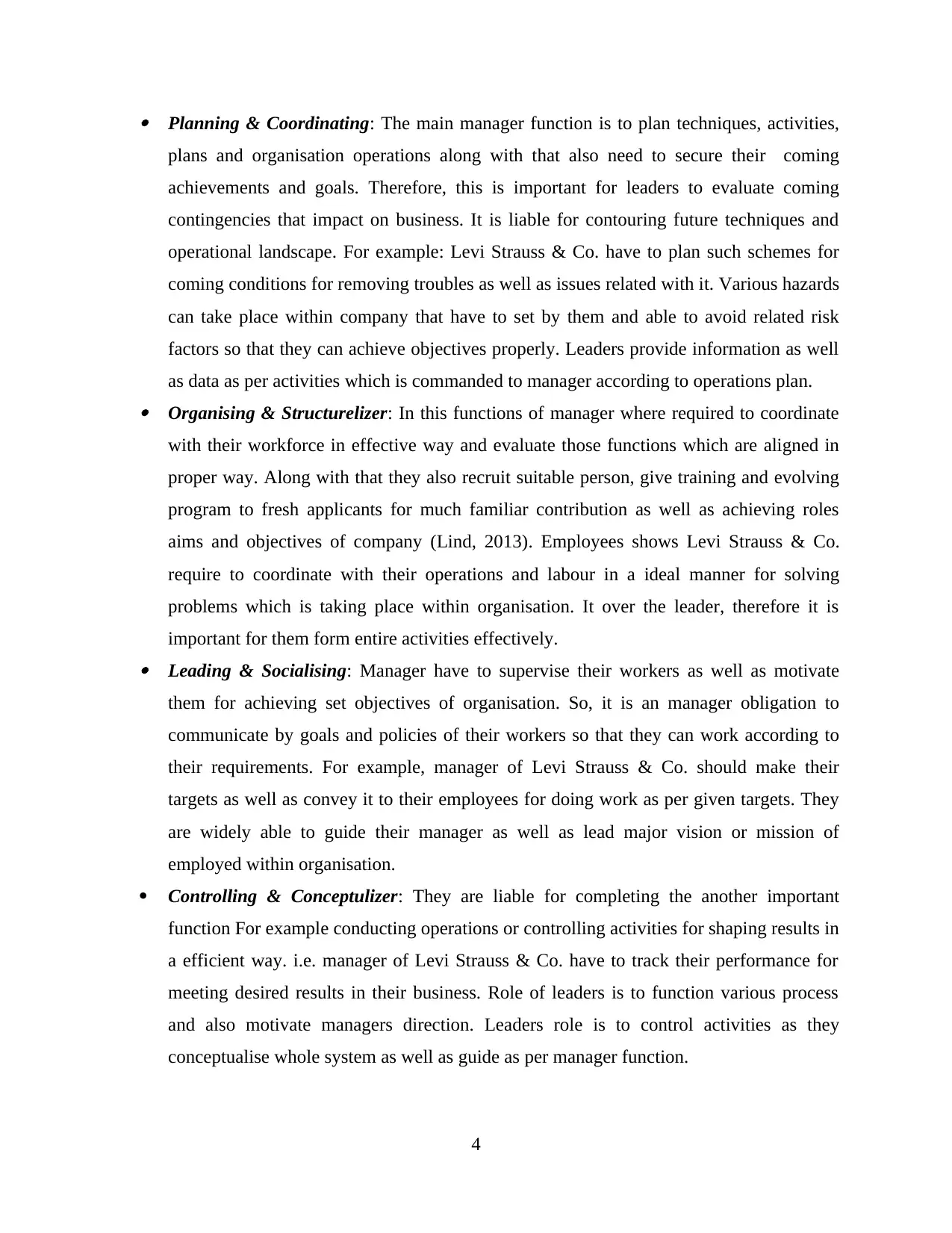
Planning & Coordinating: The main manager function is to plan techniques, activities,
plans and organisation operations along with that also need to secure their coming
achievements and goals. Therefore, this is important for leaders to evaluate coming
contingencies that impact on business. It is liable for contouring future techniques and
operational landscape. For example: Levi Strauss & Co. have to plan such schemes for
coming conditions for removing troubles as well as issues related with it. Various hazards
can take place within company that have to set by them and able to avoid related risk
factors so that they can achieve objectives properly. Leaders provide information as well
as data as per activities which is commanded to manager according to operations plan. Organising & Structurelizer: In this functions of manager where required to coordinate
with their workforce in effective way and evaluate those functions which are aligned in
proper way. Along with that they also recruit suitable person, give training and evolving
program to fresh applicants for much familiar contribution as well as achieving roles
aims and objectives of company (Lind, 2013). Employees shows Levi Strauss & Co.
require to coordinate with their operations and labour in a ideal manner for solving
problems which is taking place within organisation. It over the leader, therefore it is
important for them form entire activities effectively. Leading & Socialising: Manager have to supervise their workers as well as motivate
them for achieving set objectives of organisation. So, it is an manager obligation to
communicate by goals and policies of their workers so that they can work according to
their requirements. For example, manager of Levi Strauss & Co. should make their
targets as well as convey it to their employees for doing work as per given targets. They
are widely able to guide their manager as well as lead major vision or mission of
employed within organisation.
Controlling & Conceptulizer: They are liable for completing the another important
function For example conducting operations or controlling activities for shaping results in
a efficient way. i.e. manager of Levi Strauss & Co. have to track their performance for
meeting desired results in their business. Role of leaders is to function various process
and also motivate managers direction. Leaders role is to control activities as they
conceptualise whole system as well as guide as per manager function.
4
plans and organisation operations along with that also need to secure their coming
achievements and goals. Therefore, this is important for leaders to evaluate coming
contingencies that impact on business. It is liable for contouring future techniques and
operational landscape. For example: Levi Strauss & Co. have to plan such schemes for
coming conditions for removing troubles as well as issues related with it. Various hazards
can take place within company that have to set by them and able to avoid related risk
factors so that they can achieve objectives properly. Leaders provide information as well
as data as per activities which is commanded to manager according to operations plan. Organising & Structurelizer: In this functions of manager where required to coordinate
with their workforce in effective way and evaluate those functions which are aligned in
proper way. Along with that they also recruit suitable person, give training and evolving
program to fresh applicants for much familiar contribution as well as achieving roles
aims and objectives of company (Lind, 2013). Employees shows Levi Strauss & Co.
require to coordinate with their operations and labour in a ideal manner for solving
problems which is taking place within organisation. It over the leader, therefore it is
important for them form entire activities effectively. Leading & Socialising: Manager have to supervise their workers as well as motivate
them for achieving set objectives of organisation. So, it is an manager obligation to
communicate by goals and policies of their workers so that they can work according to
their requirements. For example, manager of Levi Strauss & Co. should make their
targets as well as convey it to their employees for doing work as per given targets. They
are widely able to guide their manager as well as lead major vision or mission of
employed within organisation.
Controlling & Conceptulizer: They are liable for completing the another important
function For example conducting operations or controlling activities for shaping results in
a efficient way. i.e. manager of Levi Strauss & Co. have to track their performance for
meeting desired results in their business. Role of leaders is to function various process
and also motivate managers direction. Leaders role is to control activities as they
conceptualise whole system as well as guide as per manager function.
4
⊘ This is a preview!⊘
Do you want full access?
Subscribe today to unlock all pages.
Trusted by 1+ million students worldwide
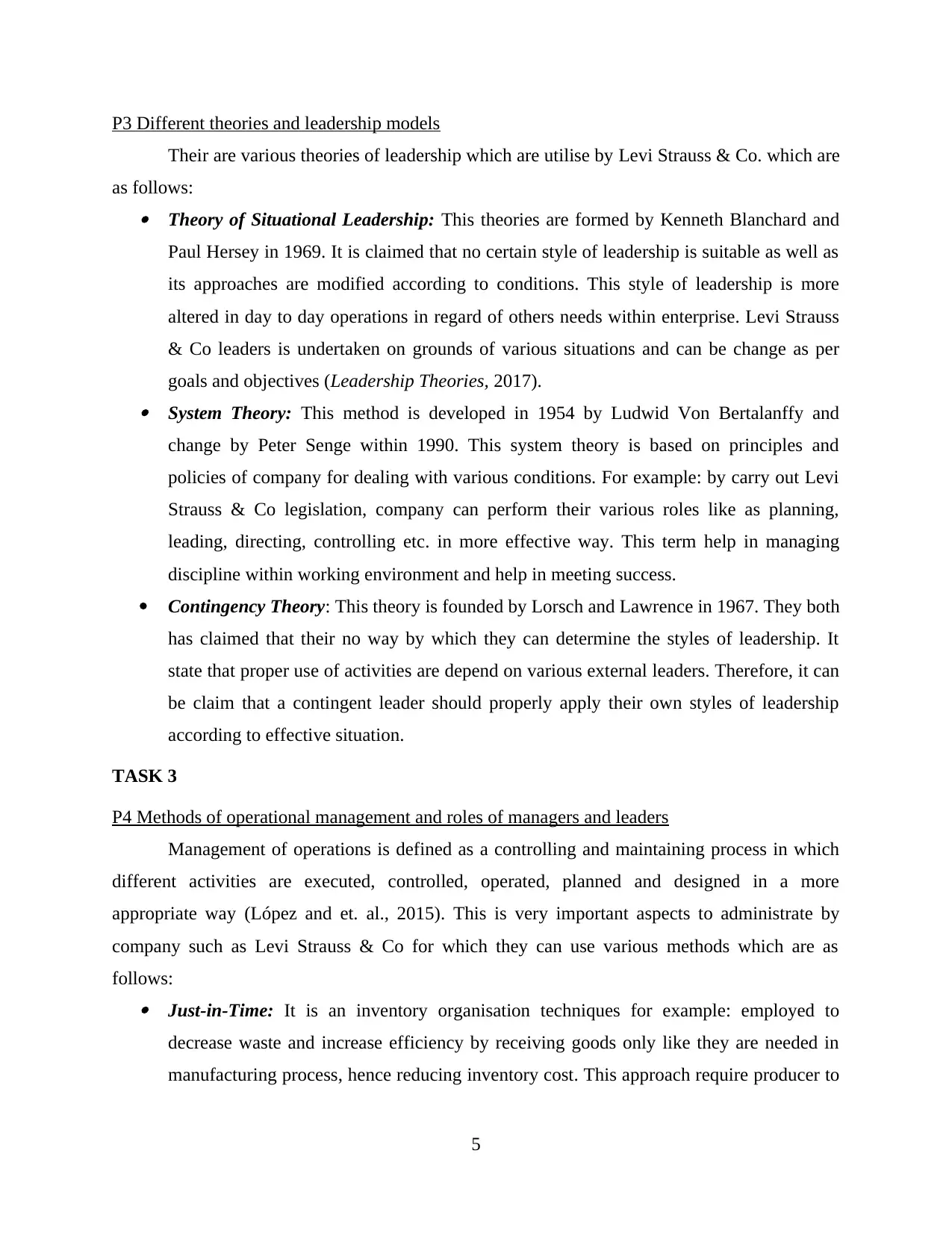
P3 Different theories and leadership models
Their are various theories of leadership which are utilise by Levi Strauss & Co. which are
as follows: Theory of Situational Leadership: This theories are formed by Kenneth Blanchard and
Paul Hersey in 1969. It is claimed that no certain style of leadership is suitable as well as
its approaches are modified according to conditions. This style of leadership is more
altered in day to day operations in regard of others needs within enterprise. Levi Strauss
& Co leaders is undertaken on grounds of various situations and can be change as per
goals and objectives (Leadership Theories, 2017). System Theory: This method is developed in 1954 by Ludwid Von Bertalanffy and
change by Peter Senge within 1990. This system theory is based on principles and
policies of company for dealing with various conditions. For example: by carry out Levi
Strauss & Co legislation, company can perform their various roles like as planning,
leading, directing, controlling etc. in more effective way. This term help in managing
discipline within working environment and help in meeting success.
Contingency Theory: This theory is founded by Lorsch and Lawrence in 1967. They both
has claimed that their no way by which they can determine the styles of leadership. It
state that proper use of activities are depend on various external leaders. Therefore, it can
be claim that a contingent leader should properly apply their own styles of leadership
according to effective situation.
TASK 3
P4 Methods of operational management and roles of managers and leaders
Management of operations is defined as a controlling and maintaining process in which
different activities are executed, controlled, operated, planned and designed in a more
appropriate way (López and et. al., 2015). This is very important aspects to administrate by
company such as Levi Strauss & Co for which they can use various methods which are as
follows: Just-in-Time: It is an inventory organisation techniques for example: employed to
decrease waste and increase efficiency by receiving goods only like they are needed in
manufacturing process, hence reducing inventory cost. This approach require producer to
5
Their are various theories of leadership which are utilise by Levi Strauss & Co. which are
as follows: Theory of Situational Leadership: This theories are formed by Kenneth Blanchard and
Paul Hersey in 1969. It is claimed that no certain style of leadership is suitable as well as
its approaches are modified according to conditions. This style of leadership is more
altered in day to day operations in regard of others needs within enterprise. Levi Strauss
& Co leaders is undertaken on grounds of various situations and can be change as per
goals and objectives (Leadership Theories, 2017). System Theory: This method is developed in 1954 by Ludwid Von Bertalanffy and
change by Peter Senge within 1990. This system theory is based on principles and
policies of company for dealing with various conditions. For example: by carry out Levi
Strauss & Co legislation, company can perform their various roles like as planning,
leading, directing, controlling etc. in more effective way. This term help in managing
discipline within working environment and help in meeting success.
Contingency Theory: This theory is founded by Lorsch and Lawrence in 1967. They both
has claimed that their no way by which they can determine the styles of leadership. It
state that proper use of activities are depend on various external leaders. Therefore, it can
be claim that a contingent leader should properly apply their own styles of leadership
according to effective situation.
TASK 3
P4 Methods of operational management and roles of managers and leaders
Management of operations is defined as a controlling and maintaining process in which
different activities are executed, controlled, operated, planned and designed in a more
appropriate way (López and et. al., 2015). This is very important aspects to administrate by
company such as Levi Strauss & Co for which they can use various methods which are as
follows: Just-in-Time: It is an inventory organisation techniques for example: employed to
decrease waste and increase efficiency by receiving goods only like they are needed in
manufacturing process, hence reducing inventory cost. This approach require producer to
5
Paraphrase This Document
Need a fresh take? Get an instant paraphrase of this document with our AI Paraphraser
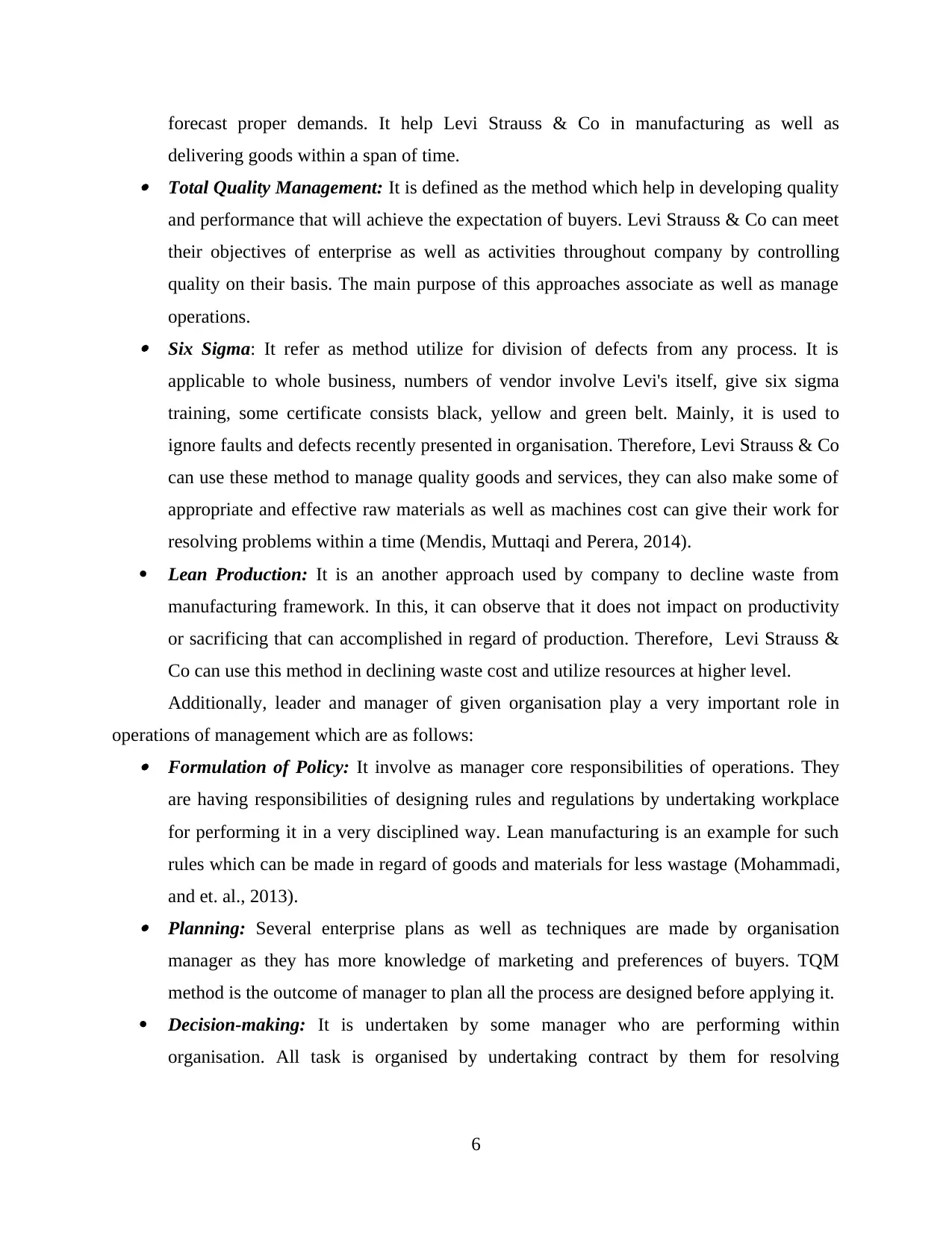
forecast proper demands. It help Levi Strauss & Co in manufacturing as well as
delivering goods within a span of time. Total Quality Management: It is defined as the method which help in developing quality
and performance that will achieve the expectation of buyers. Levi Strauss & Co can meet
their objectives of enterprise as well as activities throughout company by controlling
quality on their basis. The main purpose of this approaches associate as well as manage
operations. Six Sigma: It refer as method utilize for division of defects from any process. It is
applicable to whole business, numbers of vendor involve Levi's itself, give six sigma
training, some certificate consists black, yellow and green belt. Mainly, it is used to
ignore faults and defects recently presented in organisation. Therefore, Levi Strauss & Co
can use these method to manage quality goods and services, they can also make some of
appropriate and effective raw materials as well as machines cost can give their work for
resolving problems within a time (Mendis, Muttaqi and Perera, 2014).
Lean Production: It is an another approach used by company to decline waste from
manufacturing framework. In this, it can observe that it does not impact on productivity
or sacrificing that can accomplished in regard of production. Therefore, Levi Strauss &
Co can use this method in declining waste cost and utilize resources at higher level.
Additionally, leader and manager of given organisation play a very important role in
operations of management which are as follows: Formulation of Policy: It involve as manager core responsibilities of operations. They
are having responsibilities of designing rules and regulations by undertaking workplace
for performing it in a very disciplined way. Lean manufacturing is an example for such
rules which can be made in regard of goods and materials for less wastage (Mohammadi,
and et. al., 2013). Planning: Several enterprise plans as well as techniques are made by organisation
manager as they has more knowledge of marketing and preferences of buyers. TQM
method is the outcome of manager to plan all the process are designed before applying it.
Decision-making: It is undertaken by some manager who are performing within
organisation. All task is organised by undertaking contract by them for resolving
6
delivering goods within a span of time. Total Quality Management: It is defined as the method which help in developing quality
and performance that will achieve the expectation of buyers. Levi Strauss & Co can meet
their objectives of enterprise as well as activities throughout company by controlling
quality on their basis. The main purpose of this approaches associate as well as manage
operations. Six Sigma: It refer as method utilize for division of defects from any process. It is
applicable to whole business, numbers of vendor involve Levi's itself, give six sigma
training, some certificate consists black, yellow and green belt. Mainly, it is used to
ignore faults and defects recently presented in organisation. Therefore, Levi Strauss & Co
can use these method to manage quality goods and services, they can also make some of
appropriate and effective raw materials as well as machines cost can give their work for
resolving problems within a time (Mendis, Muttaqi and Perera, 2014).
Lean Production: It is an another approach used by company to decline waste from
manufacturing framework. In this, it can observe that it does not impact on productivity
or sacrificing that can accomplished in regard of production. Therefore, Levi Strauss &
Co can use this method in declining waste cost and utilize resources at higher level.
Additionally, leader and manager of given organisation play a very important role in
operations of management which are as follows: Formulation of Policy: It involve as manager core responsibilities of operations. They
are having responsibilities of designing rules and regulations by undertaking workplace
for performing it in a very disciplined way. Lean manufacturing is an example for such
rules which can be made in regard of goods and materials for less wastage (Mohammadi,
and et. al., 2013). Planning: Several enterprise plans as well as techniques are made by organisation
manager as they has more knowledge of marketing and preferences of buyers. TQM
method is the outcome of manager to plan all the process are designed before applying it.
Decision-making: It is undertaken by some manager who are performing within
organisation. All task is organised by undertaking contract by them for resolving
6
problems by particular person. Decisions which are made by six sigma which require to
be made by manager or leader only.
Therefore, it is claimed that Levi Strauss & Co can use all the above methods like as
TQM, six sigma, lean manufacturing etc. This method are used for managing quality by reducing
waste within a large numbers of employees.
P5 Value and importance of operations management in meeting business objectives
Management operations is a process which include managing, controlling, organising,
supervising and planning the process of production. It aid in gaining knowledge in-depth in
regard of manager operation. These functions purpose over products and services is producing
process within organisation which is necessary as others activities. Their are various Levi Strauss
& Co objectives which is determine by their management. In term of meeting those components,
organisation requirement of the process of management operations. Some of main objectives are
given below: Survival: Levi Strauss & Co require to survive within competitive market by full of
strong competitors. This can be analysed that various company are emerging which give
similar goods and services. Therefore, company desire to protect position within market
as well as remain famous within potential customers. Increasing Sales: It involve others objectives as per which can raise the entire turnover
of organisation. Firms forecast their techniques that can help in achieving targetted sales
(Nakayama and Bucks Eds., 2012). Maximising Benefits:Main concentrate of this business is to raise the amount of profit
for expanding different enterprise activities.
Satisfying Consumer: It consist as other venture objectives which refer to buyers needs
as well as accomplish demand. Levi Strauss & Co mainly concentrating over motivating
of buyers as well as full fill their needs in an effective manner.
Therefore, there is high value of managing operations for performing the above
objectives within company. It aid in meeting main functions of organisation which are given
below: Planning: It is an main design of every components in advance for accomplishing or
meet them within a span of time. Whole purpose is designed by manager of organisation
who is organising the respected enterprise operations. Initial planning as well as most
7
be made by manager or leader only.
Therefore, it is claimed that Levi Strauss & Co can use all the above methods like as
TQM, six sigma, lean manufacturing etc. This method are used for managing quality by reducing
waste within a large numbers of employees.
P5 Value and importance of operations management in meeting business objectives
Management operations is a process which include managing, controlling, organising,
supervising and planning the process of production. It aid in gaining knowledge in-depth in
regard of manager operation. These functions purpose over products and services is producing
process within organisation which is necessary as others activities. Their are various Levi Strauss
& Co objectives which is determine by their management. In term of meeting those components,
organisation requirement of the process of management operations. Some of main objectives are
given below: Survival: Levi Strauss & Co require to survive within competitive market by full of
strong competitors. This can be analysed that various company are emerging which give
similar goods and services. Therefore, company desire to protect position within market
as well as remain famous within potential customers. Increasing Sales: It involve others objectives as per which can raise the entire turnover
of organisation. Firms forecast their techniques that can help in achieving targetted sales
(Nakayama and Bucks Eds., 2012). Maximising Benefits:Main concentrate of this business is to raise the amount of profit
for expanding different enterprise activities.
Satisfying Consumer: It consist as other venture objectives which refer to buyers needs
as well as accomplish demand. Levi Strauss & Co mainly concentrating over motivating
of buyers as well as full fill their needs in an effective manner.
Therefore, there is high value of managing operations for performing the above
objectives within company. It aid in meeting main functions of organisation which are given
below: Planning: It is an main design of every components in advance for accomplishing or
meet them within a span of time. Whole purpose is designed by manager of organisation
who is organising the respected enterprise operations. Initial planning as well as most
7
⊘ This is a preview!⊘
Do you want full access?
Subscribe today to unlock all pages.
Trusted by 1+ million students worldwide
indispensable activities of organisation that aid in achieving whole designed activities
within span of time. Organising: In this manager functions aid in converting the finished good materials.
Whole process can be listed in effective way so that organisation can perform their
functions in significant style. Employees coordinate according to work activities or
quality. The entire activity can help in creating higher enterprise sustainability withour
effective arrangement as well as fruitful result. Controlling: It is an fundamental for employees to measure for ignoring policies by
organisations. Levi Strauss & Co can measure the applying activities. Additionally,
leader have to manage of measure whole members of team work by ignoring faults. It
lead all over incremental of sales as well as increase the quality of goods and services. Coordinating: Manager and leader can aid whole groups in achieving their aims and
objectives within organisation. They can motivate workers in providing better
performance and help in meeting training and development. By this way, company
determine more branches numbers in other places and turn enterprise explosion if
possible (Neck and Manz, 2010). Model: Some of leadership approaches are represented which require to complied by
Levi Strauss & Co such as situational, contingency and system leadership. Whole
functions help in surviving company as efficient leadership help in best creation of
product quality.
Behaviour: It is important to maintain good elations with employees as it help in
increasing productivity of Levi Strauss & Co. If employees keep their behaviour good
within groups then it will get more inspired for working effectively. If company is not
able to manage a healthy behaviour within working environment, it may lost their work
interest.
Therefore, it is stated that different purpose of Levi Strauss & Co and can help in
achieving by various functions of operational management. It is more important for performing
main activities such as planning, organising, coordinating, controlling etc.
8
within span of time. Organising: In this manager functions aid in converting the finished good materials.
Whole process can be listed in effective way so that organisation can perform their
functions in significant style. Employees coordinate according to work activities or
quality. The entire activity can help in creating higher enterprise sustainability withour
effective arrangement as well as fruitful result. Controlling: It is an fundamental for employees to measure for ignoring policies by
organisations. Levi Strauss & Co can measure the applying activities. Additionally,
leader have to manage of measure whole members of team work by ignoring faults. It
lead all over incremental of sales as well as increase the quality of goods and services. Coordinating: Manager and leader can aid whole groups in achieving their aims and
objectives within organisation. They can motivate workers in providing better
performance and help in meeting training and development. By this way, company
determine more branches numbers in other places and turn enterprise explosion if
possible (Neck and Manz, 2010). Model: Some of leadership approaches are represented which require to complied by
Levi Strauss & Co such as situational, contingency and system leadership. Whole
functions help in surviving company as efficient leadership help in best creation of
product quality.
Behaviour: It is important to maintain good elations with employees as it help in
increasing productivity of Levi Strauss & Co. If employees keep their behaviour good
within groups then it will get more inspired for working effectively. If company is not
able to manage a healthy behaviour within working environment, it may lost their work
interest.
Therefore, it is stated that different purpose of Levi Strauss & Co and can help in
achieving by various functions of operational management. It is more important for performing
main activities such as planning, organising, coordinating, controlling etc.
8
Paraphrase This Document
Need a fresh take? Get an instant paraphrase of this document with our AI Paraphraser
TASK 4
P6 Factors that influence on operational management and decision making
It refer to management and planning different activities for directing organisation in such
direction. Their are different components which require to impact on making decision and
manager and leader of operation management are given below: Sustainability: It is an other component which require to undertake before involving any
judgement in regard of manufacturing goods. Therefore, they have to decline the amount
of wastage which is produce by Levi Strauss & Co. Stakeholder: It is an particular person involve within company. They can also impact on
activities of enterprise. It is important for employees of Levi Strauss & Co. who require
to take decision by considering others requirements. CSR (Corporate Social Responsibility): It aid in branding and promoting companies
along with meeting enterprise objectives. They have to form some individual practices
for society welfare (Pinkerton ed., 2011).
Intrapreneurship: It is simply defined as a person who make hazards and try to solve
business problems. Manager of Levi Strauss & Co. should focus on taking decisions
which would be in negative decision and judgement can demotivate them.
Therefore, it has been claimed that whole components impact on different operations
management and process of making decisions along with that also help in managing companies
workers relations by increasing manufacturing.
CONCLUSION
As per above report it has been concluded that both leader and manager are vary with one
another that involve various roles as well as traits in a very appropriate way. While they inspire
employees, workers lead managers of company in a more appropriate way. Therefore, it is an
leaders role to socialise stimulation as well as encouraging of workforce. Leaders are able to plan
a structure, instructing and designing according to company and market conditions. In this, it is
stated that different method are managed, planned and controlled by companies manager. Proper
actions are require to take against workers who used to violate those rules and regulations.
9
P6 Factors that influence on operational management and decision making
It refer to management and planning different activities for directing organisation in such
direction. Their are different components which require to impact on making decision and
manager and leader of operation management are given below: Sustainability: It is an other component which require to undertake before involving any
judgement in regard of manufacturing goods. Therefore, they have to decline the amount
of wastage which is produce by Levi Strauss & Co. Stakeholder: It is an particular person involve within company. They can also impact on
activities of enterprise. It is important for employees of Levi Strauss & Co. who require
to take decision by considering others requirements. CSR (Corporate Social Responsibility): It aid in branding and promoting companies
along with meeting enterprise objectives. They have to form some individual practices
for society welfare (Pinkerton ed., 2011).
Intrapreneurship: It is simply defined as a person who make hazards and try to solve
business problems. Manager of Levi Strauss & Co. should focus on taking decisions
which would be in negative decision and judgement can demotivate them.
Therefore, it has been claimed that whole components impact on different operations
management and process of making decisions along with that also help in managing companies
workers relations by increasing manufacturing.
CONCLUSION
As per above report it has been concluded that both leader and manager are vary with one
another that involve various roles as well as traits in a very appropriate way. While they inspire
employees, workers lead managers of company in a more appropriate way. Therefore, it is an
leaders role to socialise stimulation as well as encouraging of workforce. Leaders are able to plan
a structure, instructing and designing according to company and market conditions. In this, it is
stated that different method are managed, planned and controlled by companies manager. Proper
actions are require to take against workers who used to violate those rules and regulations.
9
REFERENCES
Books and Journals
Bahmani-Firouzi, B and Azizipanah-Abarghooee, R., 2014. Optimal sizing of battery energy
storage for micro-grid operation management using a new improved bat algorithm.
International Journal of Electrical Power & Energy Systems. 56. pp.42-54.
DeAnna, R and et. al., 2010. System for development, management and operation of distributed
clients and servers. U.S. Patent 7,730,111.
Eyal, P.O.S.T and Haim, R., Clarizen Ltd., 2014. System and method for project management
system operation using electronic messaging. U.S. Patent 8,856,246.
Hammill, A and Tanner, T., 2011. Harmonising climate risk management: Adaptation screening
and assessment tools for development co-operation (No. 36). OECD Publishing.
Heizer, R and Barry, R., 2013. Operation Management, Sustainability and Supply Chain
management (Vol. 11). Pearson, UK.
Lind, A.O., 2013, June. Pipeline integrity management–from design to operation. In The Twenty-
third International Offshore and Polar Engineering Conference. International Society
of Offshore and Polar Engineers.
López, M.A and et. al., 2015. Demand-side management in smart grid operation considering
electric vehicles load shifting and vehicle-to-grid support. International Journal of
Electrical Power & Energy Systems.64. pp.689-698.
Mendis, N., Muttaqi, K.M and Perera, S., 2014. Management of battery-supercapacitor hybrid
energy storage and synchronous condenser for isolated operation of PMSG based
variable-speed wind turbine generating systems. IEEE Transactions on smart grid.5(2).
pp.944-953.
Mohammadi, S and et. al., 2013. An Adaptive Modified Firefly Optimisation Algorithm based on
Hong's Point Estimate Method to optimal operation management in a microgrid with
consideration of uncertainties. Energy.51.pp.339-348.
Nakayama, F.S and Bucks, D.A. Eds., 2012. Trickle irrigation for crop production: design,
operation and management (Vol. 9). Elsevier.
Neck, C.P and Manz, C.C., 2010. Mastering self-leadership: Empowering yourself for personal
excellence. Pearson.
Pinkerton, E. ed., 2011. Co-operative management of local fisheries: new directions for
improved management and community development. UBC Press.
Online
Leadership Theories. 2017. [Online]. Available through:
<http://www.leadership-central.com/leadership-theories.html#axzz4cuENJXqH>.
10
Books and Journals
Bahmani-Firouzi, B and Azizipanah-Abarghooee, R., 2014. Optimal sizing of battery energy
storage for micro-grid operation management using a new improved bat algorithm.
International Journal of Electrical Power & Energy Systems. 56. pp.42-54.
DeAnna, R and et. al., 2010. System for development, management and operation of distributed
clients and servers. U.S. Patent 7,730,111.
Eyal, P.O.S.T and Haim, R., Clarizen Ltd., 2014. System and method for project management
system operation using electronic messaging. U.S. Patent 8,856,246.
Hammill, A and Tanner, T., 2011. Harmonising climate risk management: Adaptation screening
and assessment tools for development co-operation (No. 36). OECD Publishing.
Heizer, R and Barry, R., 2013. Operation Management, Sustainability and Supply Chain
management (Vol. 11). Pearson, UK.
Lind, A.O., 2013, June. Pipeline integrity management–from design to operation. In The Twenty-
third International Offshore and Polar Engineering Conference. International Society
of Offshore and Polar Engineers.
López, M.A and et. al., 2015. Demand-side management in smart grid operation considering
electric vehicles load shifting and vehicle-to-grid support. International Journal of
Electrical Power & Energy Systems.64. pp.689-698.
Mendis, N., Muttaqi, K.M and Perera, S., 2014. Management of battery-supercapacitor hybrid
energy storage and synchronous condenser for isolated operation of PMSG based
variable-speed wind turbine generating systems. IEEE Transactions on smart grid.5(2).
pp.944-953.
Mohammadi, S and et. al., 2013. An Adaptive Modified Firefly Optimisation Algorithm based on
Hong's Point Estimate Method to optimal operation management in a microgrid with
consideration of uncertainties. Energy.51.pp.339-348.
Nakayama, F.S and Bucks, D.A. Eds., 2012. Trickle irrigation for crop production: design,
operation and management (Vol. 9). Elsevier.
Neck, C.P and Manz, C.C., 2010. Mastering self-leadership: Empowering yourself for personal
excellence. Pearson.
Pinkerton, E. ed., 2011. Co-operative management of local fisheries: new directions for
improved management and community development. UBC Press.
Online
Leadership Theories. 2017. [Online]. Available through:
<http://www.leadership-central.com/leadership-theories.html#axzz4cuENJXqH>.
10
⊘ This is a preview!⊘
Do you want full access?
Subscribe today to unlock all pages.
Trusted by 1+ million students worldwide

1 out of 12


Related Documents


Your All-in-One AI-Powered Toolkit for Academic Success.
+13062052269
info@desklib.com
Available 24*7 on WhatsApp / Email
![[object Object]](/_next/static/media/star-bottom.7253800d.svg)
Unlock your academic potential
Copyright © 2020–2026 A2Z Services. All Rights Reserved. Developed and managed by ZUCOL.