MBA Assignment: Analyzing Operations Management in R Griggs Case Study
VerifiedAdded on 2023/06/09
|15
|4914
|179
Case Study
AI Summary
This case study examines the operations management challenges faced by R Griggs & Company Limited (Dr. Martens) during a period of business process re-engineering. It delves into the importance of capacity planning, strategic decision-making, and the introduction of technological advancements. The report further explores the application of Just-In-Time (JIT) and lean operations principles to improve efficiency, reduce waste, and enhance customer satisfaction. Examples like Nestle and Toyota are used to illustrate successful operations management strategies. The analysis highlights the significance of meeting deadlines, maintaining quality work, and fostering employee morale to achieve overall organizational performance improvements. The document is available on Desklib, where students can find a wealth of resources, including past papers and solved assignments.

Running head: MANAGING OPERATIONS
MANAGING OPERATIONS
MANAGING OPERATIONS

Paraphrase This Document
Need a fresh take? Get an instant paraphrase of this document with our AI Paraphraser
MANAGING OPERATIONS
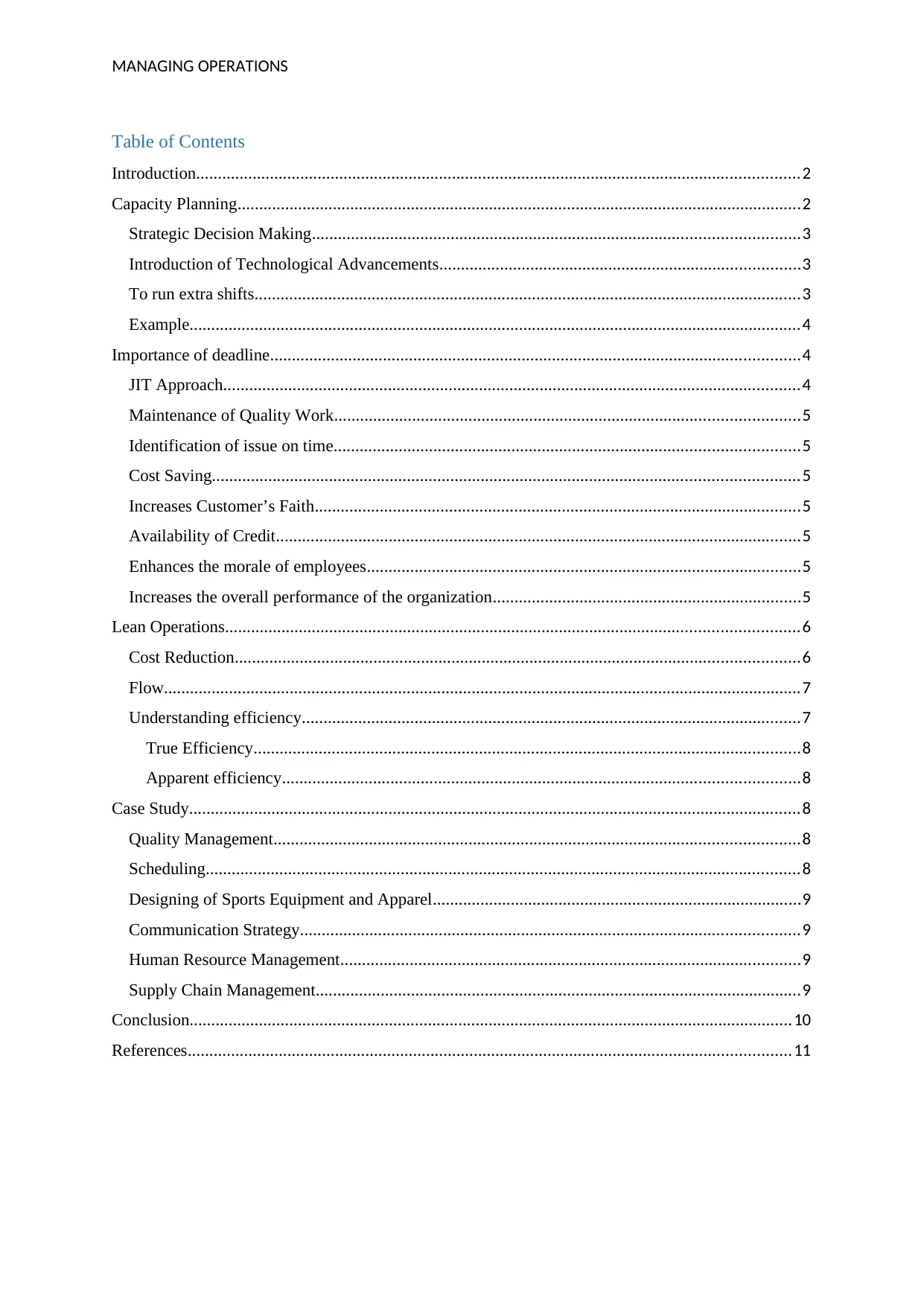
Table of Contents
Introduction...........................................................................................................................................2
Capacity Planning..................................................................................................................................2
Strategic Decision Making................................................................................................................3
Introduction of Technological Advancements...................................................................................3
To run extra shifts..............................................................................................................................3
Example.............................................................................................................................................4
Importance of deadline..........................................................................................................................4
JIT Approach.....................................................................................................................................4
Maintenance of Quality Work...........................................................................................................5
Identification of issue on time...........................................................................................................5
Cost Saving.......................................................................................................................................5
Increases Customer’s Faith................................................................................................................5
Availability of Credit.........................................................................................................................5
Enhances the morale of employees....................................................................................................5
Increases the overall performance of the organization.......................................................................5
Lean Operations....................................................................................................................................6
Cost Reduction..................................................................................................................................6
Flow...................................................................................................................................................7
Understanding efficiency...................................................................................................................7
True Efficiency..............................................................................................................................8
Apparent efficiency.......................................................................................................................8
Case Study.............................................................................................................................................8
Quality Management.........................................................................................................................8
Scheduling.........................................................................................................................................8
Designing of Sports Equipment and Apparel.....................................................................................9
Communication Strategy...................................................................................................................9
Human Resource Management..........................................................................................................9
Supply Chain Management................................................................................................................9
Conclusion...........................................................................................................................................10
References...........................................................................................................................................11
Table of Contents
Introduction...........................................................................................................................................2
Capacity Planning..................................................................................................................................2
Strategic Decision Making................................................................................................................3
Introduction of Technological Advancements...................................................................................3
To run extra shifts..............................................................................................................................3
Example.............................................................................................................................................4
Importance of deadline..........................................................................................................................4
JIT Approach.....................................................................................................................................4
Maintenance of Quality Work...........................................................................................................5
Identification of issue on time...........................................................................................................5
Cost Saving.......................................................................................................................................5
Increases Customer’s Faith................................................................................................................5
Availability of Credit.........................................................................................................................5
Enhances the morale of employees....................................................................................................5
Increases the overall performance of the organization.......................................................................5
Lean Operations....................................................................................................................................6
Cost Reduction..................................................................................................................................6
Flow...................................................................................................................................................7
Understanding efficiency...................................................................................................................7
True Efficiency..............................................................................................................................8
Apparent efficiency.......................................................................................................................8
Case Study.............................................................................................................................................8
Quality Management.........................................................................................................................8
Scheduling.........................................................................................................................................8
Designing of Sports Equipment and Apparel.....................................................................................9
Communication Strategy...................................................................................................................9
Human Resource Management..........................................................................................................9
Supply Chain Management................................................................................................................9
Conclusion...........................................................................................................................................10
References...........................................................................................................................................11
MANAGING OPERATIONS
Introduction
The concept of managing operations is related with the management of business functions
and activities to provide the higher-level satisfaction of customer by utilizing the available
capacity and efficiency in best possible manner. Operations management is a part of the
business administration, which covers all the processes of converting of raw material into
finished goods. In operations management, the management always tries to decrease the cost
of operations to keep the cost of production low and thus to increase the profitability of the
business. The use of available resources of production in the best possible way and the
introduction of new technologies at the time of requirement, there all tasks are supervised in
the operations management process. To become successful in the long run, an organization
has to work within the frame provided by the operations management team (Mary, et al.,
2015).
This report describes the analysis of the case study of R Griggs & Company Limited. The
company decided to restructure its al processes as per the changing demands of the customers
and industry. The company has to face some issues related to the restructuring of the
operations management processes and had to bear some losses also for the mismanagement
of the same. This report describes some aspect of capacity management that could help the
company at the time of change management. Further, it also describes the concept of JIT
approach and lean management system to develop a wide understanding of the operations
management in a manufacturing firm. Example of a well0knwon company is also given
which is famous for managing its operations in a good manner.
Capacity Planning
Operations are a part of the organizational process, which is responsible for the production of
goods and services. These operations are limited in terms of capacity. An organization should
be able to achieve organizational objectives and goals by controlling and planning the
capacities of these operations. Capacity planning is a set of strategies, tools, and techniques
that are used to make the estimation of production that can fulfill the projected demand of the
business (Pullman & Rodgers, 2010). It can also be termed as an issue that has to be faced by
all organizations or as an activity, which directly affects the efficiency of the operations
within an organization. The actual process of capacity planning depends upon the type of
industry in which the organization is working. The capacity can be increased by the adoption
Introduction
The concept of managing operations is related with the management of business functions
and activities to provide the higher-level satisfaction of customer by utilizing the available
capacity and efficiency in best possible manner. Operations management is a part of the
business administration, which covers all the processes of converting of raw material into
finished goods. In operations management, the management always tries to decrease the cost
of operations to keep the cost of production low and thus to increase the profitability of the
business. The use of available resources of production in the best possible way and the
introduction of new technologies at the time of requirement, there all tasks are supervised in
the operations management process. To become successful in the long run, an organization
has to work within the frame provided by the operations management team (Mary, et al.,
2015).
This report describes the analysis of the case study of R Griggs & Company Limited. The
company decided to restructure its al processes as per the changing demands of the customers
and industry. The company has to face some issues related to the restructuring of the
operations management processes and had to bear some losses also for the mismanagement
of the same. This report describes some aspect of capacity management that could help the
company at the time of change management. Further, it also describes the concept of JIT
approach and lean management system to develop a wide understanding of the operations
management in a manufacturing firm. Example of a well0knwon company is also given
which is famous for managing its operations in a good manner.
Capacity Planning
Operations are a part of the organizational process, which is responsible for the production of
goods and services. These operations are limited in terms of capacity. An organization should
be able to achieve organizational objectives and goals by controlling and planning the
capacities of these operations. Capacity planning is a set of strategies, tools, and techniques
that are used to make the estimation of production that can fulfill the projected demand of the
business (Pullman & Rodgers, 2010). It can also be termed as an issue that has to be faced by
all organizations or as an activity, which directly affects the efficiency of the operations
within an organization. The actual process of capacity planning depends upon the type of
industry in which the organization is working. The capacity can be increased by the adoption
⊘ This is a preview!⊘
Do you want full access?
Subscribe today to unlock all pages.

Trusted by 1+ million students worldwide
MANAGING OPERATIONS
of new technologies in the production process, the appointment of extra workers and offer
attractive payout for the overtime (Aarabi & Hasanian, 2014).
In the given case study of R Griggs & Company, it is clear from the reviews that scheduling
and planning system of the company was not able to meet the requirement of the purpose of
change of the company. Thus, it was necessary to restructure the entire system of planning
and scheduling according to the objectives of management change (Onyango, 2016). For
such purpose, the experience of Dr. Martens could be utilized for an effective capacity
planning as he was handling one of the topmost shoe manufacturer company in the world. R
Griggs & Company could take the following strategies to increase the capacity of the
company:
Strategic Decision Making
Strategic management is important for the development of the business. A successful strategy
aims the stability of business in the long run with earning desired profits. The second aims of
an effective business strategy are to expand the business with the minimum investment which
can also result in earning higher profits (Wairimu, 2014). For the above review of the case
study, it is clear that there was a lack of planned strategy as the management and operational
level staff was not properly communicated about their work and responsibilities. In this
situation, the management needs to work as per the planned strategies and should have
introduced a better communication system between the management and the employees
(Carvalho, et al., 2017).
Introduction of Technological Advancements
It is one of the powerful and effective strategies for the maximization of the capacity of the
operations. It includes elimination and removal of old techniques of production and invests in
some new technology at the time of change in operations management. R Griggs & Company
could introduce new procedures form the industry and new machines that could save the time
of workers and along with this the problem of delay in orders could also be solved
automatically (Dekkers, 2010).
To run extra shifts
If an organization is not willing to invest in new technologies or in extra workforces, then this
is the best option that can help in enhancing the capacity of the organization. This strategy is
of new technologies in the production process, the appointment of extra workers and offer
attractive payout for the overtime (Aarabi & Hasanian, 2014).
In the given case study of R Griggs & Company, it is clear from the reviews that scheduling
and planning system of the company was not able to meet the requirement of the purpose of
change of the company. Thus, it was necessary to restructure the entire system of planning
and scheduling according to the objectives of management change (Onyango, 2016). For
such purpose, the experience of Dr. Martens could be utilized for an effective capacity
planning as he was handling one of the topmost shoe manufacturer company in the world. R
Griggs & Company could take the following strategies to increase the capacity of the
company:
Strategic Decision Making
Strategic management is important for the development of the business. A successful strategy
aims the stability of business in the long run with earning desired profits. The second aims of
an effective business strategy are to expand the business with the minimum investment which
can also result in earning higher profits (Wairimu, 2014). For the above review of the case
study, it is clear that there was a lack of planned strategy as the management and operational
level staff was not properly communicated about their work and responsibilities. In this
situation, the management needs to work as per the planned strategies and should have
introduced a better communication system between the management and the employees
(Carvalho, et al., 2017).
Introduction of Technological Advancements
It is one of the powerful and effective strategies for the maximization of the capacity of the
operations. It includes elimination and removal of old techniques of production and invests in
some new technology at the time of change in operations management. R Griggs & Company
could introduce new procedures form the industry and new machines that could save the time
of workers and along with this the problem of delay in orders could also be solved
automatically (Dekkers, 2010).
To run extra shifts
If an organization is not willing to invest in new technologies or in extra workforces, then this
is the best option that can help in enhancing the capacity of the organization. This strategy is
Paraphrase This Document
Need a fresh take? Get an instant paraphrase of this document with our AI Paraphraser
MANAGING OPERATIONS
adopted when there are a large number of supplies pending to be delivered as in the case of R
Griggs & Company Limited (Dekkers & Kanapathy, 2012).
Example
Nestle is a well-known brand in the food and beverage industry. The company is engaged in
the manufacturing of more than 2000 products. The effective management of the operations
is one of the major reason behind the success of the company. The company is operating with
the help of its available capacity and serving its customers worldwide. For the utilization of
its workforce capability, the company has opened its manufacturing offices in the different
areas of the world so that the workers do not have to shift to any other place. Along with this,
the company to reduce the cost of production does demand management and to increase
customer satisfaction is an important tool used by Nestle.
Importance of deadline
Every organization has some deadlines of its functions and activities, which are required to
meet by the employees. The deadlines are related to the ability of an organization to complete
its responsibilities without being a delay. Although some employees often feel overwhelmed
by these deadlines, ultimately at the completion of work, they are also praised by the
management or by their customers for their efforts to complete the work within given time
slot.
JIT Approach
In the manufacturing industry, one of the most popular approaches, which is used to meet the
deadlines, is the JIT approach, abbreviated as Just-In-Time approach. An inventory
management strategy aligns the orders of raw material from suppliers to the direct production
houses. This strategy is used by the organizations to decrease the waste and increase the
efficiency of the capacity of the available resources. This strategy enables the production
house to receive the goods as per the requirement of the production process, thus the cost of
handling inventory also decreases (Abdallah & Matsui, 2007).
For the application of this strategy, an organization involved in the production and
manufacturing process is required to forecast the demand accurately, which is not easy. Most
of the companies fail to fulfill the orders and demands of the customers either because of
non-availability of sufficient raw material or mismanagement of available raw material stock.
Along with this. The storage of extra raw material increases the cost of production thus there
is an automatic increase in the sales value of the product. On the other hand, if the demand
adopted when there are a large number of supplies pending to be delivered as in the case of R
Griggs & Company Limited (Dekkers & Kanapathy, 2012).
Example
Nestle is a well-known brand in the food and beverage industry. The company is engaged in
the manufacturing of more than 2000 products. The effective management of the operations
is one of the major reason behind the success of the company. The company is operating with
the help of its available capacity and serving its customers worldwide. For the utilization of
its workforce capability, the company has opened its manufacturing offices in the different
areas of the world so that the workers do not have to shift to any other place. Along with this,
the company to reduce the cost of production does demand management and to increase
customer satisfaction is an important tool used by Nestle.
Importance of deadline
Every organization has some deadlines of its functions and activities, which are required to
meet by the employees. The deadlines are related to the ability of an organization to complete
its responsibilities without being a delay. Although some employees often feel overwhelmed
by these deadlines, ultimately at the completion of work, they are also praised by the
management or by their customers for their efforts to complete the work within given time
slot.
JIT Approach
In the manufacturing industry, one of the most popular approaches, which is used to meet the
deadlines, is the JIT approach, abbreviated as Just-In-Time approach. An inventory
management strategy aligns the orders of raw material from suppliers to the direct production
houses. This strategy is used by the organizations to decrease the waste and increase the
efficiency of the capacity of the available resources. This strategy enables the production
house to receive the goods as per the requirement of the production process, thus the cost of
handling inventory also decreases (Abdallah & Matsui, 2007).
For the application of this strategy, an organization involved in the production and
manufacturing process is required to forecast the demand accurately, which is not easy. Most
of the companies fail to fulfill the orders and demands of the customers either because of
non-availability of sufficient raw material or mismanagement of available raw material stock.
Along with this. The storage of extra raw material increases the cost of production thus there
is an automatic increase in the sales value of the product. On the other hand, if the demand
MANAGING OPERATIONS
for customer changes, then the organization may have to bear a huge loss in form of storage
of outdated raw material (Bon & Garai , 2011). Thus, the use of JIT approach and importance
of meeting deadlines can be understood with the help of below-mentioned points:
Maintenance of Quality Work
If the production process is carried out as per the given time then the quality work can be
provided to the clients as there would be no need to rust for the completion of the work in the
last minute. It can enhance the level of satisfaction in the customers.
Identification of issue on time
If there is any issue form the client side that can affect the completion of the order, can be
identified in the prior stages by focusing on the deadline. This can help the organization to
avoid any kind of losses from the client's side (Khan & Kumar, 2013).
Cost Saving
If a manufacturing organization starts working for the completion of a delivery within the
time frame then there are possibilities that it would deliver the same within the timeline. This
can save the extra cost which would have to spend by the organization for running extra shifts
and overtime in case of non-completion of order (Kootanaee, et al., 7-25).
Increases Customer’s Faith
Timely delivery of products increases the trust of the customers in the commitment of the
company. It can also help in building the good image of the company which can ultimately
result in increasing the clients and business of the company (Scavarda, et al., 2010).
Availability of Credit
Several times, the company has to borrow the raw material on credit and it is not easy for an
organization whose goodwill and the image is not good in the industry. If an organization
completes its order on time and make timely payment to its suppliers, then it would be easy to
purchase the raw material on credit in case of any type of emergency (Ukil, et al., 2016).
Enhances the morale of employees
The employees who complete their work within the given time are always valued more by the
management in comparison to the employees who are always late in their work. Such
for customer changes, then the organization may have to bear a huge loss in form of storage
of outdated raw material (Bon & Garai , 2011). Thus, the use of JIT approach and importance
of meeting deadlines can be understood with the help of below-mentioned points:
Maintenance of Quality Work
If the production process is carried out as per the given time then the quality work can be
provided to the clients as there would be no need to rust for the completion of the work in the
last minute. It can enhance the level of satisfaction in the customers.
Identification of issue on time
If there is any issue form the client side that can affect the completion of the order, can be
identified in the prior stages by focusing on the deadline. This can help the organization to
avoid any kind of losses from the client's side (Khan & Kumar, 2013).
Cost Saving
If a manufacturing organization starts working for the completion of a delivery within the
time frame then there are possibilities that it would deliver the same within the timeline. This
can save the extra cost which would have to spend by the organization for running extra shifts
and overtime in case of non-completion of order (Kootanaee, et al., 7-25).
Increases Customer’s Faith
Timely delivery of products increases the trust of the customers in the commitment of the
company. It can also help in building the good image of the company which can ultimately
result in increasing the clients and business of the company (Scavarda, et al., 2010).
Availability of Credit
Several times, the company has to borrow the raw material on credit and it is not easy for an
organization whose goodwill and the image is not good in the industry. If an organization
completes its order on time and make timely payment to its suppliers, then it would be easy to
purchase the raw material on credit in case of any type of emergency (Ukil, et al., 2016).
Enhances the morale of employees
The employees who complete their work within the given time are always valued more by the
management in comparison to the employees who are always late in their work. Such
⊘ This is a preview!⊘
Do you want full access?
Subscribe today to unlock all pages.
Trusted by 1+ million students worldwide
MANAGING OPERATIONS
employees also get promotions and rewards from their managers which enhances the morale
of employees to perform at their full capacity (Singh & Ahuja, 2012).
Increases the overall performance of the organization
When an organization is able to complete the orders on time thus the capacity of accepting
more orders automatically increases and it directly impacts the performance of the
organization in terms of time management and quality management.
Example
The best example of the success of JIT is the process management of Toyota Company. The
production strategy of Toyota contains that the raw material is not placed in the production
house until the orders are not received from the vendors and the processing products are
ready to ship. No parts are allowed for nodding unless they are important for the next node.
This strategy has enabled the company to maintain a minimum level of raw material with the
premises and to reduce the inventory handling cost. This also indicates that the company can
easily change its production processes as per the changing demands of the industry without
worrying about the loss of stored raw material.
Lean Operations:
Lean production or lean manufacturing simply termed as lean is a systematic method which is
followed in the manufacturing organizations on a very larger scale. This method is related to
the waste minimization without compromising with the productivity of the operations. It also
includes the waste generated through inequality in workload or through overburden on
employees. Lean manufacturing takes care about the contents that are obvious to the
production and add value as value is any process or action for which the customer would
have to pay. This philosophy of management is derived from the management system of a
well-known car manufacturing company named as TOYOTA. The company follows Toyota
Production System which infamous as TPS since 1990 as has also adopted by most the
successful companies for managing their operations in an effective manner. The suitability of
this method can be identified on the basis of the growth of Toyota foam a small company to
the largest automaker of the world (Puvanasvaran, et al., 2010).
The lean manufacturing system enables an organization to compete successfully in the target
market with the help of below-mentioned strategies:
employees also get promotions and rewards from their managers which enhances the morale
of employees to perform at their full capacity (Singh & Ahuja, 2012).
Increases the overall performance of the organization
When an organization is able to complete the orders on time thus the capacity of accepting
more orders automatically increases and it directly impacts the performance of the
organization in terms of time management and quality management.
Example
The best example of the success of JIT is the process management of Toyota Company. The
production strategy of Toyota contains that the raw material is not placed in the production
house until the orders are not received from the vendors and the processing products are
ready to ship. No parts are allowed for nodding unless they are important for the next node.
This strategy has enabled the company to maintain a minimum level of raw material with the
premises and to reduce the inventory handling cost. This also indicates that the company can
easily change its production processes as per the changing demands of the industry without
worrying about the loss of stored raw material.
Lean Operations:
Lean production or lean manufacturing simply termed as lean is a systematic method which is
followed in the manufacturing organizations on a very larger scale. This method is related to
the waste minimization without compromising with the productivity of the operations. It also
includes the waste generated through inequality in workload or through overburden on
employees. Lean manufacturing takes care about the contents that are obvious to the
production and add value as value is any process or action for which the customer would
have to pay. This philosophy of management is derived from the management system of a
well-known car manufacturing company named as TOYOTA. The company follows Toyota
Production System which infamous as TPS since 1990 as has also adopted by most the
successful companies for managing their operations in an effective manner. The suitability of
this method can be identified on the basis of the growth of Toyota foam a small company to
the largest automaker of the world (Puvanasvaran, et al., 2010).
The lean manufacturing system enables an organization to compete successfully in the target
market with the help of below-mentioned strategies:
Paraphrase This Document
Need a fresh take? Get an instant paraphrase of this document with our AI Paraphraser
MANAGING OPERATIONS
Cost Reduction
The first way to reduce the cost is to invest in the production of those goods which are
demanded by the people in current due to in fashion. It would control the extra manufacturing
of the products and would also help in eliminating the waste that could be occurred in the
huge manufacturing process. There are a number of ways which can be used to implement
and analyze the cost reduction techniques and areas of cost reduction. One of the major goals
of the lean manufacturing is to locate the waste in each process separately and then eliminate
it (Nenni, et al., 2014). It saves the organization from eliminating any kind of value form the
production process that is often possible when the waste is eliminated in the bulk. It is a well-
known fact that waste can never increase the value of the product, it can only increase the
cost of the product which reduces the chances of survival of the organization in the market.
The elimination of waste may lead to an organization to provide quality services to the
customer and also develops the performance structure of the organization and the employees
(Jasti & Kodali, 2014).
Flow
The flow is related to the system of dealing with people and items within a process
management system. For the efficient working of the operations department of an
organization, it is required to have a good flow among the processes to complete the main
process from first to last. A change in the flow can either lead to a decrease in the waste or
increase in the waste depending upon the quality of the newly introduced flow (Gupta & Jain,
241-249). The main flows that should be considered in the Lean manufacturing System can
be described as below:
Flow of machines
Flow of operations
Flow of raw material
Flow of Work-in-progress
Flow of finished goods
Flow of engineering
Flow of Information
Cost Reduction
The first way to reduce the cost is to invest in the production of those goods which are
demanded by the people in current due to in fashion. It would control the extra manufacturing
of the products and would also help in eliminating the waste that could be occurred in the
huge manufacturing process. There are a number of ways which can be used to implement
and analyze the cost reduction techniques and areas of cost reduction. One of the major goals
of the lean manufacturing is to locate the waste in each process separately and then eliminate
it (Nenni, et al., 2014). It saves the organization from eliminating any kind of value form the
production process that is often possible when the waste is eliminated in the bulk. It is a well-
known fact that waste can never increase the value of the product, it can only increase the
cost of the product which reduces the chances of survival of the organization in the market.
The elimination of waste may lead to an organization to provide quality services to the
customer and also develops the performance structure of the organization and the employees
(Jasti & Kodali, 2014).
Flow
The flow is related to the system of dealing with people and items within a process
management system. For the efficient working of the operations department of an
organization, it is required to have a good flow among the processes to complete the main
process from first to last. A change in the flow can either lead to a decrease in the waste or
increase in the waste depending upon the quality of the newly introduced flow (Gupta & Jain,
241-249). The main flows that should be considered in the Lean manufacturing System can
be described as below:
Flow of machines
Flow of operations
Flow of raw material
Flow of Work-in-progress
Flow of finished goods
Flow of engineering
Flow of Information
MANAGING OPERATIONS
Understanding efficiency:
The changes in efficiency that neglect that production schedule can result in increasing the
waste in form of overproduction and lead overall capacity of the organization in the wrong
direction. The improvements of efficiency can be measured by the degree of reduction in the
production cost of the product. A manufacturing organization consists of two type of
efficiencies which are required to be considered by them in the lean operations (Battistoni, et
al., 2013).
True Efficiency
It is the real efficiency of the company that can not be increased without introducing the
external factors like extra workforce and extra production equipment.
Apparent efficiency
It is considered as a way of increasing the existing efficiency without increasing the current
man hours. This efficiency is utilized by the organization in case of any big level order of in
case of a delay in orders. It works as a backup plan for delivering the orders within the
allotted time (Jedynak, 2015).
Case Study
A lean manufacturing based organization understands the value of customers and focuses its
main processes to continuously increase it. This thing helps in to bring more reliability about
the customers will the higher reassurance of the stability of effective operations management.
One of the best examples of lean operations is the business management of Nike. A well-
known American national Cooperation engaged in developing, designing, manufacturing,
marketing and sales of apparel, footwear, equipment, services, and accessories at the
international level. The headquarter of the company is located in the Portland metropolitan
area near Beaverton, Oregon. The company is one of the largest suppliers of athletic apparel
and shoes worldwide. The operations manager of the company can be understood with the
help of the below discussion:
Quality Management
Being an international brand, this is the most important concern for the company. The
company has developed a set of guidelines for its workers engaged in the manufacturing
process. The training is provided to workers for meeting the quality standard mentioned by
the company. All the parts are tested much time before going for finalization. And if in case
Understanding efficiency:
The changes in efficiency that neglect that production schedule can result in increasing the
waste in form of overproduction and lead overall capacity of the organization in the wrong
direction. The improvements of efficiency can be measured by the degree of reduction in the
production cost of the product. A manufacturing organization consists of two type of
efficiencies which are required to be considered by them in the lean operations (Battistoni, et
al., 2013).
True Efficiency
It is the real efficiency of the company that can not be increased without introducing the
external factors like extra workforce and extra production equipment.
Apparent efficiency
It is considered as a way of increasing the existing efficiency without increasing the current
man hours. This efficiency is utilized by the organization in case of any big level order of in
case of a delay in orders. It works as a backup plan for delivering the orders within the
allotted time (Jedynak, 2015).
Case Study
A lean manufacturing based organization understands the value of customers and focuses its
main processes to continuously increase it. This thing helps in to bring more reliability about
the customers will the higher reassurance of the stability of effective operations management.
One of the best examples of lean operations is the business management of Nike. A well-
known American national Cooperation engaged in developing, designing, manufacturing,
marketing and sales of apparel, footwear, equipment, services, and accessories at the
international level. The headquarter of the company is located in the Portland metropolitan
area near Beaverton, Oregon. The company is one of the largest suppliers of athletic apparel
and shoes worldwide. The operations manager of the company can be understood with the
help of the below discussion:
Quality Management
Being an international brand, this is the most important concern for the company. The
company has developed a set of guidelines for its workers engaged in the manufacturing
process. The training is provided to workers for meeting the quality standard mentioned by
the company. All the parts are tested much time before going for finalization. And if in case
⊘ This is a preview!⊘
Do you want full access?
Subscribe today to unlock all pages.
Trusted by 1+ million students worldwide
MANAGING OPERATIONS
any quality problem occurs after reaching in the hands of the customer, the company has an
easy and attractive guarantee and warranty policies to provide the maximum level of
satisfaction to the customers (Suwa & Morita, 2014).
Scheduling
The management of operation with the help of lean manufacturing has become a trend for
Nike. All operations are schedules in first to last on the basis of their priority. Then, the same
is conducted with the help of analysis of true efficiency and apparent efficiency.
Designing of Sports Equipment and Apparel
The company is the main player in the industry of sports equipment and apparel. Thus, all the
designs manufactured by the company are based on the report of several types of research
conducted by the R&D department of the company. Along with this, the designs of the
equipment are decided according to the comfort zone of the international sports players.
Here, the company follows JIT approach of lean manufacturing because demand and taste of
the customers are continuously changing in the present scenario. So the company
manufactures the products on the basis of the JIT method to avoid any kind of waste and to
work with customer value (Mazanai, 2012) (Manzouri, et al., 2014).
Communication Strategy
This is an integral and important part of the operations management. For effective operations
management, all employees and managers should be well-known for their duties and
responsibilities. Nike follows downward as well as upward communication strategy so that
all the employees can get the updates regarding the production process and other important
decisions. The upward communication strategy enables the upper-level management to know
about the problems that are faced by the workers an employees in managing the day to day
operations of the company (Leite & Vieira, 2015).
Human Resource Management
For managing the employee of the organization, human resource department and its policies
in Nike are conducted in a well-structured manner. The employees are facilitated with the
flexible time of working so that they can pay attention to their personal life. In addition to
this, all production process is conducted in two or three shift so that work can be completed
on time without pressurizing the employees and workers.
any quality problem occurs after reaching in the hands of the customer, the company has an
easy and attractive guarantee and warranty policies to provide the maximum level of
satisfaction to the customers (Suwa & Morita, 2014).
Scheduling
The management of operation with the help of lean manufacturing has become a trend for
Nike. All operations are schedules in first to last on the basis of their priority. Then, the same
is conducted with the help of analysis of true efficiency and apparent efficiency.
Designing of Sports Equipment and Apparel
The company is the main player in the industry of sports equipment and apparel. Thus, all the
designs manufactured by the company are based on the report of several types of research
conducted by the R&D department of the company. Along with this, the designs of the
equipment are decided according to the comfort zone of the international sports players.
Here, the company follows JIT approach of lean manufacturing because demand and taste of
the customers are continuously changing in the present scenario. So the company
manufactures the products on the basis of the JIT method to avoid any kind of waste and to
work with customer value (Mazanai, 2012) (Manzouri, et al., 2014).
Communication Strategy
This is an integral and important part of the operations management. For effective operations
management, all employees and managers should be well-known for their duties and
responsibilities. Nike follows downward as well as upward communication strategy so that
all the employees can get the updates regarding the production process and other important
decisions. The upward communication strategy enables the upper-level management to know
about the problems that are faced by the workers an employees in managing the day to day
operations of the company (Leite & Vieira, 2015).
Human Resource Management
For managing the employee of the organization, human resource department and its policies
in Nike are conducted in a well-structured manner. The employees are facilitated with the
flexible time of working so that they can pay attention to their personal life. In addition to
this, all production process is conducted in two or three shift so that work can be completed
on time without pressurizing the employees and workers.
Paraphrase This Document
Need a fresh take? Get an instant paraphrase of this document with our AI Paraphraser
MANAGING OPERATIONS
Supply Chain Management
The company maintains good relations with its suppliers, thus it does not have to face any
kind of problem regarding the supply of raw material. Along with this, the credibility of Nike
is also very good which is helpful in the time of non-availability of sufficient financial
resources.
It is clear from the above-mentioned points that Nike is managing its operations in a well-
effective manner and working towards the optimum utilization of available resources with the
help of capacity management techniques (Lopez-Fresno, 2012).
Conclusion
On the basis of above discussion, it can be concluded that operations management act as a
major part of the business management of a manufacturing firm. It consists of management of
day to day operations of the organization as well as the activities which enable the business to
grow faster. It is also clear from the analysis of the case study of R Griggs & Company that
deficiency in managing operations of a business can lead to it to the worst condition where its
profits can be decreased with increase in the dissatisfaction level of the customers as
happened in the given case study. There are various aspects of the operations management,
some of them are summarized in this report to provide the overview of the concept like
capacity planning, JIT approach of time management, Lean manufacturing system etc. All the
concept are related to each other and this is summarized in this paper by giving the example
of operations management of Nike, an international manufacturer which is known for an
effective operations management. The overall aim of the operations management and its
aspects is to serve the consumer in the best possible way and thus increase the profitability of
the organization.
The implications of the effective operations management system are not difficult but it needs
to analyze the market demand accurately so that capacity management and JIT approach can
be applied successfully. As provided in the case study, sometimes the demands of the market
are just opposite to the capacity and strategy of the organization especially during the change
in management. But on the other hand, the time of change in management is the best
opportunity for an organization to introduce something new in the business in terms of
strategies, processes, and techniques which can help the business to perform better in near
future. Thus, for the better customer experience, an organization needs to invest in the
operations management and its techniques because if the customer is not happy then the
Supply Chain Management
The company maintains good relations with its suppliers, thus it does not have to face any
kind of problem regarding the supply of raw material. Along with this, the credibility of Nike
is also very good which is helpful in the time of non-availability of sufficient financial
resources.
It is clear from the above-mentioned points that Nike is managing its operations in a well-
effective manner and working towards the optimum utilization of available resources with the
help of capacity management techniques (Lopez-Fresno, 2012).
Conclusion
On the basis of above discussion, it can be concluded that operations management act as a
major part of the business management of a manufacturing firm. It consists of management of
day to day operations of the organization as well as the activities which enable the business to
grow faster. It is also clear from the analysis of the case study of R Griggs & Company that
deficiency in managing operations of a business can lead to it to the worst condition where its
profits can be decreased with increase in the dissatisfaction level of the customers as
happened in the given case study. There are various aspects of the operations management,
some of them are summarized in this report to provide the overview of the concept like
capacity planning, JIT approach of time management, Lean manufacturing system etc. All the
concept are related to each other and this is summarized in this paper by giving the example
of operations management of Nike, an international manufacturer which is known for an
effective operations management. The overall aim of the operations management and its
aspects is to serve the consumer in the best possible way and thus increase the profitability of
the organization.
The implications of the effective operations management system are not difficult but it needs
to analyze the market demand accurately so that capacity management and JIT approach can
be applied successfully. As provided in the case study, sometimes the demands of the market
are just opposite to the capacity and strategy of the organization especially during the change
in management. But on the other hand, the time of change in management is the best
opportunity for an organization to introduce something new in the business in terms of
strategies, processes, and techniques which can help the business to perform better in near
future. Thus, for the better customer experience, an organization needs to invest in the
operations management and its techniques because if the customer is not happy then the

MANAGING OPERATIONS
business can never grow and management of business operations is an essential tool for such
purpose.
business can never grow and management of business operations is an essential tool for such
purpose.
⊘ This is a preview!⊘
Do you want full access?
Subscribe today to unlock all pages.
Trusted by 1+ million students worldwide

1 out of 15


Related Documents


Your All-in-One AI-Powered Toolkit for Academic Success.
+13062052269
info@desklib.com
Available 24*7 on WhatsApp / Email
![[object Object]](/_next/static/media/star-bottom.7253800d.svg)
Unlock your academic potential
Copyright © 2020–2026 A2Z Services. All Rights Reserved. Developed and managed by ZUCOL.