Operations Management Report: Quality, Process, and Layout Strategies
VerifiedAdded on 2022/11/09
|12
|3820
|398
Report
AI Summary
This report provides an executive summary of operations management, focusing on quality, process, and layout strategies within an organization. The report begins with an introduction emphasizing the importance of quality for business success, using R. M. Williams as a case study. Part A includes a literature review on quality management, exploring different perspectives and strategies. It also delves into the background of organizations' quality management strategies, with a particular focus on R. M. Williams, and explains the House of Quality (HoQ) method. Part B reviews literature on process and layout strategies. The report discusses theoretical layouts and suggests improvements. The report concludes by emphasizing the importance of maintaining quality and continuous improvement in operations management.
OPERATION MANAGEMENT

Paraphrase This Document
Need a fresh take? Get an instant paraphrase of this document with our AI Paraphraser
EXECUTIVE SUMMARY
This report is based on managing the operations under the organisation. Every
organisation has adopted certain standard of performance for maintaining the quality of its
products and services. The importance of maintaining quality and superiority is explained in the
report with the help of considering quality of house model. Furthermore, the discussion about
process and layout strategies are done. This concept and its importance has been explained with
the help of different articles.
This report is based on managing the operations under the organisation. Every
organisation has adopted certain standard of performance for maintaining the quality of its
products and services. The importance of maintaining quality and superiority is explained in the
report with the help of considering quality of house model. Furthermore, the discussion about
process and layout strategies are done. This concept and its importance has been explained with
the help of different articles.
Contents
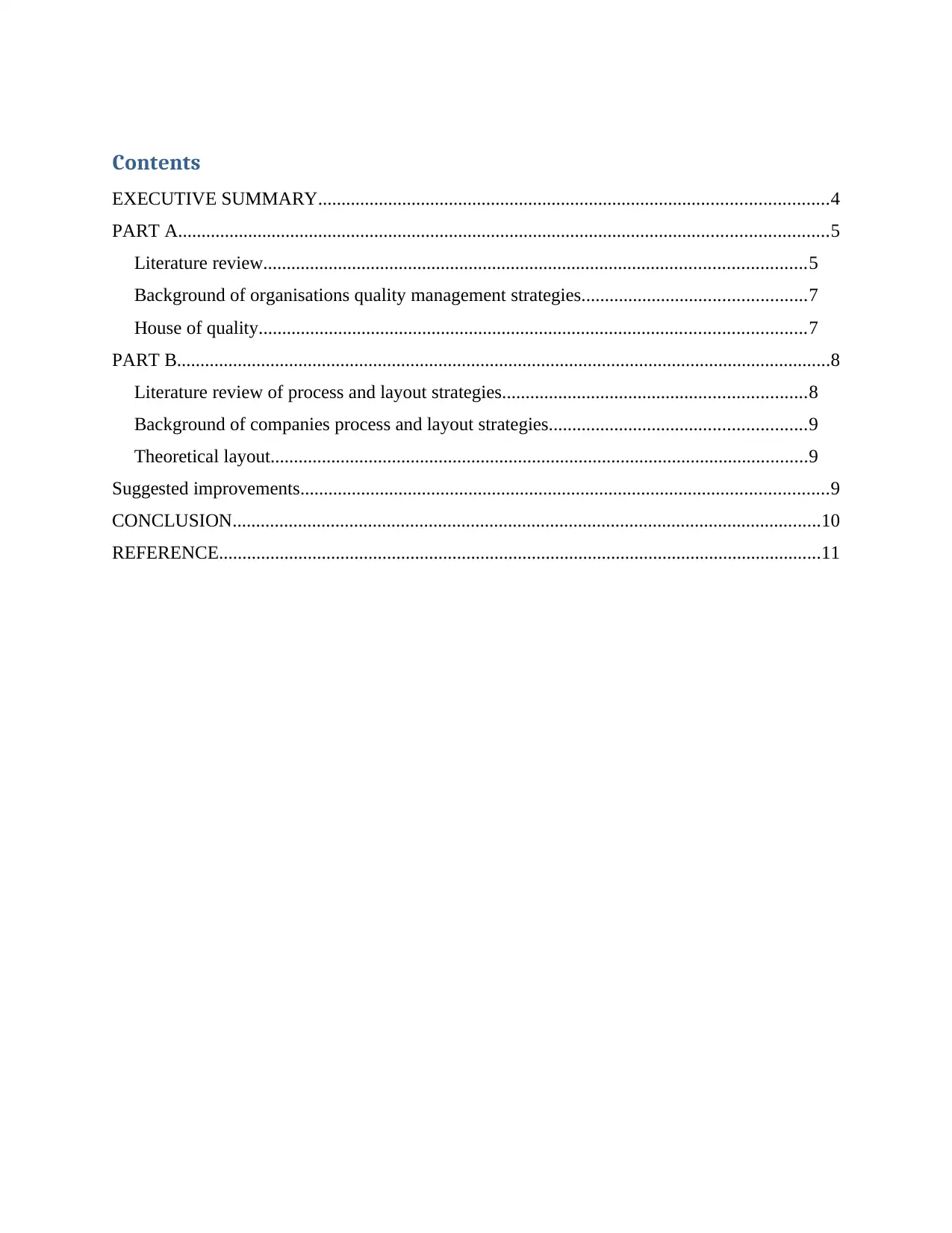
EXECUTIVE SUMMARY.............................................................................................................4
PART A...........................................................................................................................................5
Literature review....................................................................................................................5
Background of organisations quality management strategies................................................7
House of quality.....................................................................................................................7
PART B............................................................................................................................................8
Literature review of process and layout strategies.................................................................8
Background of companies process and layout strategies.......................................................9
Theoretical layout...................................................................................................................9
Suggested improvements.................................................................................................................9
CONCLUSION..............................................................................................................................10
REFERENCE.................................................................................................................................11
EXECUTIVE SUMMARY.............................................................................................................4
PART A...........................................................................................................................................5
Literature review....................................................................................................................5
Background of organisations quality management strategies................................................7
House of quality.....................................................................................................................7
PART B............................................................................................................................................8
Literature review of process and layout strategies.................................................................8
Background of companies process and layout strategies.......................................................9
Theoretical layout...................................................................................................................9
Suggested improvements.................................................................................................................9
CONCLUSION..............................................................................................................................10
REFERENCE.................................................................................................................................11
⊘ This is a preview!⊘
Do you want full access?
Subscribe today to unlock all pages.

Trusted by 1+ million students worldwide
INTRODUCTION
Quality is one of the most important aspect for every business organisation. Each and every
customers needs and requirements fluctuate depending upon the quality and superiority of the
products and services offered by the organisation (Grosse and et. al., 2015). The company which
is to be taken into consideration under this report is R. M. Williams which has initiated its
business operations from the year 1932 in Australia. The company deals in clothing and footwear
and is famous for manufacturing the Chelsea boots. This report will concentrate on assessing the
knowledge about the quality and implementing house of quality methods within the organisation.
Apart from this, the focus will be given on evaluating the understanding on the aspect of process
strategy and layout design.
PART A
Literature review
In this section, the articles relating to quality management will be discussed with their
proper and authentic sources and they are discussed below:
According to Adam Barone, 2019, quality management is the aspect of considering and
overlooking all the related and associated activities and tasks which are required to establish a
maintenance of appropriate level of excellence (Quality Management, 2019). The primary focus
of this concept is to put emphasis on long term goals and objectives with the implementation of
short term initiatives. This takes into consideration all the relevant stakeholders as this will help
them in coming and working together which ultimately improve the processes, products and
services and culture of the organisation as well. Finally with this, the company is able to attain
long term success through fulfilling the expectations and requirements of the customers. It
involves the collection of guidelines that are developed by the team members to ensure that the
products and services that they produce are of correct standard and have suitable performance. In
other words, it is a formal systematic process, procedures and responsibilities through which
quality policies and objectives can be achieved.
According to Adriano Alves Teixeira, 2019, quality management is involved in influencing the
level and maturity of different environmental practices of management. It provides superiority in
quality products and services. This quality is easily measurable and for this purpose, it takes into
account the certain performance, reliability and durability of the products. This is important
Quality is one of the most important aspect for every business organisation. Each and every
customers needs and requirements fluctuate depending upon the quality and superiority of the
products and services offered by the organisation (Grosse and et. al., 2015). The company which
is to be taken into consideration under this report is R. M. Williams which has initiated its
business operations from the year 1932 in Australia. The company deals in clothing and footwear
and is famous for manufacturing the Chelsea boots. This report will concentrate on assessing the
knowledge about the quality and implementing house of quality methods within the organisation.
Apart from this, the focus will be given on evaluating the understanding on the aspect of process
strategy and layout design.
PART A
Literature review
In this section, the articles relating to quality management will be discussed with their
proper and authentic sources and they are discussed below:
According to Adam Barone, 2019, quality management is the aspect of considering and
overlooking all the related and associated activities and tasks which are required to establish a
maintenance of appropriate level of excellence (Quality Management, 2019). The primary focus
of this concept is to put emphasis on long term goals and objectives with the implementation of
short term initiatives. This takes into consideration all the relevant stakeholders as this will help
them in coming and working together which ultimately improve the processes, products and
services and culture of the organisation as well. Finally with this, the company is able to attain
long term success through fulfilling the expectations and requirements of the customers. It
involves the collection of guidelines that are developed by the team members to ensure that the
products and services that they produce are of correct standard and have suitable performance. In
other words, it is a formal systematic process, procedures and responsibilities through which
quality policies and objectives can be achieved.
According to Adriano Alves Teixeira, 2019, quality management is involved in influencing the
level and maturity of different environmental practices of management. It provides superiority in
quality products and services. This quality is easily measurable and for this purpose, it takes into
account the certain performance, reliability and durability of the products. This is important
Paraphrase This Document
Need a fresh take? Get an instant paraphrase of this document with our AI Paraphraser
because it helps the organisations in making difference between the companies products and
services and that of competitors. With this concept, the customers are given primary importance
and when they feel satisfied with the products and services of the company then they became
loyal towards the organisation. It helps in delivering the products and services which is required
by the customers (The importance of quality management for the effectiveness of environmental
management: evidence from companies located in Brazil, 2019).
According to Graham Freeman, 2019, quality is generally used as a synonym for good.
Many products and organisations claims that their products carries the higher or superior quality
which is the manner in which the product is usually defined. There are certain aspects for which
the quality management professionals takes into account the respective points discussed below:
When customers are provided with proper quality products then this leads to their maximisation
in satisfaction and when they observe that their expectations are exceeded then this leads to
maximisation of revenue. It also includes the designing features which are not only unique and
exclusive in nature but are also free from errors and defects. If products are developed which
carries some or the other sort of risk then this will lead to increase in overall cost and
disappointment of the customers. Furthermore, the defects which will be discovered at the later
production stages are more expensive in nature than those which came into observance at earlier
stages only.
It further provides assurance of regular and continuous improvement which helps in
identifying and analysing the proper cause or problem through which the problem or defect in
the products has been increased (Kłodawski and et. al., 2017).
When the organisation is able to identify the deep and proper cause of the problem with
the process of continuous improvement then this helps in minimisation of cost of quality,
increases effectiveness and efficiency, reduces the chances of doing the repetition of work,
proper utilisation of waste materials, etc.
Therefore, quality is a term which can be considered as a perspective and an approach
through which customers satisfaction can be maximised and minimises cycle time, cost and
removes rework activities, etc. Furthermore, maintaining quality is permanent and continuous
process which has no end and each and every individual focuses on understanding the
importance and need of devotion of its importance and values (What is Quality Management and
Why Does it Matter?, 2019).
services and that of competitors. With this concept, the customers are given primary importance
and when they feel satisfied with the products and services of the company then they became
loyal towards the organisation. It helps in delivering the products and services which is required
by the customers (The importance of quality management for the effectiveness of environmental
management: evidence from companies located in Brazil, 2019).
According to Graham Freeman, 2019, quality is generally used as a synonym for good.
Many products and organisations claims that their products carries the higher or superior quality
which is the manner in which the product is usually defined. There are certain aspects for which
the quality management professionals takes into account the respective points discussed below:
When customers are provided with proper quality products then this leads to their maximisation
in satisfaction and when they observe that their expectations are exceeded then this leads to
maximisation of revenue. It also includes the designing features which are not only unique and
exclusive in nature but are also free from errors and defects. If products are developed which
carries some or the other sort of risk then this will lead to increase in overall cost and
disappointment of the customers. Furthermore, the defects which will be discovered at the later
production stages are more expensive in nature than those which came into observance at earlier
stages only.
It further provides assurance of regular and continuous improvement which helps in
identifying and analysing the proper cause or problem through which the problem or defect in
the products has been increased (Kłodawski and et. al., 2017).
When the organisation is able to identify the deep and proper cause of the problem with
the process of continuous improvement then this helps in minimisation of cost of quality,
increases effectiveness and efficiency, reduces the chances of doing the repetition of work,
proper utilisation of waste materials, etc.
Therefore, quality is a term which can be considered as a perspective and an approach
through which customers satisfaction can be maximised and minimises cycle time, cost and
removes rework activities, etc. Furthermore, maintaining quality is permanent and continuous
process which has no end and each and every individual focuses on understanding the
importance and need of devotion of its importance and values (What is Quality Management and
Why Does it Matter?, 2019).
According to Eshna Verma, 2019, quality management is an aspect which provides an
assurance of an organisations products or services which are consistent with the quality. This
concept is based on retrospective and prospective reviews. The scope of maintaining quality is
not only confined to the product or service quality but it takes into consideration the manner and
ways in which the quality standards can be maintained. This concept includes the explanation of
taking into account the respective actions through which the performance and actions of all the
factors which are associated with the quality are reached at expected level of excellence.
Furthermore, the quality management is associated with different stages and process through
which organisations are able to achieve maximisation of quality and it includes quality planning,
quality assurance and quality control and documentation (How to Improve Quality Management
Consistently, 2019). Therefore, a proper and effective quality management plan is needed for
every organisation so that the quality can be improved and maintained in a proper and desired
manner. Success in the quality management and implementation plan is always necessary so that
the organisation is able to accomplish the balance in quality, profitability and efficiency.
According to Andra Picincu, 2019, the concept of quality management plays a vital and
very crucial role in the growth and success of the business enterprise. Furthermore, this is also
considered to be the key factor for achieving the competitive advantage at the market place and
work continuously in order deliver the best possible results (The Importance of Quality
Management, 2019). For the business organisation to be successful, it is very important to have
proper standards set for improving and developing quality. The market place has become highly
competitive and with this, the needs and requirements of the customers are changing
continuously and day by day they have become more demanding. Customers have wide variety
of options available to them and have thousands of brands from the over all world and with the
technology, they have an option to easily select the products and services. In this context,
managing quality becomes prominent as it helps in meeting with the ongoing competition and
the prospect is converted into the loyal customers. Apart from this, the errors are easily detected
and managed which leads to proper maintenance of quality and products.
Background of organisations quality management strategies.
Every organisation is involved and works immensely in order to maintain the quality of its
products and services. So in case on R. M. Williams is also follows certain strategies for
maintaining the quality of its products and services. Such strategies are developed and
assurance of an organisations products or services which are consistent with the quality. This
concept is based on retrospective and prospective reviews. The scope of maintaining quality is
not only confined to the product or service quality but it takes into consideration the manner and
ways in which the quality standards can be maintained. This concept includes the explanation of
taking into account the respective actions through which the performance and actions of all the
factors which are associated with the quality are reached at expected level of excellence.
Furthermore, the quality management is associated with different stages and process through
which organisations are able to achieve maximisation of quality and it includes quality planning,
quality assurance and quality control and documentation (How to Improve Quality Management
Consistently, 2019). Therefore, a proper and effective quality management plan is needed for
every organisation so that the quality can be improved and maintained in a proper and desired
manner. Success in the quality management and implementation plan is always necessary so that
the organisation is able to accomplish the balance in quality, profitability and efficiency.
According to Andra Picincu, 2019, the concept of quality management plays a vital and
very crucial role in the growth and success of the business enterprise. Furthermore, this is also
considered to be the key factor for achieving the competitive advantage at the market place and
work continuously in order deliver the best possible results (The Importance of Quality
Management, 2019). For the business organisation to be successful, it is very important to have
proper standards set for improving and developing quality. The market place has become highly
competitive and with this, the needs and requirements of the customers are changing
continuously and day by day they have become more demanding. Customers have wide variety
of options available to them and have thousands of brands from the over all world and with the
technology, they have an option to easily select the products and services. In this context,
managing quality becomes prominent as it helps in meeting with the ongoing competition and
the prospect is converted into the loyal customers. Apart from this, the errors are easily detected
and managed which leads to proper maintenance of quality and products.
Background of organisations quality management strategies.
Every organisation is involved and works immensely in order to maintain the quality of its
products and services. So in case on R. M. Williams is also follows certain strategies for
maintaining the quality of its products and services. Such strategies are developed and
⊘ This is a preview!⊘
Do you want full access?
Subscribe today to unlock all pages.
Trusted by 1+ million students worldwide
maintained by the top management of the organisation. The company is highly focussed towards
customers. They are regularly involved in maintaining and identifying the needs and
requirements of the customers. This is important for them because every products which they
produce are for the customers, their success entirely depends on customers so it plays a vital role
in knowing the present and future needs and requirements so that customer will remain satisfied
with the organisations products and services. The another important strategy which is followed
by R. M. William is good and effective leadership which is the effective and efficient outcome of
the success of the company (Bicheno and Holweg, 2016). Proper and good leadership is
considered an important aspect for maintaining quality in the products and services because
when leader is open with their employees and workforce then it creates friendly culture and
invites innovative and new ideas for improving the quality of products. With this, the
organisation can better know the customers and improvement in internal business environment
will help in full and proper utilisation of employees and achieves its objectives and goals. Apart
from this, when the workforce have the feeling of team spirit and they work collectively with one
another then it motivates them to perform better and deliver best and more appropriate results
and outcomes. R. M. Williams in actively involved in continuous improvement and this provides
an assurance related to the improved performance, flexibility in the organisation and potential to
grab the new and more innovative opportunities of the market in order to stay competitive with
serving higher and better quality products.
House of quality.
House of quality is generally referred to the diagrammatic representation through which the
relationship between the customers demands and wants and R. M. Williams potential can be
analysed and developed (Graban, 2018). This is a potion of quality function deployment which
takes into consideration the planning matrix and relates to the customer wants and requirements
and the abilities to fulfil them. The following are the different stages of house of quality which
will be considered by the R.M. Williams and they are discussed below:
Customer requirements: This is the first and foremost step in which the R. M. Williams
will concentrate on needs and expectations of the customers which means that customer
prefers what type of boots most and what are the respective prices which they are able to
pay for the products (Kwiecinski and Slyk, 2014).
customers. They are regularly involved in maintaining and identifying the needs and
requirements of the customers. This is important for them because every products which they
produce are for the customers, their success entirely depends on customers so it plays a vital role
in knowing the present and future needs and requirements so that customer will remain satisfied
with the organisations products and services. The another important strategy which is followed
by R. M. William is good and effective leadership which is the effective and efficient outcome of
the success of the company (Bicheno and Holweg, 2016). Proper and good leadership is
considered an important aspect for maintaining quality in the products and services because
when leader is open with their employees and workforce then it creates friendly culture and
invites innovative and new ideas for improving the quality of products. With this, the
organisation can better know the customers and improvement in internal business environment
will help in full and proper utilisation of employees and achieves its objectives and goals. Apart
from this, when the workforce have the feeling of team spirit and they work collectively with one
another then it motivates them to perform better and deliver best and more appropriate results
and outcomes. R. M. Williams in actively involved in continuous improvement and this provides
an assurance related to the improved performance, flexibility in the organisation and potential to
grab the new and more innovative opportunities of the market in order to stay competitive with
serving higher and better quality products.
House of quality.
House of quality is generally referred to the diagrammatic representation through which the
relationship between the customers demands and wants and R. M. Williams potential can be
analysed and developed (Graban, 2018). This is a potion of quality function deployment which
takes into consideration the planning matrix and relates to the customer wants and requirements
and the abilities to fulfil them. The following are the different stages of house of quality which
will be considered by the R.M. Williams and they are discussed below:
Customer requirements: This is the first and foremost step in which the R. M. Williams
will concentrate on needs and expectations of the customers which means that customer
prefers what type of boots most and what are the respective prices which they are able to
pay for the products (Kwiecinski and Slyk, 2014).
Paraphrase This Document
Need a fresh take? Get an instant paraphrase of this document with our AI Paraphraser
Technical descriptors: The second stage in the house of quality is related with the
technical descriptors where the manufacturers or engineers perceptions are taken into
account. This helps the R. M. William to know that how the customers requirements can
be fulfilled and met. It takes into account the type of leather and soul needed, the type of
pricing strategies which is to be adopted, etc.
Relationship matrix: Under this step, the relation between the customer demands and
technical descriptors are established. It helps the company in knowing that technical
descriptors have clear idea regarding the customer needs and also customers are able to
understand the views and perception of the organisation (Lessing and Brege, 2015).
Correlation matrix: Under this step of house of quality, the R. M. Williams relates to the
relationship between the technical descriptors and their influence on one another. This is
very helpful in designing the next step.
Competitive assessment: It is the last phase in which, the R. M. Williams are able to
develop the block of columns that helps in establishing relations with the customers.
There is a list of number from 1 to 5 in which rating 1 is considered to be worst while
rating 5 is considered to be worst (Bowers and et. al., 2016)
.
PART B
Literature review of process and layout strategies.
In this section of the report, the literature review of five articles will be taken into
consideration which are based on process and layout strategies for the organisation.
According to Kimberlee Leonard, 2019, the process strategies is concerned with keeping
everything smooth and properly managed such that everything is at its place. Whereas, layout is
completely opposite of process where the organisation is involved in gathering the layout of
product in a line. Therefore, the process is the concept in which the raw materials are
transformed into the finished product and services whereas layout is the one which is designed
and attracts the customers (The Difference Between Process and Product Layout Manufacturing,
2019).
According to Sage publications, 2020, the organisation is required to properly plan the
process and layout designing of the products which they will going to sell to the customers. It
technical descriptors where the manufacturers or engineers perceptions are taken into
account. This helps the R. M. William to know that how the customers requirements can
be fulfilled and met. It takes into account the type of leather and soul needed, the type of
pricing strategies which is to be adopted, etc.
Relationship matrix: Under this step, the relation between the customer demands and
technical descriptors are established. It helps the company in knowing that technical
descriptors have clear idea regarding the customer needs and also customers are able to
understand the views and perception of the organisation (Lessing and Brege, 2015).
Correlation matrix: Under this step of house of quality, the R. M. Williams relates to the
relationship between the technical descriptors and their influence on one another. This is
very helpful in designing the next step.
Competitive assessment: It is the last phase in which, the R. M. Williams are able to
develop the block of columns that helps in establishing relations with the customers.
There is a list of number from 1 to 5 in which rating 1 is considered to be worst while
rating 5 is considered to be worst (Bowers and et. al., 2016)
.
PART B
Literature review of process and layout strategies.
In this section of the report, the literature review of five articles will be taken into
consideration which are based on process and layout strategies for the organisation.
According to Kimberlee Leonard, 2019, the process strategies is concerned with keeping
everything smooth and properly managed such that everything is at its place. Whereas, layout is
completely opposite of process where the organisation is involved in gathering the layout of
product in a line. Therefore, the process is the concept in which the raw materials are
transformed into the finished product and services whereas layout is the one which is designed
and attracts the customers (The Difference Between Process and Product Layout Manufacturing,
2019).
According to Sage publications, 2020, the organisation is required to properly plan the
process and layout designing of the products which they will going to sell to the customers. It
takes into consideration the process design and layout planning terms to the greater issues and
concepts. This enables the business organisation to produce and deliver the products and services
which are mostly cost effective and fulfils customers needs and requirements. This will
ultimately supports the business organisation in establishing a support for the company such that
they can attain the sustainability goals and objectives by meeting technological and managerial
constraints (Process Design and Layout Planning, 2019).
Process and layout designing are considered to be one of the most important factor in the
business organisation as it helps in fulfilling not only effectiveness of the production procedure
but also meets the needs and requirements of workforce. The primary objective of this is to fulfil
the smooth flow of work, raw materials and data with a perfect system. The layout and design of
the product and work has a greater amount of impact in the manner they work is to be done. A
good and effective integration is a process through which the requirements of the workforce and
customers, production process and machinery is able to develop a single system (Facility Layout
and Design, 2019).
According to Mihir Kulkarni, 2019, the process and layout planning is concerned with
broad aspect of the activities. It takes into consideration the different types of decisions like plant
location, plant designing which are structural in nature. It also involves the different factors
which are necessary to take into consideration like ease of future expansion or change. This
factor means that the production process has to be designed such that they can be easily and
effectively adjusted with the fluctuating needs and demands. It enhances the nature of flexibility
and dynamism. The another factor is described as flow of movement wherein, the emphasis is
given on the value of smooth flow of process (A LITERATURE REVIEW OF FACILITY
PLANNING AND PLANT LAYOUTS, 2019).
According to R. Anthony Inman, 2019, process and layout strategies are generally seen in
plant site with lines, buildings, work areas, etc. and is one of the crucial component in the
organisation because of the proper and relative performance. Their primary motive is produce
certain goods and services on regular basis which includes wide variety of processing
requirements. In improves the overall operations by minimising the errors and defects of
transportation cost, time and distances (LAYOUT, 2019).
concepts. This enables the business organisation to produce and deliver the products and services
which are mostly cost effective and fulfils customers needs and requirements. This will
ultimately supports the business organisation in establishing a support for the company such that
they can attain the sustainability goals and objectives by meeting technological and managerial
constraints (Process Design and Layout Planning, 2019).
Process and layout designing are considered to be one of the most important factor in the
business organisation as it helps in fulfilling not only effectiveness of the production procedure
but also meets the needs and requirements of workforce. The primary objective of this is to fulfil
the smooth flow of work, raw materials and data with a perfect system. The layout and design of
the product and work has a greater amount of impact in the manner they work is to be done. A
good and effective integration is a process through which the requirements of the workforce and
customers, production process and machinery is able to develop a single system (Facility Layout
and Design, 2019).
According to Mihir Kulkarni, 2019, the process and layout planning is concerned with
broad aspect of the activities. It takes into consideration the different types of decisions like plant
location, plant designing which are structural in nature. It also involves the different factors
which are necessary to take into consideration like ease of future expansion or change. This
factor means that the production process has to be designed such that they can be easily and
effectively adjusted with the fluctuating needs and demands. It enhances the nature of flexibility
and dynamism. The another factor is described as flow of movement wherein, the emphasis is
given on the value of smooth flow of process (A LITERATURE REVIEW OF FACILITY
PLANNING AND PLANT LAYOUTS, 2019).
According to R. Anthony Inman, 2019, process and layout strategies are generally seen in
plant site with lines, buildings, work areas, etc. and is one of the crucial component in the
organisation because of the proper and relative performance. Their primary motive is produce
certain goods and services on regular basis which includes wide variety of processing
requirements. In improves the overall operations by minimising the errors and defects of
transportation cost, time and distances (LAYOUT, 2019).
⊘ This is a preview!⊘
Do you want full access?
Subscribe today to unlock all pages.
Trusted by 1+ million students worldwide
Background of companies process and layout strategies.
R. M. Williams is involved in designing such process and layout strategies which helps in proper
production process and layout. The company is highly inspired by Italian craftsman and follows
their footsteps in order to develop the boots. The production process involved in the company
involves large number of people and follows the labour intensive technique where most of the
work is done by hand and provides the effectiveness and efficiency of higher level. The method
adopted in this is Burnishing which is the symbol of richness and fair attribute of leather. In this,
the boot is cut from the incomplete part and then Italian polish is applied by hand. Each piece of
boot is travelled through 90 hands before its final completion and ensures that beautiful and
unique product is created properly (Heragu, 2018).
Theoretical layout.
The theoretical layout is considered to be the manner in which the R. M. Williams are able to set
or line up the products. They have opted for the product layout such that the equipments are
assembled and organised in a manner through which sequence of operations are layered. In this
type of layout, the company is involved in producing only type of product in one layout that is
boots are only produced and manufactured in order to maintain the effectiveness and efficiency
(Brege, Stehn and Nord, 2014).
Suggested improvements
The R. M. Williams is suggested that majority of the production work of boots are done by
hand so instead of this the organisation can search and adopt different technological equipments
because this will not only make work simpler but quick production will be done by maintaining
the productivity and efficiency. Apart from this, the cost of labour will be minimised through
which profitability will be maintained.
CONCLUSION
From the above file, it has been concluded that every organisation works to produce such
products which are needed by the customers. If customers are left with the feeling of
dissatisfaction then, this will affect the overall operations of the company. For this purpose, the
company’s process and layout strategies are discussed for the product of boots which has led
them to the greater heights and success.
R. M. Williams is involved in designing such process and layout strategies which helps in proper
production process and layout. The company is highly inspired by Italian craftsman and follows
their footsteps in order to develop the boots. The production process involved in the company
involves large number of people and follows the labour intensive technique where most of the
work is done by hand and provides the effectiveness and efficiency of higher level. The method
adopted in this is Burnishing which is the symbol of richness and fair attribute of leather. In this,
the boot is cut from the incomplete part and then Italian polish is applied by hand. Each piece of
boot is travelled through 90 hands before its final completion and ensures that beautiful and
unique product is created properly (Heragu, 2018).
Theoretical layout.
The theoretical layout is considered to be the manner in which the R. M. Williams are able to set
or line up the products. They have opted for the product layout such that the equipments are
assembled and organised in a manner through which sequence of operations are layered. In this
type of layout, the company is involved in producing only type of product in one layout that is
boots are only produced and manufactured in order to maintain the effectiveness and efficiency
(Brege, Stehn and Nord, 2014).
Suggested improvements
The R. M. Williams is suggested that majority of the production work of boots are done by
hand so instead of this the organisation can search and adopt different technological equipments
because this will not only make work simpler but quick production will be done by maintaining
the productivity and efficiency. Apart from this, the cost of labour will be minimised through
which profitability will be maintained.
CONCLUSION
From the above file, it has been concluded that every organisation works to produce such
products which are needed by the customers. If customers are left with the feeling of
dissatisfaction then, this will affect the overall operations of the company. For this purpose, the
company’s process and layout strategies are discussed for the product of boots which has led
them to the greater heights and success.
Paraphrase This Document
Need a fresh take? Get an instant paraphrase of this document with our AI Paraphraser
REFERENCE
Books and Journals
Brege, S., Stehn, L., & Nord, T. (2014). Business models in industrialized building of multi-
storey houses. Construction Management and Economics, 32(1-2), 208-226.
Heragu, S. S. (2018). Facilities design. Crc Press.
Bowers, B., Roberts, T., Nolet, K., Ryther, B., THRIVE Research Collaborative, Brown, P., ... &
Reed, D. (2016). Inside the Green House “black box”: Opportunities for high‐quality
clinical decision making. Health services research. 51. 378-397.
Lessing, J., & Brege, S. (2015). Business models for product-oriented house-building
companies–experience from two Swedish case studies. Construction
innovation. 15(4). 449-472.
Kwiecinski, K., & Slyk, J. (2014). System for customer participation in the design process of
mass-customized houses.
Graban, M. (2018). Lean hospitals: improving quality, patient safety, and employee engagement.
Productivity Press.
Bicheno, J., & Holweg, M. (2016). The lean toolbox: A handbook for lean transformation.
Buckingham: Picsie Books.
Kłodawski, M., Lewczuk, K., Jacyna-Gołda, I., & Żak, J. (2017). Decision making strategies for
warehouse operations. Archives of Transport. 41.
Choi, S., Kim, B. H., & Do Noh, S. (2015). A diagnosis and evaluation method for strategic
planning and systematic design of a virtual factory in smart manufacturing
systems. International Journal of Precision Engineering and Manufacturing. 16(6).
1107-1115.
Ahn, Y. H., Kwak, Y. H., & Suk, S. J. (2015). Contractors’ transformation strategies for
adopting building information modeling. Journal of management in
engineering. 32(1). 05015005.
Bhoop, B. S. (2014). Quality by Design (QbD) for holistic pharma excellence and regulatory
compliance. Pharm Times. 46(8). 26-33.
Grosse, E. H., Glock, C. H., Jaber, M. Y., & Neumann, W. P. (2015). Incorporating human
factors in order picking planning models: framework and research
opportunities. International Journal of Production Research. 53(3). 695-717.
Online
Quality Management. 2019. [Online]. Available Through:
<https://www.investopedia.com/terms/q/quality-management.asp>.
The importance of quality management for the effectiveness of environmental management:
evidence from companies located in Brazil. 2019. [Online]. Available Through:
<https://www.tandfonline.com/doi/abs/10.1080/14783363.2017.1368377>.
Books and Journals
Brege, S., Stehn, L., & Nord, T. (2014). Business models in industrialized building of multi-
storey houses. Construction Management and Economics, 32(1-2), 208-226.
Heragu, S. S. (2018). Facilities design. Crc Press.
Bowers, B., Roberts, T., Nolet, K., Ryther, B., THRIVE Research Collaborative, Brown, P., ... &
Reed, D. (2016). Inside the Green House “black box”: Opportunities for high‐quality
clinical decision making. Health services research. 51. 378-397.
Lessing, J., & Brege, S. (2015). Business models for product-oriented house-building
companies–experience from two Swedish case studies. Construction
innovation. 15(4). 449-472.
Kwiecinski, K., & Slyk, J. (2014). System for customer participation in the design process of
mass-customized houses.
Graban, M. (2018). Lean hospitals: improving quality, patient safety, and employee engagement.
Productivity Press.
Bicheno, J., & Holweg, M. (2016). The lean toolbox: A handbook for lean transformation.
Buckingham: Picsie Books.
Kłodawski, M., Lewczuk, K., Jacyna-Gołda, I., & Żak, J. (2017). Decision making strategies for
warehouse operations. Archives of Transport. 41.
Choi, S., Kim, B. H., & Do Noh, S. (2015). A diagnosis and evaluation method for strategic
planning and systematic design of a virtual factory in smart manufacturing
systems. International Journal of Precision Engineering and Manufacturing. 16(6).
1107-1115.
Ahn, Y. H., Kwak, Y. H., & Suk, S. J. (2015). Contractors’ transformation strategies for
adopting building information modeling. Journal of management in
engineering. 32(1). 05015005.
Bhoop, B. S. (2014). Quality by Design (QbD) for holistic pharma excellence and regulatory
compliance. Pharm Times. 46(8). 26-33.
Grosse, E. H., Glock, C. H., Jaber, M. Y., & Neumann, W. P. (2015). Incorporating human
factors in order picking planning models: framework and research
opportunities. International Journal of Production Research. 53(3). 695-717.
Online
Quality Management. 2019. [Online]. Available Through:
<https://www.investopedia.com/terms/q/quality-management.asp>.
The importance of quality management for the effectiveness of environmental management:
evidence from companies located in Brazil. 2019. [Online]. Available Through:
<https://www.tandfonline.com/doi/abs/10.1080/14783363.2017.1368377>.
What is Quality Management and Why Does it Matter?. 2019. [Online]. Available Through:<
https://www.qualitymag.com/articles/95237-what-is-quality-management-and-why-does-it-
matter>.
How to Improve Quality Management Consistently. 2019. [Online]. Available Through:
<https://www.simplilearn.com/improving-quality-management-consistently-article>.
The Importance of Quality Management. 2019. [Online]. Available Through:
<https://bizfluent.com/info-10061968-7-principles-tqm.html>.
The Difference Between Process and Product Layout Manufacturing. 2019. [Online]. Available
Through: <https://smallbusiness.chron.com/difference-between-process-product-layout-
manufacturing-15991.html>.
Process Design and Layout Planning. 2019. [Online].
<https://us.sagepub.com/sites/default/files/upmbinaries/98003_9_Process_Design_and_Layout_
Planning.pdf>.
Facility Layout and Design. 2019. [Online]. Available Through:
<https://www.inc.com/encyclopedia/facility-layout-and-design.html>.
A LITERATURE REVIEW OF FACILITY PLANNING AND PLANT LAYOUTS. 2019. [Online].
Available Through:
<https://www.researchgate.net/publication/275042409_A_LITERATURE_REVIEW_OF_FACI
LITY_PLANNING_AND_PLANT_LAYOUTS>.
LAYOUT. 2019. [Online]. Available Through:
<https://www.referenceforbusiness.com/management/Int-Loc/Layout.html>.
https://www.qualitymag.com/articles/95237-what-is-quality-management-and-why-does-it-
matter>.
How to Improve Quality Management Consistently. 2019. [Online]. Available Through:
<https://www.simplilearn.com/improving-quality-management-consistently-article>.
The Importance of Quality Management. 2019. [Online]. Available Through:
<https://bizfluent.com/info-10061968-7-principles-tqm.html>.
The Difference Between Process and Product Layout Manufacturing. 2019. [Online]. Available
Through: <https://smallbusiness.chron.com/difference-between-process-product-layout-
manufacturing-15991.html>.
Process Design and Layout Planning. 2019. [Online].
<https://us.sagepub.com/sites/default/files/upmbinaries/98003_9_Process_Design_and_Layout_
Planning.pdf>.
Facility Layout and Design. 2019. [Online]. Available Through:
<https://www.inc.com/encyclopedia/facility-layout-and-design.html>.
A LITERATURE REVIEW OF FACILITY PLANNING AND PLANT LAYOUTS. 2019. [Online].
Available Through:
<https://www.researchgate.net/publication/275042409_A_LITERATURE_REVIEW_OF_FACI
LITY_PLANNING_AND_PLANT_LAYOUTS>.
LAYOUT. 2019. [Online]. Available Through:
<https://www.referenceforbusiness.com/management/Int-Loc/Layout.html>.
⊘ This is a preview!⊘
Do you want full access?
Subscribe today to unlock all pages.
Trusted by 1+ million students worldwide

1 out of 12


Related Documents


Your All-in-One AI-Powered Toolkit for Academic Success.
+13062052269
info@desklib.com
Available 24*7 on WhatsApp / Email
![[object Object]](/_next/static/media/star-bottom.7253800d.svg)
Unlock your academic potential
Copyright © 2020–2026 A2Z Services. All Rights Reserved. Developed and managed by ZUCOL.