Operations Management: Stakeholders, Processes, and Analysis Report

Verified

Added on  2023/06/10

|6
|818
|284
Report
AI Summary
This report delves into the core concepts of operations management, examining how businesses transform inputs into outputs to meet customer needs. It begins by defining business operations and their importance, emphasizing the significance of real-world examples. The report then explores transforming and transformed resources, using the South Australian Automobile Association and RAC's Breakdown Assistance Centre as examples. The 4Vs of Operations Management (Volume, Variety, Variation, and Visibility) are analyzed to understand differences in operational processes. The report also analyzes the Dabbawala's delivery process in terms of customer requirements using the Five Performance Objectives (Speed, Quality, Dependability, Flexibility, and Cost). Finally, the report highlights the impact of operations management on various stakeholders, particularly customers, and emphasizes the importance of aligning operations with societal needs. The report also answers the assignment questions which includes identifying the transforming and transformed resources, analyzing the process using the 4Vs model, and listing the short term decisions the RAC operations manager involved in. It also includes the analysis of the Dabbawala’s delivery process in terms of the customer’s requirement using the Five Performance Objectives.
Document Page
Operations Management 1
OPERATIONS MANAGEMENT
By
Course
Professor’s Name
Institution
Location of Institution
Date
tabler-icon-diamond-filled.svg

Paraphrase This Document

Need a fresh take? Get an instant paraphrase of this document with our AI Paraphraser
Document Page
Operations Management 2
Operations Management
Business operations refer to the main place in the business where the input of labor to produce a
certain result is carried out. On the other hand, in service-based organizations, operations are
usually in the form of physical output until a specific delivery is made. There is a need for
research on operations management especially from the real world because the people are the
consumers in any given set of business. In companies that manufacture raw materials, operations
follow the product from the time it is received by the organization, to the time of processing and
finally to delivery (Millard, 2015). Management of operations in organizations is crucial
because, it helps to evaluate the strengths of a business, its weaknesses and possible room for
improvement.
Transformation in operations management is the conversion of inputs into output. When
transforming goods, the output will be a tangible while when transforming services the output is
said to be intangible. An example is the South Australian Automobile Association, which is a
transforming resource since it provides services to vehicle breakdowns. On the other hand, the
vehicle becomes a transformed resource as its value is restored by the services given by the
association. A similar example of a transforming resource is the RAC’s Breakdown Assistance
Centre. It receives calls and responds to customer’s orders and therefore, add value to the motor
vehicles. The motor vehicle automatically becomes the transformed resource because its value is
improved by the services offered.
According to Millard, (2015), the 4 Vs. of Operation Management gives key ways
of how to learn about differences in operational processes. The first key is The Volume
Dimension, which depends on the customer relationship to knowing the number of goods or the
type of service needed. In the case of the breakdown above, the customer calls and explains the
Document Page
Operations Management 3
level of breakdown, which helps the service providers know all the required information like, the
location of the breakdown, and the level of breakdown. This helps in calculating the level of
input needed hence minimizing cost. The second key is The Variety Dimension, which also helps
to know the customer demand and the service needed like in the case of the motorist above.
Variety Dimension makes the third key which in the case of the motorist, gives
him a wide range of choices to make depending on the speed, dependability, quality, or cost of
the services. The last key is Visibility Dimension, which in the case of the motorist also gives the
customer an opportunity to evaluate by sight the quality of service provided and therefore make
the right choices (Somerville & Sargent, 2014).
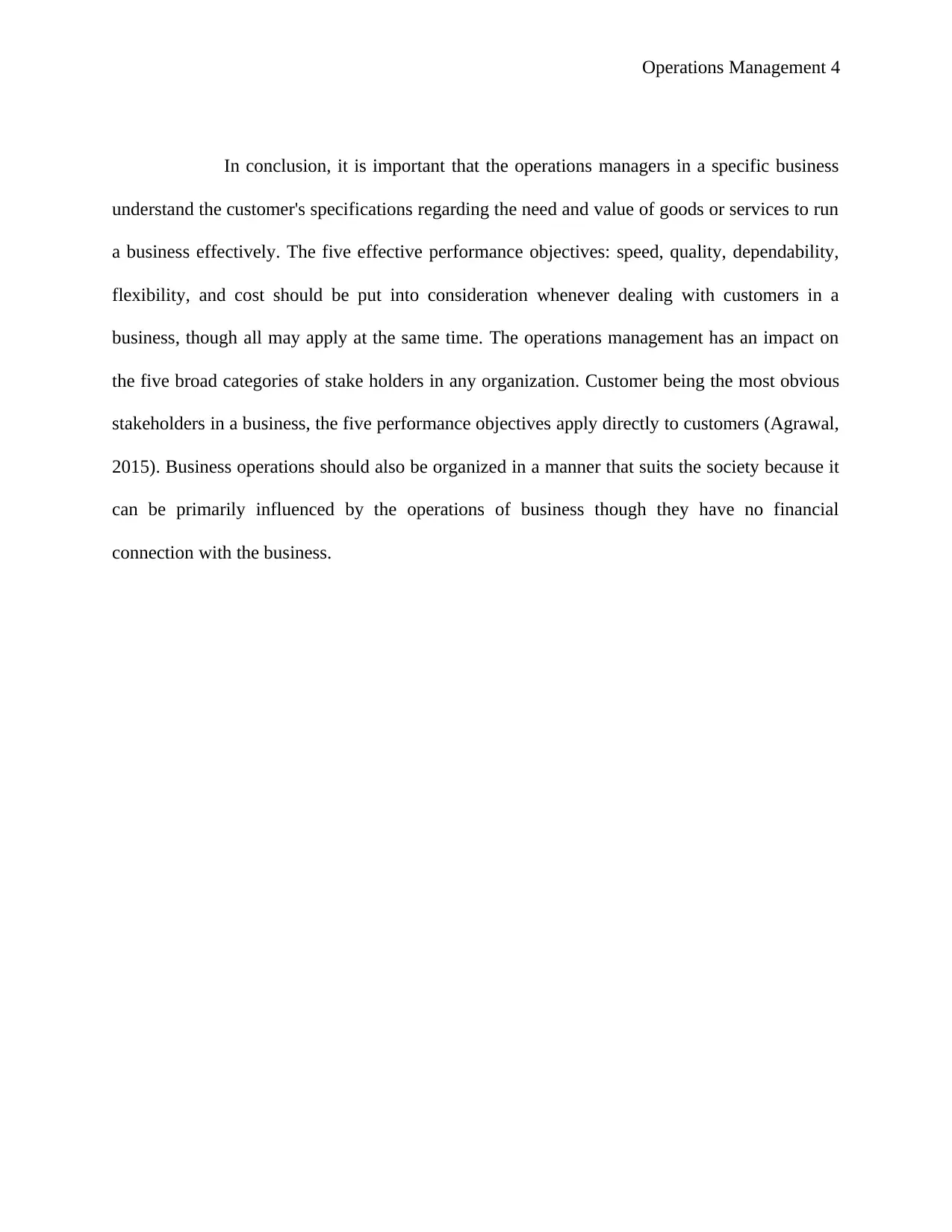
Below is the Dabbawala’s delivery process regarding customer's requirements.
Speed They deliver on time
Quality They have the best quality in Mumbai
Dependability They are very reliable
Flexibility They deliver a variety of food
Cost Very affordable
Deliver a variety of goods
Delivery is always on
time. Very reliable
They have the best quality.
Affordable prices for customers
Document Page
Operations Management 4
In conclusion, it is important that the operations managers in a specific business
understand the customer's specifications regarding the need and value of goods or services to run
a business effectively. The five effective performance objectives: speed, quality, dependability,
flexibility, and cost should be put into consideration whenever dealing with customers in a
business, though all may apply at the same time. The operations management has an impact on
the five broad categories of stake holders in any organization. Customer being the most obvious
stakeholders in a business, the five performance objectives apply directly to customers (Agrawal,
2015). Business operations should also be organized in a manner that suits the society because it
can be primarily influenced by the operations of business though they have no financial
connection with the business.
tabler-icon-diamond-filled.svg

Paraphrase This Document

Need a fresh take? Get an instant paraphrase of this document with our AI Paraphraser
Document Page
Operations Management 5
References
Agrawal, P. (2015). Mumbai dabbawalas. Retrieved from: https://www.youtube.com/watch?
v=NNwmwfu-gCg&feature=youtube>.
Millard, M. (2015). Operations Processes: Available at:
https://www,Transformationyoutube.com/watch?v=dx7DIPrvihc&feature=youtu.be.
Somerville, L., & Sargent, D. (2014). Day in the life of an RAA Patrol. [Online] Available at:
https://www.youtube.com/watch?v=Sy8K4uW39ZA&feature=youtu.be.
Document Page
Operations Management 6
chevron_up_icon
1 out of 6
circle_padding
hide_on_mobile
zoom_out_icon
[object Object]