Unit 16: Operations and Project Management Report on Marks & Spencer
VerifiedAdded on 2022/12/12
|17
|5450
|27
Report
AI Summary
This report provides a comprehensive analysis of operations and project management, using Marks & Spencer as a case study. It begins with an introduction to operation management, contrasting it with operations and exploring the implementation of key principles such as reality, organization, and accountability within the context of M&S. The report details how operation management aligns with business objectives, emphasizing continuous improvement and lean principles. The second part of the report delves into a project life cycle (PLC) analysis, evaluating project methodologies and tools relevant to M&S, and critically assesses the effectiveness of the PLC. The report highlights the practical application of these concepts within a real-world business setting, making it a valuable resource for understanding operational strategies and project management techniques. It emphasizes the importance of continuous improvement plans and how they contribute to achieving business objectives.
UNIT 16 – OPERATIONS AND
PROJECT MANAGEMENT
1
PROJECT MANAGEMENT
1

Paraphrase This Document
Need a fresh take? Get an instant paraphrase of this document with our AI Paraphraser
TABLE OF CONTENTS
PART A...........................................................................................................................................3
INTRODUCTION...........................................................................................................................3
Organisation overview.................................................................................................................3
Operation vs operation management...........................................................................................4
Implementation of operation management principles.................................................................4
Operation management meet up requirements of business entity...............................................6
Continuous improvement and lean principles.............................................................................7
Continuous improvement plan.....................................................................................................7
CONCLUSION................................................................................................................................7
PART-2............................................................................................................................................8
INTRODUCTION...........................................................................................................................8
Overview of the case study..........................................................................................................8
Application of key stages of PLC to the project..........................................................................8
Analysis of project methodologies and tool that could be used................................................12
Review and critical evaluate of effectiveness of Project life cycle...........................................14
CONCLUSION..............................................................................................................................15
REFERENCES..............................................................................................................................16
2
PART A...........................................................................................................................................3
INTRODUCTION...........................................................................................................................3
Organisation overview.................................................................................................................3
Operation vs operation management...........................................................................................4
Implementation of operation management principles.................................................................4
Operation management meet up requirements of business entity...............................................6
Continuous improvement and lean principles.............................................................................7
Continuous improvement plan.....................................................................................................7
CONCLUSION................................................................................................................................7
PART-2............................................................................................................................................8
INTRODUCTION...........................................................................................................................8
Overview of the case study..........................................................................................................8
Application of key stages of PLC to the project..........................................................................8
Analysis of project methodologies and tool that could be used................................................12
Review and critical evaluate of effectiveness of Project life cycle...........................................14
CONCLUSION..............................................................................................................................15
REFERENCES..............................................................................................................................16
2
PART A
INTRODUCTION
Operation management is processes involve managing different operations associated
with the business entity. This report is based on the case study of Marks and Spencer Company
in respect to its operation management like approaches. Henceforth, report will emphasis over
the overview of the organisation. Operation versus operation management will be discussed in
briefly under this project. Different implementation of the operation management function will
be described in detail under this project. Furthermore, project will discuss the fact that how
operation management allow the business entity to meet up its overall business objectives.
Continuous improvement and lean principles will also discuss as a part of this project. Precise
continuous improvement plan will also highlight under this whole report.
Organisation overview
Marks and Spencer Company is based in United Kingdom. Company was established in
the year 1884 by the founders Michael Marks and Thomas Spencer. Headquarter f the company
is located in London, United Kingdom. Currently company is catering its business operations at
approximately 15000 business locations at a global level. Marks and Spencer Company is also a
part of the FTSE 250 list that clearly demonstrates the dominance of the business entity in the
retail market of United Kingdom along with the globe (Wickramasinghe and Chathurani, 2020).
Company deal in high quality clothing line, food products and home products that fundamentally
allow the customers to satisfy its basic needs and requirements of living. Company offer its
services with support of its stores at different locations across the globe and also over the e-
commerce platform to achieve the best level of sales of company (Estelles-Miguel and et.al.,
2019). Marks and Spencer Company constrain more than 78000 employees at a global level as
per the recent statistics and figures of the business report. Company has given a huge emphasis
over catering quality products and services that allow the business entity to establish the long
term relationship with the potential customers in market. In the retail market at a global level
Marks and Spencer Company is one of the major brand as it offer its services at both the trading
modes online and offline. Management of company take operation management as its prominent
approach to manage all its operations and functions so that company can achieve the best level of
work efficiency in the respective market.
3
INTRODUCTION
Operation management is processes involve managing different operations associated
with the business entity. This report is based on the case study of Marks and Spencer Company
in respect to its operation management like approaches. Henceforth, report will emphasis over
the overview of the organisation. Operation versus operation management will be discussed in
briefly under this project. Different implementation of the operation management function will
be described in detail under this project. Furthermore, project will discuss the fact that how
operation management allow the business entity to meet up its overall business objectives.
Continuous improvement and lean principles will also discuss as a part of this project. Precise
continuous improvement plan will also highlight under this whole report.
Organisation overview
Marks and Spencer Company is based in United Kingdom. Company was established in
the year 1884 by the founders Michael Marks and Thomas Spencer. Headquarter f the company
is located in London, United Kingdom. Currently company is catering its business operations at
approximately 15000 business locations at a global level. Marks and Spencer Company is also a
part of the FTSE 250 list that clearly demonstrates the dominance of the business entity in the
retail market of United Kingdom along with the globe (Wickramasinghe and Chathurani, 2020).
Company deal in high quality clothing line, food products and home products that fundamentally
allow the customers to satisfy its basic needs and requirements of living. Company offer its
services with support of its stores at different locations across the globe and also over the e-
commerce platform to achieve the best level of sales of company (Estelles-Miguel and et.al.,
2019). Marks and Spencer Company constrain more than 78000 employees at a global level as
per the recent statistics and figures of the business report. Company has given a huge emphasis
over catering quality products and services that allow the business entity to establish the long
term relationship with the potential customers in market. In the retail market at a global level
Marks and Spencer Company is one of the major brand as it offer its services at both the trading
modes online and offline. Management of company take operation management as its prominent
approach to manage all its operations and functions so that company can achieve the best level of
work efficiency in the respective market.
3
⊘ This is a preview!⊘
Do you want full access?
Subscribe today to unlock all pages.

Trusted by 1+ million students worldwide
Operation vs operation management
Operation is denoted as managing different roles and responsibilities associated with the
business. Operation management is a practice follow by the Marks and Spencer Company in
which all operations denoted a specific role and responsibility at the organisation level are
mitigate by the company. Operation is a part of the operation management approach. This can be
stated as managing different operations demonstrated with the different roles in the organisation.
Operation management is a proper approach comprises with the planning, research,
implementation, control and finalise like stages (Hsu and et.al., 2020). Operation is only a part of
the operation management plan that involves the implementation stage of the organisation. The
basic difference between the operation and the operation management is that operation in only a
single practice that deliver but when it comes to operation management function in involve
management of set of functional responsibilities also comprises with the research, planning,
implementation, control and monitor the whole operation and such related task. Operation
management is a set of task that conducted while operation management is only a single task that
needed to incorporate by the professionals. Operation management activity is conducted with
support of different principles like reality, fundamentals and many such principles whole
operation on the other side conducted or implemented with support of different principles.
As a professional it require more fundamental support and skill to implement the whole
operation management practice while it take a less level of skill and ability to achieve the best
flow of operations (Lleo and et.al., 2020). This can be strategically demonstrated that operation
management is a bigger responsibility than the operation itself. This involves professional level
of practice to be delivered. Operation management on the other hand require multiple
professionals of different field and background whereas operations are conducted with support of
the professionals belong to same professional background or the different occupational areas
(Abdullah and Hua, 2017). Team formulation is also a key role in the operation management
whereas; this is possible that operations can be delivered without formation of any of the team.
The scale of responsibilities is different in case of operation management than the operations as a
solely functional area.
Implementation of operation management principles
Operation management is a professional level of practice that delivers with support of the
certain principles that favour the management to control all its operational responsibilities.
4
Operation is denoted as managing different roles and responsibilities associated with the
business. Operation management is a practice follow by the Marks and Spencer Company in
which all operations denoted a specific role and responsibility at the organisation level are
mitigate by the company. Operation is a part of the operation management approach. This can be
stated as managing different operations demonstrated with the different roles in the organisation.
Operation management is a proper approach comprises with the planning, research,
implementation, control and finalise like stages (Hsu and et.al., 2020). Operation is only a part of
the operation management plan that involves the implementation stage of the organisation. The
basic difference between the operation and the operation management is that operation in only a
single practice that deliver but when it comes to operation management function in involve
management of set of functional responsibilities also comprises with the research, planning,
implementation, control and monitor the whole operation and such related task. Operation
management is a set of task that conducted while operation management is only a single task that
needed to incorporate by the professionals. Operation management activity is conducted with
support of different principles like reality, fundamentals and many such principles whole
operation on the other side conducted or implemented with support of different principles.
As a professional it require more fundamental support and skill to implement the whole
operation management practice while it take a less level of skill and ability to achieve the best
flow of operations (Lleo and et.al., 2020). This can be strategically demonstrated that operation
management is a bigger responsibility than the operation itself. This involves professional level
of practice to be delivered. Operation management on the other hand require multiple
professionals of different field and background whereas operations are conducted with support of
the professionals belong to same professional background or the different occupational areas
(Abdullah and Hua, 2017). Team formulation is also a key role in the operation management
whereas; this is possible that operations can be delivered without formation of any of the team.
The scale of responsibilities is different in case of operation management than the operations as a
solely functional area.
Implementation of operation management principles
Operation management is a professional level of practice that delivers with support of the
certain principles that favour the management to control all its operational responsibilities.
4
Paraphrase This Document
Need a fresh take? Get an instant paraphrase of this document with our AI Paraphraser
Following are the principles that are used by the management of the Marks and Spencer
Company in process to manage and control the operations of business entity.
Reality: Operation management is a real practice that delivers the operation. All practices
adopted under the operation management must be practically possible to implement by the
business entity. This is really important for the organisation to overlook these aspects so that best
level of outcomes could have been derived by the organisation as a part of its operation
management practice (Hai, 2018). Every policy that is adopted by the management must be
practically implemented in real situation than only it should be adopted at the organisation level.
Organisation: The organisation is a key principle of operation management. All practices
company has adopted must be interred connected with each other. The organsaition should
contain a proper hierarchy that can convey all the practices at the practical ground. This principle
make processes more professional i context to the Marks and Spencer Company.
Fundamentals: Operation management must comply with all the basic requirements associated
with the organisation. This must ensure the fundamental requirement company ensure in process
to achieve the best level of operation effectiveness at the business entity level (McLean Antony
and Dahlgaard, 2017). The basic structure of the operation is such that it must cope up with all
the fundamental requirements associated with the business entity. This make processes more
strategic and static in regards to the business entity.
Accountability: Accountability is also a key principle associated with the operation
management. Senior management need to take various decisions related to the operation
management so that best level of work efficiency can be achieved by the company. All decisions
employees take must feel accountable for such decision making as it will directly affect the
overall work efficiency of the operation (Kim and et.al., 2017). All department head must also
feel accountable for all the decision company take behind managing operations of the
organisation.
Variance: Variance is about to manage the creativity around the business entity. This involves
managing the creative skill and ideology at the organisation. This improves the overall
effectiveness of the operation management implemented at the Marks and Spencer Company.
This allows boosting up to the creative mindset of the employee associated with the organisation.
Causality: Effective operation management program put a right balance over the operation
management task at the organisation. This move forwards to identify the right balance for
5
Company in process to manage and control the operations of business entity.
Reality: Operation management is a real practice that delivers the operation. All practices
adopted under the operation management must be practically possible to implement by the
business entity. This is really important for the organisation to overlook these aspects so that best
level of outcomes could have been derived by the organisation as a part of its operation
management practice (Hai, 2018). Every policy that is adopted by the management must be
practically implemented in real situation than only it should be adopted at the organisation level.
Organisation: The organisation is a key principle of operation management. All practices
company has adopted must be interred connected with each other. The organsaition should
contain a proper hierarchy that can convey all the practices at the practical ground. This principle
make processes more professional i context to the Marks and Spencer Company.
Fundamentals: Operation management must comply with all the basic requirements associated
with the organisation. This must ensure the fundamental requirement company ensure in process
to achieve the best level of operation effectiveness at the business entity level (McLean Antony
and Dahlgaard, 2017). The basic structure of the operation is such that it must cope up with all
the fundamental requirements associated with the business entity. This make processes more
strategic and static in regards to the business entity.
Accountability: Accountability is also a key principle associated with the operation
management. Senior management need to take various decisions related to the operation
management so that best level of work efficiency can be achieved by the company. All decisions
employees take must feel accountable for such decision making as it will directly affect the
overall work efficiency of the operation (Kim and et.al., 2017). All department head must also
feel accountable for all the decision company take behind managing operations of the
organisation.
Variance: Variance is about to manage the creativity around the business entity. This involves
managing the creative skill and ideology at the organisation. This improves the overall
effectiveness of the operation management implemented at the Marks and Spencer Company.
This allows boosting up to the creative mindset of the employee associated with the organisation.
Causality: Effective operation management program put a right balance over the operation
management task at the organisation. This move forwards to identify the right balance for
5
addressing all different problems and challenges operation management faces at the work place
(LI, 2017). As this is very obvious that the operation management channelizes by the company
will face several problems and issues. This principle guide the management and employee part of
the operation management campaign to take necessary steps for solving all different issues and
problems.
Managed passion: Managed person is another key principle associated with the operation
management. This involves managing the individual needs and requirements of the employee’s
part f the operation management campaign. This is important for the department heads and
senior employees of company to overlook all individual requirements of the employees become
part of the operation management approach (Sheng, Tang and Qin, 2017). Managing passion
lead the high success rate of all different operation management campaign launched by the
company.
Humility: Humility is a core principle related to the operation management. This is denoted as
the trial and error technique part of the operation management. As a operation manager many
times this technique being criticised as this is about to try out some practices so that more
importance could have been established in the operation management practice.
Success: Success is the key factor that tried to achieve by the management against the operation
management. All task and functions performed depict the aim of achieving success in the
operation management approach followed by company.
Change: Change is a core requirement of the operation management. This involves on the basis
of the needs and requirements of the business entity this lead to change in the organisation.
Operation management meet up requirements of business entity
Operation management is processes that involve on the basis of the different needs and
requirements of the retail market it involve managing all different operations of the company.
Marks and Spencer Company channelizes different functional and operational areas on the basis
of the needs and requirements of the business entity. Under the process of the operation
management different teams are formulated so that best level of work efficiency could have been
achieved by the company. All the process follow by the company allow the business entity to
meet up different business requirements (Zhang and Hu, 2017). The process of the operation
management allow the business entity to deliver different business objectives such as work
efficiency, profitability, skill of employee and many such objectives that drive the overall
6
(LI, 2017). As this is very obvious that the operation management channelizes by the company
will face several problems and issues. This principle guide the management and employee part of
the operation management campaign to take necessary steps for solving all different issues and
problems.
Managed passion: Managed person is another key principle associated with the operation
management. This involves managing the individual needs and requirements of the employee’s
part f the operation management campaign. This is important for the department heads and
senior employees of company to overlook all individual requirements of the employees become
part of the operation management approach (Sheng, Tang and Qin, 2017). Managing passion
lead the high success rate of all different operation management campaign launched by the
company.
Humility: Humility is a core principle related to the operation management. This is denoted as
the trial and error technique part of the operation management. As a operation manager many
times this technique being criticised as this is about to try out some practices so that more
importance could have been established in the operation management practice.
Success: Success is the key factor that tried to achieve by the management against the operation
management. All task and functions performed depict the aim of achieving success in the
operation management approach followed by company.
Change: Change is a core requirement of the operation management. This involves on the basis
of the needs and requirements of the business entity this lead to change in the organisation.
Operation management meet up requirements of business entity
Operation management is processes that involve on the basis of the different needs and
requirements of the retail market it involve managing all different operations of the company.
Marks and Spencer Company channelizes different functional and operational areas on the basis
of the needs and requirements of the business entity. Under the process of the operation
management different teams are formulated so that best level of work efficiency could have been
achieved by the company. All the process follow by the company allow the business entity to
meet up different business requirements (Zhang and Hu, 2017). The process of the operation
management allow the business entity to deliver different business objectives such as work
efficiency, profitability, skill of employee and many such objectives that drive the overall
6
⊘ This is a preview!⊘
Do you want full access?
Subscribe today to unlock all pages.
Trusted by 1+ million students worldwide
operations of the business entity. Requirements of the business entity is also keep on changing all
the time that also meet up with the processes like operation management. This allows the Marks
and Spencer Company to deal with the different changing requirements associated with the retail
sector. This is precisely defined that the operation management function allows the company to
achieve all different needs and requirements of the business entity.
Continuous improvement and lean principles
Continuous improvement is a key part of the operation management functions adopted by
the Marks and Spencer Company. Operation management aim to achieve the best level of work
efficiency in against to deliver different functional responsibility at the organisation. The
operation manager always evaluates and analysis the process and practices so that negative areas
involved in the practices could have been highlighted by the manager. In the process of
highlighting negative areas of the operation manager try to take actions to overcome the negative
side of the operation. Under this whole process operation manager allow the continuous
improvement policy for the business entity (Shijun, Ruiwei and Jianhua, 2018). Highlighting and
assessing the areas that seek continuous improvement is a part of the operation management
plan. This principle allows the business entity to achieve the best level of outcome possible for
delivering the overall business objectives. Lean principles are also followed as a part of the
operation management policy. This practice covers all different areas of the management and
operations which empower the business entity to achieve all business objectives.
Continuous improvement plan
Continuous improvement plan is a part of the operation management practice. This
involve highlighting the weak areas of the operations undertaken by the business entity and
based on the highlighted spot company plan the improvement process. This involves overcoming
the weak areas with support of some strategic direction undertaken by the business entity. This
plan summarises with the aim, objectives, strategies, control and evaluation and budget. All these
are the key aspects associated with the continuous improvement plan (Jurburg and et.al., 2017).
Monitoring and evaluation of the strategies are also an important part of the whole plan is that it
allow the management at top level of to constantly enhance the overall ability of the business
entity. As a part of the continuous improvement plan Marks and Spencer Company will use
methods like Kaizen, Kanban and TQM. All these are the techniques that support the company to
ensure the proper improvement in the operations and processes.
7
the time that also meet up with the processes like operation management. This allows the Marks
and Spencer Company to deal with the different changing requirements associated with the retail
sector. This is precisely defined that the operation management function allows the company to
achieve all different needs and requirements of the business entity.
Continuous improvement and lean principles
Continuous improvement is a key part of the operation management functions adopted by
the Marks and Spencer Company. Operation management aim to achieve the best level of work
efficiency in against to deliver different functional responsibility at the organisation. The
operation manager always evaluates and analysis the process and practices so that negative areas
involved in the practices could have been highlighted by the manager. In the process of
highlighting negative areas of the operation manager try to take actions to overcome the negative
side of the operation. Under this whole process operation manager allow the continuous
improvement policy for the business entity (Shijun, Ruiwei and Jianhua, 2018). Highlighting and
assessing the areas that seek continuous improvement is a part of the operation management
plan. This principle allows the business entity to achieve the best level of outcome possible for
delivering the overall business objectives. Lean principles are also followed as a part of the
operation management policy. This practice covers all different areas of the management and
operations which empower the business entity to achieve all business objectives.
Continuous improvement plan
Continuous improvement plan is a part of the operation management practice. This
involve highlighting the weak areas of the operations undertaken by the business entity and
based on the highlighted spot company plan the improvement process. This involves overcoming
the weak areas with support of some strategic direction undertaken by the business entity. This
plan summarises with the aim, objectives, strategies, control and evaluation and budget. All these
are the key aspects associated with the continuous improvement plan (Jurburg and et.al., 2017).
Monitoring and evaluation of the strategies are also an important part of the whole plan is that it
allow the management at top level of to constantly enhance the overall ability of the business
entity. As a part of the continuous improvement plan Marks and Spencer Company will use
methods like Kaizen, Kanban and TQM. All these are the techniques that support the company to
ensure the proper improvement in the operations and processes.
7
Paraphrase This Document
Need a fresh take? Get an instant paraphrase of this document with our AI Paraphraser
PDCA Cycle
Act: This is about to act over the potential improvemet can be seen in the project. This allow the
business entity to act over the potential level of improvement required in the project.
Plan: This is about to plan the improvement that is needed under the project. The plan is the
function that involve analysing the improvement requirements and based on the resources
available this is about to plan the whole improvement process.
DO: This is about to do the necessary modification.
Check: This is about to check the improvement is done in proper manner.
CONCLUSION
Operation management is a process involves managing different requirements associated
with the operations undertaken by the business entity. Operation management is supported with
set of principles that make the business entity more capable to achieve the best level of work
efficiency under the operation management practice.
PART-2
INTRODUCTION
Operation management refers to process of organisation that is concerned with
conversation of raw material into finished products and services so that wants of the customers
can be fulfilled in the best possible manner. Project management is process that includes
planning of several activities, organising resources in order to implement a project and the end
goals. This report is about large manufacturing company which is based in Midland having
around 1250 employees that are working for growth and development of company. So, this
report covers application as wells as critical review of project life cycle that the company wants
to start in order to attained the end objectives.
Overview of the case study
The project is related to starting a in house project or insight catering for the large
manufacturing organisation in Midland that is having around 1250 employees that have different
roles, responsibilities in the organisation. The company wants to achieve two objectives through
implementing or starting the project such as reducing movement of staff from premises during
lunch break because it lead in congestion issue in local area (Mukherjee and Roy, 2017).
8
Act: This is about to act over the potential improvemet can be seen in the project. This allow the
business entity to act over the potential level of improvement required in the project.
Plan: This is about to plan the improvement that is needed under the project. The plan is the
function that involve analysing the improvement requirements and based on the resources
available this is about to plan the whole improvement process.
DO: This is about to do the necessary modification.
Check: This is about to check the improvement is done in proper manner.
CONCLUSION
Operation management is a process involves managing different requirements associated
with the operations undertaken by the business entity. Operation management is supported with
set of principles that make the business entity more capable to achieve the best level of work
efficiency under the operation management practice.
PART-2
INTRODUCTION
Operation management refers to process of organisation that is concerned with
conversation of raw material into finished products and services so that wants of the customers
can be fulfilled in the best possible manner. Project management is process that includes
planning of several activities, organising resources in order to implement a project and the end
goals. This report is about large manufacturing company which is based in Midland having
around 1250 employees that are working for growth and development of company. So, this
report covers application as wells as critical review of project life cycle that the company wants
to start in order to attained the end objectives.
Overview of the case study
The project is related to starting a in house project or insight catering for the large
manufacturing organisation in Midland that is having around 1250 employees that have different
roles, responsibilities in the organisation. The company wants to achieve two objectives through
implementing or starting the project such as reducing movement of staff from premises during
lunch break because it lead in congestion issue in local area (Mukherjee and Roy, 2017).
8
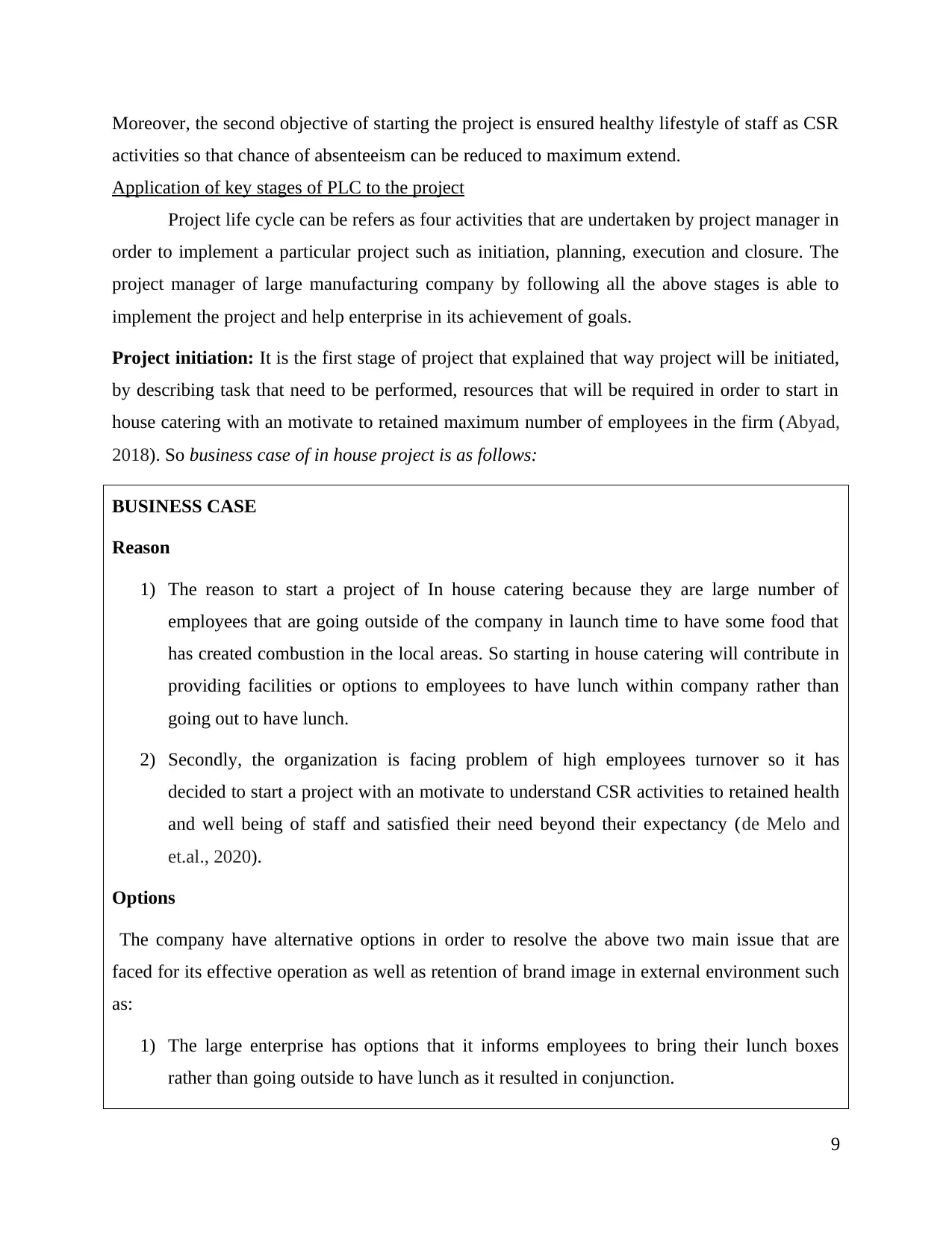
Moreover, the second objective of starting the project is ensured healthy lifestyle of staff as CSR
activities so that chance of absenteeism can be reduced to maximum extend.
Application of key stages of PLC to the project
Project life cycle can be refers as four activities that are undertaken by project manager in
order to implement a particular project such as initiation, planning, execution and closure. The
project manager of large manufacturing company by following all the above stages is able to
implement the project and help enterprise in its achievement of goals.
Project initiation: It is the first stage of project that explained that way project will be initiated,
by describing task that need to be performed, resources that will be required in order to start in
house catering with an motivate to retained maximum number of employees in the firm (Abyad,
2018). So business case of in house project is as follows:
BUSINESS CASE
Reason
1) The reason to start a project of In house catering because they are large number of
employees that are going outside of the company in launch time to have some food that
has created combustion in the local areas. So starting in house catering will contribute in
providing facilities or options to employees to have lunch within company rather than
going out to have lunch.
2) Secondly, the organization is facing problem of high employees turnover so it has
decided to start a project with an motivate to understand CSR activities to retained health
and well being of staff and satisfied their need beyond their expectancy (de Melo and
et.al., 2020).
Options
The company have alternative options in order to resolve the above two main issue that are
faced for its effective operation as well as retention of brand image in external environment such
as:
1) The large enterprise has options that it informs employees to bring their lunch boxes
rather than going outside to have lunch as it resulted in conjunction.
9
activities so that chance of absenteeism can be reduced to maximum extend.
Application of key stages of PLC to the project
Project life cycle can be refers as four activities that are undertaken by project manager in
order to implement a particular project such as initiation, planning, execution and closure. The
project manager of large manufacturing company by following all the above stages is able to
implement the project and help enterprise in its achievement of goals.
Project initiation: It is the first stage of project that explained that way project will be initiated,
by describing task that need to be performed, resources that will be required in order to start in
house catering with an motivate to retained maximum number of employees in the firm (Abyad,
2018). So business case of in house project is as follows:
BUSINESS CASE
Reason
1) The reason to start a project of In house catering because they are large number of
employees that are going outside of the company in launch time to have some food that
has created combustion in the local areas. So starting in house catering will contribute in
providing facilities or options to employees to have lunch within company rather than
going out to have lunch.
2) Secondly, the organization is facing problem of high employees turnover so it has
decided to start a project with an motivate to understand CSR activities to retained health
and well being of staff and satisfied their need beyond their expectancy (de Melo and
et.al., 2020).
Options
The company have alternative options in order to resolve the above two main issue that are
faced for its effective operation as well as retention of brand image in external environment such
as:
1) The large enterprise has options that it informs employees to bring their lunch boxes
rather than going outside to have lunch as it resulted in conjunction.
9
⊘ This is a preview!⊘
Do you want full access?
Subscribe today to unlock all pages.
Trusted by 1+ million students worldwide
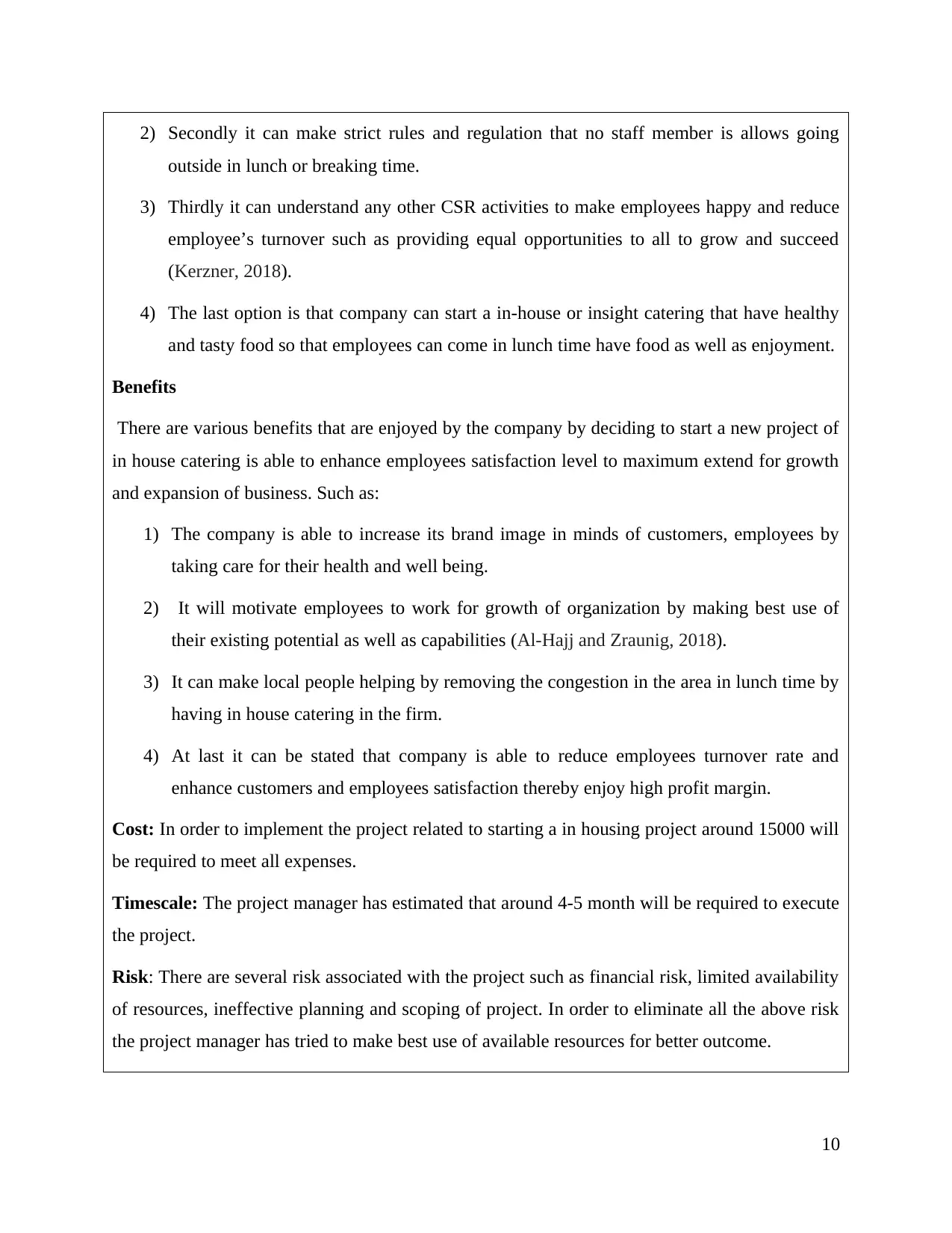
2) Secondly it can make strict rules and regulation that no staff member is allows going
outside in lunch or breaking time.
3) Thirdly it can understand any other CSR activities to make employees happy and reduce
employee’s turnover such as providing equal opportunities to all to grow and succeed
(Kerzner, 2018).
4) The last option is that company can start a in-house or insight catering that have healthy
and tasty food so that employees can come in lunch time have food as well as enjoyment.
Benefits
There are various benefits that are enjoyed by the company by deciding to start a new project of
in house catering is able to enhance employees satisfaction level to maximum extend for growth
and expansion of business. Such as:
1) The company is able to increase its brand image in minds of customers, employees by
taking care for their health and well being.
2) It will motivate employees to work for growth of organization by making best use of
their existing potential as well as capabilities (Al-Hajj and Zraunig, 2018).
3) It can make local people helping by removing the congestion in the area in lunch time by
having in house catering in the firm.
4) At last it can be stated that company is able to reduce employees turnover rate and
enhance customers and employees satisfaction thereby enjoy high profit margin.
Cost: In order to implement the project related to starting a in housing project around 15000 will
be required to meet all expenses.
Timescale: The project manager has estimated that around 4-5 month will be required to execute
the project.
Risk: There are several risk associated with the project such as financial risk, limited availability
of resources, ineffective planning and scoping of project. In order to eliminate all the above risk
the project manager has tried to make best use of available resources for better outcome.
10
outside in lunch or breaking time.
3) Thirdly it can understand any other CSR activities to make employees happy and reduce
employee’s turnover such as providing equal opportunities to all to grow and succeed
(Kerzner, 2018).
4) The last option is that company can start a in-house or insight catering that have healthy
and tasty food so that employees can come in lunch time have food as well as enjoyment.
Benefits
There are various benefits that are enjoyed by the company by deciding to start a new project of
in house catering is able to enhance employees satisfaction level to maximum extend for growth
and expansion of business. Such as:
1) The company is able to increase its brand image in minds of customers, employees by
taking care for their health and well being.
2) It will motivate employees to work for growth of organization by making best use of
their existing potential as well as capabilities (Al-Hajj and Zraunig, 2018).
3) It can make local people helping by removing the congestion in the area in lunch time by
having in house catering in the firm.
4) At last it can be stated that company is able to reduce employees turnover rate and
enhance customers and employees satisfaction thereby enjoy high profit margin.
Cost: In order to implement the project related to starting a in housing project around 15000 will
be required to meet all expenses.
Timescale: The project manager has estimated that around 4-5 month will be required to execute
the project.
Risk: There are several risk associated with the project such as financial risk, limited availability
of resources, ineffective planning and scoping of project. In order to eliminate all the above risk
the project manager has tried to make best use of available resources for better outcome.
10
Paraphrase This Document
Need a fresh take? Get an instant paraphrase of this document with our AI Paraphraser
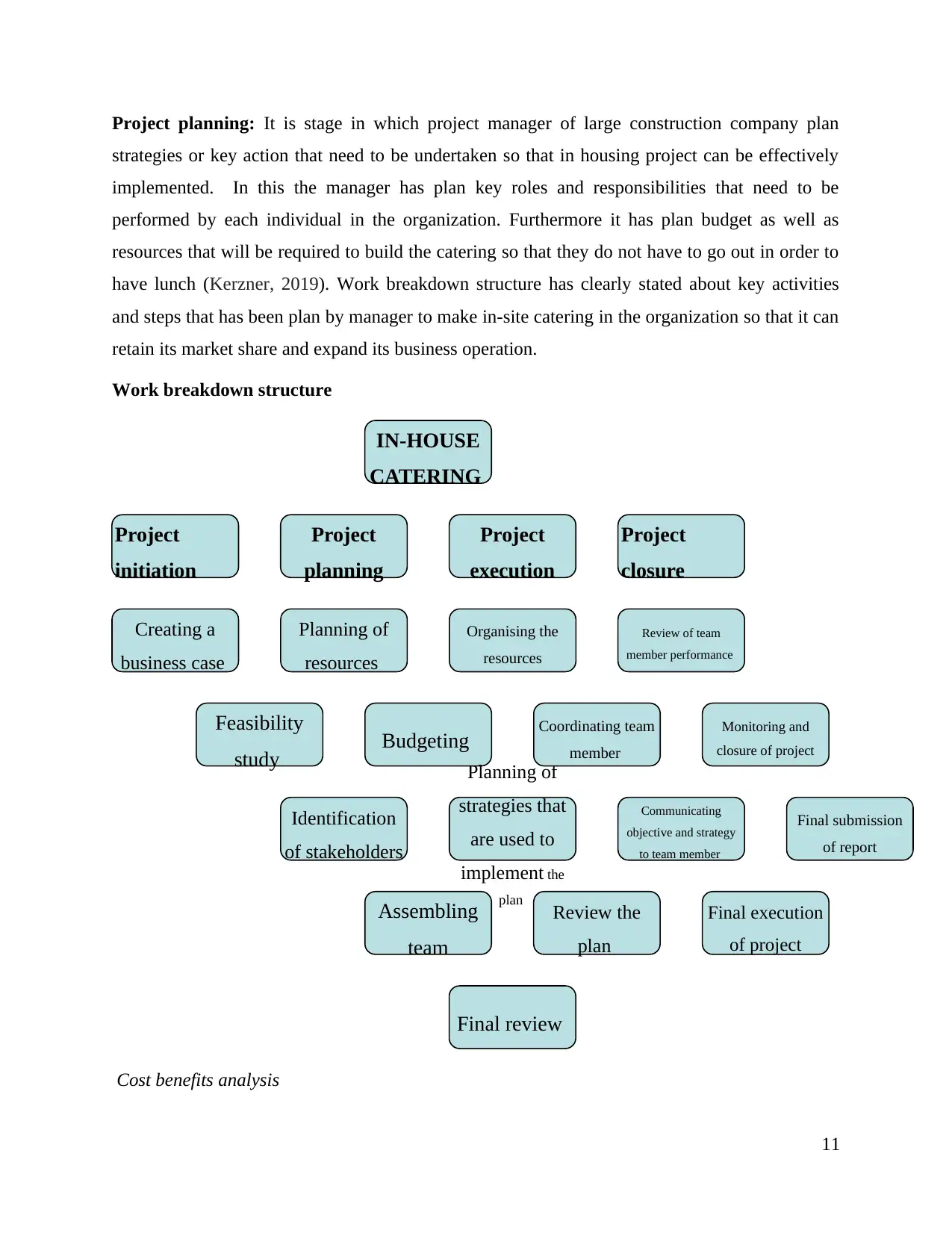
Project planning: It is stage in which project manager of large construction company plan
strategies or key action that need to be undertaken so that in housing project can be effectively
implemented. In this the manager has plan key roles and responsibilities that need to be
performed by each individual in the organization. Furthermore it has plan budget as well as
resources that will be required to build the catering so that they do not have to go out in order to
have lunch (Kerzner, 2019). Work breakdown structure has clearly stated about key activities
and steps that has been plan by manager to make in-site catering in the organization so that it can
retain its market share and expand its business operation.
Work breakdown structure
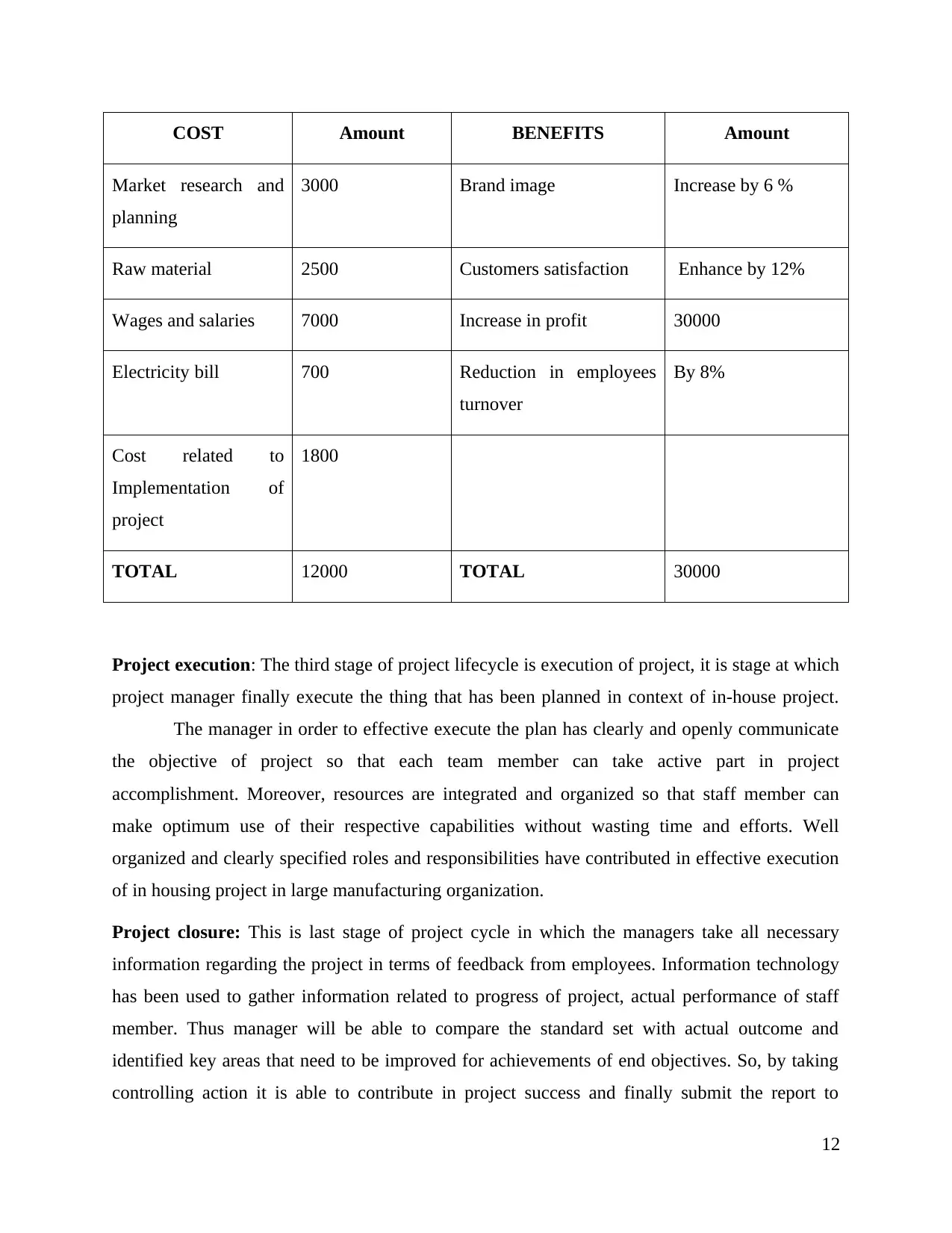
Cost benefits analysis
11
IN-HOUSE
CATERING
Project
initiation
Project
planning
Project
execution
Organising the
resources
Project
closure
Review of team
member performance
Monitoring and
closure of project
Creating a
business case
Feasibility
study
Identification
of stakeholders
Assembling
team
Planning of
resources
Budgeting
Planning of
strategies that
are used to
implement the
plan Review the
plan
Coordinating team
member
Communicating
objective and strategy
to team member
Final execution
of project
Final submission
of report
Final review
strategies or key action that need to be undertaken so that in housing project can be effectively
implemented. In this the manager has plan key roles and responsibilities that need to be
performed by each individual in the organization. Furthermore it has plan budget as well as
resources that will be required to build the catering so that they do not have to go out in order to
have lunch (Kerzner, 2019). Work breakdown structure has clearly stated about key activities
and steps that has been plan by manager to make in-site catering in the organization so that it can
retain its market share and expand its business operation.
Work breakdown structure
Cost benefits analysis
11
IN-HOUSE
CATERING
Project
initiation
Project
planning
Project
execution
Organising the
resources
Project
closure
Review of team
member performance
Monitoring and
closure of project
Creating a
business case
Feasibility
study
Identification
of stakeholders
Assembling
team
Planning of
resources
Budgeting
Planning of
strategies that
are used to
implement the
plan Review the
plan
Coordinating team
member
Communicating
objective and strategy
to team member
Final execution
of project
Final submission
of report
Final review
COST Amount BENEFITS Amount
Market research and
planning
3000 Brand image Increase by 6 %
Raw material 2500 Customers satisfaction Enhance by 12%
Wages and salaries 7000 Increase in profit 30000
Electricity bill 700 Reduction in employees
turnover
By 8%
Cost related to
Implementation of
project
1800
TOTAL 12000 TOTAL 30000
Project execution: The third stage of project lifecycle is execution of project, it is stage at which
project manager finally execute the thing that has been planned in context of in-house project.
The manager in order to effective execute the plan has clearly and openly communicate
the objective of project so that each team member can take active part in project
accomplishment. Moreover, resources are integrated and organized so that staff member can
make optimum use of their respective capabilities without wasting time and efforts. Well
organized and clearly specified roles and responsibilities have contributed in effective execution
of in housing project in large manufacturing organization.
Project closure: This is last stage of project cycle in which the managers take all necessary
information regarding the project in terms of feedback from employees. Information technology
has been used to gather information related to progress of project, actual performance of staff
member. Thus manager will be able to compare the standard set with actual outcome and
identified key areas that need to be improved for achievements of end objectives. So, by taking
controlling action it is able to contribute in project success and finally submit the report to
12
Market research and
planning
3000 Brand image Increase by 6 %
Raw material 2500 Customers satisfaction Enhance by 12%
Wages and salaries 7000 Increase in profit 30000
Electricity bill 700 Reduction in employees
turnover
By 8%
Cost related to
Implementation of
project
1800
TOTAL 12000 TOTAL 30000
Project execution: The third stage of project lifecycle is execution of project, it is stage at which
project manager finally execute the thing that has been planned in context of in-house project.
The manager in order to effective execute the plan has clearly and openly communicate
the objective of project so that each team member can take active part in project
accomplishment. Moreover, resources are integrated and organized so that staff member can
make optimum use of their respective capabilities without wasting time and efforts. Well
organized and clearly specified roles and responsibilities have contributed in effective execution
of in housing project in large manufacturing organization.
Project closure: This is last stage of project cycle in which the managers take all necessary
information regarding the project in terms of feedback from employees. Information technology
has been used to gather information related to progress of project, actual performance of staff
member. Thus manager will be able to compare the standard set with actual outcome and
identified key areas that need to be improved for achievements of end objectives. So, by taking
controlling action it is able to contribute in project success and finally submit the report to
12
⊘ This is a preview!⊘
Do you want full access?
Subscribe today to unlock all pages.
Trusted by 1+ million students worldwide

1 out of 17


Related Documents


Your All-in-One AI-Powered Toolkit for Academic Success.
+13062052269
info@desklib.com
Available 24*7 on WhatsApp / Email
![[object Object]](/_next/static/media/star-bottom.7253800d.svg)
Unlock your academic potential
Copyright © 2020–2026 A2Z Services. All Rights Reserved. Developed and managed by ZUCOL.