Operations and Project Management Report: Toyota Motor Corp Analysis
VerifiedAdded on 2023/01/11
|17
|5476
|91
Report
AI Summary
This report provides a comprehensive analysis of Toyota's operations and project management practices. It begins with an introduction to operations management, outlining key objectives such as quality, speed, dependability, flexibility, and cost. The report then delves into the five principles of Toyota management, emphasizing long-term philosophies, continuous process flow, pull systems, quality at the source, and the use of reliable technology. Furthermore, the report explores the concept of continuous improvement, presenting a plan and analyzing its effectiveness. The project management section covers the project life cycle, Work Breakdown Structure (WBS), Gantt charts, leadership, and the critical path method, evaluating their application in both large and small projects. The report concludes with a discussion of the practical and theoretical effectiveness of these tools, offering insights into Toyota's operational strategies and their impact on the company's success.
Operations and project
management
management

Paraphrase This Document
Need a fresh take? Get an instant paraphrase of this document with our AI Paraphraser
Table of Contents
INTRODUCTION...........................................................................................................................4
TASK 1............................................................................................................................................4
Objectives of operation management:....................................................................................4
P1 Five principles used by Toyota management are mentioned below:................................6
M1 Approaches to operations management...........................................................................8
TASK 2..........................................................................................................................................10
Concept of continuous improvement....................................................................................10
Briefly state the principles of continuous improvement.......................................................10
P2 Continuous improvement plan........................................................................................11
CONTINUOUS IMPROVEMENT PLAN..........................................................................11
M2 Analysis of effectiveness of the continuous improvement plan....................................13
D1 Strategies for achieving continuous improvement and efficiency at Toyota.................13
TASK 3..........................................................................................................................................14
P3 Project Life Cycle............................................................................................................14
M3 Analysis of rationale for using WBS, Gantt Chart, leadership and Critical Path for project
..............................................................................................................................................14
P4 Review of effectiveness of application of all these tools................................................15
M4 Critical analysis of using these tools for large and small projects.................................15
D2 Practical and theoretical effectiveness of PLC application in this project.....................15
CONCLUSION..............................................................................................................................16
Appendix........................................................................................................................................16
REFERENCES..............................................................................................................................18
INTRODUCTION...........................................................................................................................4
TASK 1............................................................................................................................................4
Objectives of operation management:....................................................................................4
P1 Five principles used by Toyota management are mentioned below:................................6
M1 Approaches to operations management...........................................................................8
TASK 2..........................................................................................................................................10
Concept of continuous improvement....................................................................................10
Briefly state the principles of continuous improvement.......................................................10
P2 Continuous improvement plan........................................................................................11
CONTINUOUS IMPROVEMENT PLAN..........................................................................11
M2 Analysis of effectiveness of the continuous improvement plan....................................13
D1 Strategies for achieving continuous improvement and efficiency at Toyota.................13
TASK 3..........................................................................................................................................14
P3 Project Life Cycle............................................................................................................14
M3 Analysis of rationale for using WBS, Gantt Chart, leadership and Critical Path for project
..............................................................................................................................................14
P4 Review of effectiveness of application of all these tools................................................15
M4 Critical analysis of using these tools for large and small projects.................................15
D2 Practical and theoretical effectiveness of PLC application in this project.....................15
CONCLUSION..............................................................................................................................16
Appendix........................................................................................................................................16
REFERENCES..............................................................................................................................18
INTRODUCTION
“Operation management is mainly concerned with planning, organising and supervising the
functions of production, manufacturing or the provision of services for an organisation.” This
means that the major motive of operation management is to plan, organise and supervise all the
activities which are related to manufacturing or production of products and services for an
organisation.
“Operations management is that area of management which is concerned with designing and
controlling the production process and redesigning business operations in production of goods
and services.” This explains that the process of operation management include designing of a
product or service as well as redesigning which means any innovation brought further in the
product or service is also considered under operational management. The following report is
based on oral operation management of Toyota motor Corp (Artto, Ahola and Vartiainen,
2016).It is a Japanese multinational company for manufacturing of automotive and whose
headquarter is in Toyota, Aichi, Japan. The following report contains various objectives of
operation management, approaches of operation management continuous improvement concept
for Toyota. In activity three discussion is made on business case regarding project plan, work
breakdown structure, Gantt chart and project closure.
TASK 1
Objectives of operation management:
A number of organisational expect operations involve in implementing supporting as well
as driving business strategies. There are five basic operation performance objective which are
mentioned below:
Quality: Quality is the measure through which product and services it’s just on meeting the
customers expectation. This explains how will a product confirm that the expectation of
customer is met. Although it is hard to measure the customer expectation and satisfaction but this
have a great effect on operation objectives. It is seen that quality reduces cost as no mistakes are
made in product so no extra cost is required. It is also seen that quality also have internal impacts
along with a number of external impacts so there is no distraction in employees while they work
for higher quality products which also increases their speed and enhances productivity for the
organisation. In Toyota there is a team which helps in development of new support and also
“Operation management is mainly concerned with planning, organising and supervising the
functions of production, manufacturing or the provision of services for an organisation.” This
means that the major motive of operation management is to plan, organise and supervise all the
activities which are related to manufacturing or production of products and services for an
organisation.
“Operations management is that area of management which is concerned with designing and
controlling the production process and redesigning business operations in production of goods
and services.” This explains that the process of operation management include designing of a
product or service as well as redesigning which means any innovation brought further in the
product or service is also considered under operational management. The following report is
based on oral operation management of Toyota motor Corp (Artto, Ahola and Vartiainen,
2016).It is a Japanese multinational company for manufacturing of automotive and whose
headquarter is in Toyota, Aichi, Japan. The following report contains various objectives of
operation management, approaches of operation management continuous improvement concept
for Toyota. In activity three discussion is made on business case regarding project plan, work
breakdown structure, Gantt chart and project closure.
TASK 1
Objectives of operation management:
A number of organisational expect operations involve in implementing supporting as well
as driving business strategies. There are five basic operation performance objective which are
mentioned below:
Quality: Quality is the measure through which product and services it’s just on meeting the
customers expectation. This explains how will a product confirm that the expectation of
customer is met. Although it is hard to measure the customer expectation and satisfaction but this
have a great effect on operation objectives. It is seen that quality reduces cost as no mistakes are
made in product so no extra cost is required. It is also seen that quality also have internal impacts
along with a number of external impacts so there is no distraction in employees while they work
for higher quality products which also increases their speed and enhances productivity for the
organisation. In Toyota there is a team which helps in development of new support and also
⊘ This is a preview!⊘
Do you want full access?
Subscribe today to unlock all pages.

Trusted by 1+ million students worldwide
troubleshooting the problems of customers. This helps in maintaining the quality of product.
They also focus on best quality of raw materials in order to make sure that quality of products is
not hampered.
Speed: Speed can be said to be an objective of operation which reflects the time of firm to
respond to their customer request. When operation cycle or more enhanced the speed can be
increased and higher customer satisfaction can be attained by company which will also ensure
that the customers are then more likely to buy the product again. Major objective is to make the
responsive time place and also ensure that deliveries are made which also helps in reducing cost
of total inventory in the system. When there is fast operational cycle present in an organisation
the time between customer request and the delivery of product to customer can be decreased
which will also help in increasing overall profits and revenue of the firm.
Dependability: Dependability refers to a term which also means reliability. This reflects that the
organisation is capable enough to deliver the products and services on the time required by
customer or the least time they have promised to their customers (Heizer, 2016). It is necessary
that dependability are measured and quantifiable so that the results of dependability could be
drawn by the organisation. The managers of Toyota make sure that their operational cycle is
well-defined so that they can fulfil all the promises they have made to customers and deliver the
products required by them in the already mention time. When company is failing to deliver the
product or item on the time required it may slow down the overall production cycle of the
company and will also waste a lot of time handling the disruption caused due to a single mistake.
It is seen that many a times in order to prove that the company is reliable they need to apply extra
cost, efforts and time on the product to be delivered on time. It is seen that the quicker a request
is the higher will be the price for the product. It will also delay the overall revenue for the
company. Cost is highly affected by dependability factor of operation management.
Flexibility: Flexibility refers to the objective of firm to change and adapt to the dynamic
environment which is surrounded by. It is often seen that in operation management product and
service flexibility, mix of product and services flexibility, volume flexibility, delivery time
flexibility and so on are important to be attained by a company. This is an important objective of
business which have an effect on multiple operations going on in the company. Flexibility
increases speed of a company this happens as the flexible resources and operations will do not
waste any time, raw materials, equipment to fulfil the change request of a customer in order to
They also focus on best quality of raw materials in order to make sure that quality of products is
not hampered.
Speed: Speed can be said to be an objective of operation which reflects the time of firm to
respond to their customer request. When operation cycle or more enhanced the speed can be
increased and higher customer satisfaction can be attained by company which will also ensure
that the customers are then more likely to buy the product again. Major objective is to make the
responsive time place and also ensure that deliveries are made which also helps in reducing cost
of total inventory in the system. When there is fast operational cycle present in an organisation
the time between customer request and the delivery of product to customer can be decreased
which will also help in increasing overall profits and revenue of the firm.
Dependability: Dependability refers to a term which also means reliability. This reflects that the
organisation is capable enough to deliver the products and services on the time required by
customer or the least time they have promised to their customers (Heizer, 2016). It is necessary
that dependability are measured and quantifiable so that the results of dependability could be
drawn by the organisation. The managers of Toyota make sure that their operational cycle is
well-defined so that they can fulfil all the promises they have made to customers and deliver the
products required by them in the already mention time. When company is failing to deliver the
product or item on the time required it may slow down the overall production cycle of the
company and will also waste a lot of time handling the disruption caused due to a single mistake.
It is seen that many a times in order to prove that the company is reliable they need to apply extra
cost, efforts and time on the product to be delivered on time. It is seen that the quicker a request
is the higher will be the price for the product. It will also delay the overall revenue for the
company. Cost is highly affected by dependability factor of operation management.
Flexibility: Flexibility refers to the objective of firm to change and adapt to the dynamic
environment which is surrounded by. It is often seen that in operation management product and
service flexibility, mix of product and services flexibility, volume flexibility, delivery time
flexibility and so on are important to be attained by a company. This is an important objective of
business which have an effect on multiple operations going on in the company. Flexibility
increases speed of a company this happens as the flexible resources and operations will do not
waste any time, raw materials, equipment to fulfil the change request of a customer in order to
Paraphrase This Document
Need a fresh take? Get an instant paraphrase of this document with our AI Paraphraser
fulfil all their requirements and attain customer satisfaction. It is also noticed that flexibility
maintains dependability in an organisation. The flexibility of internal operations in an
organisation make sure that the operations are maintained on schedule and any uninvited
disruption or disturbance in operation plan is managed efficiently (Meredith and Shafer, 2019).
This will ultimately increase the overall dependability of the firm
Cost: It is seen that the lower is the cost of operation of a product the lower will be the price
charged by company for the product through their customers and this will make sure that
company gains higher profit regarding to the factor that there is no price competition present in
marketplace. Cost is seen as one of the most attractive objective of operation management. Cost
also increases overall productivity of an organisation it does not only increase profitability for a
farm but it also improves productivity through making the inputs better and also making the
outputs better. It make sure that there are not much overall waste produced during the operation.
The reuse of waste material, wastes tough time and waste of underutilization of resources and
facilities available is also minimized in cost management.
All these were the major objectives of operation management. All of these objectives leads
operation management to be an important function in an organisation. They are directly linked to
customer satisfaction and increase in revenue as well as profitability of the firm increasing its
overall productivity and setting up company to sustain in the market for a longer period of time.
P1 Five principles used by Toyota management are mentioned below:
Principle one: Base management decisions on long-term philosophies and expenses and
financial goals on short-term philosophies
It is seen that Toyota uses a philosophical sense of purpose which is better than making
any short-term decisions. It is often seen that work, grow and align is the fundamental used by
whole of the organisation which helps it to move towards a common purpose and also achieve
bigger quantity of profits. Company needs to understand its historical position and make the
further plans based on it. The mission of company should be the foundation for all the principles
used by the company. Toyota says that under this they need to generate value of customer,
economy as well as society from the initiating point its self (Nicholas and Steyn, 2017). They
need to evaluate and analyse every possible function so that the ability to achieve goals can be
measured. It is necessary for company to be just possible and strive for their own shit. They need
maintains dependability in an organisation. The flexibility of internal operations in an
organisation make sure that the operations are maintained on schedule and any uninvited
disruption or disturbance in operation plan is managed efficiently (Meredith and Shafer, 2019).
This will ultimately increase the overall dependability of the firm
Cost: It is seen that the lower is the cost of operation of a product the lower will be the price
charged by company for the product through their customers and this will make sure that
company gains higher profit regarding to the factor that there is no price competition present in
marketplace. Cost is seen as one of the most attractive objective of operation management. Cost
also increases overall productivity of an organisation it does not only increase profitability for a
farm but it also improves productivity through making the inputs better and also making the
outputs better. It make sure that there are not much overall waste produced during the operation.
The reuse of waste material, wastes tough time and waste of underutilization of resources and
facilities available is also minimized in cost management.
All these were the major objectives of operation management. All of these objectives leads
operation management to be an important function in an organisation. They are directly linked to
customer satisfaction and increase in revenue as well as profitability of the firm increasing its
overall productivity and setting up company to sustain in the market for a longer period of time.
P1 Five principles used by Toyota management are mentioned below:
Principle one: Base management decisions on long-term philosophies and expenses and
financial goals on short-term philosophies
It is seen that Toyota uses a philosophical sense of purpose which is better than making
any short-term decisions. It is often seen that work, grow and align is the fundamental used by
whole of the organisation which helps it to move towards a common purpose and also achieve
bigger quantity of profits. Company needs to understand its historical position and make the
further plans based on it. The mission of company should be the foundation for all the principles
used by the company. Toyota says that under this they need to generate value of customer,
economy as well as society from the initiating point its self (Nicholas and Steyn, 2017). They
need to evaluate and analyse every possible function so that the ability to achieve goals can be
measured. It is necessary for company to be just possible and strive for their own shit. They need
to act with self-reliance and also need to trust their own abilities. It is important for them to
understand the responsibilities and maintain conduct in order to improve skills.
Principle two: Continuous process flow should be created to bring problems to surface
It is necessary to redesign the work process regularly in order to achieve high value
added and continuous flow. It is necessary that company cuts down all the idol or waiting places
present in operation cycle. The flow of movement of material should be fast and the processes
and people should be linked together to solve the problems. It is necessary that the flow should
be evident throughout the organisational culture. Flow is the key to continuous improvement in
an organisation. It is necessary to minimise their work process and stock small number of
projects each day so that products are available whenever customer requires them. Toyota make
sure that they are responsive every day and, in every shift, to make sure all the customer
demands are not relying but are attempted successfully and scheduled on computer and system.
Along with this they also schedule the track of wasteful inventory present with them.
Principle three: Use Pull system to avoid over production
It is necessary that the company provides their own down light to the customers so that
the production process is known of what the customer wants, time of when they want as well as
the price at which they want it (Schönsleben, 2016). This is also referred to just in time principle
used by Toyota which includes material replenishment initiated at the time of consumption. It is
necessary that company minimises its work in process and also minimise the inventory of
warehouse stocking so that they can restock the inventory from time to time whenever the
current customer takes out the inventory. It is necessary for company to be responsive enough so
that they can efficiently use all the product available with them.
Principle four: Build a culture in order to topping to fix the problems and getting right quality
at the initiative attempt
It is seen that the quality which is required by a customer often derided the value
proposition for the firm. Toyota uses all the modern quality assurance method which enables
them to produce the goods with best quality. They have also developed a number of equipment’s
of their own in order to make sure there are no problem arising in the future. They also develop
the visual system in order to alert the team or the leaders so that they may know at what time
does the machine needs assistance. Jidoka which is a machine with human intelligence was
developed by them in order to make sure that they are building in quality. This is an inbuilt
understand the responsibilities and maintain conduct in order to improve skills.
Principle two: Continuous process flow should be created to bring problems to surface
It is necessary to redesign the work process regularly in order to achieve high value
added and continuous flow. It is necessary that company cuts down all the idol or waiting places
present in operation cycle. The flow of movement of material should be fast and the processes
and people should be linked together to solve the problems. It is necessary that the flow should
be evident throughout the organisational culture. Flow is the key to continuous improvement in
an organisation. It is necessary to minimise their work process and stock small number of
projects each day so that products are available whenever customer requires them. Toyota make
sure that they are responsive every day and, in every shift, to make sure all the customer
demands are not relying but are attempted successfully and scheduled on computer and system.
Along with this they also schedule the track of wasteful inventory present with them.
Principle three: Use Pull system to avoid over production
It is necessary that the company provides their own down light to the customers so that
the production process is known of what the customer wants, time of when they want as well as
the price at which they want it (Schönsleben, 2016). This is also referred to just in time principle
used by Toyota which includes material replenishment initiated at the time of consumption. It is
necessary that company minimises its work in process and also minimise the inventory of
warehouse stocking so that they can restock the inventory from time to time whenever the
current customer takes out the inventory. It is necessary for company to be responsive enough so
that they can efficiently use all the product available with them.
Principle four: Build a culture in order to topping to fix the problems and getting right quality
at the initiative attempt
It is seen that the quality which is required by a customer often derided the value
proposition for the firm. Toyota uses all the modern quality assurance method which enables
them to produce the goods with best quality. They have also developed a number of equipment’s
of their own in order to make sure there are no problem arising in the future. They also develop
the visual system in order to alert the team or the leaders so that they may know at what time
does the machine needs assistance. Jidoka which is a machine with human intelligence was
developed by them in order to make sure that they are building in quality. This is an inbuilt
⊘ This is a preview!⊘
Do you want full access?
Subscribe today to unlock all pages.
Trusted by 1+ million students worldwide
system in the organisational support system so that all the problems can be solved in time
(Ravindran, 2016). It is also seen that the culture of stopping the work or slowing down the work
to get the right quality of time at the first time itself is necessary so that it will enhance the
productivity of the firm for a longer period of time and make sure that sustainability is
maintained.
Principle five: use of only reliable and testing technology that serves people and processes
It is seen that company believes technology is used to support the people and should not
replace the people in an organisation. Toyota believes that it is the best way to get things done
manually before adding any technology to support the people in their task. They often see new
techniques as and reliable and do not match to the standards so this can endanger their flow of
work. They have a process through which new technology is tested to make sure that it is best for
them to adopt it. They also conduct many tests before adopting a new technology. They do not
hesitate in rejecting or modifying the technology as per their need if it conflicts with the culture
of company or in any way disrupts the predictability, reliability and stability of the firm. They
also make sure that they encourage the people in the organisation so that they look for new
technologies and new approaches to do the work. If the technology is quickly implemented, they
often conduct trials in order to improve the flow in process.
M1 Approaches to operations management
Six sigma-
Toyota motor Corp on my system in order to provide best quality of products and low phases
and shortest time available. The system of Toyota consists of major two pillars which are just in
time and Jidoka. Below mentioned are various steps taken by Toyota to apply six sigma strategy:
Decreased set up time: Company believes that all the time required for setup is a waste as they
do not add up any value to the company (Ivanov, Tsipoulanidis and Schönberger, 2017). So
company uses delivering procedures through carts and train their employees in order to carry out
their own set up. They have even been able to manage set up time for month to hours and even
minutes.
Minimum production: it is seen that manufacturing quantity is something which requires huge
set of cost, large inventories, huge warehouses, lead times and huge defects cost. Toyota uses
ideal method of production so that the set up for company is in expensive and for a short period
of time.
(Ravindran, 2016). It is also seen that the culture of stopping the work or slowing down the work
to get the right quality of time at the first time itself is necessary so that it will enhance the
productivity of the firm for a longer period of time and make sure that sustainability is
maintained.
Principle five: use of only reliable and testing technology that serves people and processes
It is seen that company believes technology is used to support the people and should not
replace the people in an organisation. Toyota believes that it is the best way to get things done
manually before adding any technology to support the people in their task. They often see new
techniques as and reliable and do not match to the standards so this can endanger their flow of
work. They have a process through which new technology is tested to make sure that it is best for
them to adopt it. They also conduct many tests before adopting a new technology. They do not
hesitate in rejecting or modifying the technology as per their need if it conflicts with the culture
of company or in any way disrupts the predictability, reliability and stability of the firm. They
also make sure that they encourage the people in the organisation so that they look for new
technologies and new approaches to do the work. If the technology is quickly implemented, they
often conduct trials in order to improve the flow in process.
M1 Approaches to operations management
Six sigma-
Toyota motor Corp on my system in order to provide best quality of products and low phases
and shortest time available. The system of Toyota consists of major two pillars which are just in
time and Jidoka. Below mentioned are various steps taken by Toyota to apply six sigma strategy:
Decreased set up time: Company believes that all the time required for setup is a waste as they
do not add up any value to the company (Ivanov, Tsipoulanidis and Schönberger, 2017). So
company uses delivering procedures through carts and train their employees in order to carry out
their own set up. They have even been able to manage set up time for month to hours and even
minutes.
Minimum production: it is seen that manufacturing quantity is something which requires huge
set of cost, large inventories, huge warehouses, lead times and huge defects cost. Toyota uses
ideal method of production so that the set up for company is in expensive and for a short period
of time.
Paraphrase This Document
Need a fresh take? Get an instant paraphrase of this document with our AI Paraphraser
Dealers Participation: according to Toyota their dealers are their company partners. They are an
integral part of company. Toyota also make sure that their dealers are familiar with the decreased
set up time of company and they also work accordingly with responsibility to manage this
initiative of company.
Empowerment of workers and their involvement: Toyota offered its team to work together and
they provide training and responsibility for specialized task to all the teams. There are also a
number of benefits such as repair equipment provided to the teams so that they can take care of
factory work internally. Every team is assigned with a hand or leader who is responsible to
achieve the task assigned to the team.
Toyota offered its team to work together and they provide training and responsibility for
specialised task to all the teams. There are also a number of benefits such as repair equipment’s
provided to the teams so that they can take care of factory work internally. Every team is
assigned with the head or leader who is responsible to achieve the task assigned to the team.
Lean Production-
Toyota has developed a lean manufacturing system. It is made to eliminate waste and understand
what are the reasons due to which wastes exist in the organisation (Lee, 2018). Company have
developed a total of some waste and methods to eliminate waste which are mentioned below:
Over production: Over production can be simply said to be production of product or material
before it is actually required. Toyota have developed just in time manufacturing because they
needed to make the product just when it is required by consumer. They have delivered this
concept to schedule and produce what is only required by the company and its customers.
Waiting: This is the time when the goods in process are not moving. The waste of rating takes
place at that time. This increases the lead time of the product company needs to make sure that
the linking processes are well built so that the waiting time can be reduced.
Unnecessary inventory: Due to excess inventory deleting time is increased and it also consumes
floor space which is another waste for company which Toyota reduces.
Excess motion: Seeing that excess of bending, walking, stretching, reaching and lifting why an
Employee is also a waste for company. This may also lead to various health and safety issues for
an employee. Organisation needs to make sure that these wastes are eliminated.
integral part of company. Toyota also make sure that their dealers are familiar with the decreased
set up time of company and they also work accordingly with responsibility to manage this
initiative of company.
Empowerment of workers and their involvement: Toyota offered its team to work together and
they provide training and responsibility for specialized task to all the teams. There are also a
number of benefits such as repair equipment provided to the teams so that they can take care of
factory work internally. Every team is assigned with a hand or leader who is responsible to
achieve the task assigned to the team.
Toyota offered its team to work together and they provide training and responsibility for
specialised task to all the teams. There are also a number of benefits such as repair equipment’s
provided to the teams so that they can take care of factory work internally. Every team is
assigned with the head or leader who is responsible to achieve the task assigned to the team.
Lean Production-
Toyota has developed a lean manufacturing system. It is made to eliminate waste and understand
what are the reasons due to which wastes exist in the organisation (Lee, 2018). Company have
developed a total of some waste and methods to eliminate waste which are mentioned below:
Over production: Over production can be simply said to be production of product or material
before it is actually required. Toyota have developed just in time manufacturing because they
needed to make the product just when it is required by consumer. They have delivered this
concept to schedule and produce what is only required by the company and its customers.
Waiting: This is the time when the goods in process are not moving. The waste of rating takes
place at that time. This increases the lead time of the product company needs to make sure that
the linking processes are well built so that the waiting time can be reduced.
Unnecessary inventory: Due to excess inventory deleting time is increased and it also consumes
floor space which is another waste for company which Toyota reduces.
Excess motion: Seeing that excess of bending, walking, stretching, reaching and lifting why an
Employee is also a waste for company. This may also lead to various health and safety issues for
an employee. Organisation needs to make sure that these wastes are eliminated.
Defects: it is often seen that scrap or river have a direct impact on cost for the organisation. It is
necessary to make sure there are no defect so that the lean manufacturing can be applied
effectively in the company.
TASK 2
Concept of continuous improvement
Continuous improvement: Continuous improvement can be defined as a process where
company try to reduce the waste of resources within the organisation.it is a method of
improvement within the operation of the firm where it can reduce the wastage as well as increase
the profitability and productivity of the firm for increasing the benefits in a competitive market.
The long-term growth of the company as minimising the wastage will lead to success of the
business operations.
Briefly state the principles of continuous improvement
Toyota is also famous company for it some improvement process where company follow
the different principles for increasing the benefits in target market. There are four principles
which are followed by Toyota for continuous improvement within the organisation these are
mentioned below:
Stop fixing and start improving: the first principle in the process of continuous
improvement is to focus on the processes and the methodology of shifting the innovation and
creativity within the organisation. This principle is against of focusing on the methodology
instead of focusing on improvement (Carter, Price and Rabadi, 2018). This type of principal on
their organisation where follow the concept where it applies the static text tools for managing the
performance and increasing the standard within the organisation for restoring the standard
performance. Organisations always use standard performance and innovation in combined form
where it can improve the overall performance and get maximum advantage.
The best practices are the ones which are already going in the organisation: this is the
second principle of the continuous improvement within the organisation where the organisation
has to believe on its on-going activities rather than launching the new program within the farm.
Method is used when it was operating within the competitive market and there is a large
competition between the US companies and Toyota. Only focus on the current activities of the
organisation rather than forming new ones for saving the resources as well as time.
necessary to make sure there are no defect so that the lean manufacturing can be applied
effectively in the company.
TASK 2
Concept of continuous improvement
Continuous improvement: Continuous improvement can be defined as a process where
company try to reduce the waste of resources within the organisation.it is a method of
improvement within the operation of the firm where it can reduce the wastage as well as increase
the profitability and productivity of the firm for increasing the benefits in a competitive market.
The long-term growth of the company as minimising the wastage will lead to success of the
business operations.
Briefly state the principles of continuous improvement
Toyota is also famous company for it some improvement process where company follow
the different principles for increasing the benefits in target market. There are four principles
which are followed by Toyota for continuous improvement within the organisation these are
mentioned below:
Stop fixing and start improving: the first principle in the process of continuous
improvement is to focus on the processes and the methodology of shifting the innovation and
creativity within the organisation. This principle is against of focusing on the methodology
instead of focusing on improvement (Carter, Price and Rabadi, 2018). This type of principal on
their organisation where follow the concept where it applies the static text tools for managing the
performance and increasing the standard within the organisation for restoring the standard
performance. Organisations always use standard performance and innovation in combined form
where it can improve the overall performance and get maximum advantage.
The best practices are the ones which are already going in the organisation: this is the
second principle of the continuous improvement within the organisation where the organisation
has to believe on its on-going activities rather than launching the new program within the farm.
Method is used when it was operating within the competitive market and there is a large
competition between the US companies and Toyota. Only focus on the current activities of the
organisation rather than forming new ones for saving the resources as well as time.
⊘ This is a preview!⊘
Do you want full access?
Subscribe today to unlock all pages.
Trusted by 1+ million students worldwide
Changing behaviour is more important than changing processes: Toyota always
believe that changing behaviour is important within the organisation then changing the process
this is because company think why when the processor technology are reconstructed there is still
number of tools which can used by the people within the organisation for doing the work inside
IT company change the behaviour within the organisation that it can easily implement the
changes regarding the process.
If there is no fall than company is trying: this is the last principle which is also followed
by Toyota, according to this principle Toyota believe that if there is no downfall within the profit
of the company then it is always the growth of the fall. Company believes that closure of
operation is the last stage which is act as a problem of the organisation. All other problems are
constant and can be tolerated by doing the continuous improvement within the organisation.
P2 Continuous improvement plan
Smart objectives are those criteria for marking the objectives and goals of the
organization in proper manner where it can achieve these goals and objectives in an effective
manner. Smart is consisting of specific, measurable, achievable, and relevant and time bound
objective which are easy to achieve. Smart objective second letter for achieving organizational
effectiveness are mentioned below:
Teamwork: it is important part of the improvement plan on Toyota, where company in to
increase the teamwork within the organization for increasing the productivity and profitability.
Respect: it is important for every organization established their respective environment
for employees they can work with the effective motivation and increase the contribution toward
the firm. Always try to improve within the organization it is the main objective of firm for
improvement plan.
Timely decision: for continuous improvement within the organization, Toyota always
focus on maintaining a timely decision stood in the organization for improving the different
functions ability as well as accountability of manager for timely work.
Governance to improve the culture: is also important objective improvement plan started by the
Toyota indirectly help in increasing the motivation of the employees and maintain the
organization environment with ethical practices every employee feels as a part of which directly
motivated increase the working condition of the organization (Padalkar and Gopinath, 2016).
believe that changing behaviour is important within the organisation then changing the process
this is because company think why when the processor technology are reconstructed there is still
number of tools which can used by the people within the organisation for doing the work inside
IT company change the behaviour within the organisation that it can easily implement the
changes regarding the process.
If there is no fall than company is trying: this is the last principle which is also followed
by Toyota, according to this principle Toyota believe that if there is no downfall within the profit
of the company then it is always the growth of the fall. Company believes that closure of
operation is the last stage which is act as a problem of the organisation. All other problems are
constant and can be tolerated by doing the continuous improvement within the organisation.
P2 Continuous improvement plan
Smart objectives are those criteria for marking the objectives and goals of the
organization in proper manner where it can achieve these goals and objectives in an effective
manner. Smart is consisting of specific, measurable, achievable, and relevant and time bound
objective which are easy to achieve. Smart objective second letter for achieving organizational
effectiveness are mentioned below:
Teamwork: it is important part of the improvement plan on Toyota, where company in to
increase the teamwork within the organization for increasing the productivity and profitability.
Respect: it is important for every organization established their respective environment
for employees they can work with the effective motivation and increase the contribution toward
the firm. Always try to improve within the organization it is the main objective of firm for
improvement plan.
Timely decision: for continuous improvement within the organization, Toyota always
focus on maintaining a timely decision stood in the organization for improving the different
functions ability as well as accountability of manager for timely work.
Governance to improve the culture: is also important objective improvement plan started by the
Toyota indirectly help in increasing the motivation of the employees and maintain the
organization environment with ethical practices every employee feels as a part of which directly
motivated increase the working condition of the organization (Padalkar and Gopinath, 2016).
Paraphrase This Document
Need a fresh take? Get an instant paraphrase of this document with our AI Paraphraser
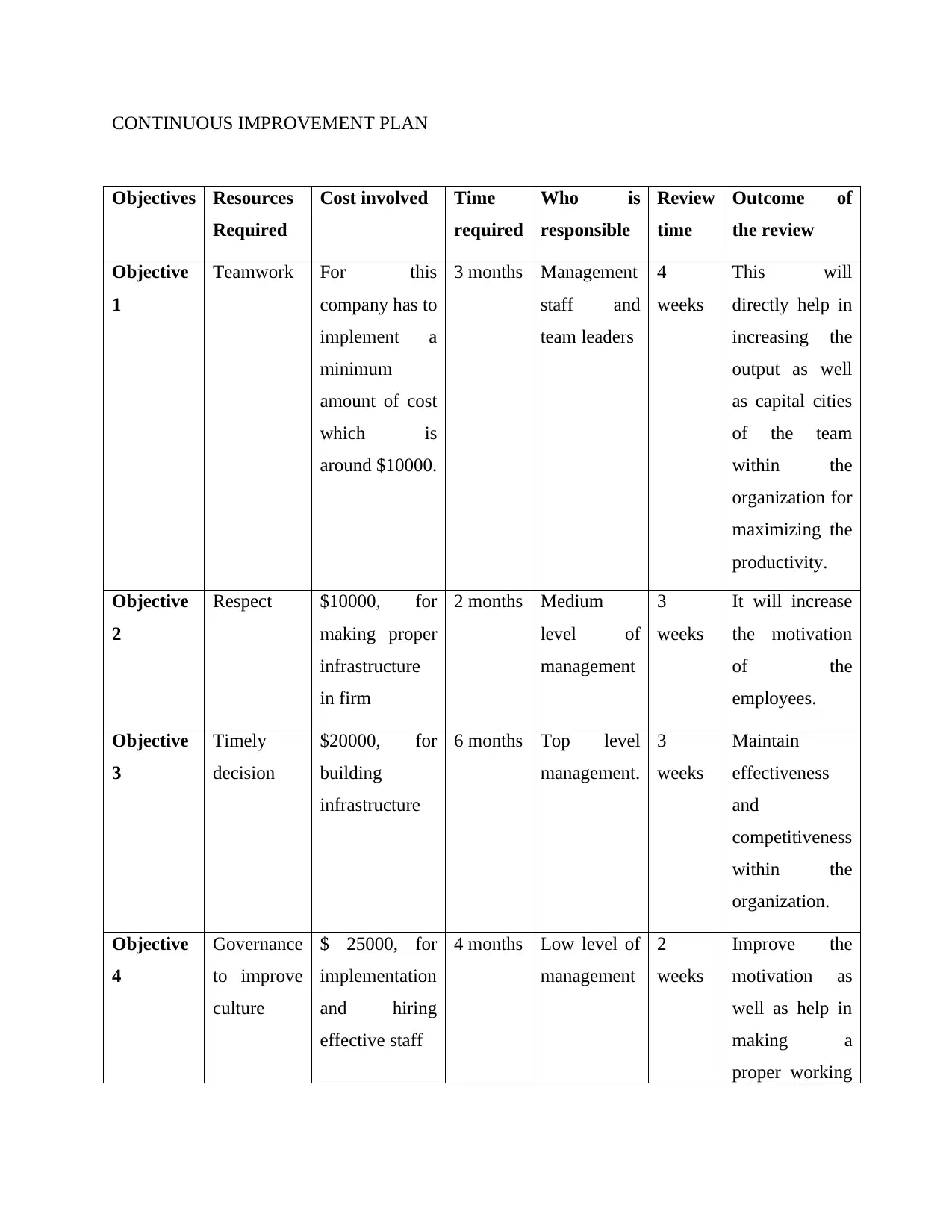
CONTINUOUS IMPROVEMENT PLAN
Objectives Resources
Required
Cost involved Time
required
Who is
responsible
Review
time
Outcome of
the review
Objective
1
Teamwork For this
company has to
implement a
minimum
amount of cost
which is
around $10000.
3 months Management
staff and
team leaders
4
weeks
This will
directly help in
increasing the
output as well
as capital cities
of the team
within the
organization for
maximizing the
productivity.
Objective
2
Respect $10000, for
making proper
infrastructure
in firm
2 months Medium
level of
management
3
weeks
It will increase
the motivation
of the
employees.
Objective
3
Timely
decision
$20000, for
building
infrastructure
6 months Top level
management.
3
weeks
Maintain
effectiveness
and
competitiveness
within the
organization.
Objective
4
Governance
to improve
culture
$ 25000, for
implementation
and hiring
effective staff
4 months Low level of
management
2
weeks
Improve the
motivation as
well as help in
making a
proper working
Objectives Resources
Required
Cost involved Time
required
Who is
responsible
Review
time
Outcome of
the review
Objective
1
Teamwork For this
company has to
implement a
minimum
amount of cost
which is
around $10000.
3 months Management
staff and
team leaders
4
weeks
This will
directly help in
increasing the
output as well
as capital cities
of the team
within the
organization for
maximizing the
productivity.
Objective
2
Respect $10000, for
making proper
infrastructure
in firm
2 months Medium
level of
management
3
weeks
It will increase
the motivation
of the
employees.
Objective
3
Timely
decision
$20000, for
building
infrastructure
6 months Top level
management.
3
weeks
Maintain
effectiveness
and
competitiveness
within the
organization.
Objective
4
Governance
to improve
culture
$ 25000, for
implementation
and hiring
effective staff
4 months Low level of
management
2
weeks
Improve the
motivation as
well as help in
making a
proper working
environment.
M2 Analysis of effectiveness of the continuous improvement plan
Did the plan achieve its objectives and how?
Continuous improvement plan is effective for Toyota as it achieves its objectives and
effective manner by the use of proper tools and techniques and effective utilization of
management and resources. There are number of tools and techniques used by the management
for managing the resources and getting the plan achieve (Friedman and Schustack, 2016).
Why did the plan overachieve or under-achieve? How can you explain the variances?
The plan is achieved on the time as well as according to the requirement of the company
there is no underachievement and achievement within the plan so it is not so important for the
organization to identify the various because there is no such type of variance which can impact
on organization.
How can the plan be improved for next period?
It is true that there are some scopes which can be used for improvement within the plan.
It can be improved by the organization by using different methods and metrics and analyzing the
situation within the organization for improving the function. Recruitment sections can also
increase and a proper recruitment process must be included for increasing the skills and abilities
for proper execution of plan.
D1 Strategies for achieving continuous improvement and efficiency at Toyota
Toyota is a leading automobiles company with 30% share in the market. Company always
focus on its operation management where it reduces the cost and wasteful activities by the use of
different tools and techniques (Ouma, 2016). The major tool is used by company is six sigma
concept total quality management.by the use of six sigma concept company always prefer the
reduction in the wastage of resources by making the infrastructure and other facilities at a good
level. Company also focus on total quality management within the organisation where it reduces
the wastage of the product by maintaining the quality within the product. Is also Help Company
in competing with the American giant automobile companies.
M2 Analysis of effectiveness of the continuous improvement plan
Did the plan achieve its objectives and how?
Continuous improvement plan is effective for Toyota as it achieves its objectives and
effective manner by the use of proper tools and techniques and effective utilization of
management and resources. There are number of tools and techniques used by the management
for managing the resources and getting the plan achieve (Friedman and Schustack, 2016).
Why did the plan overachieve or under-achieve? How can you explain the variances?
The plan is achieved on the time as well as according to the requirement of the company
there is no underachievement and achievement within the plan so it is not so important for the
organization to identify the various because there is no such type of variance which can impact
on organization.
How can the plan be improved for next period?
It is true that there are some scopes which can be used for improvement within the plan.
It can be improved by the organization by using different methods and metrics and analyzing the
situation within the organization for improving the function. Recruitment sections can also
increase and a proper recruitment process must be included for increasing the skills and abilities
for proper execution of plan.
D1 Strategies for achieving continuous improvement and efficiency at Toyota
Toyota is a leading automobiles company with 30% share in the market. Company always
focus on its operation management where it reduces the cost and wasteful activities by the use of
different tools and techniques (Ouma, 2016). The major tool is used by company is six sigma
concept total quality management.by the use of six sigma concept company always prefer the
reduction in the wastage of resources by making the infrastructure and other facilities at a good
level. Company also focus on total quality management within the organisation where it reduces
the wastage of the product by maintaining the quality within the product. Is also Help Company
in competing with the American giant automobile companies.
⊘ This is a preview!⊘
Do you want full access?
Subscribe today to unlock all pages.
Trusted by 1+ million students worldwide

1 out of 17


Related Documents


Your All-in-One AI-Powered Toolkit for Academic Success.
+13062052269
info@desklib.com
Available 24*7 on WhatsApp / Email
![[object Object]](/_next/static/media/star-bottom.7253800d.svg)
Unlock your academic potential
Copyright © 2020–2026 A2Z Services. All Rights Reserved. Developed and managed by ZUCOL.