Operations Management Analysis and Improvement Plan for Unilever
VerifiedAdded on 2023/06/04
|15
|5962
|326
Report
AI Summary
This report provides a comprehensive review and critique of operations management principles within Unilever. It begins with an introduction to Unilever, followed by a distinction between operation and operations management. The report analyzes the implementation of operations management principles within Unilever, evaluating how well the organization meets its requirements. It discusses continuous improvement as a philosophy, describing Lean principles and offering a continuous improvement plan with justified recommendations. The analysis covers product quality, cost-effectiveness, and workplace coordination as key factors. The report also delves into Lean methodology, emphasizing value definition and value stream mapping to reduce waste and improve efficiency within Unilever's operations. The ultimate goal is to provide a roadmap for sustained growth and success for Unilever in the global market. Desklib is a platform where students can find similar solved assignments and study tools.
ID
Unit Number and Title Unit 187 –
Operations and
Project Management
Title Review and Critique
of Operations
Management (Part
1
Unit Number and Title Unit 187 –
Operations and
Project Management
Title Review and Critique
of Operations
Management (Part
1

Paraphrase This Document
Need a fresh take? Get an instant paraphrase of this document with our AI Paraphraser
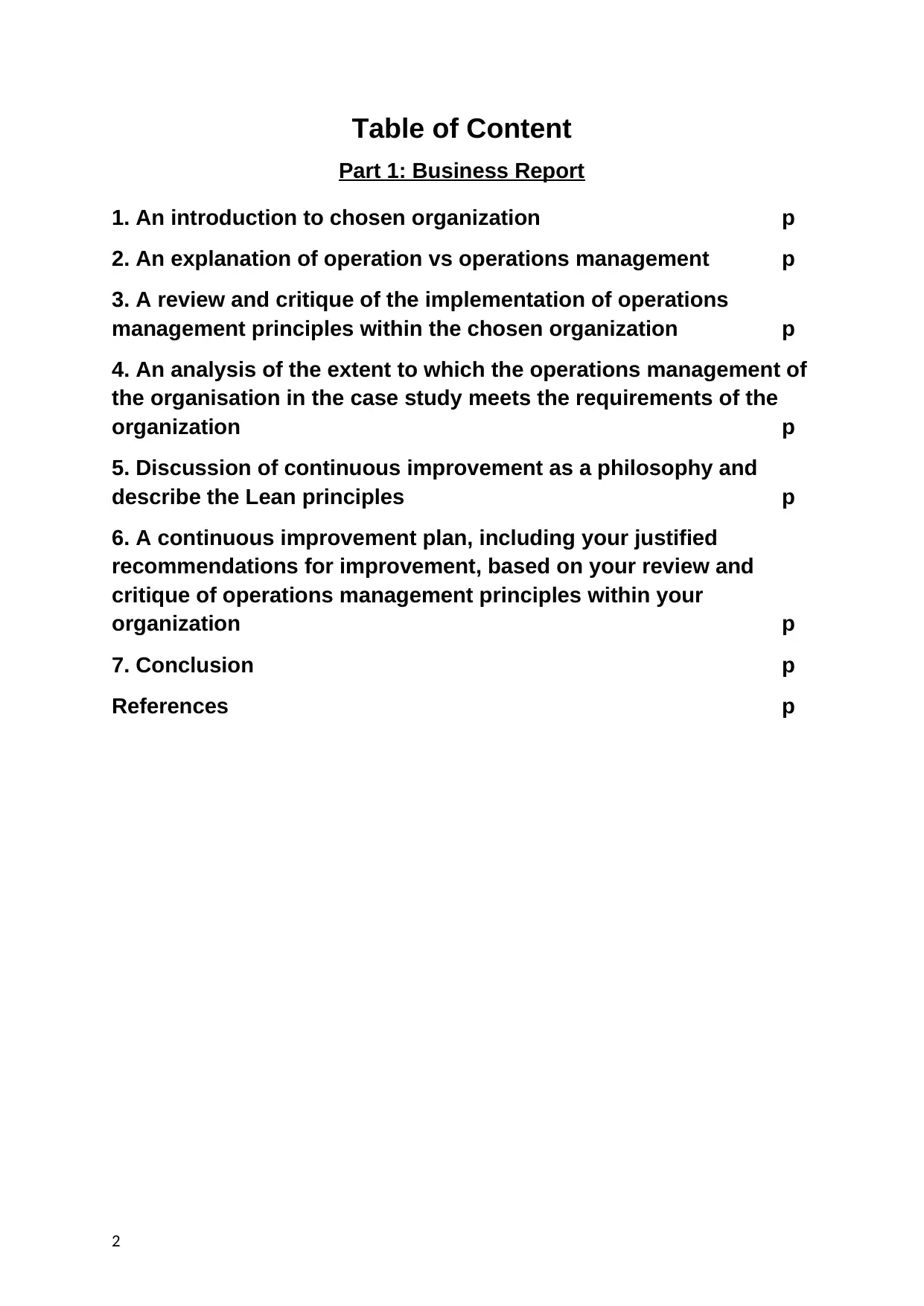
Table of Content
Part 1: Business Report
1. An introduction to chosen organization p
2. An explanation of operation vs operations management p
3. A review and critique of the implementation of operations
management principles within the chosen organization p
4. An analysis of the extent to which the operations management of
the organisation in the case study meets the requirements of the
organization p
5. Discussion of continuous improvement as a philosophy and
describe the Lean principles p
6. A continuous improvement plan, including your justified
recommendations for improvement, based on your review and
critique of operations management principles within your
organization p
7. Conclusion p
References p
2
Part 1: Business Report
1. An introduction to chosen organization p
2. An explanation of operation vs operations management p
3. A review and critique of the implementation of operations
management principles within the chosen organization p
4. An analysis of the extent to which the operations management of
the organisation in the case study meets the requirements of the
organization p
5. Discussion of continuous improvement as a philosophy and
describe the Lean principles p
6. A continuous improvement plan, including your justified
recommendations for improvement, based on your review and
critique of operations management principles within your
organization p
7. Conclusion p
References p
2
1. An introduction to chosen organization
Operations and project management plays important role as these both are
the part of organization. It refers to the management of business practices to
establish highest level of efficiency in an organization. It is basically deals with
converting labor and material into products and services as effectively to increase
the organizational profit. Management operations team attempt to maintain balance
in costs with profit to gain the highest net operating profit. On the other Hand project
management is an effective process of initially leading the work of team to fulfill
goals of project. Main goal of management of project is to complete project which
organize as per the client's objectives. Main aim of this report is to analyze and
review operations management principles effectiveness and Project life cycle of
company and in what manner project life cycle used in an organization (Fallatah and
Syed 2018). This report includes operational management and project life cycle deep
analyses of Unilever organization. Unilever is an multinational consumer product and
services organization in London. Organization deals in various goods and services
such as personal care products, food, beauty care, grocery, electronics etc.
2. An explanation of operation vs operations management
Operations:
It indicates the internal working of overall business management for effective
operations and functioning. Operation require in each and every business whether it
can be goods and services manufacturing process, distribution process, every
department of management need to identify and analyze the better functioning of
every operations, and that includes different factors such as resourcing, operations
planning, and effective technology which plays essential role in business growth and
development. In terms of business type and size of business each and every
business analyze their operations, it can not be refers as the appropriate physical
movement, sometimes, it can also refer as the enhancement in the proper planning,
strategies of various markets or system. Operations also involves ground work which
includes even the low factor of the task. In case of small organization from low to
high operations functions not only includes only by single person it require overall
team members works and their co-ordination.
Operational Management:
It indicates the top-level management which mission and vision is depends
upon the fulfilling the organization long-term targets. It gives useful direction and
action-plan to be completed in order to make sure that all the planned action are
important to fulfill goals and objectives of organization. It refers to the shift of labor
and raw material with the efficient service commodity and quality as effective which
supports the business to earn high profit for particular organization. IT involves the
effective utilization of scare resources with the effective resources, technology and
staffing. Unilever operational management team sets their effective planning goals,
strategies for establishing an similier and equal balance between the revenue and
costs so, that they can achieve their targets effectively and efficiently with high
operating profit (David and et.al 2019). In Unilever organization it is the responsibility
of operations manger to set, maintain products according to the requirements and
3
Operations and project management plays important role as these both are
the part of organization. It refers to the management of business practices to
establish highest level of efficiency in an organization. It is basically deals with
converting labor and material into products and services as effectively to increase
the organizational profit. Management operations team attempt to maintain balance
in costs with profit to gain the highest net operating profit. On the other Hand project
management is an effective process of initially leading the work of team to fulfill
goals of project. Main goal of management of project is to complete project which
organize as per the client's objectives. Main aim of this report is to analyze and
review operations management principles effectiveness and Project life cycle of
company and in what manner project life cycle used in an organization (Fallatah and
Syed 2018). This report includes operational management and project life cycle deep
analyses of Unilever organization. Unilever is an multinational consumer product and
services organization in London. Organization deals in various goods and services
such as personal care products, food, beauty care, grocery, electronics etc.
2. An explanation of operation vs operations management
Operations:
It indicates the internal working of overall business management for effective
operations and functioning. Operation require in each and every business whether it
can be goods and services manufacturing process, distribution process, every
department of management need to identify and analyze the better functioning of
every operations, and that includes different factors such as resourcing, operations
planning, and effective technology which plays essential role in business growth and
development. In terms of business type and size of business each and every
business analyze their operations, it can not be refers as the appropriate physical
movement, sometimes, it can also refer as the enhancement in the proper planning,
strategies of various markets or system. Operations also involves ground work which
includes even the low factor of the task. In case of small organization from low to
high operations functions not only includes only by single person it require overall
team members works and their co-ordination.
Operational Management:
It indicates the top-level management which mission and vision is depends
upon the fulfilling the organization long-term targets. It gives useful direction and
action-plan to be completed in order to make sure that all the planned action are
important to fulfill goals and objectives of organization. It refers to the shift of labor
and raw material with the efficient service commodity and quality as effective which
supports the business to earn high profit for particular organization. IT involves the
effective utilization of scare resources with the effective resources, technology and
staffing. Unilever operational management team sets their effective planning goals,
strategies for establishing an similier and equal balance between the revenue and
costs so, that they can achieve their targets effectively and efficiently with high
operating profit (David and et.al 2019). In Unilever organization it is the responsibility
of operations manger to set, maintain products according to the requirements and
3
⊘ This is a preview!⊘
Do you want full access?
Subscribe today to unlock all pages.

Trusted by 1+ million students worldwide
wants of the customer's. They face and manage the high strategic problems which
involves selection of plant size production, sets the information technology networks.
Along with this there are also some other issues related to the operational
management such as raw material, stock level management which also effects the
whole functioning of the management (Ottrey Jong and Porter 2018).
3. A review and critique of the implementation of operations management
principles within the chosen organization
Operations Management:
For effective management operations management involves process of
planning, organizing and supervision to ensure the higher profitability and
enhancement of efficiency within an manufacturing operations. The main target of
operational management is to effectively use all material, resources, labor and
equipment's in order to equal the demand and supply. Implementation of operations
management, key adjustments that are establish to support the organization for the
effective completion of targets. Unilever organization main target is to focus on
providing the effective quality of product and services to their targeted customer's.
Unilever organization can effectively achieve their goals through analyzing the
essential principles of operations management. There are different principles which
help the Unilever business to maintain their all functions and operations in an
effective manner.
Reality: This principle is mainly concerned with the issues of the organization
instead of focusing on tools and methods. Operational management have to
understand overall issues, instead of using tools and techniques because no
single techniques itself will be able to give overall solution to all the issues at a
particular period of time that can be encountered.
Organized: At the workplace in an organization where the all activities and
operations whether it is Production, distribution and financing all are
interrelated with each other. Top-level management deals and control all the
operations for the effective results in an organization. A well-organized
management of operations involves the promotion of all the operations and
functions so, that each one operation and activity can enhance their
productivity of all other different operations.
Humility: In an organization all the departments have to understand that the
reconciliation cost that is error and trial processes are also extremely costly.
In models there are some limitations on making errors, and there is require to
set the strategies effectively. This will support the business to protect the
scare resources, money as well as time.
Accountability: For the effective functions of all the operations accountability
plays essential role in all manufacturing operations. If organization manager is
accountable for all the functions and operations has the main reason for
effective business functioning. Manager main role is to set rules and
regulation for doing different organizational functions and operations for the
effective completion of set goals and targets (Bridoux and Stoelhorst 2022).
Secondly they have to manage and control working going as per the
4
involves selection of plant size production, sets the information technology networks.
Along with this there are also some other issues related to the operational
management such as raw material, stock level management which also effects the
whole functioning of the management (Ottrey Jong and Porter 2018).
3. A review and critique of the implementation of operations management
principles within the chosen organization
Operations Management:
For effective management operations management involves process of
planning, organizing and supervision to ensure the higher profitability and
enhancement of efficiency within an manufacturing operations. The main target of
operational management is to effectively use all material, resources, labor and
equipment's in order to equal the demand and supply. Implementation of operations
management, key adjustments that are establish to support the organization for the
effective completion of targets. Unilever organization main target is to focus on
providing the effective quality of product and services to their targeted customer's.
Unilever organization can effectively achieve their goals through analyzing the
essential principles of operations management. There are different principles which
help the Unilever business to maintain their all functions and operations in an
effective manner.
Reality: This principle is mainly concerned with the issues of the organization
instead of focusing on tools and methods. Operational management have to
understand overall issues, instead of using tools and techniques because no
single techniques itself will be able to give overall solution to all the issues at a
particular period of time that can be encountered.
Organized: At the workplace in an organization where the all activities and
operations whether it is Production, distribution and financing all are
interrelated with each other. Top-level management deals and control all the
operations for the effective results in an organization. A well-organized
management of operations involves the promotion of all the operations and
functions so, that each one operation and activity can enhance their
productivity of all other different operations.
Humility: In an organization all the departments have to understand that the
reconciliation cost that is error and trial processes are also extremely costly.
In models there are some limitations on making errors, and there is require to
set the strategies effectively. This will support the business to protect the
scare resources, money as well as time.
Accountability: For the effective functions of all the operations accountability
plays essential role in all manufacturing operations. If organization manager is
accountable for all the functions and operations has the main reason for
effective business functioning. Manager main role is to set rules and
regulation for doing different organizational functions and operations for the
effective completion of set goals and targets (Bridoux and Stoelhorst 2022).
Secondly they have to manage and control working going as per the
4
Paraphrase This Document
Need a fresh take? Get an instant paraphrase of this document with our AI Paraphraser
requirements of goods and services that are able to solve all the problems on
respective time to achieve set targets and goals.
Change: In an organization change refers to an constant thing and this
changes mostly positively effects business operations and functions. With the
help of new and efficient theories with solutions they can easily analyze their
manufacturing operations, and being allow to change will help business to
maintain stable operations in the long-run for business.
Variance: It indicates the variance in demand which provide sign of
increasing issues in the manufacturing facilities and production units. In terms
of variance processes and techniques set in effective place that have to
motivate to creativity and innovation which allow for the effective response to
the other sources of variation (Halamek and et.al,. 2019).
4. An analysis of the extent to which the operations management of the
organisation in the case study meets the requirements of the organization
Operations management are essential for the business growth and success.
Unilever organization is one of the reputed company which covers large and diverse
area in whole market, not only their products and services but their market share is
also wide which represents the effective and efficient growth and enhancement of
the business, but also while making business decisions there are also so many
threads and hurdles in terms of planning and strategies of all functions and
operations in regards of advertisement, branding, manufacturing and distribution, till
the product reach its consumer. Operational Management support the organization
in achieving the respected goals and objectives not only organizational goals but
also at the same time employee's objectives. All these factors support the
organization on successfully achieving goals in whole market or help business to
earn high profit with considering customer's satisfaction.
Product quality is the most important factor as each and every customer
before purchasing product they see quality of product. It is requirement of
customer to purchase or consume that goods and services which are good
quality and healthy in nature. Customer want to purchase product which is
safe and durable. They attract and considered that product and services
which are healthy and rich. Efficient quality of products and services attract
more customer's. Customer's became more quality concern after the covid 19.
After that company's also concern with effective quality to attract more
customer's.
Unilever organization have to manage techniques of cost effective in their
operations management because this will help business to earn customer's
loyalty and trust in regards of goods and services, and also in terms of their
product brand if they sell their products and services on a accurate and
reasonable price with an effective and efficient quality in whole market.
Unilever have to focus on maintain an effective workplace that helps them in
effective co-ordination, or achieving goals before deadlines ( O’Donovan and
et.al,. 2019). Operation manger have to focus on creating proper sessions
and met tings for their respected targets along with fulfilling the objectives of
employees. So, that it help in better coordination in between the employees,
5
respective time to achieve set targets and goals.
Change: In an organization change refers to an constant thing and this
changes mostly positively effects business operations and functions. With the
help of new and efficient theories with solutions they can easily analyze their
manufacturing operations, and being allow to change will help business to
maintain stable operations in the long-run for business.
Variance: It indicates the variance in demand which provide sign of
increasing issues in the manufacturing facilities and production units. In terms
of variance processes and techniques set in effective place that have to
motivate to creativity and innovation which allow for the effective response to
the other sources of variation (Halamek and et.al,. 2019).
4. An analysis of the extent to which the operations management of the
organisation in the case study meets the requirements of the organization
Operations management are essential for the business growth and success.
Unilever organization is one of the reputed company which covers large and diverse
area in whole market, not only their products and services but their market share is
also wide which represents the effective and efficient growth and enhancement of
the business, but also while making business decisions there are also so many
threads and hurdles in terms of planning and strategies of all functions and
operations in regards of advertisement, branding, manufacturing and distribution, till
the product reach its consumer. Operational Management support the organization
in achieving the respected goals and objectives not only organizational goals but
also at the same time employee's objectives. All these factors support the
organization on successfully achieving goals in whole market or help business to
earn high profit with considering customer's satisfaction.
Product quality is the most important factor as each and every customer
before purchasing product they see quality of product. It is requirement of
customer to purchase or consume that goods and services which are good
quality and healthy in nature. Customer want to purchase product which is
safe and durable. They attract and considered that product and services
which are healthy and rich. Efficient quality of products and services attract
more customer's. Customer's became more quality concern after the covid 19.
After that company's also concern with effective quality to attract more
customer's.
Unilever organization have to manage techniques of cost effective in their
operations management because this will help business to earn customer's
loyalty and trust in regards of goods and services, and also in terms of their
product brand if they sell their products and services on a accurate and
reasonable price with an effective and efficient quality in whole market.
Unilever have to focus on maintain an effective workplace that helps them in
effective co-ordination, or achieving goals before deadlines ( O’Donovan and
et.al,. 2019). Operation manger have to focus on creating proper sessions
and met tings for their respected targets along with fulfilling the objectives of
employees. So, that it help in better coordination in between the employees,
5
which will improve the work productivity and support the organization in
achieving their goals and targets in an effective and efficient manner.
5. Discussion of continuous improvement as a philosophy and In an
organization continuous improvement plan are an effective process for establishing
plans, rules and strategies with the main aim of improve in business activities within
the workplace. It is fact that improvement in anything are always result better than
causes this is because causes may be impact in a negative way on the company's
goodwill of Unilever. Therefore ongoing procedure and continuous improvement
support management in retaing control over all the products and services quality.
This will help Unilever organization in resulting better sustainable growth and
success, also help to expend business across all over the world. Lean Methodology
arises when there is some wastage of resources in an organization. Lean is also
called as rigorous elimination of waste due to the methodology which mainly focus
on maintaing efficient environment that help business in faster growth
(Sankaranarayanan Castañeda and Villa 2018).
Lean Principles
Lean principle methodology is only relevant for managing and controlling limited
resources wasted in an organization. Lean principles can help Unilever in reduction
of cost of production and set an reasonable at which they can sell their goods and
services.
Define Value: This principle refers that, the value of goods and services that
consumer buy describes the requirement of that particular product for
consumer. Each and every consumer want to buy that goods who are worth
buying so, that their amount did not go waste. Unilever organization fulfill
requirements and wants of their customer's by giving them effective quality,
innovative product every time which are going on trends in whole market with
effective quality on the affordable rate.
Value stream mapping: This principle main aim is to analyze the elements
that each and every customer's value. Unilever organization considered each
and every small factors in production and distribution like quality of
commodity, product and services final price, its features which require
improvement and product with various uses that gives effective value to the
targeted customer's. Unilever is always working in order to reduces
unnecessary things
6. A continuous improvement plan, including your justified recommendations
for improvement, based on your review and critique of operations
management principles within your organization
Continuous improvement plan is an effective framework and plays important
role which have to be maintained for solve different problems related to the product
quality within the production procedure. Unilever organization have to done this
practice by approaching PSCA (Plan, do, check. Act ) in their business plan
strategies and functions.
Plan: An business should not cancel planning according to the colon planning
approach (Rajan and Dhir 2020). This is because plan must be ongoing within
the workplace of Unilever for effective plans and analyzing the market targets
6
achieving their goals and targets in an effective and efficient manner.
5. Discussion of continuous improvement as a philosophy and In an
organization continuous improvement plan are an effective process for establishing
plans, rules and strategies with the main aim of improve in business activities within
the workplace. It is fact that improvement in anything are always result better than
causes this is because causes may be impact in a negative way on the company's
goodwill of Unilever. Therefore ongoing procedure and continuous improvement
support management in retaing control over all the products and services quality.
This will help Unilever organization in resulting better sustainable growth and
success, also help to expend business across all over the world. Lean Methodology
arises when there is some wastage of resources in an organization. Lean is also
called as rigorous elimination of waste due to the methodology which mainly focus
on maintaing efficient environment that help business in faster growth
(Sankaranarayanan Castañeda and Villa 2018).
Lean Principles
Lean principle methodology is only relevant for managing and controlling limited
resources wasted in an organization. Lean principles can help Unilever in reduction
of cost of production and set an reasonable at which they can sell their goods and
services.
Define Value: This principle refers that, the value of goods and services that
consumer buy describes the requirement of that particular product for
consumer. Each and every consumer want to buy that goods who are worth
buying so, that their amount did not go waste. Unilever organization fulfill
requirements and wants of their customer's by giving them effective quality,
innovative product every time which are going on trends in whole market with
effective quality on the affordable rate.
Value stream mapping: This principle main aim is to analyze the elements
that each and every customer's value. Unilever organization considered each
and every small factors in production and distribution like quality of
commodity, product and services final price, its features which require
improvement and product with various uses that gives effective value to the
targeted customer's. Unilever is always working in order to reduces
unnecessary things
6. A continuous improvement plan, including your justified recommendations
for improvement, based on your review and critique of operations
management principles within your organization
Continuous improvement plan is an effective framework and plays important
role which have to be maintained for solve different problems related to the product
quality within the production procedure. Unilever organization have to done this
practice by approaching PSCA (Plan, do, check. Act ) in their business plan
strategies and functions.
Plan: An business should not cancel planning according to the colon planning
approach (Rajan and Dhir 2020). This is because plan must be ongoing within
the workplace of Unilever for effective plans and analyzing the market targets
6
⊘ This is a preview!⊘
Do you want full access?
Subscribe today to unlock all pages.
Trusted by 1+ million students worldwide
with need and requirement of consumer's by adopting changes and
improvement that they can implement. Unilever needs to do daily basis
planning in regards of implementation of new and effective technologies. As
the top-level management determined by analyzing whole market in pandemic
that now requirements of market and high organic and quality products
(Khan and Yairi 2018).
Do: Unilever organization required to start performing practices in order to
implement improvement and changes in their workplace. These exercise must
be implement on the basis of short-term because sometimes it is not
necessary that these kinds of changes are accurate for organization but this
will mostly results in innovative and positive results. At the time of performing
this, Unilever managers must keep an physical visit that employees in the
workplace are able to understand and perform with these new introductions
and Again if employees not understand effectively then training and
development programs are must.
Check: It refers that changes arises with colon planning have to be in
observation and in under the control of management. Regular check in itself
state that each and every small thing that linked with the goodwill and
reputation of organization must be analyzed because many a times these tiny
things can results in big loss for the company.
Act: In colon planning changes are not arises in a while or by itself, it require
some effective action from management. This action should be in a way that
help organization in an effective development of the organization.
7. Conclusion
It is concluded from the above report that both the operation and operational
management are important practices in order to produce or distribute accurate goods
with effective quality at the reasonable rate, that help business in earning more
customer's which leads to high growth and development of organization. All the
related problems and solutions with the goods and services with any manner are
responsible for operations management department. This will involves decision
related with the amount of final products to be manufacture, purchases of raw
material, designing of product, analyzing channels for effective marketing and
distribution. After this, continuous improvement plan has been establish for different
changes that are essential for organization (Erinjeri and Udelsman 2019).
References
7
improvement that they can implement. Unilever needs to do daily basis
planning in regards of implementation of new and effective technologies. As
the top-level management determined by analyzing whole market in pandemic
that now requirements of market and high organic and quality products
(Khan and Yairi 2018).
Do: Unilever organization required to start performing practices in order to
implement improvement and changes in their workplace. These exercise must
be implement on the basis of short-term because sometimes it is not
necessary that these kinds of changes are accurate for organization but this
will mostly results in innovative and positive results. At the time of performing
this, Unilever managers must keep an physical visit that employees in the
workplace are able to understand and perform with these new introductions
and Again if employees not understand effectively then training and
development programs are must.
Check: It refers that changes arises with colon planning have to be in
observation and in under the control of management. Regular check in itself
state that each and every small thing that linked with the goodwill and
reputation of organization must be analyzed because many a times these tiny
things can results in big loss for the company.
Act: In colon planning changes are not arises in a while or by itself, it require
some effective action from management. This action should be in a way that
help organization in an effective development of the organization.
7. Conclusion
It is concluded from the above report that both the operation and operational
management are important practices in order to produce or distribute accurate goods
with effective quality at the reasonable rate, that help business in earning more
customer's which leads to high growth and development of organization. All the
related problems and solutions with the goods and services with any manner are
responsible for operations management department. This will involves decision
related with the amount of final products to be manufacture, purchases of raw
material, designing of product, analyzing channels for effective marketing and
distribution. After this, continuous improvement plan has been establish for different
changes that are essential for organization (Erinjeri and Udelsman 2019).
References
7
Paraphrase This Document
Need a fresh take? Get an instant paraphrase of this document with our AI Paraphraser
Fallatah, R. H. M. and Syed, J., 2018. A critical review of Maslow’s hierarchy of
needs. Employee Motivation in Saudi Arabia. (pp.19-59).
David, R. J. , and et.al,. 2019. Institutional theory in organization studies. In Oxford
Research Encyclopedia of Business and Management.
Ottrey, E., Jong, J. and Porter, J., 2018. Ethnography in nutrition and dietetics
research: A systematic review. Journal of the Academy of Nutrition and
Dietetics. 118(10). (pp.1903-1942).
Bridoux, F. and Stoelhorst, J.W., 2022. Stakeholder governance: Solving the
collective action problems in joint value creation. Academy of Management
Review. 47(2). (pp.214-236).
Halamek, L.P., and et.al,. 2019, December. Using briefing, simulation and debriefing
to improve human and system performance. In Seminars in Perinatology.
(Vol. 43, No. 8, p. 151178). WB Saunders.
O’Donovan, R., and et.al,. 2019. Safety culture in health care teams: A narrative
review of the literature. Journal of nursing management. 27(5). (pp.871-8839).
Sankaranarayanan, K., Castañeda, J.A. and Villa, S., 2018. Future research in
humanitarian operations: A behavioral operations perspective. In The
Palgrave handbook of humanitarian logistics and supply chain
management. (pp. 71-117). Palgrave Macmillan, London.
Rajan, R. and Dhir, S., 2020. Alliance termination research: a bibliometric review and
research agenda. Journal of Strategy and Management. 13(3). (pp.351-375).
Khan, S. and Yairi, T., 2018. A review on the application of deep learning in system
health management. Mechanical Systems and Signal Processing. 107.
(pp.241-265).
Erinjeri, N. J. and Udelsman, R., 2019. Volume–outcome relationship in parathyroid
surgery. Best Practice & Research Clinical Endocrinology &
Metabolism. 33(5). (p.101287).
Wamsler, C. and Restoy, F., 2020. Emotional intelligence and the sustainable
development goals: supporting peaceful, just, and inclusive societies. Peace,
Justice and Strong Institutions. (pp.1-11).
Table of Content
Part 2: Project Portfolio
Project Title p
An overview of the case study you have been given p
An explanation of each stage of the PLC that applies to your
selected project, including supporting documentation for each
8
needs. Employee Motivation in Saudi Arabia. (pp.19-59).
David, R. J. , and et.al,. 2019. Institutional theory in organization studies. In Oxford
Research Encyclopedia of Business and Management.
Ottrey, E., Jong, J. and Porter, J., 2018. Ethnography in nutrition and dietetics
research: A systematic review. Journal of the Academy of Nutrition and
Dietetics. 118(10). (pp.1903-1942).
Bridoux, F. and Stoelhorst, J.W., 2022. Stakeholder governance: Solving the
collective action problems in joint value creation. Academy of Management
Review. 47(2). (pp.214-236).
Halamek, L.P., and et.al,. 2019, December. Using briefing, simulation and debriefing
to improve human and system performance. In Seminars in Perinatology.
(Vol. 43, No. 8, p. 151178). WB Saunders.
O’Donovan, R., and et.al,. 2019. Safety culture in health care teams: A narrative
review of the literature. Journal of nursing management. 27(5). (pp.871-8839).
Sankaranarayanan, K., Castañeda, J.A. and Villa, S., 2018. Future research in
humanitarian operations: A behavioral operations perspective. In The
Palgrave handbook of humanitarian logistics and supply chain
management. (pp. 71-117). Palgrave Macmillan, London.
Rajan, R. and Dhir, S., 2020. Alliance termination research: a bibliometric review and
research agenda. Journal of Strategy and Management. 13(3). (pp.351-375).
Khan, S. and Yairi, T., 2018. A review on the application of deep learning in system
health management. Mechanical Systems and Signal Processing. 107.
(pp.241-265).
Erinjeri, N. J. and Udelsman, R., 2019. Volume–outcome relationship in parathyroid
surgery. Best Practice & Research Clinical Endocrinology &
Metabolism. 33(5). (p.101287).
Wamsler, C. and Restoy, F., 2020. Emotional intelligence and the sustainable
development goals: supporting peaceful, just, and inclusive societies. Peace,
Justice and Strong Institutions. (pp.1-11).
Table of Content
Part 2: Project Portfolio
Project Title p
An overview of the case study you have been given p
An explanation of each stage of the PLC that applies to your
selected project, including supporting documentation for each
8
stage (e.g., business case, the project plan, cost-benefit analysis
and work breakdown structure):
Project initiation p
Project planning p
Project execution p
Project closure p
Analysis of the project methodologies and tools used p
Review and critically evaluate the effectiveness of the PLC in
application to your project using the appropriate theories models
and concepts p
Project Title
9
and work breakdown structure):
Project initiation p
Project planning p
Project execution p
Project closure p
Analysis of the project methodologies and tools used p
Review and critically evaluate the effectiveness of the PLC in
application to your project using the appropriate theories models
and concepts p
Project Title
9
⊘ This is a preview!⊘
Do you want full access?
Subscribe today to unlock all pages.
Trusted by 1+ million students worldwide
Project life cycle of Unilever Organization
An overview of the case study you have been given
Project life cycle is an effective framework which plays important role in an
organization. It is an systematic way in which various functions are maintain or
completed in effective way that help business to achieve targets on time. IT is
basically a complete time period of given project, which is identified into different
stages for task of how the project is performing and what kind of result it yields. This
cycle is also involves in deliverance of projects related to any project of the
organization, while keeping in mind that all the projects have to done as per the
mentioned deadlines with the help of effective planning and execution of required
steps. For the effective understanding of project life cycle concept as well as fulfilling
the main purpose of this project, the analysis Unilever project life cycle (Thang and
Trung 2018). This report includes brief analysis of Unilever project life cycle process
which help them to effective completion of all task on timely manner. Along with this
report includes different stages of project life cycle for each and every task in an
organization.
Project Life Cycle:
It refers to an business tool that help organization in efficient planning,
initiation and execution of project. IT is an systematic sequence of phases through
which a project progresses. Project life cycle gives an basic foundation of the actions
that has to be done in the given project, irrespective of the particular work include.
Project life cycle includes four main stages which help the overall organization in
determine and evaluating the whole activities of organization. All these stages are
briefly discussed below:
An explanation of each stage of the PLC that applies to
your selected project, including supporting documentation
for each stage (e.g., business case, the project plan, cost-
benefit analysis and work breakdown structure):
Project initiation
This is the first stage in the project life cycle which state as identification
stage. Project initiation refers when business plan or introduce new ideas, thoughts
for fulfilling the targets and goals of business. Business can establish their goals and
objectives, Also business can analyze the upcoming opportunities, threats, problems
which may arise in Future. IN relation to Unilever project initiation helps in analyzing
the direction of projects, such as what are the actual needs of projects for effective
performance. IN this Unilever manger firstly have to analyze the issues that can
solve by their projects in future (Gopanagoni and Velpula 2020). Unilever business
can also use different diagrams of workflow which includes data visualization with
the help of techniques for identifying team members performance. After that
10
An overview of the case study you have been given
Project life cycle is an effective framework which plays important role in an
organization. It is an systematic way in which various functions are maintain or
completed in effective way that help business to achieve targets on time. IT is
basically a complete time period of given project, which is identified into different
stages for task of how the project is performing and what kind of result it yields. This
cycle is also involves in deliverance of projects related to any project of the
organization, while keeping in mind that all the projects have to done as per the
mentioned deadlines with the help of effective planning and execution of required
steps. For the effective understanding of project life cycle concept as well as fulfilling
the main purpose of this project, the analysis Unilever project life cycle (Thang and
Trung 2018). This report includes brief analysis of Unilever project life cycle process
which help them to effective completion of all task on timely manner. Along with this
report includes different stages of project life cycle for each and every task in an
organization.
Project Life Cycle:
It refers to an business tool that help organization in efficient planning,
initiation and execution of project. IT is an systematic sequence of phases through
which a project progresses. Project life cycle gives an basic foundation of the actions
that has to be done in the given project, irrespective of the particular work include.
Project life cycle includes four main stages which help the overall organization in
determine and evaluating the whole activities of organization. All these stages are
briefly discussed below:
An explanation of each stage of the PLC that applies to
your selected project, including supporting documentation
for each stage (e.g., business case, the project plan, cost-
benefit analysis and work breakdown structure):
Project initiation
This is the first stage in the project life cycle which state as identification
stage. Project initiation refers when business plan or introduce new ideas, thoughts
for fulfilling the targets and goals of business. Business can establish their goals and
objectives, Also business can analyze the upcoming opportunities, threats, problems
which may arise in Future. IN relation to Unilever project initiation helps in analyzing
the direction of projects, such as what are the actual needs of projects for effective
performance. IN this Unilever manger firstly have to analyze the issues that can
solve by their projects in future (Gopanagoni and Velpula 2020). Unilever business
can also use different diagrams of workflow which includes data visualization with
the help of techniques for identifying team members performance. After that
10
Paraphrase This Document
Need a fresh take? Get an instant paraphrase of this document with our AI Paraphraser
company can use budget estimation which provides clear picture of finance such as
cost estimation for analyzing how much amount spend on equipment, resources.
Project planning
It refers to the second stage of project life cycle after the imitation, set plan
now is establish for completion of further process. An effective strategic plan act as
an road map for the progress of project management. It includes various factors
such as determine the targets, that is connected with the main aim of projects, its
reclination for plan processing, and also the way that marks it closure. Secondly it
help in determining the scope that take cares that plan must be in way that help
business to accomplish the project benefits. After that it comes on scheduling
activities like beginning date with ending date and defining time span that will taken
by the project. Project generation is very essential in each and every project as they
includes operations that has to be structured, deliverables and results from the
projects. Planning is essential as it gives guidance to the whole management team
for completing task according to the schedule by help them in knowing accurate tools
for particular operations. IT helps the management to stay engaged and productive
for effective completion of project. IT also essential for all the results should be check
and test on regular basis (Maienza and et.al 2020).
Project execution
Execution is that phase in the project life cycle management that ensures that
all the planning done by managers must be putted by team into action. Simplify,
execution those plans and strategies that top level of organization outlined for
completion of a project. It is also known as project implementation. Execution is the
11
cost estimation for analyzing how much amount spend on equipment, resources.
Project planning
It refers to the second stage of project life cycle after the imitation, set plan
now is establish for completion of further process. An effective strategic plan act as
an road map for the progress of project management. It includes various factors
such as determine the targets, that is connected with the main aim of projects, its
reclination for plan processing, and also the way that marks it closure. Secondly it
help in determining the scope that take cares that plan must be in way that help
business to accomplish the project benefits. After that it comes on scheduling
activities like beginning date with ending date and defining time span that will taken
by the project. Project generation is very essential in each and every project as they
includes operations that has to be structured, deliverables and results from the
projects. Planning is essential as it gives guidance to the whole management team
for completing task according to the schedule by help them in knowing accurate tools
for particular operations. IT helps the management to stay engaged and productive
for effective completion of project. IT also essential for all the results should be check
and test on regular basis (Maienza and et.al 2020).
Project execution
Execution is that phase in the project life cycle management that ensures that
all the planning done by managers must be putted by team into action. Simplify,
execution those plans and strategies that top level of organization outlined for
completion of a project. It is also known as project implementation. Execution is the
11
third stage of the whole life cycle. This phase can be easy if the previous steps were
performed with clarity because that are all ground work but sometimes execution
become struggling for the whole team due to some uncertain circumstances. It
happens many a times that things would not work according to the plan and in these
situation team suffers with various problems like, making a budget is far then
implementing it, because might be organization loose their shareholders or some
natural calamity occur or market goes down. Execution has many challenges in it.
Here, the work of project manager is to make sure that tasks are going on track.
Communication plays a crucial role in better execution of plans as it ensures that all
the plans and tasks are communicated in right manner to avoid any confusion
because due to gap in communication sometimes tasks are not allotted correctly that
leads to wastage of resources and efficiency of employees as well (Saravanan and
et,al 2020).
Project closure
This stage indicates that once the team complete or fulfill all the requirements
and needs of the project, manager of project sign all the deliverables are completed
then the project is closed. This phase is the finalization of all the documents are
formally signed and transferred. Ensure that all the plans were executed effectively
and all the procedure were effectively performed. There are many benefits of project
closure like it help in avoiding some mistakes in future, also avoid excess liabilities
and ensuring timely payment. An clear and effective closure of project help in
carrying transition effectively according to the requirements of customer's. Closure
gives information to bthe stakeholders that they require with resources as well. It
refers to the final stamp of project completion, because declaring completion of
project will not sufficient it requires clear conformation. Also the conformation must
be declared with approval from the stakeholders for the project deliverables along
with the official signature. Review of documentation is also important with closing of
contract with the customer. Proper communication about the project must involves
analysis of success or failure of project with the problems, it help them in identifying
new opportunities and continuous growth as well.
There are some key factors for the project:
Business Case: Business case refers which is established in the starting
stage of project and help in identifying in the purpose that how, why, what it is
beneficial or worth full for doing project. Maintaing the businesses case involves and
brings all the project issues, risks, advantages, benefits of the going situation and
give a effective vision for the future which helps the business in deciding the project
process (Di and Kumar 2020).
Project Plan: Proper project plan helps the business delivering the business
in a limited time period helps in providing better communication with the other team
members provides the essential information to the team members on time, helps the
stakeholders to know that what is essential or not.
Cost-benefit Analysis: It refers to the systematic way which helps the
business in evaluation about the decisions that what decision should follow, and
what should not. This includes various techniques of Financial metrics like saves
cost, earned revenue for the further process of the projects.
12
performed with clarity because that are all ground work but sometimes execution
become struggling for the whole team due to some uncertain circumstances. It
happens many a times that things would not work according to the plan and in these
situation team suffers with various problems like, making a budget is far then
implementing it, because might be organization loose their shareholders or some
natural calamity occur or market goes down. Execution has many challenges in it.
Here, the work of project manager is to make sure that tasks are going on track.
Communication plays a crucial role in better execution of plans as it ensures that all
the plans and tasks are communicated in right manner to avoid any confusion
because due to gap in communication sometimes tasks are not allotted correctly that
leads to wastage of resources and efficiency of employees as well (Saravanan and
et,al 2020).
Project closure
This stage indicates that once the team complete or fulfill all the requirements
and needs of the project, manager of project sign all the deliverables are completed
then the project is closed. This phase is the finalization of all the documents are
formally signed and transferred. Ensure that all the plans were executed effectively
and all the procedure were effectively performed. There are many benefits of project
closure like it help in avoiding some mistakes in future, also avoid excess liabilities
and ensuring timely payment. An clear and effective closure of project help in
carrying transition effectively according to the requirements of customer's. Closure
gives information to bthe stakeholders that they require with resources as well. It
refers to the final stamp of project completion, because declaring completion of
project will not sufficient it requires clear conformation. Also the conformation must
be declared with approval from the stakeholders for the project deliverables along
with the official signature. Review of documentation is also important with closing of
contract with the customer. Proper communication about the project must involves
analysis of success or failure of project with the problems, it help them in identifying
new opportunities and continuous growth as well.
There are some key factors for the project:
Business Case: Business case refers which is established in the starting
stage of project and help in identifying in the purpose that how, why, what it is
beneficial or worth full for doing project. Maintaing the businesses case involves and
brings all the project issues, risks, advantages, benefits of the going situation and
give a effective vision for the future which helps the business in deciding the project
process (Di and Kumar 2020).
Project Plan: Proper project plan helps the business delivering the business
in a limited time period helps in providing better communication with the other team
members provides the essential information to the team members on time, helps the
stakeholders to know that what is essential or not.
Cost-benefit Analysis: It refers to the systematic way which helps the
business in evaluation about the decisions that what decision should follow, and
what should not. This includes various techniques of Financial metrics like saves
cost, earned revenue for the further process of the projects.
12
⊘ This is a preview!⊘
Do you want full access?
Subscribe today to unlock all pages.
Trusted by 1+ million students worldwide

1 out of 15


Related Documents


Your All-in-One AI-Powered Toolkit for Academic Success.
+13062052269
info@desklib.com
Available 24*7 on WhatsApp / Email
![[object Object]](/_next/static/media/star-bottom.7253800d.svg)
Unlock your academic potential
Copyright © 2020–2026 A2Z Services. All Rights Reserved. Developed and managed by ZUCOL.