University Operations and Supply Chain Management Report Analysis
VerifiedAdded on 2023/04/11
|13
|2935
|203
Report
AI Summary
This report delves into the principles of operations and supply chain management, focusing on their application within a healthcare business context. It examines various improvement principles, including accountability, employee motivation, and continuous improvement, and assesses their impact on business performance. The report emphasizes the importance of operational efficiency, inventory control, and customer focus. It also highlights the use of technology, strategic planning, and employee involvement to achieve operational success. The analysis includes recommendations for Healthcare support ltd. and underscores the need for a holistic approach that integrates various operational aspects for sustained business improvement. The report also provides a detailed analysis of how the discussed principles can be used to improve the business performance and what are the key benefits of the various principles.
Running head: OPERATIONS AND SUPPLY CHAIN MANAGEMENT
Operations and supply chain management
Name of the student
Name of the university
Author’s Note
Operations and supply chain management
Name of the student
Name of the university
Author’s Note

Paraphrase This Document
Need a fresh take? Get an instant paraphrase of this document with our AI Paraphraser
OPERATIONS AND SUPPLY CHAIN MANAGEMENT
1.1. Some suitable operations improvement principles to the business (Healthcare support
ltd).
Operations management is address as the production management, within the hospitality
sector, it all began with the division of production. Operations management is now addressed as
a multidisciplinary function area within a company along with finance and marketing. It is the
operations management that ensures that the raw material, equipment and other inputs are
utilised most effectively and efficiently within an organisation with the sole objective of
minimising the output.
However, there are a required set of skills; they are as follows:
Organisational abilities, the Analytical capability which is an understanding of the operational
process; there should be proper coordination among the various operational process, skills that
stay in the hand of the people, the creativity of the people, and problem solving capability.
The ten sets of principles to carry on suitable operations management are as follows:
Accountability - Under this state of principal there is a very important role which is played
by the top hierarchy management authority. There is a specific set of rules and procedures
which is introduced by the top hierarchy, and it is required to be made mandatory for each
and every performing individual within an organisation to work in accordance to the specific
set of rules. Each and every performing organisation has its own set of business rules which
are being Taylor made according to the business activities and with the vision to obtain their
desired goals.1
1 Reid, R. Dan, and Nada R. Sanders. Operations Management, Binder Ready Version: An Integrated
Approach. John Wiley & Sons, 2015.
1.1. Some suitable operations improvement principles to the business (Healthcare support
ltd).
Operations management is address as the production management, within the hospitality
sector, it all began with the division of production. Operations management is now addressed as
a multidisciplinary function area within a company along with finance and marketing. It is the
operations management that ensures that the raw material, equipment and other inputs are
utilised most effectively and efficiently within an organisation with the sole objective of
minimising the output.
However, there are a required set of skills; they are as follows:
Organisational abilities, the Analytical capability which is an understanding of the operational
process; there should be proper coordination among the various operational process, skills that
stay in the hand of the people, the creativity of the people, and problem solving capability.
The ten sets of principles to carry on suitable operations management are as follows:
Accountability - Under this state of principal there is a very important role which is played
by the top hierarchy management authority. There is a specific set of rules and procedures
which is introduced by the top hierarchy, and it is required to be made mandatory for each
and every performing individual within an organisation to work in accordance to the specific
set of rules. Each and every performing organisation has its own set of business rules which
are being Taylor made according to the business activities and with the vision to obtain their
desired goals.1
1 Reid, R. Dan, and Nada R. Sanders. Operations Management, Binder Ready Version: An Integrated
Approach. John Wiley & Sons, 2015.
OPERATIONS AND SUPPLY CHAIN MANAGEMENT
Fundamentals - According to fundamental it has been observed that 80% of the business
success results because of maintaining record and disciplines. On the other hand, 20% of
business success results from applying new techniques for carrying business operations. This
is also referred to as Pareto rule.
Organisation - Various manufacturing processes are interconnected within an organisation;
the sub-department is connected with its top department. Every department needs to be
consistent in order to achieve a desirable outcome in terms of profits.2
Managing the passion of the employees - The level of employee motivation and that of the
local employee and workers are one of the key factors towards a business success and
operations management. When the employees evolve the desire to contribute positively
towards the organisation goal, this, in turn, results in useful operations improvement.
Reality - According to the reality the area of the concerning problem should be given much
of the priority and focus in respect to the manner of the operations. The techniques being
used for carrying out a specific activity (operation) is not to be given much priority in
comparison to both the factors.
Nature of casualty - Any specific problem taking place within the operations of the
concerning business should not be undertaken as a burden. It should be viewed as a normal
day to day issue and should focus more on dealing with it, so that it may not occur again in
the near future, rather than taking the problem as a burden and eliminating the ongoing
operations of the business.
Reid, R. Dan, and Nada R. Sanders. Operations Management, Binder Ready Version: An Integrated
Approach. John Wiley & Sons, 2015.
2 Hitt, Michael A., Kai Xu, and Christina Matz Carnes. "Resource based theory in operations management
research." Journal of Operations Management 41 (2016): 77-94.
Fundamentals - According to fundamental it has been observed that 80% of the business
success results because of maintaining record and disciplines. On the other hand, 20% of
business success results from applying new techniques for carrying business operations. This
is also referred to as Pareto rule.
Organisation - Various manufacturing processes are interconnected within an organisation;
the sub-department is connected with its top department. Every department needs to be
consistent in order to achieve a desirable outcome in terms of profits.2
Managing the passion of the employees - The level of employee motivation and that of the
local employee and workers are one of the key factors towards a business success and
operations management. When the employees evolve the desire to contribute positively
towards the organisation goal, this, in turn, results in useful operations improvement.
Reality - According to the reality the area of the concerning problem should be given much
of the priority and focus in respect to the manner of the operations. The techniques being
used for carrying out a specific activity (operation) is not to be given much priority in
comparison to both the factors.
Nature of casualty - Any specific problem taking place within the operations of the
concerning business should not be undertaken as a burden. It should be viewed as a normal
day to day issue and should focus more on dealing with it, so that it may not occur again in
the near future, rather than taking the problem as a burden and eliminating the ongoing
operations of the business.
Reid, R. Dan, and Nada R. Sanders. Operations Management, Binder Ready Version: An Integrated
Approach. John Wiley & Sons, 2015.
2 Hitt, Michael A., Kai Xu, and Christina Matz Carnes. "Resource based theory in operations management
research." Journal of Operations Management 41 (2016): 77-94.
⊘ This is a preview!⊘
Do you want full access?
Subscribe today to unlock all pages.

Trusted by 1+ million students worldwide
OPERATIONS AND SUPPLY CHAIN MANAGEMENT
Variances of the operations - The variations of the operations should be encouraged because
they can be resourceful for the concerning business if managed carefully and effectively.
The humility - The manager, should always acknowledge the limitations rather than cost trial
and error process.
Success - The interest of the individual customer, should be given particular focus because at
present the success will change over time. In order to maintain the progress and the customer
interest, each and every business principles are required to be verified and revised on an
occasional basis.
Change in the field of operations theory - As the business environment changes this brings in
new operations principle theory. Hence, one should not stick to a particular approach.
Forming team with customers - There is an immense need to understand the consumption
behaviour of the consumer in order to organise and manage operations accordingly.
Never ending process continuous and rapid movement - The business firm should always aim
towards non-stop Rapid improvement in order to deliver the best quality which is the aim for
a quick response towards the customer demand.3
Unified purpose - It is concerned with the Frontline employees in strategic decision making;
they should understand the very soul purpose of the operations of the concerning business.
Awareness in regard to the competition - Understanding of the customer's perceptions of
their practices and that of their competitive edges.
Effective organisation of operational resources - Setup matrix in regard to organising the
resources in such a manner that operations are close to the consumption rate and demand.
3 Walker, Professor Helen, Professor Stefan Seuring, Professor Joseph Sarkis, and Professor Robert
Klassen. "Sustainable operations management: recent trends and future directions." International Journal
of Operations & Production Management 34, no. 5 (2014).
Variances of the operations - The variations of the operations should be encouraged because
they can be resourceful for the concerning business if managed carefully and effectively.
The humility - The manager, should always acknowledge the limitations rather than cost trial
and error process.
Success - The interest of the individual customer, should be given particular focus because at
present the success will change over time. In order to maintain the progress and the customer
interest, each and every business principles are required to be verified and revised on an
occasional basis.
Change in the field of operations theory - As the business environment changes this brings in
new operations principle theory. Hence, one should not stick to a particular approach.
Forming team with customers - There is an immense need to understand the consumption
behaviour of the consumer in order to organise and manage operations accordingly.
Never ending process continuous and rapid movement - The business firm should always aim
towards non-stop Rapid improvement in order to deliver the best quality which is the aim for
a quick response towards the customer demand.3
Unified purpose - It is concerned with the Frontline employees in strategic decision making;
they should understand the very soul purpose of the operations of the concerning business.
Awareness in regard to the competition - Understanding of the customer's perceptions of
their practices and that of their competitive edges.
Effective organisation of operational resources - Setup matrix in regard to organising the
resources in such a manner that operations are close to the consumption rate and demand.
3 Walker, Professor Helen, Professor Stefan Seuring, Professor Joseph Sarkis, and Professor Robert
Klassen. "Sustainable operations management: recent trends and future directions." International Journal
of Operations & Production Management 34, no. 5 (2014).
Paraphrase This Document
Need a fresh take? Get an instant paraphrase of this document with our AI Paraphraser
OPERATIONS AND SUPPLY CHAIN MANAGEMENT
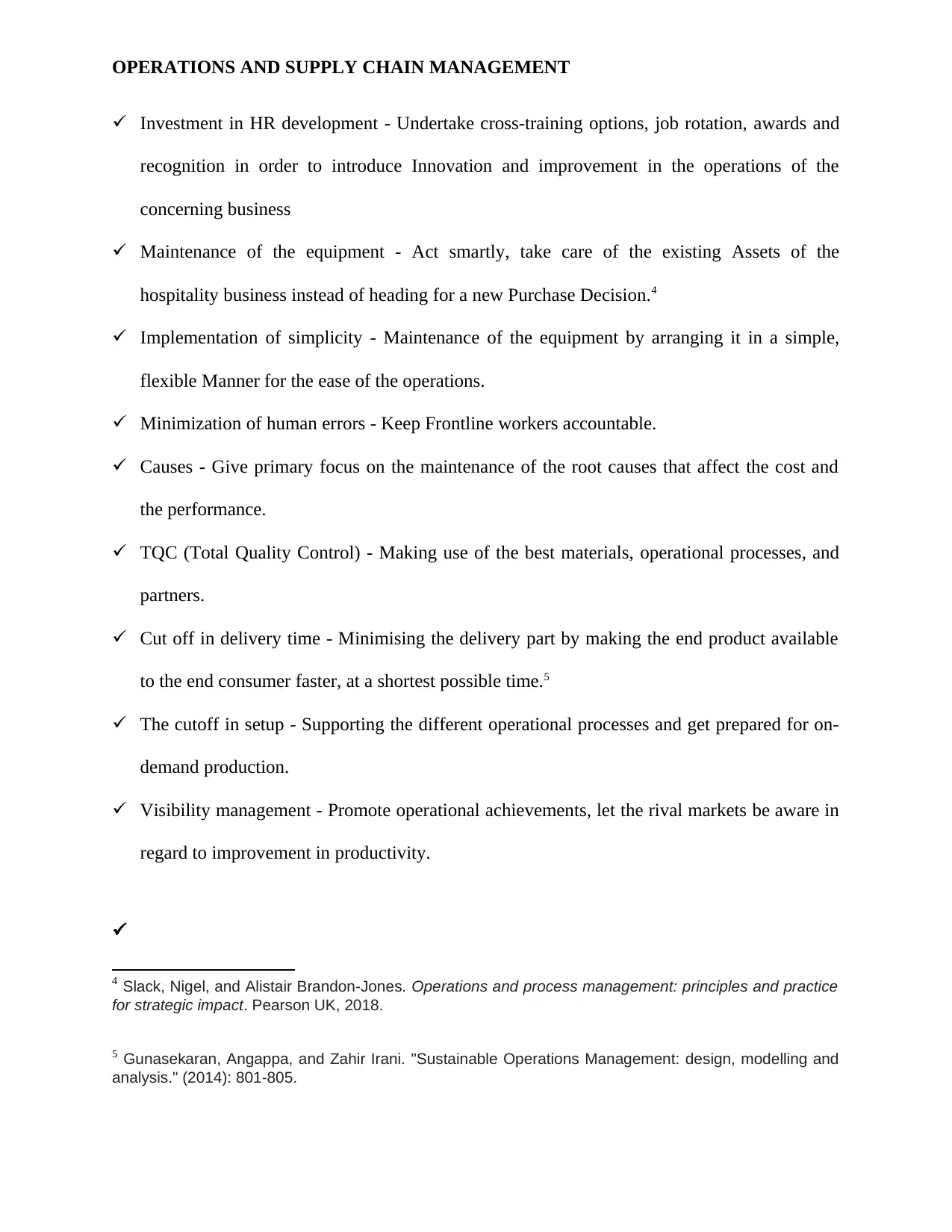
Investment in HR development - Undertake cross-training options, job rotation, awards and
recognition in order to introduce Innovation and improvement in the operations of the
concerning business
Maintenance of the equipment - Act smartly, take care of the existing Assets of the
hospitality business instead of heading for a new Purchase Decision.4
Implementation of simplicity - Maintenance of the equipment by arranging it in a simple,
flexible Manner for the ease of the operations.
Minimization of human errors - Keep Frontline workers accountable.
Causes - Give primary focus on the maintenance of the root causes that affect the cost and
the performance.
TQC (Total Quality Control) - Making use of the best materials, operational processes, and
partners.
Cut off in delivery time - Minimising the delivery part by making the end product available
to the end consumer faster, at a shortest possible time.5
The cutoff in setup - Supporting the different operational processes and get prepared for on-
demand production.
Visibility management - Promote operational achievements, let the rival markets be aware in
regard to improvement in productivity.
4 Slack, Nigel, and Alistair Brandon-Jones. Operations and process management: principles and practice
for strategic impact. Pearson UK, 2018.
5 Gunasekaran, Angappa, and Zahir Irani. "Sustainable Operations Management: design, modelling and
analysis." (2014): 801-805.
Investment in HR development - Undertake cross-training options, job rotation, awards and
recognition in order to introduce Innovation and improvement in the operations of the
concerning business
Maintenance of the equipment - Act smartly, take care of the existing Assets of the
hospitality business instead of heading for a new Purchase Decision.4
Implementation of simplicity - Maintenance of the equipment by arranging it in a simple,
flexible Manner for the ease of the operations.
Minimization of human errors - Keep Frontline workers accountable.
Causes - Give primary focus on the maintenance of the root causes that affect the cost and
the performance.
TQC (Total Quality Control) - Making use of the best materials, operational processes, and
partners.
Cut off in delivery time - Minimising the delivery part by making the end product available
to the end consumer faster, at a shortest possible time.5
The cutoff in setup - Supporting the different operational processes and get prepared for on-
demand production.
Visibility management - Promote operational achievements, let the rival markets be aware in
regard to improvement in productivity.
4 Slack, Nigel, and Alistair Brandon-Jones. Operations and process management: principles and practice
for strategic impact. Pearson UK, 2018.
5 Gunasekaran, Angappa, and Zahir Irani. "Sustainable Operations Management: design, modelling and
analysis." (2014): 801-805.
OPERATIONS AND SUPPLY CHAIN MANAGEMENT
2.1. How would these improve business performance?
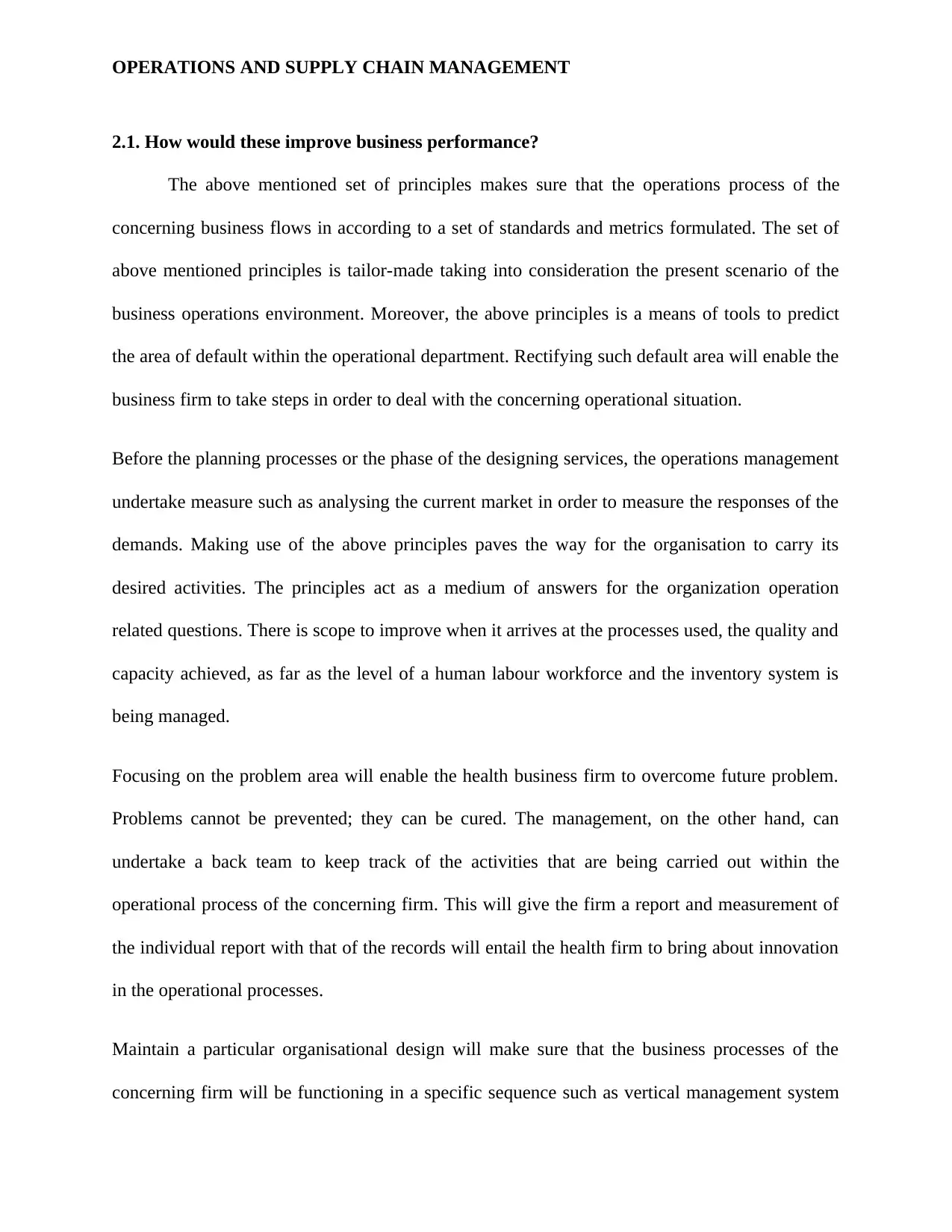
The above mentioned set of principles makes sure that the operations process of the
concerning business flows in according to a set of standards and metrics formulated. The set of
above mentioned principles is tailor-made taking into consideration the present scenario of the
business operations environment. Moreover, the above principles is a means of tools to predict
the area of default within the operational department. Rectifying such default area will enable the
business firm to take steps in order to deal with the concerning operational situation.
Before the planning processes or the phase of the designing services, the operations management
undertake measure such as analysing the current market in order to measure the responses of the
demands. Making use of the above principles paves the way for the organisation to carry its
desired activities. The principles act as a medium of answers for the organization operation
related questions. There is scope to improve when it arrives at the processes used, the quality and
capacity achieved, as far as the level of a human labour workforce and the inventory system is
being managed.
Focusing on the problem area will enable the health business firm to overcome future problem.
Problems cannot be prevented; they can be cured. The management, on the other hand, can
undertake a back team to keep track of the activities that are being carried out within the
operational process of the concerning firm. This will give the firm a report and measurement of
the individual report with that of the records will entail the health firm to bring about innovation
in the operational processes.
Maintain a particular organisational design will make sure that the business processes of the
concerning firm will be functioning in a specific sequence such as vertical management system
2.1. How would these improve business performance?
The above mentioned set of principles makes sure that the operations process of the
concerning business flows in according to a set of standards and metrics formulated. The set of
above mentioned principles is tailor-made taking into consideration the present scenario of the
business operations environment. Moreover, the above principles is a means of tools to predict
the area of default within the operational department. Rectifying such default area will enable the
business firm to take steps in order to deal with the concerning operational situation.
Before the planning processes or the phase of the designing services, the operations management
undertake measure such as analysing the current market in order to measure the responses of the
demands. Making use of the above principles paves the way for the organisation to carry its
desired activities. The principles act as a medium of answers for the organization operation
related questions. There is scope to improve when it arrives at the processes used, the quality and
capacity achieved, as far as the level of a human labour workforce and the inventory system is
being managed.
Focusing on the problem area will enable the health business firm to overcome future problem.
Problems cannot be prevented; they can be cured. The management, on the other hand, can
undertake a back team to keep track of the activities that are being carried out within the
operational process of the concerning firm. This will give the firm a report and measurement of
the individual report with that of the records will entail the health firm to bring about innovation
in the operational processes.
Maintain a particular organisational design will make sure that the business processes of the
concerning firm will be functioning in a specific sequence such as vertical management system
⊘ This is a preview!⊘
Do you want full access?
Subscribe today to unlock all pages.
Trusted by 1+ million students worldwide
OPERATIONS AND SUPPLY CHAIN MANAGEMENT
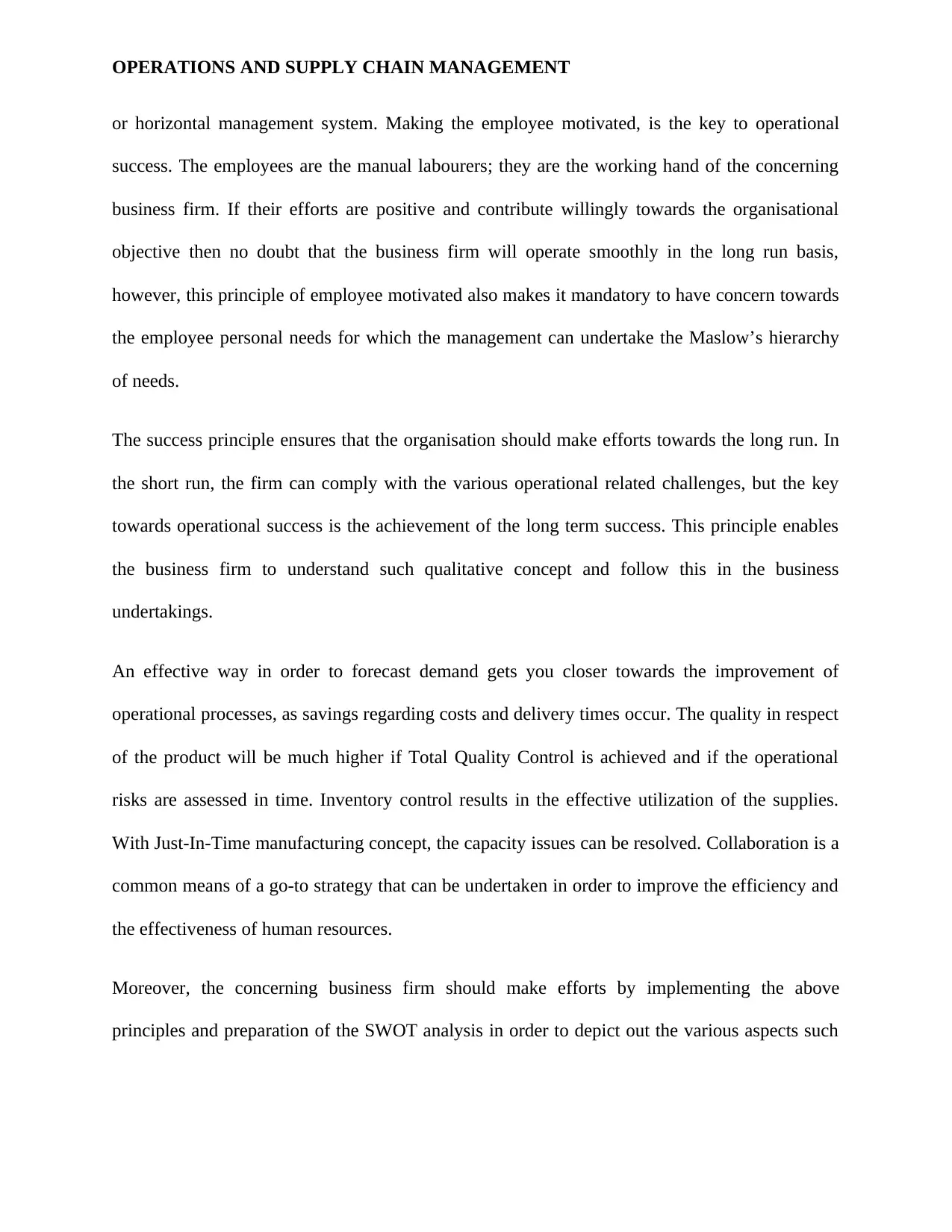
or horizontal management system. Making the employee motivated, is the key to operational
success. The employees are the manual labourers; they are the working hand of the concerning
business firm. If their efforts are positive and contribute willingly towards the organisational
objective then no doubt that the business firm will operate smoothly in the long run basis,
however, this principle of employee motivated also makes it mandatory to have concern towards
the employee personal needs for which the management can undertake the Maslow’s hierarchy
of needs.
The success principle ensures that the organisation should make efforts towards the long run. In
the short run, the firm can comply with the various operational related challenges, but the key
towards operational success is the achievement of the long term success. This principle enables
the business firm to understand such qualitative concept and follow this in the business
undertakings.
An effective way in order to forecast demand gets you closer towards the improvement of
operational processes, as savings regarding costs and delivery times occur. The quality in respect
of the product will be much higher if Total Quality Control is achieved and if the operational
risks are assessed in time. Inventory control results in the effective utilization of the supplies.
With Just-In-Time manufacturing concept, the capacity issues can be resolved. Collaboration is a
common means of a go-to strategy that can be undertaken in order to improve the efficiency and
the effectiveness of human resources.
Moreover, the concerning business firm should make efforts by implementing the above
principles and preparation of the SWOT analysis in order to depict out the various aspects such
or horizontal management system. Making the employee motivated, is the key to operational
success. The employees are the manual labourers; they are the working hand of the concerning
business firm. If their efforts are positive and contribute willingly towards the organisational
objective then no doubt that the business firm will operate smoothly in the long run basis,
however, this principle of employee motivated also makes it mandatory to have concern towards
the employee personal needs for which the management can undertake the Maslow’s hierarchy
of needs.
The success principle ensures that the organisation should make efforts towards the long run. In
the short run, the firm can comply with the various operational related challenges, but the key
towards operational success is the achievement of the long term success. This principle enables
the business firm to understand such qualitative concept and follow this in the business
undertakings.
An effective way in order to forecast demand gets you closer towards the improvement of
operational processes, as savings regarding costs and delivery times occur. The quality in respect
of the product will be much higher if Total Quality Control is achieved and if the operational
risks are assessed in time. Inventory control results in the effective utilization of the supplies.
With Just-In-Time manufacturing concept, the capacity issues can be resolved. Collaboration is a
common means of a go-to strategy that can be undertaken in order to improve the efficiency and
the effectiveness of human resources.
Moreover, the concerning business firm should make efforts by implementing the above
principles and preparation of the SWOT analysis in order to depict out the various aspects such
Paraphrase This Document
Need a fresh take? Get an instant paraphrase of this document with our AI Paraphraser
OPERATIONS AND SUPPLY CHAIN MANAGEMENT
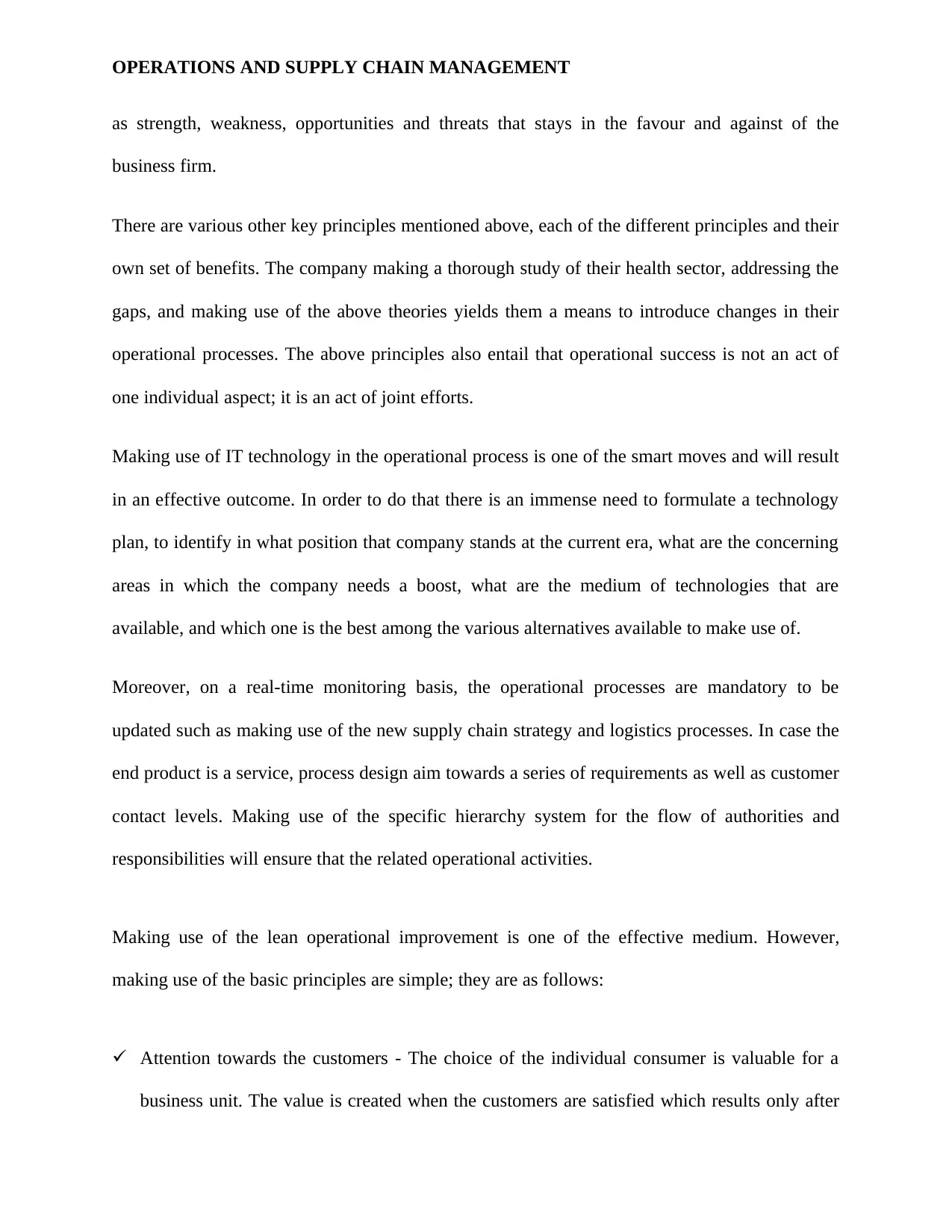
as strength, weakness, opportunities and threats that stays in the favour and against of the
business firm.
There are various other key principles mentioned above, each of the different principles and their
own set of benefits. The company making a thorough study of their health sector, addressing the
gaps, and making use of the above theories yields them a means to introduce changes in their
operational processes. The above principles also entail that operational success is not an act of
one individual aspect; it is an act of joint efforts.
Making use of IT technology in the operational process is one of the smart moves and will result
in an effective outcome. In order to do that there is an immense need to formulate a technology
plan, to identify in what position that company stands at the current era, what are the concerning
areas in which the company needs a boost, what are the medium of technologies that are
available, and which one is the best among the various alternatives available to make use of.
Moreover, on a real-time monitoring basis, the operational processes are mandatory to be
updated such as making use of the new supply chain strategy and logistics processes. In case the
end product is a service, process design aim towards a series of requirements as well as customer
contact levels. Making use of the specific hierarchy system for the flow of authorities and
responsibilities will ensure that the related operational activities.
Making use of the lean operational improvement is one of the effective medium. However,
making use of the basic principles are simple; they are as follows:
Attention towards the customers - The choice of the individual consumer is valuable for a
business unit. The value is created when the customers are satisfied which results only after
as strength, weakness, opportunities and threats that stays in the favour and against of the
business firm.
There are various other key principles mentioned above, each of the different principles and their
own set of benefits. The company making a thorough study of their health sector, addressing the
gaps, and making use of the above theories yields them a means to introduce changes in their
operational processes. The above principles also entail that operational success is not an act of
one individual aspect; it is an act of joint efforts.
Making use of IT technology in the operational process is one of the smart moves and will result
in an effective outcome. In order to do that there is an immense need to formulate a technology
plan, to identify in what position that company stands at the current era, what are the concerning
areas in which the company needs a boost, what are the medium of technologies that are
available, and which one is the best among the various alternatives available to make use of.
Moreover, on a real-time monitoring basis, the operational processes are mandatory to be
updated such as making use of the new supply chain strategy and logistics processes. In case the
end product is a service, process design aim towards a series of requirements as well as customer
contact levels. Making use of the specific hierarchy system for the flow of authorities and
responsibilities will ensure that the related operational activities.
Making use of the lean operational improvement is one of the effective medium. However,
making use of the basic principles are simple; they are as follows:
Attention towards the customers - The choice of the individual consumer is valuable for a
business unit. The value is created when the customers are satisfied which results only after
OPERATIONS AND SUPPLY CHAIN MANAGEMENT
the delivery of qualitative products at a minimum cost. This can be obtained by predicting as
of what the customer seeks and how such can be provided.
Elimination of the inefficiency and waste - once the process of the operation is recognized
the next step is to evaluate the process that does not result in the creation of value for the end
customers. Undertaking activities such as managing, improving, and introducing smooth
within the operational process in order to eliminate the non-value added activity such as idle
time which is waste, idle management efforts, hampering of the inventory because of over-
production, delay in making the product available to the customers, time consumed for
approval waiting’s, delay resulting from the bulk of batch activities, duplication of effort, and
errors and rework.
To figure out how the operational activity is performed - The awareness in regard to the
operational activity is quite known but doesn’t exactly provides what exactly is being
processed behind the operational activity. In most of the cases, the operational activity is not
carried out as per day to day activity basis; it is just carried out as a work that is intended to
perform. The entire operational work can be divided in accordance with daily basis effort;
this will bring about improvement within the business process. Moreover, making the other
workers and labourers watch the manner of operational activity provides a scope for the firm
to reduce the time required for assisting them. As they can make use of this session on their
own to carry out the desired task by repeating it in the same manner as observed by them.
Track numbers and manage by evidence – Very often in a business environment operational
activities are not carried out a planned. In order to eliminate this issue introduction of the
testing phase is required in order to test one’s own business operational processes as this
gives a better glimpse of the workflow. Collection of data and facts in regard to how the
the delivery of qualitative products at a minimum cost. This can be obtained by predicting as
of what the customer seeks and how such can be provided.
Elimination of the inefficiency and waste - once the process of the operation is recognized
the next step is to evaluate the process that does not result in the creation of value for the end
customers. Undertaking activities such as managing, improving, and introducing smooth
within the operational process in order to eliminate the non-value added activity such as idle
time which is waste, idle management efforts, hampering of the inventory because of over-
production, delay in making the product available to the customers, time consumed for
approval waiting’s, delay resulting from the bulk of batch activities, duplication of effort, and
errors and rework.
To figure out how the operational activity is performed - The awareness in regard to the
operational activity is quite known but doesn’t exactly provides what exactly is being
processed behind the operational activity. In most of the cases, the operational activity is not
carried out as per day to day activity basis; it is just carried out as a work that is intended to
perform. The entire operational work can be divided in accordance with daily basis effort;
this will bring about improvement within the business process. Moreover, making the other
workers and labourers watch the manner of operational activity provides a scope for the firm
to reduce the time required for assisting them. As they can make use of this session on their
own to carry out the desired task by repeating it in the same manner as observed by them.
Track numbers and manage by evidence – Very often in a business environment operational
activities are not carried out a planned. In order to eliminate this issue introduction of the
testing phase is required in order to test one’s own business operational processes as this
gives a better glimpse of the workflow. Collection of data and facts in regard to how the
⊘ This is a preview!⊘
Do you want full access?
Subscribe today to unlock all pages.
Trusted by 1+ million students worldwide
OPERATIONS AND SUPPLY CHAIN MANAGEMENT
operational activities are being carried both in term of qualitative and in terms of the
quantitative figures. Observation of such will enable the business firm to highlight and
eliminate errors, and seek continuous improvements in value.
Empowering the worker and labourers who are operating the process - The best step in order
to improve the operational process within the concerning firm would be by grooming the
person in charge of the operational activity. Improvement of the worker and labourer will, in
turn, bring about change in the operational process.
Introduction of innovation in the operational process – The existing pattern and sequence of
working may be fruitful in the present scenario but may fail to produce favourable outcomes in
the near future. This brings in need to make use of different operational techniques with the
changing business environment and with that of changing demand and fluctuations in the budget
formation.
operational activities are being carried both in term of qualitative and in terms of the
quantitative figures. Observation of such will enable the business firm to highlight and
eliminate errors, and seek continuous improvements in value.
Empowering the worker and labourers who are operating the process - The best step in order
to improve the operational process within the concerning firm would be by grooming the
person in charge of the operational activity. Improvement of the worker and labourer will, in
turn, bring about change in the operational process.
Introduction of innovation in the operational process – The existing pattern and sequence of
working may be fruitful in the present scenario but may fail to produce favourable outcomes in
the near future. This brings in need to make use of different operational techniques with the
changing business environment and with that of changing demand and fluctuations in the budget
formation.
Paraphrase This Document
Need a fresh take? Get an instant paraphrase of this document with our AI Paraphraser
OPERATIONS AND SUPPLY CHAIN MANAGEMENT
Bibliography
Annarelli, Alessandro, and Fabio Nonino. "Strategic and operational management of
organizational resilience: Current state of research and future directions." Omega 62 (2016): 1-
18.
Davenport, Thomas H. "Process management for knowledge work." In Handbook on Business
Process Management 1, pp. 17-35. Springer, Berlin, Heidelberg, 2015.
Dobrzykowski, David, Vafa Saboori Deilami, Paul Hong, and Seung-Chul Kim. "A structured
analysis of operations and supply chain management research in healthcare (1982–2011)."
International Journal of Production Economics 147 (2014): 514-530.
Gunasekaran, Angappa, and Zahir Irani. "Sustainable Operations Management: design,
modelling and analysis." (2014): 801-805.
Gupta, Sushil, and Martin Starr. Production and operations management systems. CRC Press,
2014.
Hill, Alex, and Terry Hill. Essential operations management. Macmillan International Higher
Education, 2017.
Hitt, Michael A., Kai Xu, and Christina Matz Carnes. "Resource based theory in operations
management research." Journal of Operations Management 41 (2016): 77-94.
Jeston, John. Business process management. Routledge, 2014.
Li, Xiang. "Operations management of logistics and supply chain: Issues and directions."
Discrete Dynamics in Nature and Society 2014 (2014).
Bibliography
Annarelli, Alessandro, and Fabio Nonino. "Strategic and operational management of
organizational resilience: Current state of research and future directions." Omega 62 (2016): 1-
18.
Davenport, Thomas H. "Process management for knowledge work." In Handbook on Business
Process Management 1, pp. 17-35. Springer, Berlin, Heidelberg, 2015.
Dobrzykowski, David, Vafa Saboori Deilami, Paul Hong, and Seung-Chul Kim. "A structured
analysis of operations and supply chain management research in healthcare (1982–2011)."
International Journal of Production Economics 147 (2014): 514-530.
Gunasekaran, Angappa, and Zahir Irani. "Sustainable Operations Management: design,
modelling and analysis." (2014): 801-805.
Gupta, Sushil, and Martin Starr. Production and operations management systems. CRC Press,
2014.
Hill, Alex, and Terry Hill. Essential operations management. Macmillan International Higher
Education, 2017.
Hitt, Michael A., Kai Xu, and Christina Matz Carnes. "Resource based theory in operations
management research." Journal of Operations Management 41 (2016): 77-94.
Jeston, John. Business process management. Routledge, 2014.
Li, Xiang. "Operations management of logistics and supply chain: Issues and directions."
Discrete Dynamics in Nature and Society 2014 (2014).
OPERATIONS AND SUPPLY CHAIN MANAGEMENT
Mahadevan, B. Operations management: Theory and practice. Pearson Education India, 2015.
Piercy, Niall, and Nick Rich. "The relationship between lean operations and sustainable
operations." International Journal of Operations & Production Management 35, no. 2 (2015):
282-315.
Reid, R. Dan, and Nada R. Sanders. Operations Management, Binder Ready Version: An
Integrated Approach. John Wiley & Sons, 2015.
Rosemann, Michael, and Jan vom Brocke. "The six core elements of business process
management." In Handbook on business process management 1, pp. 105-122. Springer, Berlin,
Heidelberg, 2015.
Sabella, Anton, Rami Kashou, and Omar Omran. "Quality management practices and their
relationship to organizational performance." International Journal of Operations & Production
Management 34, no. 12 (2014): 1487-1505.
Slack, Nigel, and Alistair Brandon-Jones. Operations and process management: principles and
practice for strategic impact. Pearson UK, 2018.
Spring, Martin, Alan Hughes, Katy Mason, and Paul McCaffrey. "Creating the competitive edge:
A new relationship between operations management and industrial policy." Journal of
Operations Management 49 (2017): 6-19.
Stanton, Pauline, Richard Gough, Ruth Ballardie, Timothy Bartram, Greg J. Bamber, and Amrik
Sohal. "Implementing lean management/Six Sigma in hospitals: beyond empowerment or work
intensification?." The International Journal of Human Resource Management 25, no. 21 (2014):
2926-2940.
Mahadevan, B. Operations management: Theory and practice. Pearson Education India, 2015.
Piercy, Niall, and Nick Rich. "The relationship between lean operations and sustainable
operations." International Journal of Operations & Production Management 35, no. 2 (2015):
282-315.
Reid, R. Dan, and Nada R. Sanders. Operations Management, Binder Ready Version: An
Integrated Approach. John Wiley & Sons, 2015.
Rosemann, Michael, and Jan vom Brocke. "The six core elements of business process
management." In Handbook on business process management 1, pp. 105-122. Springer, Berlin,
Heidelberg, 2015.
Sabella, Anton, Rami Kashou, and Omar Omran. "Quality management practices and their
relationship to organizational performance." International Journal of Operations & Production
Management 34, no. 12 (2014): 1487-1505.
Slack, Nigel, and Alistair Brandon-Jones. Operations and process management: principles and
practice for strategic impact. Pearson UK, 2018.
Spring, Martin, Alan Hughes, Katy Mason, and Paul McCaffrey. "Creating the competitive edge:
A new relationship between operations management and industrial policy." Journal of
Operations Management 49 (2017): 6-19.
Stanton, Pauline, Richard Gough, Ruth Ballardie, Timothy Bartram, Greg J. Bamber, and Amrik
Sohal. "Implementing lean management/Six Sigma in hospitals: beyond empowerment or work
intensification?." The International Journal of Human Resource Management 25, no. 21 (2014):
2926-2940.
⊘ This is a preview!⊘
Do you want full access?
Subscribe today to unlock all pages.
Trusted by 1+ million students worldwide

1 out of 13


Related Documents


Your All-in-One AI-Powered Toolkit for Academic Success.
+13062052269
info@desklib.com
Available 24*7 on WhatsApp / Email
![[object Object]](/_next/static/media/star-bottom.7253800d.svg)
Unlock your academic potential
Copyright © 2020–2026 A2Z Services. All Rights Reserved. Developed and managed by ZUCOL.