OPM300: Love Spell Flowchart

Verified

Added on  2019/09/16

|2
|777
|388
Practical Assignment
AI Summary
This assignment for OPM300: Introduction to Operations Management at Trident University International involves creating a flowchart to represent a process. The scenario is a whimsical one: casting a love spell. Students must consider various factors, including the target's gender, available ingredients (Eye of Newt or Tongue of Cobra), and the phase of the moon. The flowchart needs to depict the decision points and actions based on these factors. The assignment emphasizes using standard flowchart symbology, providing a brief explanation, and citing provided resources. The resources include articles on the Delphi method and PowerPoint slides on flowcharting. The final submission should include a cover sheet, a flowchart, a glossary (if needed), and a short explanation of the chart with proper citations.
Document Page
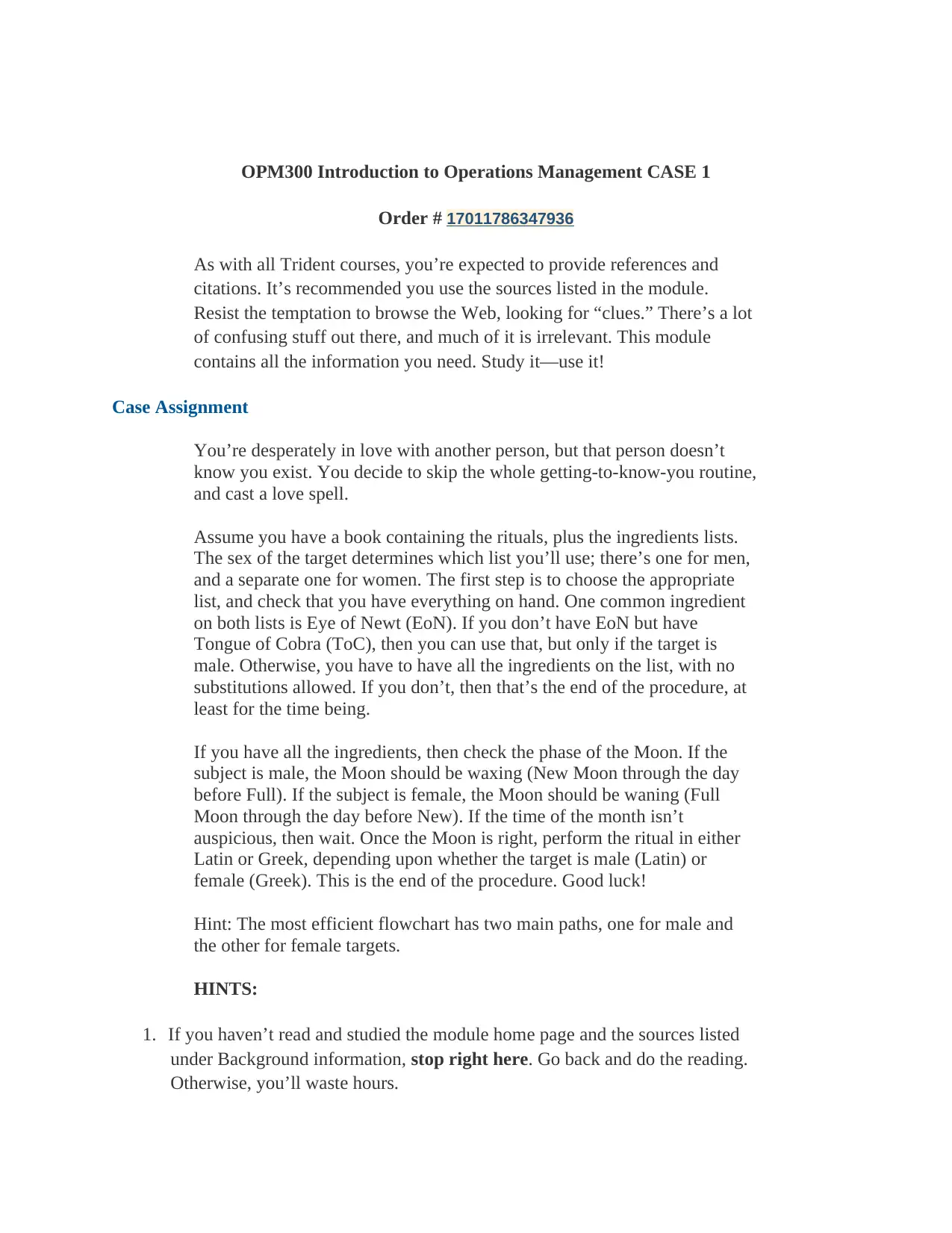
OPM300 Introduction to Operations Management CASE 1
Order # 17011786347936
As with all Trident courses, you’re expected to provide references and
citations. It’s recommended you use the sources listed in the module.
Resist the temptation to browse the Web, looking for “clues.” There’s a lot
of confusing stuff out there, and much of it is irrelevant. This module
contains all the information you need. Study it—use it!
Case Assignment
You’re desperately in love with another person, but that person doesn’t
know you exist. You decide to skip the whole getting-to-know-you routine,
and cast a love spell.
Assume you have a book containing the rituals, plus the ingredients lists.
The sex of the target determines which list you’ll use; there’s one for men,
and a separate one for women. The first step is to choose the appropriate
list, and check that you have everything on hand. One common ingredient
on both lists is Eye of Newt (EoN). If you don’t have EoN but have
Tongue of Cobra (ToC), then you can use that, but only if the target is
male. Otherwise, you have to have all the ingredients on the list, with no
substitutions allowed. If you don’t, then that’s the end of the procedure, at
least for the time being.
If you have all the ingredients, then check the phase of the Moon. If the
subject is male, the Moon should be waxing (New Moon through the day
before Full). If the subject is female, the Moon should be waning (Full
Moon through the day before New). If the time of the month isn’t
auspicious, then wait. Once the Moon is right, perform the ritual in either
Latin or Greek, depending upon whether the target is male (Latin) or
female (Greek). This is the end of the procedure. Good luck!
Hint: The most efficient flowchart has two main paths, one for male and
the other for female targets.
HINTS:
1. If you haven’t read and studied the module home page and the sources listed
under Background information, stop right here. Go back and do the reading.
Otherwise, you’ll waste hours.
tabler-icon-diamond-filled.svg

Paraphrase This Document

Need a fresh take? Get an instant paraphrase of this document with our AI Paraphraser
Document Page
2. Don’t browse the Web looking for information about how to create a
flowchart, until you’ve read and studied the sources in the module. The Case
was designed with these sources in mind. They contain all the information
you’ll need. You should reference and cite them, in accordance with the
Writing Guide.
3. You aren’t being asked to write an essay about flowcharting, but rather to
draw a flowchart. If your Case write-up doesn’t contain a flowchart, then it’s
incomplete.
4. Despite 4 above, your Case should follow standard format, with a cover sheet
and a brief discussion of the problem. Be sure to include references and
citations.
Assignment Expectations
Reduce the case to a series of discrete, single activities and decisions.
Avoid clutter. In the flowchart, abbreviate the activities and decisions. If
necessary, explain the abbreviations in a glossary.
Use standard flowchart symbology.
Provide a short (one or two paragraph) explanation of the chart. Include
citations.
References
Landeta, J. (2006). Current validity of the Delphi method in
social sciences. Technological Forecasting and social
change, 73(5): 467-482.
Linstone, H. & Turoff, M. (2011). Delphi: A brief look
backward and forward. Technological Forecasting and
Social Change, 78 (9); 1712-1719
Rensvold, R. (2014a). How to draw a process
flowchart [PowerPoint slides]. Available in OPM300
Introduction to Operations Management at Trident University
International, 5757 Plaza Drive, Suite 100, Cypress, CA
90630.
*Rensvold, R. (2014b). Delphi exercise example [Word
document]. Available in OPM300 Introduction to Operations
Management at Trident University International, 5757 Plaza
Drive, Suite 100, Cypress, CA 90630.
chevron_up_icon
1 out of 2
circle_padding
hide_on_mobile
zoom_out_icon
[object Object]