Opportunities and Challenges Facing the Auditing Profession
VerifiedAdded on 2023/06/07
|14
|3437
|79
Essay
AI Summary
This essay examines the opportunities and challenges facing the auditing profession, particularly in Australia. It discusses the increasing demand for auditing and assurance services due to greater stakeholder accountability, highlighting the ethical dilemmas auditors face in balancing client expectations with legally acceptable auditing practices. The paper outlines the Australian auditing model, regulated by the Australian Auditing and Assurance Standards Board and guided by the Corporations Act 2001, International Standards on Auditing (ISA), and US Generally Accepted Accounting Standards (USGAAP). It details specific regulations, including ASQC 1, ASA 200, ASA 240, ASA 250, ASA 102, ASA 500-510, ASA 700-710, and ASA 800. The essay identifies opportunities such as diversity in business, technological advancements, the desire for public confidence, the need to give confidence to stakeholders, and the compliance mind-set. Challenges include ethical problems, difficulty in work-life balance, and the demanding workload of the profession.
Running head: THE AUDITING PROFESSION 1
Opportunities and Challenges for the Auditing Profession
Your Name
Institutional Affiliation
Opportunities and Challenges for the Auditing Profession
Your Name
Institutional Affiliation

Paraphrase This Document
Need a fresh take? Get an instant paraphrase of this document with our AI Paraphraser
OPPORTUNITIES AND CHALLENGES FOR THE AUDITING PROFESSION 2
Opportunities and Challenges for the Auditing Profession
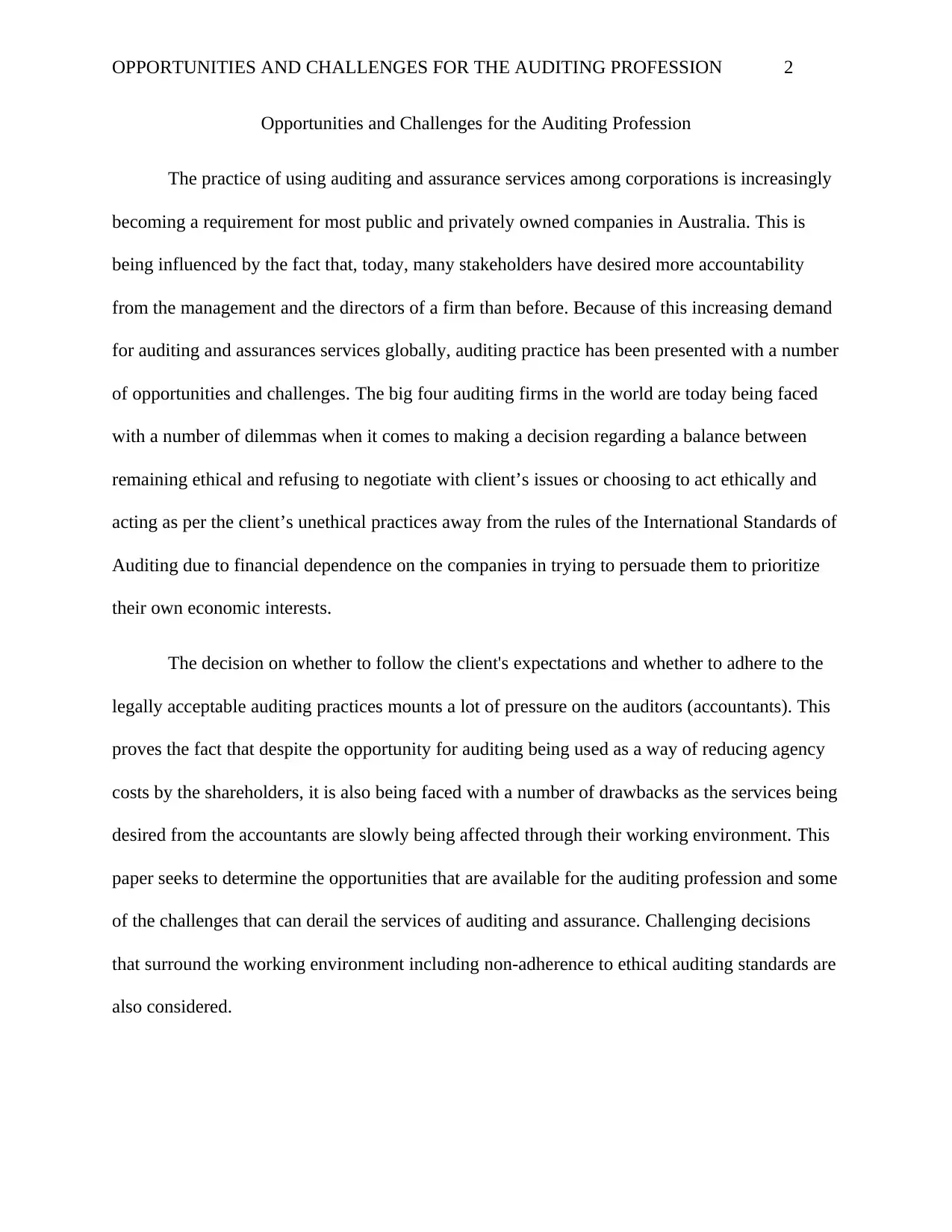
The practice of using auditing and assurance services among corporations is increasingly
becoming a requirement for most public and privately owned companies in Australia. This is
being influenced by the fact that, today, many stakeholders have desired more accountability
from the management and the directors of a firm than before. Because of this increasing demand
for auditing and assurances services globally, auditing practice has been presented with a number
of opportunities and challenges. The big four auditing firms in the world are today being faced
with a number of dilemmas when it comes to making a decision regarding a balance between
remaining ethical and refusing to negotiate with client’s issues or choosing to act ethically and
acting as per the client’s unethical practices away from the rules of the International Standards of
Auditing due to financial dependence on the companies in trying to persuade them to prioritize
their own economic interests.
The decision on whether to follow the client's expectations and whether to adhere to the
legally acceptable auditing practices mounts a lot of pressure on the auditors (accountants). This
proves the fact that despite the opportunity for auditing being used as a way of reducing agency
costs by the shareholders, it is also being faced with a number of drawbacks as the services being
desired from the accountants are slowly being affected through their working environment. This
paper seeks to determine the opportunities that are available for the auditing profession and some
of the challenges that can derail the services of auditing and assurance. Challenging decisions
that surround the working environment including non-adherence to ethical auditing standards are
also considered.
Opportunities and Challenges for the Auditing Profession
The practice of using auditing and assurance services among corporations is increasingly
becoming a requirement for most public and privately owned companies in Australia. This is
being influenced by the fact that, today, many stakeholders have desired more accountability
from the management and the directors of a firm than before. Because of this increasing demand
for auditing and assurances services globally, auditing practice has been presented with a number
of opportunities and challenges. The big four auditing firms in the world are today being faced
with a number of dilemmas when it comes to making a decision regarding a balance between
remaining ethical and refusing to negotiate with client’s issues or choosing to act ethically and
acting as per the client’s unethical practices away from the rules of the International Standards of
Auditing due to financial dependence on the companies in trying to persuade them to prioritize
their own economic interests.
The decision on whether to follow the client's expectations and whether to adhere to the
legally acceptable auditing practices mounts a lot of pressure on the auditors (accountants). This
proves the fact that despite the opportunity for auditing being used as a way of reducing agency
costs by the shareholders, it is also being faced with a number of drawbacks as the services being
desired from the accountants are slowly being affected through their working environment. This
paper seeks to determine the opportunities that are available for the auditing profession and some
of the challenges that can derail the services of auditing and assurance. Challenging decisions
that surround the working environment including non-adherence to ethical auditing standards are
also considered.
OPPORTUNITIES AND CHALLENGES FOR THE AUDITING PROFESSION 3
The Australian Auditing Model
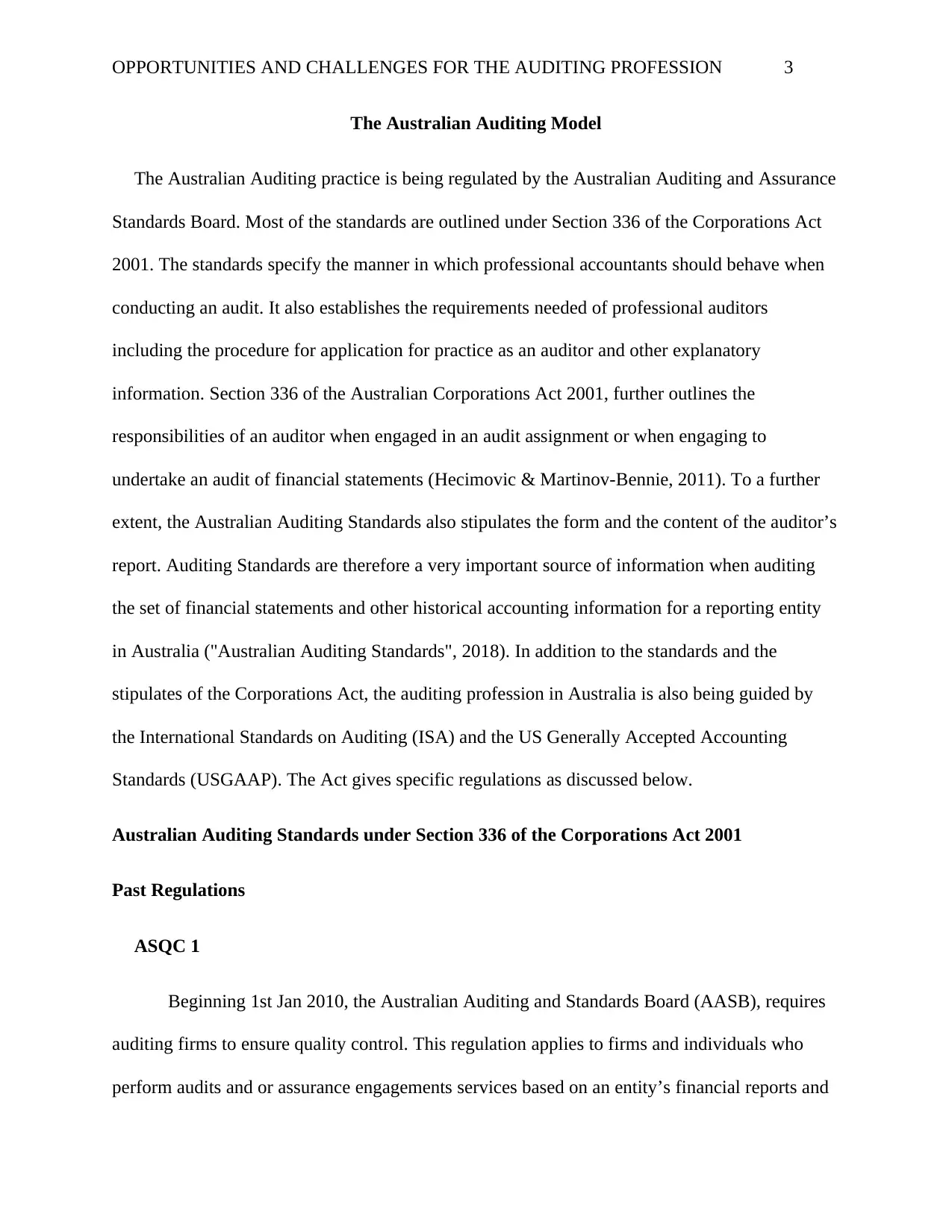
The Australian Auditing practice is being regulated by the Australian Auditing and Assurance
Standards Board. Most of the standards are outlined under Section 336 of the Corporations Act
2001. The standards specify the manner in which professional accountants should behave when
conducting an audit. It also establishes the requirements needed of professional auditors
including the procedure for application for practice as an auditor and other explanatory
information. Section 336 of the Australian Corporations Act 2001, further outlines the
responsibilities of an auditor when engaged in an audit assignment or when engaging to
undertake an audit of financial statements (Hecimovic & Martinov-Bennie, 2011). To a further
extent, the Australian Auditing Standards also stipulates the form and the content of the auditor’s
report. Auditing Standards are therefore a very important source of information when auditing
the set of financial statements and other historical accounting information for a reporting entity
in Australia ("Australian Auditing Standards", 2018). In addition to the standards and the
stipulates of the Corporations Act, the auditing profession in Australia is also being guided by
the International Standards on Auditing (ISA) and the US Generally Accepted Accounting
Standards (USGAAP). The Act gives specific regulations as discussed below.
Australian Auditing Standards under Section 336 of the Corporations Act 2001
Past Regulations
ASQC 1
Beginning 1st Jan 2010, the Australian Auditing and Standards Board (AASB), requires
auditing firms to ensure quality control. This regulation applies to firms and individuals who
perform audits and or assurance engagements services based on an entity’s financial reports and
The Australian Auditing Model
The Australian Auditing practice is being regulated by the Australian Auditing and Assurance
Standards Board. Most of the standards are outlined under Section 336 of the Corporations Act
2001. The standards specify the manner in which professional accountants should behave when
conducting an audit. It also establishes the requirements needed of professional auditors
including the procedure for application for practice as an auditor and other explanatory
information. Section 336 of the Australian Corporations Act 2001, further outlines the
responsibilities of an auditor when engaged in an audit assignment or when engaging to
undertake an audit of financial statements (Hecimovic & Martinov-Bennie, 2011). To a further
extent, the Australian Auditing Standards also stipulates the form and the content of the auditor’s
report. Auditing Standards are therefore a very important source of information when auditing
the set of financial statements and other historical accounting information for a reporting entity
in Australia ("Australian Auditing Standards", 2018). In addition to the standards and the
stipulates of the Corporations Act, the auditing profession in Australia is also being guided by
the International Standards on Auditing (ISA) and the US Generally Accepted Accounting
Standards (USGAAP). The Act gives specific regulations as discussed below.
Australian Auditing Standards under Section 336 of the Corporations Act 2001
Past Regulations
ASQC 1
Beginning 1st Jan 2010, the Australian Auditing and Standards Board (AASB), requires
auditing firms to ensure quality control. This regulation applies to firms and individuals who
perform audits and or assurance engagements services based on an entity’s financial reports and
⊘ This is a preview!⊘
Do you want full access?
Subscribe today to unlock all pages.

Trusted by 1+ million students worldwide
OPPORTUNITIES AND CHALLENGES FOR THE AUDITING PROFESSION 4
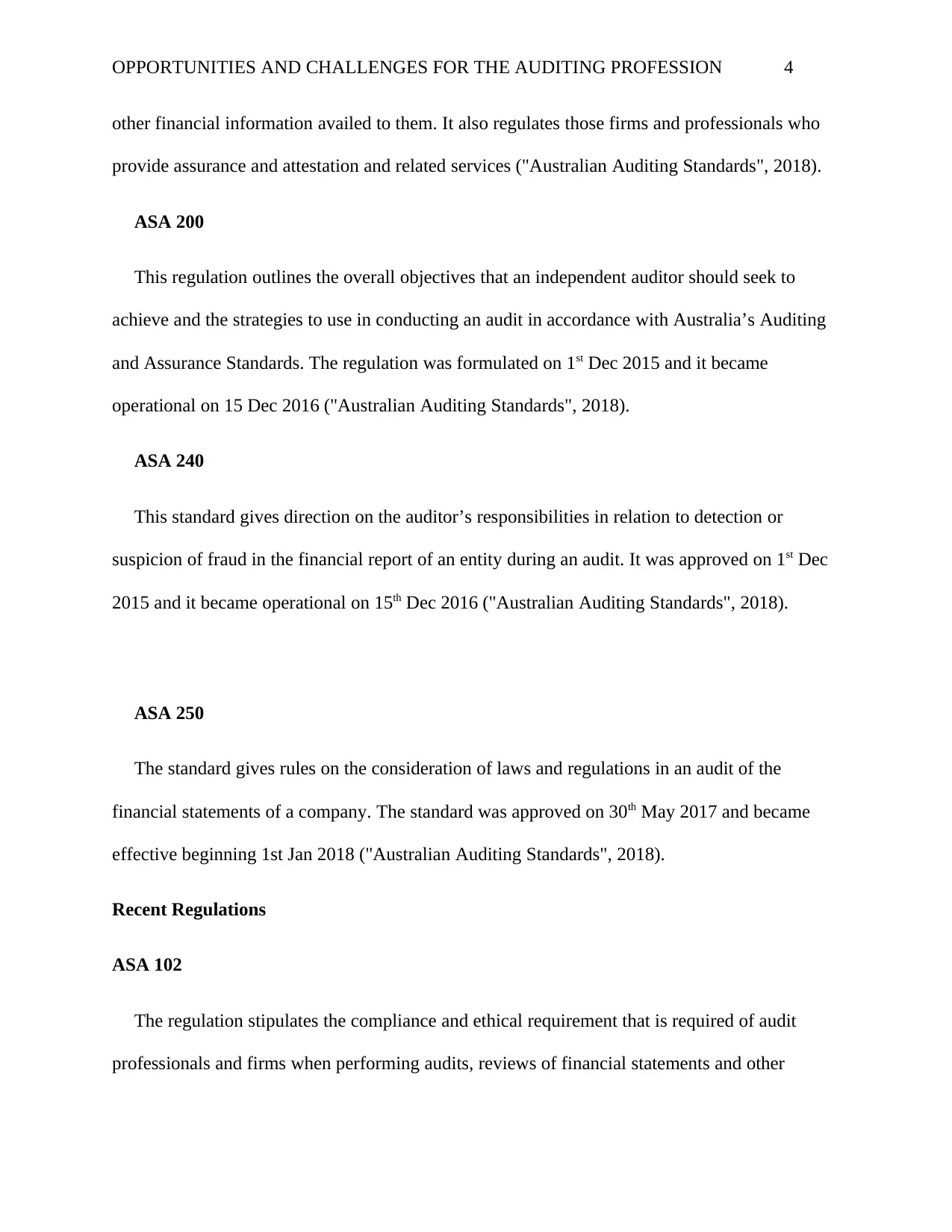
other financial information availed to them. It also regulates those firms and professionals who
provide assurance and attestation and related services ("Australian Auditing Standards", 2018).
ASA 200
This regulation outlines the overall objectives that an independent auditor should seek to
achieve and the strategies to use in conducting an audit in accordance with Australia’s Auditing
and Assurance Standards. The regulation was formulated on 1st Dec 2015 and it became
operational on 15 Dec 2016 ("Australian Auditing Standards", 2018).
ASA 240
This standard gives direction on the auditor’s responsibilities in relation to detection or
suspicion of fraud in the financial report of an entity during an audit. It was approved on 1st Dec
2015 and it became operational on 15th Dec 2016 ("Australian Auditing Standards", 2018).
ASA 250
The standard gives rules on the consideration of laws and regulations in an audit of the
financial statements of a company. The standard was approved on 30th May 2017 and became
effective beginning 1st Jan 2018 ("Australian Auditing Standards", 2018).
Recent Regulations
ASA 102
The regulation stipulates the compliance and ethical requirement that is required of audit
professionals and firms when performing audits, reviews of financial statements and other
other financial information availed to them. It also regulates those firms and professionals who
provide assurance and attestation and related services ("Australian Auditing Standards", 2018).
ASA 200
This regulation outlines the overall objectives that an independent auditor should seek to
achieve and the strategies to use in conducting an audit in accordance with Australia’s Auditing
and Assurance Standards. The regulation was formulated on 1st Dec 2015 and it became
operational on 15 Dec 2016 ("Australian Auditing Standards", 2018).
ASA 240
This standard gives direction on the auditor’s responsibilities in relation to detection or
suspicion of fraud in the financial report of an entity during an audit. It was approved on 1st Dec
2015 and it became operational on 15th Dec 2016 ("Australian Auditing Standards", 2018).
ASA 250
The standard gives rules on the consideration of laws and regulations in an audit of the
financial statements of a company. The standard was approved on 30th May 2017 and became
effective beginning 1st Jan 2018 ("Australian Auditing Standards", 2018).
Recent Regulations
ASA 102
The regulation stipulates the compliance and ethical requirement that is required of audit
professionals and firms when performing audits, reviews of financial statements and other
Paraphrase This Document
Need a fresh take? Get an instant paraphrase of this document with our AI Paraphraser
OPPORTUNITIES AND CHALLENGES FOR THE AUDITING PROFESSION 5
assurance and engagement services. The regulation was approved on 7th March 2018 and it
became operative on 31st March 2018 ("Australian Auditing Standards", 2018).
ASA 250
In regard to the considerations of laws and regulations when it comes to audit of financial
reports, the following changes have been made.
It is the sole responsibility of the management and those charged with governance to take
responsibility and ensure that the corporations operations are conducted in line with the
provisions of the existing laws and regulations.
It also the responsibility of the governance to ensure Compliance with the provisions of policies
that stipulates how the reported amounts and other disclosers were arrived at in the company’s
financial report ("Financial reporting and audit | ASIC - Australian Securities and Investments
Commission", 2018).
ASA 500-510
It gives the changes when it comes to how audit evidence is gathered and the particular
considerations to be made for segment and inventory information. It also outlines the
considerations to be made when it comes to litigation and claims, external confirmations, initial
auditing engagements and manner in which opening balances are treated. These regulations were
approved between 27th Oct 2017 and 30th May 2018 with most being operation by August 2018
("Australian Auditing Standards", 2018).
ASA 700-710
assurance and engagement services. The regulation was approved on 7th March 2018 and it
became operative on 31st March 2018 ("Australian Auditing Standards", 2018).
ASA 250
In regard to the considerations of laws and regulations when it comes to audit of financial
reports, the following changes have been made.
It is the sole responsibility of the management and those charged with governance to take
responsibility and ensure that the corporations operations are conducted in line with the
provisions of the existing laws and regulations.
It also the responsibility of the governance to ensure Compliance with the provisions of policies
that stipulates how the reported amounts and other disclosers were arrived at in the company’s
financial report ("Financial reporting and audit | ASIC - Australian Securities and Investments
Commission", 2018).
ASA 500-510
It gives the changes when it comes to how audit evidence is gathered and the particular
considerations to be made for segment and inventory information. It also outlines the
considerations to be made when it comes to litigation and claims, external confirmations, initial
auditing engagements and manner in which opening balances are treated. These regulations were
approved between 27th Oct 2017 and 30th May 2018 with most being operation by August 2018
("Australian Auditing Standards", 2018).
ASA 700-710
OPPORTUNITIES AND CHALLENGES FOR THE AUDITING PROFESSION 6
The standards deal with issues to do with the formation of an audit opinion and reporting it on
an entity’s financial report. It also specifies the manner in which key audit matters are
communicated by the auditors, the manner in which modification of the audit opinion can be
done, the way of dealing with the emphasis of matter paragraphs and other matter paragraphs in
an audit. ASA 710 also outlines the way in which comparative information and its corresponding
information is dealt with ("Australian Auditing Standards", 2018).
ASA 800
The standard gives direction on how special audit considerations when it comes to financial
reports are prepared by adhering to special purpose frameworks ("Australian Auditing
Standards", 2018).
Opportunities Available for the Auditing Profession
Diversity in Ways of Doing Business
Due to the diversity in the current commercial and business environment all over the
world, there has been increasing complexity of doing business a situation which has seen most
corporations to increasingly desire the Services of a Professional Accountant so as to determine
whether the management is acting as per their interests or not (Bailey, 2008). The increasing use
of e-commerce, electronic funds transfer and global business operations places a company at a
vulnerable position which necessitates the need for an independent examination and
investigation. This situation presents a great opportunity for accountants (auditors) especially
the big four auditing firms as it is likely that more corporations are likely to be in need of
auditing and assurance services than before. Due to the increasing need for auditing and
The standards deal with issues to do with the formation of an audit opinion and reporting it on
an entity’s financial report. It also specifies the manner in which key audit matters are
communicated by the auditors, the manner in which modification of the audit opinion can be
done, the way of dealing with the emphasis of matter paragraphs and other matter paragraphs in
an audit. ASA 710 also outlines the way in which comparative information and its corresponding
information is dealt with ("Australian Auditing Standards", 2018).
ASA 800
The standard gives direction on how special audit considerations when it comes to financial
reports are prepared by adhering to special purpose frameworks ("Australian Auditing
Standards", 2018).
Opportunities Available for the Auditing Profession
Diversity in Ways of Doing Business
Due to the diversity in the current commercial and business environment all over the
world, there has been increasing complexity of doing business a situation which has seen most
corporations to increasingly desire the Services of a Professional Accountant so as to determine
whether the management is acting as per their interests or not (Bailey, 2008). The increasing use
of e-commerce, electronic funds transfer and global business operations places a company at a
vulnerable position which necessitates the need for an independent examination and
investigation. This situation presents a great opportunity for accountants (auditors) especially
the big four auditing firms as it is likely that more corporations are likely to be in need of
auditing and assurance services than before. Due to the increasing need for auditing and
⊘ This is a preview!⊘
Do you want full access?
Subscribe today to unlock all pages.
Trusted by 1+ million students worldwide
OPPORTUNITIES AND CHALLENGES FOR THE AUDITING PROFESSION 7
assurances services, auditors and accountants can use this opportunity to get more clients and
earn more through acting ethically.
The Impact of Technology
Technology has also presented a number of a great opportunity to the audit profession.
Because of the current millennial generation that is greatly effective in the use of the latest
technology. As firms adopt the modern technology in carrying out certain tasks, a number of
opportunity for technology audit arises as more work areas will be automated a situation which
might be prone to fraud.
Desire by Most Companies to Foster Public Confidence
Most corporations in Australia have identified that in the world of today, the public is
more interested in the burdens of firms being bonded to more rigorous high quality and an
organization with a strong internal control system. Since the cost of losing public confidence is
much higher than the cost of hiring a professional auditor to go through the books of accounts of
an entity, corporations today believe that, to manage the reputation of the company, independent
professional auditors should be hired (Bakarich & Kerr, 2016; Gates, Jordan Lowe & Reckers,
2006). Because of this trend, auditing firms and audit professionals are now presented with more
auditing services than before (Sikka, Filling & Liew, 2009; (Bierstaker, Chen, Christ, Ege &
Mintchik, 2012). This is a great opportunity for the ethically perceived auditing firms and
professionals to earn more through the provision of the desired auditing, assurance and
attestation services.
The Need To Give Confidence to Stakeholders
assurances services, auditors and accountants can use this opportunity to get more clients and
earn more through acting ethically.
The Impact of Technology
Technology has also presented a number of a great opportunity to the audit profession.
Because of the current millennial generation that is greatly effective in the use of the latest
technology. As firms adopt the modern technology in carrying out certain tasks, a number of
opportunity for technology audit arises as more work areas will be automated a situation which
might be prone to fraud.
Desire by Most Companies to Foster Public Confidence
Most corporations in Australia have identified that in the world of today, the public is
more interested in the burdens of firms being bonded to more rigorous high quality and an
organization with a strong internal control system. Since the cost of losing public confidence is
much higher than the cost of hiring a professional auditor to go through the books of accounts of
an entity, corporations today believe that, to manage the reputation of the company, independent
professional auditors should be hired (Bakarich & Kerr, 2016; Gates, Jordan Lowe & Reckers,
2006). Because of this trend, auditing firms and audit professionals are now presented with more
auditing services than before (Sikka, Filling & Liew, 2009; (Bierstaker, Chen, Christ, Ege &
Mintchik, 2012). This is a great opportunity for the ethically perceived auditing firms and
professionals to earn more through the provision of the desired auditing, assurance and
attestation services.
The Need To Give Confidence to Stakeholders
Paraphrase This Document
Need a fresh take? Get an instant paraphrase of this document with our AI Paraphraser
OPPORTUNITIES AND CHALLENGES FOR THE AUDITING PROFESSION 8
The auditing profession is rapidly gaining popularity due to the confidence desired by
stakeholders from an audit. Today, various stakeholders such as investors, customers, suppliers,
regulators and even the public have a desire to get assurance from an independent auditor that the
business is stable and it is running well. To have confidence in a certain company, the
stakeholders have to understand the results of business operations of a company and that the
financial report being presented reflects the true state of affairs of the company (Öhman, Häckner
& Sörbom, 2012). Moreover, an audit is also being considered to be a platform where risks are
identified, managed and controlled both at the entity’s level and across the industry. Because of
these factors, auditing services are now being demanded more than before (the Auditing
Practices Board, 2015). This is further supported by the fact that various groups of stakeholders
have the believe that auditors who are involved in auditing an organization have the ability to use
their specialized industry, experiential and financial knowledge to get an in-depth understanding
of the financial performance of an organization and how the organization is functioning using
analytical techniques. The desire for confidence, therefore, creates more opportunities for the
audit profession.
The Compliance Mind-Set
An Independent and Professional audit is perceived to create desirable and intellectual
challenges that might not be created by the organization's employees due to work pressure.
Auditing is therefore considered to provide a professional judgment that is required to make all
the elements of work remain central to the firm (International Federation of Accountants, 2016).
A shift of focus has therefore been channelled to auditing as a way of providing work quality and
balance of compliance with both internal and external rules and regulations.
Challenges Facing the Auditing Profession
The auditing profession is rapidly gaining popularity due to the confidence desired by
stakeholders from an audit. Today, various stakeholders such as investors, customers, suppliers,
regulators and even the public have a desire to get assurance from an independent auditor that the
business is stable and it is running well. To have confidence in a certain company, the
stakeholders have to understand the results of business operations of a company and that the
financial report being presented reflects the true state of affairs of the company (Öhman, Häckner
& Sörbom, 2012). Moreover, an audit is also being considered to be a platform where risks are
identified, managed and controlled both at the entity’s level and across the industry. Because of
these factors, auditing services are now being demanded more than before (the Auditing
Practices Board, 2015). This is further supported by the fact that various groups of stakeholders
have the believe that auditors who are involved in auditing an organization have the ability to use
their specialized industry, experiential and financial knowledge to get an in-depth understanding
of the financial performance of an organization and how the organization is functioning using
analytical techniques. The desire for confidence, therefore, creates more opportunities for the
audit profession.
The Compliance Mind-Set
An Independent and Professional audit is perceived to create desirable and intellectual
challenges that might not be created by the organization's employees due to work pressure.
Auditing is therefore considered to provide a professional judgment that is required to make all
the elements of work remain central to the firm (International Federation of Accountants, 2016).
A shift of focus has therefore been channelled to auditing as a way of providing work quality and
balance of compliance with both internal and external rules and regulations.
Challenges Facing the Auditing Profession
OPPORTUNITIES AND CHALLENGES FOR THE AUDITING PROFESSION 9
The auditing profession is being faced with a number of challenges. These challenges
include:
Ethical Problems in the Accountancy Profession
There is a lot of pressure that accountants encounter in their work environment as they
practice. Because of such pressure’s auditors encounter difficulty in investigating questionable
transactions in a reporting entity. In other cases, professional auditors also experience difficulties
even after investigating and finding out questionable issues in the books of accounts by making
decisions that may affect their ability to maintain an ethical practice (Nuijten, van Twist & van
der Steen, 2015). Many auditors are also torn between remaining ethical and acting against their
client’s expectations and colluding with the management of a company to doctor adverse audit
report (Mazurkiewicz, 2015; Helliar, & Bebbington, 2004). Ethical issues when it comes to
auditing greatly derails the accounting profession and if it continues, it can reduce corporation’s
reliance on audit services.
Difficulty in Work-life Balance
The audit profession is known to be a very demanding type of profession when it comes
to the workload especially during the peak seasons of the year. Due to this requirement, young
audit professionals have a tendency of valuing their personal and social life achievements more
than work (Buchheit, Dalton, Harp & Hollingsworth, 2014). Because of this trend, the auditing
profession is at risk because it is being perceived to aid less when it comes to detecting fraud or
enhancing compliance with a company's internal control policies.
Familiarity and Intimidation
The auditing profession is being faced with a number of challenges. These challenges
include:
Ethical Problems in the Accountancy Profession
There is a lot of pressure that accountants encounter in their work environment as they
practice. Because of such pressure’s auditors encounter difficulty in investigating questionable
transactions in a reporting entity. In other cases, professional auditors also experience difficulties
even after investigating and finding out questionable issues in the books of accounts by making
decisions that may affect their ability to maintain an ethical practice (Nuijten, van Twist & van
der Steen, 2015). Many auditors are also torn between remaining ethical and acting against their
client’s expectations and colluding with the management of a company to doctor adverse audit
report (Mazurkiewicz, 2015; Helliar, & Bebbington, 2004). Ethical issues when it comes to
auditing greatly derails the accounting profession and if it continues, it can reduce corporation’s
reliance on audit services.
Difficulty in Work-life Balance
The audit profession is known to be a very demanding type of profession when it comes
to the workload especially during the peak seasons of the year. Due to this requirement, young
audit professionals have a tendency of valuing their personal and social life achievements more
than work (Buchheit, Dalton, Harp & Hollingsworth, 2014). Because of this trend, the auditing
profession is at risk because it is being perceived to aid less when it comes to detecting fraud or
enhancing compliance with a company's internal control policies.
Familiarity and Intimidation
⊘ This is a preview!⊘
Do you want full access?
Subscribe today to unlock all pages.
Trusted by 1+ million students worldwide
OPPORTUNITIES AND CHALLENGES FOR THE AUDITING PROFESSION 10
Familiarity and Intimidation are the main threats to auditing. For intimidation, the auditor
is unable to work or act independently because he or she fears intimidation threats from the
employees or the management of the company being audited. Such threats make the auditor end
up working as per the client's wishes (Hassan, Luehlfing & Wilkie, 2011). Familiarity involves a
situation where the client and the auditor have a too close relationship due to a long-term
association (Ryan, 2018). Familiarity has the effect of reducing independence of the auditor and
hence the audit itself.
Advocacy, Self-Review and Self- Interest
Advocacy is a situation where the auditor is hired so as to defend or justify the position of
the client by acting as its advocate. Advocacy threatens the independence and objectivity of the
audit. Self-review is a condition where the same auditor is tasked with a review of the judgment
or opinion he or she has made by himself. Self-interest involves a situation where the auditor has
some financial interest in a matter (Tricker, 2002, Reinstein, Pacini & Green, 2017). Because of
the motive for money, the auditor may not act independently and objectively.
Conclusion
To sum up, it evident that the auditing profession in Australia is presented with a number
of opportunities and challenges. Most of the opportunities are tied to the increasing nature of
technological advancement which has increased automation of many tasks. Moreover, auditing is
also gaining more popularity due to the ever-changing complexity of doing business and other
issues such as e-commerce. It is because of the aforementioned factors plus a more mature block
chain of the artificial intelligence-driven world that today, investors and other stakeholders desire
to hire professional auditors to establish if the financial statements being presented by the
Familiarity and Intimidation are the main threats to auditing. For intimidation, the auditor
is unable to work or act independently because he or she fears intimidation threats from the
employees or the management of the company being audited. Such threats make the auditor end
up working as per the client's wishes (Hassan, Luehlfing & Wilkie, 2011). Familiarity involves a
situation where the client and the auditor have a too close relationship due to a long-term
association (Ryan, 2018). Familiarity has the effect of reducing independence of the auditor and
hence the audit itself.
Advocacy, Self-Review and Self- Interest
Advocacy is a situation where the auditor is hired so as to defend or justify the position of
the client by acting as its advocate. Advocacy threatens the independence and objectivity of the
audit. Self-review is a condition where the same auditor is tasked with a review of the judgment
or opinion he or she has made by himself. Self-interest involves a situation where the auditor has
some financial interest in a matter (Tricker, 2002, Reinstein, Pacini & Green, 2017). Because of
the motive for money, the auditor may not act independently and objectively.
Conclusion
To sum up, it evident that the auditing profession in Australia is presented with a number
of opportunities and challenges. Most of the opportunities are tied to the increasing nature of
technological advancement which has increased automation of many tasks. Moreover, auditing is
also gaining more popularity due to the ever-changing complexity of doing business and other
issues such as e-commerce. It is because of the aforementioned factors plus a more mature block
chain of the artificial intelligence-driven world that today, investors and other stakeholders desire
to hire professional auditors to establish if the financial statements being presented by the
Paraphrase This Document
Need a fresh take? Get an instant paraphrase of this document with our AI Paraphraser
OPPORTUNITIES AND CHALLENGES FOR THE AUDITING PROFESSION 11
management and the directors reflects the true state of affairs of the company. On the other hand,
the auditing profession has also not been free from challenges. Issues to do with conflicts of
interest, familiarity, intimidation and financial pressure has tended to derail the practice in some
way. Amid all these challenges, the issue of ethical behaviour stands out as one of the most
fundamental virtues that should characterize quality audits. Nevertheless, the audit profession is
still gaining more popularity despite the challenges and is expected to create more chances for
auditors as discussed above.
References
Australian Auditing Standards. (2018). Retrieved from
https://www.auasb.gov.au/Pronouncements/Australian-Auditing-Standards.aspx
management and the directors reflects the true state of affairs of the company. On the other hand,
the auditing profession has also not been free from challenges. Issues to do with conflicts of
interest, familiarity, intimidation and financial pressure has tended to derail the practice in some
way. Amid all these challenges, the issue of ethical behaviour stands out as one of the most
fundamental virtues that should characterize quality audits. Nevertheless, the audit profession is
still gaining more popularity despite the challenges and is expected to create more chances for
auditors as discussed above.
References
Australian Auditing Standards. (2018). Retrieved from
https://www.auasb.gov.au/Pronouncements/Australian-Auditing-Standards.aspx
OPPORTUNITIES AND CHALLENGES FOR THE AUDITING PROFESSION 12
Auditing Practices Board (2015), Draft Ethical Standards for Auditors, Auditing Practices Board,
London.
Bakarich, K., & Kerr, J. (2016). Compliance Costs and Book-Tax Conformity: Evidence from
Audit Fees and Audit Quality. SSRN Electronic Journal. doi: 10.2139/ssrn.2761107
Bailey, A. (2008). Perspectives on the Auditing Profession Part I: The Practicing
Profession. Current Issues In Auditing, 2(1), C28-C36. doi: 10.2308/ciia.2008.2.1.c28
Bierstaker, J., Chen, L., Christ, M., Ege, M., & Mintchik, N. (2012). Obtaining Assurance for
Financial Statement Audits and Control Audits when Aspects of the Financial Reporting
Process are Outsourced. SSRN Electronic Journal. doi: 10.2139/ssrn.2031706
Buchheit, S., Dalton, D., Harp, N., & Hollingsworth, C. (2014). An Analysis of Auditing and
Accounting Professionalss Work-Life Balance in the Post-Sarbanes-Oxley Era. SSRN
Electronic Journal. doi: 10.2139/ssrn.2501805
Bromell, T (2004), “Taking an Ethical Lead”, Accountancy Magazine, Sept, pp.131-141.
Financial reporting and audit | ASIC - Australian Securities and Investments Commission.
(2018). Retrieved from https://asic.gov.au/regulatory-resources/financial-reporting-and-
audit/
Gates, S., Jordan Lowe, D., & Reckers, P. (2006). Restoring public confidence in capital markets
through auditor rotation. Managerial Auditing Journal, 22(1), 5-17. doi:
10.1108/02686900710715611
Auditing Practices Board (2015), Draft Ethical Standards for Auditors, Auditing Practices Board,
London.
Bakarich, K., & Kerr, J. (2016). Compliance Costs and Book-Tax Conformity: Evidence from
Audit Fees and Audit Quality. SSRN Electronic Journal. doi: 10.2139/ssrn.2761107
Bailey, A. (2008). Perspectives on the Auditing Profession Part I: The Practicing
Profession. Current Issues In Auditing, 2(1), C28-C36. doi: 10.2308/ciia.2008.2.1.c28
Bierstaker, J., Chen, L., Christ, M., Ege, M., & Mintchik, N. (2012). Obtaining Assurance for
Financial Statement Audits and Control Audits when Aspects of the Financial Reporting
Process are Outsourced. SSRN Electronic Journal. doi: 10.2139/ssrn.2031706
Buchheit, S., Dalton, D., Harp, N., & Hollingsworth, C. (2014). An Analysis of Auditing and
Accounting Professionalss Work-Life Balance in the Post-Sarbanes-Oxley Era. SSRN
Electronic Journal. doi: 10.2139/ssrn.2501805
Bromell, T (2004), “Taking an Ethical Lead”, Accountancy Magazine, Sept, pp.131-141.
Financial reporting and audit | ASIC - Australian Securities and Investments Commission.
(2018). Retrieved from https://asic.gov.au/regulatory-resources/financial-reporting-and-
audit/
Gates, S., Jordan Lowe, D., & Reckers, P. (2006). Restoring public confidence in capital markets
through auditor rotation. Managerial Auditing Journal, 22(1), 5-17. doi:
10.1108/02686900710715611
⊘ This is a preview!⊘
Do you want full access?
Subscribe today to unlock all pages.
Trusted by 1+ million students worldwide

1 out of 14


Related Documents


Your All-in-One AI-Powered Toolkit for Academic Success.
+13062052269
info@desklib.com
Available 24*7 on WhatsApp / Email
![[object Object]](/_next/static/media/star-bottom.7253800d.svg)
Unlock your academic potential
Copyright © 2020–2026 A2Z Services. All Rights Reserved. Developed and managed by ZUCOL.