Opportunity Journal 2, S2 2018: Business Reflection & Checklist

Verified

Added on  2023/06/07

|6
|922
|434
Homework Assignment
AI Summary
This assignment, "Opportunity Journal 2," requires students to reflect on converting their business ideas into a concrete plan. The student begins by discussing their passion for music and technology, highlighting how these interests can fuel entrepreneurial ventures. The assignment then delves into self-reflection, exploring the student's strengths, weaknesses, and the importance of teamwork in fostering entrepreneurship. It emphasizes the significance of understanding the work environment to boost productivity. The core of the assignment involves answering questions about a new business idea, researching its viability, and creating an opportunity checklist that analyzes customers, competitors, vendors, and government regulations. The student provides detailed responses to each question, offering insights into their business concept and the steps required to bring it to fruition. The assignment concludes with a reference list.

Document Page
Student ID: Student Name:
Opportunity Journal 2_S2 2018
Student
Tutor
Institutional Affiliation
Date
-1-
tabler-icon-diamond-filled.svg

Paraphrase This Document

Need a fresh take? Get an instant paraphrase of this document with our AI Paraphraser
Document Page
Student ID: Student Name:
Opportunity Journal 2_S2 2018
Answer sheet
Converting Your Ideas into a Business
Reflection Point – Your Thoughts
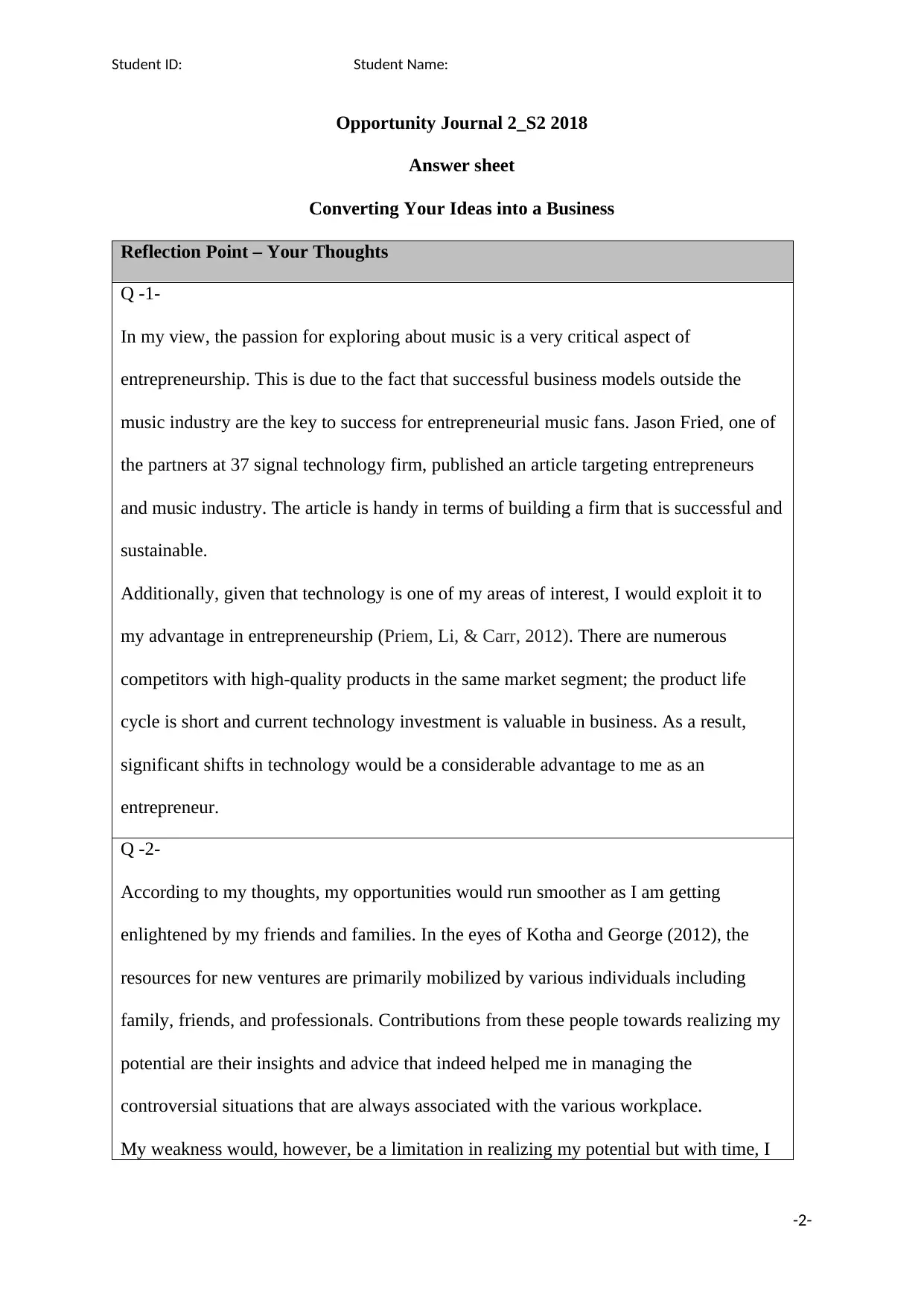
Q -1-
In my view, the passion for exploring about music is a very critical aspect of
entrepreneurship. This is due to the fact that successful business models outside the
music industry are the key to success for entrepreneurial music fans. Jason Fried, one of
the partners at 37 signal technology firm, published an article targeting entrepreneurs
and music industry. The article is handy in terms of building a firm that is successful and
sustainable.
Additionally, given that technology is one of my areas of interest, I would exploit it to
my advantage in entrepreneurship (Priem, Li, & Carr, 2012). There are numerous
competitors with high-quality products in the same market segment; the product life
cycle is short and current technology investment is valuable in business. As a result,
significant shifts in technology would be a considerable advantage to me as an
entrepreneur.
Q -2-
According to my thoughts, my opportunities would run smoother as I am getting
enlightened by my friends and families. In the eyes of Kotha and George (2012), the
resources for new ventures are primarily mobilized by various individuals including
family, friends, and professionals. Contributions from these people towards realizing my
potential are their insights and advice that indeed helped me in managing the
controversial situations that are always associated with the various workplace.
My weakness would, however, be a limitation in realizing my potential but with time, I
-2-
Document Page
Student ID: Student Name:
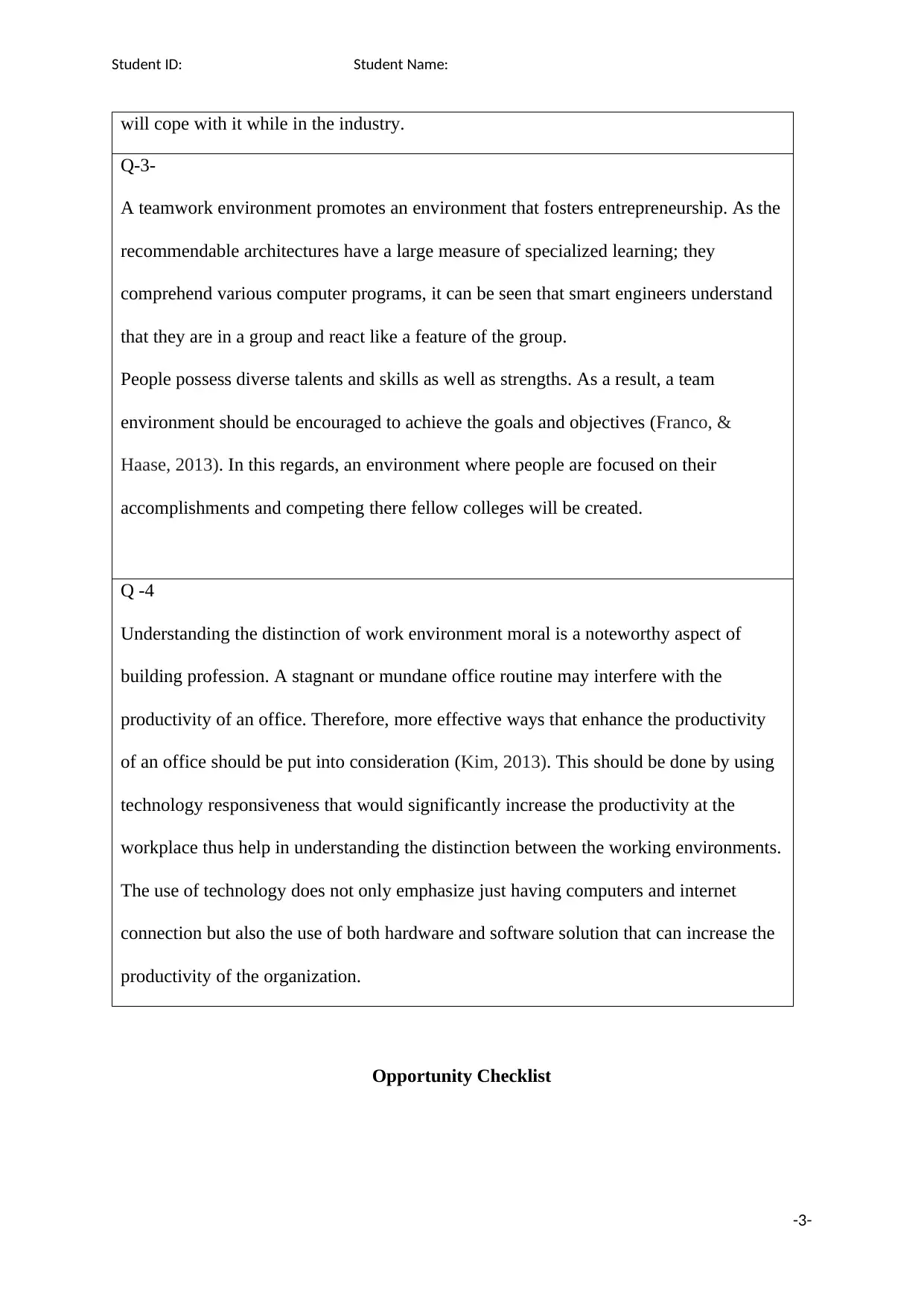
will cope with it while in the industry.
Q-3-
A teamwork environment promotes an environment that fosters entrepreneurship. As the
recommendable architectures have a large measure of specialized learning; they
comprehend various computer programs, it can be seen that smart engineers understand
that they are in a group and react like a feature of the group.
People possess diverse talents and skills as well as strengths. As a result, a team
environment should be encouraged to achieve the goals and objectives (Franco, &
Haase, 2013). In this regards, an environment where people are focused on their
accomplishments and competing there fellow colleges will be created.
Q -4
Understanding the distinction of work environment moral is a noteworthy aspect of
building profession. A stagnant or mundane office routine may interfere with the
productivity of an office. Therefore, more effective ways that enhance the productivity
of an office should be put into consideration (Kim, 2013). This should be done by using
technology responsiveness that would significantly increase the productivity at the
workplace thus help in understanding the distinction between the working environments.
The use of technology does not only emphasize just having computers and internet
connection but also the use of both hardware and software solution that can increase the
productivity of the organization.
Opportunity Checklist
-3-
Document Page
Student ID: Student Name:
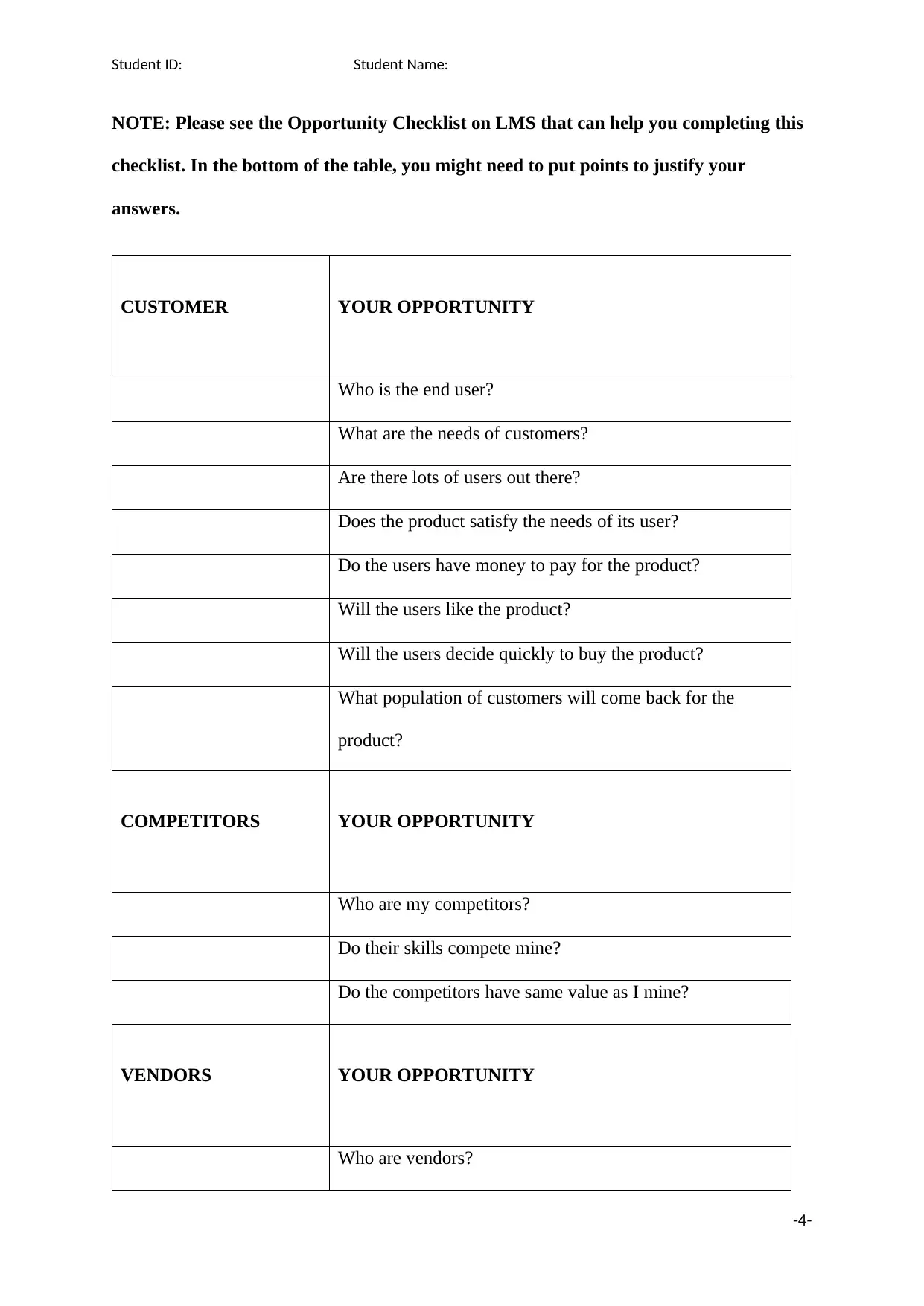
NOTE: Please see the Opportunity Checklist on LMS that can help you completing this
checklist. In the bottom of the table, you might need to put points to justify your
answers.
CUSTOMER YOUR OPPORTUNITY
Who is the end user?
What are the needs of customers?
Are there lots of users out there?
Does the product satisfy the needs of its user?
Do the users have money to pay for the product?
Will the users like the product?
Will the users decide quickly to buy the product?
What population of customers will come back for the
product?
COMPETITORS YOUR OPPORTUNITY
Who are my competitors?
Do their skills compete mine?
Do the competitors have same value as I mine?
VENDORS YOUR OPPORTUNITY
Who are vendors?
-4-
tabler-icon-diamond-filled.svg

Paraphrase This Document

Need a fresh take? Get an instant paraphrase of this document with our AI Paraphraser
Document Page
Student ID: Student Name:
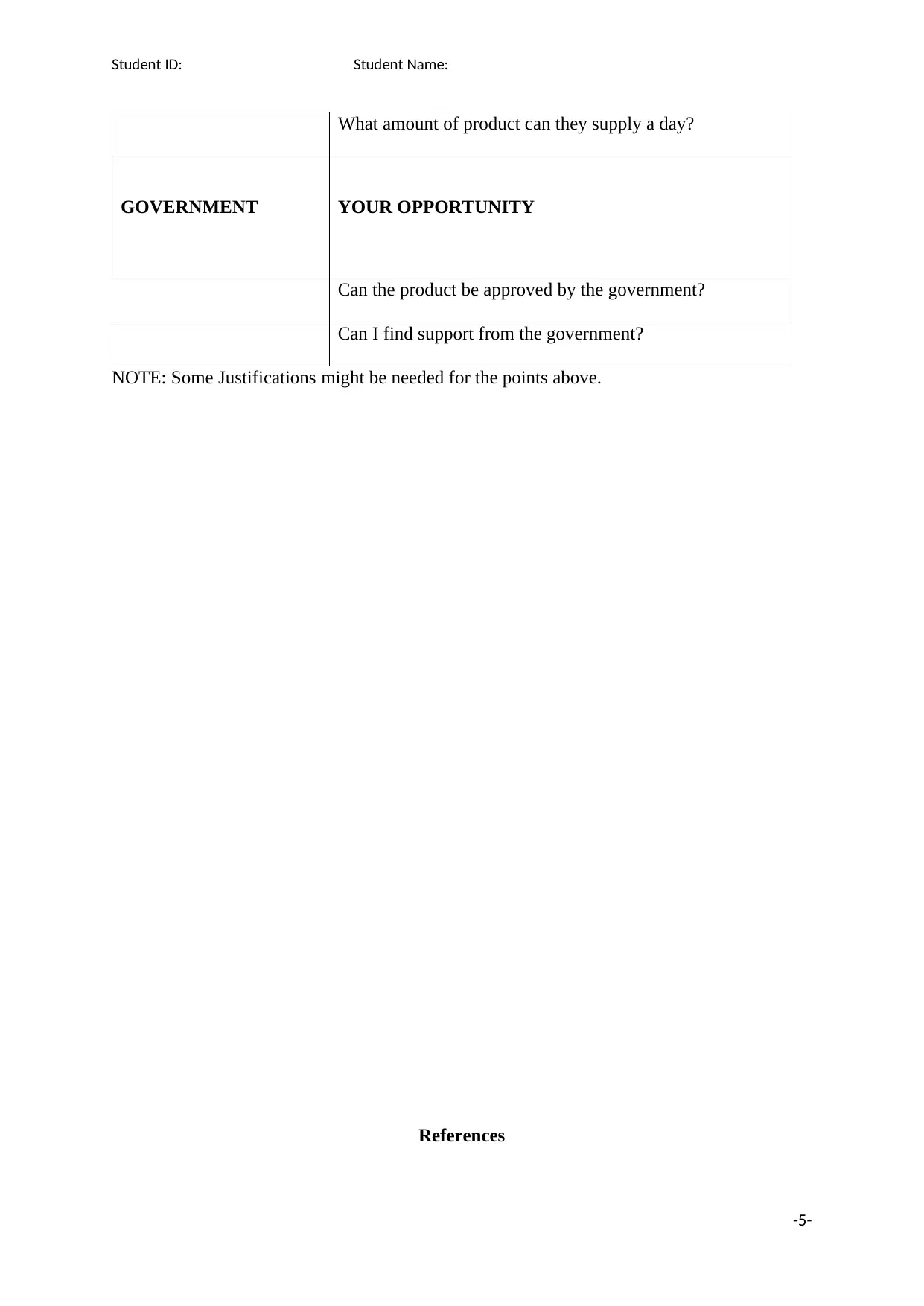
What amount of product can they supply a day?
GOVERNMENT YOUR OPPORTUNITY
Can the product be approved by the government?
Can I find support from the government?
NOTE: Some Justifications might be needed for the points above.
References
-5-
Document Page
Student ID: Student Name:
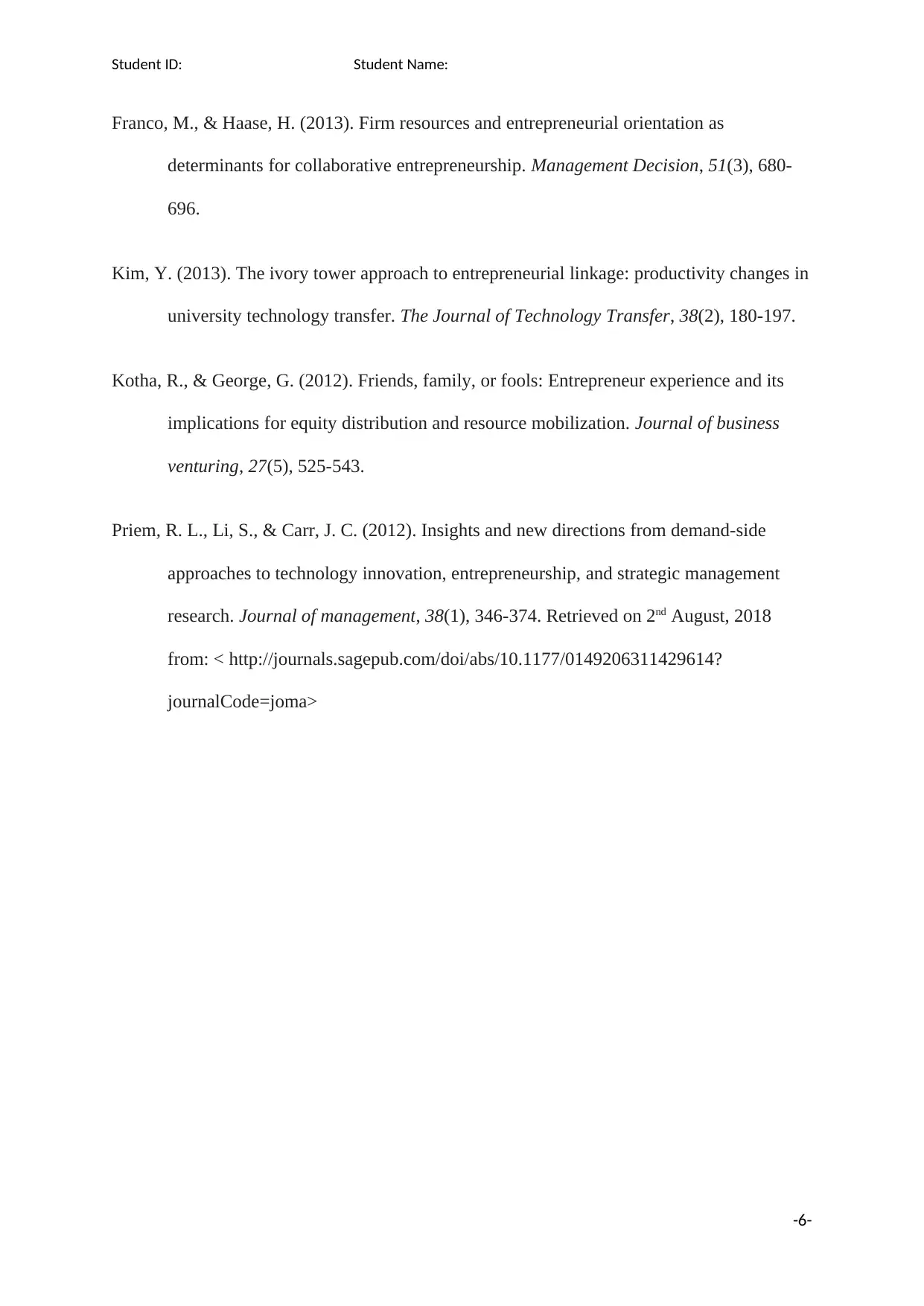
Franco, M., & Haase, H. (2013). Firm resources and entrepreneurial orientation as
determinants for collaborative entrepreneurship. Management Decision, 51(3), 680-
696.
Kim, Y. (2013). The ivory tower approach to entrepreneurial linkage: productivity changes in
university technology transfer. The Journal of Technology Transfer, 38(2), 180-197.
Kotha, R., & George, G. (2012). Friends, family, or fools: Entrepreneur experience and its
implications for equity distribution and resource mobilization. Journal of business
venturing, 27(5), 525-543.
Priem, R. L., Li, S., & Carr, J. C. (2012). Insights and new directions from demand-side
approaches to technology innovation, entrepreneurship, and strategic management
research. Journal of management, 38(1), 346-374. Retrieved on 2nd August, 2018
from: < http://journals.sagepub.com/doi/abs/10.1177/0149206311429614?
journalCode=joma>
-6-
chevron_up_icon
1 out of 6
circle_padding
hide_on_mobile
zoom_out_icon
[object Object]