Physics Assignment: Optical Physics of Human Eye and Camera

Verified

Added on  2022/09/09

|5
|1281
|16
Homework Assignment
AI Summary
This assignment delves into the fascinating realm of optical physics, specifically comparing the mechanics of the human eye to that of a camera. The discussion begins by highlighting the key components of the human eye, including the pupil, iris, cornea, retina, and lens, and explaining how these elements work together to form images. The paper emphasizes the role of the lens and cornea in image formation and the adjustability of the lens to accommodate different object distances. It then draws parallels between the human eye and a camera, noting similarities in the presence of a lens for focusing light, a diaphragm for controlling light intake, and a method of image sensing. The assignment also explores the differences, particularly in how the brain processes the images formed on the retina, and how vision correction methods like diverging and converging lenses are used. The assignment concludes by reiterating the significance of optical physics in understanding daily life applications, such as the human eye versus camera comparison. The provided solution includes cited sources to support the analysis.
Document Page
Running Head: PHYSICS
0
Physics
Physics in Daily-life
(Student Details: )
12/12/2019
tabler-icon-diamond-filled.svg

Paraphrase This Document

Need a fresh take? Get an instant paraphrase of this document with our AI Paraphraser
Document Page
Physics
1
Physics application in daily life
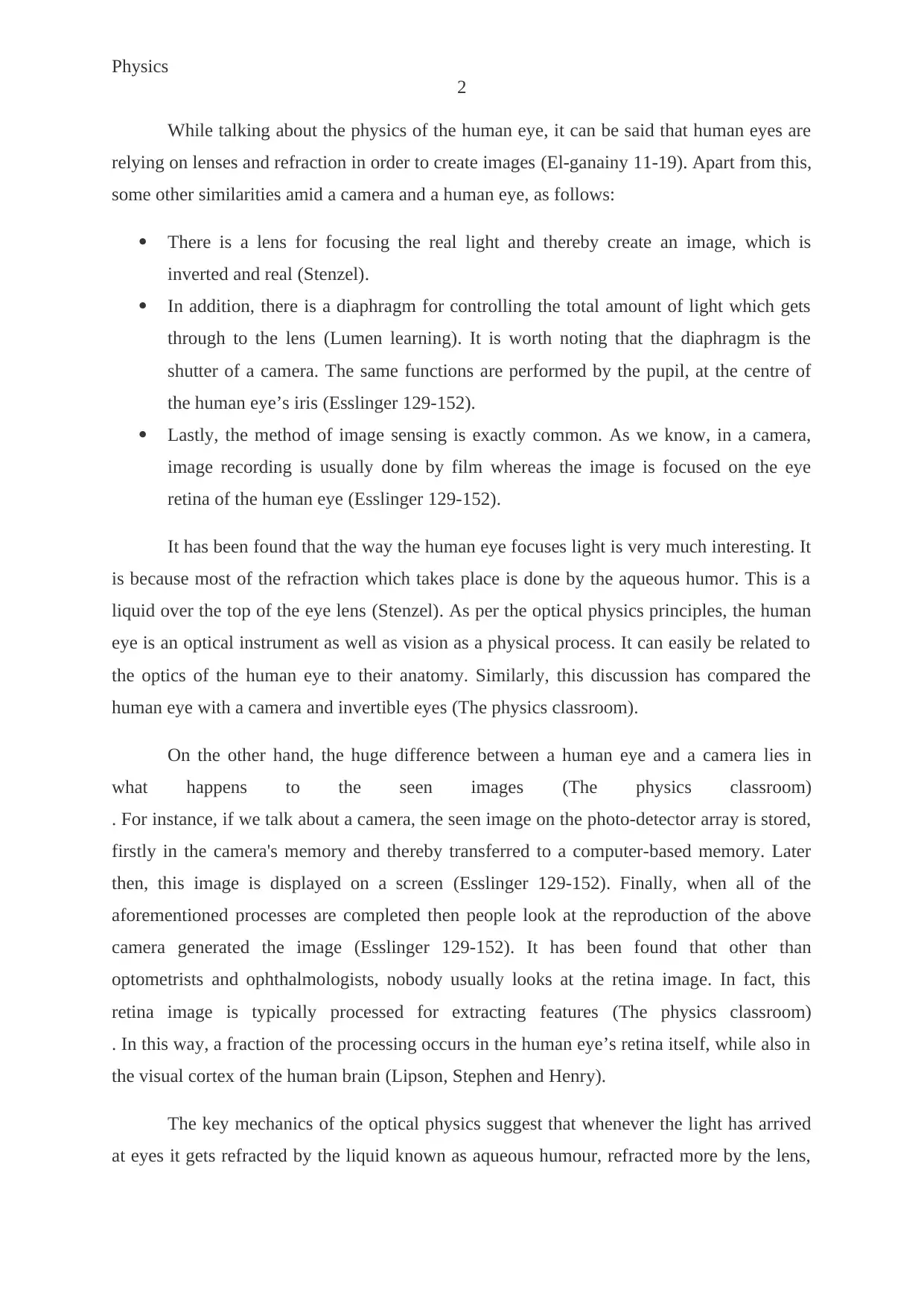
This discussion is based on a physics-related subject so that daily-life activities can be
understood while identifying their connections with physics. This paper will discuss human
eyes versus camera mechanics with the help of optical physics (Kamps). In this context, this
research is majorly focused on optical physics lies in human eyes while seeing and looking at
different objects (Stengel). Besides, the optical physics of the human eye like a camera and
lens will be discussed in detail. In general, it is an understandable comparison between the
human eye and camera. Moreover, the human eye typically consists of an aperture ring as the
pupil and iris, a front element as the cornea, a sensor as the retina and a lens as well (Stengel).
Source: (El-ganainy 11-19)
It is well-aware fact that the human eye is remarkable in the way it forms images as
well as the richness of the details with color it is able to detect (El-ganainy 11-19). It has been
found that image formation with human eyes along with the common vision correction can
easily be analysed with optical physics or optics (Roger). In this optical physics of the human
eye, the lens and cornea of the eye act together for forming a real image on the light-sensing
retina (El-ganainy 11-19). Besides, the radius of curvature of the lens of a human eye is
always adjustable while forming an image over the retina for so many object distances
(Lumen learning). Apart from this, there is a layer of tissues having varied indices of
refraction in the eye lens in a human eye (El-ganainy 11-19).
Document Page
Physics
2
While talking about the physics of the human eye, it can be said that human eyes are
relying on lenses and refraction in order to create images (El-ganainy 11-19). Apart from this,
some other similarities amid a camera and a human eye, as follows:
There is a lens for focusing the real light and thereby create an image, which is
inverted and real (Stenzel).
In addition, there is a diaphragm for controlling the total amount of light which gets
through to the lens (Lumen learning). It is worth noting that the diaphragm is the
shutter of a camera. The same functions are performed by the pupil, at the centre of
the human eye’s iris (Esslinger 129-152).
Lastly, the method of image sensing is exactly common. As we know, in a camera,
image recording is usually done by film whereas the image is focused on the eye
retina of the human eye (Esslinger 129-152).
It has been found that the way the human eye focuses light is very much interesting. It
is because most of the refraction which takes place is done by the aqueous humor. This is a
liquid over the top of the eye lens (Stenzel). As per the optical physics principles, the human
eye is an optical instrument as well as vision as a physical process. It can easily be related to
the optics of the human eye to their anatomy. Similarly, this discussion has compared the
human eye with a camera and invertible eyes (The physics classroom).
On the other hand, the huge difference between a human eye and a camera lies in
what happens to the seen images (The physics classroom)
. For instance, if we talk about a camera, the seen image on the photo-detector array is stored,
firstly in the camera's memory and thereby transferred to a computer-based memory. Later
then, this image is displayed on a screen (Esslinger 129-152). Finally, when all of the
aforementioned processes are completed then people look at the reproduction of the above
camera generated the image (Esslinger 129-152). It has been found that other than
optometrists and ophthalmologists, nobody usually looks at the retina image. In fact, this
retina image is typically processed for extracting features (The physics classroom)
. In this way, a fraction of the processing occurs in the human eye’s retina itself, while also in
the visual cortex of the human brain (Lipson, Stephen and Henry).
The key mechanics of the optical physics suggest that whenever the light has arrived
at eyes it gets refracted by the liquid known as aqueous humour, refracted more by the lens,
Document Page
Physics
3
as well as more by the vitreous humor (Lipson, Stephen and Henry). It is worth knowing that
lens is essential for forming a sharp image on the human eye, and it is the best feature of the
human eye (Lipson, Stephen and Henry). In addition to that, when a person is near sighted
then he or she can only form sharp images of the close-situated objects. In order to correct the
vision, a lens can always be placed in front of the human eye. In this context, it can be said
that the diverging lens is needed whenever there is a need to diverge the light rays (Kamps).
On the contrary, whenever a converging lens is utilised to correct farsightedness then it
allows images to be brought in sharp focus at the human eye’s retina (Lipson, Stephen and
Henry).
In whole, this discussion has successfully explored the physics-related subject, optical
physics. Based on optics, it can be said that human eyes are having a lot of pixels as
compared to a camera. This discussion has found so many similarities and differences
between a camera and a human eye. In this way, physics is containing a wide syllabus
containing a wide range of subjects which can easily be applied to several daily-life activities
like the human eye versus camera.
tabler-icon-diamond-filled.svg

Paraphrase This Document

Need a fresh take? Get an instant paraphrase of this document with our AI Paraphraser
Document Page
Physics
4
Work-Cited
El-ganainy, Ramy " Non-hermitian physics and pt symmetry ". Nature physics. 14.1. 2018:
11-19.
Esslinger, Tilman " Fermi-hubbard physics with atoms in an optical lattice ". Annu. rev.
condens. matter phys.. 1.1. 2010: 129-152.
Kamps, Haje jan " What’s the difference between a camera and a human eye?. " Medium.
Web 2019. 2019. < https://medium.com/photography-secrets/whats-the-difference-
between-a-camera-and-a-human-eye-a006a795b09f. >
Lipson, Ariel , G Lipson Stephen, and Lipson Henry, " Optical physics ". London:
Cambridge university press, 2010.
Lumen learning, Ll " The human eye. " Lumen learning. Web 2019. 2019. <
https://courses.lumenlearning.com/boundless-physics/chapter/the-human-eye/. >
Roger, Cicala " The camera versus the human eye. " Peta pixel. Web 2019. 2019. <
https://petapixel.com/2012/11/17/the-camera-versus-the-human-eye/. >
Stenzel, Olaf " The physics of thin film optical spectra ". London: Springer, 2015.
The physics classroom, Pc " The anatomy of the eye. " The physics classroom. Web 2019.
2019. < https://www.physicsclassroom.com/class/refrn/Lesson-6/The-Anatomy-of-
the-Eye. >
chevron_up_icon
1 out of 5
circle_padding
hide_on_mobile
zoom_out_icon
[object Object]