Optimizing Supply Chain Network for Fresh Vegetable Delivery

Verified

Added on  2023/06/03

|5
|776
|258
Report
AI Summary
This report provides an overview of supply chain network design considerations for vegetables, a fast-moving and perishable good. It highlights the importance of a short supply chain with specialized storage facilities to maintain freshness and minimize losses. The report emphasizes key considerations such as cost optimization through lean strategies and reducing the number of intermediaries, proper storage facilities including freezers in warehouses and refrigerated transportation, and strategic location of production and storage near markets to ensure timely delivery. By addressing these factors, the supply chain network can effectively meet customer needs with fresh vegetables while minimizing costs and losses.

Document Page
LAST NAME 1
SUPPLY CHAIN NETWORK
Name of student
Name of institution
Date
tabler-icon-diamond-filled.svg

Paraphrase This Document

Need a fresh take? Get an instant paraphrase of this document with our AI Paraphraser
Document Page
LAST NAME 2
Introduction
The fast-moving good of choice is vegetables, which are perishable. The perishable
nature could lead to losses and damages when the products take long before reaching the
market. The vegetables require special attention when moving from the producers to the final
consumers¹. Vegetables require a short supply chain with special storage facilities that ensure
that the products stay fresh for long. The products should also move through a short chain to
avoid increases in the market costs.
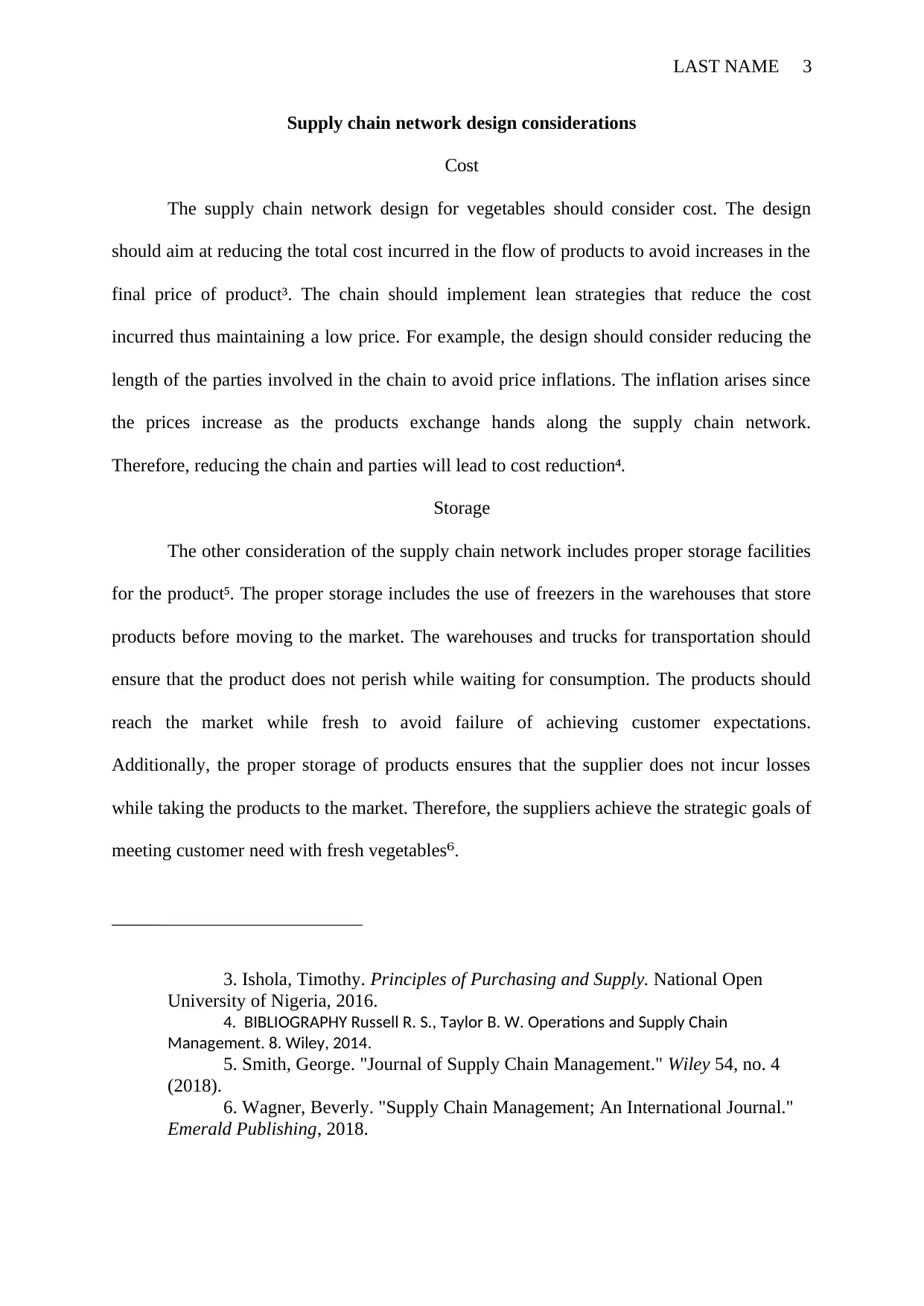
Supply chain network diagram for vegetables
The producers include the farmers who grow vegetables in the firms. The products
require quick movement after harvest to prevent damages. Therefore, the retailers buy
directly from the producers and deliver directly to the customers. The few parties ensure that
the vegetables do not delay before reaching the customers. Moreover, the elimination of
delay ensures the maintenance of product quality².
1. Russell R. S., Taylor B. W. Operations and Supply Chain Management. 8.
Wiley, 2014.
2. Ishola, Timothy. Principles of Purchasing and Supply. National Open
University of Nigeria, 2016.
producer retailers consumers
Document Page
LAST NAME 3
Supply chain network design considerations
Cost
The supply chain network design for vegetables should consider cost. The design
should aim at reducing the total cost incurred in the flow of products to avoid increases in the
final price of product³. The chain should implement lean strategies that reduce the cost
incurred thus maintaining a low price. For example, the design should consider reducing the
length of the parties involved in the chain to avoid price inflations. The inflation arises since
the prices increase as the products exchange hands along the supply chain network.
Therefore, reducing the chain and parties will lead to cost reduction⁴.
Storage
The other consideration of the supply chain network includes proper storage facilities
for the product⁵. The proper storage includes the use of freezers in the warehouses that store
products before moving to the market. The warehouses and trucks for transportation should
ensure that the product does not perish while waiting for consumption. The products should
reach the market while fresh to avoid failure of achieving customer expectations.
Additionally, the proper storage of products ensures that the supplier does not incur losses
while taking the products to the market. Therefore, the suppliers achieve the strategic goals of
meeting customer need with fresh vegetables .
3. Ishola, Timothy. Principles of Purchasing and Supply. National Open
University of Nigeria, 2016.
4. BIBLIOGRAPHY Russell R. S., Taylor B. W. Operations and Supply Chain
Management. 8. Wiley, 2014.
5. Smith, George. "Journal of Supply Chain Management." Wiley 54, no. 4
(2018).
6. Wagner, Beverly. "Supply Chain Management; An International Journal."
Emerald Publishing, 2018.
Document Page
LAST NAME 4
Location
The supply chain design should ensure that the product reaches the market quickly.
The vegetable could achieve fast market delivery by ensuring storage and production in
places near the market⁷. The supply chain network should ensure the positioning of storage
facilities such as warehouses near the markets and consumers. The positioning of warehouses
near the market ensures that the products do not face delays while moving to the consumers.
On the other hand, the producers should produce the vegetables in places near the market or
places with efficient transport to the market⁸. Therefore, the strategy ensures that the
vegetables do not go bad or incur excessive costs during transportation.
7. Wagner, Beverly. "Supply Chain Management; An International Journal."
Emerald Publishing, 2018.
8. Russell R. S., Taylor B. W. Operations and Supply Chain Management. 8.
Wiley, 2014.
tabler-icon-diamond-filled.svg

Paraphrase This Document

Need a fresh take? Get an instant paraphrase of this document with our AI Paraphraser
Document Page
LAST NAME 5
.
Bibliography
Ishola, Timothy. Principles of Purchasing and Supply. National Open University of Nigeria,
2016.
Russell R. S., Taylor B. W. Operations and Supply Chain Management. 8. Wiley, 2014.
Smith, George. "Journal of Supply Chain Management." Wiley 54, no. 4 (2018).
Wagner, Beverly. "Supply Chain Management; An International Journal." Emerald
Publishing, 2018.
chevron_up_icon
1 out of 5
circle_padding
hide_on_mobile
zoom_out_icon
[object Object]