Literature Review: Oral Health Education in Type 1 Diabetes Patients
VerifiedAdded on 2022/10/06
|21
|4371
|19
Report
AI Summary
This report presents a literature review that investigates the effectiveness of verbal and non-verbal oral health education in improving oral health and blood sugar levels in Type 1 diabetic patients. The study explores the impact of dental health training, including the use of videos and presentations, compared to standard verbal instructions. The review examines the relationship between oral health conditions, such as dental caries and periodontal diseases, and blood sugar control. It analyzes various studies, including systematic reviews and randomized clinical trials, assessing the methodologies used and the risk of bias. The findings suggest that oral health education, especially when incorporating non-verbal methods, can significantly improve oral health outcomes and potentially influence blood sugar levels in Type 1 diabetic patients. The review highlights the importance of educating patients about the connection between oral health and overall health, emphasizing the role of healthcare professionals in providing effective oral hygiene instructions.


Paraphrase This Document
Need a fresh take? Get an instant paraphrase of this document with our AI Paraphraser
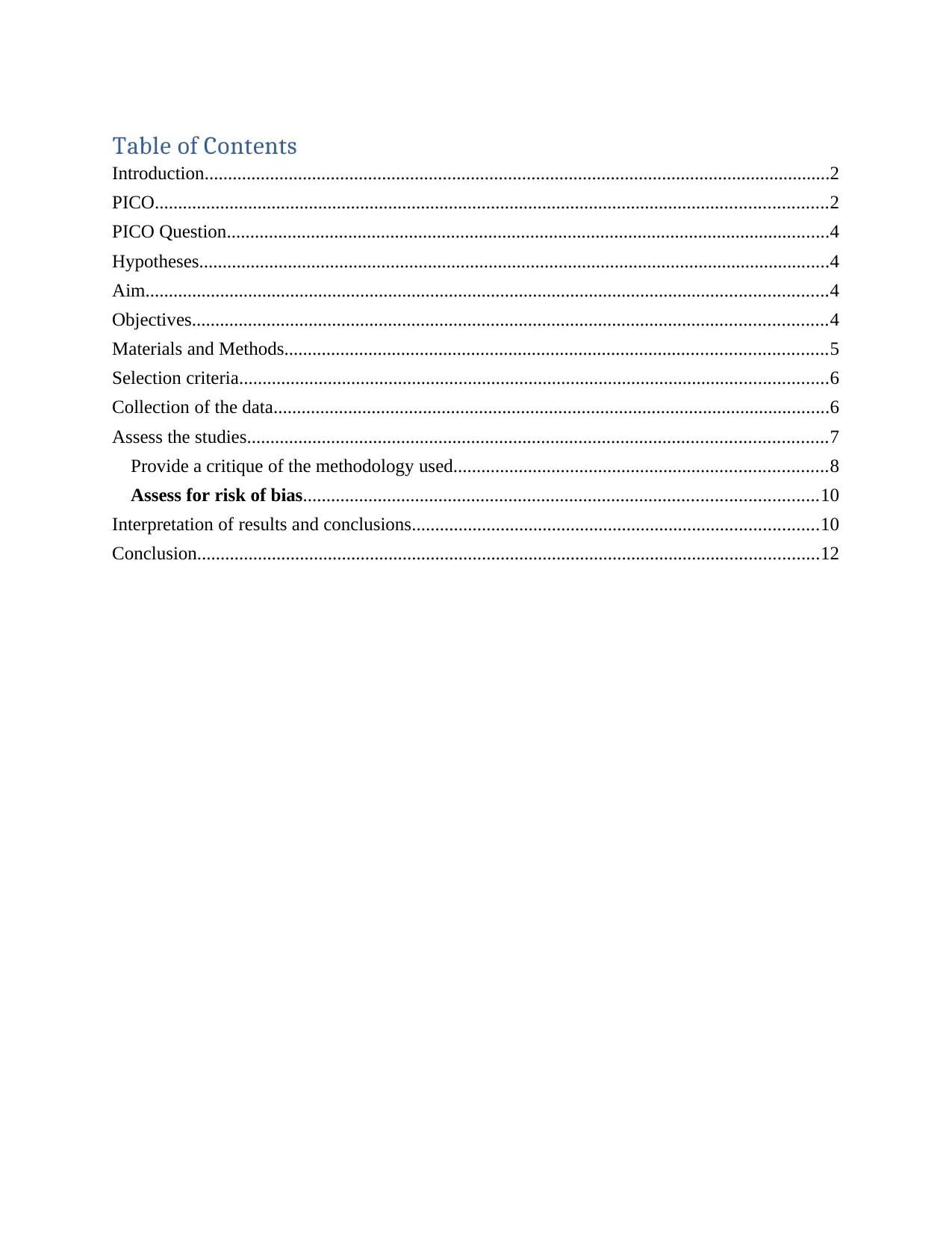
Table of Contents
Introduction......................................................................................................................................2
PICO................................................................................................................................................2
PICO Question.................................................................................................................................4
Hypotheses.......................................................................................................................................4
Aim..................................................................................................................................................4
Objectives........................................................................................................................................4
Materials and Methods....................................................................................................................5
Selection criteria..............................................................................................................................6
Collection of the data.......................................................................................................................6
Assess the studies............................................................................................................................7
Provide a critique of the methodology used................................................................................8
Assess for risk of bias..............................................................................................................10
Interpretation of results and conclusions.......................................................................................10
Conclusion.....................................................................................................................................12
Introduction......................................................................................................................................2
PICO................................................................................................................................................2
PICO Question.................................................................................................................................4
Hypotheses.......................................................................................................................................4
Aim..................................................................................................................................................4
Objectives........................................................................................................................................4
Materials and Methods....................................................................................................................5
Selection criteria..............................................................................................................................6
Collection of the data.......................................................................................................................6
Assess the studies............................................................................................................................7
Provide a critique of the methodology used................................................................................8
Assess for risk of bias..............................................................................................................10
Interpretation of results and conclusions.......................................................................................10
Conclusion.....................................................................................................................................12
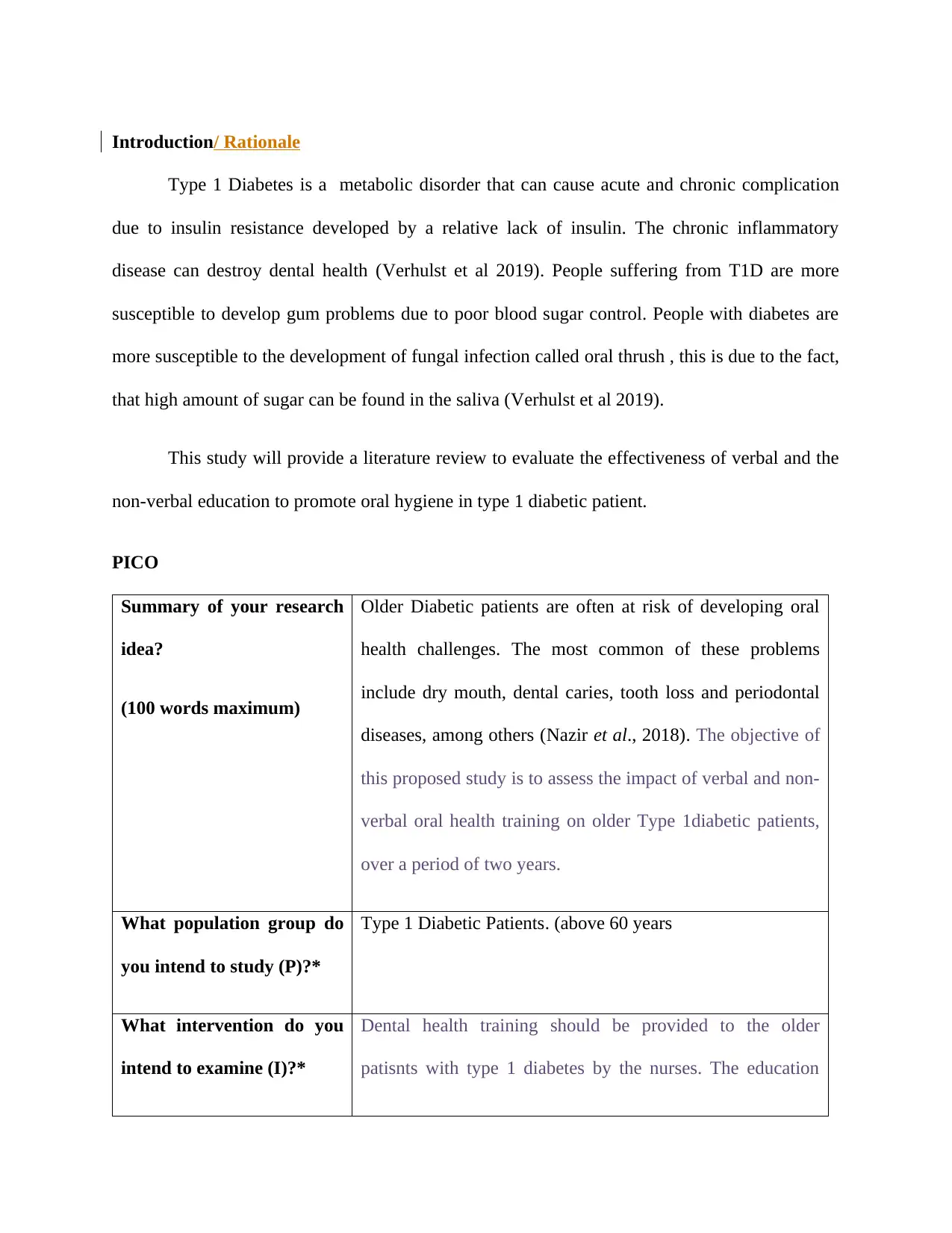
Introduction/ Rationale
Type 1 Diabetes is a metabolic disorder that can cause acute and chronic complication
due to insulin resistance developed by a relative lack of insulin. The chronic inflammatory
disease can destroy dental health (Verhulst et al 2019). People suffering from T1D are more
susceptible to develop gum problems due to poor blood sugar control. People with diabetes are
more susceptible to the development of fungal infection called oral thrush , this is due to the fact,
that high amount of sugar can be found in the saliva (Verhulst et al 2019).
This study will provide a literature review to evaluate the effectiveness of verbal and the
non-verbal education to promote oral hygiene in type 1 diabetic patient.
PICO
Summary of your research
idea?
(100 words maximum)
Older Diabetic patients are often at risk of developing oral
health challenges. The most common of these problems
include dry mouth, dental caries, tooth loss and periodontal
diseases, among others (Nazir et al., 2018). The objective of
this proposed study is to assess the impact of verbal and non-
verbal oral health training on older Type 1diabetic patients,
over a period of two years.
What population group do
you intend to study (P)?*
Type 1 Diabetic Patients. (above 60 years
What intervention do you
intend to examine (I)?*
Dental health training should be provided to the older
patisnts with type 1 diabetes by the nurses. The education
Type 1 Diabetes is a metabolic disorder that can cause acute and chronic complication
due to insulin resistance developed by a relative lack of insulin. The chronic inflammatory
disease can destroy dental health (Verhulst et al 2019). People suffering from T1D are more
susceptible to develop gum problems due to poor blood sugar control. People with diabetes are
more susceptible to the development of fungal infection called oral thrush , this is due to the fact,
that high amount of sugar can be found in the saliva (Verhulst et al 2019).
This study will provide a literature review to evaluate the effectiveness of verbal and the
non-verbal education to promote oral hygiene in type 1 diabetic patient.
PICO
Summary of your research
idea?
(100 words maximum)
Older Diabetic patients are often at risk of developing oral
health challenges. The most common of these problems
include dry mouth, dental caries, tooth loss and periodontal
diseases, among others (Nazir et al., 2018). The objective of
this proposed study is to assess the impact of verbal and non-
verbal oral health training on older Type 1diabetic patients,
over a period of two years.
What population group do
you intend to study (P)?*
Type 1 Diabetic Patients. (above 60 years
What intervention do you
intend to examine (I)?*
Dental health training should be provided to the older
patisnts with type 1 diabetes by the nurses. The education
⊘ This is a preview!⊘
Do you want full access?
Subscribe today to unlock all pages.

Trusted by 1+ million students worldwide
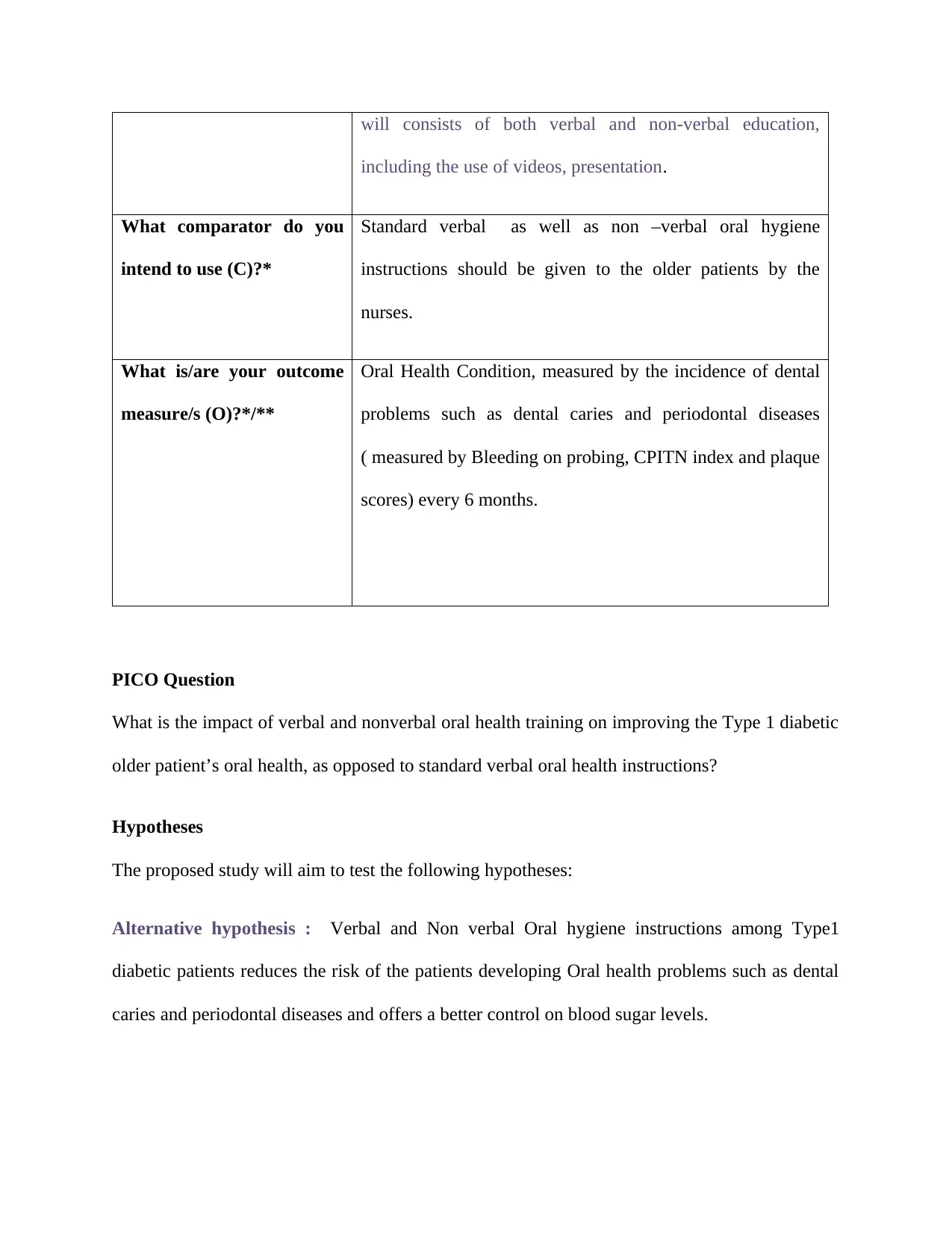
will consists of both verbal and non-verbal education,
including the use of videos, presentation.
What comparator do you
intend to use (C)?*
Standard verbal as well as non –verbal oral hygiene
instructions should be given to the older patients by the
nurses.
What is/are your outcome
measure/s (O)?*/**
Oral Health Condition, measured by the incidence of dental
problems such as dental caries and periodontal diseases
( measured by Bleeding on probing, CPITN index and plaque
scores) every 6 months.
PICO Question
What is the impact of verbal and nonverbal oral health training on improving the Type 1 diabetic
older patient’s oral health, as opposed to standard verbal oral health instructions?
Hypotheses
The proposed study will aim to test the following hypotheses:
Alternative hypothesis : Verbal and Non verbal Oral hygiene instructions among Type1
diabetic patients reduces the risk of the patients developing Oral health problems such as dental
caries and periodontal diseases and offers a better control on blood sugar levels.
including the use of videos, presentation.
What comparator do you
intend to use (C)?*
Standard verbal as well as non –verbal oral hygiene
instructions should be given to the older patients by the
nurses.
What is/are your outcome
measure/s (O)?*/**
Oral Health Condition, measured by the incidence of dental
problems such as dental caries and periodontal diseases
( measured by Bleeding on probing, CPITN index and plaque
scores) every 6 months.
PICO Question
What is the impact of verbal and nonverbal oral health training on improving the Type 1 diabetic
older patient’s oral health, as opposed to standard verbal oral health instructions?
Hypotheses
The proposed study will aim to test the following hypotheses:
Alternative hypothesis : Verbal and Non verbal Oral hygiene instructions among Type1
diabetic patients reduces the risk of the patients developing Oral health problems such as dental
caries and periodontal diseases and offers a better control on blood sugar levels.
Paraphrase This Document
Need a fresh take? Get an instant paraphrase of this document with our AI Paraphraser

Null hypothesis: Standard Verbal oral hygiene instructions alone among Type1 diabetic patients
does not effectively reduce the chances of the patients developing Oral health problems such as
dental caries and periodontal diseases, which also indirectly leads to poor blood sugar levels.
does not effectively reduce the chances of the patients developing Oral health problems such as
dental caries and periodontal diseases, which also indirectly leads to poor blood sugar levels.
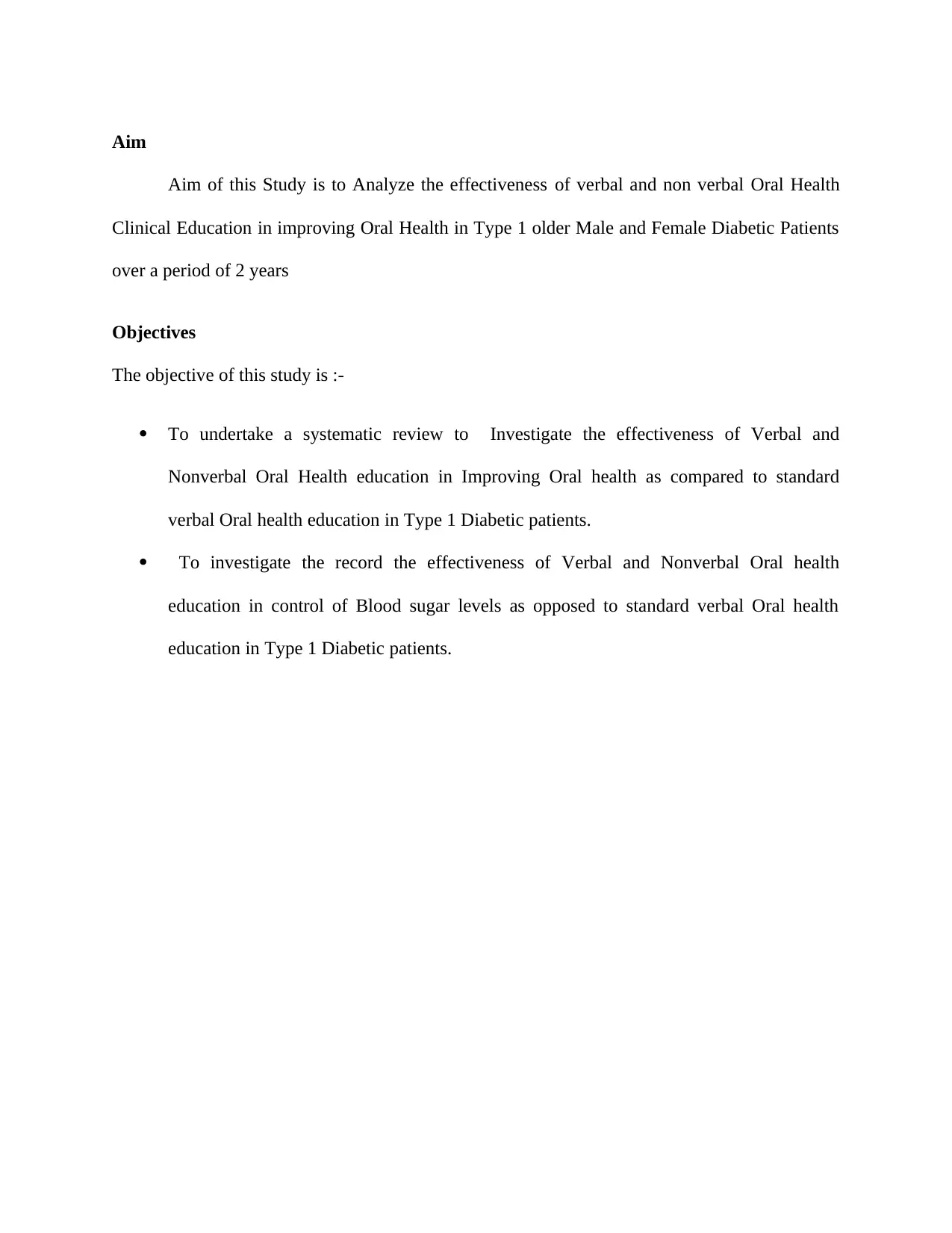
Aim
Aim of this Study is to Analyze the effectiveness of verbal and non verbal Oral Health
Clinical Education in improving Oral Health in Type 1 older Male and Female Diabetic Patients
over a period of 2 years
Objectives
The objective of this study is :-
To undertake a systematic review to Investigate the effectiveness of Verbal and
Nonverbal Oral Health education in Improving Oral health as compared to standard
verbal Oral health education in Type 1 Diabetic patients.
To investigate the record the effectiveness of Verbal and Nonverbal Oral health
education in control of Blood sugar levels as opposed to standard verbal Oral health
education in Type 1 Diabetic patients.
Aim of this Study is to Analyze the effectiveness of verbal and non verbal Oral Health
Clinical Education in improving Oral Health in Type 1 older Male and Female Diabetic Patients
over a period of 2 years
Objectives
The objective of this study is :-
To undertake a systematic review to Investigate the effectiveness of Verbal and
Nonverbal Oral Health education in Improving Oral health as compared to standard
verbal Oral health education in Type 1 Diabetic patients.
To investigate the record the effectiveness of Verbal and Nonverbal Oral health
education in control of Blood sugar levels as opposed to standard verbal Oral health
education in Type 1 Diabetic patients.
⊘ This is a preview!⊘
Do you want full access?
Subscribe today to unlock all pages.
Trusted by 1+ million students worldwide
Literature review
Background information
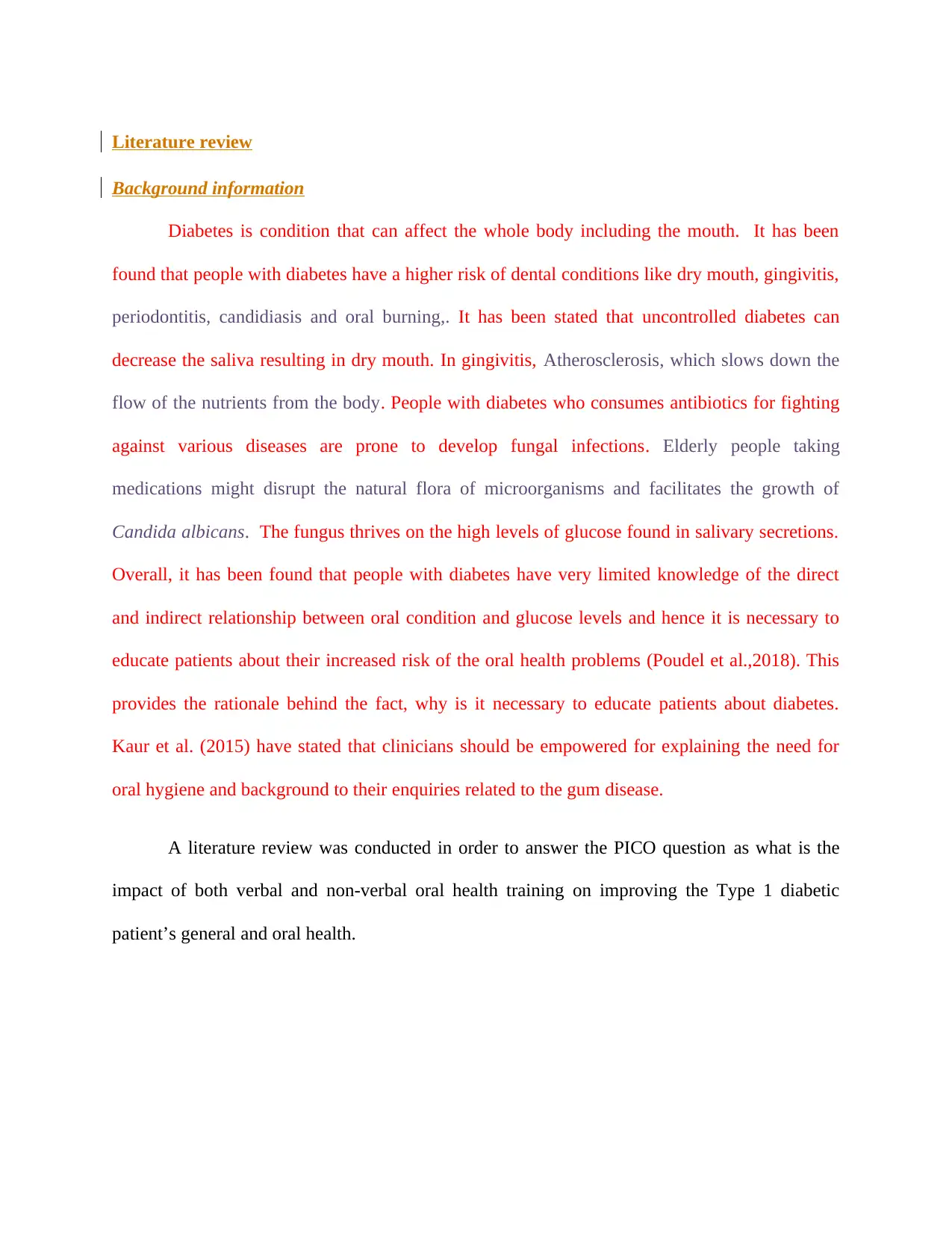
Diabetes is condition that can affect the whole body including the mouth. It has been
found that people with diabetes have a higher risk of dental conditions like dry mouth, gingivitis,
periodontitis, candidiasis and oral burning,. It has been stated that uncontrolled diabetes can
decrease the saliva resulting in dry mouth. In gingivitis, Atherosclerosis, which slows down the
flow of the nutrients from the body. People with diabetes who consumes antibiotics for fighting
against various diseases are prone to develop fungal infections. Elderly people taking
medications might disrupt the natural flora of microorganisms and facilitates the growth of
Candida albicans. The fungus thrives on the high levels of glucose found in salivary secretions.
Overall, it has been found that people with diabetes have very limited knowledge of the direct
and indirect relationship between oral condition and glucose levels and hence it is necessary to
educate patients about their increased risk of the oral health problems (Poudel et al.,2018). This
provides the rationale behind the fact, why is it necessary to educate patients about diabetes.
Kaur et al. (2015) have stated that clinicians should be empowered for explaining the need for
oral hygiene and background to their enquiries related to the gum disease.
A literature review was conducted in order to answer the PICO question as what is the
impact of both verbal and non-verbal oral health training on improving the Type 1 diabetic
patient’s general and oral health.
Background information
Diabetes is condition that can affect the whole body including the mouth. It has been
found that people with diabetes have a higher risk of dental conditions like dry mouth, gingivitis,
periodontitis, candidiasis and oral burning,. It has been stated that uncontrolled diabetes can
decrease the saliva resulting in dry mouth. In gingivitis, Atherosclerosis, which slows down the
flow of the nutrients from the body. People with diabetes who consumes antibiotics for fighting
against various diseases are prone to develop fungal infections. Elderly people taking
medications might disrupt the natural flora of microorganisms and facilitates the growth of
Candida albicans. The fungus thrives on the high levels of glucose found in salivary secretions.
Overall, it has been found that people with diabetes have very limited knowledge of the direct
and indirect relationship between oral condition and glucose levels and hence it is necessary to
educate patients about their increased risk of the oral health problems (Poudel et al.,2018). This
provides the rationale behind the fact, why is it necessary to educate patients about diabetes.
Kaur et al. (2015) have stated that clinicians should be empowered for explaining the need for
oral hygiene and background to their enquiries related to the gum disease.
A literature review was conducted in order to answer the PICO question as what is the
impact of both verbal and non-verbal oral health training on improving the Type 1 diabetic
patient’s general and oral health.
Paraphrase This Document
Need a fresh take? Get an instant paraphrase of this document with our AI Paraphraser
Search strategy to identify relevant articles
A proper literature search can only be conducted after using proper keywords. These
keywords cover the main concept of the research question. These key words were used in
electronic databases for identification of the relevant studies.
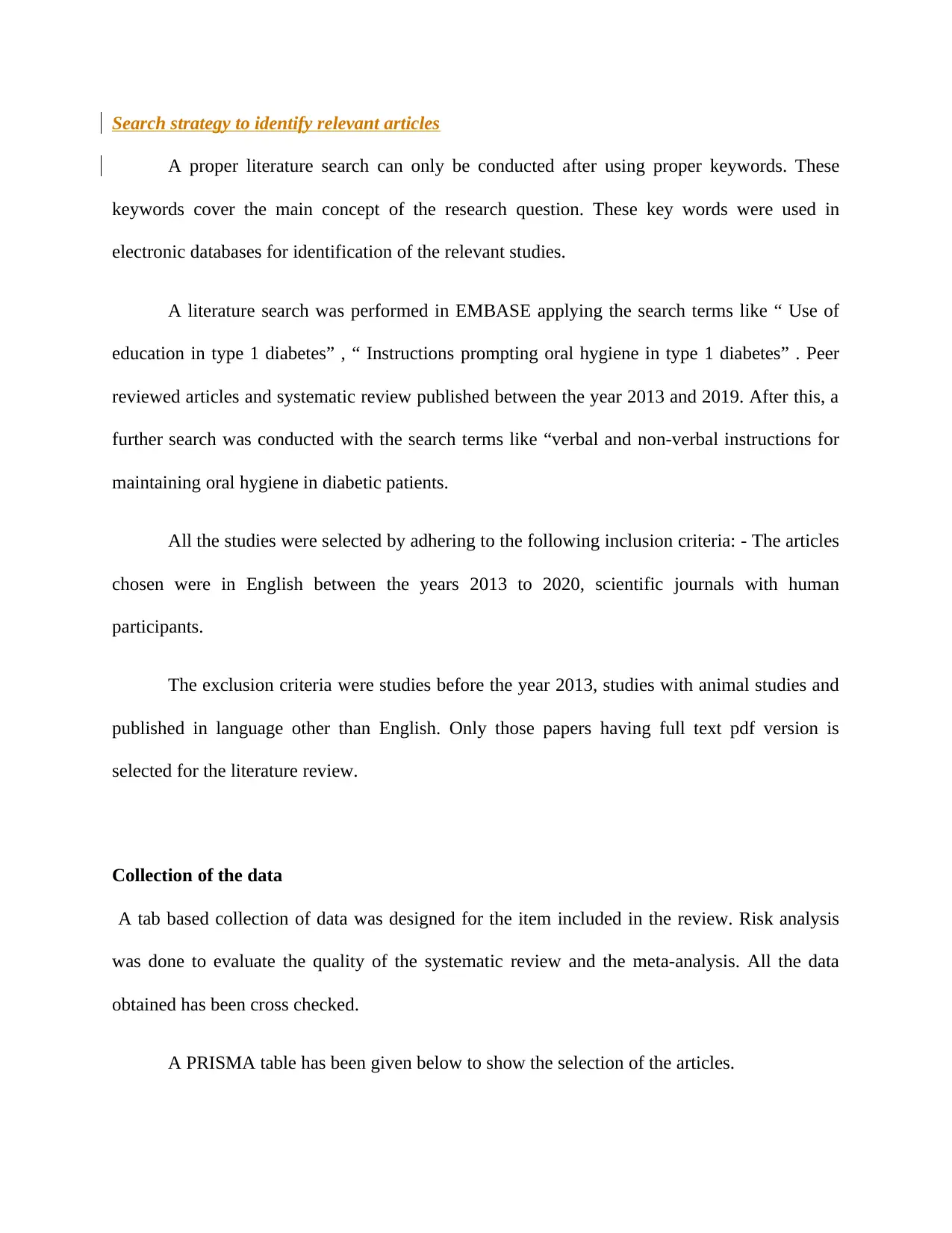
A literature search was performed in EMBASE applying the search terms like “ Use of
education in type 1 diabetes” , “ Instructions prompting oral hygiene in type 1 diabetes” . Peer
reviewed articles and systematic review published between the year 2013 and 2019. After this, a
further search was conducted with the search terms like “verbal and non-verbal instructions for
maintaining oral hygiene in diabetic patients.
All the studies were selected by adhering to the following inclusion criteria: - The articles
chosen were in English between the years 2013 to 2020, scientific journals with human
participants.
The exclusion criteria were studies before the year 2013, studies with animal studies and
published in language other than English. Only those papers having full text pdf version is
selected for the literature review.
Collection of the data
A tab based collection of data was designed for the item included in the review. Risk analysis
was done to evaluate the quality of the systematic review and the meta-analysis. All the data
obtained has been cross checked.
A PRISMA table has been given below to show the selection of the articles.
A proper literature search can only be conducted after using proper keywords. These
keywords cover the main concept of the research question. These key words were used in
electronic databases for identification of the relevant studies.
A literature search was performed in EMBASE applying the search terms like “ Use of
education in type 1 diabetes” , “ Instructions prompting oral hygiene in type 1 diabetes” . Peer
reviewed articles and systematic review published between the year 2013 and 2019. After this, a
further search was conducted with the search terms like “verbal and non-verbal instructions for
maintaining oral hygiene in diabetic patients.
All the studies were selected by adhering to the following inclusion criteria: - The articles
chosen were in English between the years 2013 to 2020, scientific journals with human
participants.
The exclusion criteria were studies before the year 2013, studies with animal studies and
published in language other than English. Only those papers having full text pdf version is
selected for the literature review.
Collection of the data
A tab based collection of data was designed for the item included in the review. Risk analysis
was done to evaluate the quality of the systematic review and the meta-analysis. All the data
obtained has been cross checked.
A PRISMA table has been given below to show the selection of the articles.

⊘ This is a preview!⊘
Do you want full access?
Subscribe today to unlock all pages.
Trusted by 1+ million students worldwide
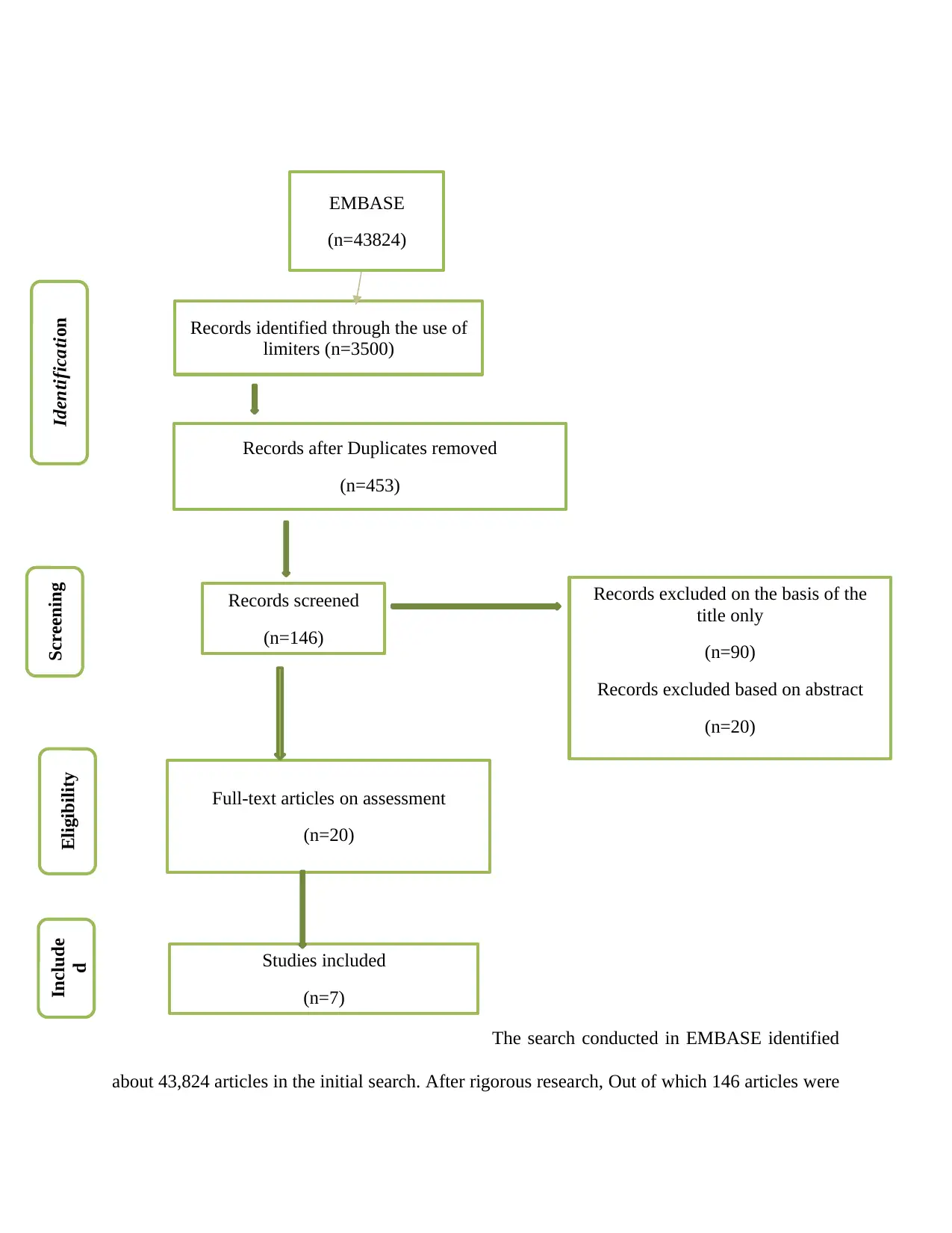
The search conducted in EMBASE identified
about 43,824 articles in the initial search. After rigorous research, Out of which 146 articles were
Records identified through the use of
limiters (n=3500)
Studies included
(n=7)
Records after Duplicates removed
(n=453)
Records screened
(n=146)
Full-text articles on assessment
(n=20)
Records excluded on the basis of the
title only
(n=90)
Records excluded based on abstract
(n=20)
IdentificationScreening
Eligibility
Include
d
EMBASE
(n=43824)
about 43,824 articles in the initial search. After rigorous research, Out of which 146 articles were
Records identified through the use of
limiters (n=3500)
Studies included
(n=7)
Records after Duplicates removed
(n=453)
Records screened
(n=146)
Full-text articles on assessment
(n=20)
Records excluded on the basis of the
title only
(n=90)
Records excluded based on abstract
(n=20)
IdentificationScreening
Eligibility
Include
d
EMBASE
(n=43824)
Paraphrase This Document
Need a fresh take? Get an instant paraphrase of this document with our AI Paraphraser
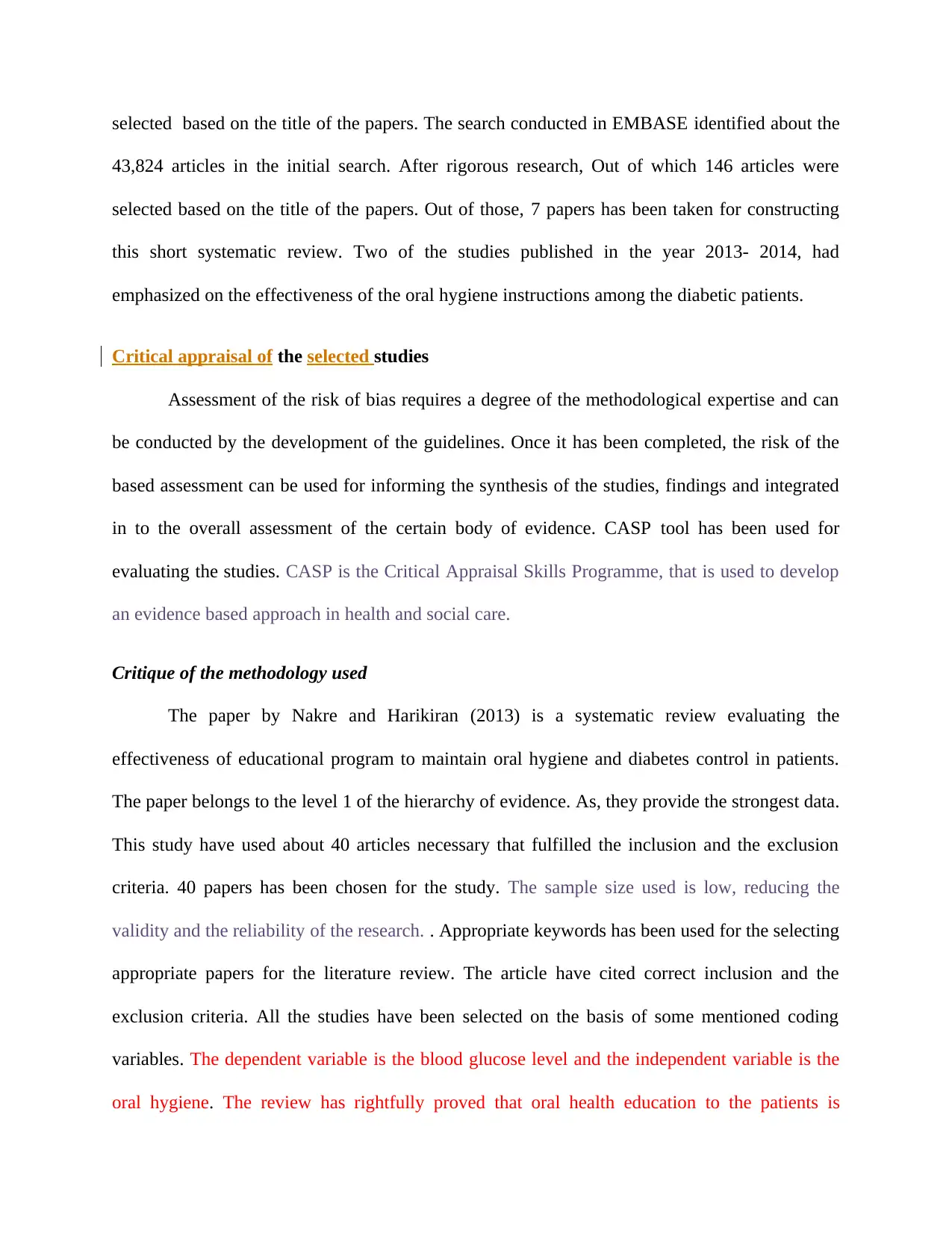
selected based on the title of the papers. The search conducted in EMBASE identified about the
43,824 articles in the initial search. After rigorous research, Out of which 146 articles were
selected based on the title of the papers. Out of those, 7 papers has been taken for constructing
this short systematic review. Two of the studies published in the year 2013- 2014, had
emphasized on the effectiveness of the oral hygiene instructions among the diabetic patients.
Critical appraisal of the selected studies
Assessment of the risk of bias requires a degree of the methodological expertise and can
be conducted by the development of the guidelines. Once it has been completed, the risk of the
based assessment can be used for informing the synthesis of the studies, findings and integrated
in to the overall assessment of the certain body of evidence. CASP tool has been used for
evaluating the studies. CASP is the Critical Appraisal Skills Programme, that is used to develop
an evidence based approach in health and social care.
Critique of the methodology used
The paper by Nakre and Harikiran (2013) is a systematic review evaluating the
effectiveness of educational program to maintain oral hygiene and diabetes control in patients.
The paper belongs to the level 1 of the hierarchy of evidence. As, they provide the strongest data.
This study have used about 40 articles necessary that fulfilled the inclusion and the exclusion
criteria. 40 papers has been chosen for the study. The sample size used is low, reducing the
validity and the reliability of the research. . Appropriate keywords has been used for the selecting
appropriate papers for the literature review. The article have cited correct inclusion and the
exclusion criteria. All the studies have been selected on the basis of some mentioned coding
variables. The dependent variable is the blood glucose level and the independent variable is the
oral hygiene. The review has rightfully proved that oral health education to the patients is
43,824 articles in the initial search. After rigorous research, Out of which 146 articles were
selected based on the title of the papers. Out of those, 7 papers has been taken for constructing
this short systematic review. Two of the studies published in the year 2013- 2014, had
emphasized on the effectiveness of the oral hygiene instructions among the diabetic patients.
Critical appraisal of the selected studies
Assessment of the risk of bias requires a degree of the methodological expertise and can
be conducted by the development of the guidelines. Once it has been completed, the risk of the
based assessment can be used for informing the synthesis of the studies, findings and integrated
in to the overall assessment of the certain body of evidence. CASP tool has been used for
evaluating the studies. CASP is the Critical Appraisal Skills Programme, that is used to develop
an evidence based approach in health and social care.
Critique of the methodology used
The paper by Nakre and Harikiran (2013) is a systematic review evaluating the
effectiveness of educational program to maintain oral hygiene and diabetes control in patients.
The paper belongs to the level 1 of the hierarchy of evidence. As, they provide the strongest data.
This study have used about 40 articles necessary that fulfilled the inclusion and the exclusion
criteria. 40 papers has been chosen for the study. The sample size used is low, reducing the
validity and the reliability of the research. . Appropriate keywords has been used for the selecting
appropriate papers for the literature review. The article have cited correct inclusion and the
exclusion criteria. All the studies have been selected on the basis of some mentioned coding
variables. The dependent variable is the blood glucose level and the independent variable is the
oral hygiene. The review has rightfully proved that oral health education to the patients is
important to reduce dental problems and also helps in glycemic control in individuals with high
blood glucose level. The education should be provided by the nurses and the physicians.
The randomized clinical study by Raman et al. (2014), have proved that both dental
health education and periodontal therapy is necessary to treat the clinical manifestations in
chronic peridonitis in patients with the high glycemic level. A randomized control is the most
rigorous way of determining a cause and effect relation. A randomized control increases the
reliability of the study as they involve random allocation of the intervention groups. A total of
40 subjects has been included in the study, which is quite low in comparison to a randomized
control study.
Dickinson et al. (2017) have conducted a systematic review to find out the use of
languages in the diabetes care and education. This paper belongs to level one of the hierarchy of
evidence due to its high impact factor. The paper had provided information about the different
types of verbal communication that are used for educating a target population, such as the use of
strength based language and person first language. The study addressed a clearly focused
question like how effective language can be used in diabetic care and education. This paper had
chosen certain relevant papers. But some of the references were not relevant to the study.
The quasi-experimental study by Saengtipbovorn and Taneepanichskul, (2014) have
proved that together with some life style changes and dental care in one program has been found
to be helpful in managing the oral complication in elderly patients having diabetes. This paper
has employed a quasi-experimental studies as it brings about realistic features from both the
experimental data and non –experimental designs. In can be used for maximizing the internal and
the external validity of the study. 66 diabetic patients has been chosen for the study, hence the
blood glucose level. The education should be provided by the nurses and the physicians.
The randomized clinical study by Raman et al. (2014), have proved that both dental
health education and periodontal therapy is necessary to treat the clinical manifestations in
chronic peridonitis in patients with the high glycemic level. A randomized control is the most
rigorous way of determining a cause and effect relation. A randomized control increases the
reliability of the study as they involve random allocation of the intervention groups. A total of
40 subjects has been included in the study, which is quite low in comparison to a randomized
control study.
Dickinson et al. (2017) have conducted a systematic review to find out the use of
languages in the diabetes care and education. This paper belongs to level one of the hierarchy of
evidence due to its high impact factor. The paper had provided information about the different
types of verbal communication that are used for educating a target population, such as the use of
strength based language and person first language. The study addressed a clearly focused
question like how effective language can be used in diabetic care and education. This paper had
chosen certain relevant papers. But some of the references were not relevant to the study.
The quasi-experimental study by Saengtipbovorn and Taneepanichskul, (2014) have
proved that together with some life style changes and dental care in one program has been found
to be helpful in managing the oral complication in elderly patients having diabetes. This paper
has employed a quasi-experimental studies as it brings about realistic features from both the
experimental data and non –experimental designs. In can be used for maximizing the internal and
the external validity of the study. 66 diabetic patients has been chosen for the study, hence the
⊘ This is a preview!⊘
Do you want full access?
Subscribe today to unlock all pages.
Trusted by 1+ million students worldwide

1 out of 21


Related Documents


Your All-in-One AI-Powered Toolkit for Academic Success.
+13062052269
info@desklib.com
Available 24*7 on WhatsApp / Email
![[object Object]](/_next/static/media/star-bottom.7253800d.svg)
Unlock your academic potential
Copyright © 2020–2026 A2Z Services. All Rights Reserved. Developed and managed by ZUCOL.