Business Communication: Reflection on Oral & Interpersonal Skills
VerifiedAdded on 2023/06/15
|7
|2162
|387
Report
AI Summary
This report provides a reflective analysis of oral communication and interpersonal skills, including emotional intelligence, self-talk, and assertiveness, within the context of business communication. It explores the author's experiences with oral communication, highlighting its importance in idea generation, business transactions, and overall business growth. The report distinguishes between formal and informal oral communication, providing examples and scenarios for their appropriate use. Furthermore, it delves into the significance of emotional intelligence, self-talk, and assertiveness as interpersonal skills that contribute to effective decision-making and positive business outcomes. The author emphasizes the need for individuals to develop these skills through training and practical application, ultimately enhancing their ability to navigate complex business communication scenarios. The report concludes that a comprehensive understanding of these communication channels is crucial for gathering information and promoting business growth and career development.
BUSINESS COMMUNICATION SKILLS 1
BUSINESS COMMUNICATION SKILLS
By Name
Course
Instructor
Institution
Location
Date
BUSINESS COMMUNICATION SKILLS
By Name
Course
Instructor
Institution
Location
Date
Paraphrase This Document
Need a fresh take? Get an instant paraphrase of this document with our AI Paraphraser

BUSINESS COMMUNICATION SKILLS 2
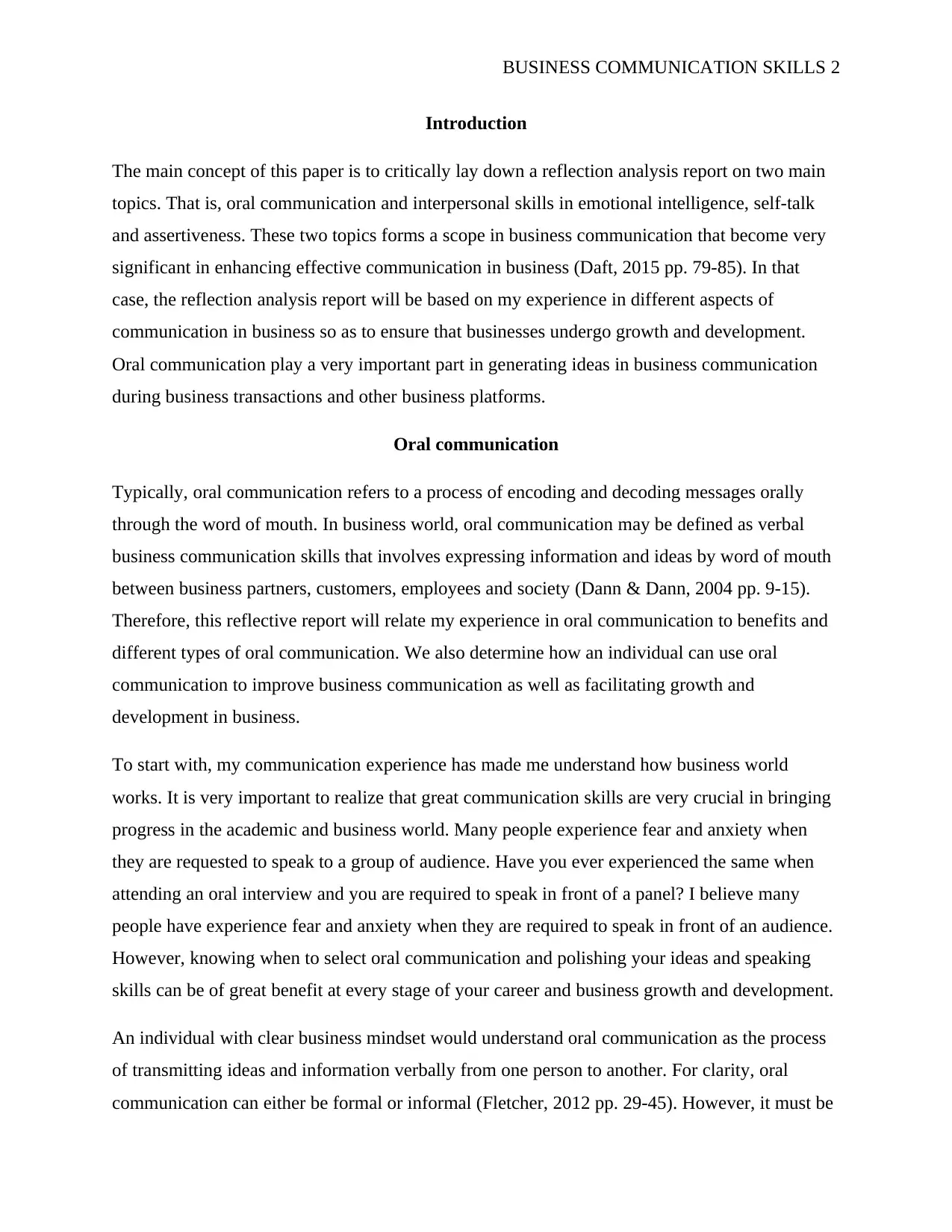
Introduction
The main concept of this paper is to critically lay down a reflection analysis report on two main
topics. That is, oral communication and interpersonal skills in emotional intelligence, self-talk
and assertiveness. These two topics forms a scope in business communication that become very
significant in enhancing effective communication in business (Daft, 2015 pp. 79-85). In that
case, the reflection analysis report will be based on my experience in different aspects of
communication in business so as to ensure that businesses undergo growth and development.
Oral communication play a very important part in generating ideas in business communication
during business transactions and other business platforms.
Oral communication
Typically, oral communication refers to a process of encoding and decoding messages orally
through the word of mouth. In business world, oral communication may be defined as verbal
business communication skills that involves expressing information and ideas by word of mouth
between business partners, customers, employees and society (Dann & Dann, 2004 pp. 9-15).
Therefore, this reflective report will relate my experience in oral communication to benefits and
different types of oral communication. We also determine how an individual can use oral
communication to improve business communication as well as facilitating growth and
development in business.
To start with, my communication experience has made me understand how business world
works. It is very important to realize that great communication skills are very crucial in bringing
progress in the academic and business world. Many people experience fear and anxiety when
they are requested to speak to a group of audience. Have you ever experienced the same when
attending an oral interview and you are required to speak in front of a panel? I believe many
people have experience fear and anxiety when they are required to speak in front of an audience.
However, knowing when to select oral communication and polishing your ideas and speaking
skills can be of great benefit at every stage of your career and business growth and development.
An individual with clear business mindset would understand oral communication as the process
of transmitting ideas and information verbally from one person to another. For clarity, oral
communication can either be formal or informal (Fletcher, 2012 pp. 29-45). However, it must be
Introduction
The main concept of this paper is to critically lay down a reflection analysis report on two main
topics. That is, oral communication and interpersonal skills in emotional intelligence, self-talk
and assertiveness. These two topics forms a scope in business communication that become very
significant in enhancing effective communication in business (Daft, 2015 pp. 79-85). In that
case, the reflection analysis report will be based on my experience in different aspects of
communication in business so as to ensure that businesses undergo growth and development.
Oral communication play a very important part in generating ideas in business communication
during business transactions and other business platforms.
Oral communication
Typically, oral communication refers to a process of encoding and decoding messages orally
through the word of mouth. In business world, oral communication may be defined as verbal
business communication skills that involves expressing information and ideas by word of mouth
between business partners, customers, employees and society (Dann & Dann, 2004 pp. 9-15).
Therefore, this reflective report will relate my experience in oral communication to benefits and
different types of oral communication. We also determine how an individual can use oral
communication to improve business communication as well as facilitating growth and
development in business.
To start with, my communication experience has made me understand how business world
works. It is very important to realize that great communication skills are very crucial in bringing
progress in the academic and business world. Many people experience fear and anxiety when
they are requested to speak to a group of audience. Have you ever experienced the same when
attending an oral interview and you are required to speak in front of a panel? I believe many
people have experience fear and anxiety when they are required to speak in front of an audience.
However, knowing when to select oral communication and polishing your ideas and speaking
skills can be of great benefit at every stage of your career and business growth and development.
An individual with clear business mindset would understand oral communication as the process
of transmitting ideas and information verbally from one person to another. For clarity, oral
communication can either be formal or informal (Fletcher, 2012 pp. 29-45). However, it must be

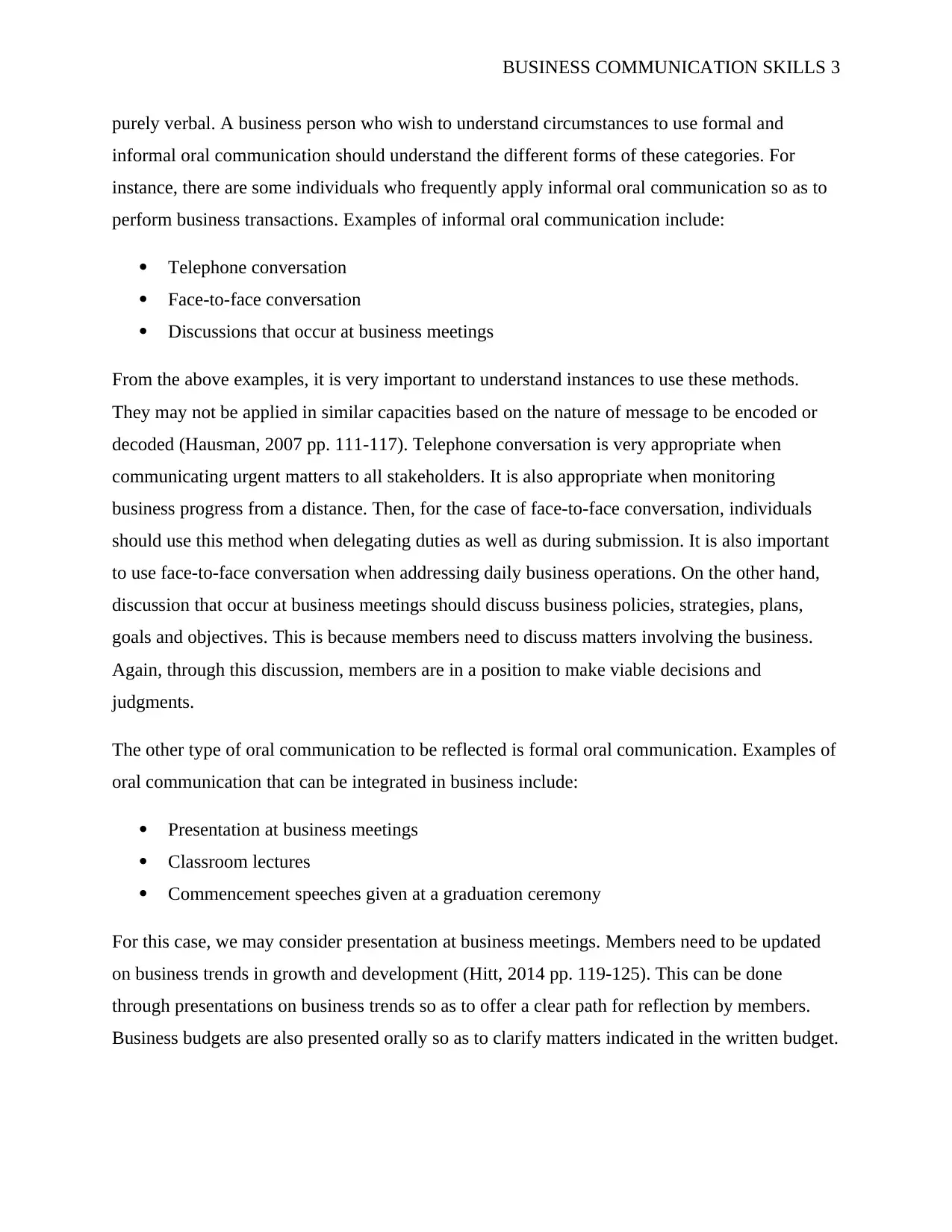
BUSINESS COMMUNICATION SKILLS 3
purely verbal. A business person who wish to understand circumstances to use formal and
informal oral communication should understand the different forms of these categories. For
instance, there are some individuals who frequently apply informal oral communication so as to
perform business transactions. Examples of informal oral communication include:
Telephone conversation
Face-to-face conversation
Discussions that occur at business meetings
From the above examples, it is very important to understand instances to use these methods.
They may not be applied in similar capacities based on the nature of message to be encoded or
decoded (Hausman, 2007 pp. 111-117). Telephone conversation is very appropriate when
communicating urgent matters to all stakeholders. It is also appropriate when monitoring
business progress from a distance. Then, for the case of face-to-face conversation, individuals
should use this method when delegating duties as well as during submission. It is also important
to use face-to-face conversation when addressing daily business operations. On the other hand,
discussion that occur at business meetings should discuss business policies, strategies, plans,
goals and objectives. This is because members need to discuss matters involving the business.
Again, through this discussion, members are in a position to make viable decisions and
judgments.
The other type of oral communication to be reflected is formal oral communication. Examples of
oral communication that can be integrated in business include:
Presentation at business meetings
Classroom lectures
Commencement speeches given at a graduation ceremony
For this case, we may consider presentation at business meetings. Members need to be updated
on business trends in growth and development (Hitt, 2014 pp. 119-125). This can be done
through presentations on business trends so as to offer a clear path for reflection by members.
Business budgets are also presented orally so as to clarify matters indicated in the written budget.
purely verbal. A business person who wish to understand circumstances to use formal and
informal oral communication should understand the different forms of these categories. For
instance, there are some individuals who frequently apply informal oral communication so as to
perform business transactions. Examples of informal oral communication include:
Telephone conversation
Face-to-face conversation
Discussions that occur at business meetings
From the above examples, it is very important to understand instances to use these methods.
They may not be applied in similar capacities based on the nature of message to be encoded or
decoded (Hausman, 2007 pp. 111-117). Telephone conversation is very appropriate when
communicating urgent matters to all stakeholders. It is also appropriate when monitoring
business progress from a distance. Then, for the case of face-to-face conversation, individuals
should use this method when delegating duties as well as during submission. It is also important
to use face-to-face conversation when addressing daily business operations. On the other hand,
discussion that occur at business meetings should discuss business policies, strategies, plans,
goals and objectives. This is because members need to discuss matters involving the business.
Again, through this discussion, members are in a position to make viable decisions and
judgments.
The other type of oral communication to be reflected is formal oral communication. Examples of
oral communication that can be integrated in business include:
Presentation at business meetings
Classroom lectures
Commencement speeches given at a graduation ceremony
For this case, we may consider presentation at business meetings. Members need to be updated
on business trends in growth and development (Hitt, 2014 pp. 119-125). This can be done
through presentations on business trends so as to offer a clear path for reflection by members.
Business budgets are also presented orally so as to clarify matters indicated in the written budget.
⊘ This is a preview!⊘
Do you want full access?
Subscribe today to unlock all pages.

Trusted by 1+ million students worldwide

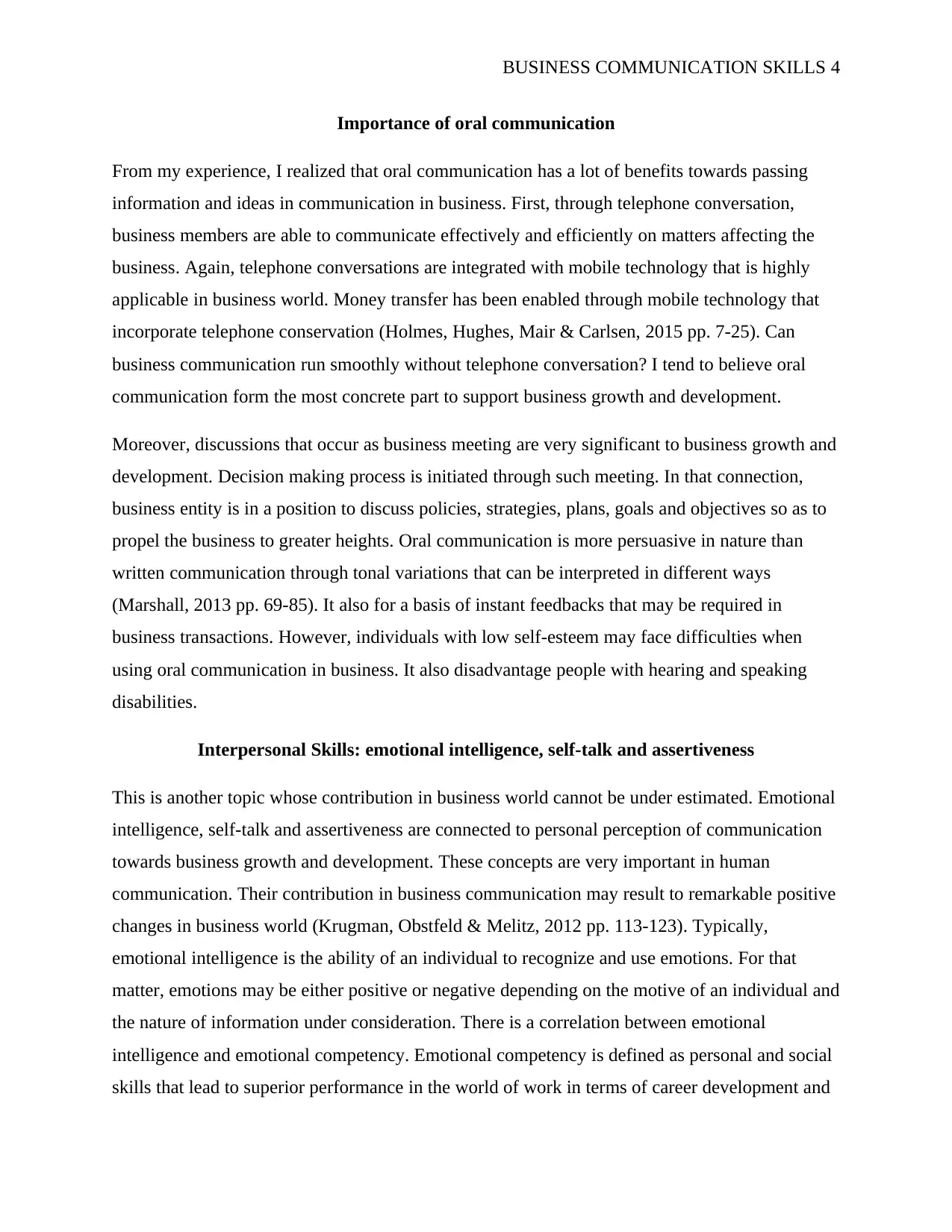
BUSINESS COMMUNICATION SKILLS 4
Importance of oral communication
From my experience, I realized that oral communication has a lot of benefits towards passing
information and ideas in communication in business. First, through telephone conversation,
business members are able to communicate effectively and efficiently on matters affecting the
business. Again, telephone conversations are integrated with mobile technology that is highly
applicable in business world. Money transfer has been enabled through mobile technology that
incorporate telephone conservation (Holmes, Hughes, Mair & Carlsen, 2015 pp. 7-25). Can
business communication run smoothly without telephone conversation? I tend to believe oral
communication form the most concrete part to support business growth and development.
Moreover, discussions that occur as business meeting are very significant to business growth and
development. Decision making process is initiated through such meeting. In that connection,
business entity is in a position to discuss policies, strategies, plans, goals and objectives so as to
propel the business to greater heights. Oral communication is more persuasive in nature than
written communication through tonal variations that can be interpreted in different ways
(Marshall, 2013 pp. 69-85). It also for a basis of instant feedbacks that may be required in
business transactions. However, individuals with low self-esteem may face difficulties when
using oral communication in business. It also disadvantage people with hearing and speaking
disabilities.
Interpersonal Skills: emotional intelligence, self-talk and assertiveness
This is another topic whose contribution in business world cannot be under estimated. Emotional
intelligence, self-talk and assertiveness are connected to personal perception of communication
towards business growth and development. These concepts are very important in human
communication. Their contribution in business communication may result to remarkable positive
changes in business world (Krugman, Obstfeld & Melitz, 2012 pp. 113-123). Typically,
emotional intelligence is the ability of an individual to recognize and use emotions. For that
matter, emotions may be either positive or negative depending on the motive of an individual and
the nature of information under consideration. There is a correlation between emotional
intelligence and emotional competency. Emotional competency is defined as personal and social
skills that lead to superior performance in the world of work in terms of career development and
Importance of oral communication
From my experience, I realized that oral communication has a lot of benefits towards passing
information and ideas in communication in business. First, through telephone conversation,
business members are able to communicate effectively and efficiently on matters affecting the
business. Again, telephone conversations are integrated with mobile technology that is highly
applicable in business world. Money transfer has been enabled through mobile technology that
incorporate telephone conservation (Holmes, Hughes, Mair & Carlsen, 2015 pp. 7-25). Can
business communication run smoothly without telephone conversation? I tend to believe oral
communication form the most concrete part to support business growth and development.
Moreover, discussions that occur as business meeting are very significant to business growth and
development. Decision making process is initiated through such meeting. In that connection,
business entity is in a position to discuss policies, strategies, plans, goals and objectives so as to
propel the business to greater heights. Oral communication is more persuasive in nature than
written communication through tonal variations that can be interpreted in different ways
(Marshall, 2013 pp. 69-85). It also for a basis of instant feedbacks that may be required in
business transactions. However, individuals with low self-esteem may face difficulties when
using oral communication in business. It also disadvantage people with hearing and speaking
disabilities.
Interpersonal Skills: emotional intelligence, self-talk and assertiveness
This is another topic whose contribution in business world cannot be under estimated. Emotional
intelligence, self-talk and assertiveness are connected to personal perception of communication
towards business growth and development. These concepts are very important in human
communication. Their contribution in business communication may result to remarkable positive
changes in business world (Krugman, Obstfeld & Melitz, 2012 pp. 113-123). Typically,
emotional intelligence is the ability of an individual to recognize and use emotions. For that
matter, emotions may be either positive or negative depending on the motive of an individual and
the nature of information under consideration. There is a correlation between emotional
intelligence and emotional competency. Emotional competency is defined as personal and social
skills that lead to superior performance in the world of work in terms of career development and
Paraphrase This Document
Need a fresh take? Get an instant paraphrase of this document with our AI Paraphraser

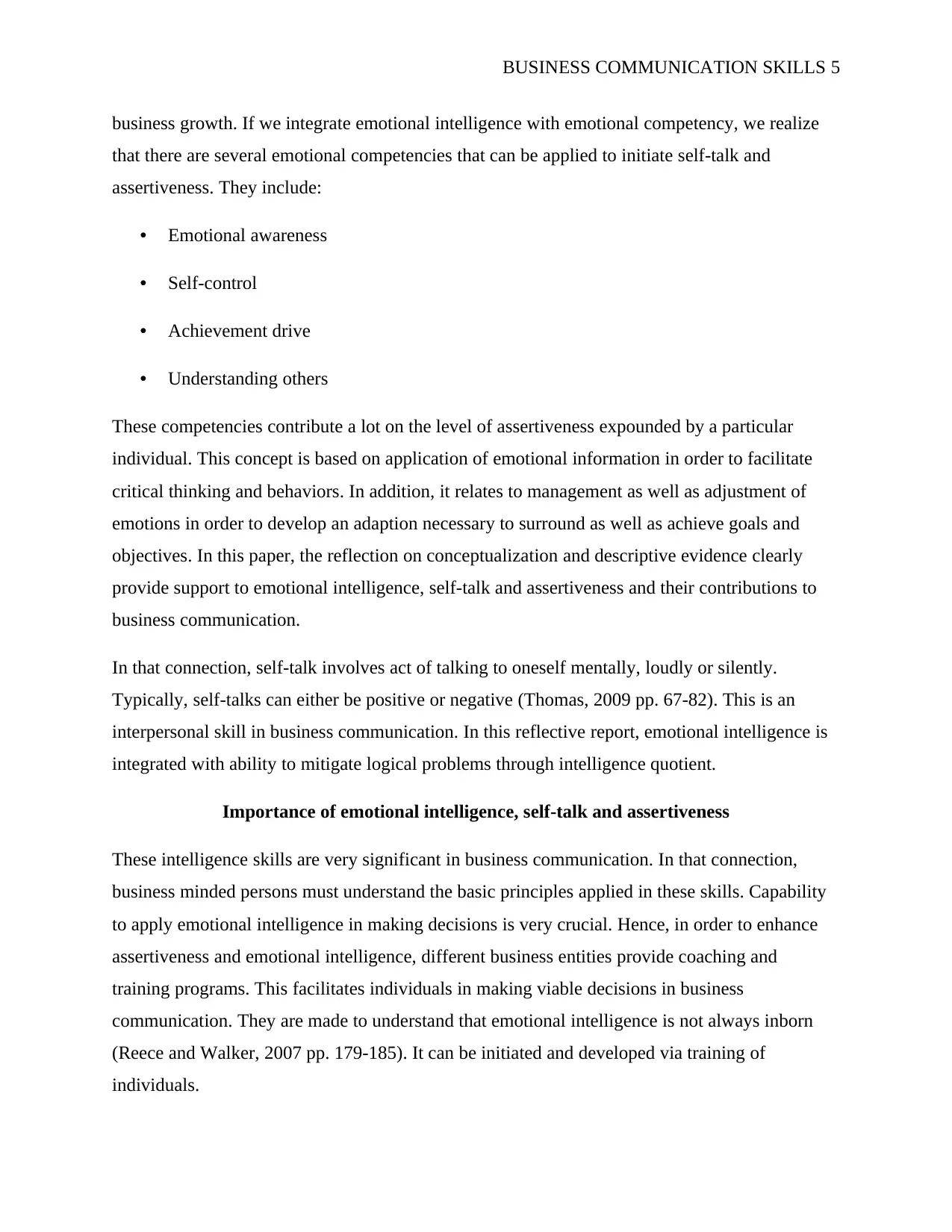
BUSINESS COMMUNICATION SKILLS 5
business growth. If we integrate emotional intelligence with emotional competency, we realize
that there are several emotional competencies that can be applied to initiate self-talk and
assertiveness. They include:
• Emotional awareness
• Self-control
• Achievement drive
• Understanding others
These competencies contribute a lot on the level of assertiveness expounded by a particular
individual. This concept is based on application of emotional information in order to facilitate
critical thinking and behaviors. In addition, it relates to management as well as adjustment of
emotions in order to develop an adaption necessary to surround as well as achieve goals and
objectives. In this paper, the reflection on conceptualization and descriptive evidence clearly
provide support to emotional intelligence, self-talk and assertiveness and their contributions to
business communication.
In that connection, self-talk involves act of talking to oneself mentally, loudly or silently.
Typically, self-talks can either be positive or negative (Thomas, 2009 pp. 67-82). This is an
interpersonal skill in business communication. In this reflective report, emotional intelligence is
integrated with ability to mitigate logical problems through intelligence quotient.
Importance of emotional intelligence, self-talk and assertiveness
These intelligence skills are very significant in business communication. In that connection,
business minded persons must understand the basic principles applied in these skills. Capability
to apply emotional intelligence in making decisions is very crucial. Hence, in order to enhance
assertiveness and emotional intelligence, different business entities provide coaching and
training programs. This facilitates individuals in making viable decisions in business
communication. They are made to understand that emotional intelligence is not always inborn
(Reece and Walker, 2007 pp. 179-185). It can be initiated and developed via training of
individuals.
business growth. If we integrate emotional intelligence with emotional competency, we realize
that there are several emotional competencies that can be applied to initiate self-talk and
assertiveness. They include:
• Emotional awareness
• Self-control
• Achievement drive
• Understanding others
These competencies contribute a lot on the level of assertiveness expounded by a particular
individual. This concept is based on application of emotional information in order to facilitate
critical thinking and behaviors. In addition, it relates to management as well as adjustment of
emotions in order to develop an adaption necessary to surround as well as achieve goals and
objectives. In this paper, the reflection on conceptualization and descriptive evidence clearly
provide support to emotional intelligence, self-talk and assertiveness and their contributions to
business communication.
In that connection, self-talk involves act of talking to oneself mentally, loudly or silently.
Typically, self-talks can either be positive or negative (Thomas, 2009 pp. 67-82). This is an
interpersonal skill in business communication. In this reflective report, emotional intelligence is
integrated with ability to mitigate logical problems through intelligence quotient.
Importance of emotional intelligence, self-talk and assertiveness
These intelligence skills are very significant in business communication. In that connection,
business minded persons must understand the basic principles applied in these skills. Capability
to apply emotional intelligence in making decisions is very crucial. Hence, in order to enhance
assertiveness and emotional intelligence, different business entities provide coaching and
training programs. This facilitates individuals in making viable decisions in business
communication. They are made to understand that emotional intelligence is not always inborn
(Reece and Walker, 2007 pp. 179-185). It can be initiated and developed via training of
individuals.

BUSINESS COMMUNICATION SKILLS 6
In addition, if we consider self-talks and assertiveness in business communication, business
oriented people are in a position to initiative positive self-talk process. This process facilitate
them to generate policies, strategies, plans, goals, objectives, ideas and opinions (Dann & Dann,
2007 pp. 179-185). If I integrate these concepts with my business and work experience, then I
concur with assertion that ideas are purely developed through emotional intelligence. In that
case, business people are required to apply assertiveness, emotional intelligence and self-talks as
their intellectual skills to make viable decisions. There are some business communication that
require personal assertiveness and emotional intelligence rather than using oral communication
process that may be exposed to some limiting factors.
In conclusion, the moment individuals realize that business communication is a process, then
they will use all available resources to collect data and information regarding the intellectual
skills of emotional intelligence, assertiveness and self-talks. It is equally important to relate these
issues with personal experience so as to facilitate a better process in future. Information is power
and it keep in changing day in day out (Ryan & Deci, 2017 pp. 93-112). Therefore, individuals
need to use all communication channels to gather necessary information relevant to business
world. It is also important to be assertive to ideas and opinions provided via heighted examples
of oral communication. Business communication is very significant and individuals need to
understand how oral communication, emotional intelligence, self-talk and assertiveness
contribute to business growth and career development (Thomas, 2009 pp. 67-82). From my
reflection and personal point of view, my thinking changes in terms of business communication
after reflecting contributions provided by oral communication, emotional intelligence,
assertiveness and self-talks.
In addition, if we consider self-talks and assertiveness in business communication, business
oriented people are in a position to initiative positive self-talk process. This process facilitate
them to generate policies, strategies, plans, goals, objectives, ideas and opinions (Dann & Dann,
2007 pp. 179-185). If I integrate these concepts with my business and work experience, then I
concur with assertion that ideas are purely developed through emotional intelligence. In that
case, business people are required to apply assertiveness, emotional intelligence and self-talks as
their intellectual skills to make viable decisions. There are some business communication that
require personal assertiveness and emotional intelligence rather than using oral communication
process that may be exposed to some limiting factors.
In conclusion, the moment individuals realize that business communication is a process, then
they will use all available resources to collect data and information regarding the intellectual
skills of emotional intelligence, assertiveness and self-talks. It is equally important to relate these
issues with personal experience so as to facilitate a better process in future. Information is power
and it keep in changing day in day out (Ryan & Deci, 2017 pp. 93-112). Therefore, individuals
need to use all communication channels to gather necessary information relevant to business
world. It is also important to be assertive to ideas and opinions provided via heighted examples
of oral communication. Business communication is very significant and individuals need to
understand how oral communication, emotional intelligence, self-talk and assertiveness
contribute to business growth and career development (Thomas, 2009 pp. 67-82). From my
reflection and personal point of view, my thinking changes in terms of business communication
after reflecting contributions provided by oral communication, emotional intelligence,
assertiveness and self-talks.
⊘ This is a preview!⊘
Do you want full access?
Subscribe today to unlock all pages.

Trusted by 1+ million students worldwide

BUSINESS COMMUNICATION SKILLS 7
References
Daft, R.L. (2015) Management. South Western College Pub. Pp. 79-85.
Dann, S., & Dann, S. (2004) Strategic Internet Marketing. Brisbane: John Wiley & Sons. Pp. 9-
15.
Dann, S., & Dann, S. (2007) Competitive marketing strategy. French’s Forest, NSW: Pearson
Education. Pp. 179-185.
Fletcher, F. (2012) Business Problem Solving. Routledge. Pp. 29-45.
Hausman, D. M. (Ed.). (2007) The philosophy of economics: An anthology. 3rd ed. Cambridge:
Cambridge University Press. Pp. 111-117.
Hitt, M.A. (2014) Strategic Management: Concept, Competitiveness and Globalization. South-
Western College Pub. Pp. 119-125.
Holmes, K, Hughes, M, Mair, J & Carlsen, J. (2015) Events and sustainability.1st edition.
Abingdon: Routledge. Pp. 7-25.
Krugman, P. R., Obstfeld, M., & Melitz, M. J. (2012) International economics: Theory & policy.
9th ed. Harlow: Pearson Education. Pp. 113-123.
Marshall, B. (2013) Accounting Information Systems. Australian edition. French’s Forest, NSW:
Pearson Australia. Pp. 69-85.
Reece, I. and Walker, S. (2007) Teaching, training & learning: a practical guide. 6th ed.
London: Business Education Publishers Limited. Pp. 179-185.
Ryan, R.M., & Deci, EL. (2017) Self-Determination Theory: Basic Psychological Need in
Motivation, development and Wellness. The Guilford press. Pp. 93-112.
Thomas, K.W. (2009) Intrinsic Motivation: What Really Drives Employees Engagement. Berret-
Koehler publishers. Pp. 67-82.
References
Daft, R.L. (2015) Management. South Western College Pub. Pp. 79-85.
Dann, S., & Dann, S. (2004) Strategic Internet Marketing. Brisbane: John Wiley & Sons. Pp. 9-
15.
Dann, S., & Dann, S. (2007) Competitive marketing strategy. French’s Forest, NSW: Pearson
Education. Pp. 179-185.
Fletcher, F. (2012) Business Problem Solving. Routledge. Pp. 29-45.
Hausman, D. M. (Ed.). (2007) The philosophy of economics: An anthology. 3rd ed. Cambridge:
Cambridge University Press. Pp. 111-117.
Hitt, M.A. (2014) Strategic Management: Concept, Competitiveness and Globalization. South-
Western College Pub. Pp. 119-125.
Holmes, K, Hughes, M, Mair, J & Carlsen, J. (2015) Events and sustainability.1st edition.
Abingdon: Routledge. Pp. 7-25.
Krugman, P. R., Obstfeld, M., & Melitz, M. J. (2012) International economics: Theory & policy.
9th ed. Harlow: Pearson Education. Pp. 113-123.
Marshall, B. (2013) Accounting Information Systems. Australian edition. French’s Forest, NSW:
Pearson Australia. Pp. 69-85.
Reece, I. and Walker, S. (2007) Teaching, training & learning: a practical guide. 6th ed.
London: Business Education Publishers Limited. Pp. 179-185.
Ryan, R.M., & Deci, EL. (2017) Self-Determination Theory: Basic Psychological Need in
Motivation, development and Wellness. The Guilford press. Pp. 93-112.
Thomas, K.W. (2009) Intrinsic Motivation: What Really Drives Employees Engagement. Berret-
Koehler publishers. Pp. 67-82.
1 out of 7
Related Documents
Your All-in-One AI-Powered Toolkit for Academic Success.
+13062052269
info@desklib.com
Available 24*7 on WhatsApp / Email
Unlock your academic potential
Copyright © 2020–2025 A2Z Services. All Rights Reserved. Developed and managed by ZUCOL.