Organisational Culture and Motivation Report: Sainsbury's
VerifiedAdded on 2020/11/12
|14
|3301
|431
Report
AI Summary
This report provides an in-depth analysis of Sainsbury's organizational behavior, focusing on its organizational culture, structure, and employee motivation. It begins by defining organizational culture and exploring relevant theories such as Handy's typology, including power, role, and task cultures, and how these apply to Sainsbury's operations. The report then examines the role of structure and culture in facilitating effective communication within the organization, with a focus on the Schramm model. Furthermore, it delves into the concept of motivation, explaining Maslow's hierarchy of needs and how Sainsbury's addresses employee needs. The report also discusses the importance of culture in enhancing organizational success, emphasizing the creation of social order and the socialization of new members. Primary research methods are mentioned, and the report concludes by identifying and illustrating Sainsbury's organizational culture, linking it with the theories and models discussed throughout the analysis. Overall, the report offers a comprehensive understanding of how Sainsbury's manages its organizational behavior to achieve its goals.
Organisational behaviour

Paraphrase This Document
Need a fresh take? Get an instant paraphrase of this document with our AI Paraphraser
Table of Contents
INTRODUCTION...........................................................................................................................3
Culture of the Organisation.........................................................................................................3
Structure and culture with focus on communication...................................................................4
Motivation...................................................................................................................................5
Role of culture in an organisation for further enhancement in their success..............................6
Identify and illustrate the culture of an organisation and link with models or theories..............8
CONCLUSION................................................................................................................................9
REFERENCES..............................................................................................................................10
INTRODUCTION...........................................................................................................................3
Culture of the Organisation.........................................................................................................3
Structure and culture with focus on communication...................................................................4
Motivation...................................................................................................................................5
Role of culture in an organisation for further enhancement in their success..............................6
Identify and illustrate the culture of an organisation and link with models or theories..............8
CONCLUSION................................................................................................................................9
REFERENCES..............................................................................................................................10

⊘ This is a preview!⊘
Do you want full access?
Subscribe today to unlock all pages.

Trusted by 1+ million students worldwide
INTRODUCTION
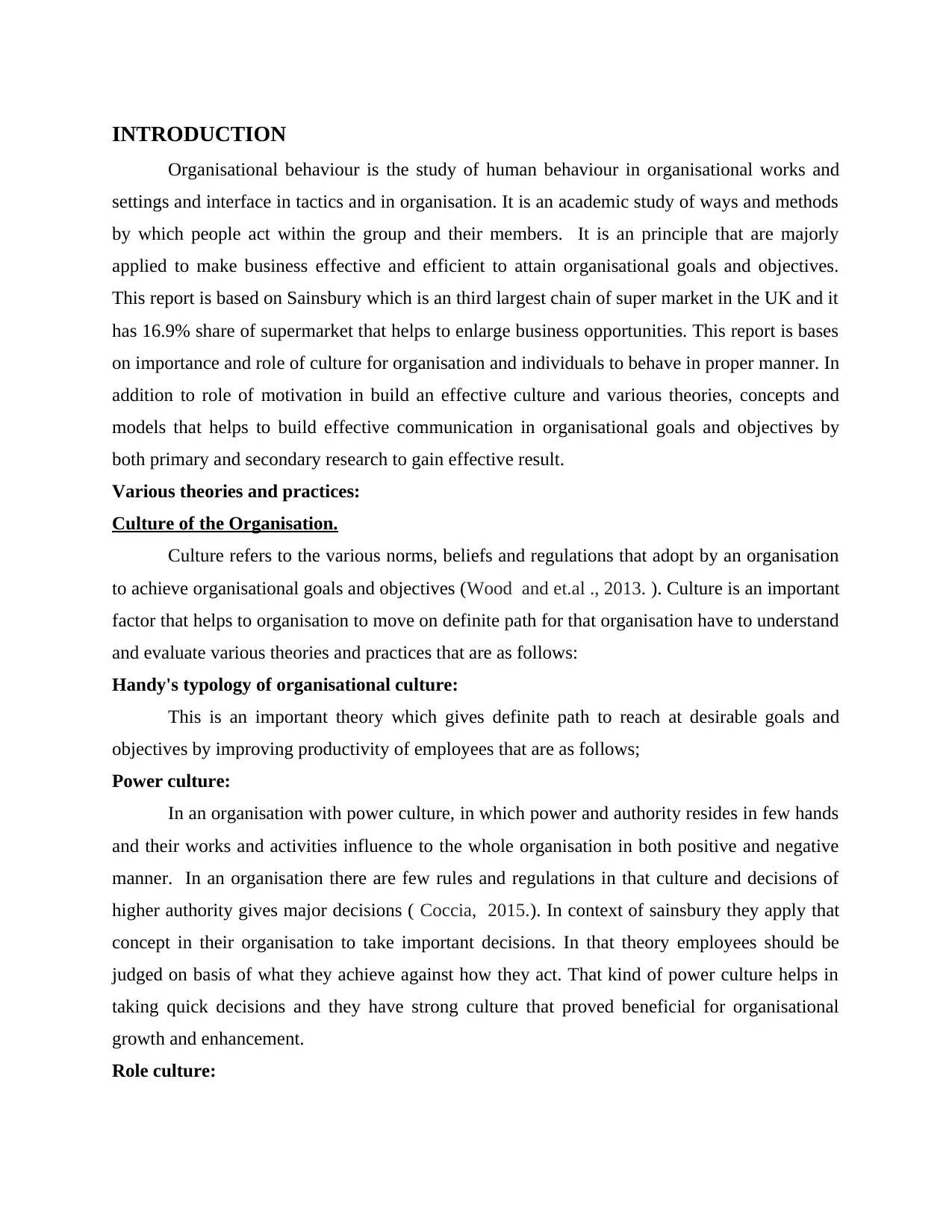
Organisational behaviour is the study of human behaviour in organisational works and
settings and interface in tactics and in organisation. It is an academic study of ways and methods
by which people act within the group and their members. It is an principle that are majorly
applied to make business effective and efficient to attain organisational goals and objectives.
This report is based on Sainsbury which is an third largest chain of super market in the UK and it
has 16.9% share of supermarket that helps to enlarge business opportunities. This report is bases
on importance and role of culture for organisation and individuals to behave in proper manner. In
addition to role of motivation in build an effective culture and various theories, concepts and
models that helps to build effective communication in organisational goals and objectives by
both primary and secondary research to gain effective result.
Various theories and practices:
Culture of the Organisation.
Culture refers to the various norms, beliefs and regulations that adopt by an organisation
to achieve organisational goals and objectives (Wood and et.al ., 2013. ). Culture is an important
factor that helps to organisation to move on definite path for that organisation have to understand
and evaluate various theories and practices that are as follows:
Handy's typology of organisational culture:
This is an important theory which gives definite path to reach at desirable goals and
objectives by improving productivity of employees that are as follows;
Power culture:
In an organisation with power culture, in which power and authority resides in few hands
and their works and activities influence to the whole organisation in both positive and negative
manner. In an organisation there are few rules and regulations in that culture and decisions of
higher authority gives major decisions ( Coccia, 2015.). In context of sainsbury they apply that
concept in their organisation to take important decisions. In that theory employees should be
judged on basis of what they achieve against how they act. That kind of power culture helps in
taking quick decisions and they have strong culture that proved beneficial for organisational
growth and enhancement.
Role culture:
Organisational behaviour is the study of human behaviour in organisational works and
settings and interface in tactics and in organisation. It is an academic study of ways and methods
by which people act within the group and their members. It is an principle that are majorly
applied to make business effective and efficient to attain organisational goals and objectives.
This report is based on Sainsbury which is an third largest chain of super market in the UK and it
has 16.9% share of supermarket that helps to enlarge business opportunities. This report is bases
on importance and role of culture for organisation and individuals to behave in proper manner. In
addition to role of motivation in build an effective culture and various theories, concepts and
models that helps to build effective communication in organisational goals and objectives by
both primary and secondary research to gain effective result.
Various theories and practices:
Culture of the Organisation.
Culture refers to the various norms, beliefs and regulations that adopt by an organisation
to achieve organisational goals and objectives (Wood and et.al ., 2013. ). Culture is an important
factor that helps to organisation to move on definite path for that organisation have to understand
and evaluate various theories and practices that are as follows:
Handy's typology of organisational culture:
This is an important theory which gives definite path to reach at desirable goals and
objectives by improving productivity of employees that are as follows;
Power culture:
In an organisation with power culture, in which power and authority resides in few hands
and their works and activities influence to the whole organisation in both positive and negative
manner. In an organisation there are few rules and regulations in that culture and decisions of
higher authority gives major decisions ( Coccia, 2015.). In context of sainsbury they apply that
concept in their organisation to take important decisions. In that theory employees should be
judged on basis of what they achieve against how they act. That kind of power culture helps in
taking quick decisions and they have strong culture that proved beneficial for organisational
growth and enhancement.
Role culture:
Paraphrase This Document
Need a fresh take? Get an instant paraphrase of this document with our AI Paraphraser
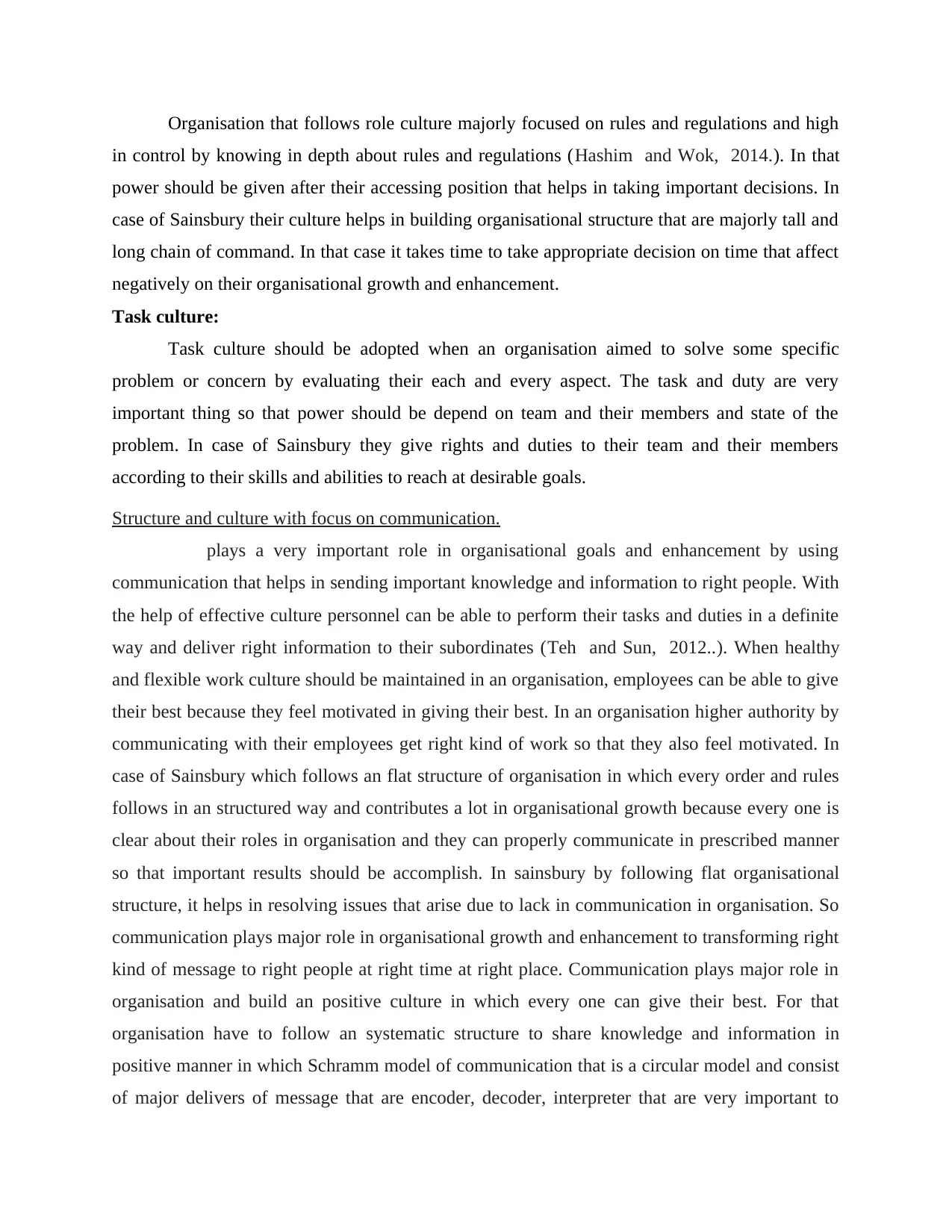
Organisation that follows role culture majorly focused on rules and regulations and high
in control by knowing in depth about rules and regulations (Hashim and Wok, 2014.). In that
power should be given after their accessing position that helps in taking important decisions. In
case of Sainsbury their culture helps in building organisational structure that are majorly tall and
long chain of command. In that case it takes time to take appropriate decision on time that affect
negatively on their organisational growth and enhancement.
Task culture:
Task culture should be adopted when an organisation aimed to solve some specific
problem or concern by evaluating their each and every aspect. The task and duty are very
important thing so that power should be depend on team and their members and state of the
problem. In case of Sainsbury they give rights and duties to their team and their members
according to their skills and abilities to reach at desirable goals.
Structure and culture with focus on communication.
plays a very important role in organisational goals and enhancement by using
communication that helps in sending important knowledge and information to right people. With
the help of effective culture personnel can be able to perform their tasks and duties in a definite
way and deliver right information to their subordinates (Teh and Sun, 2012..). When healthy
and flexible work culture should be maintained in an organisation, employees can be able to give
their best because they feel motivated in giving their best. In an organisation higher authority by
communicating with their employees get right kind of work so that they also feel motivated. In
case of Sainsbury which follows an flat structure of organisation in which every order and rules
follows in an structured way and contributes a lot in organisational growth because every one is
clear about their roles in organisation and they can properly communicate in prescribed manner
so that important results should be accomplish. In sainsbury by following flat organisational
structure, it helps in resolving issues that arise due to lack in communication in organisation. So
communication plays major role in organisational growth and enhancement to transforming right
kind of message to right people at right time at right place. Communication plays major role in
organisation and build an positive culture in which every one can give their best. For that
organisation have to follow an systematic structure to share knowledge and information in
positive manner in which Schramm model of communication that is a circular model and consist
of major delivers of message that are encoder, decoder, interpreter that are very important to
in control by knowing in depth about rules and regulations (Hashim and Wok, 2014.). In that
power should be given after their accessing position that helps in taking important decisions. In
case of Sainsbury their culture helps in building organisational structure that are majorly tall and
long chain of command. In that case it takes time to take appropriate decision on time that affect
negatively on their organisational growth and enhancement.
Task culture:
Task culture should be adopted when an organisation aimed to solve some specific
problem or concern by evaluating their each and every aspect. The task and duty are very
important thing so that power should be depend on team and their members and state of the
problem. In case of Sainsbury they give rights and duties to their team and their members
according to their skills and abilities to reach at desirable goals.
Structure and culture with focus on communication.
plays a very important role in organisational goals and enhancement by using
communication that helps in sending important knowledge and information to right people. With
the help of effective culture personnel can be able to perform their tasks and duties in a definite
way and deliver right information to their subordinates (Teh and Sun, 2012..). When healthy
and flexible work culture should be maintained in an organisation, employees can be able to give
their best because they feel motivated in giving their best. In an organisation higher authority by
communicating with their employees get right kind of work so that they also feel motivated. In
case of Sainsbury which follows an flat structure of organisation in which every order and rules
follows in an structured way and contributes a lot in organisational growth because every one is
clear about their roles in organisation and they can properly communicate in prescribed manner
so that important results should be accomplish. In sainsbury by following flat organisational
structure, it helps in resolving issues that arise due to lack in communication in organisation. So
communication plays major role in organisational growth and enhancement to transforming right
kind of message to right people at right time at right place. Communication plays major role in
organisation and build an positive culture in which every one can give their best. For that
organisation have to follow an systematic structure to share knowledge and information in
positive manner in which Schramm model of communication that is a circular model and consist
of major delivers of message that are encoder, decoder, interpreter that are very important to
share knowledge and information to right people at right time. According to that model encoder
is an person who encode or send the message to other person. On other hand decoder is one who
receive message and at last person who try to interpret the message to reach at right kind of
knowledge and information. So to bring an positive culture organisation have to follow an
prescribed path that helps in coordinate each and every activity to remain always competitive in
marketplace.
Motivation
Motivation is an important factor and it is the reason of actions of people, willingness to
do work and actions to reach at goals and objectives (Hyde, Harris and Boaden, 2013.). In an
organisation motivation is an important factor to enhance productivity of employees so that they
can deliver right works and procedure in organisational growth. To enhance the motivation level
of different employees organisation have to understand the motivation level of employees by
using Maslow's hierarchy of need that are as follows:
There are five stages of needs that helps to evaluate the needs of personnel that are as follows:
Physiological needs:
In that kinds of needs consist of biological requirement of an individual in which human
survival needs such as air, food, drinks and clothing are very much important for each and every
individual to survive in the world (Fuchs and Edwards, 2012.). In case of Sainsbury they take
care primary needs of their employees so that they remain positive.
Safety needs:
In safety needs consist of protection from various elements, giving security, order, law
and stability with freedom from any kind of fear so that they remain always motivated to give
their best in organisational growth and enhancement. In case of Sainsbury they give proper
guidance to their employees while dealing with dangerous things and also provide insurance so
that they feel safe and secure.
Love and belongingness needs:
After satisfying above mentioned needs and wants in proper manner organisation focus
on compensating the social and needs related to belongingness. In which consist of give them
proper care and love so that they remain always positive. In case of Sainsbury for their
employees time to time give promotions and other facilities so that they remain always motivated
in giving their best.
is an person who encode or send the message to other person. On other hand decoder is one who
receive message and at last person who try to interpret the message to reach at right kind of
knowledge and information. So to bring an positive culture organisation have to follow an
prescribed path that helps in coordinate each and every activity to remain always competitive in
marketplace.
Motivation
Motivation is an important factor and it is the reason of actions of people, willingness to
do work and actions to reach at goals and objectives (Hyde, Harris and Boaden, 2013.). In an
organisation motivation is an important factor to enhance productivity of employees so that they
can deliver right works and procedure in organisational growth. To enhance the motivation level
of different employees organisation have to understand the motivation level of employees by
using Maslow's hierarchy of need that are as follows:
There are five stages of needs that helps to evaluate the needs of personnel that are as follows:
Physiological needs:
In that kinds of needs consist of biological requirement of an individual in which human
survival needs such as air, food, drinks and clothing are very much important for each and every
individual to survive in the world (Fuchs and Edwards, 2012.). In case of Sainsbury they take
care primary needs of their employees so that they remain positive.
Safety needs:
In safety needs consist of protection from various elements, giving security, order, law
and stability with freedom from any kind of fear so that they remain always motivated to give
their best in organisational growth and enhancement. In case of Sainsbury they give proper
guidance to their employees while dealing with dangerous things and also provide insurance so
that they feel safe and secure.
Love and belongingness needs:
After satisfying above mentioned needs and wants in proper manner organisation focus
on compensating the social and needs related to belongingness. In which consist of give them
proper care and love so that they remain always positive. In case of Sainsbury for their
employees time to time give promotions and other facilities so that they remain always motivated
in giving their best.
⊘ This is a preview!⊘
Do you want full access?
Subscribe today to unlock all pages.
Trusted by 1+ million students worldwide
Esteem needs:
In that kinds of needs consist two major categories in which esteem for oneself in which
dignity, achievement and independence should be included in it. On other hand respect for other
s in which status, prestige to others are very important for an individual. In case of Sainsbury
they focus on needs and wants of employees by giving prestige with help of promotions so tha
they feel always motivated towards organisational goals and objectives.
Self actualization needs:
In self-actualising needs consist of realizing potential of an personal, their self fulfilment
needs, growth of career with experience (Xerri, M.J. and Brunetto, Y., 2013.). In case of
Sainsbury it is an important need and want for an individual to deal and behave in positive
manner. They give employees some challenging tasks and responsibilities that helps in their
career growth also motivate them.
So all needs are very much important for organisation to accessing needs and wants in proper
manner by that organisation can easy to access their formalised manner to keep them motivated.
Role of culture in an organisation for further enhancement in their success.
Culture is an important factor to reach at desirable goals and objectives to gain
competitive advantage by coordinating each and every activity in proper way. In sainsbury they
provide flexible working hours to employees so that they can contributes in organisational
development and enhancement that can be understand by using theory of culture that are as
follow:
Before applying culture and their relative practices organisation have to take suggestions from
their subordinates so that they elaborate about their concern in easy manner and organisation
could take suggestions accordingly. In case of Sainsbury before adopting any kind of changes in
their organisation they take suggestions from their subordinates so that they feel motivated.
Culture helps in create social order which social order is an fundamental concept in sociology
that defines various ways and methods of society and their structure and institutions, their
relations with interactions (Wong, Wong and Ngo, 2012.). It also happens in organisation too
when culture is harmonious in nature it helps to attach various employees to each other and they
get motivated to give their best in organisational growth and enhancement in positively manner.
There are some other factors that should be improve after applying harmonious culture and their
values in organisation culture and ethics in better manner that are it helps to improve behaviour
In that kinds of needs consist two major categories in which esteem for oneself in which
dignity, achievement and independence should be included in it. On other hand respect for other
s in which status, prestige to others are very important for an individual. In case of Sainsbury
they focus on needs and wants of employees by giving prestige with help of promotions so tha
they feel always motivated towards organisational goals and objectives.
Self actualization needs:
In self-actualising needs consist of realizing potential of an personal, their self fulfilment
needs, growth of career with experience (Xerri, M.J. and Brunetto, Y., 2013.). In case of
Sainsbury it is an important need and want for an individual to deal and behave in positive
manner. They give employees some challenging tasks and responsibilities that helps in their
career growth also motivate them.
So all needs are very much important for organisation to accessing needs and wants in proper
manner by that organisation can easy to access their formalised manner to keep them motivated.
Role of culture in an organisation for further enhancement in their success.
Culture is an important factor to reach at desirable goals and objectives to gain
competitive advantage by coordinating each and every activity in proper way. In sainsbury they
provide flexible working hours to employees so that they can contributes in organisational
development and enhancement that can be understand by using theory of culture that are as
follow:
Before applying culture and their relative practices organisation have to take suggestions from
their subordinates so that they elaborate about their concern in easy manner and organisation
could take suggestions accordingly. In case of Sainsbury before adopting any kind of changes in
their organisation they take suggestions from their subordinates so that they feel motivated.
Culture helps in create social order which social order is an fundamental concept in sociology
that defines various ways and methods of society and their structure and institutions, their
relations with interactions (Wong, Wong and Ngo, 2012.). It also happens in organisation too
when culture is harmonious in nature it helps to attach various employees to each other and they
get motivated to give their best in organisational growth and enhancement in positively manner.
There are some other factors that should be improve after applying harmonious culture and their
values in organisation culture and ethics in better manner that are it helps to improve behaviour
Paraphrase This Document
Need a fresh take? Get an instant paraphrase of this document with our AI Paraphraser
of people and they react in proper manner while some situation arise in an organisation that helps
in get positive response from consumer side also. Culture helps in socialization of new members
when they enter into organisation with the help of positive culture new members coordinate with
other member in positive manner and motivate to give their best in organisational growth and
enhancement. When organisation build healthy culture in an organisation people remain always
motivate and can be easily interact with their colleagues and also it raise feeling to share
belongingness and committed towards their goals and objectives by contributing a lot.
Organisational culture is an important attribute to make employees highly interactive and
subjective also in which they contributes a lot in giving their best in organisational growth and
enhancement ( Kazemipour and Mohd Amin, 2012.). Culture is an important attribute that helps
in terms and conditions in which all members easily give their accent in giving their best in
organisational growth and enhancement also they helps in create social order which is an
important thing for both employees and organisation for their enhancement. In order to culture
gives major teaching about historical and current activities that are very much obligatory for
organisational growth and enhancement. Such as in case of Sainsbury to enhance motivation
level organisation provides flexible working hours and give many kinds of benefits to them so
that they remain always productive (Emami, and et.al 2012.). To build an suitable work culture
organisation have to write every rule and regulation in written format not in verbal manner so
that they can be follow by everyone and each and every activity should be coordinated in
positive way. Hence organisation culture is an important attribute to bring harmony in
organisation work and culture to remain always competitive into marketplace.
Primary research:
Primary research is an research which conduct by an individual and involves directly to
the source usually from consumers and perspective consumers to target market. In that by asking
questions and gather important knowledge and information so that important insights should be
gathered.
Identify and illustrate the culture of an organisation and link with models or theories.
Culture plays very important role in organisational growth and enhancement for that
Sainsbury focus on many major spheres in which they held many kinds of workshops that
majorly conduct in deaf sign languages by developing a film. In that workshop they give major
insights about experience of their colleagues while shop and it become one of most useful
in get positive response from consumer side also. Culture helps in socialization of new members
when they enter into organisation with the help of positive culture new members coordinate with
other member in positive manner and motivate to give their best in organisational growth and
enhancement. When organisation build healthy culture in an organisation people remain always
motivate and can be easily interact with their colleagues and also it raise feeling to share
belongingness and committed towards their goals and objectives by contributing a lot.
Organisational culture is an important attribute to make employees highly interactive and
subjective also in which they contributes a lot in giving their best in organisational growth and
enhancement ( Kazemipour and Mohd Amin, 2012.). Culture is an important attribute that helps
in terms and conditions in which all members easily give their accent in giving their best in
organisational growth and enhancement also they helps in create social order which is an
important thing for both employees and organisation for their enhancement. In order to culture
gives major teaching about historical and current activities that are very much obligatory for
organisational growth and enhancement. Such as in case of Sainsbury to enhance motivation
level organisation provides flexible working hours and give many kinds of benefits to them so
that they remain always productive (Emami, and et.al 2012.). To build an suitable work culture
organisation have to write every rule and regulation in written format not in verbal manner so
that they can be follow by everyone and each and every activity should be coordinated in
positive way. Hence organisation culture is an important attribute to bring harmony in
organisation work and culture to remain always competitive into marketplace.
Primary research:
Primary research is an research which conduct by an individual and involves directly to
the source usually from consumers and perspective consumers to target market. In that by asking
questions and gather important knowledge and information so that important insights should be
gathered.
Identify and illustrate the culture of an organisation and link with models or theories.
Culture plays very important role in organisational growth and enhancement for that
Sainsbury focus on many major spheres in which they held many kinds of workshops that
majorly conduct in deaf sign languages by developing a film. In that workshop they give major
insights about experience of their colleagues while shop and it become one of most useful
teaching for both consumers as well as employees. From that workshops they build an positive
culture in which every employee feel motivated that organisation very much concern for them.
Their main vision is that they build a workplace where people love to work and shop. To build
positive communication and always motivate people they give training and development and
special help to consumers (Coccia and Cadario, 2014.). Organisational culture is one of most
important attribute from many decades and backbone of organisational growth and enhancement.
When consumers visit the visible aspects of the culture in an organisation that employees are in
uniforms and functions in proper way. The proper displays in shelves, colour schemes on their
walls, different people from different cultural background and labelling on the store and layout
that builds its own identity in market and distinguish from their fierce competitors. They have
their different values, beliefs and style of behaving that makes their business an differ identity,
for an example in their homepage “passionate about working in a consumer facing environment”
that focus on selecting best candidates and majorly giving best environment to gain objectives
and goals. To build an healthy and flexible work culture organisation apply various theories and
practices that are Handy's culture typology and to give motivation they use Maslow's need
hierarchy that helps in understand the tactics and behaviour in particular situation of an employee
so that major insights should be drawn (Okurame, 2012.). In case of Sainsbury they use Handy's
typology which assist their employees to behave in moderate manner by understanding key terms
in that theory and practices. On other hand by applying need hierarchy that helps to higher
authority in accessing needs of employees at different level of their position. In that case
Sainsbury evaluate each and every factor that helps in giving motivation to their employees by
coordinating in proper way, communication for that they also use an systematic chain of
command by which right kind of message reach at right people at right time (Odetunde, 2013).
So all theories and practices are very much important for an organisation to reach at desirable
goals and objectives. Sainsbury focus on needs and wants of their employees and accordingly
give them incentives, perks and promotions that proved beneficial in enhance their motivation
level and bring harmony in their works and activities in proper manner.
culture in which every employee feel motivated that organisation very much concern for them.
Their main vision is that they build a workplace where people love to work and shop. To build
positive communication and always motivate people they give training and development and
special help to consumers (Coccia and Cadario, 2014.). Organisational culture is one of most
important attribute from many decades and backbone of organisational growth and enhancement.
When consumers visit the visible aspects of the culture in an organisation that employees are in
uniforms and functions in proper way. The proper displays in shelves, colour schemes on their
walls, different people from different cultural background and labelling on the store and layout
that builds its own identity in market and distinguish from their fierce competitors. They have
their different values, beliefs and style of behaving that makes their business an differ identity,
for an example in their homepage “passionate about working in a consumer facing environment”
that focus on selecting best candidates and majorly giving best environment to gain objectives
and goals. To build an healthy and flexible work culture organisation apply various theories and
practices that are Handy's culture typology and to give motivation they use Maslow's need
hierarchy that helps in understand the tactics and behaviour in particular situation of an employee
so that major insights should be drawn (Okurame, 2012.). In case of Sainsbury they use Handy's
typology which assist their employees to behave in moderate manner by understanding key terms
in that theory and practices. On other hand by applying need hierarchy that helps to higher
authority in accessing needs of employees at different level of their position. In that case
Sainsbury evaluate each and every factor that helps in giving motivation to their employees by
coordinating in proper way, communication for that they also use an systematic chain of
command by which right kind of message reach at right people at right time (Odetunde, 2013).
So all theories and practices are very much important for an organisation to reach at desirable
goals and objectives. Sainsbury focus on needs and wants of their employees and accordingly
give them incentives, perks and promotions that proved beneficial in enhance their motivation
level and bring harmony in their works and activities in proper manner.
⊘ This is a preview!⊘
Do you want full access?
Subscribe today to unlock all pages.
Trusted by 1+ million students worldwide
CONCLUSION
From the above report it has been summarised that organisation behaviour is an important
attribute to bring harmony in organisation works and procedures. For an organisation
communication and motivation is very much obligatory to keep employees always productive so
that they can easily contributes in organisational works and procedures. To keep activities
coordinated organisation have to apply various kinds of theories and practices that helps in bring
harmonious culture in an organisation. Hence culture, communication and motivation is an
important attribute for organisational enhancement and growth.
From the above report it has been summarised that organisation behaviour is an important
attribute to bring harmony in organisation works and procedures. For an organisation
communication and motivation is very much obligatory to keep employees always productive so
that they can easily contributes in organisational works and procedures. To keep activities
coordinated organisation have to apply various kinds of theories and practices that helps in bring
harmonious culture in an organisation. Hence culture, communication and motivation is an
important attribute for organisational enhancement and growth.
Paraphrase This Document
Need a fresh take? Get an instant paraphrase of this document with our AI Paraphraser
REFERENCES
Books and journals:
Wood, J., and et.al ., 2013. Organisational behaviour: Core concepts and applications. John
Wiley & Sons.
Coccia, M., 2015. Structure and organisational behaviour of public research institutions under
unstable growth of human resources. Coccia, M.(2014)‘Structure and organisational
behaviour of public research institutions under unstable growth of human resources’,
Int. J. Services Technology and Management. 20(4/5). p.6.
Hashim, J. and Wok, S., 2014. Predictors to employees with disabilities’ organisational
behaviour and involvement in employment. Equality, Diversity and Inclusion: An
International Journal. 33(2). pp.193-209.
Teh, P.L. and Sun, H., 2012. Knowledge sharing, job attitudes and organisational citizenship
behaviour. Industrial Management & Data Systems. 112(1). pp.64-82.
Hyde, P., Harris, C. and Boaden, R., 2013. Pro-social organisational behaviour of health care
workers The International Journal of Human Resource Management. 24(16). pp.3115-
3130.
Fuchs, S. and Edwards, M.R., 2012. Predicting pro‐change behaviour: The role of perceived
organisational justice and organisational identification. Human Resource Management
Journal. 22(1). pp.39-59.
Xerri, M.J. and Brunetto, Y., 2013. Fostering innovative behaviour: The importance of employee
commitment and organisational citizenship behaviour. The International Journal of
Human Resource Management. 24(16). pp.3163-3177.
Wong, Y.T., Wong, C.S. and Ngo, H.Y., 2012. The effects of trust in organisation and perceived
organisational support on organisational citizenship behaviour: a test of three competing
models. The International Journal of Human Resource Management. 23(2). pp.278-
293.
Kazemipour, F. and Mohd Amin, S., 2012. The impact of workplace spirituality dimensions on
organisational citizenship behaviour among nurses with the mediating effect of affective
organisational commitment. Journal of Nursing Management. 20(8). pp.1039-1048.
Books and journals:
Wood, J., and et.al ., 2013. Organisational behaviour: Core concepts and applications. John
Wiley & Sons.
Coccia, M., 2015. Structure and organisational behaviour of public research institutions under
unstable growth of human resources. Coccia, M.(2014)‘Structure and organisational
behaviour of public research institutions under unstable growth of human resources’,
Int. J. Services Technology and Management. 20(4/5). p.6.
Hashim, J. and Wok, S., 2014. Predictors to employees with disabilities’ organisational
behaviour and involvement in employment. Equality, Diversity and Inclusion: An
International Journal. 33(2). pp.193-209.
Teh, P.L. and Sun, H., 2012. Knowledge sharing, job attitudes and organisational citizenship
behaviour. Industrial Management & Data Systems. 112(1). pp.64-82.
Hyde, P., Harris, C. and Boaden, R., 2013. Pro-social organisational behaviour of health care
workers The International Journal of Human Resource Management. 24(16). pp.3115-
3130.
Fuchs, S. and Edwards, M.R., 2012. Predicting pro‐change behaviour: The role of perceived
organisational justice and organisational identification. Human Resource Management
Journal. 22(1). pp.39-59.
Xerri, M.J. and Brunetto, Y., 2013. Fostering innovative behaviour: The importance of employee
commitment and organisational citizenship behaviour. The International Journal of
Human Resource Management. 24(16). pp.3163-3177.
Wong, Y.T., Wong, C.S. and Ngo, H.Y., 2012. The effects of trust in organisation and perceived
organisational support on organisational citizenship behaviour: a test of three competing
models. The International Journal of Human Resource Management. 23(2). pp.278-
293.
Kazemipour, F. and Mohd Amin, S., 2012. The impact of workplace spirituality dimensions on
organisational citizenship behaviour among nurses with the mediating effect of affective
organisational commitment. Journal of Nursing Management. 20(8). pp.1039-1048.
Emami, M., Alizadeh, Z., Nazari, K. and Darvishi, S., 2012. Antecedents and consequences of
organisational citizenship behaviour (OCB). Interdisciplinary Journal of Contemporary
Research in Business. 3(9).
Coccia, M. and Cadario, E., 2014. Organisational (un) learning of public research labs in
turbulent context. Int. J. Innovation and Learning. 15(2). pp.115-129.
Okurame, D., 2012. Impact of career growth prospects and formal mentoring on organisational
citizenship behaviour. Leadership & Organization Development Journal. 33(1). pp.66-
85.
Odetunde, O.J., 2013. Influence of transformational and transactional leaderships, and leaders'
sex on organisational conflict management behaviour. Gender and Behaviour. 11(1).
pp.5323-5335.
Unsworth, K.L., Dmitrieva, A. and Adriasola, E., 2013. Changing behaviour: Increasing the
effectiveness of workplace interventions in creating pro‐environmental behaviour
change. Journal of Organizational Behavior. 34(2). pp.211-229.
Online:
Organization Structure Of Sainsburys Management Essay 2019 [Online] Available
through<https://www.ukessays.com/essays/management/organization-structure-of-
sainsburys-management-essay.php>.
Sainsbury’s Communications Strategy 2019 [Online] Available through<https://research-
methodology.net/sainsburys-communications-strategy/>.
organisational citizenship behaviour (OCB). Interdisciplinary Journal of Contemporary
Research in Business. 3(9).
Coccia, M. and Cadario, E., 2014. Organisational (un) learning of public research labs in
turbulent context. Int. J. Innovation and Learning. 15(2). pp.115-129.
Okurame, D., 2012. Impact of career growth prospects and formal mentoring on organisational
citizenship behaviour. Leadership & Organization Development Journal. 33(1). pp.66-
85.
Odetunde, O.J., 2013. Influence of transformational and transactional leaderships, and leaders'
sex on organisational conflict management behaviour. Gender and Behaviour. 11(1).
pp.5323-5335.
Unsworth, K.L., Dmitrieva, A. and Adriasola, E., 2013. Changing behaviour: Increasing the
effectiveness of workplace interventions in creating pro‐environmental behaviour
change. Journal of Organizational Behavior. 34(2). pp.211-229.
Online:
Organization Structure Of Sainsburys Management Essay 2019 [Online] Available
through<https://www.ukessays.com/essays/management/organization-structure-of-
sainsburys-management-essay.php>.
Sainsbury’s Communications Strategy 2019 [Online] Available through<https://research-
methodology.net/sainsburys-communications-strategy/>.
⊘ This is a preview!⊘
Do you want full access?
Subscribe today to unlock all pages.
Trusted by 1+ million students worldwide

1 out of 14


Related Documents


Your All-in-One AI-Powered Toolkit for Academic Success.
+13062052269
info@desklib.com
Available 24*7 on WhatsApp / Email
![[object Object]](/_next/static/media/star-bottom.7253800d.svg)
Unlock your academic potential
Copyright © 2020–2026 A2Z Services. All Rights Reserved. Developed and managed by ZUCOL.